Search…

Play Travel Photo Roulette #48 – Theme is “What the?!”

We’re excited to say we’re hosting round #48 of Travel Photo Roulette!

For each round a new theme is chosen, and independent travel bloggers are asked to submit their photos. Then a winner is chosen to host (and judge) the following round on their website!

Do you have a photo to enter? It’s EASY and you get a shot at hosting this very popular contest on your site!

Don’t have a photo to enter? Check in often to see some amazing photographs – by the world’s best independent travel bloggers – and  please, PLEASE, PLEASE help us pick a winner by leaving a comment about your favorite shot!

SUBMIT YOUR PHOTO OR COMMENT HERE!


Our winning photo!

We’re excited to say we’re hosting round #48 of Travel Photo Roulette! Thank you so much to Bridges and Balloons for choosing our photo of this duo enjoying the “Excellent Splendour of the Universe” in The Galapagos Islands.

Travel Photo Roulette was started by Jeremy at Living the Dream almost two years ago as a way for travel bloggers to showcase their best photography.

For each round a new theme is chosen, and independent travel bloggers are asked to submit their photos. Then a winner is chosen to host (and judge) the following round on their website.


This Week’s Theme is:
WHAT THE ?!
Click here to see the winners


Here’s some inspiration:

Human Bone Church, Czech Repubic
This macabre church in the Czech Republic is decorated with human bones. WHAT THE ?!
Dancing on horseback during Courir de Mardi Gras in Rural Louisiana
In rural Louisiana, at 5 AM, men get dressed up, liquored up & dance on horses for Mardi Gras. Then they chase chickens.
The World's Largest Ball of Paint
In Indiana, this man turned a baseball into The World’s Largest Ball of Paint
How Guinea Pig is served in Peru
Here’s how guinea pig is served in Peru. WHAT THE ?!

Everyone who travels has those WHAT THE ?! moments. It can be in nature, or the most unnatural of occurrences. Sometimes it’s as simple as a funny sign, a wacky name of a town, a weird food or an unfortunate piece of art. All nomads find themselves in cultural situations that can cause us to do a double-take, make us uncomfortable or feel completely out of our element. Moments like that are our favorites. Show us yours!

How Travel Photo Roulette works

The rules are simple. The hosting blogger is the chosen winner of the previous round. The new host chooses a theme for the next round and bloggers can submit a single entry based on how they interpret the theme. The time frame for submissions is one week. At the end of the week, the host blogger chooses the winner for that round and said winner repeats the process on their own blog. Readers can always try and sway the host via comments during the contest, but the host is free to give as little or as much weight to people’s opinions as they wish.

The rules for Travel Photo Roulette

1) One submission per blog (so sites that have 2+ authors only get one entry).
2) No photoshopping allowed unless specifically called for! Cropping and correction for red-eye or camera flaws are ok, however. Minor edits are totally fine for this round if you think it improves your image.
3) Abstract submissions welcomed as long as it fits within the interpretation of the chosen phrase. Remember, the hosting blogger chooses the winner, so if they cannot understand the submission, you might not win!
4) Keep phrases general so that all bloggers can participate. Specific items like “Eiffel Tower” should be avoided but rather made open-ended like “monuments.” For variety, it is okay to say focused things such as “monuments at night” in which most of us have pictures of.
6) Abstract thoughts are appreciated, but keep it within the realm that all readers will understand. No “Kafka-esque”, but “Overlooking Creation” is able to be interpreted by all.
7) No obscene pictures or phrases allowed. Suggestive phrases and photography can be accepted, but please keep it within reason.
8) After a sufficient period of time, phrases can be reused, however new photos must be submitted. Keep the ideas and photos fresh!
9) Pictures from your entire portfolio are fair to submit. You do not have to take the photo within the week of the contest period to submit it.
10) Most importantly, ALL PHOTOS MUST BE YOUR OWN.
11) And last but not the least, talk about Photo Roulette! When tweeting about it, don’t forget to use the #PhotoRoulette hashtag.


How to submit

Entering is easy. Just leave a comment below with a link to the image you’d like to submit and a caption or description of the image to help flesh it out. Once you’ve added your comment, we’ll add the image to the submissions. Don’t forget to check back during the week to see the other submissions and join the conversation by leaving comments for others. We’d love to hear what you think.

The contest runs for a week, starting September 8th and ending September 16 (Sunday to Sunday). The winner will be announced within a few days of the end of the contest and the selected blogger will then host round #49.

Please do your best to keep your images to a medium size and be aware that anything larger than 700px wide will be reduced in size to fit our site layout.

The Entries!

#27 From Shane at The Working Traveller: I’d long forgotten the real name of this temple in Malaysia, instead, somewhat disrespectfully, remembering it as the Nazi Buddha Turtle Temple. This photo partly suggests why:
Nazi Buddha Turtle Temple

#26 From Gerard at GQ trippin: Blurry shot taken from Thailand’s Songkran celebration. Q shooting at the SWAT team? What the?!
Swat Spray by Gerard of GQ Trippin

#25 From Melissa at Melissa To and Fro: While perusing a local market in Chiang Mai, Thailand, I stumbled upon this bizarre egg variation. Yuck!!
Horse Pee Eggs fro Melissa of Melissa To and Fro

#24 From Adrian B. at Travel to Sun: The Merry Cemetery from Săpânţa (Maramureş County, Romania) is a unique place where colored funeral crosses carry cheerful lyrics and paintings inspired by memorable moments in the life of the deceased:
The Merry Cemetery by Adrian B. of Travel to Sun

#23 From Zara at Backpack ME: For all the traveling racists out there, beware that IN Thailand, the pick-pockets are NON THAI! That’s right.. the locals are aaaalways goodie, goodie!
Racist Thai Sign by Zara of Backpack ME

#22 From Clare at Earth Travel Unlimited: South Africa is a fabulous country and home to much quirkiness. Frequently, you’ll find entrepreneurs advertising their services (typically builders, painters, pest removal etc) via home-made signs fixed to lamp-posts, road signs etc. We’ve seen many hilarious signs, but this one certainly had us going “What the…???”.
Husband For Night by Clare of Earth Travel Unlimited

#21 From Suzanne at Boomeresque: These were the “helpful” instructions we were given to enter the “onsen” (communal bath) at our hotel in Takamatsu, Japan.
Helpful Instruction by Suzanne at Boomeresque

#20 From Noah at Somewhere or Bust: I said “WHAT THE?!” when this kid passed by me on a beach in Sihanoukville, Cambodia. I chased after him for this photo.
I Could be your Daughter by Noah of Somewhere or Bust

#19 From Kat at Travel With Kat: At a Jola Festval in The Gambia, men were striking themselves with knives, broken bottles and razor blades but not actually cutting themselves at all!
Jola Knives by Kat at Travel With Kat

#18 From Hannah at Love. Play. Work: ‘WHAT THE…’ was certainly the words coming out of my mouth, but also everyone in the boat watching me too! Big thanks to our Oregon home exchange neighbours for taking us out on the lake.
Han Flying by Hannah at Love. Play. Work

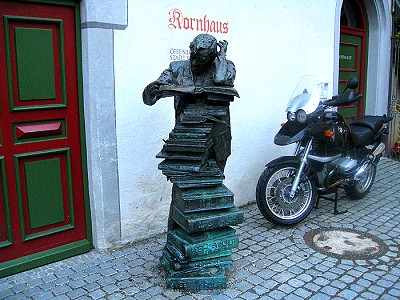
#17 From Cam at Traveling Canucks: This street performer in Bernkastel-Kues, Germany had me saying “What the…?!”
Floating Street Performer by Cam of Traveling Canucks

#16 From Jade at Our Oyster: While hitchhiking the North Island of New Zealand we got dropped off in a small town where the main roads fork. We were careful not to get too close to any of the resident rabies goats though!
Rabies Goat by Jade of Our Oyster

#15 From Raymond at Man On The Lam: This is from the Gopher Hole Museum in Torrington, Alberta, CANADA. Basically, it’s a museum filled with stuffed dead gophers. This one was my fave…
Old Tyme Music Gophers by Ramond of Man On The Lam

#14 From Micki & Charles at The Barefoot Nomad: Our “What the ?” moment is from a highway on New Zealand’s South Island. The highway’s road/rail wooden bridge was barely wide enough for our tiny car. I can’t imagine how an entire train would fit. You can just see the yellow sign at the end indicating a sharp curve after the bridge, making it impossible to see oncoming cars or trains The worst part? We thought we could hear a train in the distance.
Crazy Train Highway in New Zealand by Micki & Charles at The Barefood Nomad

#12 From Torre at Fearful Adventurer: On Koh Chang Thailand, at dusk every night, it is possible to spot homo sapiens in action. These mammals sprawl shoreside and pose for the camera in a peculiar mating ritual that scientists call “My Latest Facebook Photo.” If you get really lucky, you’ll get to spot an elusive threesome in which the male performs a thonged mating dance in front of two submissive females. (What the?!)
Thailand Thong Guy by Torre at Fearful Adventurer

#11 From Tash at jouljet: Whilst I was in Dominica, I was constantly surprised at the types of homemade rums they would make, but this selection takes the cake! Snake, grasshopper, centipede, snake fat??? What the??!!!???
Crazy Homemade Rums by Tash of jouljet

#10 From Ted at Traveling Ted: On the famous Nha Trang booze cruise tour in Vietnam, our hosts decided we needed more entertainment: as if snorkeling, volleyball, and a floating bar was not enough. They broke into song and this particular number was a cover of the Beatles Ob-la-di, Ob-la-da. The Beatles never toured for the White Album, but if they did I am sure John, Paul, George, and Ringo would have been adorned in a similar fashion.
Nha Trang Cruise Tour by Ted of Traveling Ted

#9 From Natasha at World Wandering Kiwi: I enjoyed enthusiastic local hospitality many times when travelling in Central Asia but I’m sure this was the only day in my life when I had vodka with lunch, tea and supper. On this memorable evening in Tajikistan I struggled to keep up with the endless (unintelligible to me) toasts and when called upon to reciprocate, could only come up with inanities such as “Nova Zelandiya!” and “Nyet Taliban!” Perhaps ‘What the..!’ would have been more appropriate!
Toasting in Tajikistan by Natasha of World Wandering Kiwi

#8 From Irina at Trips That Work: People in Toronto love dogs. Some of them love their dogs a little too much… what the???
Pink Poodle by Irina Trips That Work

#7 From Lilliane at wanderlass: When i first arrived in S.A., i found the cholitas quite interesting. Eventually got used to them BUT nothing, NOTHING could prepare anyone for the Cholita Wrestling in Cuzco! waadaa?? hahaha
Cholita Wrestling in Cuzco by Lilliane at wanderlass

#6 From Melissa at The MellyBoo Project: Taken during my stint volunteering at a lion conservation project in Zimbabwe.  We were laying out the partially frozen offals (innards) out in the sun to defrost so that the lions in the breeding program could have their meal.  I happened to find some x-rated cow/bull parts and felt this was necessary behaviour to be documented on camera!
Cow Offal for Lions by Melissa at The MellyBoo Project

#5 From David at The Roaming Boomers: After a stunningly beautiful hike in Arizona’s Superstition Mountains, we noticed that one of our photographs contained a very mysterious watcher.
Perhaps it’s an ancient artifact guarding the Lost Dutchman’s mine!
Look closely on the hoodoo just left of center.  See the face?
WHAT THE….!

Mysterious Watcher in Superstition Mountains by David of The Roaming Boomers


#4 From Dani at GlobetrotterGirls: Earlier this year we witnessed the incredible Thaipusam festival in Penang, Malaysia, in which the devotees carry out sacrificial acts, mainly mortification of flesh in various degrees… Seeing some of the devotees, all we could think was WHAT THE ?!
Penang Man with Spear through his Mouth by Dani of the GlobetrotterGirls

#3 From Jeremy at Living the Dream:
We stopped at a small island in Halong Bay to play on the beach.  Other travelers were there, and I couldn’t help but notice that this guy was in the most opposite extreme of beach clothes I’ve ever seen. Love it!
Extreme Beach Clothes by Jeremy at Living The Dream

#2 From Greg Goodman at Adventures of a GoodMan: I love India. It’s a magical country where every minute I’m out of my guesthouse, there’s something new and different to see.
Usually it makes sense, but I can’t come up with a single reason for this man to be watering a dirt patch on the side of the road in the Punjab countryside.
Is he trying to grow mud?
Simulating the rainy season?
Making a dirty slip and slide?
What the?!
Man Watering a Dirt Patch by Greg Goodman of Adventures of a Goodman

#1 From Denise at The Art of Slow Travel: This is easy!!! My biggest what the??? moment while travelling was when I came across the ‘Grand Prix Priest’ in London
Grand Prix Priest by Diane of The Art of Slow Travel

YOUR TURN: If you’re not submitting a photo, please, PLEASE, PLEASE help us pick a winner by leaving comments about your favorite shots! – David & Veronica

Seal-ing the Deal in the Galápagos (but these are sea LIONS)!

Of all of the fabulous animals in The Galápagos Islands, the one that made it hardest to obey the always-stay-six-feet-away-from-the-animals-rule were the sea lions.

Sea lions, or lobos del mar (wolves… CONTINUE READING >>

WATCH: Veronica is treated to several minutes of frolicking with a Galapagos sea lion – UNDERWATER!

Snorkeling with a sea lion is the galapagos!

Of all of the fabulous animals in The Galapagos Islands, the one that made it hardest to obey the always-stay-six-feet-away-from-the-animals rule were the sea lions.

Sea lions, or lobos del mar (wolves of the sea) as they are called in Ecuador, have great personalities, are cute, cuddly looking and have no fear of humans (even underwater!).

A sea lion plays in a lagoon

Sometimes they seemed to be begging for a hug or a pat. But we also should point out that they have big sharp lion – or wolf-like – teeth. One look at those incisors and the six feet rule seems like a pretty good idea.

A sea lion pup takes a nap on the beach in the Galapagos Islands
A pup takes a nap on the beach.

Snorkeling with a sea lion is the galapagos!

So to avoid making contact we found ourselves stepping and swimming away from the more friendly of these adorable creatures.

As hard as it was to keep from reaching out and petting one, we tried to keep in mind that a finger might just stay in the Galapagos if we did.

Sea Lion in the Galapagos Islands

So many sea lions in the Galapagos!

David with his new sea lion friend
David with his new sea lion friend.

Sea lions have ear flaps, seals do not

Prior to our Galapagos adventure we were unclear on exactly what characteristics distinguish seals from sea lions.

Though there are differences with their flippers, the easiest way to tell the them apart is by checking out their ears. Sea lions have external ear flaps, seals simply have holes on the side of their heads.

In addition to the hundreds of sea lions we came across, we were treated to a brief encounter with a Galapagos fur seal – actually a misnamed type of a sea lion – while riding along the cliffs of Genovesa Island in a Zodiac.

See our full adventure The Galapagos!

Galapagos Fur Seal

This guy looked more like a walrus than a seal lion and, with all of that fur, it was not easy to make the ear-flap-or-no-ear-flap call. So we’ll have to forgive whoever misnamed them.

Galapagos Fur Seal

Lava lizard on a sea lion's back in The Galapagos!

One warm afternoon we noticed a unique relationship between lava lizards and sea lions. When sea lions nap on the beach, they attract flies.

Lava lizards love to dine on the insects, and the sea lions apparently find the lizards to be less annoying than the buzzing bugs.

Very soon we have discovered why – David was bitten by a fly on this very beach – and it HURTS (no lasting problems, but really gets one’s attention at the moment).

A sea lion hitched a ride on Yolita in the Galapagos
This sea lion decides to take a quick break on the swim platform on the back of our boat for the week, the Yolita II.

Several times we were enamored with sightings of sea lions sunning themselves on boats, including one that climbed aboard the back of ours, but our guide, Franklin, filled us in on why the fishermen of the region did not find this behavior nearly as cute as we did.Sea lion lounging on a boat in the Galapagos Islands

Many times, a whole herd will commandeer a vessel, and it is not rare for a boat to sink under their weight.

A sea lion suns himself on a boat in The Galapagos Islands

WATCH: Seal lions are so funny on land!

Snorkeling with a sea lion is the galapagos!

As lazy and cumbersome as sea lions seemed out of the water, once we donned our snorkels and fins we were able to see these guys in their element.

In the water they swim with ease, grace and agility.

The pups are like any children, they love to romp and play. Surprisingly even with us!

Several pups came face-to-face with us as if they were looking at their reflections in our masks. These brief frolics will go down as some of the greatest undersea moments in our lives.

WATCH: Mommy and baby sea lion find each other!

David & Veronica, GypsyNester.com

Click here for our entire live-blog of our adventure in The
Galapagos

Delve deeper:
See the incredible work done at Giant Tortoise Breeding Center
Check out the landscape of The Galapagos
Cavort with Sea Lions!
The Birds of The Galapagos – wild!
The Underwater World of The Galapagos
People live in the Galapagos?
Our tips for visiting The Galapagos Islands – including what to pack

YOUR TURN: Are The Galapagos Islands on YOUR bucket list? Have we inspired you to go? 

Sea Lion Mother Finds Her Lost Baby!


enlarge video

A mother sea lion is reunited with her lost baby and… CONTINUE READING >>

The cutest, sweetest sea lion video ever! A lost baby and mother find each other and kiss hello!

For more great Galapagos sea lion footage (and find out how to tell the difference between a sea lion and a seal)!

David & Veronica, GypsyNester.com

Click here for our entire live-blog of our adventure in The
Galapagos

Delve deeper:
See the incredible work done at Giant Tortoise Breeding Center
Check out the landscape of The Galapagos
Cavort with Sea Lions!
The Birds of The Galapagos – wild!
The Underwater World of The Galapagos
People live in the Galapagos?
Our tips for visiting The Galapagos Islands – including what to pack

YOUR TURN: Are The Galapagos Islands on YOUR bucket list? Have we inspired you to go? 

Visit our GypsyNester YouTube Channel!

Quito, Ecuador in a Day!


enlarge video

Enter a church completely coated in gold, see the changing of the guard at the Presidential Palace, explore Quito’s unique food and take in a giant winged Virgin… CONTINUE READING >>

Quito has the distinction of being the world capital that sits closer to the equator than any other. Her Colonial Center is perhaps the largest and best preserved historic center in the Americas, and was the first New World city to be declared a World Heritage Site by UNESCO.

Enter a church completely coated in gold, see the changing of the guard at the Presidential Palace, explore Quito’s unique food and take in a giant winged Virgin Mary!

For more about our adventures in Quito: https://www.gypsynester.com/quito.htm

Visit our GypsyNester YouTube Channel!

“Delayed-Launch Period?” Really?

Uh. I can’t let this one go by. The Wall Street Journal has published an article entitled “Benefits of a Late Launch,” discussing a new book, “Not Quite Adults.”

I haven’t read the book and it’s going to take some time before I gather the fortitude to do so, as the subtitle is enough to make me cringe: “WHY 20-SOMETHINGS ARE CHOOSING A SLOWER PATH TO ADULTHOOD, AND WHY IT’S GOOD FOR EVERYONE.” I want to be clear that I am responding to the Journal article, not the book.

To be fair, before I go off on my own rant, I will cite the benefits as the Journal lays them out… CONTINUE READING >>

Boomerang Kid!

Uh. I can’t let this one go by. The Wall Street Journal has published an article entitled “Benefits of a Late Launch,” discussing a new book, “Not Quite Adults.

I haven’t read the book and it’s going to take some time before I gather the fortitude to do so, as the subtitle is enough to make me cringe: “WHY 20-SOMETHINGS ARE CHOOSING A SLOWER PATH TO ADULTHOOD, AND WHY IT’S GOOD FOR EVERYONE.” I want to be clear that I am responding to the Journal article, not the book.

To be fair, before I go off on my own rant, I will cite the benefits as the Journal lays them out:

“A recent book suggests the trend may actually be a good thing. Few young adults who live at home are slackers mooching off their parents, say the authors of “Not Quite Adults,” a book based on more than 20 large, long-term data sets supported by the MacArthur Foundation, and interviews with 500 young people ages 18 to 35.

More often, they are using the parental subsidies to get through college or professional training, and to save money, say the authors, Richard Settersten, a professor of human development at Oregon State University, and writer Barbara Ray.

In fact, many young adults who finish college and delay marriage get a much stronger start in life, according to the authors.

Settersten and Ray also contend that the closeness between today’s parents and young-adult children can ‘open new kinds of conversation’ that can deepen family bonds. They see ‘some great things about how this period of life is being shaken up,’ including a wider range of lifestyle and education choices for young people. That assumes, of course, that the young adults are actually making progress during the delayed-launch period toward getting an education, saving money and building their credentials, the authors add.

Of course, another factor is that young adults have higher expectations as consumers, to own items once considered luxuries such as cell phones, dishwashers and digital cable TV…”

I find the term “parental subsidies” comically offensive. What are we – the Department of Agriculture? David and I were very clear with our Spawn, it’s known in our family as THE Talk. Any help we would offer monetarily once The Spawn reached eighteen would be a gift.

We do not “owe” them anything. We were blessed enough to be able to help them with their higher education, and we’ve put a cap on that, limiting it to an undergraduate degree.
We feel further “subsidizing” could easily become a counterproductive disincentive to starting their own lives.

Are we now expected to give our 20-somethings “a wider range of lifestyle and education choices” on our dime? Are we to give this oh-so-special generation more advantages?
Let ’em go out and see the world while we sit at home eating 25-cents-a-bag ramen noodles, paying the credit card bills and watching our retirement savings dwindle?

I worked my hind end off and saved my hard-earned dollars so I could enjoy this part of my life. I was an over-involved, over-the-top helicopter mom, just like I was supposed to be. David and I gave our offspring every opportunity our situation allowed. Now I’m supposed cough up MORE so the Spawn can live the dream? I think not.

Even more comical is “that young adults have higher expectations as consumers.” ARE YOU KIDDING ME? Dishwashers and digital cable TV? I don’t have those luxuries and I’m certainly not going to pay for my adult kids to have them. And if they ever live in my basement, THEY will be the dishwashers – and I will be hosting many lavish dinner parties. Heck, I might even start a catering business.

Delaying marriage is often attributed to “kids” boomeranging back home after college. The Journal cites the authors of “Not Quite Adults” as feeling that this gives a young adult a “much stronger start in life.” Possibly so.

My three un-boomeranged Spawn would be considered an Old Maid, Confirmed Bachelor and the dreaded Spinster Cat Lady if they lived in a different time.

Staying single longer is a choice many of today’s 20-somethings make. But trading marriage (or a solid relationship) for twelve more years of childhood – while Mommy does your laundry and Daddy sets up your job interviews – is not a “delayed-launch period.” It’s extended adolescence.

The kicker is that the article dubs “young people ages 18 to 35.”
Isn’t thirty-five the beginning of middle age? Are we to have our offspring skip over the part where they learn the joy of earning the benefits of a life for themselves? If the saying is true, and “fifty is the new thirty” then, possibly thirty is the new infant.

Break out the diapers Honey, Junior’s moving home to enjoy our parental
subsidies.

I have grave doubts as to whether anyone living with Mommy and Daddy at thirty-five receives any long-term benefit from the situation. Unless, of course, they have moved back home to take care of their parents in their old age.

Now, there’s a trend that I could get behind.

Veronica, GypsyNester.com

So you’ve heard my side of this. What’s your take?

Oh My Stars!

Looking up at the night sky at an out-in-the-boondocks National Park sent my thoughts wandering, as only the night sky can. Then came a shocking thought:How long until we can no longer see the stars?

Sitting up and scanning the land around me I saw the bright dots from tiny little towns – and, alas, the Park itself – enough light pollution to hinder me from observing what The Ancients or Magella… CONTINUE READING >>

Starry, Starry Night

Looking up at the night sky at an out-in-the-boondocks National Park sent my thoughts wandering, as only the night sky can. Then came a shocking thought:

How long until we can no longer see the stars?

Sitting up and scanning the land around me I saw the bright dots from tiny little towns – and, alas, the Park itself – enough light pollution to hinder me from observing what The Ancients or Magellan or Shakespeare would have seen in their day.

Growing up in the desert of California, the stars danced over my head. As a Girl Scout I consulted a guidebook, sought out the major constellations and relished the romantic stories behind them.

But if there are kids currently living in my childhood home, they most likely never see those big beautiful balls of gas. The area has grown much too populated.

Don’t get me wrong – I enjoy being able to see where I’m going at night without tripping and breaking my face. Humanity’s scientific progress has given me much – the ability to read comfortably in bed or not getting attacked in a dark alley being among my favorites.

As long as I’m being honest, I’ll admit that outer space scares the crap out of me. I find it rather daunting to think that I’m but a speck-on-a-speck dancing around an outrageously huge universe. I don’t cotton to being insignificant – it messes with my self-centered human sensibilities.

Because of this, I understand why the Ancients wrote stories about the constellations, why the stars were tied in with so many belief systems. People like me have to bring the stars down-to-earth somehow or the entire thing just gets too much for us. If I didn’t have anything to do at night but look at the stars, I’d be making up stories about them too – just to make sense of the whole thing.

I forced my attention back to our Park Ranger as she pointed out the Pleiades. Seven beautiful, virginal sisters sent off into the sky for the safekeeping of their virtue while poor pent-up Orion chases after them for eternity…

Again I sat up with a ghastly thought.

My future grandkids (if it’s in the stars) might never see this.

I began to wonder why this was so distressing to an outer space fearer like myself. A major reason would be our connection to our past.

How can we possibly teach about ancient societies to a kid who has never really seen the stars?

How difficult will it be to explain to a city-dwelling child with every up-to-the-minute light emitting electronic gadget that the sky provided our ancestors entertainment before the onset of reality TV, Nintendo and the Metroplex Cineplex Imax 36?

As for the Explorers – those incredibly brave, ballsy men who discovered new worlds and trade routes – the stars must have been wondrous indeed. I imagine that even today, if a person is hanging out in the middle of the Atlantic Ocean, those celestial orbs are plenty bright to guide the way to his destination.

No longer needed for navigation, I wonder if a ship’s crew look away from the GPS systems long enough to enjoy the beauty of the night sky. Do passengers leave the gaming tables, endless buffets and showrooms to visit Orion and his taunting little virginal vixens?

What if Shakespeare hadn’t seen the stars? What would we have lost? Would Romeo and Juliet be those achingly beautiful star-crossed lovers without the night sky? We might have ended up with blood pudding-crossed lovers or, worse, just an ordinary pair of very upset teenagers.

My hope for our future grandkids is they understand society, history, romance and literature in a meaningful way. Then and there I vowed that I would be the one to show them the stars.

I spent the next few hours gazing on the heavens, dreaming up ways to trick the little buggers into leaving their state-of-the-art smart phones at home, if only for one night.

Veronica, GypsyNester.com

Dispatch 3, Machu Picchu & Peru, South America Live-Blog

Our live-blog continues through Peru with Machu Picchu, The Sacred Valley, the Ollantaytambo and Sacsayhuaman Ruins, Cusco, Aguas Calientes, Guayaquil and Lima.

Stunning mountain-hugging train rides, a visit to a weaving cooperative, and the mysteries of the Incas… CONTINUE READING >>

DAY TEN: Gorgeous Guayaquil, Ecuador

Afternoon:
Guayaquil is the largest and the most populous city in Ecuador, with around 4 million residents, and is graced with many stunning examples of Spanish, Italian and French influenced architecture.

Guayaquil, Ecuador's Central BankWe head out by bus to explore the city with our fantastic guide, Fernando, pointing out the most important, and beautiful buildings. At the central bank, answering a question about the capital of Ecuador, he quips that his home town of Guayaquil is like the New York of Ecuador and Quito the Washington, D.C. “We make the money and they spend it.”

Veronica FINALLY gets to pet an iguana!
At a downtown park, directly in front of the cathedral, we exit the bus and get a big surprise…

Iguanas in Guayaquil, Ecuador
Dozens of Iguanas roaming free, no wonder everyone calls this the Iguana Park. Not quite Galapagos numbers of Iguanas, but a bigger shock to see them right in the middle of a city.


One of the rangers even gives Veronica a chance to feed one… our Spanish es no muy bueno, but we think that sign says don’t feed the animals – maybe we didn’t see the part about unless assisted by a ranger.

To see more about beautiful Guayaquil, click here

The Malecon, Guayaquil, Ecuador
From the unlikely lizards we make our way to the Malecon, a two mile long river walk along the Guayas River. We didn’t perambulate the entire distance, but caught the highlights, The Moorish Tower, gardens, statues, snack shops and the like. Hard to think of a nicer spot to while away a sunny afternoon.

Evening:
Santa Ana Hill, Guayaquil, Ecuador
But Fernando knew an even better spot, Santa Ana Hill in the oldest part of the city.

Santa Ana Hill, Guayaquil, Ecuador
The stairs leading up the hill are a community all to themselves… and we must say one of the most intriguing quarters of any city we have ever come upon.

Santa Ana Hill, Guayaquil, Ecuador
The buildings along the stone staircase are all recently refurbished so the little homes, restaurants and shops gleam in brightly colored freshness while kids play and folks mill about chatting and grabbing a bite.

Lighthouse atop Santa Ana Hill, Guayaquil
At the top, after 444 steps, there is a small chapel and a lighthouse, plus the reward of a panorama of the entire city.

We check into the Hotel Oro Verde, meaning green gold, which Fernando explains refers to bananas. Ecuador is the world’s leading exporter of bananas and most of them pass through the port here in Guayaquil. The hotel is absolutely extraordinary. Gorgeous rooms and truly first class service.

Dinner at The Hotel Oro Verde lived up to the fine standard set by everything else we encountered here in Guayaquil. Our only complaint is that we couldn’t stay longer.

To see more about beautiful Guayaquil, click here

DAY ELEVEN: The Sacred Valley of the Incas

Morning:
Flying into Cusco, we don’t have to descend very far from our cruising altitude since we will be landing over 11,000 feet high in the Peruvian Andes.

WATCH: The most amazing, insanely beautiful flight we’ve ever taken!

a booth with something called Oxyshot. But wait, the clerk is out cold, must be the thin air.
Inside the airport we spot a cure for the light-headed feeling and sleepiness that the low oxygen at high altitude can bring on, a booth with something called OxiShot. But wait, the clerk is out cold, must be the thin air.

Click here to learn how we dealt with altitude issues while in Peru

Afternoon:
The Sacred Valley of the Incas, Peru
On the bus from Cusco to The Sacred Valley of the Incas (Valle Sagrado de los Incas) our guide for this portion of the trip, Eddy, points out the Urubamba River, which formed this valley, is part of the headwaters of the Amazon River.

See more about The Sacred Valley of the Incas

The Sacred Valley of the Incas, Peru
Eddy goes on to explain something that has been misunderstood for centuries. The name for the people who lived in this area when the Spanish came was not the Incas, but the Quechua. Pronounced Ke-chu-wa, the name is routinely used only for the language the people spoke, and many still speak, but that is not really correct. Inca was only the name for the ruler, as in, the Inca ruled over the Quechua. But in order to replace the rulers, the Spanish began to call everyone and everything Inca, thus taking away its royal meaning.

open air market in the town of Pisac, Peru
Before we check in to our hotel for the evening, we make a quick stop at the open air market in the town of Pisac.

open air market in the town of Pisac, Peru
On our way off the bus Eddy warns us that, in the tourist market, many items claimed to be made of the finest “baby alpaca” wool are more likely made from the notorious “maybe alpaca” wool.

Pisac, Peru in the sacred valley

Posada del Inca in Yucay, Sacred Valley. Peru
Our hotel for the next two days is the Posada del Inca in Yucay, a beautiful former convent. The grounds are stunning, with wonderfully restored buildings surrounded by gardens that would make the greenest green thumb green with envy.

Coca Tea in Peru at Posada del Inca in Yucay
Upon arrival we are offered coca tea, a local tea purported to help with altitude issues. A bit timid about trying it, we decide to give it a shot since we had both nodded out on the bus. We don’t want to miss anything! We’ll be sure to report on its effects, if any.

Click here for more ways we dealt with the altitude

Evening:
Alpaca in Peru
Dinner at Posada del Inca gives us a chance to try some alpaca. Our first real culinary adventure on the trip, alpaca is basically a smaller version of the llama. Although they look somewhat like sheep, alpaca are actually a relative of the camel. Can’t say we ever had a hankering to try any roasted dromedary, but the alpaca looked quite good. Tastes like chicken, just kidding, more like veal but with a texture a bit like liver.

DAY TWELVE: Secrets of The Sacred Valley

Morning:
Chincheros, Peru
We begin a new day in the highlands of Peru by taking a bus over a mountain pass to the town of Chincheros.

Roof shrines in The Sacred Valley, Peru
In town our guide Eddy tells us how the mountain people hold on to their traditions and directs our attention to the roofs of the houses. Small shrines including a cross indicating the family is Christian, ceramic bulls for strength and fertility, a cask of corn beer to tie them to their ancestors, and a vial of holy water to sanctify the house.

See more about The Sacred Valley of the Incas

Spinning yarn at the weaving cooperative in Chincheros, Peru
Another age-old tradition is weaving and we are given a demonstration of the Quechua techniques, from spinning the yarn…

…and dying it with colors obtained from various plants, minerals…
Dying wool at the weaving cooperative in Chincheros, Peru

…and even bugs.
Dying yarn at the weaving cooperative in Chincheros, Peru

See more about our visit to this wonderful weaving cooperative!

The weaving cooperative in Chincheros, Peru
Then the yarn is woven into cloth with intricate patterns and figures. The final result is amazing and has been accomplished in this manner for centuries.

WATCH: How Peruvian rugs are made – you’ll never believe some of the “secret” ingredients that are used in the dying process!

See more about our visit to this wonderful weaving cooperative!

Farming in The Sacred Valley, Peru
Next we learn about the agriculture of the area, from agronomist Maywa Blanco, who explained much of which we got to see on our bus ride over here.

Some of the many varieties of corn in Peru
For the Quechua, survival requires wide diversity in their crops to help insure an acceptable harvest in the unpredictable mountain climate.

Some of the many varieties of potato in Peru
To account for various weather possibilities, such as unusually dry, wet or cold conditions the planting would be scattered over several months and at many different altitudes. Also many varieties of the same type of crop would be planted, for example over two hundred types of potatoes have been known to be raised in this area.

Choclo con queso in Peru
To finish up with our agriculture culture, we sneak in some street food and grab a choclo con queso -yum! The cheese is unbelievably buttery.

Afternoon: Ollantaytambo, Peru
The afternoon gives us our first chance to see some ruins from back in the time when the Incas ruled the Quechua.

Ollantaytambo, Peru
The Ollantaytambo Ruins are not ruins in the traditional sense, they are in too good of shape. This is more like a town that still contains some original buildings constructed in the time of the Incas, overshadowed by huge stone terracing that leads up to an unfinished temple. It is where the Inca came to make their last stand in the highlands against the Spanish.

See more Ollantaytambo Ruins

Ollantaytambo, Peru
Many of the stones were left sitting where ever they happened to be at the time that work was abandoned so Eddy points out some of the amazing stone cutting and shaping. Our guide, Eddy, points out many of the unfinished stones that show how this site was still under construction when the Spanish arrived in the 1500s.

The Ollantaytambo Ruins, Sacred Valley, Peru
The terracing goes all the way up the mountain and was designed not only to provide flat spaces for farming, but also to prevent landslides and flooding in times of heavy rains.

Even in the thin air up here, we make our way to the top and get a view on one side across the valley of the quarry where the stones were originally cut…

Grain storage buildings at Ollantaytambo, Peru
…and on the other we can see stone buildings that were used for storing grain.

See more Ollantaytambo Ruins

Coca candy in Peru
We did, however, find another way to help with the altitude – coca candy. We’re convinced it and the tea are helping. We’ve even taken to chewing the leaves!

Click here for more ways we dealt with the altitude

Ollantaytambo, Peru
From there the giant rocks were hauled down the mountain, over the river, and back up this mountain, all without the use of wheels. One of the many mysteries that surround the building abilities of the Quechua people when ruled by the Inca is the lack of the wheel. Eddy offers us the theory that the round shape represented the sun and moon and therefore was sacred so it could not be used for such mundane tasks as moving rocks, but no one knows for certain why they didn’t use wheels.

The massive stones fit together tightly at Ollantaytambo, Peru
Another of the mysteries of Ollantaytambo is exactly how the stone was cut, because no metal hard enough to cut granite was available at that time. Since the Quechua language was not written, and the Spanish destroyed most evidence of methods used in construction, we may never know the answers.

The massive stones fit together tightly at Ollantaytambo, Peru

See more Ollantaytambo Ruins

Evening:
In the evening anthropologist Teo Paredes gives us a briefing on our visit to Machu Picchu, and more of the mysteries and mysticism of the ancient people of this remarkable region. Tomorrow we will see these first hand, and hopefully begin to understand more.

DAY THIRTEEN: Heading to Machu Picchu (or our day of eating pets)

Morning:
Train Station in Ollantaytambo, Peru on the way to Machu Picchu
The big day has arrived, today we see Machu Picchu, but first a train ride. And not just any old train, a narrow gauge ride along the Urubamba River through spectacular Andes mountain scenery. The Expedition Train takes us down The Sacred Valley to the town of Aguas Calientes, base camp for our two days at the site of one of the New Seven Wonders of the World.

The bus ride up to Machu Picchu
Upon arrival we waste no time and proceed directly to the road up to Machu Picchu. We do not stop to eat, we do not check into our hotel, we do not pass go, we do not collect two hundred dollars, we just jump on a bus for a harrowing ride up a crazy-sheer cliff.

The road to Machu Picchu
The road takes thirteen switchbacks to make it up the mountain, all while passing busses coming back down this much-less-than-two-lane dirt road. Several times we are hanging right on the edge… with no guard rails… not that they would stop a bus from going over the side. But hey, they would make us feel better.

Machu Picchu, Peru with Road Scholar
As soon as we round the last switchback and see the site spread out before us, all of that is forgotten.

Goldfish Cerviche in Peru
Super-guide Eddy is going to take us through the entire site, but first lunch and some delicious Goldfish Cerviche… we have no idea, hopefully a translation snafu and not actually the bowl-inhabiting pet. Crazy name aside, it’s tasty.

Machu Picchu (old mountain)
Over our Goldfish, Eddy explains that Machu Picchu is not really the name for the city – the original name is lost forever. When Hiram Bingham came here in 1911 the locals told him of a place between Machu Picchu (old mountain)…

Huayna Picchu (young mountain)
…and Huayna Picchu (young mountain). When he told the world of his “discovery” (How does one discover something that lots of people already knew about?) the name stuck.

more pics from our Machu Picchu journey – & more info about this incredible site!

Afternoon:
The many types of stonework at Machu Picchu
Once inside, Eddy begins our tour by showing us the very different styles of stone work, which implies that the building of Machu Picchu took place at different times. This goes against many of the guidebooks we have seen that claim the entire city was built, occupied, and abandoned within the span of about one hundred years. Eddy most certainly doesn’t buy that theory, but as with so much about the time of the Incas, the facts remain a mystery.

Wonky stones at Machu Picchu
By cutting and arranging the stones in what appears a random fashion at first glance, using no mortar between the stones and slightly slanting the walls inward, the structures have survived numerous quakes that have destroyed almost all of the newer buildings in their path.

Amazing stone work at Machu Pichhu
Many things about the Quechua can be ascertained with some certainty through their reverence for the sun, moon, earth and water and their skill as builders and designers. Throughout the Inca Empire the buildings were made to withstand earthquakes.

Machu Picchu
Another point that Eddy makes is that it is not the ruins themselves that are so mind blowing, it is the location.

At first that sounds strange, but as we look throughout the sight we have to agree. Not to discount the remarkable structures and work involved, just to acknowledge that this spot is truly amazing above and beyond the ruins.

Beautiful Machu Picchu
Theories abound as to the purpose of this place… summer home for the Inca, agricultural testing site, hideout, fortress, or sacred city, but no single explanation seems to fit. Perhaps the truth is some combination of these that will forever remain a mystery.

more pics from our Machu Picchu journey – & more info about this incredible site!

Hitching post of the sun at Machu Picchu
As the tour continues Eddy shows us a rock cut and placed to represent and align with The Southern Cross, then another incredibly carved boulder that aligns with the sun called Intihuatana. In the Quechua language inti means sun and watana (huatana in Spanish) means place to tie up. So this is often called the hitching post for the sun.

Reflecting pool at Machu Picchu
A small building contains two carved stone pools that perfectly reflect the sky to the viewer at an angle through a window when standing on the small rocks that mark the proper spot. It is believed that these were used for star gazing at night… perhaps an Inca version of late night TV.

An extra wall was to keep the llamas out of the food supply at Machu Picchu
In one tiny entrance we notice a strange doorway. A wall blocks direct access, forming a kind of S turn to get inside, so we asked Eddy about it. He says this is a storage room and the extra wall was to keep the llamas out of the food supply. Ingenious.

Llama at Machu Picchu

See more great photos of the pensive llamas of Machu Picchu!

A llama blocks our path in Machu Picchu
Speaking of llamas, our fellow Road Scholar, Bill, saves the day by applying his llama whispering skills to this stubborn, furry fellow blocking our path.

When the site closes at five, we head back down the crazy road to find our hotel and some food.

more pics from our Machu Picchu journey – & more info about this incredible site!

Evening:
Pisco Sour, the drink of Peru
After we check into the very European feeling Hotel El Mapi, we toast the day with a Pisco Sour. Pisco is a distilled grape type of brandy and is considered the drink of Peru.

Since we have sampled the quintessential Peruvian drink, and we have tonight to explore culinary adventures on our own, we figured we should set out in search of some cuy for dinner. Cuy is Guinea Pig – yes just like the pets – and is traditionally eaten in the highlands on special occasions. We decide an occasion couldn’t get much more special than celebrating our visit to Machu Picchu so when we see a place with cuy al horno (oven roasted guinea pig) on the menu, we sit right down.


The cuy comes baked and quartered on a plate, head and all, with some potatoes on the side. Most disturbing are the tiny little feet and the two buck teeth.

Cuy, Guinea Pig, in Peru
But we’ve come this far so we have to eat it. Once again with the old cliché… it tastes like chicken. Only this time it’s true. Like a chicken thigh, or closer to rabbit. It’s good, and yes, we ate the whole thing… which is not really very much.

Our beautiful room at the Hotel El Mapi in Aguas Calientes
As we lay our heads down in our beautiful room at the Hotel El Mapi in Aguas Calientes, we dream of the sunrise at Machu Picchu tomorrow -AND we look back on one of the best days of our lives.

Click here to learn how we dealt with altitude issues while in Peru

DAY FOURTEEN: Breaking the Day at Machu Picchu

Early Morning:
For our second day at Machu Picchu we decide to get up before daylight so we can watch the sun rise at the Temple of the Sun while most of the other Road Scholars sleep in and then take in the sights of Aguas Calientes.

Several sources mentioned long lines for the bus to go up, but once again Eddy steers us in the right direction and advises us to get to the bus just before 6am. At 5:55 we walk right on to the second bus.

Morning:
Pre sunrise at Machu Picchu
With daylight breaking we scurry toward the temple which stands in the center of the ruins. Luckily the sun does not break over the mountains until over an hour after actual sunrise.

The Temple of the Sun before sunrise
We stake out a spot above where we can watch the sun come through the window of the temple. Two windows are aligned so that on the solstice the sun will rise in a notch on the mountain and shine directly through them. Since we are less than a week away from the June solstice (winter here, summer in the northern hemisphere), we figure it should be pretty darn close.

Sunrise! It is pretty darn close and the window lights up as advertised. Everyone around us is feeling very in tune with the cosmos right about now.

Sunrise at Machu Picchu

Sunrise at Machu Picchu

Sunrise at the Temple of the Sun in Machu Picchu Peru

The Temple of the Sun at sunrise

more pics from our Machu Picchu journey – & more info about this incredible site!

The back side of Machu Picchu
From the temple we climb upward to the top of the ridge between Machu and Huayna Picchu and get our first view of the back side of the ruins. We are surprised by how much is back here. We would say it is about half as big as the front side, but concentrated more on the terraces that were used for farming and, perhaps more important in this case, preventing erosion and landslides.

The Sun Gate at Machu Picchu
From here the famous Inca Trail leads up to the Sun Gate, or Inti Punku in the Quechua language.

The Inca Trail is a remnant from the expansive system of roads or trails that spanned Tawantinsuyu, the Quechua name for the Inca Empire.

The trail takes about an hour to hike up another few hundred feet above sea level from the main part of Machu Picchu, taking us over 2,000 feet above the valley below. Inti Punku is the spot where the sunrise can be seen from the Sun Temple window on the solstice in December. It is also where hikers that have walked the four days along the Inca Trail from The Sacred Valley get their first view of Machu Picchu.

Machu Picchu from the Sun Gate
For almost an hour we simply soak it all in until we need to make our way back so we don’t miss our train. Missing the train would be a problem since it is the only way in or out of Aguas Calientes… unless we want to walk back up to the Inca trail and hoof it another four days back to Ollanaytambo.

more pics from our Machu Picchu journey – & more info about this incredible site!

Afternoon:
WATCH: The breathtaking scenery through the Sacred Valley to Machu Picchu on The Expedition Train! This is the second highest railroad in the world, after the Qinghai–Tibet Railway.

In addition to the spectacular scenery as we head back up The Sacred Valley, the train’s crew entertains us with a traditional dance, including wild costumes, and a fashion show of alpaca wool items. These are not “maybe alpaca” and the prices reflect it, so we are content to just watch.

Evening:
We finish our day in Cusco, formerly the capital of The Inca Empire, and try our best to digest all we have seen in the last two days.

DAY FIFTEEN: Day of the “Sexy Woman”

Evening:
The enormous stones at Sacsayhuaman, Cusco, Peru
Our day in Cusco begins with a trip to the Sacsayhuaman ruins. Sacsayhuaman, pronounced very close to “sexy woman” (which proves easy to implant in our memory banks), is remarkable for the size of the stones. Pictured is the lovely Diana, Road Scholar and sexy woman, putting the size of the stones in perspective.

The Sacsayhuaman ruins in Cusco, Peru
Some of the blocks weigh in at around 200 tons and, as with every other site we have visited, they are expertly carved and placed.

The Sacsayhuaman ruins in Cusco, Peru
Eddy gives us an excellent explanation as to how the builders used the force of gravity to set the stones into each other and strengthen the structure. Each piece is cut to fit exactly in place and distribute the weight so as to hold everything in place. Some of the gigantic stones have a grid laid out over them to lend a better understanding to the wonkiness.

See more about the Sacsayhuaman site

Most of the site was destroyed by the Spanish after their conquest and the stones removed to be used in constructing new buildings down below in the city of Cusco, so only the largest rocks remain.

View of Cusco from the Sacsayhuaman ruins in Cusco, Peru
We scramble up to the top and find a fantastic view of Cusco, dubbed the Navel of the World during its run as the center of the Inca Empire. Sadly, only the foundations of the once splendid temples that used to stand at Sacsayhuaman are left.

See more about the Sacsayhuaman site

Street shot in Cusco, Peru
Many of the buildings in Cusco are built on top of the seemingly indestructible Quechua stone work walls.

Click here to see more pics and info about Cusco!

Afternoon:
The Temple of the Sun, Cusco, PeruLeaving the sexy woman behind, we make our way to the Korikancha, Temple of the Sun. This was the most important temple in the empire, dedicated to Inti, the sun god.

Because of the incredible stone stacking abilities of the Quechua, the original walls of the temple withstood earthquakes that reduced the Convent of Santo Domingo that Spanish colonists built on top of them to rubble.

Convent of Santo Domingo, Cusco, Peru
The convent was rebuilt, damaged again, and repaired to its current state as a museum.

Mysterious perfectly drilled circular hole at the sun temple in Cusco!
Inside our guide, Eddy, promises to blow our minds, and proceeds to show us a perfectly circular hole drilled through solid stone. The method to accomplish this is completely unknown to modern man. OK, minds blown!

Click here see more about The Temple of the Sun!

A double doorway leads to a sacred place
We also find a classic double doorway that indicates a special sacred room.

Window and niches in the Temple of the Sun God, Cusco, Peru
In this, and several other rooms, we see more of the window-like niches that are very common in all of the ruins we have visited. The construction of these niches is almost identical to windows except that they do not go completely through the wall, so no light comes through. They served as places for offerings, such as the best of the harvest or corn beer, to please the gods.

Cathedral of Santo Domingo, Cusco, Peru
From one temple to another, we head to the center of the belly button, Plaza de Armas and the Cathedral of Santo Domingo.

Plaza de Armas in Cusco, Peru
The plaza is unique in that it is dominated by two churches, because of a falling out between the Jesuits and Dominicans centuries ago. Both were built directly on top of the palaces of former Inca rulers with stones taken from Sacsayhuaman. (There’s that sexy woman again.)

We really have just one goal in mind, find the painting of The Last Supper where Jesus and the disciples are eating cuy. That’s right, we hear there’s a guinea pig last supper in the Cathedral of Santo Domingo.

Last Supper with cuy or guinea pig in Cusco, Peru

Inside the cathedral we find alters layered with insane amounts of silver, literally tons, but we are on a mission… and we succeed. A version of the classic scene, by Marcos Zapata, featuring a platter of cuy and bottles of chicha, the traditional corn beer.

Click here to see more pics and info about Cusco, her churches and this Last Supper!

Evening:
With our artistic mission accomplished we’re ready for a demonstration of traditional Peruvian musical instruments with Gustavo León Flores at our hotel, the lovely Casa Andina.

Peruvian musical instruments
Gustavo begins with the wind instruments by showing us many varieties of the ceramic Ocarina and flute-like quena made from bone or bamboo.

Pervian Musical Instruments
Next he demonstrates the sicus or zampolla, a version of panpipe that has practically become synonymous with Andean music. Other more exotic horns include the wakrapuku, made from cattle horns, and the conch shell.

Gustavo plays a harp in Cusco Peru
Gustavo plays all of the instruments expertly, especially the final group of stringed, where begins with a tune on a very different looking harp.

David attempts the charango in Cusco, Peru
Gustavo even gives David a shot on the charango, or kirkincho when it’s made from an armadillo shell, but our intrepid GypsyNester is somewhat flummoxed by the twenty strings… fourteen more than he’s used to.

Click here to learn how we dealt with altitude issues while in Peru

DAY SIXTEEN: Amazing Food in Lovely Lima, Peru

Morning:
Our last day of our Road Scholar trip begins with a surprise. It’s the feast of Corpus Christi and a huge procession in honor of St. Jerome is staging right in front of our hotel. Each year on Corpus Christi the churches of Cusco carry their patron saints through the streets to the cathedral in the main square.

The procession of feast of Corpus Christi in Cusco, Peru
The processions include bands, dancers…and very feisty llama…

St. Jerome being carried through the streets of Cusco, Peru
…and then culminates with a huge likeness of the saint carried through the streets on the shoulders of a couple dozen men.

WATCH: The surprise procession in front of our hotel!

With the parade passed, we can proceed to the airport and our flight to Lima.

Afternoon:
Plaza Mayor, Lima Peru
In Lima we get a quick tour of the main square, Plaza Mayor, and a brief history lesson. From the square we go to Señorio de Sulco Restaurant for a class in Peruvian cuisine.

To see more about our antics in Lima, click here

Cerviche Pescado at Señorio de Sulco Restaurant
We begin with Ceviche Pescado, it is commonly held that ceviche originated in Peru and it is somewhat of the national dish. Our chef, Ricardo, marinates filet of sole in lime juice, onion, chili peppers, salt & pepper, cilantro and leche de trigre, or tiger’s milk, which is made from fish sauce and more citrus juice. This is served with boiled sweet potatoes (camote) and toasted corn known as cancha.

Causa Limeña at Señorio de Sulco Restaurant, Lima Peru
The next dish is Causa Limeña, delicious mashed potatoes prepared with lime, onion, chili and a little oil, layered with avocado and chicken salad, formed in a round mold and beautifully garnished.

Do you love cooking classes like we do? Click here to see our classes from around the world!

Lomo Saltado at Señorio de Sulco Restaurant in Lima, Peru
For the main event, Chef Ricardo breaks out a wok and fires up some Lomo Saltado. This is a marinated, sliced beef stir fried very fast at high temperature with onions, garlic, tomato and soy sauces, then served with rice and french fries. Simple and crazy delicious.

WATCH: Chef Ricardo makes Causa Limeña – Oh. Yum.

Lucky for us, after watching these dishes get prepared we get to have our last meal together as Road Scholars by devouring Ricardo’s efforts.

To see more about our antics in Lima, click here

PREVIOUS DISPATCH: Galapagos Islands

David & Veronica, GypsyNester.com

We’re traveling with Road Scholar – a not-for-profit organization – through Ecuador, Peru, The Galapagos Islands, Machu Picchu and much, much more!