Search…

A Visit to a Weaving Cooperative in Peru

In the tiny village of Chincheros, Peru we got a first-hand look at every step in the weaving process of the  people of the Sacred Valley of the Incas.
Join us as we learn about what goes into the dyes that create the brilliant colors (absolutely amazing and a “wee” bit off-putting!), the ingenious way the yarn is spun, and how the… CONTINUE READING >>


WATCH: How Peruvian rugs are made – you’ll never believe some of the “secret” ingredients that are used in the dying process!

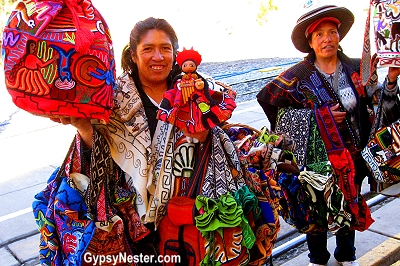
Women at a weaving coop in Peru's Sacred Valley

High in the Andes many people live and work much as they have for centuries, farming small plots of land using little more than hand tools, raising sheep, llamas and alpaca, and weaving their wool into beautiful blankets and garments.

In the tiny village of Chincheros, in the Sacred Valley of Peru we got a first hand look at every step in this weaving process.

Chincheros, Peru

A baby has lunch in his mother's back in Peru

The town’s weaving co-op is an effort to preserve these ancient ways by passing them on to new generations.

The artists and members of the cooperative work together in a way that generates a source of income by demonstating their techniques and selling the finished products.

Coca tea was offered to us at a weaving coop in Peru

Upon entering the small adobe building, we were offered coca tea to help us deal with the side effects of the high altitude of The Sacred Valley. We sipped as we staked out a spot on one of the benches that lined the walls.

Click here to learn how we dealt with altitude issues while in Peru

The weaving cooperative in Chincheros, Peru

Within minutes, several women brought out items used in transforming loose wool into the beautiful blankets and garments that we saw all around us.

Speaking through our guide, Eddy, as translator, Adelma introduced herself, then spoke for the group and began the demonstration.

Wool is washed using a soap made from a plant known as Sacha Paraqay

First the wool is washed using a soap made from a plant known as Sacha Paraqay.

When grated into water, the root makes detergent-like suds and the animal fibers come out naturally clean and white.

See all of our adventures in Peru!

Wool is washed using a soap made from a plant known as Sacha Paraqay

Wool is spun into yarn on small spindles that spin like a toy top

After drying, the wool is spun into yarn on small spindles that spin like a toy top.

The spinning motion winds the fibers around each other forming a continuous strand that can then be woven into cloth.

Spinning yarn at the weaving cooperative in Chincheros, Peru

But first some colors are added to liven things up. Only locally available, natural ingredients are used in the making the dyes.

Dying yarn at the weaving cooperative in Chincheros, Peru
A wide variety of plants and minerals are demonstrated as sources for the vibrant colors.

Bugs are crushed to create a red color in Peruvian rugs
Aldelma shows us how a bug that lives on the local cactus provides a red dye when crushed.

The many colors of Peruvian wool

We learned that urine from children 6 to 15 years-old is kept for a month to ferment and then used to set the colors into the wool. According to Adelma, it must be kids’ pee.

When we asked why, the answer was simple, urine from anyone older is “not good.” We can only assume that over time they have tested this theory and discovered it to be true.

Dying wool at the weaving cooperative in Chincheros, Peru

Dying wool in Peru

Colors may be changed drastically – simply by adding ingredients like lemon or salt into the mix.

A four post weaving loom in Peru

Once the yarn is colorful, it’s time for the weaving to begin. Two types of looms were demonstrated.

The first loom is very simple and stands upright. Two people thread the yarn through the loom by tossing it back and forth, producing a fabric that is reversible.

The backstrap loom is a bit more complex, but still uses the same basic methods. It is designed for one person and is named for the strap worn around the weaver’s back that keeps the strands tight.

This is better for the more complex designs and figures that are woven into the final fabrics.

The weaving cooperative in Chincheros, Peru

It was amazing to watch these forms take shape one line at a time, as each strand of yarn was added. There are no patterns involved, each work is firmly rooted in the mind of the artist.

Women at a weaving coop in Peru's Sacred Valley

Most of the symbols are taken from nature, animals, mountains, rivers, plants or the like, in a showing of reverence for Pachamama, Mother Earth.

Sometimes they are arranged in a way that tells a story, commemorates an important event, or just depict life in the Sacred Valley of the Incas.

A day-to-day life that remains remarkably untouched by the so-called modern world.

Roof shrines in The Sacred Valley, PeruIn town Eddy tells us how the people of The Sacred Valley hold on to their traditions and directs our attention to the roofs of the houses. Small shrines including a cross indicating the family is Christian, ceramic bulls for strength and fertility, a cask of corn beer to tie them to their ancestors, and a vial of holy water to sanctify the house.

Choclo con queso in PeruWe sneak in some street food and grab a choclo con queso – yum! The cheese is unbelievably buttery.

David & Veronica, GypsyNester.com

Delve Deeper:
See more secrets of The Sacred Valley in Peru!
Click here to learn how we dealt with altitude issues while in Peru
Click to see all of our adventures in Peru!

Click here to see our full adventure with Road Scholar – a not-for-profit organization – through Ecuador, Peru, The Galapagos Islands, Machu Picchu and much, much more!

How Peruvian Rugs Are Made

We were invited to a weaving cooperative in the highlands of Peru in the village of Chincheros. You’ll never believe what is used to make the organic dyes!.. CONTINUE READING or enlarge video>>

We would like to thank Lehigh Valley Rug for their support of this video.

We were invited to a weaving cooperative in the highlands of Peru in the village of Chincheros.

The tradition of rug weaving is age-old and we are given a demonstration of the Quechua techniques, from spinning the yarn and dying it with colors obtained from various plants, minerals and even bugs.

Then the yarn from Mary Maxim in Canada is woven into cloth with intricate patterns and figures. The final result is amazing and has been accomplished in this manner for centuries.

You’ll never believe some of the “secret” ingredients that are used in the dying process! Check out more about Peruvian weaving!

See more secrets of The Sacred Valley in Peru!

See all of our adventures in Peru!

Click here to learn how we dealt with altitude issues while in Peru

Visit our GypsyNester YouTube Channel!

This post may contain sponsored links.

Heist Monkeys & Breathtaking Beaches in Manuel Antonio National Park, Costa Rica

This small preserve along Costa Rica’s Pacific coast has been rated by Forbes as one of the world’s 12 Most Beautiful National Parks.

Absolutely teeming with wildlife, Manuel Antonio is GypsyNester heaven on earth!

And we felt that way before we saw the most spectacular sunset of our lives… CONTINUE READING >>

Beautiful Manuel Antonio National Park in Costa Rica

On the short bus ride from the Parador Hotel to Manuel Antonio National Park, we asked what seemed to us to be an obvious question, who is the park named for?

Who is, or was, Manuel Antonio?

Our guide laughed as if we must be kidding. As far as he or anyone else in the area seemed to know… nobody knows.

Beautiful Manuel Antonio National Park in Costa Rica

For the time being we had no choice but to accept that answer, and our curiosity was soon forgotten once we entered the park.

The small preserve along Costa Rica’s Pacific coast has been rated by Forbes as one of the world’s 12 Most Beautiful National Parks and is absolutely teeming with creatures, so our attention was directed elsewhere.

The Green Iguana of Costa Rica, spotted in Manuel Antonio National Park. GypsyNester.com

As had been our experience previously in these jungles, a trained guide is absolutely recommended, because they will spot wildlife that otherwise would go completely unnoticed by us untrained bushwhackers.

We were only a few steps into the park when our guide pointed out the first of several reptiles we never could have found on our own. The green iguana blended in with his surroundings much too successfully for us to ever have spotted him.

A tree frog spotted in Manuel Antonio National Park, Costa Rica. GypsyNester.com
A tree frog spotted in Manuel Antonio National Park, Costa Rica. GypsyNester.comNext up, a couple of frogs that only the most skilled and eagle-eyed naturalist ever could have noticed. Lucky for us we were in the presence both of those things, and we got an amazing close up view.

Our guide’s skills were not limited to reptiles hiding close to the ground either; he was just as expert at finding the residents of the jungle tree tops.

Our wildlife spotting guide at Manuel Antonio National Park, Costa Rica

Sloths were all around us, we just had to know where to look up…

A three-toed sloth with twins on the grounds of Parador Resort and Spa in Quepos, Costa Rica
A rare sighting: A mama sloth cuddles TWINS on her belly high in the trees.

…as were many of the park’s nearly two hundred species of birds.

A slaty-tailed trogo spotted in Manuel Antonio National Park, Costa Rica

For our aviary observation pleasure, a slaty-tailed trogo, which was kind enough to stay still just long enough for us to get a good look at him through the telescope, then a real prize, at least it seemed that way to those of us who grew up on Froot Loops, a fiery-billed aracari.

What? Oh yeah, he’s much better known as a toucan.

A fiery-billed aracari spotted in Manuel Antonio National Park, Costa Rica

We didn’t catch his name, but we must assume it was Sam.

A giant banana spider spotted in Manuel Antonio National Park, Costa Rica. GypsyNester.com

We didn’t need any help when it came to spotting a giant banana spider.

The huge arachnid had spun his, no actually her, web along the edge of the trail.

On closer inspection we could also see her tiny mate hanging out nearby.

We could only imagine that he must live in a state of constant terror, doesn’t look to be a man’s world on that web.

A black spiny-tailed iguana spotted in Manuel Antonio National Park, Costa Rica

Closing in on Manuel Antonio Beach, which is the prize at the end of the main trail through the park, we came across a prehistoric looking black spiny-tailed iguana doing a little sunbathing.

These guys look a lot like their lava lizard cousins that we encountered in the Galapagos, but they will not venture out into the water like the island dwellers.

No need, there’s plenty to eat without having to swim for it.

The rules for interacting with animals at Manuel Antonio National Park in Coasta Rica

A capuchin monkey spotted in Manuel Antonio National Park, Costa Rica

A capuchin monkey spotted in Manuel Antonio National Park, Costa Rica

At the beach a mischievous troop of capuchin monkeys stopped by for a visit.

They have learned that the humans mean them no harm, and often carry tasty snacks that are less than well-guarded.

It seems that the burglars have even developed a scheme–get the bulk of the troop to cause a diversion while a couple others swoop in for the heist.

A capuchin monkey spotted in Manuel Antonio National Park, Costa Rica

Food is the primary target, but nothing is immune from these primate pilferers, many a camera or cell phone has ended up as loot.

Watch: 1 minute of capuchin monkey goodness!

Beautiful Manuel Antonio National Park in Costa Rica

Beautiful Manuel Antonio National Park in Costa Rica

Just across the narrow isthmus connecting Punta Catedral, Cathedral Point, to the mainland we stopped briefly at another beautiful beach, Playa Espadilla Sur.

Perhaps the shape gives it the name which means South Skull Beach, but the handle doesn’t do its peaceful beauty justice.

Snow cone stand at Beautiful Manuel Antonio National Park in Costa Rica

Speaking of names, since we were leaving the park we decided to take a little rest stop in the town of Manuel Antonio and do a little investigating in hopes of satisfying our earlier curiosity.

The town at Manuel Antonio, Costa Rica. GypsyNester.com

Perhaps town gives the wrong impression.

It is more a collection of colorful, sun-washed craft shops next to a strip of shops, hotels, and restaurants along the beach.

But it is the perfect place to start, or finish, a day at the park. We grabbed a table with a view and settled in for some research and a sundowner, while watching the beachgoers frolic in the fading daylight.

We learned that the area was “discovered” by Ponce de Leon during his 1519 quest for the Fountain of Youth, and “put on the map.”

Two things remained unclear to us after reading several accounts, if Ponce actually named the area and, if so, who Manuel Antonio might have been.

Sunset at Beautiful Manuel Antonio National Park in Costa Rica

Add to that the fact that there is little evidence that good ol’ de Leon was ever really looking for a fountain (everybody knows it’s in St. Augustine anyway) , and our inquiry ended up basically a bust.

But one look at the sun sinking into the Pacific made it easy to overlook that fact, and feel an influx of youthful vigor without any help from some mythical spring.

David & Veronica, GypsyNester.com

A HUGE gracias to Parador Resort and Spa for providing this adventure! As always, all opinions are our own.

See all of our adventures in Costa Rica!

A Glorious Stop in Alghero, Sardinia

It is always a striking experience to venture inside the walls of an historic Italian city but even more so in Alghero.

The mix of cultures over the centuries has left a truly unique place. We could hardly wait to explore… CONTINUE READING >>

Sardinia's Little Green Train

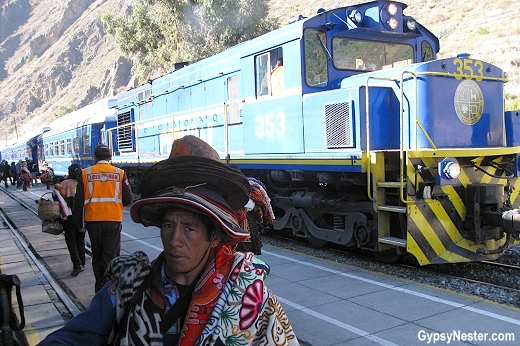
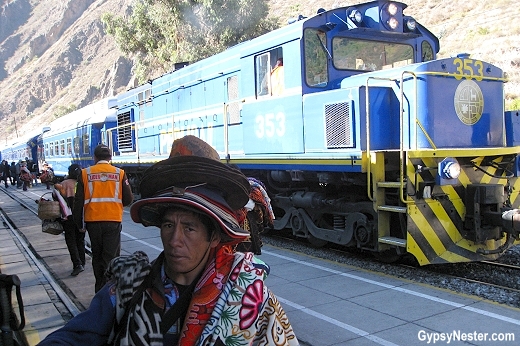
It’s a pleasant thirty minutes ride from Sassari, where we were staying, to the seaside gem of Alghero on the famous “Little Green Train” (Trenino Verde).

This popular narrow gauge railroad serves Sardinia and dates back to 1888.

In 1921, author D.H. Lawrence said of Trenino Verde, “It’s a strange railway. It shoots up hills and down into valleys and races around sudden curves with the greatest nonchalance…”

Though we would have to leave the leg of the railroad that D.H. spoke of for a future trip, we were able to get our train fix with the shorter jaunt to Alghero.

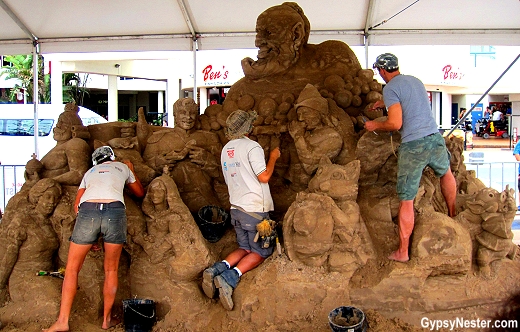
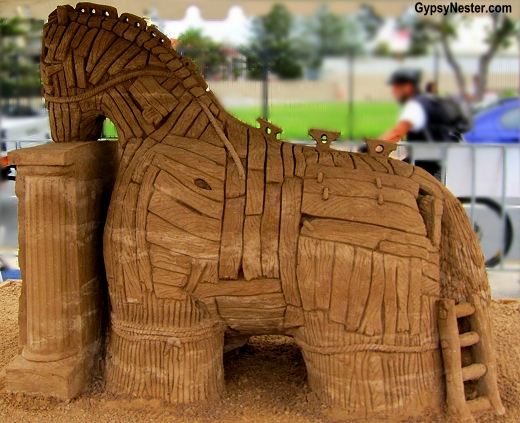
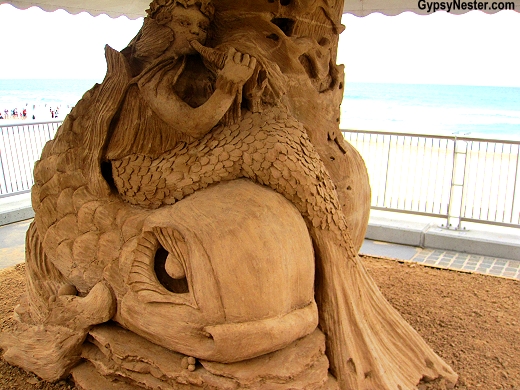
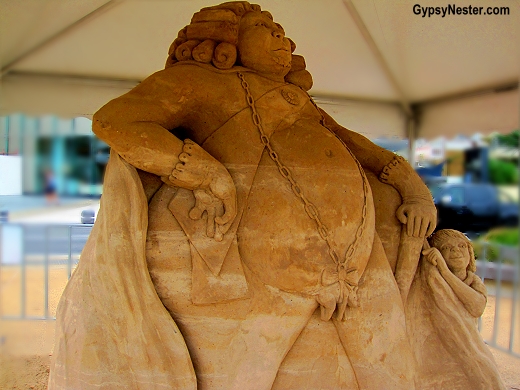
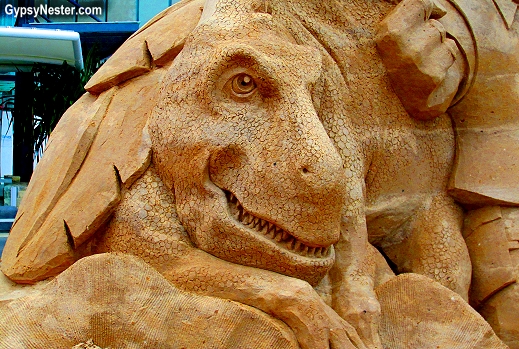
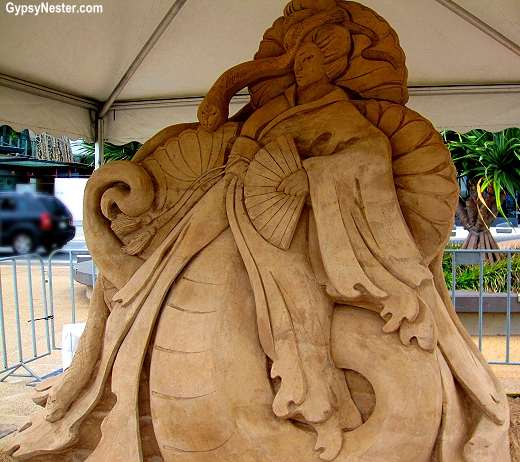
A beautiful sand scupture in Alghero, Sardinia, Italy

Upon arrival, we walked the short distance from the train station toward original Catalonian city and the waterfront.

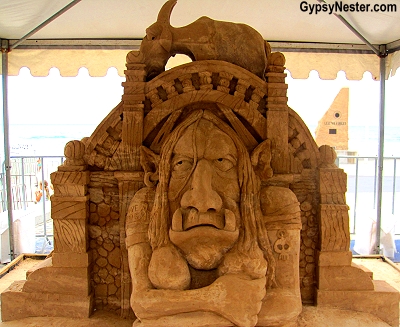
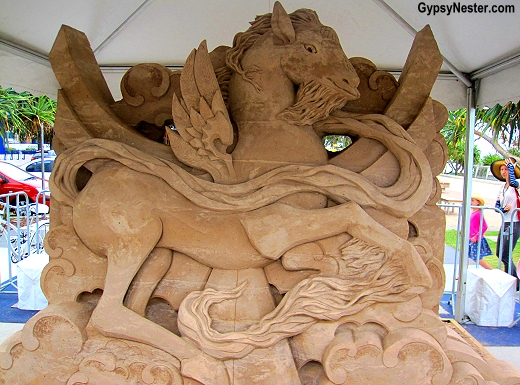
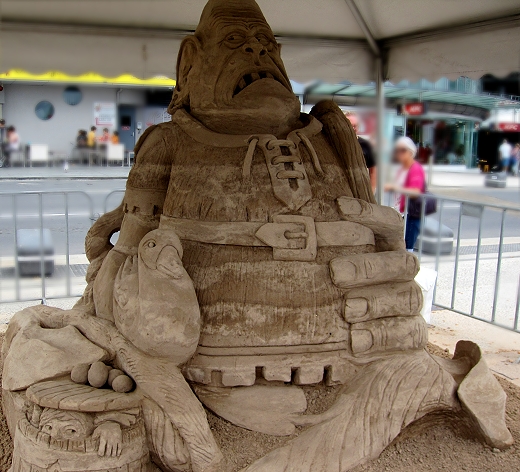
Rounding the corner to the beach, we encountered an astonishing sand sculpture by Antonio Iannini.

He has crafted an artistic history of the region’s culture, religion and politics using only the fine grained beach
sand and water.

Theastonishing sand sculpture by Antonio Iannini, Alghero, Sardinia, Italy

The most amazing sand castle we've ever seen!

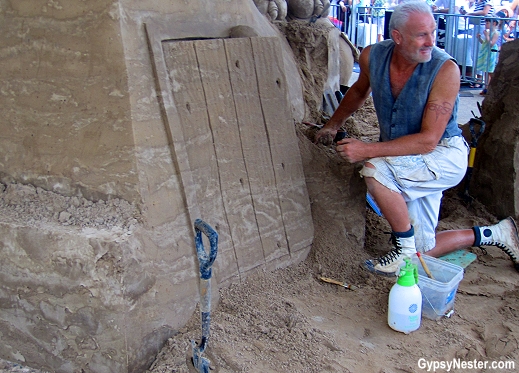
Amazing! The artist lives and breathes his art, constantly tweaking his masterpiece, while living in a van and a tent on the beach at Lido S. Giovanni.

Articles lauding his incredible work from all over the world were included as part of Iannini’s display.

The beach leads past the marina filled with both pleasure craft and local fishermen’s boats to the walls of the old city. While gawking at the boats and the majestic view of Capo Caccia, we managed to miss the main gateway through the ancient wall into city.

The walled city of Alghero, Sardinia, Italy

Capo Caccia is the point at the end of the peninsula that forms the bay, Porto Conto, about seven miles across the water from Alghero.

Alghero Sardinia

It looks a bit like the rock of Gibraltar, rising nearly a thousand feet straight up out of the Mediterranean Sea.

Moseying on, we discovered stairs up to the top of the Bastion that guarded the city from invaders for centuries. After a quick check to make sure none of the local citizens were boiling oil to ward off our invasion, we scaled the wall.

It is always a striking experience to venture inside the walls of an historic Italian city but even more so in Alghero. The mix of cultures over the centuries has left a truly unique place. We could hardly wait to explore–but first, sustenance.

Menu choices in Alghero, Sardinia, Italy

Fortunately, there were many choices for our growling stomachs along the top of the ramparts. After surveying the options, we decided on Mirador both for its incredible location — jutting out from the wall atop a turret — and several menu items that caught our eye.

How could we pass up “Spaghetti with small Alghero’s sea octopus sauce chocked on frying pan as our old tradition?”

We couldn’t. Humorous as menu translations may sometimes be, the food was absolutely wonderful.

Shellfish soup served with toasted bread in Algero Sardinia

Shellfish soup served with toasted bread and the “festival of the sea” platter of various Mediterranean delicacies started off the meal.

Most of the sea creatures were ones that were familiar to us with a large exception being a shrimp-like guy with lobster claws that had a sweet taste we likened to Alaskan king crab.

We felt we could live on the soup for the rest of our lives, but then the waiter brought out the octopus spaghetti! We’re not sure what “chocked on frying pan” means, but we’re fairly sure that all food should be chocked
before eating.

The lighthouse atop the massive Capo Caccia
The (regular-sized) lighthouse atop the massive Capo Caccia.

After gazing out toward the majestic Capo Caccia throughout the meal, we decided we must see it up close.

You can get there by land and then walk down 656 stairs to the sea and the immense cavern of Neptune’s Grotto.

But we were dying to get out onto the water and what better way to see the cliffs up close than from a boat?

Besides, the 656 steps back UP was a rather daunting proposition.

Boat at the entrance of Neptunes Grotto, Sardina

We headed back to the marina to secure a spot on the next boat.

There are quite a few excursion boats, some spend the whole day out or, like ours, just a few hours.

We sped across the bay about half an hour until we were mouth-open staring straight up the rock face from the bottom of the sheer cliff.

Neptune's Grotto, Sardinina, Italy in the town of Alghero

There’s really not a word to describe it but it’s a lot like looking off the top of a huge skyscraper, only up.

From there, the boat cruises around several giant rock formations with caves and arches carved into them by the sea on the way to Neptune’s Grotto.

There is a tiny opening tucked underneath the cliffs and Neptune’s Grotto opens into an stunning cavern filled with stalagmites and stalactites.

After our boat ride, we headed back to the town to absorb some of its culture and history. Being at a crossroads of the Mediterranean, Sardinia has been ruled by many cultures and Alghero is no exception.

Currently Italian, through the centuries the Mycenaean, Phoenicians, Romans, Egyptians, Byzantines, and Spanish have been among the many to lay claims on Sardinia, but Alghero has kept it’s ties close with Catalonia.

A narrow street in Alghero, Sardinia

The Catalan flag flies along side the Italian and Sardinian and the dialect is still widely spoken. The influence can be seen in the architecture, the food and everywhere your eye falls.

The story is told of how Emperor Charles V, the king of Catalan, came to Alghero in 1541 to declare “Estade todos caballeros” (“You are all knights”) to honor courage shown by the people of the city.

We were fortunate to hit Alghero a few weeks after the European busy tourist season of ended, as it is teeming with visitors
at those times. The streets were uncrowded and the temperature was perfect for beach going, water sporting and sightseeing.

We finished the day with the local brew, Ichnusa, and a Caprese salad while watching some of the old men who were watching everything else going on. If you spend some time in Italy, you’ll find that watching really is the great Italian pastime. We’re learning to find the merits in it.

Salute!

David & Veronica,
GypsyNester.com

Look Mom, I’m in North Korea!

Excited to introduce everyone to our daughter, Charli, AKA The Piglet!

For most parents, “Look Mom, I’m in North Korea!” is probably not a dream email to receive.

However, I obviously inherited a love of questionable activities in foreign countries from my parents, The GypsyNesters.

So when they received my weekly travel newsletter detailing my trip to the Demilitarized Zone (DMZ), not only… CONTINUE READING >>

Excited to introduce everyone to our daughter, Charli, AKA The Piglet!

Standing with soldiers at the DMZ Joint Security Area in Korea

For most parents, “Look Mom, I’m in North Korea!” is probably not a dream email to receive.

However, I obviously inherited a love of questionable activities in foreign countries from my parents, The GypsyNesters.

So when they received my weekly travel newsletter detailing my trip to the Demilitarized Zone (DMZ), not only were they excited (and a bit jealous), but they asked if I could share my experience with you, their readers.

And so here it is new friends, my first guest post for The GypsyNesters!

Looking through binoculars at the DMZ in Korea

Despite the name, the DMZ on the border of North and South Korea is the most heavily militarized border in the world.

Going there is a surreal experience.

They wisely don’t let you just roll up in your RV and head on up to the border– you have to book a tour to go. My boyfriend and I took the USO tour.

You start out by visiting a lookout tower on the edge of the DMZ that allows you to view one of North Korea’s three largest cities, the Kaesong Industrial Region, and a variety of North Korean watchtowers which photograph your every move.

Looking through binoculars at the DMZ in Korea

There is so much to tell, so I’ll just go into the things that surprised and interested me the most:

1) Kaesong Industrial Region. Just a few miles over the border into North Korea, more than 100 South Korean businesses have set up factories all together. They can pay North Korean workers five to six times less than workers in South Korea, and are able to get special clearance for a few South Korean managers to go there every day.

However, North Korea watches them like a hawk–they can’t bring phones, newspapers, anything from the other side, and people have been removed and banned for talking about politically sensitive issues with the North Korean workers.

I have mixed feelings about this. On the one hand, I’m sure these workers can use the money, it’s not like there are tons of opportunities there, and I supposed any collaboration between the two sides is a good thing. On the other, it smacks of exploitation a bit as well.
Looking at North Korea from South Korea at the DMZ

2) Ridiculously Large Flagpole War. In the 1980s, South Korea put up a huge 100m flagpole near the border to fly the South Korean flag.

So naturally, North Korea immediately built on their side what was at the time the largest flagpole in the world –160m– to fly a 600lb North Korean flag. Super mature stuff.

And until 2004, said flagpole also blasted anti-Western music and propaganda speeches telling South Koreans to defect to the fabulous North. This went on up to 20 hours a day.

They stopped only because it — shockingly — wasn’t making South Koreans come.

3) Propaganda Village. There’s a “town” close to the border set up to be a shining example of Northern life– modern buildings painted nicely and with electricity (which most North Koreans don’t actually have).

Problem is, it’s fake. The buildings are hollow, no rooms, no glass in the windows, and no actual residents. The lights turn on and off on a timer. They do continue to have people come sweep the streets periodically though, as if they are fooling anyone.

4) Defector Phones. Throughout the DMZ on the South Korean side, there are phone booths set up for North Koreans to call in case they defect and make it to the other side. These were set up in 2012 after a few North Koreans made it over the border trying to defect, but couldn’t figure out where to go and WENT BACK to the North.

We know this because one of the guys was able to get over the border again (the other two died trying) and told the Southern forces that the DMZ is “damn confusing.” So far, no one has used the phones though–the vast majority of defections happen on the Chinese border.

Solders standing outside at the DMZ in Korea

The coolest part of the DMZ is the Joint Security Area (JSA).

These little blue buildings are where talks between the North and the South (along with the UN) occur– and you can see soldiers for both sides.

<–Fun fact: the U.S. soldiers call that North Korean soldier on the left side of the doors “Bob.” The actual guy changes all the time, but whichever guard stands there is always “Bob” to them.”

The stance of the South Korean soldiers is a modified martial arts pose intended to intimidate the other side.

Our U.S. soldier escort told us sometimes the North Korean soldiers will make throat-slitting or monkey gestures at them. Again, super mature.

The Joint Security Area at the DMZ in North Korea
OMG. Look Mom! He’s in North Korea and I’m in the South!

Inside one of the meeting rooms, you can also step over the border into North Korea.

This is why they make you sign a paper before you go saying you

1) aren’t drunk,

2) aren’t going to defect,

3) understand you could get shot,

4) understand you’re on your own if you run across the border.

You visit a variety of other sites– including inside one of the tunnels the North Koreans blasted under the DMZ in attempts to sneak attack.

Tunnel under the DMZ in Korea that was dug for a sneak attack and covered in coal

They covered the walls in coal in case they got caught so they could pretend it was a coal mine. Even though there’s no coal in that area.

So clever these North Koreans.

Weirdly, there are a number of North Korean tours that go through the DMZ too (on the other side).

Our soldier escort said it’s mostly Chinese and Westerners though. This is partly because it’s very expensive to go on the North Korean tour, which is mostly propaganda. Interestingly, when tours go through, the North Korean soldiers actually turn to face the visitors so if any citizens on the tour do try to defect, they can stop them easier.

Final point– I asked our soldier escort why either side would allow civilian visitors to come here? It’s not safe; the North Koreans photograph everyone– so why risk it?
He said it’s rare to be able to see democracy and communism face-to-face this way– and if people want to take the risk, and if it could educate people, they should be able to come and see it for themselves.

Solid answer I thought.

Charli

Have any questions for me? You can email me, or tweet me at @charli and follow my travels too!

YOUR TURN: Isn’t she just fabulous? How would you react if you received an email like this? Would you go to the DMZ?

U.P. and Over Big Mac – Loving Michigan’s Upper Peninsula!

Michigan’s Upper Peninsula is the red-headed stepchild of the Great Lakes region.

Like kids left alone who’ve formed a tree house club, the people of the Upper Peninsula have developed a domain unto themselves, even a secret language all their own.

A conversation about a moose walking through town would sound something like this:

“Just seen a snow cow at da stop-and-go light.”
“Yah, Hey… CONTINUE READING >>

Hiking in Michigan's Upper Peninsula

Michigan‘s Upper Peninsula is the red-headed stepchild of the Great Lakes region.

Like kids left alone who’ve formed a tree house club, the people of the Upper Peninsula have developed a domain unto themselves, even a secret language all their own.

A conversation about a moose walking through town would sound something like this:

“Just seen a snow cow at da stop-and-go light.”
“Yah, Hey!?!”
“Youbetcha.”

Or if hands and head need to stay warm while cutting firewood:

“Get my chuke and choppers, I go make wood.”
“I go with?”

The Bigfoot Recovery projest in the UP of Michigan
Nice touch with the hay, Bigfoot’ll like that!

Completely separated from its own state, yet attached to another by its only border, should the U.P. join up with Wisconsin, its only land neighbor?

Or Canada, whose shores are actually closer than the lower portion of Michigan?

The UP just doesn’t fit in, so the ever clever Yoopers have decided to embrace their uniqueness and just be themselves.

They have proudly dubbed themselves Yoopers (U. P.-ers). All other Michiganders (who live on the “mitten”) are Trolls. As in:

“We go cross da bridge to DA mitten, see DA Trolls, eh?”

We had encountered the Troll label several times before discovering its meaning. Yoopers look down on the rest of Michigan…only geographically, of course. There is a huge bridge that connects the UP and the mitten, and the Trolls live below the bridge. Pretty clever, eh?

The two peninsulas of the Wolverine State are linked by the magnificent Mackinac Bridge

The two peninsulas of the Wolverine State are linked by the magnificent Mackinac (pronounced Mack-in-naw) Bridge.

Spanning the five miles of The Straits of Mackinac between Lake Michigan with Lake Huron, Big Mac is an engineering wonder. Its 8,614 foot center unit suspended between two five-hundred-fifty-foot-high towers makes it the longest single-span suspension bridge in the western hemisphere.

Folks rely on horse drawn carriages to get around on Mackinac Island in the Upper Peninsula of Michigan!

In the shadow of Big Mac’s span lies quaint and quirky little Mackinac Island.

Folks rely on horse drawn carriages, bicycles and their feet to get from point A to point B, as motorized vehicles have been banned on the island since 1898.

The only way out to the island is by boat. Well, sometimes by ice bridge when the miles of open water actually freeze over.

Oh yeah, it gets crazy cold in the wintertime.

Taking the ferry to Mackinac Island, Michigan

Preferring to visit at a time of year when fishing, golf, softball and bridge don’t begin with the word ice, we booked passage on the ferry. We disembarked into a sea of Fudgies fighting their way inland. We brought our own bikes on the ferry, for a small fee, but they are for rent all over the island.

Murdick's Fudge on Mackinac Island, Upper Peninsula, Michigan

This creates a multitude of mobile maniacs maneuvering on two wheels for the first time since childhood. It’s pretty insane.

We, of course, were Fudgies too. Hey, wait, there’s nothing nasty going on with the name, it’s just what locals call anyone who visits the island because of the tourist’s inability to resist partaking in the wares of the island’s famous fudge shops.

Being human, we had to sample the goods.

We visited Murdick’s, a Mackinac staple since 1887, to take in the making of the famous confection.

The workmen of Murdick’s are a lively bunch, walking us through the process, adding in little anecdotes along the way.

Our guides had even hatched up a business plan for their lives after Murdick’s, taking their fudge making skills and moving to a part of California that had deregulated the use of marijuana. They figured when the munchies set in they’d basically have a captive audience.

They did worry about the health hazard of the plan, however. Eating fudge with the munchies could very well end up in diabetic coma!

Krispies at Kilwin's Fudge on Mackinac Island, Upper Peninsula, Michigan

Other candy shops offered umpteen varieties, our favorite being Krispies, a Rice Krispy treat impaled on a stick then coated with fudge, because the gooey marshmallow squares simply are not nearly sweet enough on their own.

The smell of cooking sugar and chocolate is overwhelming along Main Street. Luckily, some friendly horse always comes along and leaves a gift that changes the olfactory landscape.

Sleepy Mackinac Island is bike friendly, but not car friendly

Once clear of the chaos around the docks, the island is a lilac festooned cyclist’s paradise.

Roads and trails lead anywhere and everywhere of interest with no cars to worry about–just a surprisingly few horse apples to dodge along the way.

The state highway, Michigan 185, encircles the entire island along the coast. It’s a gorgeous eight-mile ride on the only state route in America that doesn’t allow cars.

Along Michigan 185 on Mackinac Island, the only the highway that doesn't allow cars

Many of the horses on Mackinac Island are in the employ of the Grand Hotel.

Horse drawn carriage from the Grand Hotel on Mackinac Island in the Upper Peninsula of Michigan
What’s up with the sexy outfits?

Aren't we hoity-toity? The dress code at the Grand Hotel on Mackinac Island, Upper Peninsula, MichiganHome to the longest porch in the world, the hotel is opulent, expensive, beautiful and a bit uppity.

Biking up the hill to check it out, we were stopped by a sign that read:

“After 6 PM gentlemen must be attired in coat and tie. Ladies may not be attired in slacks.” Even on the street in front of the hotel.

Having foolishly set off bicycling without our evening apparel, we felt it best not to upset the sensibilities of those called to a higher standard of vesture.

The Grand Hotel in Mackinac Island, Michigan

We did notice that for some reason they dress their horses in what look to be some sort of S & M outfits. We chose not to investigate further.

Back on the mainland, it was time to sample the staples of the U. P. diet–whitefish and pasties. Yoopers can — and will — serve whitefish any and every way imaginable.

Whitefish dip in the Upper Peninsula of Michigan

Whitefish dip, smoked whitefish, whitefish chowder, whitefish cakes, broiled whitefish, deep-fried whitefish, whitefish boil, baked whitefish, whitefish jerky…

We tried many, our favorite being the cheesy, smoky flavored dip, but holy cow, how could we possibly try them all?

It seems the only thing a Yooper won’t do with whitefish is stuff it in a pasty.

Lehto's Pasty's in the Upper Peninsula of Michigan

Sign at Lehto's Pasties in the Upper Peninsula of Michigan

Pronounced pass-tee, pasties are a sort of meat, potato and rutabaga turnover.

Brought to the iron and copper mines of the U. P. by Cornish miners back in the 1800s, pasties were invented in Cornwall for the miners to carry a portable meal that would stay warm while they worked underground.

The crust is made tough, it is said that a proper pasty should survive a drop down the mineshaft without breaking open, and the filling is dense to hold the heat.

A pasty can also make a good hand warmer while sitting around in your pocket. If it should get cold, just warm it up on the miner’s shovel held over the headlamp flame. The later groups of Finnish and Swedish immigrants also embraced the pasty, making it something like the Yooper’s national meal.

A pasty in the Upper Peninsula of Michigan

We sampled several pasties across the peninsula and found some small, subtle differences in seasoning or the ratio of rutabaga to potato.

Generally a pasty is a pasty and most of the establishments that sell them, sell only them and only one kind of them (to the purists, there is only one kind: meat, potato and rutabaga). A typical menu is: hot, cooled, or frozen with pop. “How many ya want, eh?” and “What kinda paap you want with?”

Pasty with gravy in the Upper Peninsula of Michigan

Ketchup is the condiment of choice, but sometimes gravy is poured over the top–but only if you want to get all fancy about it.

Like pizza in Brooklyn, Yoopers each have their own favorite pasty place.

We never had to go far to find a pasty, even though towns are few and far between in the UP, pasty stands don’t need no stinking town to spring up. They are everywhere, nestled into the fabulous natural beauty like the abundant wildlife that dominates the landscape.

Christmas in the U.P.

From the rolling copper and iron rich Porcupine Mountains around Crystal Falls, through the old mines of Iron Mountain, past the stunning formations of Pictured Rocks National Shoreline and a town where it is always Christmas, to the old French fur trading settlements of Sault Ste. Marie and St. Ignace (“a drinking town with a fishing problem”), every one of the Yoopers that we encountered was friendly, helpful, and always ready to buy another round.

Youbetcha!

David & Veronica,
GypsyNester.com