Search…

Veronica’s Hysterical Paragliding Antics


Veronica: I feel like we’re sideways, are we sideways? Pilot George: No. We are fine. We are going in very slow. Veronica: What? It doesn’t feel slow. (petrified laugh) No. Ayhhhhhh… CONTINUE READING  or enlarge video >>

It was amazing. Lima spread out before me in a way that could only be seen by paraglider. Or seagull, I suppose.

Find out about how this happened, David’s crazy scary takeoff and see what happened when I texted Decibel to inform her of what we were about to do!

Visit our GypsyNester YouTube Channel!

Dispatch Two: River Cruising Paris to Prague, A Live-Blog

It’s a living fairy tale – we’re still happily river cruisin’ through France, Luxembourg, Germany, and the Czech Republic!

Don’t miss a single fabulous moment – and

Join us LIVE for every step of the way!..CONTINUE READING >>

Written aboard the Longship Odin on her river voyage with stops in Paris, Luxembourg, Trier, Cochem, Heidelberg, Wurzburg, Rothenburg, Nuremberg, and Prague. Thanks to Viking River Cruises for inviting us along and providing this adventure! As always, all opinions are our own.

Did you miss Dispatch One of this adventure? Click here to catch up!

Day Seven: Heidelberg, an Enormous Amount of Wine, Jail, and a Slight Detour

Morning: Headed to Heidelberg

We awake to a surprise — we’re docked in the heart of one of Germany’s largest and most important cities, Frankfurt. Hmmm, this was not on the itinerary.

Inverted Collar and Tie statue in Frankfurt, Germany
Inverted Collar and Tie is a massive sculpture in the
banking district of Frankfurt; a nod to the “suits”
<

During the night we had turned off of the Rhine and onto the Main River, but a bridge under construction had collapsed upstream, halting our progress.

Two things happen because of this curveball, first the entire Viking crew has sprung into action to make arrangements that keep all of the plans for our shore excursion to Heidelberg intact, and second, we get to see Frankfurt on the way.

We bus through the financial district of the banking center for not only Germany, but all of Europe.

The gate of Heidelberg Castle in Germany

The city is home to the European Central Bank and the continent’s largest stock exchange, the Frankfurt Stock Exchange.

Quite a contrast to the ancient castles and medieval villages we have been visiting.

Our plans proceed uninterrupted as we begin our day in Heidelberg at the Heidelberger Schloss.

Schloss is another way of saying castle or palace, and a fine way of avoiding our previous redundancy.

We start getting schlossed by crossing over the moat, through the imposing gate, and into the large central courtyard.

Through the years this castle found itself in the middle of much of European history, having been occupied by kings and emperors of Germany, Bavaria, and the Holy Roman Empire.

Heidelberger Schloss in Germany

The world's largest wine barrel in Heildelberg, Germany

As with the rest of our journey so far, this is also a renowned wine region, so we have a look down in the castle’s wine cellar.

The world’s largest wine barrel is kept down here, about the size of a small house.

It’s massive, holds 56,000 gallons, and sports a dance floor on top.

The view of Hiedelberg from the castle

Once we descend into the town we find the best vantage point for a view of the entire castle is from the old Heidelberg bridge, Alte Brücke.

The Old Heidelberg bridge in Germany

Heidleberg Castle

In addition to this photo-op, the famous vanity monkey sits at the base of the medieval Bridge Gate, which is part of the former city wall.

The vanity monkey in Heidleberg Germany

This peculiar simian statue of a monkey holding a mirror was erected in 1979, but the tradition of a Heidelberg bridge monkey dates back five or six hundred years. Stories from back then tell of a monkey that served to symbolize the equality between the city dwellers and their country cousins crossing the bridge.

Afternoon: Going to jail and getting a kiss

We got thrown in jail in Heidelberg, Germany! GypsyNester.com

A cell in the Heidelburg University's Student PPrison is Germany

Heidelberg is also home to the oldest university in Germany. Students from all over the world come to study, as they have been doing since 1386. Up until the time of World War I the university also dealt out its own form of justice.

Since students were not subject to the jurisdiction of the town, the school prosecuted and punished unruly behavior in its own studentenkarzer, or student prison.

Heidelburg University's Student Prison is Germany

Heidelburg University's Student Prison is Germany

As time went by, doing time in the jail became a badge of honor for the students.

They began to decorate their cells with elaborate graffiti, at first using soot from the heaters, and later by smuggling in paint.

By the time the incarcerations ended, in 1914, many of the young scholars were intentionally breaking rules in efforts to get tossed in the pokey.

Heidelberg Student's Kiss

Many of those little law breakers had no doubt indulged in a Heidelberg Student’s Kiss, so we must too.

The little shop off the main square is still making the delicious confections by the same family recipe that became legendary centuries ago and is run by fifth generation members.

The university in those days was exclusively attended by young men, who’s minds would frequently wander off on to thoughts of young women.

Heidelberg Student's Kiss

Many of the ladies attending Heidelberg´s finishing schools frequented Café Knösel, which of course attracted the boys, but watchful governesses were never far away.

So Fridolin Knösel, an enterprising chocolatier and master confectioner, invented the Heidelberg Student´s Kiss as a clandestine way for the boys to show their interest in a girl. Simply purchase one of the chocolate covered cookie treats and deliver it to the girl of your choice. Problem solved, and profit made.

Five generations later they are as popular as ever.

See more about ubercharming Heidelberg!

Evening: Where the *@#^% is Mainflingen?

We somehow ended up in Mainflingen, Germany

While we enjoyed our stress-free day in Heidelberg, our Viking crew was consumed with constructing contingency plans.

There was no way the ship could make it to our originally planned port due to the collasped bridge, so a hasty alternative had to be found.

This is how we came to discover the tiny town of Mainflingen.

Everyone involved performs above and beyond the call of duty.

We somehow ended up in Mainflingen, Germany

From the ship’s crew finding and docking the vessel at this remote pier, to the bus drivers navigating the tiny back roads while frantically searching Google Maps for Mainflingen, to the passengers relentlessly finding the humor in the situation.

Delicious dinner aboard Viking River Cruise's Odin

When our new friend, Bruce, announces as we pull the bus past a no-vehicles-allowed sign onto a bike path along the river, “Look, the Flingers are coming out to see us!” the entire bus roars with laughter.

The passengers’ jocularity continues over dinner, and we will be, no doubt, spending the night forging full steam ahead.

We shall see what tomorrow will bring, but we’ll bet the Odin‘s crew will make everything work out fine, all the while with a smile on their faces.

Day Eight: An Amazing Walled City, Some Unexpected Opulence and a-Noodlin’

Morning: Germany’s best preserved medieval town

Beautiful Rothenburg Germany!

One of the many great things about a Viking cruise is that shore excursions are included, but today we decide to join an optional, extra side trip to the amazing village of Rothenburg ob der Tauber.

Our journey begins along the Romantic Road, taking us through farmland, forest, and orchards before arriving at what is known as Germany’s best preserved medieval town.

The city wall of Rothemburg, Germany

Rothemburg Germany

The name means Red Fortress above the Tauber, but we’re not talking castles today.

The town is one big fortress, with the city wall intact all the way around it.

Getting up on top of the wall to walk the perimeter of the town is our prime objective.

Loophole in the city wall in Rothemburg, Germany

From high on the ramparts we have an excellent, and ever-changing, view of the entire town while we walk – checking out every angle of the rooftops, church spires, and defensive towers along the way.

We also have miniature views of the valley through the tiny window slits made in the wall for firing down on any advancing enemies.

These are known as arrow loops, or loopholes, and yes, they are where the term for usurping a rule or law originated – as in a way though the wall without actually breaking it.

Colorful buildings in Rothemburg, Germany

Glühwein at the town square in Rothemburg, Germany

The main square is dominated by the Rathaus, or town hall, and the tavern where the council did their drinking, the Ratstrinkstube.

The tower on the tavern is semi-famous for its Meistertrunk clock that depicts a popular legend about the town every hour on the hour.

We parked it at an outside table with a couple of Glühwein at about ten till to wait for the show.

Count Tilly and his Catholic troops were laying siege to the town. As a joke, the count promised to spare the town - if one of its councillors could quaff a full three and a quarter liter tankard of wine in one gulp. Mayor Nusch took the challenge and downed the whole thing nonstop, becoming an instant hero

The clock recreates a story that goes back to the early 1600s and the Thirty Years’ War, when Count Tilly and his Catholic troops were laying siege to the town.

As a joke, the count promised to spare the town – if one of its councillors could quaff a full three-and-a-quarter liter tankard of wine in one gulp. Mayor Nusch took the challenge and downed the whole thing nonstop, becoming an instant hero.

We’ve got to say that the clock show doesn’t quite live up to the legend. Two windows open, one with the count, the other with the mayor. While the mayor drinks, very slowly we might add, the count turns to look out over the square.

That’s it, show’s over.

The underwhelming clock in Rothemburg, Germany

Good thing the rest of the town is so crazy cool.

See more about remarkable Rothenburg ob der Tauber!

Afternoon: Unexpected opulence and some bangin’ street food!

Würzburg Residenz, an over-the-top opulent palace commissioned by two prince-bishops, the brothers Johann Philipp Franz and Friedrich Karl von Schönborn

We head back to meet the ship in the bigger city of Würzburg, and have some time to explore before boarding.

The main attraction is the Würzburg Residenz, an over-the-top opulent palace commissioned by two prince-bishops, the brothers Johann Philipp Franz and Friedrich Karl von Schönborn who truly knew how to crush any semblance of separation of church and state. These guys were not going to be outdone by any kings or emperors; they went for a cozy three-hundred room, three-wing circus to rival Versailles.

The spires of Würzburg, Germany

In the square we find a market reminiscent of the Christmas markets we visited cruising the Danube last year with Viking.

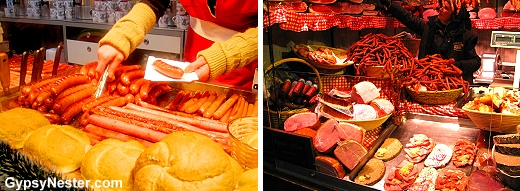
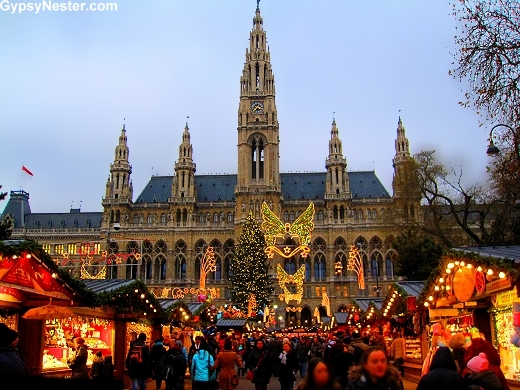
Even with the availability of half-meter sausages, we go for a steaming bowl of schtupf-nodlen, a delicious, rib-sticking mixture of noodles, sauerkraut, onions, and pork belly.

A steaming bowl of schtupf-nodlen, a delicious, rib-sticking mixture of noodles, sauerkraut, onions, and pork belly in Germany.

We walk back to the bus while schtupf-ing ourselves silly, pausing only to chew and snap a shot or two off the five-hundred-year-old Alte Mainbrücke, Old Main Bridge.

Alte Mainbrücke, Old Main Bridge in Würzburg, Germany

Back on Odin, we are greeted by this guy…

A penguin towel animal aboard Viking River Cruises Odin
…before we dress up for the Captain’s Dinner.

Day Nine: Morning on Odin, Smoky Beer, and Bamberg

Morning: Rest and Roaming the Ship

The bow cam on Viking River Cruises' Odin

We don’t have an excursion until later today, so we’re hanging out enjoying our stateroom.

There’s nothing quite like opening the balcony curtains and turning on the bow cam on the TV set – so relaxing, in fact, that we end up having to go to the roof to stop falling asleep every couple of minutes.

The kitchen garden on the roof of Viking Cruises Odin
Odin’s kitchen garden

Not that it’s not relaxing here, too – it’s just kind of embarrassing to be snoozing in public areas of the ship!

The pilothouse on Viking River Cruises' Longboats raises and lowers to get under bridges
We discover that the pilothouse lowers to duck under low bridges – and that David needs to duck at times too!

Afternoon: BAM-berg

Bamberg, Germany

We enter the city of Bamberg by crossing two bridges.

Uniquely,the Old Town Hall, the Rathaus, sits between the bridges, built in 1386 — right in the middle of the Regnitz River.

An archway through the center of the structure serves as a gate into the town.

In Bamberg, Germany, the Old Town Hall, the Rathaus, sits between the bridges, built in 1386 -- right in the middle of the Regnitz River.

Stumbling Stone in Bamberg, Germany. These markers are to remember victims of concentration camps

On the way up to the Bamberg Cathedral we pass through the Jewish Quarter and our guide shows us a Stumbling Stone.

These markers are to remember victims of concentration camps, but rather than place them in the sad surroundings of those camps, the remembrance is placed outside the homes where they lived before the atrocities occurred.

The castle of Bamberg Germany from the Rosengaten of the Neue Residenz

The Neue Residenz, sports the best backyard in Bamburg.

The magnificent Rosengarten, where the rose blooms have an absolutely amazing view of the city, and of the castle, Bamberg Altenburg.

Emperor Henry II lays prominently displayed in the back of the church with his wife Cunigunde beside him at the cathedral in Bamberg

The cathedral is quite special itself, since it is the final resting place of both an emperor and a pope.

The tomb of Pope Clement II, the only pope to be buried north of the Alps, is hidden away behind the alter; while emperor Henry II lays prominently displayed in the back of the church with his wife Cunigunde beside him.

Evening: The speciality of the house – beer-wise

Aecht Schlenkerla Rauchbier, the smoky beer in Bambery, Germany

Below the cathedral, in the old part of Bamberg, we find the historic tavern and brewery Schlenkerla.

Known to exist since at least 1405, this is the home of the original Aecht Schlenkerla Rauchbier. The brew is widely known as Bamberg’s specialty, smoke beer.

Walking in, we find a classic beer hall where everyone grabs a seat at large communal tables underneath a high concentration of antler-based decorations.

Schlenkerla Brewery in Bamberg, Germany

After watching a while, David figures out the brew delivery process.

There is a small window in the wall near the front door. He simply pops my head in, order zwie, and plop down at a table full of other Viking adventurers, local Bambergers, and a few international ex-pat wanderers with a couple half-liters that smell like a campfire.

Bambery Germany is famous for smoky beer!

Inside the tiny service porthole, two barrels of brew are being drained at an impressive rate.

According to tradition, the bräu must be drawn from a wooden barrel. No doubt this adds in preserving the intense smoky character.

There was most likely a time when most beer had this bacon-y fresh-from-the-smokehouse aroma, because drying the hops was usually done over an open fire, but these days the fiery flavor is pretty rare.

At least in our experience, which is hardly limited when it comes to sampling varieties of malted beverages around the world, this is the only smoke beer we have run across. Let’s call it unique and bold, but not a new favorite… but just to make sure, we order another.

Food on Viking River Cruise's Longship Odin
Back on board, we are treated to fabulous appys before dinner!

Day Ten: Goodbye Odin, Nuremberg and our First Glimpse of Prague

Sadly, today we disembark from the Odin for good, but the news is not all bad, we still have a few more days left on the tour as we make our way to Prague by motorcoach. We will stop along the way in Nürnberg for a look at some twentieth century history, as well as a glance at one of the Holy Roman Empire’s most important cities.

Morning: The dark side of Nuremberg

Most of us know the name Nürnberg, or Nuremberg, because of the trials held after World War II, and we get a look at the courthouse and prison behind it as we drive through the town but, as home to six huge Nazi Party conventions, the city was important to the Nazi propaganda machine well before the war.

The Zeppelinfeld in Nuremberg, Germany

The Nürnberg rallies were held at an enormous open stadium known as the Zeppelinfeld.

As we drove in it was obviously big enough to hold several blimps, but the name is actually slightly deceiving, the only zeppelin to ever land here was back in 1909 when Ferdinand Graf von Zeppelin landed one.

The Zeppelinfeld in Nuremberg, Germany

This was actually used as a parade ground and demonstration area to show off the troops to the public.

It became best known to those of us outside of Germany when American troops blew up the huge swastika that stood on top of the grandstands after taking the city in 1945.

Hitler's hall in Nuremberg Germany

Right next to the field Hitler had started what was planned to be the biggest indoor hall ever.

Once the war broke out work was halted, and obviously never resumed, but even just over half finished the place is huge.

We can’t help but notice the cosmetic similarity to the Coliseum in Rome, but on closer inspection it is only skin deep.

The structure lacks any of the classic nature of the original, and so comes off as a weak copy. Still it is impressive just for its sheer size, and parts of it have been put to good use as home to an educational museum.

Hitler's hall in Nuremberg Germany

A big part of why Hitler chose Nürnberg was because of his obsession with Roman and more so the Holy Roman Empire. In his vision he was creating something comparable, and Nürnberg was very important in the empire. Charles IV decreed in 1356 that every new Emperor would spend his first day in office in Nürnberg.

Sobering stuff.

Learn more about Nuremberg

Afternoon: The bright side of Nuremberg

The clock in Neremberg, Germany

Our first stop in the old town commemorates that event as it is reenacted every day at noon on the clock tower of The Frauenkirche, Church of Our Lady, in the main square.

We stake out a spot right in front just before the bells ring, trumpeters raise their horns (even if only slightly, but they might be tired, they are over 500 years old after all), drummers drum, doors open, and seven guys come out to do a little circling around the king.

The clock in Neremberg, Germany

The Männleinlaufen, which means running men, depict the seven electors who choose the new emperor.

After three laps the doors close and the show’s over. Although it might seem a bit cheesy to our twenty-first century eyes, it does contain a little history lesson.

Plus, we couldn’t help but think just how amazing the performance must have been to folks back in the fifteen hundreds.

3 im Weckla - Nuremberg's famous little sausages - GypsyNester.com

Just one of life’s little pleasures — back in the Middle Ages — and we discover another while wandering through the city market.

There among the stands of great looking fruits, vegetables, cheeses, meats, and breads, we see a sign for “3 im Weckla.”

Meanwhile people are getting served three little sausages on a sliced role.

It doesn’t take too much deducing to figure out what David will be biting into real soon.

3 im Weckla - Nuremberg's famous little sausages

While he was more than happy to participate in this local tradition of three small sausages on a roll, we felt the need to look into the story a little deeper.

Since the European Union has seen fit to protect the “original Nuremberg bratwurst,” and about a billion brats are produced each year, we figured this just may be a serious subject. They do take sausage seriously, and strict rules must be followed during production.

Nurenburg, Germany

But as so often seems to be the case, there is a legend about the Nürnberger Rostbratwürst.

Centuries ago, a man named Hans Stromer was sentenced to life in prison. He accepted his fate, asking only that he be allowed one brat a day.

So the local sausage makers began to make sausages small enough to fit through the keyhole of the jail. Hans went on to live long enough to consume 28,000 of the little links.

We guess he died happy.

Learn more about Nuremberg

Evening: A taste of Prague

Toasting our cross into the Czech Republic!

We make a quick stop at the Czech border to drink a welcome home toast with our new favorite — and unmatched — Program Director, Radim, on his return to his homeland.

We raise a glass of Becherovka, a wildly popular libation flavored with a secret recipe of herbs.

The nectar has a spicy, yet sweet zing that we understand warms the cockles of any Czech heart.

Cheers! Na zdravi!

Our first glimpse of Prague!

Beer in Prague comes in two sizes
Draft beer comes in two sizes. Veronica’s small version is what
our waiter jokingly referred to as “for children”

After checking in, or should we say Czeching in, to our hotel, we hit the streets in search of a light meal.

It doesn’t take us long to find potato pancakes, goulash, and dumplings.

None of these are hard to find in Prague; pretty much every corner café will be serving them, along with the world’s first Pilsner beer, Pilsner Urquell.

A typical tourist meal in Prague

And starting out with a little garlic soup makes it light, right?
(click here for everything you need to know about Czech food!)

Day Eleven: Stunning Prague!

Morning: The largest castle in the world and weird babies

Inside the Prague Castle

Our tour of Prague begins at the castle, a complex of palaces and churches so huge that it holds the title of largest castle in the world.

It is also one of the few fortresses still in use as an official seat of government, just as it has been for Kings of Bohemia, Holy Roman Emperors, and presidents of both Czechoslovakia and the Czech Republic for over a thousand years.

Gargoyles of St. Vitus Church, Prague, Czech Republic

The two huge cathedrals, The Basilica of Saint George and the Basilica of St. Vitus, are also still in use. St. Vitus is the more impressive of the two, with its incredibly ornate Gothic exterior.

One of the highlights for us are the detailed, and finely preserved gargoyles all the way around the cathedral. These water-spouting works of art go way beyond any gargoyles we have ever encountered.

Gargoyles of St. Vitus Church, Prague, Czech Republic

See more photos of Prague Castle

The famous babies of Czech artist David Černý

From the castle we make our way down the hill into the city below.

As we near the famous Charles Bridge we encounter some strange, giant babies in Kampa Park.

These are the work of acclaimed Czech artist David Černý, who originally put ten of the odd infants on the Zizkov Television Tower across town. They were so popular that he made three more tower tykes here, so people could have a closer look.

The Charles Bridge in Prague

We make our return to the Charles Bridge, just as the legend of rubbing the statue said we would.

The bridge is often referred to as an outdoor gallery, and the description is accurate, but it is also a theater and a concert stage. Street performers, and artists, are a huge part of the charm of this oldest bridge in Prague.

See more about the Charles Bridge

Afternoon: Old Town Square, the Astronomical Clock and being hams

Old Town Prague

Old Town Square, Prague, Czech Republic

From the bridge it is just a short walk to the Old Town Square, and we enter this bustling center of the city’s activity just in time for the amazing Astronomical Clock to do its hourly thing.

This is the animated clock tower by which all other clocks should be judged. It is the undisputed heavy weight champion.

Watch: The clock comes to life!

See more about the Astronomical Clock!

Prague ham and Halusky

After the show, we stop by the stands that line the square for a not-so-light lunch of Prague ham and Halušky.

Classic Prague ham is rotisserie cooked over an open fire, and carved right off the bone onto the plate.

Pretty basic stuff, simply served with a couple of slices of bread, and that’s all that is needed for a real treat.

Just in case the ham might not be enough to stuff us like a turkey, we order a nice big bowl of Halušky on the side. Yeah baby, nothing like potato dumplings with onions, sauerkraut, and yet more ham to top things off. Gobble, gobble!

See more about Old Town Square!

The Jewish Quarter in Prague, Czech Republic

Jewish Quarter, Prague, Czech Republic

Amazingly, we can still walk, just barely, so we waddle over to the nearby Jewish Quarter, known as Josefov.

One of our favorite stories about the Jewish Quarter is the legend of the Golem.

In the tale, a 16th century rabbi known as the Maharal brought to life a golem he had made out of clay to defend the Prague ghetto from anti-Semitic attacks.

The rabbi had the ability to turn off the golem, but somehow things went awry.

Even though the golem was trying to help, he made a mess of things, but the rabbi managed to stop him and kept the body in the attic of the synagogue just in case he should ever be needed again.

Little clay models are available at all of the stands in Josefov, so we get a pocket sized version. Doesn’t seem like he could go on much of a rampage.

The Golem of Prague

See more about Prague’s Jewish Quarter (and the full story of Golem)!

Evening: Prague is magical at night

Prague is magical at night

Vladimir Pinta - our favorite Prague street musician

As we venture out after dark, we find that the street performers are still going strong.

The ongoing show that graces the streets of Prague certainly doesn’t slow down just because the sun goes down.

Earlier in the day we saw full bands set up on corners, and a favorite from our last trip, Vladimir Pinta, singer, sax, and trombone player extraordinaire.

Our night time stroll finds some new blood in the square, a great keyboard player and singer performing under the watchful eye of the Astronomical Clock, and for a nightcap in front of the opera house, an astounding musician using water filled brandy snifters as his instrument. He played with the skill of a concert pianist… perhaps he should be inside the hall.

Watch: The incredibly talented (and hysterically funny) Peter! He even performs a special serenade to Veronica!

On that beautiful note, we end another Viking Cruise. If it is possible, we had an even better time on this one than on last year’s Christmas Market tour along the Danube. No, come to think of it, it is not possible. Let’s just call it a draw, both were absolutely outstanding. We met some great people and the crew on The Odin was exceptional. Even under a few difficult circumstances they made sure that everything ran smoothly, we didn’t miss a thing and had the time of our lives.

A huge thank you to all involved!

Did you miss Dispatch One of this adventure? Click here to catch up!

David & Veronica, GypsyNester.com

Written aboard the Longship Odin on her river voyage with stops in Paris, Luxembourg, Trier, Cochem, Heidelberg, Wurzburg, Rothenburg, Nuremberg, and Prague. Thanks to Viking River Cruises for inviting us along and providing this adventure! As always, all opinions are our own.

Incredible Water Goblet Musician in Prague!

The incredibly talented (and hysterically funny) Peter! He even performs a special serenade to Veronica!.. See our cruise from Paris to Prague or enlarge video>>


In front of the opera house in Prague, an astounding musician using water filled brandy snifters as his instrument. He played with the skill of a concert pianist… perhaps he should be inside the hall.

Watch: The incredibly talented (and hysterically funny) Peter! He even performs a special serenade to Veronica!.. See more

See all of our adventures in Prague!

Visit our GypsyNester YouTube Channel!

Jousting with Middle Age

What is middle aged? I suppose we are implying the middle of our lifespan. So let’s say eighty years. That makes forty, give or take a few years, middle aged. Ninety is certainly a possibility, so, forty-five. Some of us might even live to be 100, so I can even go as high as fifty.
After that it gets a little curious. Fifty-five? Well, people have lived to 110, so let’s call the late fifties the absolute top side of middle age.

If someone sixty-plus is going around claiming to be middle aged, basically they are declaring… CONTINUE READING >>

David Writes

What is middle aged? I suppose we are implying the middle of our lifespan. So let’s say eighty years. That makes forty, give or take a few years, middle aged.
Ninety is certainly a possibility, so, forty-five. Some of us might even live to be 100, so I can even go as high as fifty.

After that it gets a little curious. Fifty-five? Well, people have lived to 110, so let’s call the late fifties the absolute top side of middle age.
If someone sixty-plus is going around claiming to be middle aged, basically they are declaring that they intend to live to be the oldest human ever in the history of the world. I’m not buying it.

The fact is that only one person in two billion will live to be 116 or older, so we’ve got to draw the line somewhere.

Personally, I have absolutely no desire to live past 100. No thanks, that’s just more time than I need. But wait — I could get Willard Scott to announce my birthday on the Today Show. Of course ol’ Willie would be 257 by then, so… it might be worth it just to see that.

Perhaps I’m looking at this the wrong way. Maybe middle age isn’t so much about chronology, but more about functionality. Like the way a car’s age is more about mileage than model year.

One thing’s for sure, I rolled my odometer over a long time ago. My vision started going at twenty-nine and shows no signs of magically returning to the eagle-eyed sharpness of my youth. A dozen new lenses later, I’m about half blind now, so… middle age.

I’m certainly at least half deaf. The predictable outcome from decades of playing in some pretty loud bands. I have several drummers to personally thank. Nothing like a few good cymbal crashes right at ear level to take the edge off of that pesky ability to hear. What did you say?

I am also ridiculously forgetful, but I always have been. So either I was senile at eighteen or it’s just the way I am. I’m not talking about not being able to find my keys — I literally drive along the freeway, miles past my exit, and come to my senses wondering What in the world am I doing here?

I have shown up at concerts without my guitar, not just once or twice, many times. I pick up cell phones and listen for a dial tone… every time. I pay for gas but don’t remember to put it in the tank. Do me a favor, next time a car goes by with a coffee cup, laptop, book or a bag of groceries on the roof, give me a little wave.

I’m going to make the smoothest transition into dementia ever, I won’t even notice it. It’s all a matter of getting the supply of brain cells down to a manageable number.

So I guess the middle means half of the expected life of our bodily functions. The warranty must be running out on a bunch of my parts. When they’re halfway worn out, then that must be middle age. Because when they’re all the way spent, well… bucket, meet foot.

Still, I can’t decide if I feel old or young. Maybe THAT’s what middle age is all about. There are times I think, I don’t feel much different than I did thirty years ago. Other times I think I might keel over any minute. Depends on the day — or even more so — the time of day.

Mornings? I’m not exactly springing up like Jack from his box these days. Snap, Crackle, Pop — I sound like a bowl of Rice Krispies getting out of bed. But I figure if I wake up looking no worse than my driver’s license picture I’m off to a pretty good start. No worries, it’s nothing a gallon or two of strong coffee can’t bring around.

Afternoons? They’re usually OK, as long as the weather isn’t doing something squirrelly. Several of those cereal-sounding joints can put the National Weather Service to shame. I wonder why they don’t just call me for the forecast, because I am regularly kicking their butts in the accuracy department. Of course they’d have to catch me before I get into some of Granny Clampett’s rheumatiz medicine.

Speaking of hooch, evenings can be pretty groovy after a couple cold fellahs. Of course timing is important, because it’s pretty easy for happy hour to turn into nap time. Then I’d have to go back to square one and the driver’s license photo test and, well, might as well just stay in bed. It’s terribly grueling.

Bottom line? It’s getting to the point where it’s hard for me to claim to be middle aged anymore. I don’t buy this fifty-is-the-new forty horse hockey — the old dirt nap is the new big sleep.

Don’t get me wrong, I’m not saying I’ve got one foot in the grave, that would certainly not be middle aged. I guess that would be old age. That’s a whole ‘nother discussion, and I’m not ready for that.

I haven’t even made it to the point where I can start bragging about my age yet.

David, GypsyNester.com

YOUR TURN: You’ve heard what I have to say. What do you think? Are you celebrating any of these same issues?

Dispatch One: River Cruising Cities of Light, A Live-Blog

We’re excited to bring you along LIVE as we explore the cities of light along the Rhine, Moselle and Main Rivers!

We’ll be cruisin’ through France, Luxembourg, Germany, and the Czech Republic starting in Paris and steaming toward Prague.

Join us for every step of the way – live!.. CONTINUE READING >>

Written aboard the Longship Odin on her river voyage with stops in Paris, Luxembourg, Trier, Cochem, Heidelberg, Wurzburg, Rothenburg, Nuremberg and Prague. Thanks to Viking River Cruises for inviting us along and providing this adventure! As always, all opinions are our own.

We’re excited to bring you along LIVE as we explore the cities of light along the Rhine, Moselle and Main Rivers!

We’ll be cruisin’ through France, Luxembourg, Germany, and the Czech Republic with stays in two of Europe’s most glorious cities, Paris and Prague.

Map of Viking River Cruises' Cities of Light Cruise down the Rhine River

Day One: Paris!

Afternoon: We make a beeline for the Eiffel Tower

Straight up from under the Eiffel Tower! GypsyNester.com

When Gustave Eiffel designed and built his tower in 1889 as an entrance to the 1889 World’s Fair he probably had no idea that it would become the enduring symbol of the city of Paris.

Seems like the perfect first stop for our visit to the City of Light.

The Eiffel Tower in Paris

Once the tallest man-made structure on earth, the Eiffel Tower stands over a thousand feet high, but we were content to climb to the second observation level, just over a third of the way up. Even through the fog the panoramic view of the city was spectacular.

The view of Paris from the Eiffel Tower!

See more photos of our antics at the Eiffel Tower!

Evening: Notre Dame c’est magnifique!

Notre Dame Cathedral in Paris, France

While the Notre-Dame Cathedral might be best known to us Americans for its bells — and a certain odd little man who rang them — the gargoyles, rose window, and flying buttresses are what are most catching our attention.

Built over the course of nearly two hundred years, beginning in 1163, Notre-Dame de Paris was among the first buildings in the world to incorporate the flying buttress as reinforcements for the walls. Although they were not part of the original design, its size required the additional support.

Gargoyles and statues on Notre Dame Cathedral in Paris

Notre Dame Cathedral in Paris - at night!

In the several hours we spend observing the church from every possible angle, and then while we hang around in the nearby Latin Quarter, we hear the bells toll several times.

No idea who has the honor of ringing them though.

Check out more about Notre Dame Cathedral


Night: Triumphantly conquering the Arc!


10 Second video: Click the pic – and the crazy traffic comes
to life!

Next to the Eiffel Tower, the Arc de Triomphe may be the most recognizable monument in Paris.

The insane traffic clogging the roundabout that encircles the arch makes it look as though it might be impossible to get to.
Next to the Eiffel Tower, the Arc de Triomphe may be the most recognizable monument in Paris

Luckily there is a tunnel underneath the street that makes passage possible without risking our lives.

Built in 1806 to commemorate the victory at Austerlitz by Emperor Napoleon, the massive arch has gained significance as a memorial for all of the wars since and houses the tomb of the Unknown Soldier.

The tomb of the unknown soldier in Paris

The Eiffel Tower from the top of the the Arc de Triomphe in Paris

We exit the tunnel just in time to see the changing of the guard at the tomb.

Impressive as the perspective is from the ground, we are most excited to climb to the top for the ultimate view of the city.

A few hundred steps later and a full 360 degree panorama of Paris is spread out before us just as darkness is falling.

The vantage point is unbeatable, not only for photographing Gustave Eiffel’s handiwork, but observing the continuous chaos on the roads below.

The flow of vehicles begins to look as if it is a living organism coursing through the arteries of the city.

Take a peek inside the Arc de Triomphe

See our antics at the Eiffel Tower and learn a few things about her that you didn’t know!Fun poses with the Eiffel Tower! GypsyNester.com

For a final treat before we descend, the moon peeks out of the clouds just as the twinkling lights come to life on the Tour Eiffel.

Magnifique!

<–10 Second video: Click the pic – and be dazzled!

We haven’t taken our jet-lag into account yet — due to excitement — but we’d better head to our hotel before we collapse!

See all of our adventures in Paris!

Day Two: Creepy Catacombs and the Amazing Art and Architecture of Paris

Morning: Mon Dieu! Down deep into Paris

The world's largest grave - the underground catacombs in Paris, France

As far as we can tell, Halloween isn’t celebrated much in Paris, so we found a way to scare ourselves silly and dig our way deep into Paris.

There is a surprisingly long line to enter the Catacombes de Paris, but the underground adventure turns out to be more than worth the wait.

These tunnels and excavations were originally dug as a limestone quarry to supply building material for the world above. Years later, when several of the city’s cemeteries ran out of room for any more burials, the remains of some six million people were moved into the Catacombs.

The entrance to the catacombs in Paris: Stop! This is the Empire of Death

Over time this became known as The World’s Largest Grave and began to attract curious visitors, including King Charles X, and was quite an attraction at the 1900 World’s Fair Exposition.

We proceed past the warning, Stop! This is the Empire of Death, and enter to see for ourselves.

What we find is beyond extraordinary, it’s downright bizarre, and the Halloween timing of our visit makes us just a little jumpy.

Bones are stacked in a decorative manner at the underground catacombs in Paris, France

Bones are stacked in a decorative manner at the underground catacombs in Paris, France

Bones are stacked in a decorative manner at the underground catacombs in Paris, France

Head deep inside the Catacombes de Paris for more

Afternoon: Just LOOK at these buildings!

As part of our Viking cruise we set out on a bus tour of Paris for a peek at some of the city’s preeminent landmarks. A quick spin through the roundabout encircling the Arc de Triomphe gives us a great view of the monument, plus a taste for the crazy traffic that fights its way between the twelve streets that connect here.

Madeleine Church in Paris

Nearby, La Madeleine looks much more like a Roman temple than a church. In fact, The Madeleine Church was built as a temple to the glory of Napoleon’s army in 1806.

Years later, King Louis XVIII decided that the building should be used as a church, and dedicated it to Mary Magdalene.

The Paris Opera House

Golden statue atop the Paris Opera House

Next we pass the Palais Garnier, generally known as the Opéra de Paris, or Paris Opera House.

We know it as the home to the Phantom of the Opera, but that is only a small part of why this may be the most famous opera house in the world.

The amazing architecture could be more responsible for that stature.

<– This statue is atop the building (see left corner of the pic above)!

The Lourve in Paris, France

We do a drive-by through the courtyard of the Louvre, where it is easy to see how it was originally built as the Louvre Palace over eight hundred years ago.

When Louis XIV chose to move to the Palace of Versailles in 1682, the Louvre became a place to display the royal collection, including an impressive array of ancient Greek and Roman sculpture.

If not for the fact that we are coming back later, we would jump out and run inside.

Notre Dame Cathedral in Paris

Speaking of inside, we do get to go in the Notre Dame Cathedral, and it is every bit as amazing as we expected.

Our guide offers an amusing warning about pickpockets, saying that it is the perfect spot for these thieves because of the darkness and the availability of immediate confessions in twelve different languages.

The sunlight streaming through the stained glass rose windows lit the otherwise darkened sanctuary in muted colors and makes us feel perfectly safe.

No nefarious characters in sight, hunchbacked or otherwise.

Rose window in Notre Dame Catherdal in Paris

A quick stop for some macaroons gives us the energy to walk along the Seine back to the Louvre and a visit with a couple of grand ladies, Mona Lisa and Venus de Milo.

The former prison on the Seine in Paris, FranceMacaroons by the Seine - glorious!

Evening: Loving the Louvre!

View from a window of the Louvre in Paris, France

It would be impossible to see the collection at the Louvre in one afternoon, so our plan is to hit the highlights.

The former royal palace is home to an array of works that even uninformed art aficionados such as ourselves recognize immediately.

We are surprised to discover that a spot right near the entrance marked “New Acquisition” has been made ready for Veronica’s napkin masterpiece cover art sketch of Going Gypsy.

The cover sketch of Going Gypsy hanging at the Louvre in Paris

Unfortunately, we only have an iPad (new media?) copy with us. The original is being held for safe keeping at Skyhorse Publishing, just in case it becomes really valuable, or pigs start flying, whichever comes first.

From that coveted position we make our way to the sculptures of ancient Greece, many of which strike us as downright bizarre. A few of our favorites are…

Boy wrestling goose at the Louvre in ParisBoy Delivering Severe Beat-down to Goose…

Weird art at the Louvre in Paris
Man Pulling Guts Out of Animal… Ancient Greek Dude Taking a Selfie…

Cupid riding a centaur in the Louvre in Paris, France
Cupid Riding a Centaur…

…and Supine Woman With Shocking Surprise on the Front Side (turns out she’s just one of the boys!).
Weird art at the Louvre in Paris

What Venus de Milo sees at the Louvre in Paris

Guess what, these are not the actual names. Truth is, these are all remarkable, masterfully sculpted works of art.

Heretofore we shall endeavor to display a modicum of proper decorum. The sight of Venus de Milo snaps us back to a state of appropriate awe.

<– Here’s what Venus de Milo sees

Named for the Greek Isle Milos, where it was discovered in 1820, she is Aphrodite, goddess of love and was sculpted over one hundred years before the time of Christ. She is considered a classic example of ancient Greek sculpture and, despite her loss of limbs, looks mighty good for her age.

What Mona Lisa sees at the Louvre in Paris, France

Leaving the marble masterpieces behind, we head to the gallery of Italian artists.

Here we shall find Leonardo da Vinci’s most famous work, Mona Lisa.

Perhaps her appearance in the background of countless tourist selfies is what is keeping her smiling these days.

Selfies in front of the Mona Lisa in Paris

Want to see our full collection of odd art at the Louvre?

See all of our adventures in Paris!

Day Three: Four Countries in One Day

Morning: Bidding Adeau to France

The French Countryside

Today begins with a ride across the rolling hills and fields of France, the first of four countries we will set foot in today on our way to our Viking ship Odin.

With the Champagne region, famous for obvious reasons, rolling by our window autumn is on display much more than back in the big city.

Champagne<

Nearing the end of our time in France we pass through the region of Lorraine, which is known for the egg dish that our program director Radim called a salty pie… quiche.

Afternoon: Luxurious Luxembourg

Luxembourg

We stop in the Grand Duchy of Luxembourg, the world’s last remaining grand duchy, meaning that it is headed by a grand duke.

Taking a wild guess, we say that its survival has a lot to do with the fortifications we pass entering Luxembourg City.

Inside the walls of Luxembourg

Inside the walls we get a glimpse of what life looked like centuries ago.

Space was at a premium within the ramparts, so the streets were narrow and homes crowded together.

An arch displays crossed arrows above the doorway, a superstition utilized for plague avoiding. The idea was that since the sores from the dreaded disease looked like arrow wounds, perhaps this symbol might keep it away.

Luxembourg

Standing on what is called the most beautiful balcony in Europe, it is easy to see why this was once called the Gibraltar of the North. The city was built with nearly perfect natural protection on three sides.

Luxembourg

A church in Luxembourgh

Slightly smaller than Rhode Island, Luxembourg is one of the smallest countries in Europe and is surrounded by France, Belgium, and Germany.

This has made for an interesting mixture of languages, with official business being conducted in three, Luxembourgish, French, and German.

As far as day-to-day life on the streets goes, we hear dozens of languages, often several used within the same conversation.

See more about fantastic Luxembourg!

Evening: An All Saints Day visit to our fallen

The Luxembourg American Cemetery and Memorial

Just outside the city we visit the the solemn ground of the Luxembourg American Cemetery and Memorial, which is technically American soil, therefore entering our third country of the day.

Luxembourg presented the land to the United States in perpetuity in appreciation for being freed from Nazi occupation.

The Luxembourg American Cemetery and Memorial

The Luxembourg American Cemetery and Memorial

Many of the soldiers who lost their lives at the nearby Battle of the Bulge, which was instrumental in ending World War II, are buried here.

General George S. Patton, who survived the battle but perished in an automobile accident a few months later, is also laid to rest here.

See more about our visit to the Luxembourg American Cemetery

Hello Odin!

Viking River Cruises Odin in Trier, Germany

Crossing one more border, making for our fourth nation in one day, we finish the day in Germany’s oldest city, Trier.

Our home for the next week, the Viking Longship Odin, waits docked on the Moselle River.

Our view of Trier, Germany from our balcony of Viking's Longship Odin
The view from our balcony!

WATCH: Our hotel manager, Thomas, shows us around our stateroom!

Day Four: Ancient Germany, Wine Country, and Sausage Walking

Morning: The oldest town in Germany

The market square in Trier, Germany

We awake from our first night aboard the Odin ready for a tour of Trier, known as the oldest city in Germany.

Established by the Romans over 2000 years ago as Augusta Treverorum, the city is certifiably ancient, however it has only been a part of Germany for the last two hundred of those years. For more than a thousand years in between it was ruled by the Franks.

As the largest Roman city north of the Alps, Trier was extremely important, and much of the Roman history is well preserved. On our way to the main square, we pass the Roman Bridge over the Moselle River, two cranes along the banks, parts of the original city walls, an amphitheater, and a large section of ruins from the Roman baths. All, we are told, are the oldest in Germany.

The Palace Basilica that Emperor Constantine built in the year 310 in Trier, Germany

The modern city is still centered around the Palace Basilica that Emperor Constantine built in the year 310, making it another oldest in Germany.

It is an amazing piece of preserved Roman architecture, with the brick work still in remarkable condition. As with so many Roman structures, it became a church, and also served as the residence for the bishop…

Bishops Residence in Trier, Germany

until a more proper palace connected to the front was constructed in the seventeenth century.

The Liebfrauenkirche (Church of Our Lady) holds the title of the oldest Gothic church in Germany, while next to it, the even older High Cathedral of Saint Peter is the oldest church of any kind in the country. Trier Germany

The Liebfrauenkirche (Church of Our Lady) holds the title of the oldest Gothic church in Germany, while next to it, the even older High Cathedral of Saint Peter is the oldest church of any kind in the country.

The cathedral was constructed using the bricks and stones from the even older Roman ruins beneath it.

Trier, Germany's most famous landmark is the Porta Nigra, or black gate

Perhaps Trier’s most famous landmark is the Porta Nigra, or black gate, the only remaining of the four original passages through the defensive city walls that the Romans built around 200 AD.

About a thousand years ago it too was transformed into a church, then in 1804 Napoleon ordered it restored to its original Roman form. Oh, and there is no older Roman gate in Germany.

Karl Marx's house in Trier, Germany

The “oldest in Germany” moniker became a bit of a running gag with our guide, Jens, as most anything notable was identified as the oldest in Germany.

So to recap, we saw the oldest bridge, crane, walls, baths, amphitheater, palace, churches, and Karl Marx house in Germany. Wait, what?

Oh yeah, Karl Marx was from Trier, and his house is right by the Porta Nigra. It is now a Euro Shop, or what we know as a dollar store.

Somehow we just don’t see the author of The Communist Manifesto shouting out, “price check on aisle 3,” before bursting into laughter because everything costs one Euro.

Afternoon: Cruising through the most beautiful wine country

Riesling wine country in Germany

As we make our way down the Moselle we are cruising through one of Germany’s best known, and certainly most beautiful, wine regions.

Oh yeah, and the oldest too, because it was the Romans who first planted grapes here.
Riesling wine country in Germany

Riesling wine country in Germany

These picturesque hillsides produce wonderful Rieslings thanks to the sun on the south facing slopes, and perfect climate.

By now most of the vineyards have been harvested, but we do spot a group gathering grapes up one steep hillside.

Riesling wine country in Germany

Evening: Upping the Riesling ante

Landshut Castle in Bernkastel, Germany

The charming medieval village of Bernkastel is our next stop.

We dock directly under Landshut Castle and disembark for an evening exploration. Our first mission, join the Executive Chef from our ship, Andreas Glashke, for a sampling of sausages from a riverside stand.

David enjoys a sausage walk ing Bernkastel, Germany

This “sausage walk” was a last minute surprise that we discover is added to the itinerary from time to time.

Generally, according to unnamed crew sources, whenever Chef Andreas gets a hankering for some sausage.

After a few bites of brats and currywürst we, and most of the rest of the passengers, were sure glad he did.

The crazy leaning buildings of Bernkastle, Germany

The distinctive buildings of the town, known as half-timber houses, look decidedly top heavy as they jut out and expand from the second floor up.

Many look to be leaning to and fro in a most precarious way.

The story we hear is that the design was developed to avoid taxes.

It seems that buildings were taxed based on the size of their ground floor, so the extended upstairs were basically tax free.

Sampling Riesling in Bernkastle, Germany
Veronica has hers laced with Weinbergspfirsichlikor,
a regional peach liquor

The area is all about the wines, but when we stop in a little gasthaus we discover that chanterelle mushrooms are nearly as big a deal in these parts.

So by all means, we must try the two together.

We order two reislings, one trocken (dry) and the other halbtrocken (half-dry), to go with two bowls of wild mushroom soup.

Cruise towel animal - elephant on Viking River Cruises!

Back aboard the Odin we find our bed is occupied by an unexpected guest.

Who knew that elephants live in the Moselle valley?

Our cabin steward, Ionut, is happy to hear how much we like his addition to our collection of cruise towel animals and promises even better specimens to come.

We can hardly wait.

Day Five: The View from a Castle and Towel Animals Gone Awry

Morning: Storming the castle

The Reichsburg Castle at Cochem, Germany

Rainy day in Cochem. GypsyNester.com

Our rainy day begins in Cochem, another town deeply connected to wine, and overseen by the imposing Imperial castle Reichsburg on the hill high above.

As we enter through the medieval city gate we see by the flood water markings that the city is also dominated by the Mosel River.

The city gate of Cochem, Germany

Inside the walls we find several wine presses on display, most real, but one odd statue of a goat in a press.

Our guide explains that legend has it that the goat was suspected of eating grapes, so the town judge decided to use the wine press to see if any wine would come out when the poor billy was squeezed.

The legend of the goat fountain in Cochem, Germany

Nope, only blood, and since only white wines are produced in this region the now dead goat was pronounced innocent.

We must confess to some confusion as to why this story is worthy of being immortalized in statue form.

The bell tower of St. Martin's Church in Cochem, Germany

The bell tower of St. Martin’s Church, Martinskirche, overlooks the old town market, where the saint is also remembered with a fountain. But the highlight for us comes when a special performance of Handel is played on the bells of the optometrist’s building.

Yet another odd story, the bells were installed as a sarcastic gesture toward the city hall across the square. Three times a day the bells ring out, basically declaring “I built this in spite of your rules” to the town council.

All of this is only an appetizer for the main course, the Cochem Imperial castle, Reichsburg. Actually, saying Reichsburg castle is redundant, like saying Reichs castle castle, because burg means castle.

By any name it is a fantastic sight looming over the town. It is even more impressive inside. Originally built in 1130, what we see was reconstructed from ruins by a private businessman, Louis Ravené, about one hundred and fifty years ago.

The view from The Reichsburg Castle at Cochem, Germany

Afternoon: Enjoying Odin

Castle and vineyard along Mosel River

We spend the afternoon aboard the Odin, but there is no shortage of activities to keep us entertained. Chef Andreas shows us how to make bread pudding, and there are painting and German classes.

Of course, first and foremost there is the breathtaking scenery of vineyards, quaint towns, and ancient castles flowing past us at all times.

Linje Aquavits

At the Viking Explorer Society cocktail party, where all veteran Viking sailors meet and greet with each other and the crew, our Hotel Manager, Thomas, introduces us to an age-old Norwegian tradition, Linje Aquavits.

Aquavits is a Scandinavian liquor similar to vodka, but aged in oak barrels.

To earn the Linje title the casks must be aboard a ship that crosses the equator (the Linje) at least twice. The rocking of the ship makes for a smooth flavor that just can’t be replicated on land.

Evening: Getting the ol’ blood pumping

Upon returning to our cabin we were given quite a start by opening the door to find someone in our bed – in the dark and watching CNN on our TV. Thinking we must be in the wrong room we sheepishly apologize and quickly shut the door.

Craziest cruise towel animal ever on Viking River Cruises

Is the Aquavits that strong?

No, we aren’t crazy or drunk, this is our room. Looking in again we discover that Ionut has raised the bar of cruise towel animals to a new high, moving into the realm of humans.

We must find a way to up the ante ourselves.

Koblenz, Germany

Just before sundown we arrive at Koblenz, where the Moselle River joins up with the Rhine.

After spending the night docked we will be sailing upstream along what is known as the Middle Rhine, or Romantic Rhine, with an incredible concentration of medieval castles unlike anywhere else in the world.

Day Six: Castles of the Rhine and a Taste of Germany

Morning: Let’s check out what goes on inside a castle

Marksburg Castle in Germany

Today is all about the castles. What better place to begin than the only one on the Rhine that has never been destroyed, Marksburg Castle.

Oops, there we go being redundant again, burg means castle, burg means castle… No matter, from our perch high above the river it is easy to see how no invaders ever managed to ransack this stronghold.

The kitchen in Marksburg Castle, Germany

Inside we get to see eight-hundred years of well-preserved history.

The furnishings have been restored through the efforts of the German Castles Association, who bought the castle in 1900.

Although most of the artifacts are from other places, they provide an excellent look into life in the middle ages.

A bedroom in Marksburg Castle, Germany

The toilet in Marksburg Castle in Germany is in the dining room

We get a lesson in medieval plumbing in the knights room, where the privy sits right behind the dining table.

The idea was that no knight wanted to miss out on what was being said at dinner simply because nature called.

The next room depicts a timeline of various knights’ uniforms, armors, and weaponry on a series of mannequins. The array of spears, battleaxes, maces, clubs, and other implements of mayhem make the shields and armor look wildly insufficient.

Eye-opening displays of torture, no wait, let’s call them criminal punishment devices, harken back to the days when Marksburg served as a prison. Certainly looks as though harsh sentences were the order of the day back then.


Of course, the view from the castle is spectacular – with the Longship Odin on the water!

Afternoon: Soooooo many castles!

Our afternoon consists of cruising through an unbelievably beautiful onslaught of castles along both sides of the Rhine.

We never travel more than a mile or so before seeing the next fortress.

In fact, it is very possible that we are never out of sight of at least one castle.

The castles of the Middle Rhine in Germany

Evening: A taste of Germany (or how David ODs on delicious sausages)

Making Rudesheimer coffee aboard Viking River Cruises

Yummy desserts on Viking Cruises
Yummy, local desserts are served with the finished product!

To keep us warm and alert while castle watching, a special Rudesheimer coffee-making demonstration is set up in the lounge.

Veronica volunteers to burn some sugar, and then some Asbach, a brandy made from local reisling grapes.

With whipped cream on top, the finished product perks everyone up for another round of fortress finding.

Yummy desserts on Viking Cruises

The galley kitchen on Viking River Cruises Longship Oden

Chef Andreas has prepared a spectacular Taste of Germany for dinner this evening.

A remarkable array of sausages, more sausages, meats, cheeses, dumplings, sauerkraut, sweets and sausages is laid out buffet style through the lounge, the dining room, and even in the galley.

light-taste-organ

While we are browsing the culinary options, our new friend and hotel manager, Thomas, regales us with some music from a barrel organ.

In doing so, he becomes an organ grinder, as in one who cranks a barrel organ. Unfortunately, (or perhaps very fortunately depending on the point of view) there are no monkeys involved.

Sausages during Taste of Germany on Viking's Odin
Jose tempts us with just one more sausage!

Turns out that there may well be a limit to just how much sausage a human can consume before becoming comatose.

David found that line after dry pork sausage, hot sausage, beef sausage, veal sausage, and several types of salami, when bed became the only viable option.

We’re not done yet! Continue along with us on our way to Prague!

David & Veronica, GypsyNester.com

Written aboard the Longship Odin on her river voyage with stops in Paris, Luxembourg, Trier, Cochem, Heidelberg, Wurzburg, Rothenburg, Nuremberg, and Prague. Thanks to Viking River Cruises for inviting us along and providing this adventure! As always, all opinions are our own.

Fall Festivals of Upstate New York!

It’s shear madness! Sheep, beer and, okay, more beer!.. CONTINUE READING or enlarge video>>

It’s shear madness! Sheep, beer and, okay, more beer!.. READ THE ENTIRE STORY >>

David & Veronica, GypsyNester.com

Thanks to the folks at Ensure who were kind enough to sponsor our video, and provided a supply of their new Ensure Active, which kept us hydrated throughout our escapades. All opinions are our own.

See all of our adventures in New York!

Visit our GypsyNester YouTube Channel!