For an introduction to the canal system of Amsterdam, often called the Venice of the North, we hopped on one of the many tour boats for a guided cruise… CONTINUE READING or enlarge video>>
For an introduction to the canal system of Amsterdam, often called the Venice of the North, we hopped on one of the many tour boats for a guided cruise.
First our boat took us through the harbor, among the cargo barges and ferries crossing over to what the locals call the “opposite side,” before we left the river, we enter the canals in what is known as the Canal Ring.
These three waterways were dug in the early sixteen hundreds, and form a semicircle around the city center.
Veronica had never been to South Carolina, and we were both intrigued by the town of Charleston, so we headed for the coastal Lowcountry and discovered one of America’s most interesting cities… CONTINUE READING >>
We didn’t really have a destination in mind other than south to escape the winter.
Veronica had never been to South Carolina, and we were both intrigued by the town of Charleston, so we headed for the coastal “Lowcountry” and discovered one of America’s most interesting cities.
Originally called Charles Towne way back in 1670, after the Revolutionary War when the British left, the name was officially changed to Charleston in 1783.
Remarkably, it looks much as it did back then.
A phenomenal amount of the colonial structures remain, and most have been restored to like-new condition.
To get a closer look at these gems, we knocked the dust off of our trusty bikes and cycled into the heart Charleston’s historic district.
Highlights of the district included The Market Hall and Sheds, known simply as the Market, built in the 1830s, Battery Park with its cannons, the promenade, and a plethora of churches.
In Charleston steeples, not skyscrapers, form the skyline.
Charleston is sometimes called “The Holy City” in recognition of all those churches, as well as being one of the few cities in colonial America practicing religious tolerance.
In fact, it was one of the first to allow Jews to openly practice their faith and, until the 1830s, boasted the largest Jewish community in North America.
Something else stood out to us as we pedaled around – many homes had odd doors facing the street leading to outside porches.
Having never seen such before, we dubbed them “porch doors,” and tossed around quite a few theories as to why they existed before finding out their true function.
Known as hospitality doors, these portals were a way of communicating with friends and neighbors.
Leaving the door open meant the occupants were home and ready to receive guests and offer up some good old southern hospitality. Possibly with a mint julep on the veranda.
We would have been on the lookout for open doors if we had known this fact ahead of time – who knows what we missed out on.
Hospitality doors are a staple feature of the colonial style homes known as the Charleston Single, unique to the city.
The houses were situated perpendicular to the street with the porch facing sideways. This allowed for maximum outdoor living space, more cross ventilation and, more homes fit on longer, narrow lots.
After a quick pit stop for some shrimp & grits, a Lowcountry favorite, we happened upon the campus of Charleston College, right in the midst of the historic old town.
Talk about historic – the college was founded in 1770 – C of C is the oldest municipal college, and 13th oldest college of any kind, in the United States.
Three of the school’s founders signed The Declaration of Independence and, three more, The Constitution.
Through the years the campus has grown and now incorporates some amazing stately old mansions.
Hope these young whippersnapper students appreciate their surroundings – with its Spanish moss draped trees and elegant architecture, it is the most beautiful campus we’ve seen.
The old city is packed tightly onto a peninsula in the harbor, so to get to a good stretch of beach we needed to get out of town.
On the nearby Isle of Palms, it wasn’t warm enough for swimming, but plenty of folks were out enjoying the gorgeous day.
Turns out it was also the perfect day for military helicopter maneuvers and kite flying.
And we may have found the kite king. Anyone who can fly a dozen kites attached together has got to be royalty. He finds pure joy making the strangers around him happy!
Just a hop, skip and a jump closer to Charleston from The Isle of Palms is Sullivan’s Island and Fort Moultrie National Monument – the best place to view Fort Sumter from dry land.
Fearing an impending attack from the Brits in 1776, Fort Moultrie was the first of Charleston’s many fortifications.
The fort was originally built of Palmetto tree logs because the trees were readily available and the colonists were in a hurry.
This turned out to be a stroke of incredible luck though, since the palm logs are soft and rubbery.
When the British attacked, their cannon balls pretty much bounced off the fort doing little damage. The King’s navy was held at bay, and South Carolina became known as The Palmetto State.
Fort Moultrie went on to see service guarding Charleston in every conflict through World War II, including firing some of the first shots of The Civil War, when General Pierre G. T. Beauregard fired on the Union.
In the Visitors Center, exhibits detail the nonmilitary history of Sullivan’s Island as well.
The Island was the largest slave port in North America, with over two hundred thousand shackled people passing through.
Almost half of all African Americans have an ancestor forced to disembark there, a kind of reprehensible version of Ellis Island.
Once onshore, the enslaved Africans were mostly left to themselves on these coastal islands, since the plantation owners feared diseases and wanted to live in the city.
A unique culture and language developed on these sea islands in The Carolinas and Georgia known as Gullah.
Norway is amazing in the wintertime – and we are planning to see as much of it as we can, by train!
Follow us LIVE as we discover fjords, master painters, breathtaking scenery, strange food, amazing animals on our way to our to our ultimate goal – the Arctic Circle and the Northern Lights… CONTINUE READING >>
Thanks to Eurail for providing the 15-day rail pass that inspired this crazy adventure! Also HUGE thanks for the support from Visit Norway and Visit Oslo! As always, all opinions are our own.
The brief appearance of the sun just as we are leaving Stockholm dissipates rapidly as we make our way toward the Norwegian border and Oslo.
We are remaining confidant that skies will clear when we go even farther north, so that some serious aurora borealis can shine down upon us.
View from our (train) window: Sweden–>Norway
Afternoon: Give Peace a Chance
On arrival in Oslo we pick up Oslo Pass cards, which are good for all public transportation and entry into dozens of museums and attractions.
We put them to good use right away at the Nobel Peace Center, on the waterfront near the Sentralstasjon.
The building, which formerly served as the train station, houses a high-tech display of video screens with photos of all of the Nobel Peace Prize laureates and descriptions of their accomplishments.
It’s very cool; each display comes to life as we approach it, automatically scrolling through biographies, notable achievements, and other information about the Nobel Prize honorees.
Another interesting display provides new information every year on the fiftieth anniversary of each recipient’s award.
Until the required passage of five decades, all of the details, who else was nominated or may have come close to winning, is kept strictly secret.
In 1964 Dr. Martin Luther King Jr. won the prize, so this year the files regarding his nomination were unsealed.
There is also a space for timely exhibitions, currently featuring a program called BeDemocracy.
This installation examines the role social media plays in spreading and maintaining democracy around the world. There are several interactive displays and a giant video board with tweets displayed in real time.
Of course we can’t resist sending one and watching it come up.
Evening: Just put us on ice!
Before dinner we stop in at the Magic Ice Bar which, as the name implies, is a bar made of ice… entirely of ice.
Even the glasses that the drinks are served in are ice.
Needless to say, it is cold inside, but before we enter we are issued parkas.
<–10 Second video: Click the pic – and Veronica comes to life!
The coats not only help hold the cold at bay, but add to the Nordic explorer look that we are feeling at this point.
In our brief stay (did we mention it was cold?) we get a little dose of what the famous ice hotel must be like.
Several people have asked if we are going there, — and we would love to — but won’t be seeing it on this trip, so this is the next best thing.
We decide to walk to dinner to warm up, yes, the nearly freezing temperature outside felt warm compared to the ice bar.
So we stroll down to the harbor and, after a bit of scouting through some ancient cobblestone streets, find the Festningen Restaurant tucked away beside the walls of the Akershus Castle.
Festningen means fortress, but tonight it means great food in an unbeatable setting.
We stay with the chef’s menu for the evening, starting with a salmon appetizer.
The main course brings out the carnivore even in the self-proclaimed meat avoider Veronica. We can’t recall cutting into a better hunk of beef anytime recently, if ever. Lean but still very tender, and seared just right, it is outstanding.
The dessert includes a variation on an old favorite, ice cream, but this is gingerbread flavored.
It is new to us, and delicious, but a little out of place with the chocolate and berry sauce next to it.
No worries, we just eat them separately and it’s like having two desserts. Viola! Our three course meal morphed into a four.
Day Seven: Leaping into the Abyss, Haunted Ships, and Stalking Munch
Morning: These guys are NUTS!
With a chill in the air, and a few flakes flying, we can almost feel the Norwegian’s thoughts turning to skiing.
So we head up to Holmenkollen for a look at the site of the 1952 Winter Olympics and the FIS Nordic World Ski Championships, the Holmenkollbakken ski jumping hill.
Oslo has grown to surround the hill so it is easy to get to; there is a metro stop just a few minutes’ hike away. Not much farther than the skiers go when flying off of the hill.
The sport of leaping off of a huge ramp while on skis was invented in Norway about a hundred and fifty years ago, and the Norwegians have dominated ever since.
So this is a fitting site for a ski museum, with a fascinating collection of old ski equipment, some of which looked familiar from back in the old days of David’s first set of skis.
While we have been known to strap boards to our feet and slide down a snowy slope, never in a million years would we go anywhere near a hill like this.
Still, somewhere in the back of our minds we always wondered what it would be like.
Now’s our chance to find out!
The complex includes a simulator that recreates the sensation of flying down the ski jump, no skis required.
We actually get to sit down, which is good because the thing rocks, rolls, tilts, and bumps enough that we feel like we got a pretty good idea of the real experience.
OK, now we are ready to go to the top and stare down this beast.
The view down the slope leaves no doubt in our minds that the simulation is the closest we will ever get to trying this.
The view of the city is fantastic though, especially since we know that we will be taking the elevator back down.
WATCH: Your GypsyNesters get schooled on how scary ski jumping is!
Three ships, the Oseberg, Gokstad, and Tune are on display here after being discovered as burial sites in the late eighteen and early nineteen hundreds.
The Oseberg dominates the main hall and is the best preserved of the three, in fact it is widely considered one of the finest finds to have survived the Viking Age.
The ships were carefully excavated, and brought to this museum that was made specifically for them.
The Oseberg was first to be moved in 1926, then new wings were added as the other ships were brought in. The project was completed in 1957.
Important Vikings were buried in these ships filled with items to help them make the journey to the next world.
This custom gives us an amazing look into Nordic life from over one thousand years ago. Carts, sleds, weapons, furniture, clothes, and many more items, including human remains, were found and are now on display.
Late afternoon: We don’t know art, but we know we like Munch
Munch’s paints, dyes, and palettes are also on display
Just a few stops away on the metro, (we’ve learned to look for the T signs) is the Munch Museum.
Edvard Munch, best known for The Scream, is Norway’s most renowned artist and bequeathed much of his work to start the museum after his death.
By adding to the collection, the museum now has over half of his paintings and copies of all of his prints.
After spending a couple of hours with his work, we both agree that Edvard is our new favorite artist.
We can see his influence in a wide variety of mediums — obviously other artists that followed him — but also in pop culture such as cartoons, advertisements, television shows, and movies like Edward Scissorhands and the Scream series of horror films.
Munch was known for creating several renditions of many of his works, for instance, this Scream is one of four versions he created. In order to do a comparison, we head over to the National Gallery for a look at the first one he painted.
The Nasjonalgalleriet is part of the National Museum of Art, Architecture and Design, and has a remarkable collection, much of it by Norwegian artists, but it also includes selections from Renoir, Monet, Cézanne, and Picasso.
No offense guys, but we are here to see the Munch, specifically his original Scream from 1893.
This first effort is a bit brighter colored and more vibrant than the later 1910 version we saw at the Munch Museum and, being the distinguished art critics that we are, we deem it the better of the two.
No doubt both museums will be incredibly interested and influenced by our spur-of-the-moment decision.
Dinner: Fun with locals; the best way to learn about local food
Maybe we should move on to a subject we know a little more about, eating.
For a taste of the sea we head over to the uber-sleek Havsmak, which means, well, taste of the sea.
Our extremely helpful and friendly server suggests the chef’s menu of the night which begins with brosme, a fish much like cod, prepared with foam of potato, deep fried rosemary, and almonds.
We are off to a good start.
As we finish our brosme, the festive group next to us strikes up a conversation. They inform us that they have ordered a special holiday meal, consisting of favorites of the Jul (Christmas) season, but we had the sneaking suspicion they were wanting to see just how adventurous we might be when it comes to trying new things.
Little do they know we’ll try just about anything and are more than happy to share a special meal with new friends. Bring it on!
After generously buying us a round of aquavit, they are ready to test us with some rakfisk, which they describe as “rotted fish.”
It is trout, salted and fermented for weeks or even months, then eaten on potato bread with onion, beets, and sour cream. We give it a try and don’t freak out, which forces our new friends to up the ante.
This time we get to sample a bizarre form of reconstituted cod, lutefisk.
The description, which granted may have been less than clear due to language barriers, involves dried cod that has been rehydrated using what our friends refer to as caustic soda.
By all means, let’s give it a go!
When consumed with all of the accoutrements it goes down right nicely, but the texture leaves a lot to be desired. It has a jelly-like consistency reminiscent of the cod tongues we had in Newfoundland.
We figure it’s time to get back to our real meal — if only to make our server feel better, he’s lost all control of the situation (actually he’s rolling with the flow quite nicely and jumping in on the fun) — which seems much safer than our neighbors’ holiday specialities.
We turn to our main course of hake, yet member of the cod family, along with a lentil ragu with mushrooms and a quail egg. This particular fish is properly cooked, as opposed to fermented or reconstituted, and we consider that a huge step in the right direction.
This is one of the most popular day trips in the country because, as the name implies, it includes a little bit of everything that makes Norway so cool.
Of course, trains have been front and center on this trip — and we will be riding some of the most scenic rails on earth today — but we are also going boating in a fjord.
We pull out of Oslo before daylight, which this time of year (this far north) is not really all that early. By nine o’clock or so, we are getting sun for the first time in several days. We are squinting like mole people.
As we climb up the four-thousand-feet-(plus)-high Hardangervidda Plateau, the scenery and weather begin to change.
This is the Norway of Alpine winter sports, and winter is well underway up here.
As we pull into Myrdal where we change trains to the Flåm Line things have changed again and blue sky prevails.
We are certainly seeing Norway’s weather in a nutshell!
Train food? Yes please! Seasonal favorites are served aboard
Afternoon: Falling into Flåm (BTW, å is now officially Veronica’s favorite letter!)
The railway down to the little town of Flåm is a scenic and engineering marvel.
The twenty kilometers are some of the steepest tracks in the world, dropping nearly three thousand feet through twenty tunnels.
We start down the canyon along five hairpin, switchback curves that take us to the river which we follow down to the sea.
Along the way we pass countless waterfalls streaming over the edges of the valley walls.
The glaciers that carved this landscape left behind nearly vertical cliffs on both sides, perfect for the streams that flow over the edge to spill into misty veils of falling water.
The town of Flåm features a small museum that chronicles the building of the railroad, but mostly we are excited to get on the ferry that will take us to Gudvangen via two of Norway’s most picturesque fjords.
So we eagerly climb aboard the Fjord1 ferry and bundle up ’cause we’re riding outside on the top deck all the way, baby!
Late Afternoon/Evening: You can’t see THIS in the summertime!
Our cruise begins in Aurlandsfjord, which looks like a classic fjord, because it is. We sail along beneath five thousand feet of cliffs and mountains, with our jaws dropped and eyes wide.
About an hour into our journey we turn into Nærøyfjorden.
It takes us a second, but we sound out the name and figure out that this is so named because it gets crazy narrow, only a few hundred meters wide in some spots.
Both fjords are branches of the Sognefjord, which is the largest fjord in Norway, and the whole area has been named the West Norwegian Fjords UNESCO world heritage site.
The remainder of our journey, along the famed Bergen Railway, unfortunately is happening after dark, so we’ll leave you with another “fjord after dark” pic.
But luckily we will get to see this scenic stretch of track in a couple of days when we make our way back across the country and then up above the Arctic Circle.
All dressed up for the holidays! The sleek and trendy Scandic Ørnen – our home for the night!
Day Nine: Bergen – Norway’s Second City
Morning: There’s Norway, and then there’s Bergen (or so the locals tell us)
Our Norway in a Nutshell tour ends in Bergen, the country’s second largest city, so we spend a day exploring before climbing back aboard the train for the long journey way up north.
<–Bergen’s train station
Bergen‘s thousand-year history of the city has always had to do with trading on the sea, so it only seems right to begin at the harbor.
Bergen’s port is the busiest in Norway, but much of its history was as a part of Denmark.
In fact, Norway has only been fully independent since 1905, before that the Scandinavian kingdoms formed alliances, and sometimes fought, while the seat of power was either Denmark or Sweden.
In the case of Bergen, much of its power came from Germany and the Hanseatic League that we first learned about in Lübeck.
These traders formed a city within a city along the waterfront that became known as Bryggen, meaning wharf, and has been preserved as a UNESCO World Cultural Heritage site.
We wind our way through the maze of tiny alleys and walkways among the storehouses, trying to get a feel for what it must have been like seven hundred years ago with fish and humans piled in here on top of each other.
It’s hard to imagine, but thousands of pounds of fish were processed and shipped south from these tiny buildings every season.
To get a look at what the inside of one of these structures we pop into the Hanseatic Museum.
The building has a history to itself, built in 1702 after one of the many fires that have ravaged Bergen through the years, it became a museum in 1872.
The ground floor still has dried fish hanging from the rafters, but we have no doubt that the slight aroma is nothing like reeking chaos that was going on back in the heyday of Bryggen.
Boiling out cod liver oil and pressing dried cod into barrels no doubt kicked up quite a stink.
Climbing up the narrow, dark, steep staircase we reach the second floor, which has bunks for the workers, offices, and trading space. Up one more flight are the nicer quarters. The bosses stayed up here, as far from the mess below as possible.
Afternoon: Protecting the harbor and the view from the top
Past the rows of wooden warehouses, at the entrance to the port, we find the Bergenhus Fortress.
This area was the royal residence dating back nearly a thousand years, but the surviving buildings are from the middle of the thirteenth century.
The Håkonshallen, named for King Haakon, and the Rosenkrantz tower are still standing after surviving severe damage during World War II.
Norway was occupied by Germany during the war, and Bergen became an important submarine base for the Nazis, but the damage was caused by an accident, not bombing.
On April 20th, 1944, a Dutch ship loaded with explosives caught fire in the harbor and the resulting blast damaged or destroyed hundreds of buildings. Sabotage by the Norwegian resistance forces was suspected, especially since it took place on Hitler’s birthday, but it was only a coincidence.
We only have to walk a few blocks from the water to get to one of Norway’s most popular attractions, the Fløibanen, using our Bergen City Card to gain admission.
This funicular railway goes a thousand feet up the side of Fløyen, one of the seven mountains that surround the city of Bergen.
The basic idea of a funicular is something like an elevator.
Two cars are attached to each other by a cable so that they counterbalance each other. As one goes up, the other comes down.
All we know is that it worked just fine to give us an amazing panoramic view of the city, fjords, and surrounding mountains.
Even with the damp conditions we can see for miles.
Actually, considering that Bergen gets about seven feet of rain each year, we have to count ourselves as lucky that it’s not pouring on us.
Especially since fall is the rainiest time of year.
Bergen has also been known as a cultural center for centuries.
Several collectors have established museums over the years, including one of the largest collections of Munch paintings anywhere outside of Oslo, but the city is better known for its contribution to music.
In the main shopping area we come upon a statue of a man playing violin. Being curious, we inquire and discover he is Ole Bornemann Bull.
While something less than a household name these days, he was huge back in his day, the mid 1800s. As a worldwide star he played everywhere, including the good ole U.S. of A.
He liked the states so much he decided to make a New Norway in northern Pennsylvania, so he built a castle and founded cities but his plan went bust.
The land wasn’t very good for farming and Ole Bull returned to Bergen while most of his citizens moved on to Minnesota and the Dakotas. His legacy lives on though, since the one-time settlement has become Ole Bull State Park.
Nearby we encounter another statue, an upset-looking, naked boy crying in a pond.
This wonderfully expressive guy is called Grinegutten, crying boy in Norwegian, and we strongly feel that he has every right to be cranky — he’s been left stranded standing in his birthday suit in the middle of a fountain.
The audacity of it all!
We also strongly feel that Norway’s second city has left us feeling a whole lot happier than this little guy.
Day Ten and Eleven: The Epic Journey North – C’mon Northern Lights!
Morning: The most important meal of the day and trains, trains, trains
Today we embark on the most epic portion of our journey, crossing the Arctic Circle.
But first we have about a thousand miles of rails to ride.
So we partake in the Scandic Ørnen‘s legendary breakfast, because riding on trains is hard work – and we don’t want to lose our momentum.
There are also made-to-order eggs, an omelet station, AND hot meat and potato dishes, but we can’t make it that far!
Boarding the first of the three trains that will take us there we learn that the tracks are closed up ahead so crews can service the tracks.
Uh-oh, we have connections to make, but the Norwegian Rail Service solves the problem without missing a beat.
There are buses waiting to take us past the problem area and we pull into Oslo only a few minutes after our scheduled time.
Not only do we have plenty of time for our connection, but we get to see all of the spectacular scenery along the Bergen Line that we missed in the dark at the end of Norway in a Nutshell.
We would have found the family cars in Norway very handy back when we had small children – the little padded playroom is an excellent idea!
Later (we admit we’re losing our grip of time a bit): Into the Arctic
Our night train from Oslo takes us to Trondheim, where we change trains in the morning for the trip into the Arctic.
Between an overnight on the train and the sun barely making an appearance, things are starting to feel seriously weird.
<– Breakfast: Yummy waffle with sweet goat cheese!
The sky is a really odd, glowy, dark blue when we jump off (and we do mean jump off) of the train at about two in the afternoon at Lønsdal.
This is not a regular stop on the line, it is what’s known as a flag stop. The train only stops if someone wants to get on or off, and it doesn’t waste any time.
There is no town here, just a hotel, two National Parks, more natural beauty than you’ll ever know what to do with, and the Arctic Circle Centre.
The station and hotel came about because in the 1950s this was as far north as the railroad ran. Buses shuttled people back and forth to all points beyond.
The hotel’s popularity waned when the Nordlandsbanen line continued north, but now it is back, catering to hikers, cross-country skiers, families, and anyone who wants to soak in the quiet of a Nordic arctic lodge.
We’ve staked out our base camp for Northern Lights hunting tonight – dispatches coming from here for the rest of the day
Later (honestly, it doesn’t really matter at this point!): Up the mountain into some real weather
Arctic Circle Centre
Sissel, the innkeeper of the Saltfjellet Hotel Polarsirkelen, picks us up in her truck and we blaze a path through the snow to stand upon the line that marks the arctic.
As we drive up the mountain toward the Arctic Circle Centre, the snow flies, the wind howls and we definitely feel like we’re pretty darn close to the pole.
The visitor center is open May to September, so we have to improvise.
We wander around the frigid dark, listen to the odd-sounding, glass-crunchy snow beneath our feet, and look at the park signs by the light of our camera’s flash.
We are soon forced by the cold to shift into four-wheel drive to avoid spending the night in a drift – our non-arctic butts wouldn’t survive an hour in one.
Later: Reindeer!
Back on the main road, we stop in at a Sami reindeer herder’s house.
The Sami people have lived in the northern area of Scandinavia for thousands of years, fishing, trapping, and herding reindeer.
Most of the reindeer roam free, but we have high hopes of seeing one of the famous sleigh pullers.
A buck happens to be hanging out nearby, and he is relatively tame, so we attempt to move in close without scaring him off.
We try to entice him by pulling some grass out of the snow and he sniffs around, but is a little skittish about getting too near.
After a bit of patience and sweet-talk, Veronica soon has him eating out of her hand. Normally, she gets all squeally when she is in the presence of animals, this time she was careful to keep the squeal inside.
Dinner: Reindeer (in Sissel’s defense, she did ask if we preferred something else)
Warm, hearty and not as gamey as we expected, we eat each tender medallion with that sense of thankfulness that comes from knowing where one’s food comes from.
Night: On the look out for the lights
We’re splitting up the night watch for Northern Lights – waking up and heading outside at intervals.
No luck so far… and just one more night to find them…
<– Interesting cloud and light action going on here but, alas, it’s to the south
Day Twelve: To Bodø and Beyond!
Morning: If we’re not north enough…
The termination, and by far northernmost point, of our journey is Bodø.
A city whose name we struggled to pronounce until we got here and heard the residents say it. It sounds a lot like “Buddha,” yet somehow we can tell that they are not referring to any Eastern mystics.
From the train we can see our hotel, it’s hard to miss since the Scandic Havet is the tallest building in town.
While walking to it, David mentions how great it would be if we were high up and facing the ocean.
He must be the mystic, because that’s right where our room is.
But we only have time for a quick gawk out the window, and to drop our bags, because we have so much to see…
Late Morning: Pulling out all the stops
Our first stop is another of the city’s landmark buildings, the Bodø Kathedral.
The Cathedral, like almost everything in Bodø, was built after World War II because almost all of the town was destroyed by a German bombing raid in 1940.
The church has a classic style, with an eye-catching free standing bell tower, but the most fascinating part of our tour inside is a demonstration of the remarkable pipe organ.
Organist Brian Hepworth takes us up to the loft and explains the inner workings of this incredible instrument, showing us the different tones and qualities of the various types of the thousands of pipes.
For the icing on the cake he gives us a bit of a private concert.
We can actually feel the movement underneath us when he pulls out the various stops that control which pipes are sounding.
Then he pulls out all of the stops (yes, this is where that old saying comes from) and we really feel the power.
We know the word is wildly overused, but awesome is about the only way to describe it.
Saltstraumen is a narrow channel between two fjords where the world’s strongest tidal flow is found.
This bottleneck forces the tide waters to rush through, forming incredible, massive whirlpools and eddies as the levels desperately seek to equalize.
As we drive over the bridge that spans the straights we get an aerial view of the swirling designs that the wild currents form in the water.
For a closer look, the bus stops under the bridge and we walk right to the water’s edge.
WATCH: You’ve got to see the video to get the full idea of the crazy speed!
Clinging to the rocky shore we can really get a feel for the rushing water as the tide rises.
When the tide turns and heads back out to sea there will be a brief time that the straights are calm, but soon after the process reverses itself and the water rushes just as fast the other way.
As with many remote outposts such as Bodø, aviation has played a big role in recent history.
Flying makes these far corners of the globe so much more accessible.
So on our way back into town we stop at the Luftfarstmuseet, which is the Norwegian Aviation Museum.
The building is cleverly designed in the shape of a giant propeller, with one blade housing historic displays of civilian aviation, and the other highlighting military flight.
In the middle there is a control tower overlooking the real Bodø airport. That’s where we start, and immediately get to see a couple of Scandinavian Airlines jets come in to land.
For many years seaplanes were the usual aircraft in this area, in fact throughout Norway, until landing strips were made. The museum features a large collection of many of these classic planes.
Most are the pontoon variety, with floats in place of landing gear, but there are a couple of the old “flying boats” as well. These are designed just as the name implies, like a boat with wings over the top.
The military side has several World War II era German airplanes on display that had crashed in the mountains after the war.
There is also a beautifully preserved Supermarine Spitfire, often mentioned along with the P-51 Mustang as the best fighter the Allies had.
Across the street from the museum is the Bodø Spectrum, a huge indoor waterpark and swimming complex which includes the Spectrum Spa. No way are we passing up the chance for some sauna action in the arctic, so we sweat, steam, sunlamp and soak for a while before heading back to our fabulous hotel.
The ride back is filled with high hopes that tonight’s the night for some momentous Aurora action, it kind of has to be, since it is our last chance…
Night: So did we see the Northern Lights?
David here: As I observed earlier, the Scandic Hotel’s placement is perfect, right on the water, so there are no lights in our path, and facing north.
Now all we need is for it to clear up.
We’ve seen a few patches of blue sky during the short daylight hours, so we are cautiously optimistic. Around ten o’clock we head out to the dock to scan the northern heavens, and lo and behold a greenish glow begins to appear.
As it grows brighter, our doubts that it might just be a reflection or something else are removed.
This is most definitely the aurora, not a spectacular display, but certainly one nonetheless.
We even manage to capture some of it on camera.
Between the cold and fatigue from the trip, even this excitement can’t keep us from crawling into bed, but Veronica doesn’t stay down.
She ventures back out after midnight, just in time for a much better aurora episode. This time there are some waves and even various colors.
After clicking her brains out on the camera, and trying every possible setting, she feels confident enough in her capturing the moment to come inside to wake me up.
When I see the photos I jump out of bed and throw on my clothes and a coat. I’ve got to see this!
But alas, by the time we get back out there only a faint glow remains. We wait and watch for a while but now it’s getting seriously cold… like arctic cold.
If we didn’t have pictures, we know it would be hard to believe.
But we could actually say that about this whole trip.
We will have to spend some time with our photos just to reassure ourselves that all of this really happened on our amazing adventure across Scandinavia as we trekked up to the arctic.
Wow! Just wow!
Wonder how all of this happened?
Are we crazy? It’s possible we’ve finally gone off the rails.
When Eurail contacted us to see if we’d like to take advantage of a 15-day rail pass, David the Train Nut’s pupils got wide and his answer was a resounding YES!
Veronica was all aboard too, and started dreaming of a wintertime jaunt to sunny Spain. David, however, had other plans. He suggested Scandinavia.
Veronica was not so onboard with this. Right. Let’s head north into the cold and dark. Why, pray tell? Then David said two words: Northern Lights.
Thanks to Eurail for providing the 15-day rail pass that inspired this crazy adventure! Also HUGE thanks for the support from Visit Norway and Visit Oslo! As always, all opinions are our own.
YOUR TURN: HAVE we gone completely off the rails? Would you embark on a journey like this? How much trouble would David have been in if Veronica didn’t get to see the Northern Lights?
One of the experiences we were most excited about when visiting Stockholm was the chance to tackle a traditional Swedish smörgåsbord.
The idea of a smörgåsbord has a humble background. The name is a combination of the words smörgås, meaning sandwich, and bord, which means table, but in practice there is a whole lot more than sandwiches going down.
A warm and hearty thank you to the Grand Hotel and Visit Stockholm for providing this gastronomic adventure! As always, all opinions are our own.
One of the experiences we were most excited about when visiting Stockholm was the chance to tackle a traditional Swedish smörgåsbord.
By all accounts, the place to partake is the renowned Grand Hôtel.
It’s a very extravagant setting for what originally was not particularly fancy fare.
The idea behind a smörgåsbord has a more humble background.
The name is a combination of the words smörgås, meaning sandwich, and bord, which means table, but in practice there is a whole lot more than sandwiches going down.
In fact, there is an entire method to properly approach the smörgåsbord which our server kindly walked us through before we took our first bites.
Most important, we were told not to pile too much on our plates at one time. Using multiple plates is not being piggy; it is expected, perhaps even mandatory.
Each group of delicious delicacies requires separate attention — and china.
We began with cold dishes, first a section of herring prepared several different ways, each with a sauce as a sidekick.
The next plate was salmon, smoked, salted, or marinated — also with various sauces — and warm potatoes with dill accompanied both of these first two fish dishes.
Bread and cheeses, especially knäckebröd — a rye crispbread that seems to go with just about everything throughout Scandinavia — is also introduced at this time.
Another common companion for the smoked and salted fish phase of the meal is aquavit.
Aquavit is basically vodka that has been flavored with herbs, usually caraway and dill, but cumin, anise, fennel, and lemon or orange peel can make an appearance too.
Unlike most liquors, aquavit is almost always a part of a meal, consumed more like wine than a cocktail.
We then moved on to meats, but only those on the cold table.
There was a wide array of beef, raw, roasted, smoked and otherwise, along with cold cuts and salami. Again, we had to be careful not to get carried away, because there was still a long row to hoe.
Yup, a whole table of hot foods awaited, led by the classic Swedish meatballs.
These were just as we dreamed of them, swimming in a crazy-good sour cream sauce, the real deal. There were quite a few other meat dishes too, and finally some vegetables to round out the meal.
Actually, a smörgåsbord is more of an event than a meal; we spent a good three hours partaking – having a blast the entire time. Good company, new friends, lots of stories – great fun.
Of course there was also a dessert table and, in recognition of the abundance that precedes it, it was mercifully small. We manage to find room for a little more.
Riding along the famous Vogelfluglinie, The Bird Flight Line, from Lübeck to Puttgarden in the cockpit of an Inter-City Express train, David the Train Nut had one of the best experience of his lifelong train obsession.
The line got its name from the fact that it is the straightest, shortest route to Copenhagen, Denmark.
David the Train Nut is ready to go!
Leaving Lubeck, Germany with a full travel day ahead of us, one that involved more than just trains, as we had water to cross, so a boat would need to be involved.
The plan was to ride the train onto a ferry, then cross the Baltic Sea into Denmark.
Unfortunately when we boarded, the conductor explained to us that due to construction on the tracks, we would have to take a bus to get on the ferry. Not quite as fun, but hey, we still get a boat ride nonetheless.
Any residual disappointment we may have had disappeared instantly when the engineer, Thomas, invited us to ride in the cab for a while.
Nearing the ferry, we excuse ourselves to go back and gather our things, but Thomas stops us. He says we should wait until we cross the first bridge over the Baltic. Who are we to argue with the engineer?
What a great experience, some of our best training ever! (Gonna keep using training as a verb ’til we see if it catches on.)
Are we crazy? It’s possible we’ve finally gone off the rails.
When Eurail contacted us to see if we’d like to take advantage of a 15-day rail pass, David the Train Nut’s pupils got wide and his answer was a resounding YES!
Veronica was all aboard too, and started dreaming of a wintertime jaunt to sunny Spain. David, however, had other plans. He suggested Scandinavia.
Veronica was not so onboard with this. Right. Let’s head north into the cold and dark. Why, pray tell? Then David said two words: Northern Lights.
Are we crazy? It’s possible we’ve finally gone off the rails.
When Eurail contacted us to see if we’d like to take advantage of a 15-day rail pass, David the Train Nut’s pupils got wide and his answer was a resounding YES!
Veronica was all aboard too, and started dreaming of a wintertime jaunt to sunny Spain. David, however, had other plans. He suggested Scandinavia.
Veronica was not so onboard with this. Right. Let’s head north into the cold and dark. Why, pray tell? Then David said two words: Northern Lights.
That did it. Join us LIVE as we embark on a wintry expedition above the Arctic Circle… CONTINUE READING >>
Are we crazy? It’s possible we’ve finally gone off the rails.
When Eurail contacted us to see if we’d like to take advantage of a 15-day rail pass, David the Train Nut’s pupils got wide and his answer was a resounding YES!
Veronica was all aboard too, and started dreaming of a wintertime jaunt to sunny Spain. David, however, had other plans. He suggested Scandinavia.
Veronica was not so onboard with this. Right. Let’s head north into the cold and dark. Why, pray tell? Then David said two words: Northern Lights.
That did it. Join us LIVE as we embark on a wintry expedition from Amsterdam to above the Arctic Circle with stops in Luebeck, Malmo, Stockholm, Oslo, Flam (via fjords by boat), Bergen, Lonsdal, and Bodo.
Day One: Amsterdam!
Morning: Arrival and visiting Anne Frank
We begin our fifteen-day Eurail pass adventure in amazing Amsterdam.
Coming out of Centraal Station is quite an eye-opening experience!
The city is bustling with pedestrians, trams, and a crazy amount of bicycles scurrying every which way. We use our handy Iamsterdam city card to board a tram and we’re off.
This is the actual building where the Frank family, along with their friends the Van Pels and Fritz Pfeffer, stayed hidden from the Nazis for two years.
The “house” was actually several upstairs rooms that were sealed off from the work space and offices below, in the business that Otto Frank owned.
Anne called it the Secret Annex in her famous diary.
The story unfolds in quotes from Anne’s diary as we walk from room to room.
Without any furnishings, we think the feeling of the small space is actually accented.
Otto, the only one of the eight to survive the war, insisted that the house be left this way, just as the Nazis left it after capturing them and removing everything. He was instrumental in preserving the house, and also in getting his daughter’s diary published.
The view from the building that housed the Secret Annex
The canal that runs in front of the building
Anne Frank’s story is heartbreaking, and made even more poignant by two facts; that the allied forces were only a matter of weeks away from liberating all of Europe when she passed away, and that she expressed the desire to be a famous author, which she accomplished only after death.
Anne Frank’s diary has been published in over 70 languages
Make sure the you have time to take this must-do, emotional tour when visiting Amsterdam – the line to enter can be hours long. An option is to get advanced tickets, but there is often a waiting list, so plan ahead. The link for tickets is here.
Late Morning: Talkin’ Tulips
On a much lighter note, the Amsterdam Tulip Museum is right across the Prinsengracht, or Prince’s canal, the outermost of the famous Canal Ring.
We walk over the bridge and into a colorful collection of all kinds of blooming bulbs.
We quickly discover that there is quite a flowery history to the tulip and its relationship with Holland.
Brought from Turkey by biologist Carolus Clusius over four hundred years ago, tulips caused such a craze that the first ever speculative commodity bubble was inflated as people began trading the bulbs with reckless abandon.
Before long a single bulb was bring prices well over the annual salary of reasonably wealthy merchants.
At the peak, ounce for ounce tulips were selling for about one hundred times the price of gold.
But what goes up must come down, and the crash of Tulipmania was spectacular.
After the fall back to earth, the flowers became reasonably priced once again and found a spot in almost every garden.
<–To ward off another crash, we run to the Amsterdam Stock Exchange and take the bull by the horns.
Afternoon: Wondering around, trying to stay out of trouble (rather successfully we may add!)
The royal palace
We hop on a tram again for a look at Dam Square. This is the site of the original dam on the Amstel River, which is where the city gets its name.
Around 1170 a bridge over, and a dam across the river was built, giving the village the name Aemstelredamme.
We must say, it is a dam big square, filled with thousands of pigeons, and surrounded by the Royal Palace, the War Memorial, and the Nieuwe Kerk, or New Church (which is new because it is only 600 years old).
Not far away is the Oude Kerk, Old Church, which is not only the oldest church, but the oldest building in town.
Amsterdam has a long relationship with the world’s oldest profession, having legalized it two hundred years ago, and looking the other way for a long time before that.
In this section of town things are particularly out in the open.
<–We don’t feel comfy photographing the ladies of the red light district, so here’s more pigeon and architecture for ya!
A coffee shop with an adjoining snack bar for when
the
munchies hit. Clever – get ’em coming and going!
More recently, “coffee shops” that sell marijuana and other cannabis products have sprung up.
Beginning in the seventies, these were operating outside the law, again with the authorities tolerating it as long as things didn’t get out of hand. But now they have become registered businesses and are taxed and regulated as such.
We will not be participating in any of the offerings from either group of entrepreneurs (not that we’re judging, we’re just more comfortable with a cold beverage and each other’s company). 😉
Evening: We can’t believe we get to stay here!
The view from our porthole!
Another intriguing aspect of Amsterdam are the multitudes of boats lining the banks of the canals – there are about 2,400 of these semi-seafaring gems docked along the walls of the city.
Most now serve as homes, and we are lucky enough to be staying in one!
For an introduction to the canal system and an overview of the city often called the Venice of the North, we hop on one of the many tour boats for a guided cruise.
Once again our Iamsterdam city card comes in handy, since the cruise, as well as dozens of museums and other attractions, are included with it.
The boat takes us through the harbor, among the cargo barges and ferries crossing over to what the locals call the “opposite side.”
On our way to the Amstel River we pass the old city watchtower and many of the old warehouses from the Dutch Golden Age, including the one for the Dutch East India Company.
When we leave the river, we enter the canals in what is known as the Canal Ring.
These three waterways were dug in the early sixteen hundreds, and form a semicircle around the city center.
This allowed for expansion as Holland was entering that Golden Age. Dutch ships and merchants spanned the globe over the next century and Amsterdam grew into one of the world’s great cities.
One thing we can’t help but notice, both from the boat and while we were walking around, is the propensity for the older buildings to slant every which way.
The land is very soft, so in order to build wooden pilings had to be set deep into the soil to reach more solid ground. But these have settled over time and left some crazy crooked structures!
There is a definite style to the houses built along the canals, tall and skinny.
Since space along the waterways is limited, builders chose to make narrow, deep houses that are two or three times as long as they are wide, and stand at least three or four stories high.
The design makes it hard to get furnishings in and out, so almost every house has hoisting beams attached above the highest windows.
This way furniture or heavy repair materials can be pulled up and brought inside through a large window.
Think piano movers in an old silent movie, that’s the idea.
Of course we can never come to a new city and not dig into the local fare, so we are on the lookout for some bitterballen.
It is not a difficult search, they are everywhere.
The little deep fried balls of meat, broth, flour, and butter, with herbs and spices and wrapped in a crunchy breadcrumb coating can be found in just about every bar and cafe.
But these are just a snack, for real stick to your ribs comfort food we try a stamppot, hutspot to be exact, the most traditional of the stamppots.
This hefty mix of mashed potatoes, carrots, onion, and rookworst, a Dutch smoked sausage, dates back hundreds of years.
It became a staple during World War II because all of the vegetable ingredients could be grown underground. It’s not fancy, but it certainly fills the tummy.
For dessert we try poffertjes, little fluffy pancakes with chocolate sauce and powdered sugar.
Even after a stampot we could find room for these.
Probably couldn’t say that about the olliebollen we found yesterday though.
We expected a better bollen here in the land of their birth, and we were not disappointed.
Even though the name translates to fat ball, or perhaps grease ball, here in Holland, The Netherlands that is, they are light and fluffy, and downright delicious.
No wonder they are so often used to celebrate and ring in the New Year. Now that’s a real Dutch treat!
Day Three: Time to Hit the Road, No, Rails!
Morning: A crazy amount of bikes!
We can’t leave Amsterdam without mentioning one of the most obvious elements of the city, bikes… yes, bicycles. They are everywhere.
At first it was a little scary, street crossings felt like an adventure as bikes were flying through intersections and along the sides of every street, often with riders talking on the phone or even texting – a very talented lot.
There have been several times we came way too close to getting clipped.
But we adapted fast, and already it feels fairly normal — as normal as nearly a million bikes can feel.
That’s right, we looked it up, there are nearly one million bikes in Amsterdam, just about one for every person.
They use them too, like mailmen; neither rain, nor sleet, nor dark of night will keep the cyclists from pedaling.
The three-story bicycle parking lot at the Amsterdam train station! We were told that an expansion is necessary and plans are underway.
Back at Amsterdam Centraal Station and we’re off on our Eurail journey to Scandinavia.
First we will make our way across Holland and Northern Germany.
The fields and gardens along the way are surprisingly green for this late in the year.
We loved how our refreshment guy carried all of his stuff – including a tube of coffee cups and a backpack full of hot water!
The glass cubicle we are sitting in, with six seats facing each other, totally makes us feel like we are in the movie A Hard Day’s Night.
A quick change of trains in Hamburg solidifies the feeling, because we can’t help but think that The Beatles must have walked through this very spot back when they came here to perform at several clubs in the early sixties.
The view from our train window – foggy German countryside
Evening: Lübeck after dark
This last leg of today’s journey leads to our destination for the evening, Lübeck, which turns out to be a real gem.
The city is one of those lucky coincidences that sometimes happen while traveling. We chose it as a stopover mostly for its location, but inside the Holsten Gate there is a wonderful, history-filled city.
Walking under the arch, we notice the side of the gate facing the city is dated 1477, which is the year it was made. Another date, 1871, shows when the town voted to save the gate instead of tear it down with the rest of the walls.
The story is that the resolution passed by just one vote, and this is one of the last remnants of the walls that once protected the city.
The restored gate went on to become the symbol of the city, and actually became quite famous, appearing on several stamps, the old 50 Deutsche Mark bills, and now the German version of the two euro coin features it.
Walking along the pedestrian mall in the center of town, we come upon the Lübecker Rathaus. This is the town hall by which all town halls should be judged.
Construction started in 1230, and when it was completed in 1308 this incredible building served as a meeting place for the Hanseatic League, a powerful alliance of Baltic and North Sea traders that lasted for over five centuries.
LOVE the staircase
Over time additions were completed to accommodate the Supreme Court for the region and a Danzelhusand (dancehall) for community events.
Now the structure covers an entire city block.
There are a number of intriguing details about the building, the glazed bricks, vaulted ceilings inside, and the different sized doors for exiting the court (the taller one for those found innocent, shorter for the guilty)
The figures decorating the little balcony are the most eye catching to us.
Dinner: And here, it gets a little weird (GN translation, weird=good)
View across the invading hoard-evading moat
After a day of training (our new verb for riding the rails) and exploring, we are ready to eat.
On the recommendation of our hotel desk clerk we pop in to Potter’s, a little cafe that is known for serving traditional regional fare on the banks of the Trave River. The river splits to form a natural moat around the old city center, so we feel safe having dinner without the threat of any invading hoards.
The specials on the menu are completely unknown to us, which is right up our alley.
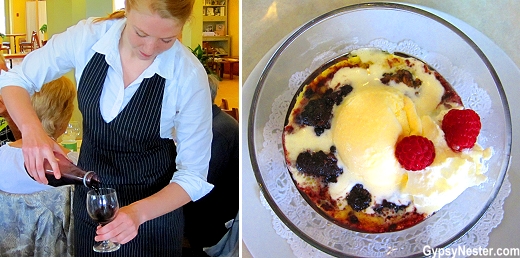
The first, päron, bönor och bacon, is well described as pears, beans and bacon with potatoes, but also includes the quote: “What gave grandma already to pears,” “vad var där för att Mormor redan.”
Our old friend Google tells us that this is a correct translation, but not of German, it is Swedish. We ask our server to explain and get no farther in our understanding, but order it anyway. If it’s good enough for grandma…
The other special, Labskaus, seems clear enough; mashed potatoes, corned beef, onions, beets, cucumber, egg and herring fillet.
But when we ask about this, the explanation takes a turn.
Yes – we should try it, it tastes good but it looks terrible. Her exact words were, “It looks like Scheiße.” We know just enough German to know what that means, but we order it anyway… and beer, just in case.
The dishes arrive and grandma, and our server didn’t steer us wrong.
The pears, cooked with bacon and green beans is certainly different and new, but really go well together.
On the other hand, the Labskaus does fit the description given, the meat being mashed into the potatoes gives it the not-so-appetizing look.
But it tastes good, like corned beef hash with a fried egg on top. Not sure what the herring is doing alongside, or the beets and gherkins. It’s almost like these are two completely separate dishes.
We are glad, as always, to add another couple of new local favorites to our epicurean adventure list, and we certainly aren’t leaving hungry. This might be a trend developing, with the weather turning colder — and us training norther — traditional winter comfort food is bound to follow.
Today we have a full travel day ahead of us, one that involves more than just trains, we have water to cross, so a boat will be involved.
The plan is to ride the train onto a ferry, then cross the Baltic Sea into Denmark.
David the Train Nut is ready to go!
Unfortunately, the conductor explains to us that due to construction on the tracks, we will have to board a bus to get on the ferry. Not quite as fun, but hey, we still get a boat ride nonetheless.
Any residual disappointment we may have had disappears instantly when the engineer, Thomas, invites us to ride in the cab for a while.
Seriously, how cool is this?
<–10 Second video: Click the pic – and David’s glee comes to life!
We are riding along the famous Vogelfluglinie, The Bird Flight Line, from Lübeck to Puttgarden in the cockpit of an Inter-City Express train. The line got its name from the fact that it is the straightest, shortest route to Copenhagen, and our stopping place for the night, Malmo, almost as the crow flies.
Nearing the ferry, we excuse ourselves to go back and gather our things, but Thomas stops us. He says we should wait until we cross the first bridge over the Baltic. Who are we to argue with the engineer?
<–10 Second video: Click the pic – and watch us fly over the bridge!
Heading to the bus for our ride to the ferry we bid farewell to Thomas, and Germany.
Watch: David the Train Nut is downright giddy!
What a great experience, some of our best training ever! (Gonna keep using it as a verb ’til we see if it catches on.)
Afternoon: Denmark by ferry!
Climbing up out of the truck-bus-train hold of the ship, we walk into what looks more like a shopping mall than a ferry.
Brightly lit duty-free shops attract quite the crowds of border-crossing shoppers, but our interest is more focused on getting outside to get a real feel for the crossing.
We aren’t the only ones crazy enough to be out on the deck on such a blustery day, but we are definitely in a select group of hardy sailors.
The Baltic Sea looks every bit as grey and choppy as we expected for a mid November morning.
<–10 Second video: The sea was angry that day, my friend!
The ship has quite the jammin’ looking buffet, but this is a narrow point in the sea, and we don’t want to be in a hurry to snarf down the delicacies, so we opt for a couple of danishes from the snack bar to toast our impending arrival in Denmark.
Yes, we know it’s cheesy… we mean us, not the pastries.
View from our (train) window: Denmark
Evening: Tired and happy after a great day training!
Back on board the train, we are rolling across Denmark and are now the farthest north that Veronica has ever been, beyond even the northern tip of Newfoundland.
There is still quite a way to go for David to top Fairbanks, Alaska though, but it is coming soon.
Once we hit Copenhagen, we stop just in time to run outside, snap a pic and catch the train to Malmo, Sweden.
<– The Copenhagen station
Time to crash before heading onward tomorrow. Stockholm, ba-by!
Day Five: Unique Stockholm
Morning: Training to Stockholm (a look at our life on the trains)
<–David (doing his best Vanna White) is going to show us around!
Our train to Stockholm has everything we could want – comfy seats, coffee, snacks, power outlets, and fast internet, all with a view of Sweden passing by our window.
Now that’s what we call first class.
Three seats across provide roomier seats and coffee, tea, fruit, and brownies (!) are included in first class
Good food (including seafood!) for purchase and free wifi (so we can post this!). And, yes, we couldn’t resist “Du surfar med full fart”
In order to get a quick taste of Stockholm we opt to walk from the train station over the Vasabron Bridge to Gamla Stan.
This small island is where Stockholm began, and we soon realize we are in a place like no other.
The old town has been preserved here, and our hotel is in one of the buildings that date back to the sixteen hundreds.
Evening: Spending the night with the captain!
The lobby
Every now and then we happen upon accommodations that are far above and beyond anything we could ever expect. The Victory Hotel is most definitely one of those places.
The collector is the hotel’s founder — and namesake — Gunnar Bengtsson, who over many years gathered an amazing amalgamation of artifacts, mostly focused on the torrid love story of Admiral Lord Nelson and his scandalous squeeze, Lady Hamilton.
Spoiled much? This was in our room when we arrived!
An authentic letter to Lady Hamilton from Admiral Nelson
Our host and Gunnar’s son, Mats, explained how, while he was growing up, the collection began to overtake the house.
Ship’s mastheads, antiques, and other assorted marine memorabilia was stuffed under the beds, in the closets, and almost every other nook and cranny.
His father’s solution was to start a hotel and decorate it with his treasures, so the Lord Nelson Hotel was born. But one hotel couldn’t contain the collection, and soon the Lady Hamilton and the Victory, named after Captain Nelson’s ship, were added to the family.
Each room is much more than just a place to stay for the night, this is lodging with a story to tell. They are all named for a captain, and feature paintings of his ship, family heirlooms, and pictures.
Our suite, honoring Captain Johansson, is filled with fantastic 18th century furnishings, wedding pictures, and original paintings dated 1642.
This doesn’t mean modern amenities are missing, flat screen TV, wifi, a stereo system, and best of all, a fully functional, absolutely phenomenal jacuzzi tub.
Day Five: Storming Stockholm (and an incredible amount of delicious seafood)
Morning: Royal shenanigans
For a whirlwind overview of Stockholm we meet up with our guide Marco, a font of Swedish knowledge, and set out on an early morning tour of the city.
Beginning by walking through the old town, we catch up on the history of not only the city, but also the country.
As with its Scandinavian neighbors, Denmark and Norway, Sweden is a constitutional monarchy. Kings have ruled here for at least a thousand years, but these days the actual political power is in the hands of parliament.
As we near the Kungliga Slottet, which is the Royal Palace, we get to see some of that royal presence when mounted guards escort dignitaries in horse drawn carriages inside for a meeting with the king.
There is a definite level of old-fashioned pomp and circumstance involved, as well as a surprisingly low key approach to security. Marco explains that the royal family regularly goes out in public without causing too much of a stir.
From the small island that contains the old, original city, we take a ferry to see an unbelievably preserved piece of Swedish history, the Vasa.
The two hundred-foot ship sank while still in Stockholm’s harbor, just a mile into its maiden voyage in 1628.
Incredibly, it sat submerged and undisturbed for over 300 years.
King Gustavus Adolphus’ desire to have the biggest, baddest ship on the sea was the vessel’s undoing.
By adding an additional deck of canons without offsetting the weight below the water line, the design was badly flawed and the top-heavy ship rolled over and sank within a few minutes of launch.
In 1961, salvage efforts were undertaken, and now the remarkably undamaged ship stands almost entirely intact in the Vasa Museum. The only parts to suffer much from the centuries under water were the nails, so they have mostly been replaced.
Afternoon: An amazing time capsule and seafood to die for!
From the Vasa Museum, we hop on a tram using our Stockholm Card and enter into another time capsule of sorts, a perfectly preserved mansion from the gilded age of the 1890s.
Built for the Count Walther von Hallwyl and his wife, Wilhelmina, everything has remained virtually untouched.
This was completely intentional; the countess had a system of cataloguing every household item that she employed almost immediately upon moving into the home in 1898.
We aren’t talking about just the valuable stuff either, Wilhelmina had volume after volume filled with details numbering, photographing and identifying every single thing in the house.
Her eccentric obsession, possibly what we would call OCD today, makes for a remarkable glimpse into life of the aristocracy over a century ago.
She even left the rooms “as is” and covered many of the tables and desks in glass cases so that nothing would be disturbed.
For a look at how Swedes shopped and ate back in that same era, and for a quick bite of lunch, we walk over to the nearby Östermalm Food Hall.
This covered market served as the supermarket for the city back at the end of the 1800s, with farmers and fishermen bringing in their products fresh every day.
For some inside scoop we met with Johan, from the shop and restaurant Lisa Elmqvist.
Lisa began selling seafood here nearly one hundred years ago, and for four generations her family has continued.
He shows us all of the fresh fish offerings and gives us an idea of the logistics behind the scenes.
After looking over all of the offerings, Johan suggests we try a couple – he didn’t have to ask twice.
We start with a sample their signature dish, Toast Skagen with bleak roe, which is high on the list of the best things we have ever put in our mouths.
Wow, this combination of shrimp, dill, and caviar, well, let’s just say we see why the king himself is a frequent customer.
We follow up with mouth-watering, salt-cured salmon and a creamy fish soup with trout roe, which are certainly not shabby themselves, but the shrimp on the toasted bread has spoiled us forever.
We may never be the same. It will haunt our dreams.
OK, OK, so that’s a little over the top, but seriously… royally good.
One thing we learn while walking around Stockholm is that it is a world leader in high tech development and cutting edge companies.
Spotify, Skype, IKEA, H&M, and Ericsson all began here.
So we decided to step into the modern and take a ride to the top of the world’s largest spherical building.
That would be the Ericsson Globe, an amazing arena that has a couple of much smaller glass globes that travel over four hundred feet up to the top of it known as SkyView.
We step inside one and it climbs right up the side of the sphere.
We are immune to any queasy feelings about the ride up, being mostly mesmerized by the view, and when we reach the top we have a 360 degree panorama of the entire city.
But the trip down is a different story.
When we head over the edge it feels something like a slow motion roller coaster.
We must not have been looking down much on the ride up so we didn’t notice, but being suspended on the side of the globe, nothing but air beneath us feels pretty darn unnerving.
But hey, that’s part of the fun, everybody likes a little scare now and then, and soworth it for the view.
It is hard to comprehend how much we have seen and done in one day in fabulous Stockholm, but we still have one big event on our schedule.
One thing we had been looking forward to since we first looked into visiting Stockholm was trying a real traditional Swedish smörgåsbord.
By all accounts, the place to partake is the renowned Grand Hôtel.
It’s a very extravagant setting for what originally was not particularly fancy fare.
The idea behind a smörgåsbord has a more humble background. The name is a combination of the words smörgås, meaning sandwich, and bord, which means table, but in practice there is a whole lot more than sandwiches going down.
In fact, there is an entire method to properly approach the smörgåsbord which our server kindly walks us through before we take our first bite.
Most important, we were told not to pile too much on the plate at one time. Using many plates is not being piggy; it is expected, perhaps even mandatory.
Each group of delicious delicacies requires separate attention — and china. We begin with the cold dishes, first a section of herring prepared several different ways, each with a sauce as a sidekick.
YOUR TURN: HAVE we gone completely off the rails? Would you embark on a journey like this? How much trouble is David going to be in if Veronica doesn’t get to see the Northern Lights?
One of many interesting aspects of Amsterdam that we noticed upon
arriving were the colorful houseboats lining the canals – there are
about 2,400 of these semi-seafaring gems docked along the walls of the
city.
We were overjoyed to have the opportunity to stay on one of them during…CONTINUE READING >>
Thanks to I Amsterdam and and Amsterdam Book Now for hosting us on our beautiful houseboat on the Amstel River! As always, all opinions are our own.
The view from our porthole!
One of many interesting aspects of Amsterdam that we noticed upon arriving were the colorful houseboats lining the canals – there are about 2,400 of these semi-seafaring gems docked along the walls of the city.
We were overjoyed to have the opportunity to stay on one of them during our visit.
Our hostess, the affable Myra, explained that boats have been used to ferry goods throughout the canals since Amsterdam’s conception, but it wasn’t until the 1960s and 70s that utilizing boats exclusively for a residence really caught on.
“It was a bit freer back then, more of a hippy culture. People just brought their boats into the city and lived, sometimes communally, on them – often simply bathing in the canals. These days, the city has gotten involved and it is more regulated.”
This regulation means a limit to the amount of boats in the canals, and the houseboats are charged by the meter for docking space.
The upside is that for these fees, Amsterdam houseboat owners have access to city water and sewage – and a place to have mail delivered.
As the lifestyle became trendy, money followed, and soon the “WaterYuppies” moved in, though Myra takes issue with the nickname.
“Most of the people living on the houseboats still appreciate the freer, more bohemian lifestyle. Many of my friends are artist and entrepreneurs – and enjoy working on their vessels themselves. There is quite a bit of work to do on a daily basis when living on a steel ship.”
This is evident in the way Myra lives herself.
She resides in the front part of her 28-meter, circa 1910 historic tjalk (a cargo ship traditionally used on the canals) while renting out the aft as a bed and breakfast.
Since purchasing her tjalk, she has renovated and beautifully redesigned the entire interior herself.
Sitting out on our private aft deck, we had breathtaking views of Amsterdam. Flanked on one side by the Opera House…
…and on the other the famous Skinny Bridge, named — not for its present width — but for the original bridge built in 1691 by two sisters who lived on opposite sides of the river.
Wanting to visit each other, but not having the means to build a proper bridge, it was said to be too skinny for people to pass one another while crossing.
And lit up at night, it’s one of the most romantic spots in the world.
The houseboat served us well during our short stay. If you are in the city for longer and want to check other accommodation options, go to HousingAnywhere.com!