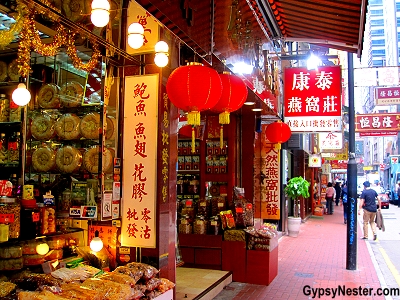
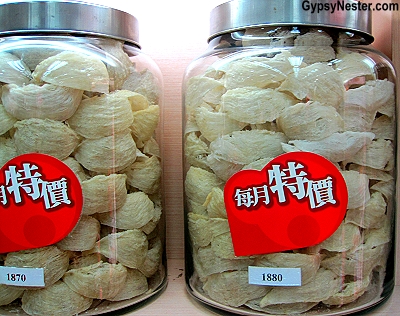
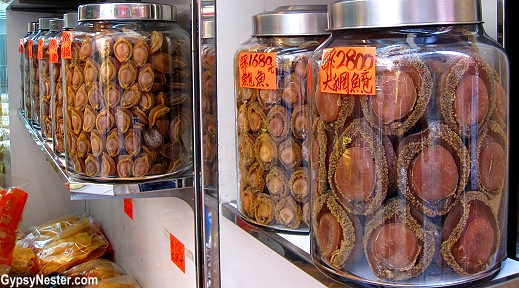
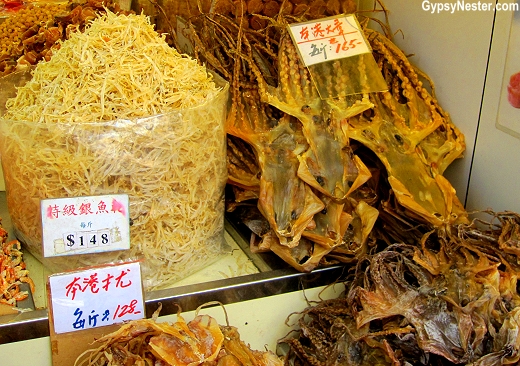
Famous for ancient Chinese medicines, traditional herbal remedies, and tonic foods such as $5,000-per-pound bird’s nests, Hong Kong’s Wing Lok and Ko Shing Streets are bursting with wonderful oddities.
And trust us, that’s the tame stuff!
The life expectancy in Hong Kong is among the highest in the world, so who are we to argue? Click in to see some truly incredible wonders… CONTINUE READING >>
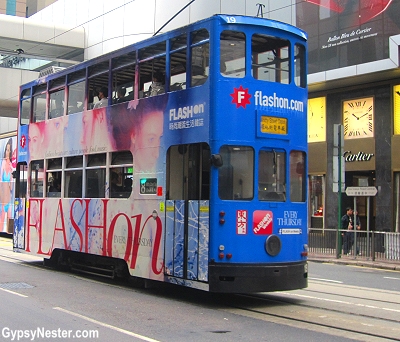
A whole fleet of double decker street cars rolls endlessly back and forth along the north shore of Hong Kong Island, which is the most bustling part of the city.
The trolleys are affectionately known as “ding dings” for the bells they seem to be constantly ringing.
Because the fare for these wonderful old trolleys is also a mere pittance, we jumped on and off several times, whenever something caught our eye.
Toward the western end of the line, we bailed out at Queen Street.
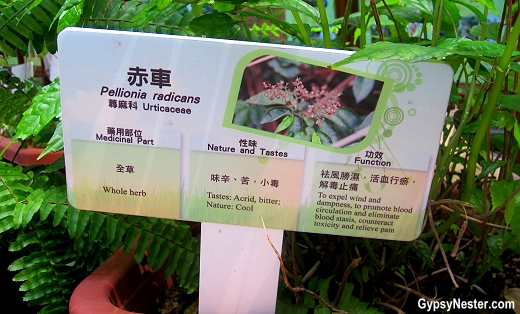
This area is famous for ancient Chinese medicines, traditional herbal remedies, and tonic foods such as ginseng and bird’s nest.
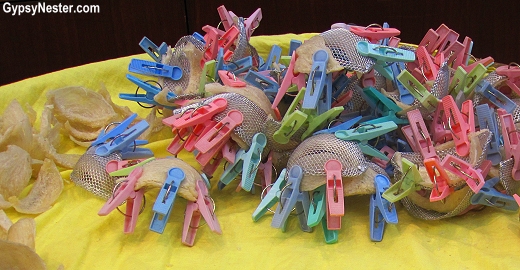
Shaping the bird’s nests
These are real nests, taken from swiftlets, and can cost up to $5,000 a pound.
Needless to say, we did not make a purchase.
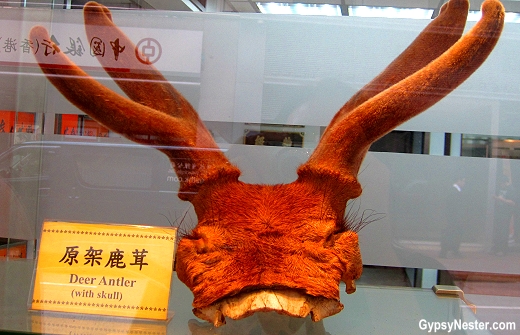
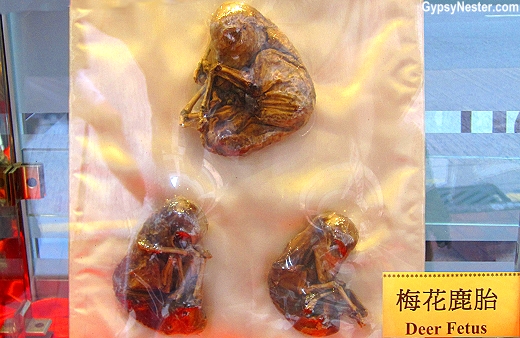
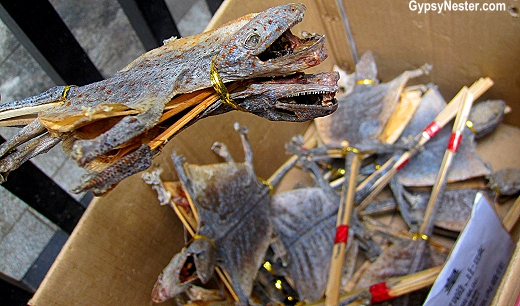
We wandered up and down Wing Lok and Ko Shing Streets looking into shop after shop filled with strange and exotic items that are believed to promote health, vigor, and long life.
Deer Antler (with skull)
The life expectancy in Hong Kong is among the highest in the world, so who are we to argue?
This glossary of modern parenting terms from around the world provides a cautionary tale through definitions. Could a Snow Plow Parent accidentally raise a Kidult in a perpetual state of Adultescence?
Snow Plow Parents
Like the snow removal apparatus, a Snow Plow Parent will be sure to… CONTINUE READING >>
This glossary of modern parenting terms from around the world provides a cautionary tale through definitions.
Could a Snow Plow Parent accidentally raise a Kidult in a perpetual state of Adultescence?
Snow Plow Parents
Like the snow removal apparatus, a Snow Plow Parent will be sure to clear the path ahead, ensuring nothing will challenge their children’s happiness.
Creating an obstacle-free world allows their child to dodge all the pitfalls and challenges that are necessary for molding responsible, competent adults.
Helicopter Parents
Veronica considers herself a recovering Helicopter Mommy, so we know all about these guys. Helicopter Parents hover over every aspect of their children’s lives, micromanaging every move they make. From arranging highly-scripted toddler playdates to writing their college-aged spawn‘s term papers, the Helicopter whirlybird is ever present.
Also known as Hovering Mothers, Smothers
Boomerang “Kids”
Like the Australian hunting stick, Boomerang Kids return to the place they’ve been thrown from. Initially the term described kids returning home after being away at college, but has broadened to any able-bodied adult offspring who lives with his/her parents. We do, however, have some tips for nudging them from the nest!
Also known as Parasite Singles in Japan, Bamboccioni (Big Babies) in Italy, Nesthockers in Germany (referring to birds with their mouths open, waiting for Mommy to feed them) and Basement Dwellers
Parasite “Kids”
The Boomeranger returns home to rely on its host for room, board and Mama’s cooking, but the Parasite “Kid” will eventually kill its host by latching on and sucking the nest egg dry while living on its own. It’s long-distance leeching, in a manner of speaking. These bloodsuckers have gotten it into their heads that their parents’ job of funding them never ends.
Also known as KIPPERS (Kids In Parents’ Pockets Eroding Retirement Savings) in England and Australia, and Trustafarians (kids living on parents’ trusts whilst dressing up and pretending to be Rastafarians) in The Virgin Islands
Hotel Mama
A place the Boomerang “Kid” calls home in Germany. Comes with parental housekeeping.
Kidult
Neither kid nor adult, or possibly both kid and adult. A new life phase between the teen years and true adulthood, the Kidult has a few more years to mess around, avoid a real job and all the pesky life lessons of one’s early twenties. It’s basically an extension of the teen years with the ability to legally drink. What could possibly go wrong?
Also known as Twixters. Similar:NEETs (Not in Education, Employment or Training) in England, Ni-Nis (ni trabaja, ni estudia — neither work nor study) in Spain and Mexico
We work hard on keeping our relationship fresh (to varying degrees, of course!) and continue to try new things together.
But sometimes a girl’s gotta get away.
One of many stage shows – aren’t they the CUTEST?
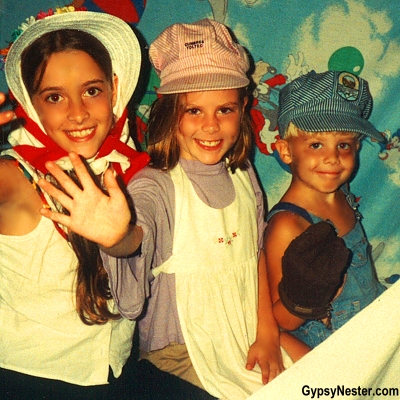
When the chicks were in the nest, our family was very girl-centric.
Our daughters, The Piglet and Decibel, are very dynamic people and, if we weren’t careful, they would overshadow their more reserved younger brother, The Boy.
The men in our family were outnumbered and, many times, outmatched.
When the girls graduated from high school and struck out on their own, I found myself in a whole new world. Sports were — more often than not — blaring from the TV, scores and stats that I didn’t understand (or, frankly, had no interest in) were bandied about until I was blurry-eyed.
I’m so glad that David and The Boy had that bonding period; it did them both a world of good.
But I did feel lonely. I missed my estrogen-infused days, when we girls ruled the roost (that’s a little heavy-handed, but we were, as team, a force to be reckoned with!).
Once David and I sold the nest and hit the road, we became very focused on rekindling our relationship, our Nation of Two.
Until that point, raising The Spawn to be happy, healthy, productive adults became our main focus in life and had been – and always will be — our greatest achievement.
But we had half a lifetime stretching out before us and if we didn’t get off of our butts and get to working with each other, that second half could become an ugly eternity. So we got to working.
But sometimes a girl’s gotta get away.
Now we are six years into our grand GypsyNesting experiment, and we are currently in The States traversing the now familiar family-and-friends route.
We’re making frequent trips to NYC to horn in on the girls, and spent a month near The Boy before he made his big move to Alaska. We’re spending time with our parents and siblings, and seeing a lot of our friends.
I’ve realized through these visits that I miss my girlfriends more than I had thought. Sure, we talk on the phone, and sure we banter on Facebook, but having my gals around me in person is not always so easy to do.
And forget about that big, nurturing group of ladies I used to have – now that our nests are all empty, many of us have relocated, or taken on jobs with more responsibly or — gasp — found a new group of friends. How dare they not wait around for me!
Ann Voorhees Baker
And then, in steps Ann Voorhees Baker who invites me to be her guest at Women At Woodstock.
When she first brought up the idea, I literally thought UGH.Is a women’s retreat for me?
It didn’t sound like my thing – at all. Then I looked into Women At Woodstock a bit further and became intrigued. I was first compelled by the locations (imagine that!), but was hooked when I saw the workshops.
This Ann V. Baker lady’s pretty wily and she knew how to hook me! I’m always looking to beef up my writing skills, so the writing workshops are really exciting to me, and the business stuff looks invaluable.
But, oddly enough (and I hate to admit this) it was the estrogen-infused events that made me accept the invite.
Obviously, I need some girl time, STAT.
Come join me and let’s get our girl on! I’ll be at the Woodstock, NY retreat on October 13th, 2014 and there are later ones in Palm Springs, CA and Charleston, SC.
As with everything about life in Newfoundland, the food revolves around the sea.
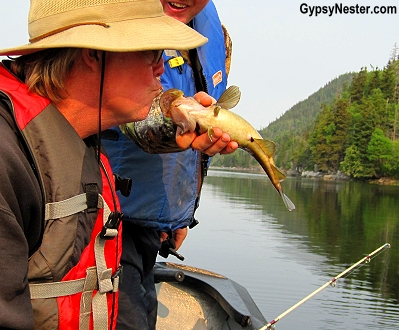
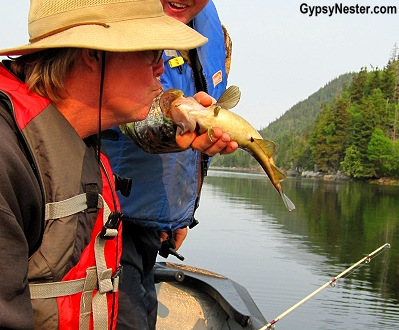
<– David kisses a cod!
In fact, seafood is the main reason that settlers from Europe came to the island in the first place.
See all the wonderful ways Newfoundland prepares the catch of the day!… CONTINUE READING >>
Yes, David’s kissing a cod! More on this later, read on…
As with everything about life in Newfoundland, the food revolves around the sea.
In fact, seafood is the main reason that settlers from Europe came to the island in the first place.
Just five years after Columbus sailed the ocean blue, King Henry VII of England sent the Venetian explorer Zuan Cabotto in search of new lands to the north of Christopher’s discovery.
The captain, better known by his English name of John Cabot, came upon Newfoundland and wrote, “the sea there is full of fish that can be taken not only with nets but with fishing-baskets.”
Those fish were cod, and cod became the backbone of the economy, as well as the staple of the diet. It was only fitting that we would dive right in to some cod on our very first night.
How Many Ways Can You Cook a Cod?
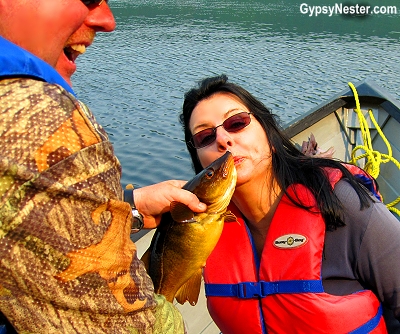
Before dinner we heard stories about the fabled fish, some involving kissing them. Well, we can truthfully testify that not only will a Newfoundlander kiss a cod, they aren’t shy about using some tongue.
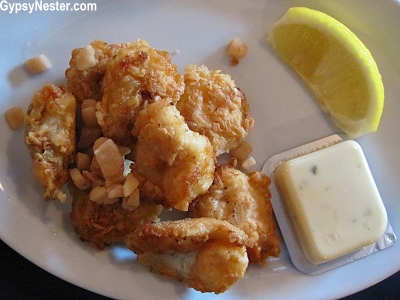
Cod tongue was our appetizer, and the first bite of food we consumed on the island. Fried tidbits straight from the fish’s mouth, served with scrunchions; deep fried bits of pork fat.
The tongues taste like cod, with a very slight gelled consistency. And everything’s good with a little pig fat on it… so down the hatch.
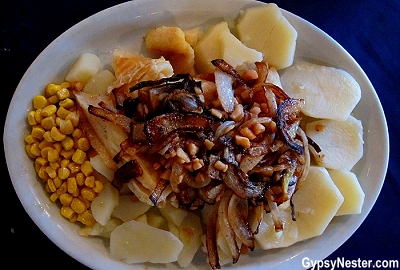
We were starting to feel like real live locals, so we ordered up the Fisherman’s Brewis for the main course.
This was a slightly fancier version of the Newfoundland classic Fish & Brewis, which consists of salt cod and hardtack, boiled, broken up, and mixed together.
The embellished variety we found at the St. Christopher’s Hotel in Port aux Basques was dressed up with potatoes and corn, and a handful of scrunchions for added flavor.
There was none of that on the traditional plate we found a few days later, but either way, it tastes way better than it sounds… or looks.
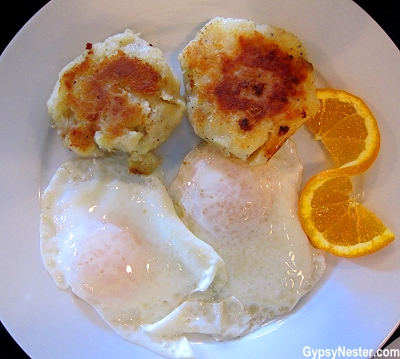
Just in case we hadn’t had enough the night before, breakfast was focused on the fish too, cod cakes and eggs.
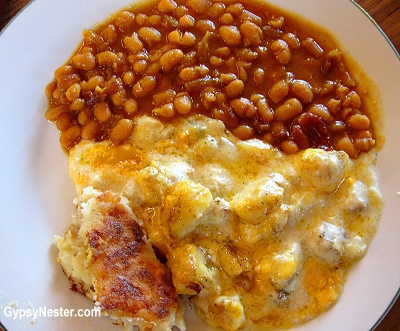
Then at lunch with Paul and Ruth Gale at Pirate’s Haven was another Newfoundland favorite, cod au gratin.
We are happy to report that all tongues stayed in their mouths, and the fish were set free.
We were finally going to eat something other than cod! Don’t get us wrong, — we love it — but as non-Newfoundlanders, our bodies craved a little variety.
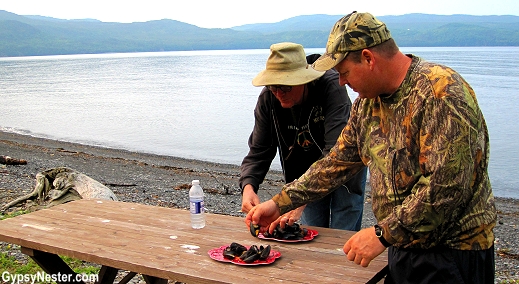
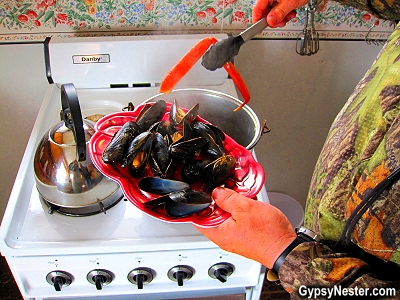
Darren grabbed a bucket of mussels he had gathered nearby and scooped some water from the bay into it. At low tide, he simply walks along the shore and picks the shellfish up.
Toss in some fresh snow crab, give it a few minutes on the stove, and we were ready for a feast.
This was the first of several times that we would eat a meal fit for the finest gourmet restaurant while sitting at a picnic table by the water’s edge.
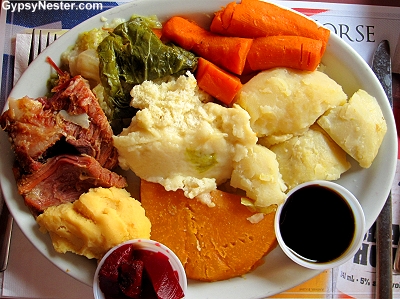
At some point we had to eat something other than seafood, and we finally found a time-honored alternative at an establishment with an unlikely name, Fisherman’s Landing in Gros Morne National Park.
The special of the day was Jiggs Dinner, which features salt beef, and is kind of like a Newfoundland version of the good ole Irish corned beef and cabbage. Jiggs Dinner includes carrots, turnips, and pease pudding — a pudding in the British use of the term.
Made from split yellow peas and cooked in a pudding bag along with the rest of the ingredients, it is almost like a dumpling.
All we know is that we got downright jiggy with it.
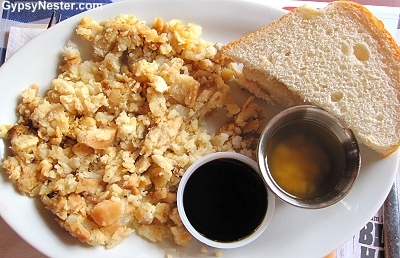
The Non-Fancy Version of Fish & Brewis
Of course fish was also prominent of the menu, and this is where we found the more traditional Fish & Brewis,
Both of the dishes date back to the days before refrigeration, so they are based on easily kept ingredients like salted meat, root vegetables, and dried bread or hardtack.
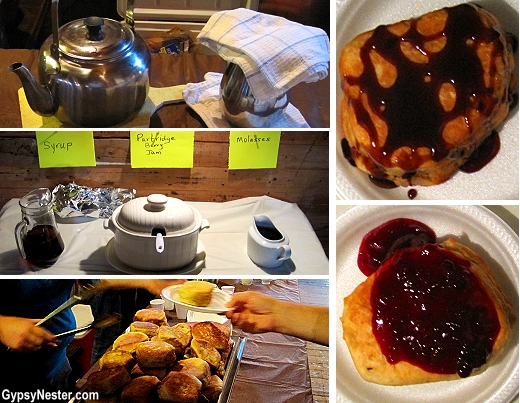
Between sets of homespun humor and harmonies by this group of women who have been entertaining for over twenty years, we tried toutons, a traditional fried bread accompanied by molasses or partridge berry jam.
After our break from seafood we realized that we had not sampled the island’s most popular non-cod offering from the water, lobster.
They are so common in the area around Twillingate that folks remember it in their lunch boxes as children. Some say they actually got sick of it, like we did bologna or PB&J sandwiches!
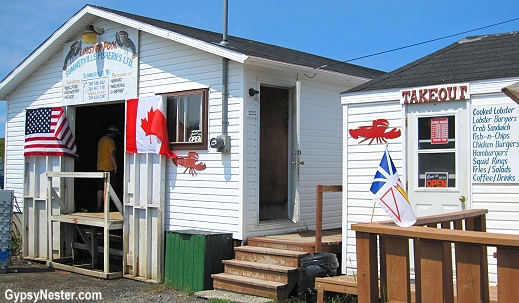
There are signs all along the roads advertising lobster pools, so we stopped off to check one out.
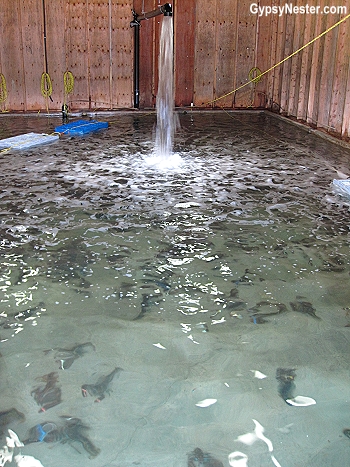
The name is quite accurate, think swimming pool filled with lobsters, hundreds if not thousands of them just waiting for someone from a restaurant or store to haul them away.
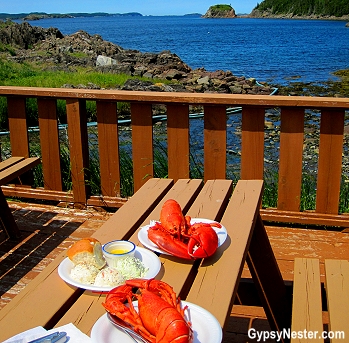
As a sideline, and happily for those of us who are not sick of lobster, most of the pools sell steamed lobsters to curious wanderers like us.
We picked out a couple of beauties and settled in at a picnic table on the shore.
No five-star establishment could have been better – and the view was unbeatable.
Of course food is not the only thing consumed in Newfoundland, libations have a long history too.
Distilled spirits played a big part in the early fishing trade as salt cod was shipped down to the Caribbean and rum made its way back up.
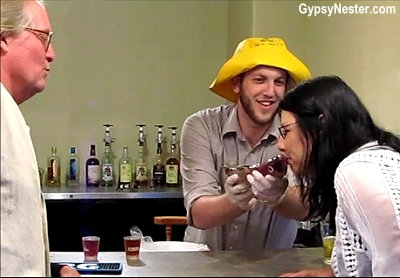
One of the most common types became known as Screech, allegedly for the sound a person makes after downing a shot.
Somewhere along the way “Screeching In” took hold as a way to induct folks who “come from away” but would like to become an honorary Newfoundlander.
This is a revered practice on the island, and as such must be performed properly by a registered screecher.
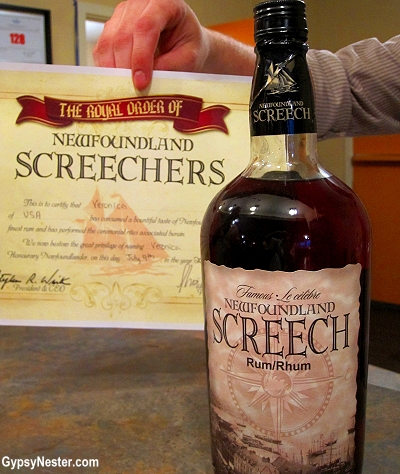
After a week or more crisscrossing the land we felt pretty close to real live locals, so we took the plunge, and the pledge. With a shot of Screech and a kiss of another cod, we were initiated.
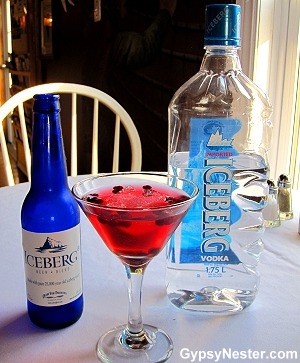
We would never dream of tampering with tradition, but we did wish that perhaps one of the island’s iceberg infused beverages could have been substituted for the Screech.
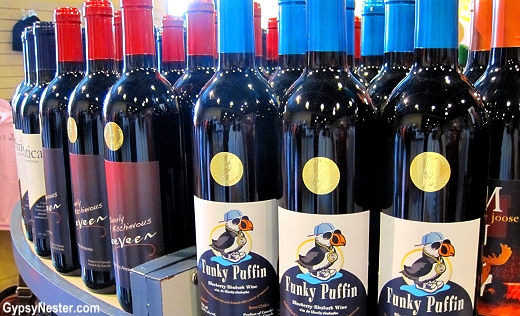
Resourceful captains have created a cottage industry of harvesting the bergs, hauling them ashore, and selling the pristine water. The Auk Island Winery is even using it to make wine.
The Elusive Moose Strikes Again
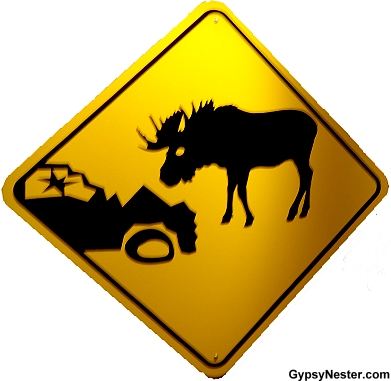
“Moose” sign
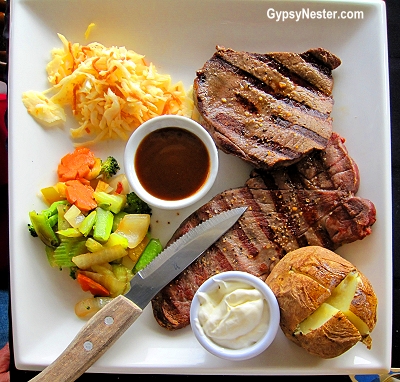
We were definitely noticing that land animals were rarely found on the bill of fare in Newfoundland, so when we saw moose steak on the menu at Chucky’s Seafood and Wildgame Restaurant in the town of Happy Adventure.
We figured we ought to take advantage of the opportunity.
One problem, moose are supposed to be thick all over the island — warning signs for motorists are everywhere — but the only time we got a good look at one was on our plate.
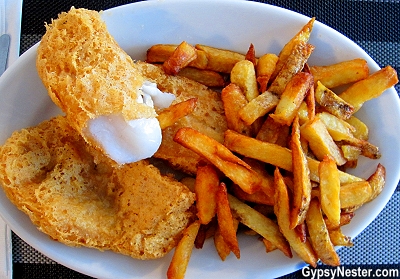
Our last meal on the island was one of the best, a park ranger at Cape St. Mary’s Ecological Reserve recommended the nearby Gannet’s Nest restaurant for the best fish & chips in Newfoundland.
He was most certainly right about the restaurant, fantastic fresh, crispy, lightly breaded fish right out of the nearby water. So we began and ended with cod, the Alpha and Omega of gastronomy in Newfoundland.
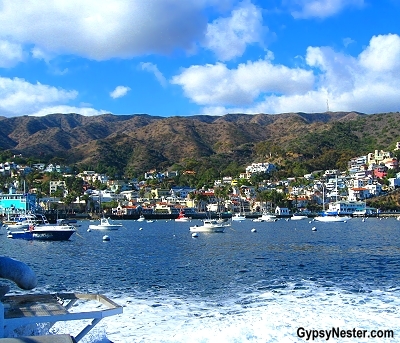
Like the early Californian explorers, we approached Catalina by boat.
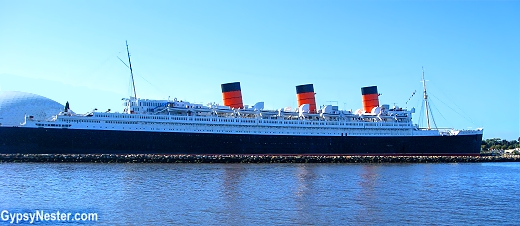
Steaming out of Long Beach Harbor past The Queen Mary, we were intrepid sailors in our air-conditioned, high-speed ferry complete with snack bar, lounge and cinematic classic on the big screen.
“A rose by any other name…” No doubt ol’ Bill Shakespeare didn’t know Catalina from Capulet but the little island off the coast of California sure has had its share of monikers. The Tongva, dating back to 7000 BC, lived on the island and called it Pimu.
Portuguese explorer and serial-California-stuff namer Juan Rodriguez Cabrillo dubbed it San Salvador in 1542. In 1602, Spain rechristened it Santa Catalina. Today, it’s Catalina Island or just plain Catalina.
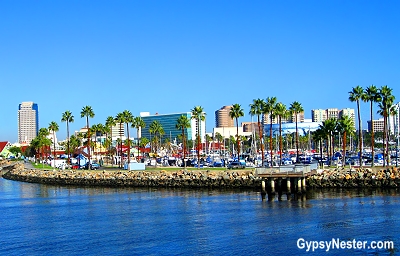
We sailed past the Queen Mary in her permanent birth in Long Beach.Long Beach from the water.
Like those early explorers, we approached Catalina by boat.
Steaming out of Long Beach Harbor past the Queen Mary we were intrepid sailors in our air-conditioned, high-speed ferry complete with snack bar, lounge and cinematic classic on the big screen.
Arrrgh, the briny deep, matey.
Upon disembarking by gangplank we noticed that there were cars and trucks on the roads.
WHAT?
Isn’t Catalina famous for not having any cars?
It was our understanding that this sort of vehicle was not welcome on the island.
If there’s a ban, it’s one loosely enforced sucker.
Let’s say that cars are discouraged.
The island is fairly large — over twenty miles long — so practicality dictates that some motored vehicles are necessary.
There is limit on the number of cars allowed on Catalina at any given time, creating a ten year-ish long waiting list for the privilege.
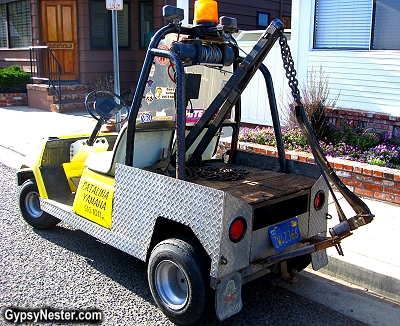
So folks wait and drive golf carts.
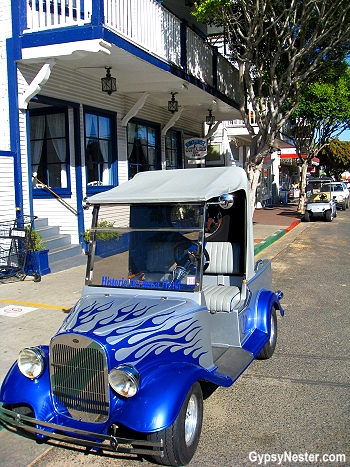
Give a human any sort of vehicle and they will inevitably trick it out.
Kids add bells and streamers to their bikes, threading playing cards in the spokes for some acoustical flair.
Teens will fire-ball paint their heaps and sport glass packs, chrome pipes and hot rims or, nowadays, an ear-bleeding stereo that could easily serve as a sound system for an AC/DC concert.
Midlife crisis guys get cherry red painted rag tops and Catalina folk have their golf carts.
Where do they find these pint-sized chrome wheels and accessories? Is there a “pimp your golf cart” web site out there somewhere?
Feeling rather inadequate on our non-tricked out bikes, we nonetheless forged ahead having brought them with us on the ferry.
Catalina is bike-friendly; however, the hills are not friendly at all.
It was easy enough to ride around Avalon, the island’s only town, but level ground is nearly nonexistent everywhere else.
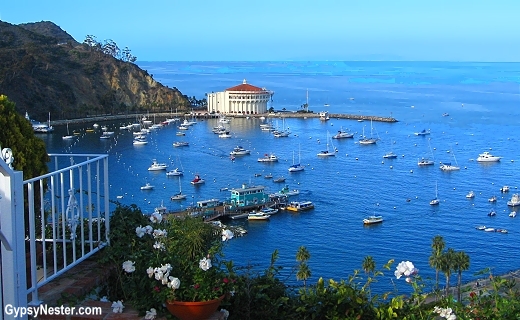
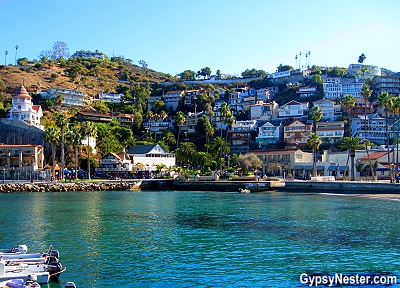
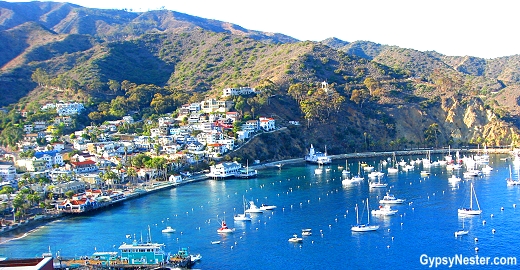
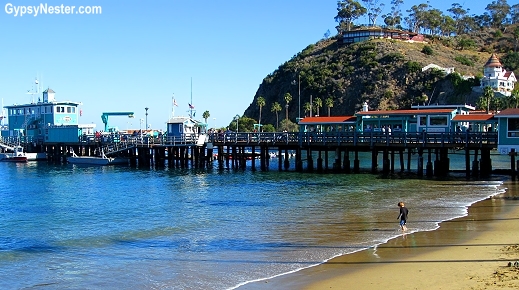
Almost all of the 3,700 residents of Catalina reside in Avalon, crowded in a semicircle around the harbor.
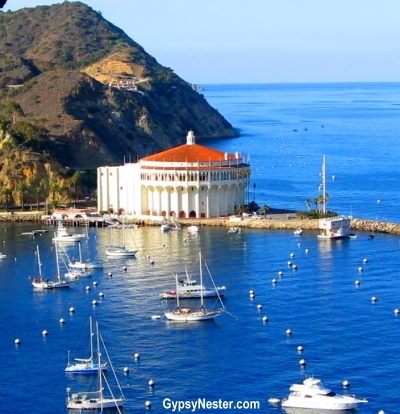
The bay is lined with restaurants and shops and dominated by The Casino – no, not a fine establishment filled with gentleman in tuxes and gaming tables, a casino as in the formal definition.
From the Italian, casa, meaning house, a casino is a building for housing civic functions like concerts and dancing.
So we weren’t off the hook in the gentleman department.
Civilized, it is.
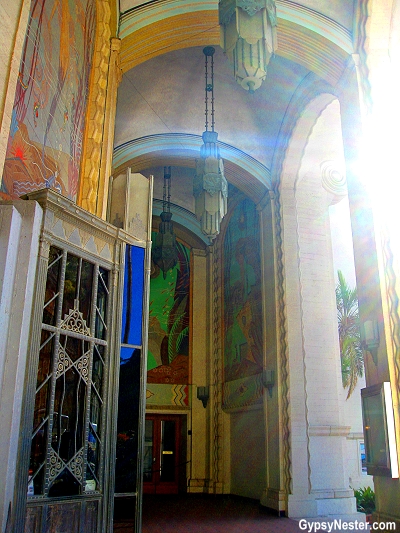
The beautiful twelve-story high, round Art Deco structure juts majestically into the sea and includes the world’s largest circular ballroom on the upper level.
Score! We love us some world’s largest stuff!
And this one was so unexpected.
The lower portion is the 1,184 seat Avalon Theater that is still showing those newfangled moving pictures, talkies even.
The Casino and many of the island’s other most prominent structures were built in the 1920s by chewing gum magnate William Wrigley, Jr.
After buying the Santa Catalina Island Company in 1919, plans immediately began to promote Catalina as a tourist Mecca. The gum man even purchased two ships to ferry folks out to his friendly little Shangri-La.
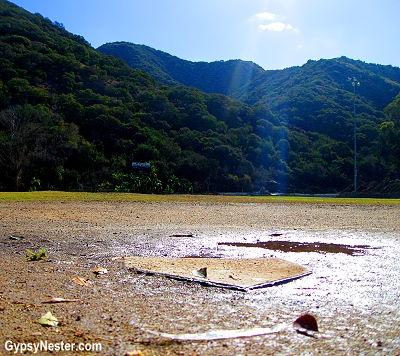
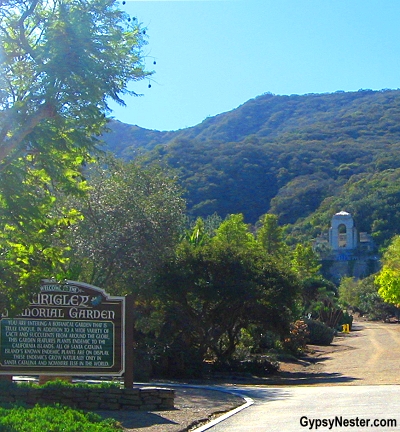
We rode our trusty bikes up Avalon Canyon Road, passing the site where Cub Spring Training was held from 1921 to 1951, to the Wrigley Memorial and Gardens. Wrigley also happened to own the Chicago Cubs.
Home plate at the Cub’s old training field.
He made the decision to have the Cubbies spring training on the island — and it must have put some pepper in their play as it was during that time that they won their last pennant.
Hmmm… rather than blaming the Curse of the Goat, the Cubs should hightail it back out to Catalina.
‘Cause, damn, it’s just getting embarrassing.
A 130-foot high memorial was built to honor Wrigley after his death in 1932 and the surrounding thirty-eight acres were set aside as a nature conservatory.
Pedaling up the steep road was a slow go — the passing golf carts seemed to whiz by at a rubber burning 15 or 20 miles per hour.
Nothing like a rented souped-up golf cart to bring the inner wild man out in a tourist — we had to smile every time a laughing bunch zoomed by as we labored.
At the top we took a break to enjoy the view and the many examples of flora and fauna preserved in the gardens.
Living harmoniously with the indigenous island animals are celebrity bison. These burly buggers were brought over for a movie in 1924, left behind, and now thrive in the preserve.
The Wrigley Memorial Garden Foundation places special interest on protecting the native endemic plants Catalina Ironwood, Catalina Mahogany, St. Catherine’s Lace, Catalina Live-Forever, Catalina Manzanita, and Catalina Bedstraw.
These species don’t grow any place else on Earth.
A breathtaking panoramic view spread out before us as we coasted back down the canyon road — giving the old brakes quite the workout.
By the time we reached Avalon the shoes were smokin’ so we dismounted and strolled the waterfront and The Green Pleasure Pier.
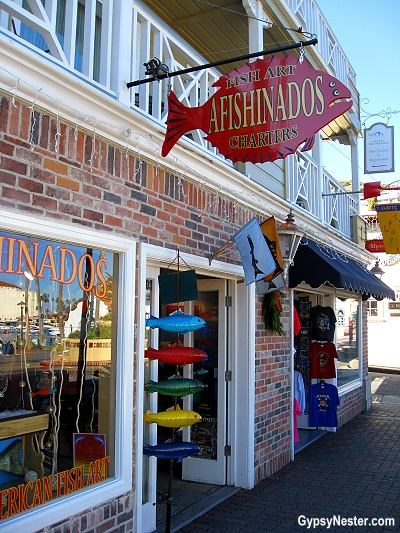
The pier is the place to find tour boats, glass bottomed and otherwise, grab a bite, shop for fishy souvenirs or just soak up some sun.
Content with solar soaking, we whiled away the remainder of the afternoon listening to the waves lap at the sand, the gulls calling overhead and the puttering electric hum of golf carts.
Widely heralded as the birthplace of the Renaissance, Firenza is the center of Italy’s art universe, and home to many of the world’s greatest masterpieces.
Florence has treasures that could take days, weeks, months, years, or perhaps a lifetime to fully explore… CONTINUE READING >>
We hate to say it, because Florence has treasures that could take days, weeks, months, years, or perhaps a lifetime to fully explore, but we were going to attempt to absorb as much of the historic capital city of Tuscany as possible within the confines of one day.
We should add that we had an assist from the tour office of our ship, The Royal Princess, docked in nearby Livorno. Joining their group provided invaluable information and allowed us to skip the lines at the museums.
Widely heralded as the birthplace of the Renaissance, Firenza is the center of Italy’s art universe, and home to many of the world’s greatest masterpieces.
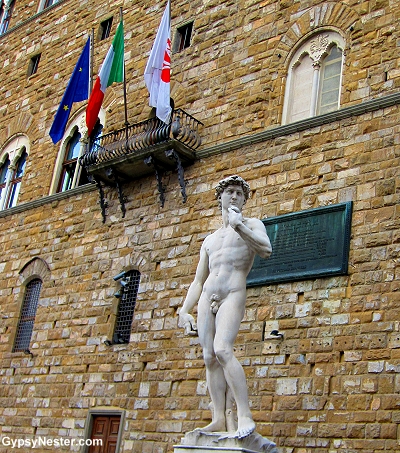
If there is one must see work among those, it would have to be Michelangelo’s David, so that is where we started our day. The sculpted giant slayer stands seventeen feet tall in a special rotunda at the Galleria dell’Accademia.
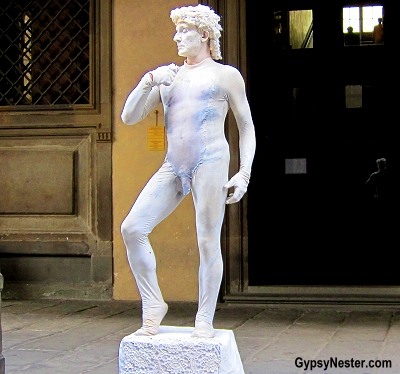
NOT the real David.
At only twenty-six years old, Michelangelo transformed a huge block of stone — that most had deemed unworkable — into this marble miracle.
Unfortunately photographs are not allowed, so there was nothing to do but stare for as long as possible hoping to permanently imprint the image onto our brains.
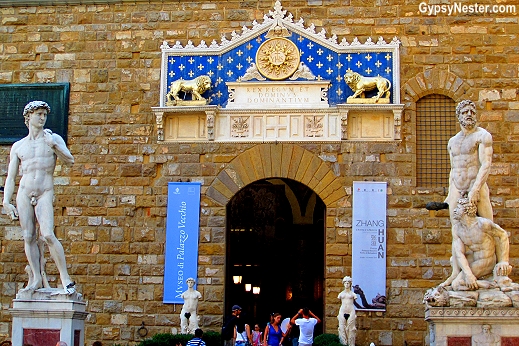
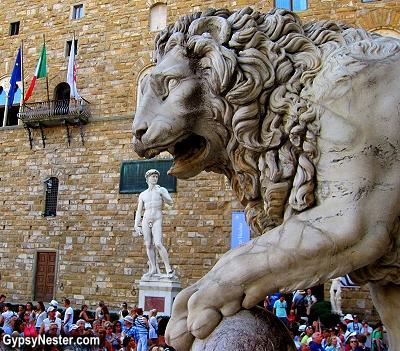
We did get a chance to snap a few shots later, when we saw the statue’s original location in the Piazza della Signoria. A respectable replica now stands in the spot, since the authentic David was moved inside for protection in 1873.
The Accademia is home to many other incredible works we would have loved to linger over but, unlike The Rolling Stones, time was not on our side.
We had to make tracks if we were going to accomplish a respectable overview of the city in our allotted time, so we headed for the focal point of Florence, the Piazza del Duomo.
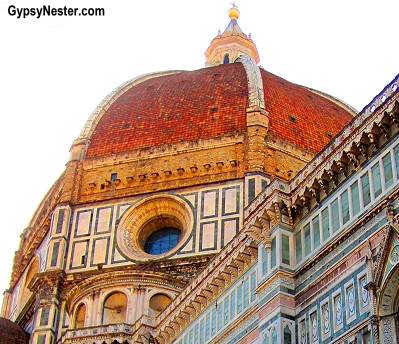
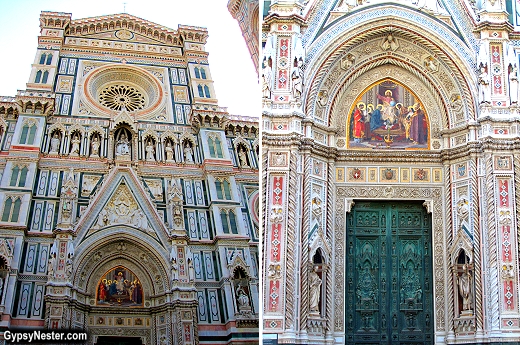
The plaza is dominated by the Basilica di Santa Maria del Fior, or Basilica of Saint Mary of the Flower, which is the main church of Florence.
Work was begun in 1296 and ended one hundred and forty years later with the finishing touches on what is still the largest brick dome ever constructed.
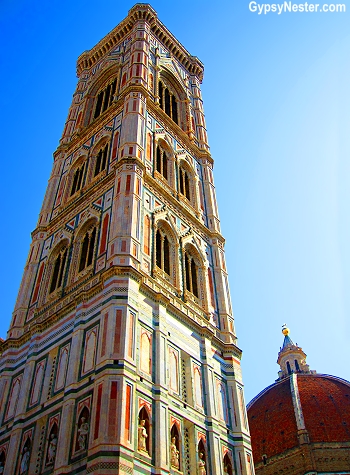
Remarkably, the duomo may not be the most impressive structure in the plaza, Giotto’s Campanile towers above it, nearly three hundred feet high.
The colorful exterior of green, pink, and white marble panels matches the façade of the basilica.
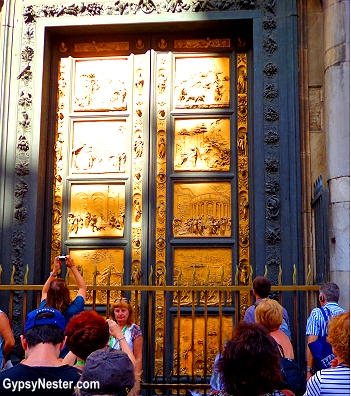
Still, the most notable work in the piazza isn’t on either of these buildings, it is on the doors of the nearby baptistery.
The Baptistery is one of the oldest buildings in the city, dating back to 1059, and is renowned for the notable Renaissance figures who were baptized here, including the poet Dante.
The east doors
But even more impressive are the bronze reliefs on the doors. The south doors, sculpted by Andrea Pisano, depict scenes from the life of St. John the Baptist and the eight virtues of hope, faith, charity, humility, fortitude, temperance, justice and prudence.
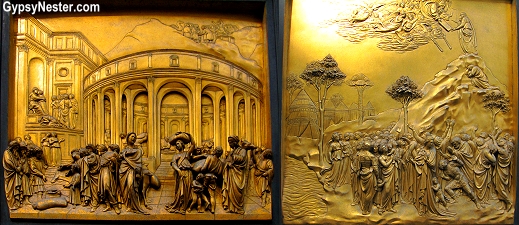
These are without a doubt some of the finest bronze work we could ever hope to see, but it is the east doors, created by Lorenzo Ghiberti, that draw the most attention.
Joseph Sold Into Slavery and Moses and the Ten Commandments.
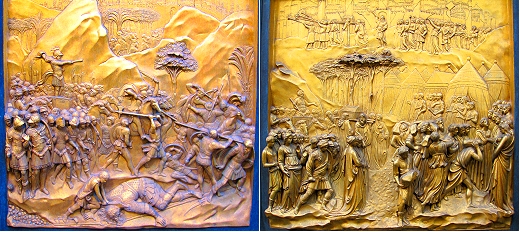
These works, portraying scenes from the Old Testament, were proclaimed by Michelangelo to be the “gates of paradise.” Unfortunately, the ones we were looking at are not the same ones good ol’ Mike praised so highly.
The panels currently on display are copies, the originals are safely tucked away in the Museo dell’Opera del Duomo for their own protection.
David and Goliath and The Fall of Jericho.
With so much left to see we had no time to dawdle, so we high-tailed it over to the Piazza della Signoria for a quick look at several other world famous masterpieces. A huge statue of Hercules and Cacus by Baccio Bandinelli is opposite the replacement David, standing guard at the doors of the Palazzo Vecchio.
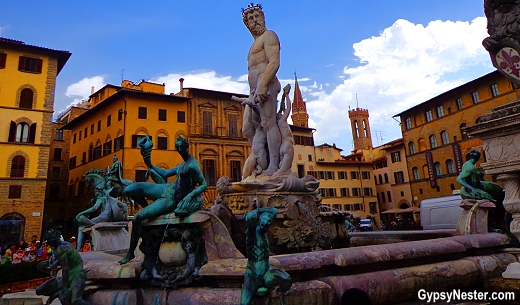
Beyond them the square is dominated by The Fountain of Neptune.
The fountain was completed in 1565 as a symbol of Florentine dominion of the over the sea, but once again we were looking at a reproduction, the original god of the deep is in the National Museum.
Along one side of the plaza the Loggia dei Lanzi serves as an open air gallery of Renaissance sculpture.
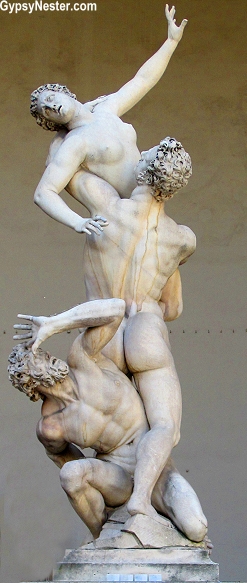
We strolled through, able to stop and stare just inches away from Benvenuto Cellini’s Perseus with the Head of Medusa, The Rape of the Sabine Women by Giambologna and the famous, often-copied Medici Lions.
The Rape of the Sabine Women
The Medici family was the main force behind Florence’s rise as a world power and art center. They made their fortune as early big wigs in banking, a pretty exclusive business back in the fourteenth century and, in addition to ruling Tuscany, the family produced four popes and two queens of France.
But our interest in the family was their incredible legacy as patrons of the arts. Over their reign they commissioned works by most of the Renaissance masters, and it was one of the Medici popes, Clement VII, that got Michelangelo to paint The Last Judgment for the Sistine Chapel at the Vatican.
Much of the Medici collection is on display in the Uffizzi gallery. Once used as the family’s offices, The Uffizi now houses Botticelli’s Primavera (often known as The Birth of Venus, or Venus on the Half Shell to goofballs like us), Leonardo da Vinci’s Annunciation, and Raphael’s Madonna.
The gallery is also home to the only painting by Michelangelo remaining in Florence, the Doni Madonna, sometimes called The Holy Family.
The gallery is set up with rooms dedicated to each artist along a huge hallway. Almost every exhibit we entered was centered on a priceless masterpiece that we recognized instantly.
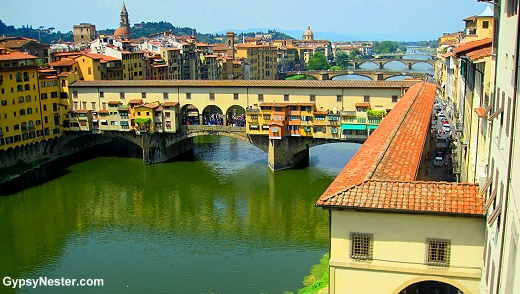
Once again photos were not allowed, so we had to settle for a shot of the Ponte Vecchio through a window.
Good enough, the old bridge would be our final destination, and there is no way a photo could have done justice to the amazing artwork that had just been permanently branded onto our brains.
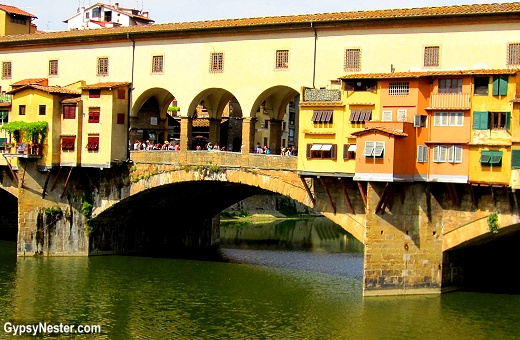
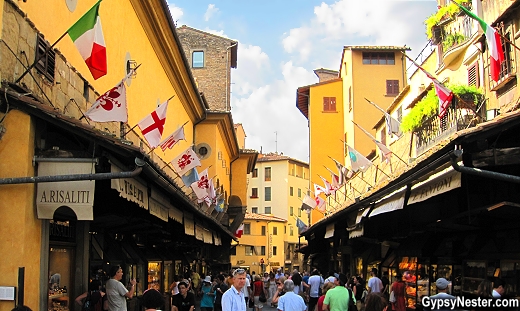
More of a crowded mall than a transportation route over the Arno River, the Ponte Vecchio is unique and celebrated for the myriad of shops that hang precariously over the side.
It is also the only bridge in the city to have survived World War II intact, so it holds a special place in the hearts of the city’s residents.
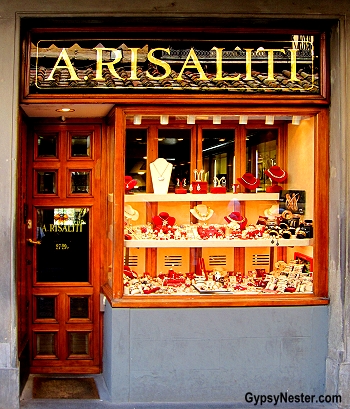
The shops are so tiny!
For us it meant the end of a whirlwind day of art overload, and a lifetime of recollections that will have to hold us over until we can spend a respectable amount of time reveling in all that Florence has to offer.
Anybody happen to have a Florentine house that needs sitting for a month or so?

 Ann Voorhees Baker