There is something quintessentially southern about the Louisiana bayou country known as Acadiana, so it seemed strange that we would go north of the U. S. border to discover its roots and origins.
The Cajuns’ ancestry traces directly back to Canada’s Maritime Provinces, so there was no better place to begin our investigation than in Nova Scotia at the Grand-Pré National Historic Site. It was along this coast on The Bay of Fundy that the first French settlers to come to the new world arrived in 1605, before… CONTINUE READING >>
Thanks to Road Scholar for providing this lifelong learning adventure through the Canadian Maritimes! As always, all opinions are our own.
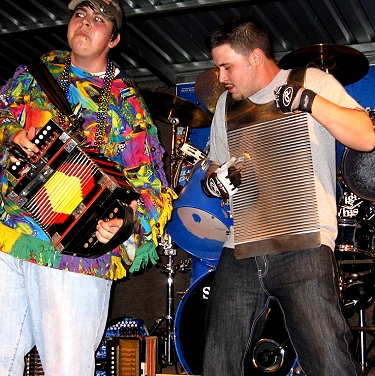
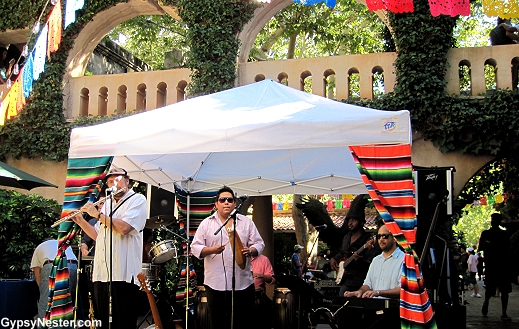
Cajun musicians in Louisiana
Since our first trip to South Louisiana, over two decades ago, we have been enamored with Cajun culture.
We have returned numerous times to enjoy the food, music, landscape, and people of this unique region. They work hard, play hard, and stay deeply connected with family, friends, the land and their history.
There is something quintessentially southern about the Louisiana bayou country known as Acadiana, so it seemed strange that we would go north of the U. S. border to discover its roots and origins.
The Cajuns’ ancestry traces directly back to Canada‘s Maritime Provinces, so there was no better place to begin our investigation than in Nova Scotia at the Grand-Pré National Historic Site. It was along this coast on The Bay of Fundy that the first French settlers to come to the new world arrived in 1605, before any arrived from England.
Through the 1600s the colony became known as Acadia, or Acadie in French, and grew to cover all of Nova Scotia, as well as parts of New Brunswick and Prince Edward Island.
The name is thought to stem from one of the earliest maps of North America, when explorer Giovanni da Verrazzano labeled the entire Atlantic coast from Virginia northward as Arcadia.
The theory is that the R was dropped at some point, or possibly the name is from Samuel de Champlain, who founded Quebec City and New France in 1608, and called the coastal French territories La Cadie.
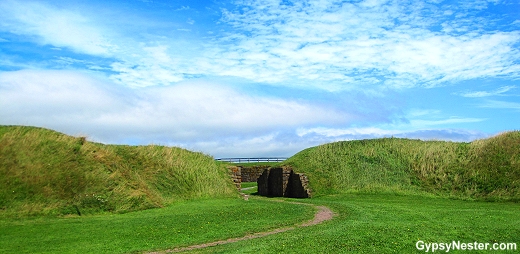
As we entered the Visitor Center we noticed a display demonstrating how these colonists reclaimed the salt water marshes, rather than clearing the forests. By building an ingenious series of dykes and canals they converted the once useless swamps into fertile farmland.
More than anything it was that skill that set the Acadians apart from the other French settlers that soon followed and populated Quebec.
Though they were joined by language and ancestral homeland, they remained distinctly different, and do to this day.
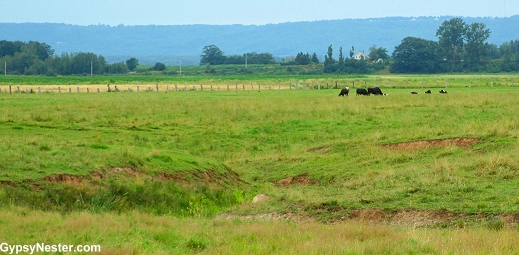
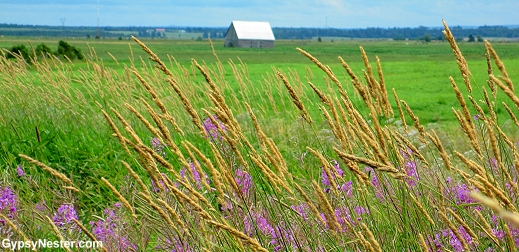
The Center overlooks a vast plain of this reclaimed land, and as we walked the impeccably maintained grounds of the Grand-Pré National Historic Site, we came to understand the significance of this area and the events that took place here.
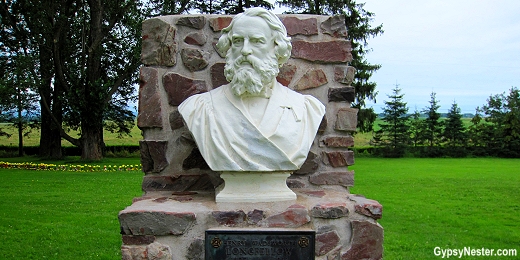
It’s no wonder Henry Wadsworth Longfellow chose this as the setting for his epic poem Evangeline.
The story, while fictitious, describes the plight of the Acadians in intense, personal terms, through the eyes of lovers, Evangeline and Gabriel, who were torn apart by circumstances beyond their control.
The poem came to be regarded as a classic, and because of it Grand-Pré has become central to Acadian and Cajun legend and lore.
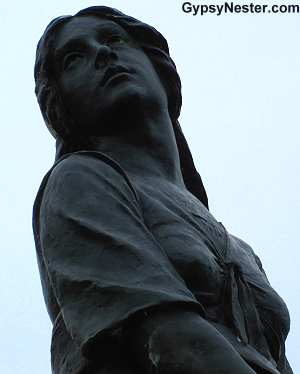
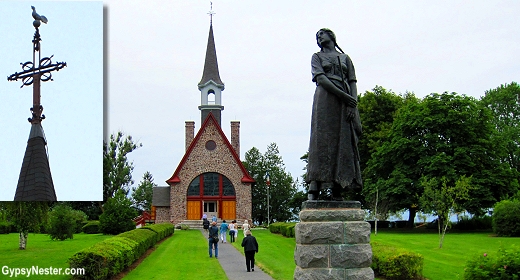
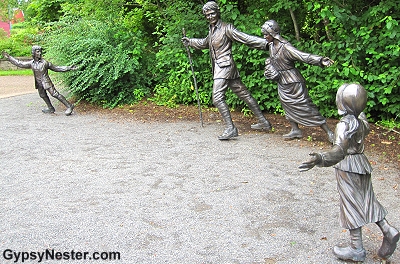
Both the author, and his heroine Evangeline, are honored with statues at the Historic Site.
The tale takes place at the culmination of years of conflict between the English and Acadians after British control of the colony began in 1710.
Many of the Acadians were not content to accept foreign rule, most simply desired to remain neutral in the ongoing hostilities between Britain and the rest of New France.
Some others engaged in guerrilla warfare against the English.
By the mid-1700s all were required to sign an oath of allegiance as England began to dominate, and demand loyalty to the crown from the vanquished Acadians.
But many refused, arguing that they wished to stay out of the struggle for control of The New World.
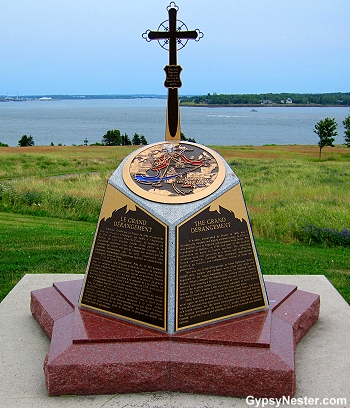
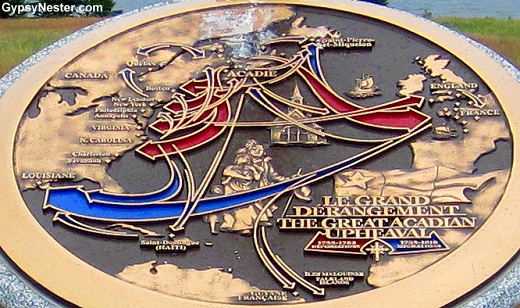
Some fled into the wilderness areas of Cape Breton and New Brunswick, while others escaped to Quebec, but thousands were forced to leave Acadia in what became known as Le Grand Dérangement, the Great Upheaval, or Great Expulsion.
The Monument at Port-la-Joye depicting the deportations.
The deportations took place over several years, and from a number of locations, but Longfellow likely chose Grand-Pré as the site to be immortalized since it was the first place where thousands of Acadians had their possessions confiscated, their homes and farms burned, and were shipped south to the American colonies.
The refugees were not welcome there either, so they were sent away and scattered across the globe, winding up in Europe, Haiti, The Falklands, Saint Pierre and Mequelon, and Guyana.
Later more Acadians were deported from all across Acadie and sent directly to Europe, with as many as half dying on the voyages.
We had the chance to visit and learn about several of these other sites in our travels throughout The Maritimes, including Port-la-Joye on Prince Edward Island, the Fortress of Louisbourg on Cape Breton Island, and Fort Beauséjour near Grand-Pré.
After years of exile in foreign lands, some Acadians managed to assimilate into their new surroundings, some found their way back to Canada, and many ended up migrating to Louisiana.
That is where the story of Evangeline continued, as the lovers arrived there separately, unbeknownst to each other. They spend the rest of their lives searching across America for one another, with their paths coming agonizingly close, but never crossing until too late.
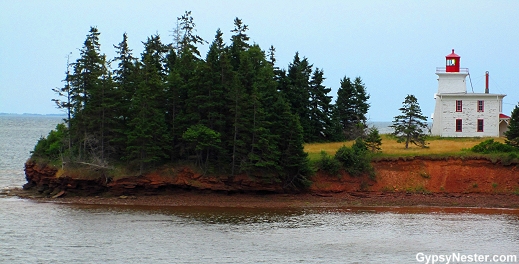
Lighthouse on Port-la-Joye, Prince Edward Island. Port-la-Joye was the capital of the island when it was under French control and called Île Saint-Jean.
The Tantramar Marshes takes its name from the Acadian French word tintamarre, meaning din or racket, in reference to the noisy flocks of birds living in the reclaimed swamp land that is now a National Wildlife Area and bird sanctuary.
Even though it was written one hundred years later, Longfellow’s masterpiece served to enlighten the world to the tragedy of Le Grand Dérangement, but perhaps more than anything it helped connect the Cajuns to their Acadian roots.
A fascinating bridge that spans a continent from south to north.
We’re giving away a 4-day, 3-night stay at the CoCo Key Hotel & Water Resort in Orlando, Florida!Enter to win and you and (up to) THREE of your friends could enjoy:
A standard room for up to four people, free resort access, free… See full details and enter to win!
CONGRATULATIONS TO CHAD C. FROM FLORIDA!
CHAD SAYS:
“My family and I plan to use this as a much needed stay-cation. Thank you!”
Enter to win and
You and (up to) THREE of your friends could enjoy: A standard room for up to four people
Free Resort access
Free Water Park access
Escape to family-friendly CoCo Key Hotel & Water Resort – Orlando. CoCo Key is located near Orlando’s premium shopping and major attractions. Featuring Orlando’s ONLY 54,000 sq. ft. canopy-covered outdoor water park with 14 slides, 4 heated pools, a 6,500 sq. ft. arcarde, and on-site dining outlets!
(our upcoming Holiday giveaway is an iPad Mini – shh! – don’t tell! Be sneaky & follow us to be in the know)
OFFICIAL RULES All contest entries must be submitted between September 23, 2013, 12:01 AM EST and November 15, 2013, 11:59 pm EST
– Entries are limited to once daily.
– Entrants will receive 5 bonus entries per Facebook friend they refer. To receive these bonus entries, the refer-a-friend feature on the entry page must be used.
– Winner will be selected in a random drawing from all qualified entries.
– Winner will be notified via email on November 16, 2013.
– To claim prize, winner must respond via email by November 23, 2013, 10PM EST
– Winner will be announced on GypsyNester.com on or before November 24, 2013 unless initial winner is not qualified and a new drawing must take place. – One grand prize winner will receive a 4-day, 3-night stay CoCo Key Hotel & Water Resort in a standard room for up to four people with free resort and water park access (7400 International Drive, Orlando, Florida 32819). – Total value of the prize is over $500.00, there are no other prizes.
– The prize is nontransferable and is subject to Water Park availability. There may be no cash or substitutions.
–
Winner will receive a certificate with an official seal that must be redeemed by September 17, 2014. No extensions or replacements will be honored.
–
Winner must make advance reservations by calling 407-351-2626 and mention the certificate at time of reservation.
– Winner must turn in the certificate at the time of winner’s check-in to CoCo Key Hotel & Water Resort
– You must be over the age of 21 to enter.
– You must be a resident of the United States to enter.
– By entering, each contestant agrees to be bound by these rules.
– Failure of the original winner to meet official rules or claim prize within the specified time period will result in automatic forfeiture of any prize and prize will be awarded to an alternate winner. Alternate winner will be chosen in a new drawing in accordance to these same rules.
Have you ever found the PERFECT Birthday Card? The absolute ONLY one that will make the receiver’s day?
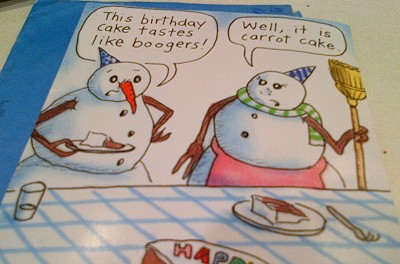
We had been carting this card around with us for quite some time – months. That’s what we do, when we find the ideal card for one of our family or friends we buy it, no matter how long it may be until the occasion that it celebrates. This one was perfect for our oldest, The notoriously carrot-hating Piglet.
Flash forward to a sunny, wildly windy day in Lafayette, Louisiana, a parade of dogs and a birthday card for our eldest to be mailed. What a pretty picture. And it was, until I noticed that the card was no longer in my coat pocket… CONTINUE READING >>
Have you ever found the PERFECT Birthday Card? The absolute ONLY one that will make the receiver’s day?
We had been carting this card around with us for quite some time – months.
That’s what we do, when we find the ideal card for one of our family or friends we buy it, no matter how long it may be until the occasion that it celebrates.
This one was perfect for our oldest, The notoriously carrot-hating Piglet.
Flash forward to a sunny, wildly windy day in Lafayette, Louisiana, a parade of dogs and a birthday card for our eldest to be mailed. What a pretty picture. And it was, until I noticed that the card was no longer in my coat pocket.
That morning we had written a semi-naughty little note inside (referring to The Piglet‘s agonizing over turning twenty-seven – we couldn’t let THAT go by without a sarcastic little jibe!), enclosed a check and stamped and addressed the envelope.
I carried the card in my pocket figuring that we’d see a mailbox somewhere along the parade route. But the ridiculously cute dogs in the Krewe de Chiens Mardi Gras Parade must have distracted me. I never noticed a mailbox.
What I did notice, a little while later, was that the card was gone. It had been poking out of my pocket all day. I kept shoving it back in, but it obviously made one final poke before I could administer another shove. I panicked. How were we going to find another perfect card in time for The Piglet’s birthday?
I surveyed the immediate area, nothing. Time to retrace my steps. We hadn’t gone too far from the last place I remembered shoving the rascal back down, plus the envelope was bright blue, so I felt good about my prospects of finding the escapee.
But I retraced like a kindergartner drawing a Thanksgiving hand turkey and found nothing. The wind was whipping around and could have easily picked up the card and carried it off, but I thought the crowd or bushes or gutter or something would have stopped it. No such luck.
So I doubled back and covered our entire path for the day, still no sign of it. Time to switch into optimist mode, most certainly not my natural state. Perhaps someone picked it up and dropped it into a mailbox.
It was already stamped, so it wouldn’t take much effort, I reasoned, but I didn’t really buy it. Between the wind, the foot traffic and the dog poop – it most likely looked like just another piece of trash amongst the Mardi Gras beads and revelry.
Veronica, on the other hand is God’s own optimist. She decided it would make an interesting social experiment. She called up The Piglet and told her the story.
Now The Piglet was excited to see if the card would show up to her apartment on Manhattan. Suddenly this was way more exciting than just any old birthday card.
About a week later we got a text message, “It came!!!!!!”
Wow, someone did mail it! My faith in humanity was bolstered.
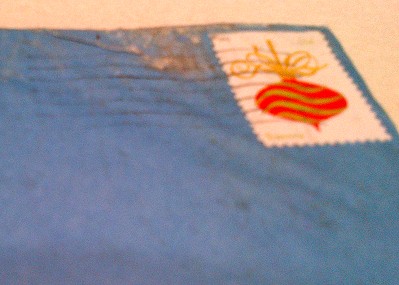
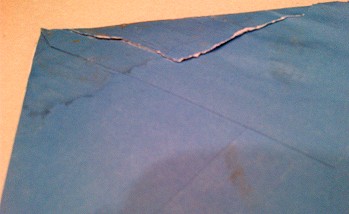
We were curious as to what kind of shape the wayward card was in, so we asked The Piglet for a picture. It was torn up, crinkled and stepped on. To think that someone took the time to mail that battered mess truly warmed our hearts. We wish we knew who it was.
So – to the caring Cajun at the dog parade in Lafayette who had a heart big enough to send kindness our way, thanks.
Up until this year’s Asian adventure our entire understanding of Buddha consisted of cheesy gold statues of a smiling, pot-bellied guy we’d seen in some restaurants. We weren’t exactly enlightened.
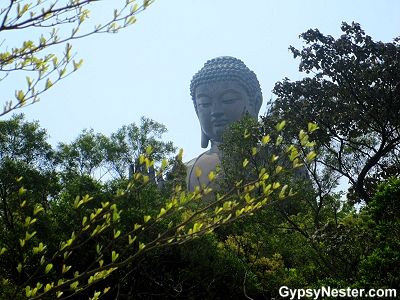
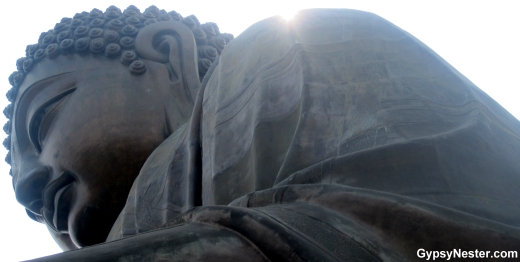
Perhaps we could clear up our conceptions a bit with a visit to The Tian Tan Buddha. He sits atop a hill on the outskirts of Hong Kong.
He stands one hundred and twelve feet high, and weighs in at… CONTINUE READING > >
Up until this year’s Asian adventure our entire understanding of Buddha consisted of cheesy gold statues of a smiling, pot-bellied guy we’d seen in some restaurants. We weren’t exactly enlightened.
Perhaps we could clear up our conceptions a bit with a visit to The Tian Tan Buddha. He sits atop a hill on the outskirts of Hong Kong.
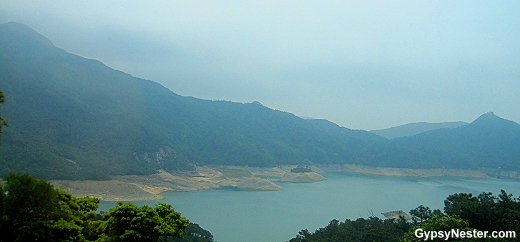
Normally a train, and then a ski-lift-type gondola suspended across three and a half miles of mountains, valleys, and lakes would take us up to Ngong Ping.
But when we got off the train the cable car was out of commission, so we had to take a bus. No doubt less spectacular, but still quite an experience on the narrow, winding mountain roads.
After a ride that gave us a pretty good idea of how a pinball feels, we arrived and entered through the main gate.
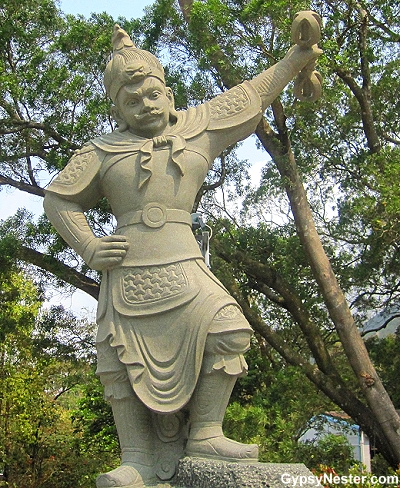
The ornate archway led to a path flanked by The Twelve Divine Generals, representing protective deities that correspond to the animals in the Chinese zodiac.
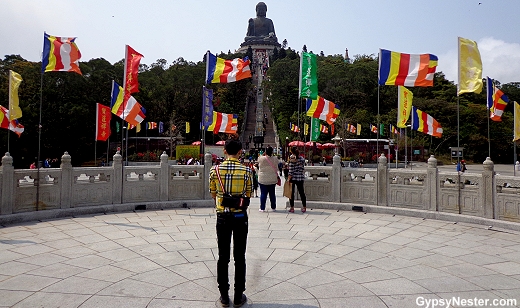
At the end of the walkway we reached a circular area perfectly aligned with stairs leading up Muyu Mountain to The Tian Tan Buddha.
He loomed as we climbed the 240 steps up, and at the top we could see for miles.
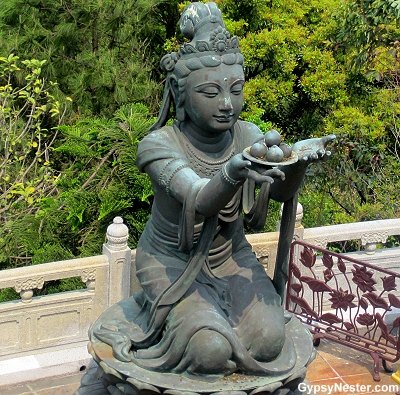
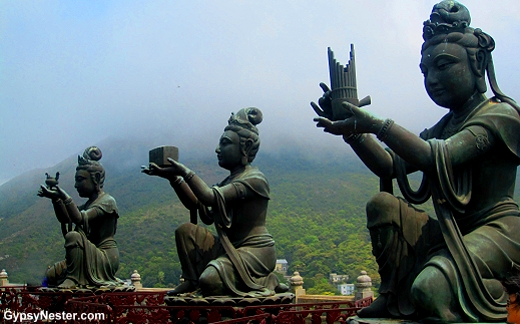
We also got a close up view of The Buddha, and The Offering of the Six Devas, six smaller statues making an offering of flowers, a lamp, incense, ointment, fruit, and music.
The offerings represent the virtues of charity, morality, patience, zeal, meditation, and wisdom.
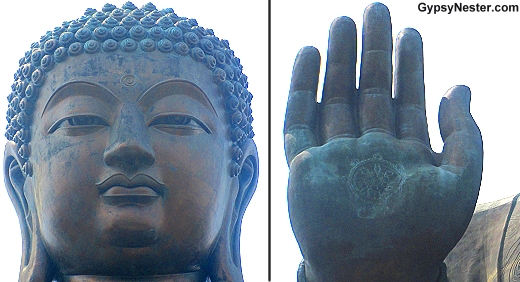
From The Devas’ point of view we could certainly see why this is commonly called Big Buddha. He is really, really big, but since buddhas come sitting, standing, or reclining, it is difficult to judge just which one is the largest, still The Tian Tan is one of the biggest in the world.
He stands, oops, I mean sits, one hundred and twelve feet high, and weighs in at a slender 280 tons of bronze.
Believe it or not, we do mean slender. The Tian Tan looks nothing like those paunchy plastic cash register buddhas, he’s quite svelte. That’s because this is a depiction of the Gautama Buddha.
The little guy that we were familiar with is an entirely different fellow. Those little statues are of Hotei, the laughing buddha (small b), also called Budai, and have become associated with good luck and prosperity.
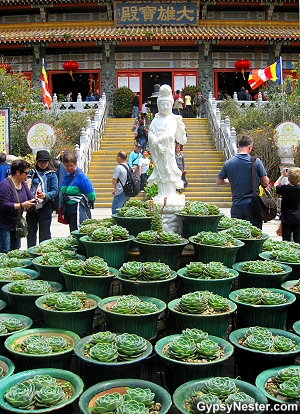
As we learned about these differences we became more and more aware of our glaring lack of knowledge, so in the hope of gaining some enlightenment we felt we should see the adjacent Po Lin (Precious Lotus) Monastery.
The monastery was founded by three monks back when this was a secluded hilltop, in 1906, and was known as The Big Hut.
It is much more than a hut these days, with several large halls housing dozens of statues.
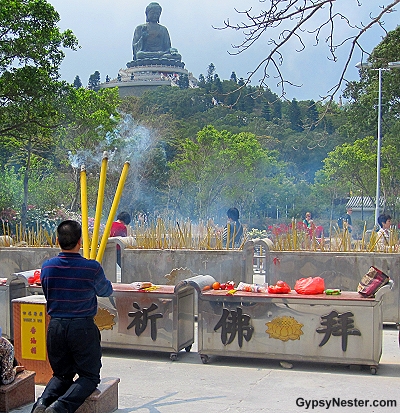
On our way to the Da Xiong Bao Dian (Great Hall of Treasure), the first thing we encountered was a cloud of thick smoke.
Fortunately there wasn’t a fire, it was incense.
Worshipers were burning massive amounts of the stuff, some holding the sticks, and others placing them in racks or sand.
It was our understanding that this is meant to purify the surroundings, and bring forth an assembly of buddhas to hear the prayers.
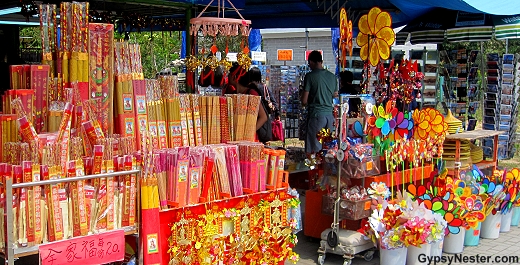
We could not discern the significance of the various sizes of the incense sticks though. They ranged from the normal little hippie-style sticks we are used to seeing, to veritable baseball bats of aromatic fumigation.
These, and many other items of religious swag, were on sale in stands lining one side of the courtyard. While we are far from experts on the trappings of worship for any religion, we could only speculate that bigger must be better.
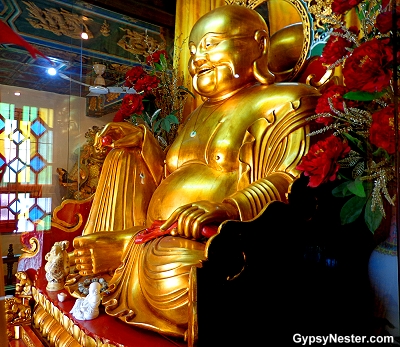
Inside the hall there are three Buddhas – Gautama, Dipamkarara, and Maitreya representing the past, present and the future.
Buddhism teaches that there have been many Buddhas, and there are more to come. Gautama is the most recent, and Dīpankara is one of the Buddhas that came before him, while Maitreya will be the next Buddha to come in the future.
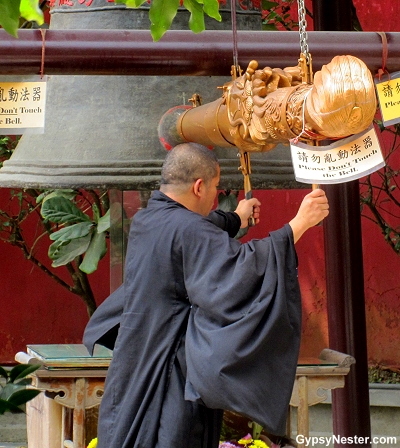
Outside, another monk swung what looked to be a small telephone pole at a 1,000 kilogram bronze bell. That is over a ton of bell!
In Buddhism, bells have an important role, their ringing is said to drive away evil spirits and represent an offering to all the buddhas in order to accumulate positive karma.
Bells also represent wisdom, so ringing the bell is the sound of wisdom that can clarify confusion.
Confused or not, we didn’t need to ask for whom the bell tolled, because the bus back to Hong Kong tolled for us.
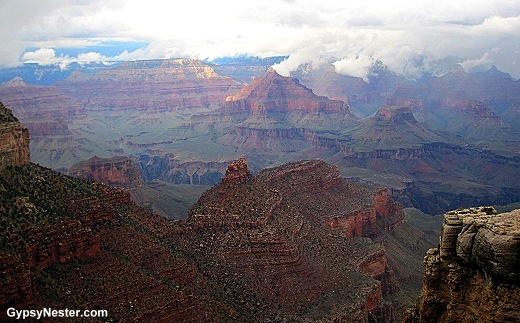
A staggering 90 percent of visitors to The Grand Canyon never venture beyond the South Rim.
Very much like the time we stopped by with our three kids (one still in diapers and the other two under six) on a crazy cross-country camping adventure. We took a peek over the rim, snapped a shot or two and then got back in the car and left. All in all a successful visit — not a single toddler toddled over the edge.
But now that our offspring are grown and on their own, we decided to take the canyon a little more seriously, and add some adventure beyond child catastrophe prevention… CONTINUE READING >>
Whooo-hoooo! We WON the Motel 6 all-expenses-paid Ultimate Bucket List Contest! As always, all opinions are our own.
Biking the Canyon
Good Morning! The view outside our room!
A staggering 90 percent of visitors to Arizona‘s Grand Canyon never venture beyond the South Rim. Very much like the time we stopped by with our three kids (one still in diapers and the other two under six) on a crazy cross-country camping adventure.
We took a peek over the rim, snapped a shot or two and then got back in the car and left.
All in all a successful visit — not a single toddler toddled over the edge.
Hint: To enlarge Instagram thumbnails click on the Instagram logo, then use your browser’s back button to return to our Grand Canyon Photo Gallery.
First glimpse of the Canyon!
David channels “Titanic”
But now that our offspring are grown and on their own, we decided to take the canyon a little more seriously, and add some adventure beyond child catastrophe prevention.
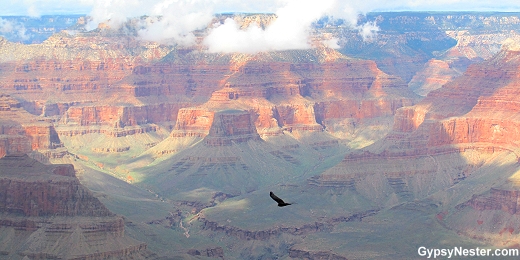
HAWK!
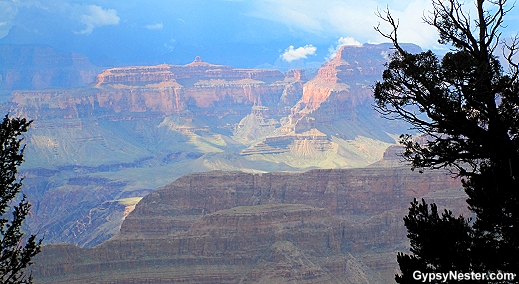
Surreal
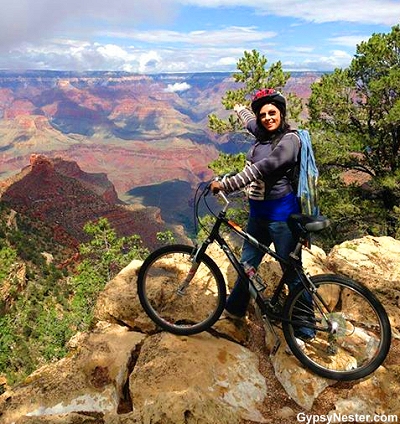
Bikes are available for rental near the Visitor’s Center on the South Rim. The rental guys were glad to give us the lowdown on the best way to combine the easier hills on the bike with the harder ones by hitching a ride on the bike-rack-enhanced shuttle buses.
They even threw in a personal tutorial on rack operation.
Grand Canyon Magic
Ecofriendly National Park
Mounting our trusty steeds, we headed west on the road that skirts the Rim Trail. Clouds meandered in and out that day, allowing the sun to peek out and give us a different perspective every time we blinked our eyes.
Just Mule-in’ Around
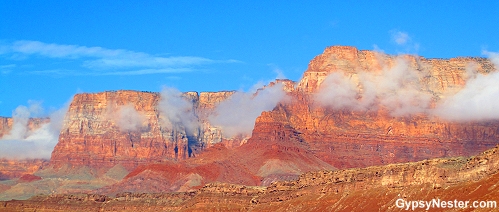
The stunning Vermillion Cliffs in Navaho Nation on the way to our mule ride
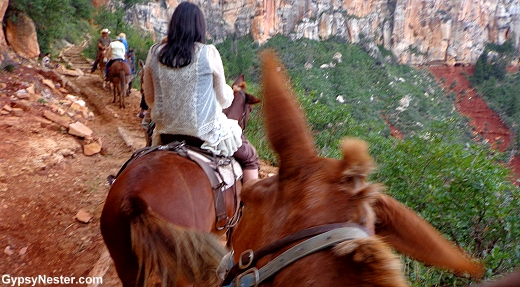
There are precious few things in life that combine breathtaking scenery, hysterical antics and outright fear. We figured that straddling a cliff-clinging beast of burden would certainly do the trick.
Why we never work with kids & animals – they always steal our thunder!
A quicky video sneak peek!
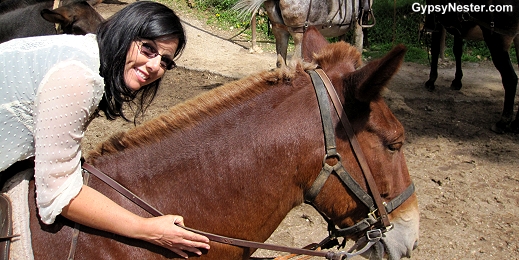
Take 2 – Veronica and her new Grand Canyon mule buddy, Slim
WATCH: Mule Cam! A between-the-ears, cliff-hugging adventure!
There’s really nothing to fear — helpful chap-wearin’ guides are there to make sure that newbies feel comfortable, and that the more advanced riders don’t do anything stupid. Besides, the mules didn’t want to fall to the bottom any more than we did.
They’re stubborn about that.
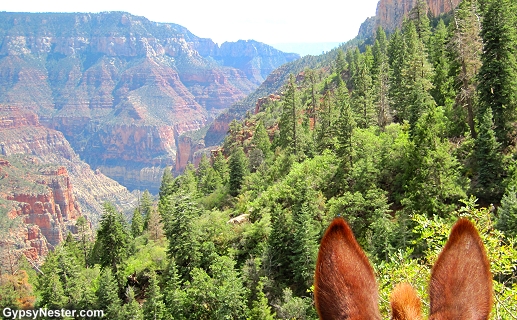
Through Slim’s eyes
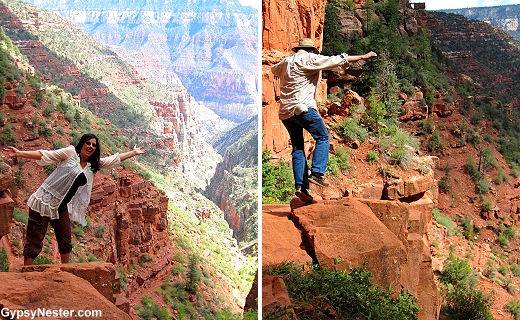
Among the mule ride options are a South Rim tour, a down-to-the-floor overnighter, and the one we chose, a half-day, half-way down trek that is only available on the North Rim. Well worth the incredibly scenic four-hour drive around to the other side of the canyon.
Through David’s mule, Mac’s, eyes
Feeling Above it All
Flying over the rim!
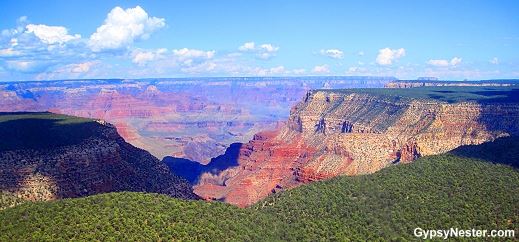
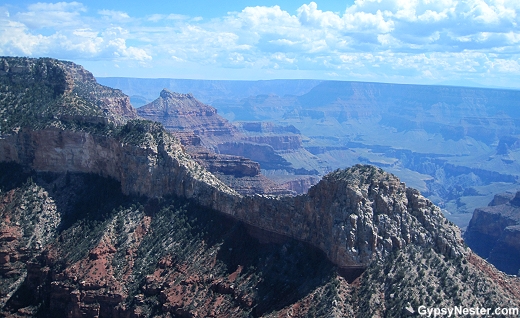
If there is a definition of a bucket list item, flying over the Grand Canyon should be included in the text. The moment we crossed over the rim and watched the ground drop a mile in an instant is something that will be forever imprinted in our minds.
No fear of flying could possibly survive the sight.
WATCH: The grandeur of the Grand Canyon from above
Words can’t describe, Veronica cried like a baby.
Our trusty steed!
Veronica literally bawled like a baby in awe, got out of one helicopter and turned around and did it again.
David had to restrain her from going a third time.