

We were surprised by a TV crew on Valentines Day after our maiden skydive in Queensland, Australia! We were totally thrown off guard – proven by how completely wind-blown we are!… Enlarge video and leave us a comment >>
We were surprised by a TV crew on Valentines Day after our maiden skydive in Queensland, Australia! We were totally thrown off guard – proven by how completely wind-blown we are!
Can’t wait to share the entire experience with everyone – our biggest fear conquering episode yet!
We should have realized something was up when we saw all of the “Throw it to me Mister” signs and fishing nets. The winner was a kid who was holding a laundry basket affixed to a broomstick, creating a target that no float rider could resist trying to make.
Post your best #GoingGypsy moments on Facebook and Twitter and be automatically entered to win an autographed first edition of Going Gypsy!
We want to see YOU in a favorite travel moment, celebrating a milestone, hugging your loved ones, conquering a fear, or posing with the cover of Going Gypsy!
We’ll be sharing your fun on Facebook and Twitter – and you could even be featured here on GypsyNester.com!
We are over-the-moon excited about the release of our new book, Going Gypsy, and to celebrate…
We want to see how YOU are #GoingGypsy!
Post your best #GoingGypsy moments on Facebook or Twitter!
We want to see YOU in a favorite travel moment, celebrating a milestone, hugging your loved ones, conquering a fear, or posing with the cover of Going Gypsy!
We’ll be sharing your fun on Facebook and Twitter – and you could even be featured here on GypsyNester.com!
What can you share? First, have fun!
Photos are excellent, but not mandatory.
Just make sure your message has the hashtag #GoingGypsy when you post to Twitter or Facebook!
Are you in a book club – or any club? Are you friendly with folks at your local bookstore or library? Do you have friends with adult kids (or soon-to-be adult kids?), friends that love to travel, friends that need inspiration, friends that are Baby Boomers?
If you love bookstores like we do – the sights, the events, the kindred spirits, the wonderful smell – head on in to your favorite store and order there.
You get a copy of Going Gypsy hot off the presses, and your local book seller learns about it too. That’s a double whammy!
Write about Going Gypsy!
Do you have a website, a newsletter, a bunch of friends? Let everyone know how excited you are to read Going Gypsy! Send out an email to your friends, write a letter or two, or give us a shout out on your website.
OFFICIAL RULES FOR #GoingGypsy Giveaway – March 27-April 21, 2015
All contest entries must be submitted between March 27, 2015 12:01 AM ET and April 21, 2015, 11:59 pm ET
– Rules are in accordance with giveaway below with ending date of April 21, drawing and notification date April 22, response date March 26 and announcement date March 27.
OFFICIAL RULES FOR #GoingGypsy Giveaway – March 5-March 26, 2015
All contest entries must be submitted between March 5, 2015 12:01 AM ET and March 26, 2015, 11:59 pm ET
– Rules are in accordance with giveaway below with ending date of March 26, drawing and notification date March 27, response date March 31 and announcement date April 1.
All entries must be submitted between on February 4th and March 4th, 2015
– Entries must include, but are not limited to, the following text: #GoingGypsy and must be tagged @gypsynester on Twitter or @GypsyNester-Celebrating Life After Kids on Facebook
– Winner will be selected in a random drawing from all qualified
entries.
– Winner will be notified via Twitter or Facebook on March 5th, 2015.
– To claim prize, winner must respond by the provided email in winning announcement by March 9, 2015,
10PM EST
– Winner will be announced on Gypsynester.com/going-gypsy-you.htm on or before March 10, 2015.
– One prize winner will receive an autographed copy of Going Gypsy: One Couple’s Adventure from Empty Nest to No Nest at All.
– Approximate total value of the prize is $16.95, there are no other
prizes.
– The prize is nontransferable. There may be no cash or substitutions.
– You must be over the age of 21 to enter.
– By posting your photos or text, you give us permission to share photos or text on social media or on GypsyNester.com
– You must be a resident of the United States to enter.
– By entering, each contestant agrees to be bound by these rules.
– Failure of the original winner to meet official rules or claim
prize within the specified time period will result in automatic
forfeiture of any prize and prize will be awarded to an alternate
winner. Alternate winner will be chosen in a new drawing in accordance
to these same rules
OFFICIAL RULES FOR SUBSCRIBE TO WIN GIVEAWAY
All contest entries must be submitted between February 3, 2015 12:01 AM ET and February 20, 2015, 11:59 pm ET
– Entries are limited to one.
– Entrants must be subscribed to GypsyNester.com’s newsletter on the date of the drawing for the entry to be valid (this is how we will be selecting winners).
– Winners will be selected in a random drawing from all qualified entries.
– Winners will be notified via email on February 21, 2015.
– To claim prize, winners must respond via email by February 26, 2015, 10PM ET
– Winner will be announced on GypsyNester.com on or before February 27, 2014 unless initial winner is not qualified and a new drawing must take place. – One grand prize winner will receive an autographed copy of Going Gypsy: One Couple’s Adventure from Empty Nest to No Nest at All.
– Approximate total value of the prize is $16.95, there are no other
prizes.
– The prize is nontransferable. There may be no cash or substitutions.
– You must be over the age of 21 to enter.
– You must be a resident of the United States to enter.
– By entering, each contestant agrees to be bound by these rules.
– Failure of the original winner to meet official rules or claim
prize within the specified time period will result in automatic
forfeiture of any prize and prize will be awarded to an alternate
winner. Alternate winner will be chosen in a new drawing in accordance
to these same rules
Denise says: “OMG!!!!!! I am So freaking happy!!!!! I was just getting ready to go to bed, and checked my email. I am bouncing off the walls right now!! I’m going to give this to my daughter for her birthday. I’ve been trying to win an iPad mini forever. Thank you for making that come true.”
This bouncing baby* iPad has 16 gigs of memory and is WiFi and Bluetooth enabled. USB lightning cable and USB Power Adapter are included in the box.
*the bouncing of an iPad – or a real baby for that matter – is not recommended.
We would like to go on the record that we are highly against this practice.
Don’t miss out on a single one of our fantastic giveaways!
OFFICIAL RULES All contest entries must be submitted between November 25, 2013, 3:01 PM ET and January 31, 2014, 11:59 pm ET
– Entries are limited to once daily.
– Entrants will receive 5 bonus entries per Facebook friend they refer. To receive these bonus entries, the refer-a-friend feature on the entry page must be used.
– Winner will be selected in a random drawing from all qualified entries.
– Winner will be notified via email on February 1, 2014.
– To claim prize, winner must respond via email by February 8, 2014, 10PM ET
– Winner will be announced on GypsyNester.com on or before February 9, 2014 unless initial winner is not qualified and a new drawing must take place. – One grand prize winner will receive a 16 gig iPad Mini. – Total value of the prize is approximately $300.00, there are no other prizes.
– The prize is nontransferable. There may be no cash or substitutions.
– You must be over the age of 21 to enter.
– You must be a resident of the United States to enter.
– By entering, each contestant agrees to be bound by these rules.
– Failure of the original winner to meet official rules or claim prize within the specified time period will result in automatic forfeiture of any prize and prize will be awarded to an alternate winner. Alternate winner will be chosen in a new drawing in accordance to these same rules.
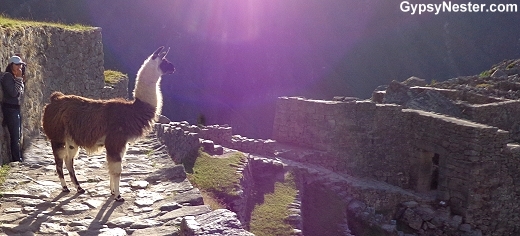
Gawking up at the stonework that covers the entire side of a mountain in The Sacred Valley, we were truly in awe.
No one knows how the stones were cut, because a metal hard enough to cut granite was not available at the time of its construction and an explanation of how the rocks were moved up the mountain has never been… CONTINUE READING >>
Ollantaytambo is a town that sits at the foot of enormous ruins that share the same name.
The town dates back to the late 15th century, contemporary with the ruins, and has some of the oldest continuously occupied dwellings in South America.
It also serves as the gateway to Machu Picchu, since it is the starting point for the famous Inca Trail (for backpackers) and the narrow gauge railway (for the oh-my-aching-back crowd) that are the only ways to reach the legendary Lost City.
As remarkable as the village of Ollantaytambo may be, the archaeological site is the main attraction.
We entered the site, gawking up at the stonework that covers the entire side of a mountain, and our guide, Eddy, gave us some background.
Originally the royal estate of Emperor Pachacutin, it became a bustling agricultural center, and then during the Spanish conquest, served as a fortress for Manco Inca Yupanqui while leading the Inca resistance.
He went on to point out the many stones left sitting where ever they happened to be at the time that work was abandoned, showing how this site was still unfinished when the Spanish arrived in the 1500s.
The freestanding stones gave us a close up look at some of the amazing stone cutting and shaping involved in the construction.
The bulk of the Ollantaytambo archaeological site is covered by huge stone terracing that was specially designed to transform the impossibly steep hillside into usable crop land.
This not only provided level ground for farming, but also prevented landslides and flooding in times of heavy rains.
Alongside these stair-stepped growing areas are granaries built to store up to five years supply of food as preparation in case of drought, blights or freezes.
This was just one of the methods used to guard against a poor harvest in The Sacred Valley .
Crops were also planted at different altitudes to insure proper growing conditions, and many varieties of each crop were developed.
For example, hundreds of different types of potatoes would be sown.
Each were cultivated for certain characteristics such as resistance to insects, cold, heat or dry conditions.
This was all fascinating stuff, but our natural inclination was to climb, so we did, up over 9000 feet. It’s a touch hard to breath up there, but we huffed and puffed, and I-think-I-can, I-think-I-canned our way to the top.
Above all of the agricultural structures is a temple. This was the part still being worked on when Ollantaytambo was abandoned, so it is not overly impressive, but some of the massive stones are, and the view certainly is.
From the top we could see for miles in every direction and make out the path across the valley to the quarry where the stones were originally cut.
From there the giant rocks were hauled down that mountain, over the river, and back up this mountain, all without the use of wheels.
One of the many mysteries that surround the building abilities of the Quechua people when ruled by the Inca is the lack of the wheel.
Eddy offered the theory that the round shape represented the sun and moon and therefore was sacred, so it could not be used for such mundane tasks as moving rocks.
Possibly, but no one knows for certain why they didn’t use wheels.
Another of the mysteries of Ollantaytambo is exactly how the stones were cut, because no metal hard enough to cut granite was available at that time.
The Quechua language was not written and the Spanish destroyed most evidence of methods used in construction.
Budapest is truly a tale of two cities, Buda and Pest, separated by the Danube River.
Buda, steeped in history and stunning with her castle on the hill, preserves the past.
And Pest, the “New City” vibrant with change, showcases the hope of the future… CONTINUE READING >>
Thanks to Viking River Cruises for inviting us along and providing this adventure! As always, all opinions are our own.
Budapest is truly a tale of two cities, Buda and Pest, separated by the Danube River. Since the Viking Longship Skadi that would serve as our hotel for the next couple of days was docked on the Pest side of the river, we set out to explore what’s called the “New City” first.
Prowling Pest
The Parliament House
New, as is often the case in Europe, can be a relative term, Pest is around one thousand years old.
Although in this case the reference is to the government and business districts which are more modern.
Perhaps the most striking of these is the Parliament House, overlooking the river.
When the two cities united in 1873 to form the capital of Hungary, it was decided that a grand new building was needed to house the legislature. A competition was held to pick a design and in 1885 construction began. The building was dedicated on the 1000th anniversary of the country in 1896, and finally completed in 1904.
Along the water in front of Parliament House there is a poignant memorial to the Jewish people of Budapest who perished at the hands of the Nazi-affiliated Arrow Cross during World War II.
Shoes on the Danube represents how people were lined up on the river bank and shot into the water so the current would carry their bodies away. But first they were ordered to remove their shoes because the footwear was considered too valuable to be lost in the river. Sculptor Gyula Pauer created sixty pairs of iron shoes to commemorate the victims.
Walking away from the river toward St. Stephen’s Basilica we came upon a much more lighthearted piece of artwork.
This bronze Hungarian policeman from the early 1900s keeps an eye on Zrínyi utca (Zrínyi Street).
Veronica seemed to think his belly needed a pat.
A King and a Saint? What a guy!
The small Christmas Market in front of St. Stephen’s Basilica
Szent István Bazilika, Saint Stephen’s, serves as the main church for Budapest. It is named for Saint Stephen I of Hungary, who tradition says became the country’s first King on Christmas in the year 1000. He was canonized in 1083 by Pope Gregory VII for bringing Christianity to Hungary.
The church is quite new compared to most of the great cathedrals of Europe, completed in 1905 after fifty-four years of construction.
Without really knowing what to expect, we bought tickets to go up in the tower. Climbing the seemingly endless stairs, we were feeling certain that there must be something really good at the top. Three hundred sixty four steps later we were not disappointed.
The Parliament Dome is off in the distance in the fog.
From the top of the cathedral dome we had a 360 degree panoramic view of the entire city. It looked to be the highest spot in town, but we discovered later that the dome on the parliament building is the exact same height.
This was done intentionally, to show the equality of political and religious power. By law, no building can be erected higher than the ninety-six meters of these two domes.
Inside the basilica, the king who became the patron saint of Hungary is honored in several ways, including a display of his right hand.
Yes, the one thousand year old mummified hand of Saint Stephen is kept in a glass case in a small chapel at the back of the church.
We know this to be true because we saw it with our own eyes. Just slip a coin into a slot and a light comes on to reveal it, looking like it had the worst case of frostbite ever. We had to get out of there.
In order to see more of the Pest side in our limited time we took a quick bus tour that hit several of the highlights. Many of the city’s landmarks line Andrássy Avenue, along with the homes of prominent residents, so that was where we began.
We passed the scariest building we’ve ever seen, the House of Terror, which served as the headquarters for the secret police of both the Arrow Cross Nazi and Communist regimes but now is a museum…
… and the Hungarian State Opera House, that has been going strong since 1884.
At the end of the avenue we made a circle around Hősök tere, Heroes’ Square, the city’s main plaza.
The center of the square features the Millennium Monument, built in 1896 to commemorate the thousandth anniversary of the founding of Hungary.
Statues of the leaders of the seven Magyar tribes that arrived in the late 9th century from Asia are depicted on one side of the main column, and more modern Hungarian heroes on the other. The column is topped with the archangel Gabriel holding a replica of the royal crown.
On our way back through town we went by the Dohány Street Synagogue. This is the largest synagogue in Europe, and the third largest in the world.
We couldn’t help noticing stark variations and contrasts between many of the buildings throughout the city.
Some have been renovated and look stunning, while others still show evidence of heavy damage from WWII or years of neglect under communist rule.
Happily, signs of ongoing renovation of these beautiful buildings are everywhere.
Checking out the Christmas Market
To finish our day in Pest we checked out the the city’s main Christmas market, a large collection of stands and kiosks all decked out in holiday style.
We were surprised how many of these were selling food or drink as opposed to gifts. It seemed that this market was more of a gathering place for friends and family to grab a bite, hang out, socialize, and listen to music than a shopping venue. Basically a street fair, so we loved it.
We started with a cup of forralt bor, meaning boiled wine, the Hungarian version of mulled wine, or glühwein.
With our cockles properly warmed we were ready to sample some of the local fare.
Everything looked fantastic but we settled on töltött káposzta, cabbage stuffed with meat and rice and served with a paprika sauce and sour cream, then we added a huge smoked meat dumpling with sauerkraut to our meal.
The Chain BridgeTunneling through the old city wall of Buda.
The next morning found us crossing the Chain Bridge, the most famous of the eight bridges that span the Danube between Buda and Pest.
The picturesque suspension bridge was the first permanent bridge across the river when it opened in 1849.
Above the bridge, the domed Buda Castle dominates the valley from its perch on Castle Hill.
Rulers and royals resided on the spot for nearly 700 years. These days, it houses a collection of museums.
Looking up at Fisherman’s Bastion
The area around the castle is like a village in itself, mostly contained within the Fisherman’s Bastion.
As with Hero’s Square and the Parliament House, the bastion was built at the time of the millennial celebration.
Although it looks like a fortress, it was made more as a monument and scenic overlook, with seven towers to represent the seven Magyar tribes that came to the area in 896.
Within the bastion walls the Matthias Church serves as the second most important church in Budapest. A church has been on this spot for around a thousand years, built and rebuilt several times.
It even served as a mosque during the Ottoman rule over Hungary. We’ve learned that many churches were converted under the Ottoman Empire. The current design, from renovations just over a century ago, is in a Byzantine style that reflects the eastern heritage of the Hungarian people.
Outside the church we once again found King, or should we say Saint, Stephen immortalized, this time mounted on his trusty steed amid the fortifications of the bastion.
Following the walls back toward the castle we happened to wander up just in time to see the changing of the guard at Sándor Palace, which now serves as the presidential palace. It was heavily damaged, along with most of the buildings on the hill, by Allied bombers in 1944 and wasn’t rebuilt until after the fall of communism in 1989.
Eating Like a Hungarian: Getting Goulash
On our way back to Skadi the chill was starting to set in again when we spotted a sign advertising the oldest restaurant in Pest.
We couldn’t pass that up, and some steaming hot soup sounded like just the ticket. The little basement dining area looked authentic enough, definitely old, if not the oldest, and proudly offered many traditional dishes.
Goulash and fish soup are both classic, typical Hungarian dishes, and what better place to try them the the self-proclaimed oldest restaurant in town?
The name 100 Éves Etterem, One Hundred Years Old Restaurant, doesn’t really tell the whole story since it was adopted upon the establishment’s centennial in the 1930s.
One hundred eighty years old would be more accurate, but hey, they can’t go changing the name every year now can they?
No matter, a soup by any other name would taste just as Mmmm, Mmmm, good.
Both were heavy on the paprika, this is Hungary after all, and served piping hot in pewter pots.
The goulash was full of meat, potatoes, and carrots, and the fish soup had big chunks of fish with hearty noodles.
A Magical Send Off
We were feeling pretty warm and fuzzy, but had to get back to the ship for what turned out to be the highlight of our entire stay in Budapest, leaving.
No kidding, the cruise up the river in the dark gave us an incredible nighttime view of the bridges and landmarks.
On the Buda side, the castle and Fisherman’s Bastion stood out like fireworks lit against the night sky.
While over on the Pest side of The Danube, The Parliament Building was absolutely stunning, glowing in the foggy darkness.
That fond farewell left memorable imprints on our minds after two remarkable days in Budapest, and an indelible desire to return someday… when it’s warmer.
Although it looks like a fortress, it was made more as a monument and scenic overlook, with seven towers to represent the seven Magyar tribes that came to the area in 896.
Outside the church we once again found King, or should we say Saint, Stephen immortalized, this time mounted on his trusty steed amid the fortifications of the bastion.
Following the walls back toward the castle we happened to wander up just in time to see the changing of the guard at Sándor Palace, which now serves as the presidential palace.
It was heavily damaged, along with most of the buildings on the hill, by Allied bombers in 1944 and wasn’t rebuilt until after the fall of communism in 1989.