Search…

Lübeck, Germany After Dark

Visiting Lübeck, Germany was one of those lucky coincidences that sometimes happen when traveling.

We chose it as a stopover on our Eurail Pass expedition across northern Europe mostly for its location.

But inside the famous Holsten Gate, we discovered a wonderful, history-filled city that lights up when night falls… CONTINUE READING >>

The Holsten Gate in Lubeck, Germany

Visiting Lübeck, Germany was one of those lucky coincidences that sometimes happen when traveling.

We chose it as a stopover on our wintertime (therefore much of it after dark!) Eurail Pass expedition across northern Europe mostly for its location.

But inside the famous Holsten Gate, we discovered a wonderful, history-filled city that lights up when night falls.

Walking under the arch into the ancient walled city, we noticed that the side of the gate facing the city is dated 1477, which is the year it was made.

The Holsten Gate in Lubeck, Germany

Another date, 1871, commemorates the year that the town voted to save the gate instead of tearing it down with the rest of the walls.

The story we heard is that the restoration resolution passed by only one vote, leaving the gate as one of the last remnants of the walls that once protected the city.

The Holsten Gate in Lubeck, Germany

The refurbished gate, with its distinctive towers, went on to become the symbol of the city, and actually became quite famous, appearing on several stamps and the old fifty Deutsche Mark bills.

Now, the German version of the two euro coin proudly displays the gate.

Lübecker Rathaus, the City Hall in Lubeck, Germany

After walking a few blocks into the city, we came to the pedestrian mall in the center of town.

Hanging a left took us to the Lübecker Rathaus, a pleasant surprise if there ever was one.

This is the town hall by which all other town halls should be judged.

Construction began in the year 1230, and was completed in 1308.

Over time, additions were added to the hall to accommodate the Supreme Court for the region and a Danzelhusand (dancehall) for community events.

The outside covered stairs at the Lübecker Rathaus town hall in Germany
LOVE this staircase.

A whimsical balcony at Lübecker Rathaus town hall in GermanyBefore too long, the structure covered an entire city block.

There are a number of intriguing details about the building that popped out on closer inspection.

The glazed bricks, vaulted ceilings inside, and figures decorating the little balcony were all eye catching, but for us the different-sized doors for exiting the courthouse were most fascinating.

It turns out that the taller doorway was for those of the accused found to be innocent, while the shorter was reserved for the guilty.

The incredible building served as a meeting place for the Hanseatic League, a powerful alliance of Baltic and North Sea traders that lasted for over five centuries.

Lübecker Rathaus

The presence of the league gave Lübeck a stature well beyond its size, and it became the de facto capital for the area.

By the 14th century, Lübeck became known as Queen of the Hanseatic League.

In fact, although it is part of Germany now, for most of its existence it was an independent city-state, the Free and Hanseatic City of Lübeck.

Potter's Restaurant in Lubeck, Germany

As compelling as this jaunt through history was, we were ready to eat.

On the recommendation of our hotel desk clerk we popped in to Potter’s, known for serving traditional regional fare.

The little cafe sits on the banks of the Trave River, which splits to form a natural moat around the old city center.

Lübeck, Germany
View across the invading hoard-evading moat.

This provided us with a feeling of safe haven while having our dinner without the threat of any invading hoards.

The specials on the menu were completely unknown to us – which is always right up our alley.

The first, päron, bönor och bacon, was well described as pears, beans and bacon with potatoes, but also included the quote:

“vad var där för att Mormor redan,” which the menu told us meant:

“What gave grandma already to pears.”

Funny menu translation is Lubeck, Germany

Our old friend Google also informed us that this was not in German, but Swedish.
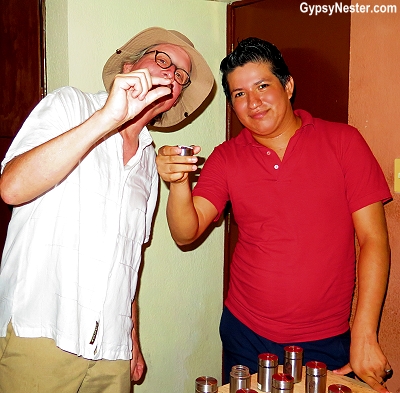
We asked our server for an explanation and got no farther in our understanding, but ordered it anyway.

We figured if it’s good enough for grandma…

Jever Beer in Germany

The other special, Labskaus, seemed clear enough; mashed potatoes, corned beef, onions, beets, cucumber, egg, and a herring fillet, but when we asked about it the answer took an unlikely turn.

Our server explained that it tastes good, but looks terrible. Oh, and yes, we should definitely try it.

Her exact words were, “It looks like scheiße.”

Now we don’t claim to sprechen sie Deutsch, but we do know just enough German to know what that meant.

We ordered it anyway… and beer, just in case we needed to wash it down quickly.

Päron, bönor och bacon in Luebeck Germany

When the dishes arrived we found that grandma, and our server, didn’t steer us wrong.

The pears, cooked with bacon and green beans, were certainly different and new, but really worked extremely well together.

Labskaus is mashed potatoes, corned beef, onions, beets, cucumber, egg and herring fillet

On the other hand, the Labskaus fit the less than appealing description given to a T.

Without a doubt, the meat mashed into the potatoes gave it a distinctively less-than-appetizing — dare we said it scheiße look — but it tasted good, sort of like corned beef hash with a fried egg on top.

We couldn’t really discern what the herring was doing alongside, nor the beets and gherkins.

An eye on a tower in Lubeck, Germany

It was very much like there were two completely separate dishes served on the same plate.

However, we were happy to add another couple of new local favorites to our epicurean adventure list, and we certainly weren’t leaving hungry.

In fact, we were fairly certain that we might never be hungry again.

That notion was short-lived though, we put it thoroughly to the test as soon as we discovered a genuine Swedish smorgasbord in Stockholm a few days later.

David & Veronica, GypsyNester.com

See our full crazy train trip from Amsterdam to above the Arctic Circle in the wintertime!

See all of our adventures in Germany!

YOUR TURN: Don’t you love those unexpected stops while traveling? Aren’t you glad that they didn’t tear that beautiful city gate down? How ’bout that food?

Wicked Views & Wonderful Wildlife Along Alaska’s Seward Highway

Revel in the amazing scenery and wonderful wildlife of Alaska’s Seward Highway with your GypsyNesters!

Gaze at glaciers, see weird animals (remember weird=good!), ride up a huge mountain on a wire, sample real-deal sourdough bread and learn how not to lose a shoe in a mudflat… CONTINUE READING >>

We are proud to be Viator Ambassadors – big thanks to Viator for providing this wondrous adventure! As always, all opinions are our own.

Ever since The Boy moved up to Alaska to pursue his flying career we have been planning our own adventure to The Last Frontier.

There were a few details to work through though; there was no way we were going during the never-ending dark and cold of the winter months, and the fact that it is a long, long way up there.

The Seward Highway of Alaska

So for over a year we had not made the trek north to Alaska but finally, with Johnny Horton’s classic ballad ringing in our ears for the entire ten hours of flight time, we reached the 49th state.

This was especially fitting, as it was also Veronica’s 49th state to check off her bucket list.

Sunset over the Great Salt Lake from an airplane

We really shouldn’t complain; the final five hours from Salt Lake City to Anchorage had some of the best views we have ever witnessed from an airplane window.

The sun was just setting over the Great Salt Lake as we took off and, due to the time of year, we chased the sunset as we jetted north and west.

Spectacular sunset over Mount Rainier from an airplane

This meant that we saw Mount Rainier and The Cascades bathed in colors we’d never experienced, as well as Vancouver Island, and the Inside Passage.

In fact, the daylight was increasing as we went toward the pole and by the time we flew over the massive glaciers in the Chugach Mountains on Alaska’s southern coast it was broad daylight.

Sunset over Anchorage, Alaska from an airplane

We knew our visit would include incredible mountain scenery, glaciers, and our best chance yet for Veronica to finally see a moose (she didn’t believe in them), but we hardly expected two out of three before we even landed.

Still, being our travel-greedy selves, we wanted a closer look, and to put an end to the moose-cuses once and for all, so we booked Viator’s Seward Highway Tour from Anchorage.

The stunning Seward Highway runs between Anchorage and Seward, Alaska

We met up with the tour in Anchorage and headed south on the Seward Highway along the Turnagain Arm of Cook Inlet.

The very same Chugach Mountains we had flown over now rose up from the water, and it was easy to see why the road has been designated a National Scenic Byway.

The stunning Seward Highway runs between Anchorage and Seward, Alaska

Captain James Cook sailed here in 1778 while searching for the Northwest Passage, but the Turnagain Arm that we were following was named by none other than William Bligh of HMS Bounty fame.

When Cook sent him to scout out the inlet he soon found that it was not a passage and had to turn around again.

The arm is also famous for having some of the biggest tidal changes in the world, up to forty feet at times, and while we drove along our guide, Chloe, noticed that the water beginning to recede.

Beluga Point, outside of Anchorage, Alaska, along the Seward Highway

We stopped at Beluga Point for a look at the mudflats that are left behind when the tide goes out.

The mud can act like quicksand and some people have been trapped in it, so Chloe impressed upon us that — no matter how cool it looked — we should avoid walking out on it.

At the very least, she explained, we’d have a shoe sucked off our foot for our misdeed. We certainly didn’t want to spend the remainder of what looked like a splendid day ahead of us muddy and one-shoed.

The mudflats at the end of Turnagain Arm in Alaska

Turnagain Arm along the Seward Highway from above on the Alyeska Aerial Tram in Girdword, Alaska

Back in the bus, we drove to the small village of Girdwood for a chance to stand on — and look down from — the peaks we had been passing all morning.

The tiny town is home to Alaska’s largest ski resort, Alyeska, but in the summer becomes an alpine playground for climbers, cyclists, and parasail jumpers.

We were more than content to confine our adventure to riding up the mountain on the Alyeska Aerial Tram.

Alyeska Aerial Tram in Girdwood, Alaska

It's a long way down on the Alyeska Aerial Tram in Girdwood, Alaska

The tram was built as a ski lift, climbing twenty-three-hundred feet above the valley below, but this time of year it carries sightseers like us, as well as daredevils with their bicycles and parachutes who either jump or free-wheel back down again.

Glaciers at the top of the Alyeska Aerial Tram in Girdwood, Alaska

Glacier at the top of the Alyeska Aerial Tram in Girdwood, Alaska
We hiked further up the mountain to get a closer view of the glaciers.

From the top we could see several hanging glaciers on the nearby peaks, and had a bird’s eye view of the cyclists and parachutists.

It’s not every day that we get to watch skydivers from above.

The Bake Shop in Girdwood, Alaska. Great sourdough bread!

Back down at the base of the slopes we settled in at outside tables to bask in the summer sunshine and enjoy lunch at The Bake Shop.

This gave us a chance to break (Alyesca sourdough) bread and converse with the members of our group who had come from all over the world, as far away as Australia and Japan.

Bottomless soup and famous Alyesca sourdough bread at the Bake Shop in Girdwood, Alaska

We even had a Russian with us, perhaps returning to visit his country’s former territory.

Fortified with bottomless gourmet soups and fresh baked breads, we were rarin’ to go onward and visit the animals at the Alaska Wildlife Conservation Center.

The Center’s primary function is as a refuge for orphaned or injured wildlife until they can be returned to the wild.

Musk ox at the Alaska Wildlife Conservation Center

They also provide temporary accommodation for species that have become rare in Alaska and are being reintroduced into their native habitat, such as elk, wood bison, and musk ox.

We had also heard the rumor that they had some real, live moose in attendance.

Hopefully we could not only see them, but get close enough to convince Veronica that they were not actually two men in a moose suit.

Musk ox at the Alaska Wildlife Conservation Center

When we arrived at the Center, the first animals we saw were some shaggy brown and black critters that looked like Cousin Itt with four legs.

Like many visitors to Alaska, this was our first time seeing musk ox and we didn’t know what to expect.

We were surprised to find them considerably smaller than we imagined.

Musk ox at the Alaska Wildlife Conservation Center

From the name we envisioned massive oxen roaming as giants of the tundra, but these guys are actually members of the goat family and their stature reflected that.

One hundred years ago there were none left in Alaska, due to over hunting, but now, since being reestablished, their numbers are increasing in the wild.

Baby Sitka black-tailed deer at the Alaska Wildlife Conservation Center

Without a doubt the cutest critters award went to three tiny Sitka black-tailed deer.

These little orphaned fawns were only a month old and still sporting their baby spots.

Their mother was hit by a car, so they will be raised and either remain safely at the Center or be released back into the wild, depending on their progress.

Alaska Wildlife Conservation Center rescues injured and orphaned animals and releases them back into the wild
This guy seems pretty happy about his rescue!

The Center is also active in breeding programs for several species, and the next two pastures were home to elk and wood bison.

Both have been successfully bred and herds have been reestablished in the wild thanks to programs like the Alaska Wildlife Conservation Center.

Wood bison are being bred successfully at the Alaska Wildlife Conservation Center

A bear at the Alaska Wildlife Conservation Center

Next we stopped briefly to see the bears.

The Center keeps several that were brought in as orphaned cubs, as well as one huge grizzly, Hugo, that arrived wounded and near death fifteen years ago.

After living with assistance, none of these bears have the proper skills to be on their own, so Hugo and his buddies they have a permanent home now.

A bear at the Alaska Wildlife Conservation Center

An sweet orphaned baby moose at the Alaska Wildlife Conservation Center

We had covered nearly the entire grounds without any sign of a moose and we were beginning to wonder if some more moose-cuses were about to be thrown out at us.

But then we noticed a sign on a barn that claimed there was a baby moose inside.

Deep down, David knew that a calf was not really going to do the trick when it came to convincing Veronica about moose.

Two bull moose lounge by a pond at the Alaska Wildlife Conservation Center

Just as he’d thought, after close inspection she declared that it was probably just an ugly cow; a cute, ugly cow.

We needed to see a big one, antlers and all, up close.

Luck was on our side, because just as we exited the barn we spotted two big fellahs lounging in the field by a pond.

A bull moose swims at the Alaska Wildlife Conservation Center. Wait. Moose can swim?

The Wildlife Center took in Nelson and Teddy after they were orphaned and they have become one of the main attractions.

We walked over to the fence to say howdy, but they were not impressed with our presence.

Then one (we are certainly not skilled enough in moose identification to know which) decided to go for a swim.

Wait. Moose can swim?!

A bull moose swims at the Alaska Wildlife Conservation Center. Wait. Moose can swim?

After climbing out of the water, he walked right up to us and stood only a few feet away for quite some time, casually munching on some tree limbs that had been left there.

We easily could have reached out and touched him, but that didn’t seem like a very good idea.

We saw moose VERY close up at the Alaska Wildlife Conservation Center.

A male moose at the Alaska Wildlife Conservation Center

So that was that, no way to deny the existence of moose anymore.

We got the chance to see a bull as up close as any human could ever hope to.

And there were no zippers anywhere in sight.

David & Veronica, GypsyNester.com

See all of our adventures in Alaska!

Find out all about the town of Seward!

We are proud to be Viator Ambassadors – big thanks to Viator for providing this wondrous adventure! As always, all opinions are our own. To see more about this tour, click here.

YOUR TURN: This HAS to be one of America’s greatest roadtrips! Do you agree?

Secrets of the Sacred Valley of the Incas

Anyone making their way to Machu Picchu must first traverse The Sacred Valley of the Incas (Valle Sagrado de los Incas), and we were no exception.

But this was no tedious trek, it was a fascinating adventure in its own right.

Join us as we visit the people, the food, the culture and the spectacular natural and ancient beauty of… CONTINUE READING >> 

The Sacred Valley of the Incas, Peru

Anyone making their way to Machu Picchu must first traverse The Sacred Valley of the Incas (Valle Sagrado de los Incas), and we were no exception. But this was no tedious trek, it was a fascinating adventure in its own right.

Farming in The Sacred Valley, Peru

The valley was formed by the Urubamba River, which is part of the headwaters of the Amazon, and has a wealth of both natural and agricultural resources. This, and the proximity to the Inca capital Cusco, made the region the heart of The Inca Empire.

Chincheros, Peru

Roof shrines in The Sacred Valley, PeruOn the roofs of most of the houses in the Sacred Valley are small shrines that include a cross indicating the family is Christian, ceramic bulls for strength and fertility, a cask of corn beer to tie them to their ancestors, and a vial of holy water to sanctify the house. (This shrine was in the town of Chincheros)

Many homes sport advertising on the outer walls facing the road. Signs for politicians seem to be most prevalent.

A woman carries her belongings on her back in the Sacred Valley of the Incas, Peru
The people of The Sacred Valley prefer to get around on foot. However, buses do run up and down the valley, as well as trains.

Visitors can catch a cab, colorful, tricked out, modified motorcycles.
Taxis – colorful, tricked out, modified motorcycles – ferry visitors and residents alike around the towns.

Visitors can catch a cab, colorful, tricked out, modified motorcycles.

Zona Urbana in the Sacred Valley, Peru

As we followed the river toward our ultimate goal we came to Ollantaytambo, a town that sits at the foot of enormous ruins that share the same name.

The town dates back to the late 15th century, contemporary with the ruins, and has some of the oldest continuously occupied dwellings in South America.

The village of Ollantaytambo

It also serves as the gateway to Machu Picchu, since this is the starting point for the famous Inca Trail (for backpackers) and the narrow gauge railway (for the oh-my-aching-back crowd) that are the only ways to reach the legendary Lost City.

Click here to learn how we dealt with altitude issues while in Peru

A street performer in the Sacred Valley of the Incas

open air market in the town of Pisac, Peru

A child plays among her mother's wares in the Sacred Valley of Peru

Ollantaytambo, the archaeological site

As remarkable as the village of   may be, the archaeological site is the main attraction.

We entered the site, gawking up at the stonework that covers the entire side of a mountain, and our guide, Eddy, gave us some background.

Originally the royal estate of Emperor Pachacutin, it became a bustling agricultural center, and then during the Spanish conquest, served as a fortress for Manco Inca Yupanqui while leading the Inca resistance.

He went on to point out the many stones left sitting where ever they happened to be at the time that work was abandoned, showing how this site was still unfinished when the Spanish arrived in the 1500s.

The freestanding stones gave us a close up look at some of the amazing stone cutting and shaping involved in the construction.

Ollantaytambo, Peru

Eddy also took this opportunity to explain something that he says has been misunderstood for centuries. The name of the people who lived in this area when the Spanish arrived was not the Incas, but the Quechua, pronounced Ke-chu-wa.

This name is now routinely used only for the language the people spoke, and many still speak, but that is not totally correct, it also identifies a people. Inca does not.

It was only the name for the ruler, as in the Inca ruled over the Quechua.

Ollantaytambo, Peru

See more Ollantaytambo Ruins

Inca Kola

In order to diminish these rulers in the eyes of the people and take their place, the Spanish began to call everyone and everything Inca, taking away its royal standing.

“You’re Inca, you’re Inca, that building is Inca, it’s all Inca.”

It was a strategy that worked so well that the original meaning has been all but lost. In fact even a popular yellow, overly sweet soda has usurped the once imperial title.

The Ollantaytambo Ruins, Sacred Valley, Peru

The bulk of the Ollantaytambo archaeological site is covered by huge stone terracing that was specially designed to transform the impossibly steep hillside into usable crop land. This not only provided level ground for farming, but also prevented landslides and flooding in times of heavy rains.

Grain storage buildings at Ollantaytambo, Peru

See more Ollantaytambo Ruins

There is a huge variety of potatoes in the Sacred Valley of Peru

Alongside these stair-stepped growing areas are granaries built to store up to five years supply of food as preparation in case of drought, blights or freezes.

This was just one of the methods used to guard against a poor harvest.

Crops were also planted at different altitudes to insure proper growing conditions, and many varieties of each crop were developed. For example, hundreds of different types of potatoes would be sown. Each cultivated for certain characteristics such as resistance to insects, cold, heat or dry conditions.

This was all fascinating stuff, but our natural inclination was to climb, so we did, up over 9000 feet. It’s a bit hard to breath up there, but we huffed and puffed, and I-think-I-can, I-think-I-canned our way to the top.

Click here to learn how we dealt with altitude issues while in Peru

Ollantaytambo, Peru

Above all of the agricultural structures is a temple. This was the part still being worked on when Ollantaytambo was abandoned, so it is not overly impressive, but some of the massive stones are, and the view certainly is.

From the top we could see for miles in every direction and make out the path across the valley to the quarry where the stones were originally cut.

View from the top of Ollantaytambo ruins

From there the giant rocks were hauled down that mountain, over the river, and back up this mountain, all without the use of wheels. One of the many mysteries that surround the building abilities of the Quechua people when ruled by the Inca is the lack of the wheel.

The massive stones fit together tightly at Ollantaytambo, Peru

Eddy offered the theory that the round shape represented the sun and moon and therefore was sacred, so it could not be used for such mundane tasks as moving rocks. Possibly, but no one knows for certain why they didn’t use wheels.

The massive stones fit together tightly at Ollantaytambo, Peru

Another of the mysteries of Ollantaytambo is exactly how the stones were cut, because no metal hard enough to cut granite was available at that time. Since the Quechua language was not written, and the Spanish destroyed most evidence of methods used in construction, we may never know the answers.

See more Ollantaytambo Ruins

Alpaca in Peru
After our climb we had worked up a pretty good appetite. Dinner at Posada del Inca, our headquarters and hotel during our stay in the Sacred Valley, gave us a chance to try some alpaca.

Our first real culinary adventure on the trip, alpaca is basically a smaller version of the llama.

Although they look somewhat like sheep, alpaca are actually a relative of the camel.

Can’t say we ever had a hankering to try any roasted dromedary, but the alpaca looked quite good. Tasted like chicken, just kidding, more like veal but with a texture a bit like liver.

The next morning promised yet another blue-skied beautiful day. As much as we had seen on our visit to The Sacred Valley, this was still a stepping stone for us.

A warm up for the main event of Machu Picchu. And since our days of hiking four days over rough terrain are probably behind us, The Inca Trail was out.

We needed to make our way to the train station.

Train Station in Ollantaytambo, Peru on the way to Machu Picchu

PeruRail operates several trains a day to the town of Aguas Calientes along track originally laid in 1928.

The town sits in the valley below Machu Picchu and the narrow gauge ride down the Urubamba River, through spectacular Andes mountain scenery, took us on the second highest railroad in the world, after the Qinghai–Tibet Railway.

Watch: The train to Machu Picchu is a trip! There is even entertainment!

The mountain, Veronica, through the dome car window in Peru

About 15 minutes out of Ollantaytambo, we spotted an enormous snow covered peak, only to find that it was named Veronica.

How about that? We just got here and they’re already naming mountains after us.

And not just any old mountain either, Veronica sports a summit over three-and-a-half miles high.
View from the Excursion Train in Peru

As we rode along we saw more of the agricultural terraces on the valley slopes, many which are still in use.
Descending downstream, the environment changed as we moved from alpine meadows into tropical rainforest.

By the time we reached the end of the line every inch of land was covered by thick jungle.

The excursion train to Machu Picchu in Peru

At that point we were close enough to our goal of Machu Picchu to feel the excitement, but it was still one arduous bus ride away… continue on to Machu Picchu

David & Veronica, GypsyNester.com

Delve Deeper:
Click here to learn how we dealt with altitude issues while in Peru
Click to see all of our adventures in Peru!

Click here to see our full adventure with Road Scholar – a not-for-profit organization – through Ecuador, Peru, The Galapagos Islands, Machu Picchu and much, much more!

Time to Eat Crow. I Now Believe in Moose!

I stand corrected. I apologize, I couldn’t have been more wrong.

Moose exist.

It was less than a week upon our arrival in Anchorage, Alaska that I spied my first moose while traveling along the Seward Highway south of town.

AND he was swimming. I am now fully obsessed with moose, as demonstrated… CONTINUE READING >>

I stand corrected. I apologize, I couldn’t have been more wrong.

Moose exist.

It was less than a week upon our arrival in Anchorage, Alaska that I spied my first moose while traveling along the Seward Highway south of town.

AND he was swimming. I am now fully obsessed with moose, as demonstrated… CONTINUE READING >>

We’re Unorthodox! What are YOU Going to do with Your Empty Nest?

Deseret News intrigued us with some interesting Boomer stats and asked us to weigh in with our thoughts and experience!

With a son who is a pilot and is able to fly and see them often, as well as two daughters who can both be visited by traveling to the same city, the family is reunited often.

‘I’m fairly certain we see our kids more traveling a lot more than if we were in one place’

What have been YOUR empty nest solutions? Are you “unorthodox” too?.. Read the full article and leave a comment here

Deseret News intrigued us with some interesting Boomer stats and asked us to weigh in with our thoughts and experience!

With a son who is a pilot and is able to fly and see them often, as well as two daughters who can both be visited in two of the world’s greatest cities, the family is reunited often.

‘I’m fairly certain we see our kids as often traveling than if we were in one place’

What have been YOUR empty nest solutions? Are you “unorthodox” too?.. Read the full article and leave a comment here

Living on the Edge of Ireland’s Wild Atlantic Way

Where is the edge of the world?

In the literal sense there obviously cannot be one on this sphere we inhabit, but figuratively, and also in a very real way, several spots where the last bit of land holds forth against the sea certainly feel like the brink.
The Dingle Peninsula on Ireland’s Wild Atlantic Way thoroughly captures this sensation… CONTINUE READING >>


A big thank you to Ireland.com for providing this cliff-hanging adventure. As always, all opinions are our own.

The Wild Atlantic Way of Ireland

Where is the edge of the world?

The Wild Atlantic Way of Ireland

In the literal sense there obviously cannot be one on this sphere we inhabit, but figuratively, and also in a very real way, several spots where the last bit of land holds forth against the sea certainly feel like the brink.

The Dingle Peninsula on Ireland’s Wild Atlantic Way thoroughly captures this sensation.

The Wild Atlantic Way of Ireland

Heading west, this is the last piece of land until North America, so the locals like to say, “The next parish over is Boston.”

But it is more the landscape than the location that gives the sensation of living on the edge. The rugged slate cliffs and crashing waves see to that.

The road on Ireland's Wild Atlantic Way gets quite hairy at times!
The road gets a bit hairy at times!

From our base in the town of Dingle, we headed out Slea Head Drive, Slí Cheann Sléibhe in the local Gaelic tongue, for a closer look at the western most tip of Europe.

The rocky point of Slea Head juts out into the surf offering a stunning view up and down the coast, crowned by the Blasket Islands to the north.

The road on Ireland's Wild Atlantic Way gets quite hairy at times! This is a two-way road?!
Wait. This is a two-way road?!

Just beyond the head our guide and font of lore and information, Fiona, pointed out the beach where parts of the Robert Mitchum movie Ryan’s Daughter were filmed.

No doubt the scenery helped it win the 1970 Oscar for Best Cinematography.

The Wild Atlantic Way of Ireland

Along Slea Head Drive on the Wild Atlantic Way in Ireland, these little dwellings, known as beehive huts, are a source of some mystery. Since they are made of nothing but stone, it is nearly impossible to accurately place a date on their construction.

Slightly farther up the tiny path that serves as a road we noticed several small stone huts.

These little dwellings, known as beehive huts, are a source of some mystery.

Since they are made of nothing but stone, it is nearly impossible to accurately place a date on their construction. Guesses go anywhere from a few hundred to well over a thousand years old.

Along Slea Head Drive on the Wild Atlantic Way in Ireland, these little dwellings, known as beehive huts, are a source of some mystery. Since they are made of nothing but stone, it is nearly impossible to accurately place a date on their construction.

Locally they are referred to as Clochán, and the prevalent thinking is that they were built by hermit monks who were followers of St. Patrick.

This would place them well to the older side of the age estimates, perhaps even dating back to the seventh or eighth centuries.

Superstition may be the reason the huts have survived so long; without the mystery — and a bit of fear — the stones would most likely been taken from the huts to be used in building more modern structures. In this case, we’re happy that fear prevailed!

Louis Mulcahy Pottery on Ireland's Wild Atlantic Way

The Dingle Peninsula is known for its stunning views, green pastures, fantastic food, and recently pottery.

A stop at Louis Mulcahy Pottery managed to encompass all of those in one spot.

Before getting a tour of the facilities, and trying our hand at the wheel, we went upstairs for a bite.

Lunch of crabmeat and potato leak soup at the cafe in Louis Mulcahy Pottery in Ireland's Wild Atlantic Way

The little café isn’t elegant but, in situations where eating is involved, we will always take tasty over fancy.

Our lunch of seafood bisque and crab sandwiches would have been right at home in any five-star establishment, but the relaxed atmosphere made it even more enjoyable.

Louis Mulcahy Pottery

Back downstairs we took a walk through the workshops where the beautifully crafted ceramics are all made, then glazed and fired in the two thousand degree kiln.

Many of the items are created by pouring liquid clay into molds, but most are still turned by hand at a potter’s wheel.

Louis Mulcahy Pottery

We found it to be nearly impossible to watch the turning process being done and not want to try it ourselves.

Well, we were in luck, this was our chance. We felt pretty special when we were allowed behind the barrier and inside the workshop, but it turns out that anyone can give this a try.

The GypsyNesters reenact a famous scene from the movie Ghost at Louis Mulcahy Pottery along the Wild Atlantic Way in Ireland

One of the resident expert potters, Susie, walked through the process step by step, right up until the time that we broke form and reenacted the famous scene from the movie Ghost.

Even with our goofy detour, we managed to make a couple of somewhat respectable cups.

WATCH (and decide!): Which of us created the better cup?

Ireland's Wild Atlantic Way

As we drove on the Blasket Islands loomed larger and larger, until we crested a hill and they spread out right before us.

The northernmost of the Blasket Islands in Ireland along the Wild Atlantic Way, Inishtooskert, is often called the sleeping giant.

From our angle it was abundantly clear why the northernmost of the islands, Inishtooskert, is often called the sleeping giant.

The silhouette certainly brought the big man taking a wet nap in focus.

Dropping down to the shore, just across the narrow strait from Great Blasket Island, we stopped in at the Blasket Centre for a closer look at these remote islands.

View of the old settlement from the Blasket Centre of Ireland's Wild Atlantic Way

We could see the remnants of the settlement where a handful of hardy souls held out from the early 1800s until 1953.

At that time an evacuation was ordered by the Irish government because they couldn’t provide for services or the safety of the residents.

In a strange quirk, the small band of settlers, there were never more than a couple of hundred, produced some of Ireland’s best known and beloved literature, The Islandman, Twenty Years A-Growing, and Peig were all penned on the island and are classics all across the country.

The Blasket Centre of Ireland's Wild Atlantic Way

The center mainly focusses on the history of the island’s inhabitants with films, photos, and artifacts telling the story, but there is a wealth of information on the geology and ecology of the Blaskets too.

Like many oceanic outposts, seabirds love these islands.

Rocky cliffs along the Wild Atlantic Way of Ireland

The rocky ledges reminded us of the incredible bird rock at St. Mary’s in Newfoundland, and many of the same species have made a home here.

We saw familiar gannets, razorbills, terns and gulls, but just like our visit on the other side of the Atlantic, we missed the puffins. The little guys just spend way too much time out at sea for our liking.

The Great Hall of the Blasket Center in Ireland's Wild Atlantic Way
The Centre’s great hall is like an arrow pointing to the
Blasket Settlement and has a wonky, ocean-like floor

Fiona filled us in on another story from this area that might also involve a bit too much time on the open ocean.

On the northern shore of the peninsula, at Cuas an Bhodaigh or Brandon Creek, legend has it that St. Brendan set sail in search of Eden, but actually found America instead.

This would have been nearly a thousand years before Columbus got lost on his journey to find the Far East, and a good five hundred before the Vikings landed at L’Anse aux Meadows on Newfoundland’s northern tip.

The beautiful stained glass mural depicts life on the Blasket Islands along the Wild Atlantic Way
Beautiful stained glass mural depicts life on the Blasket Islands.

The saint’s quest was immortalized in many writings throughout the middle ages, but there is no definitive evidence of the voyage; nothing but folklore to back up the tale.

Still, what may be a folktale to the rest of the world is held as fact by many in these parts. Just ask anybody “who discovered America?”

Gorman's Clfftop House on Ireland's Wild Atlantic Way

While we may have our doubts as to whether St. Brendan ever set foot on North America, we are certain that we found the best possible spot for dinner at Gorman’s Clifftop House.

At Gorman's Clifftop House. Our hostess, Sile, greeted us at the door with sparkling wine and steamed periwinkles along the Wild Atlantic Way.

Our hostess, Sile, greeted us at the door with sparkling wine and steamed periwinkles.

We only knew the word as a color, turns out it is also a small edible sea snail.

Sile demonstrated how to tease the little guys out with a toothpick and, after a sharp learning curve, we were soon eating ’em like champs.

Periwinkles, a small edible snail, in Ireland

Black pudding atop a potato pancake with glazed apples at Gorman's Clifftop House along the Wild Atlantic Way in Ireland

Periwinkles would be only one of many treats from the sea during the evening, but not before we tried a true Irish staple, black pudding.

The closest thing we could compare it to would be blood sausage, but it includes oats and is fried on a griddle.

Black pudding is often a part of a traditional Irish breakfast, but as an appetizer we enjoyed it served on a potato pancake with glazed apples and a mustard sauce.

Gorman's Clfftop House on Ireland's Wild Atlantic Way

This was definitely something new to our American palates, but delicious nonetheless.

Bread and butter pudding with thick Irish cream at Gorman's Clifftop House on the Wild Atlantic Way in Ireland

The main course featured a selection of seafood from the nearby waters, filets of hake, John Dory, and monk fish served with Dingle Bay crab claws and prawns, but the real star of the evening had to be the dessert.

The bread and butter pudding was fantastic, made even more so by smothering it with thick Irish cream.

This delicious dolce transported us right past the edge-of-the world to out-of-this world.

Pretty much the perfect way to end a day on the Wild Atlantic Way.

David & Veronica, GypsyNester.com

See all of our adventures in Ireland!

A big thank you to Ireland.com for providing this cliff-hanging adventure. As always, all opinions are our own.

YOUR TURN: Isn’t the Wild Atlantic Way spectacular?

Living Like an Empress Dowager at Beijing’s Summer Palace

The Summer Palace lies on the northwest edge of Beijing, China by Kunming Lake, in what used to be countryside.

As the name implies, it was the imperial getaway from summer in the city, but palace only describes a part of this place… CONTINUE READING >>

The Summer Palace of Beijing, China

The Summer Palace lies on the northwest edge of Beijing, China by Kunming Lake, in what used to be countryside.

As the name implies, it was the imperial getaway from summer in the city, but palace only describes a part of this place.

The Summer Palace of Beijing, China

What we found was hardly a summer cottage for the emperor, there are nearly three square miles of gardens, statues, and temples surrounding the lake.

All the culmination of centuries of emperors adding to the splendor since the Jin Dynasty, when emperor Wányán Liàng chose the site back in the middle of the twelfth century.

The Summer Palace of Beijing, China

The covered walkway of The Summer Palace of Beijing, China

By walking about a mile around the shore of Kunming Lake and the amazingly ornate covered walkway, we got a great vantage point for looking up Longevity Hill at the palace.

The landscape here is very flat, so the hill is actually made from the earth that was removed while digging out the lake.

Delve deeper into Beijing!

The Summer Palace of Beijing, China

The covered walkway of The Summer Palace of Beijing, China

Perhaps the best known of these leaders was one of the last, the controversial Empress Dowager Cixi.

In 1862 she declared herself empress by command of her six year-old son, the Emperor Tongzhi.

When her son died at only eighteen years-old, she appointed her nephew emperor and “retired” to The Summer Palace.

The Summer Palace of Beijing, China

But she was hardly out of the picture, continuing to rule from behind the scenes.

During this “retirement” she spent what would now be hundreds of millions of dollars on refurbishing the palace and grounds, nearly bankrupting the Chinese military.

The Summer Palace of Beijing, China

There is little doubt that this led to defeat in the Sino-Japanese War in 1895.

The fall of China‘s dynasty system, along with drastic changes, soon followed.

When our guide was telling us this story it was hard to determine whether he felt this was a good thing or a bad thing.

Sunset at The Summer Palace of Beijing, China

Either way,  Cixi got herself some nice digs. It’s good to be empress dowager.

But we’d hate to have to keep up with the housework!

David & Veronica, GypsyNester.com

See more of our adventures in China!

Delve deeper into Beijing!

Click here for our full live-blog as we traveled with Holland America aboard the ms Volendam – through Hong Kong, China, South Korea and Japan