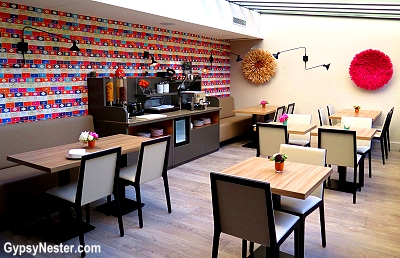
From the moment we arrived, we felt right at home.
We were warmly welcomed by the Vic Eiffel manager, Nathalie, who gave us a quick tour before settling us in our room.
After filling Nathalie in on our long journey to Paris, she suggested some local cafes for a quiet dinner… after a much needed nap.
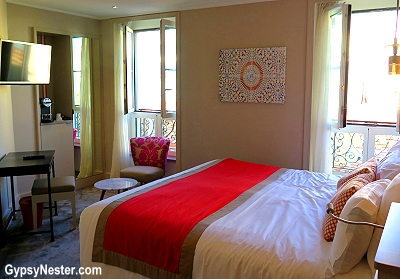
Our room was truly a haven from the busy city surrounding us – quiet, nicely sized by Euro-standards, and fitted with blissful black-out blinds.
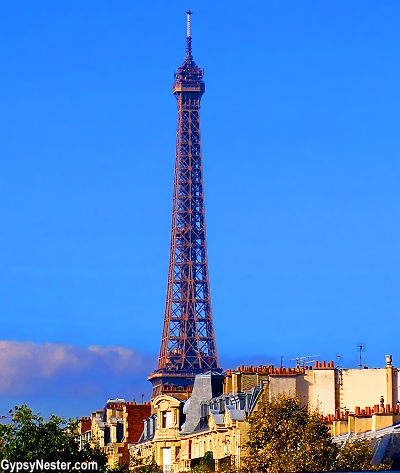
Oh, we forgot to mention the view!
Add in an uber-comfy bed, Wi-Fi in the room, and a jammin’ in-room coffee machine (took a bit for our American selves to figure out how to make it work – but so worth it when we did!) a GypsyNester’s dream.
The downside of choosing a neighborhood hotel — as opposed to one in thick of a city — is usually the lack of ease of getting around. This was not the case at Vic Eiffel.
There is a metro station right across the street (think quiet Paris trains – not NYC subway loud!). We used it on those days that we didn’t leisurely (yeah, right) stroll the lanes of Paris.
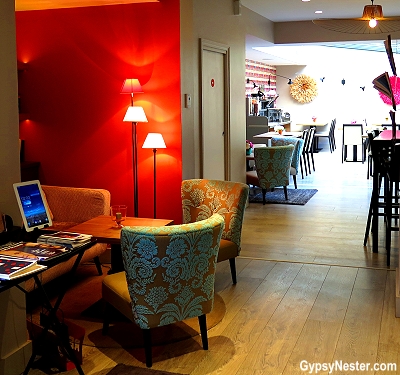
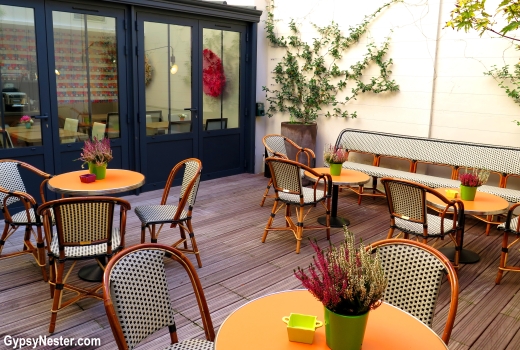
After our crazy days sightseeing, it was so nice to return to surroundings with the warmth of a family-owned inn, but fully furnished with the modern amenities that travelers have come to rely on.
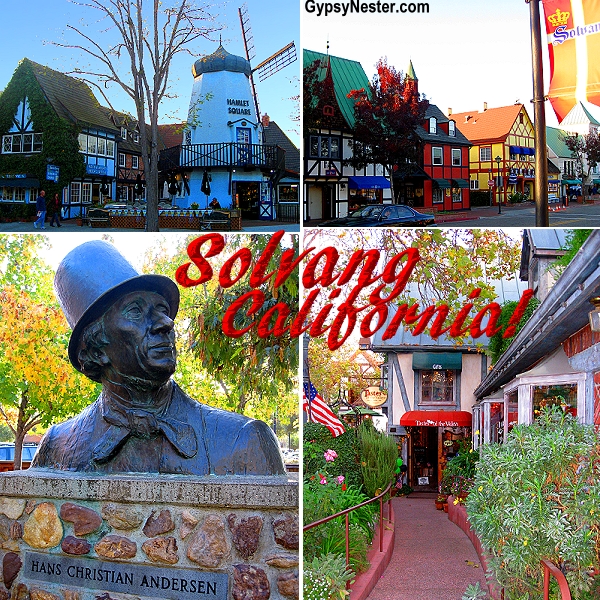
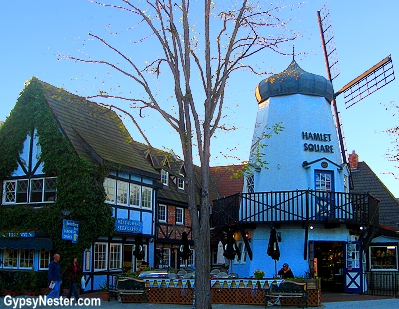
Take Native and Spanish influences, intermix with ingredients from across the Pacific, add a dash of good old American cowboy western and…Eureka!, it’s Solvang, California.
Take Native and Spanish influences, intermix with ingredients from across the Pacific, add a dash of good old American cowboy western and… Eureka!, it’s California.
Diversity aside, we never expected to stumble upon a big dollop of Denmark right in the middle of Santa Barbara County.
Eureka! It’s Solvang.
Here’s the scoop: A few Danish teachers got sick and tired of the brutal winters in the Midwestern United States and decided warmer climes must be attained.
A pioneer spirit and disdain for layering clothing brought to California the “Danish Capital of America.”
Solvang, Danish for “sunny field,” was founded in 1911 by these intrepid educators and they set about building a Danish folk school and a little slice of Scandinavia on the former Spanish land grant Rancho San Carlos de Jonata.
Now that’s cultural diversity.
The town really began to flourish after the Saturday Evening Post exposed their secret to the world in a 1946 article.
Curious tourists arrived in droves and soon hotels, restaurants, attractions and the inevitable crap shops sprung up to serve them and remove the funds from their pockets.
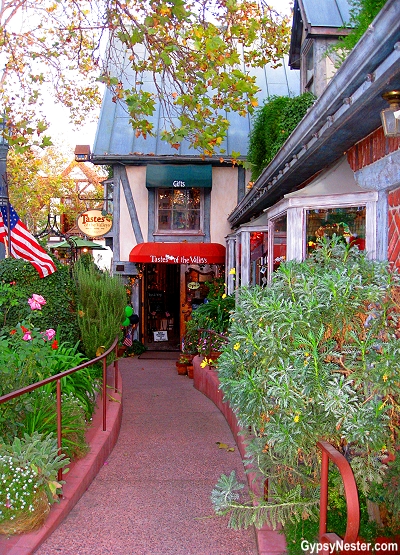
However, these establishments have not overpowered the charm of the town. Solvang doesn’t seem feel like a big tourist trap.
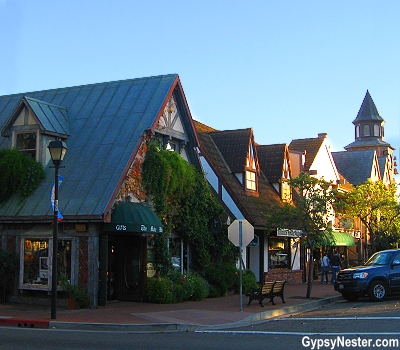
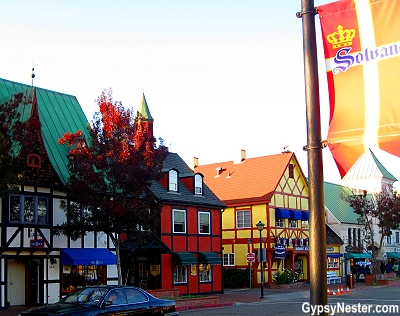
The architecture is authentic, not movie-set-false-front-ish, and the cultural roots feel nourished and well watered.
We noticed that most of the gift shops were sporting wooden shoes.
This seemed out of place because lumber clod-hoppers are generally considered to be Dutch, not Danish. We investigated, google-style.
Turns out the Danes had a flourishing wooden shoe industry back in the late 1800s, they just didn’t get famous for it. Same situation with the windmills.
Whew, we could relax knowing there was no breach of culture. Solvang’s got more Danish flavor than a Sara Lee breakfast.
The town’s not large, just a little over 5,000 folks, so we could dawdle a bit and still hit all the hot spots.
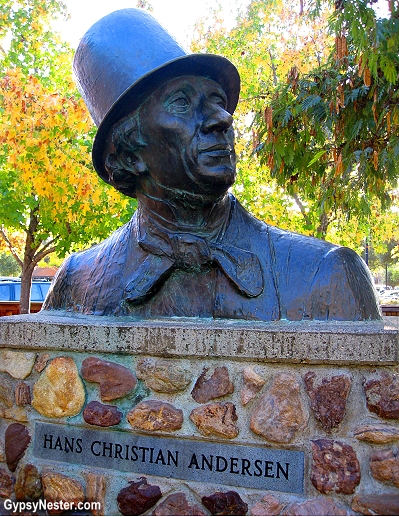
We started with a stroll through the downtown area among the charming old world-style buildings surrounding Hans Christian Andersen Park.
A statue that we thought might be Gene Wilder as Willie Wonka, turned out to be good old Hans himself. Duh./em>
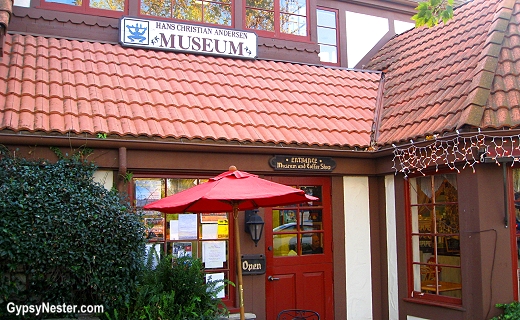
These Solvangites, Solvanginians, Solvangers… um, residents of Solvang are really into Mr. Anderson. They even created a museum in his honor.
We figured that should be our next stop.
Any kid growing up within the last century has been exposed to Hans Christian Andersen, learning valuable life lessons from the fellow that made the fable famous.
The Little Mermaid, The Princess And The Pea, Thumbelina, and The Ugly Duckling are all from his pen and the little museum features these along with lesser known yarns. Many in first editions.
In addition to his writings, Hans was also pretty handy with a pair of scissors and several of his paper cutouts and silhouettes are on display along with sketches, artifacts, and Anderson-related memorabilia.
As usual, food became our focus before too long. Maybe it was all the talk about peas with that princess.
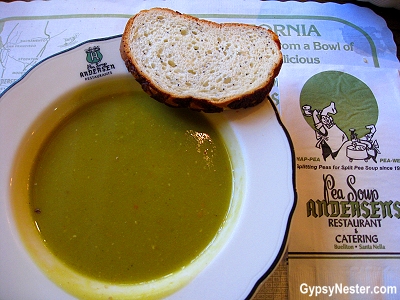
So with peas on the brain (as opposed to pea-brained) we headed just up the road to Buellton and Pea Soup Andersen’s.
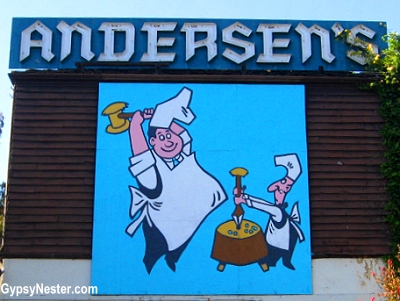
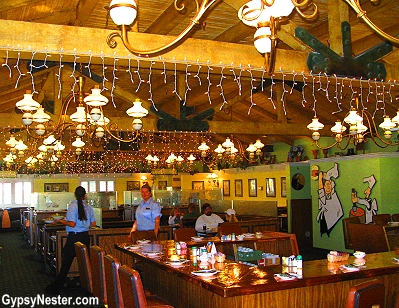
Andersen’s has been serving up All You Can Eat of the green broth for over eighty years.
Famous cartoon chefs Hap Pea and Pea Wee greet guests and entertain with their crazy pea splitting antics.
Veronica put a serious hurt on their profit margin with that offer — learning that the old elementary school joke was accurate — “what you have for lunch? Pea green soup. What did you do all night, pee…”
Sorry ’bout that.
Pea Soup Anderson’s is a Southern California institution. Ask around, everyone’s been here.
By the way, we didn’t get the name turned around. For some reason Andersen’s decided to put the Pea Soup in the front.
They don’t claim to be related to Hans Christian, but you never know.
We’ve fully handed over the Christmas planning process over to our adult daughters, led by The Piglet. We’re in full tell-us-where-and-when-to-show-up mode.
Don’t get us wrong, we feel comfy in The Piglet’s very capable hands, but it is weird. We hardly know what to do with… CONTINUE READING >>
This year marks a turning point for us. We’ve fully handed over the Christmas planning process over to our adult daughters, led by The Piglet. We’re in full tell-us-where-and-when-to-show-up mode.
Don’t get us wrong, we feel comfy in The Piglet’s very capable hands, but it is weird. We hardly know what to do with ourselves.
Things have been slowly evolving as we’ve changed locations – we no longer host Christmases at our home (mainly because we don’t have one!) instead, we all gather in New York City where the girls live. In the process, we’ve added a few new traditions while some old ones have fallen by the wayside.
Thankfully, Decibel getting her broken leg signed by Santa, did NOT become a tradition!
Pondering Christmases past, we are reminded of the ghosts of blending our own traditions when we first formed a family.
How we compromised by dropping some food traditions – Veronica’s Bohemian dumplings and sauerkraut (nobody else in the family ate it!) and David’s Midwestern staple, green bean casserole, or by jealously guarding others – we always had two kinds of potatoes, mashed and twice-baked.
To be honest, our holiday feasts had become turkey-and-carb fests – who has room for veggies when there’s more stuffing to be eaten?
Agreeing on the meal was the easy part, generally more is always better, but coalescing childhood traditions was a little trickier. Veronica’s family opened presents on Christmas Eve, David’s on Christmas morning. Do we do midnight mass or go to church on the day of?
When does the tree go up? (Taking it down was less of an issue, we both agreed preferably pre-Valentine’s Day.)
Then there was the added stress of pleasing our extended families, especially once we had kids.
We didn’t live near any of the grandparents, so deciding who to see and where to spend Christmas always added another layer of stressful decision making.
On a sad note, we are disappointed about celebrating our first Christmas without The Boy joining us.
The responsibilities of his new job are keeping him in Alaska this year, but we are comforting ourselves by imagining that he just might get to see Santa while they are both flying around up there. He’d better take pictures!
Although it’s not our first Christmas without the whole brood together (we celebrated David’s parents’ 60th wedding anniversary in Florida at Christmas-time two years ago and the girls couldn’t make it), it just doesn’t seem right without everyone being there.
On the plus side, we are really looking forward to a new blend of traditions and friends. The Piglet’s boyfriend’s family will be visiting NYC for the first time and we couldn’t be more excited to meet them. They will be coming in from Paris carrying their own customs, and we are really looking forward to a cultural cross-sharing of holiday festivities.
We know next to nothing about Christmas ceremonies in France and are having so much fun grilling The Piglet’s beau on his family’s celebrations.
We have been put in charge of the Bûche de Noël, a traditional uber-cake shaped like a yule log, and have had a blast finding the perfect French bakery with the proper Bûche to make our new friends feel at home.
Thankfully, we will be in New York – home to many Bûche choices – ‘cause baking a Bûche would surely result in a disaster!
We look forward to another holiday that will reinforce our understanding that “Home is where the heart is.”
That adage has become very real for us over the past six years since selling our house and adopting this nomadic life. For us, home for the holidays has nothing to do with a brick and mortar structure.
Home is family. Home is love.
We hope that your holidays are filled with home – wherever that may be.
Amsterdam has a reputation, but the hedonistic side of this city is just a small part of what attracts so many people.
For us, that aspect was a mere curiosity; the real allure is the entirely distinctive personality of this vibrant, energetic, aqua-centric city.
So did we stay out of trouble? Depends how you define trouble… CONTINUE READING >>
Amsterdam has a reputation, but the hedonistic side of this city is just a small part of what attracts so many people.
For us, that aspect was a mere curiosity; the real allure is the entirely distinctive personality of this vibrant, energetic, aqua-centric city.
Often referred to as the Venice of the North, we found some discrepancies in that description.
Yes, they are both built around a system of canals, but there are as many variances as similarities.
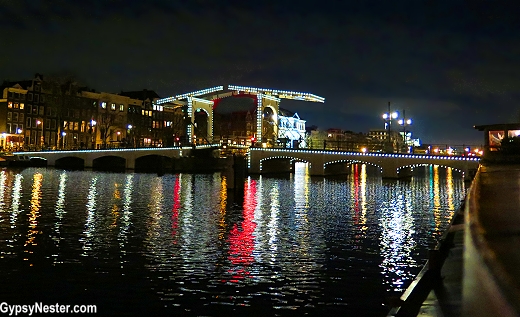
The most noticeable is in the cityscapes; Amsterdam’s main canals were laid out in an arc around the city center, whereas in Venice the canals seem to meander aimlessly.
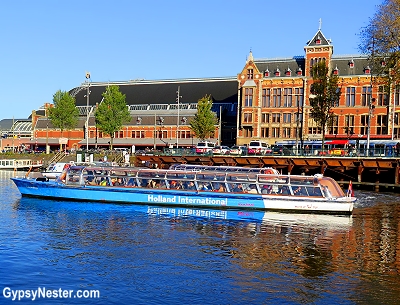
We had to get out on the water to properly see the city!
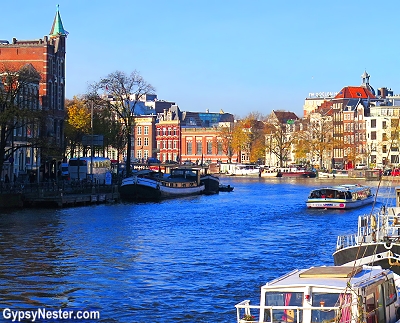
We figured there’s no better way to observe this than from the water, so we hopped on a canal tour for a quick overview.
In the early 1600s three waterways, now known as the Canal Ring, were built to develop the city outward just as Holland was entering its Golden Age.
Dutch ships and merchants spanned the globe over the next century and Amsterdam grew into one of the world’s great cities.
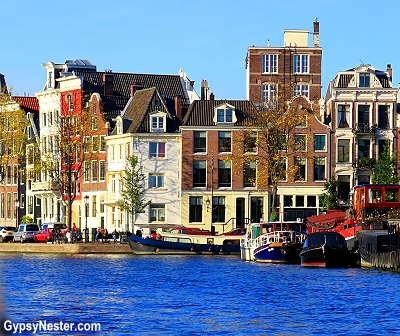
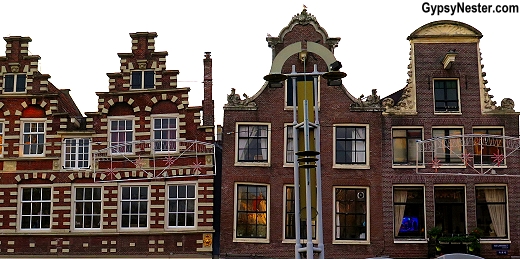
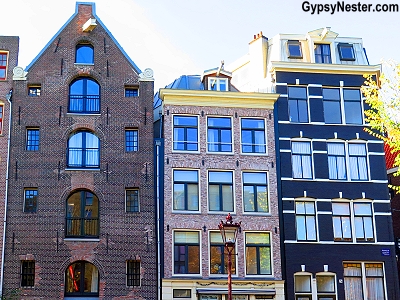
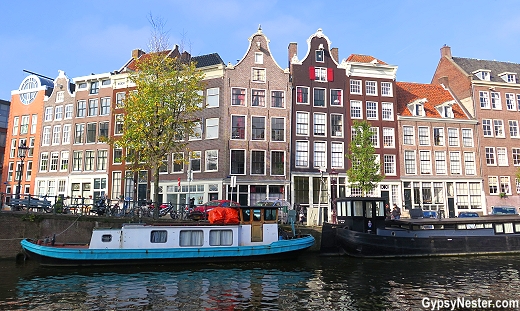
As the city expanded, a distinct architectural style developed; space along the waterways was limited so builders chose to make narrow, deep houses two or three times as long as they are wide, standing three or four stories high.
Watch:
From the boat, we couldn’t help but notice the propensity for these older buildings to slant every which way.
The land is very soft, so wooden pilings had to be set deep enough to reach more solid ground in order to build.
But these have settled over time and left some crazy-crooked structures.
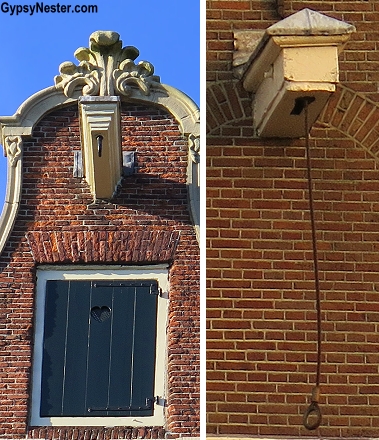
The design makes it difficult, if not impossible, to get furnishings in and out, so almost every home has a hoisting beam attached above the highest window.
This way furniture, or other heavy materials, can be pulled up and brought inside through the large upstairs windows.
Think piano movers in an old silent movie, that’s the idea.
This feature also adds to the crooked look of the houses, since they were built to lean slightly forward so that loads raised on the hoist wouldn’t bump up against the front of the house.
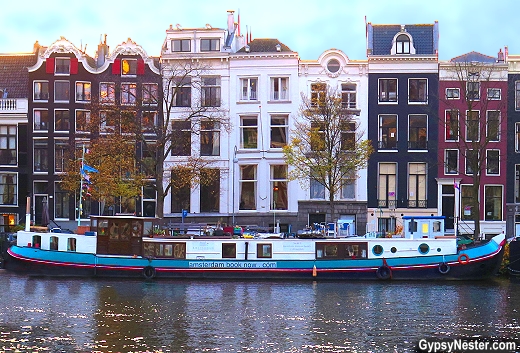
An alternative to living in a crooked house is to reside on one of the myriad of boats lining every available inch of space along Amsterdam’s waterways.
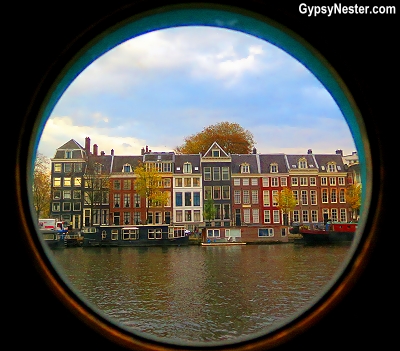
The view from our porthole!
Over the past few decades many of these former freight haulers have become fashionable residences, with a few available as vacation rentals.
We were lucky enough to secure one for our stay — one of the many benefits of off-season travel — and loved the connection to the city’s watery history this gave us.
So did we stay out of trouble? Depends on how you define trouble!
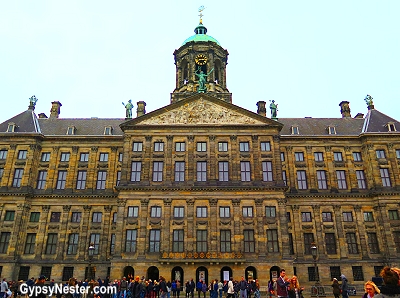
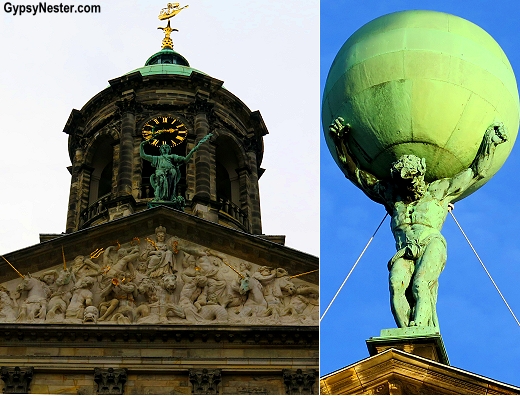
The royal palace
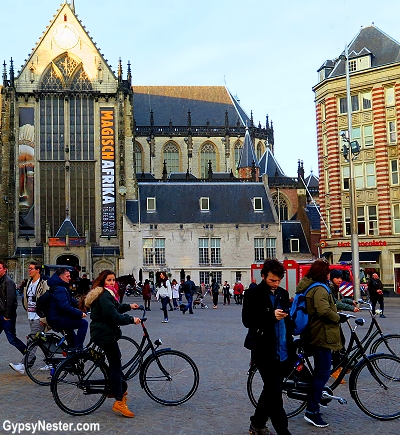
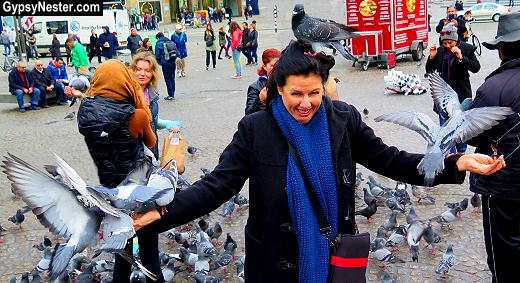
Dam Square, home to the Royal Palace, War Memorial, and the Nieuwe Kerk, or New Church (which is new because it is only 600 years old), stands on top of the old dam.
This makes a great starting point for exploring the old town and the famed red light district.
Whimsical gables atop the royal palace include unicorns and Atlas.Dam Square is also pigeon filled!
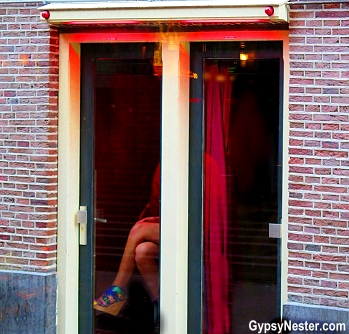
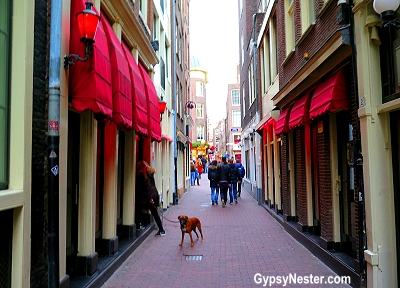
The red light district section of the city that has contributed to its somewhat dubious reputation.
Amsterdam has had a long relationship with the world’s oldest profession, legalizing it two hundred years ago, and unofficially looking the other way for a long time before that.
In this section of town, known as De Wallen because of the old city walls, things became particularly out in the open, likely due to the proximity to the port.
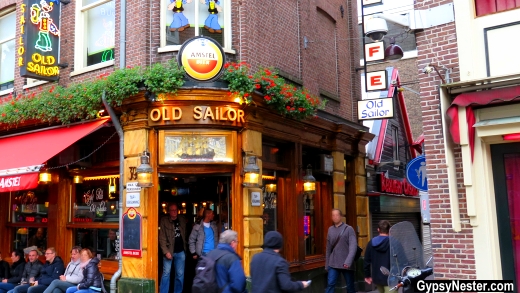
Sailors will be sailors, after all.
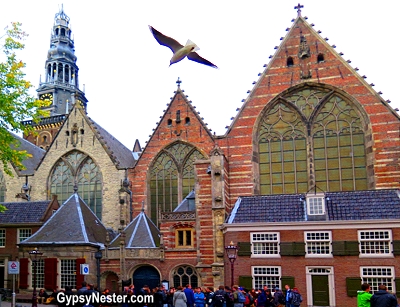
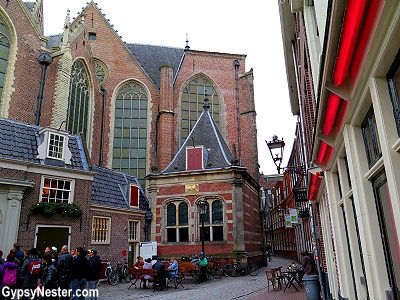
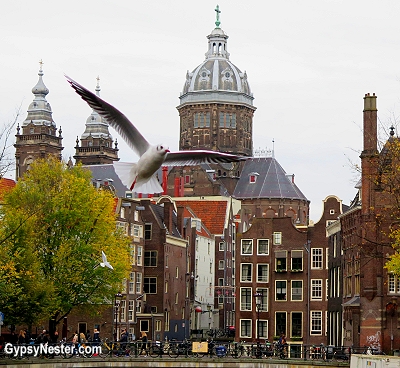
Oddly, this is also the site of the Oude Kerk, or Old Church, which is not only the oldest church, but the oldest building in town.
Originally the church was dedicated to St. Nicolas, the patron saint of sailors, so perhaps that explains the proximity of the prostitution… shore leave and all.
The Old Church is oddly surrounded by the Red Light District.
No matter how it happened, it was strange to see sex workers in windows right across from a church.
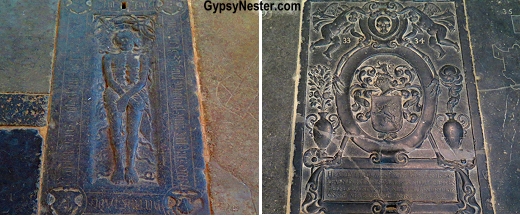
Another quirk that struck us as odd was that the entire floor is covered with graves.
The church was built over a cemetery, and the practice of burying people continued inside the building.
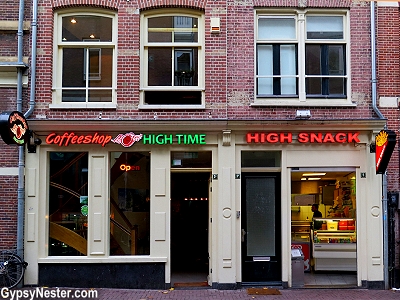
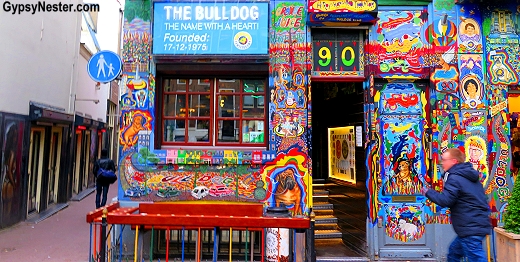
A coffee shop with an adjoining snack bar for when the munchies hit. Clever – get ’em coming and going!
The area has more recently become home to many of Amsterdam’s “coffee shops” that sell marijuana and other cannabis products.
The trend began in the seventies, when these sprung up operating outside the law.
For a while the authorities tolerated them, as long as things didn’t get out of hand. Now they have become registered businesses and are taxed and regulated as such.
The Bulldog, Amsterdam’s first coffee shop.We didn’t feel comfy photographing the ladies of the red light district, so here’s more pigeon and architecture for ya!
We didn’t participate in any of the offerings from either group of these entrepreneurs, but looking is allowed, and we must admit to our curiosity (not that we’re judging, we’re just more comfortable with a cold beverage and each other’s company). 😉
Sure, Amsterdam has a reputation, but more than anything this stems from a long tradition of tolerance, and an open-minded, live-and-let-live attitude.
Since the activities involved happen everywhere in the world — whether legal or outlawed — the city has chosen to address the situation by keeping things out in the open.
Seems odd to us, but who are we to say it’s not a reasonable solution?
Visiting Anne Frank
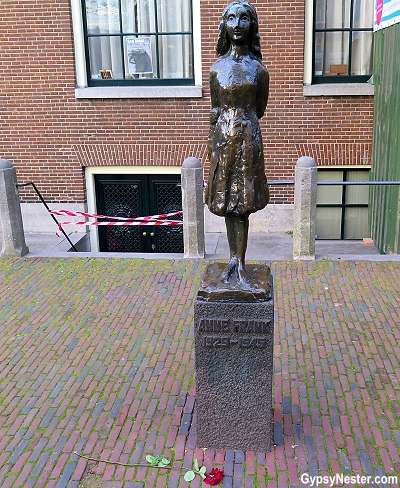
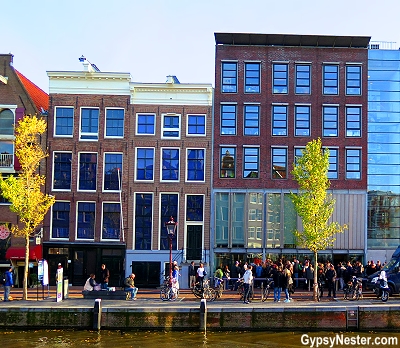
Not far away, but light years removed in significance, we visited the Anne Frank House.
This is the actual building where the Frank family, along with their friends the Van Pels and Fritz Pfeffer, stayed hidden from the Nazis for two years.
The house consisted of several upstairs rooms that were sealed off from the work space and offices of the business that Otto Frank owned.
Anne called it the Secret Annex in her famous diary.
As we walked up the tiny, hidden stairway and through the rooms, the story unfolded in quotes from Anne’s diary.
The rooms have been left without any furnishings just the way the Nazis left them after capturing the family and, to us, the intensity of the small space was actually accented by the emptiness.
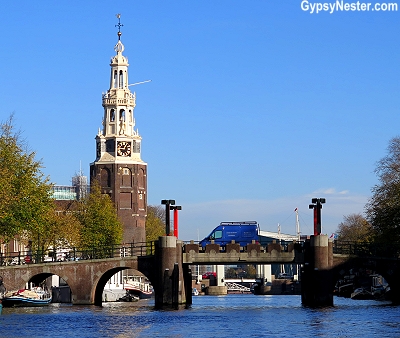
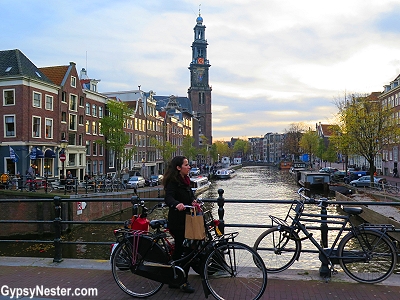
The canal that runs in front of the building, church steeple in the background.
Anne’s father Otto, the only one of the eight to survive the war, insisted that the house be left in this way, understanding the power of the stark portrayal.
He was instrumental in preserving the house, and also in getting his daughter’s diary published.
The view from the building that housed the Secret Annex.
Anne Frank’s story is heartbreaking, and made even more poignant by two facts; the allied forces were only a matter of weeks away from liberating all of Europe when she passed away, and she expressed the desire to be a famous author, which she accomplished only after her death.
Make sure the you have time to take this must-do, emotional tour when visiting Amsterdam – the line to enter can be hours long. An option is to get advance tickets, but there is often a waiting list, so plan ahead. The link for tickets is here
Talkin’ Tulips
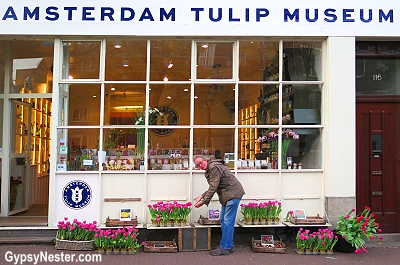
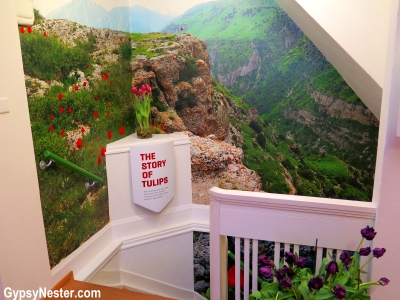
On a much lighter note, the Amsterdam Tulip Museum is right across the Prinsengracht, or Prince’s canal, the outermost of the famous Canal Ring.
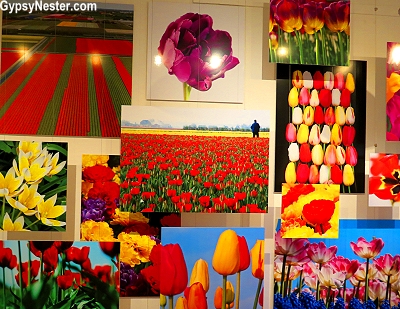
We walked over the bridge and into a colorful collection of all kinds of blooming bulbs.
Inside we quickly discovered that there is quite a flowery history to the tulip and its relationship with Holland.
Brought from Turkey by biologist Carolus Clusius over four hundred years ago, tulips caused such a craze that the first ever speculative commodity bubble was inflated as people began trading the bulbs with reckless abandon.
To ward off another crash, we run to the Amsterdam Stock Exchange and take the bull by the horns.
Before long, a single bulb was worth well over the annual salary of a reasonably wealthy merchant.
At the peak, ounce for ounce, tulips were selling for about one-hundred times the price of gold.
But the inevitable crash came and economists learned about market bubbles – but apparently not how to prevent them from reoccurring.
Dutch Masters
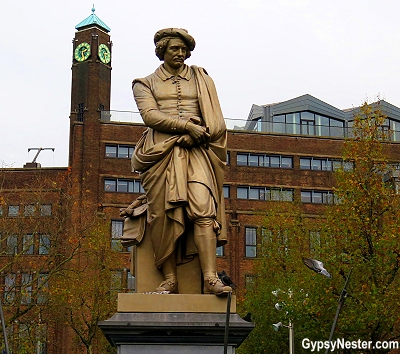
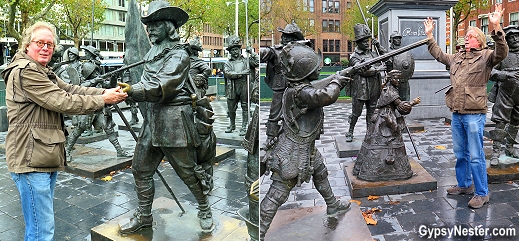
Statue of Rembrandt in Rembrandt Square
Perhaps it would have been better to invest in art, since Amsterdam is also home to some of the world’s greatest masterpieces.
Several are in the Rembrandt House Museum, which just happened to be a few blocks from our houseboat.
The artist lived there from 1639 until 1656, when bankruptcy forced him out.
Fun with the recreation of The Night Watch below the statue of Rembrandt.
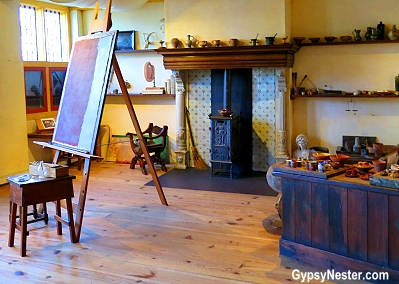
To settle his debts, all of his belongings went on the auction block, but his misfortune made for a better museum because the auction list aided in reconstructing the house just as it had been.
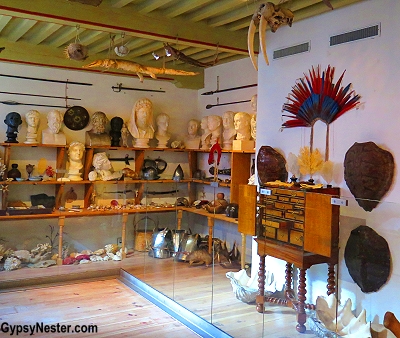
His office, living quarters, and studio all have been recreated in fine detail, including the collection of relics and oddities that contributed to his financial difficulties.
The insolvency didn’t seem to harm his work though, and Rembrandt, along with his contemporaries of the late seventeenth century, became known as the Dutch Masters.
We have no idea how the term came to be applied to rolled tobacco products.
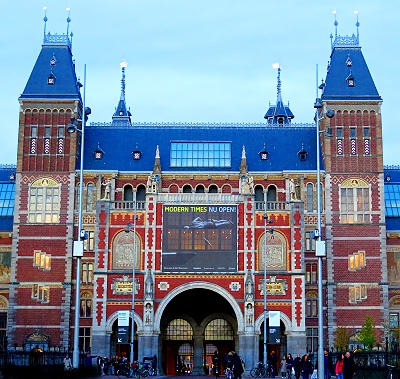
Works of Van Gogh and Rembrandt are also housed at the massive Rijksmuseum.
Two centuries later another Dutch painter also became famous, Vincent van Gogh. His works are on display at several venues around the city, but the largest collection, in fact the largest in the world, is housed at the Van Gogh Museum.
The collection is displayed along with works by some of his contemporaries, such as Monet and Picasso, in a sort of timeline that we followed as we went up through the four floors.
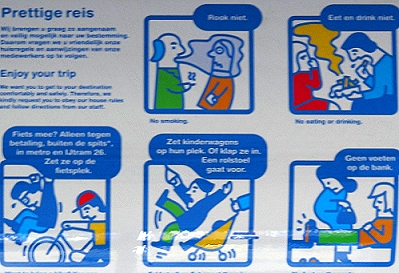
Rules for the tram – what on earth is the guy in picture #2 eating?!
The museum dedicated to van Gogh is a short tram ride away from the old town in Museum Square, and both the tram and museum were covered by our Iamsterdam city cards.
In fact, the cards also included our boat tour, and almost all of the other attractions we visited.
Dutch treats!
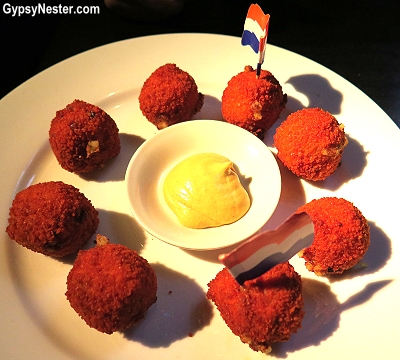
No GypsyNester adventure is complete without digging into the local food fare and our first encounter was with bitterballen.
These little deep-fried balls of meat, broth, flour, and butter, rolled in a crunchy breadcrumb coating can be found in just about every bar and cafe.
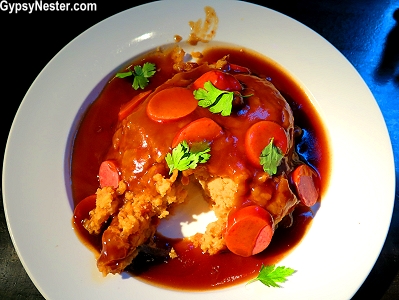
But bitterballen are just a snack, for real stick-to your-ribs comfort food we indulged in a stamppot — or hutspot to be exact — the most traditional of the stamppots.
The hefty mix of mashed potatoes, carrots, onion, and rookworst, a Dutch smoked sausage, dates back hundreds of years.
This staple became especially popular during World War II because the vegetable ingredients could be locally grown, underground.
It’s not fancy, but it certainly fills the tummy.
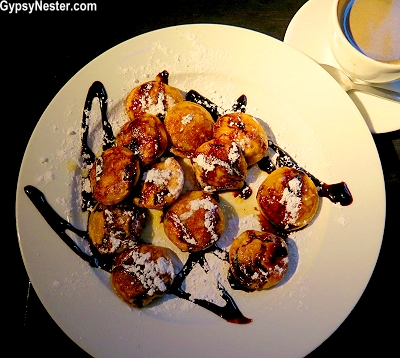
Our go-to dessert had to be the little puffy pancakes drizzled with chocolate sauce and powdered sugar called poffertjes.
Freakin’ delicious – even after a partaking in a stampot we could always find room for poffertjes.
We probably couldn’t handle more than one olliebollen – the heftier kissin’ cousin of the poffertjes.
We’d been on the lookout for a real Dutch olliebollen after our humbling experience with one at the Tulip Festival in Holland, Michigan (they were called “fat balls” there – an acceptable translation, but a little harsh!).
Luckily, our visit coincided with the holiday season — the most bollen time of the year — and it didn’t take long to find a festive street stall doling out the balls.
We expected a better bollen in the land of their birth, and we were not disappointed.
Translation aside (maybe oil ball? Grease ball? Yeah, there’s no way to make it sound good!), we found them lighter, tastier (and ultimately more easily digestible) than their Michigan counterparts.
Soooooo many bikes!
One last, huge difference between Amsterdam and Venice is the presence of roads… and bicycles, nearly a million of them.
The Dutch city is bustling with a crazy amount of bikes scurrying every which way, at least one for every resident.
As unnerving as this struck us at first, we quickly adapted to looking out for the cyclists, and just imagine what the traffic would be like if all of them were driving cars!
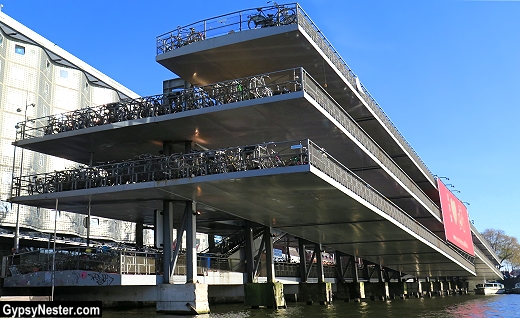
The three-story bicycle parking lot at the Amsterdam train station! We were told that an expansion is necessary and plans are underway.
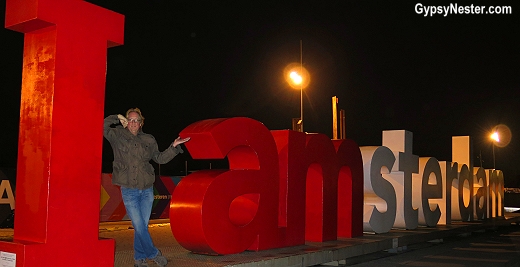
HUGE thanks to I Amsterdam and Amsterdam Book Now! for supporting this adventure – and to Eurail for the 15-day rail pass that inspired us to undertake it! As always, all opinions are our own.! As always, all opinions are our own.
For an introduction to the canal system of Amsterdam, often called the Venice of the North, we hopped on one of the many tour boats for a guided cruise… CONTINUE READING or enlarge video>>
For an introduction to the canal system of Amsterdam, often called the Venice of the North, we hopped on one of the many tour boats for a guided cruise.
First our boat took us through the harbor, among the cargo barges and ferries crossing over to what the locals call the “opposite side,” before we left the river, we enter the canals in what is known as the Canal Ring.
These three waterways were dug in the early sixteen hundreds, and form a semicircle around the city center.
Veronica had never been to South Carolina, and we were both intrigued by the town of Charleston, so we headed for the coastal Lowcountry and discovered one of America’s most interesting cities… CONTINUE READING >>
We didn’t really have a destination in mind other than south to escape the winter.
Veronica had never been to South Carolina, and we were both intrigued by the town of Charleston, so we headed for the coastal “Lowcountry” and discovered one of America’s most interesting cities.
Originally called Charles Towne way back in 1670, after the Revolutionary War when the British left, the name was officially changed to Charleston in 1783.
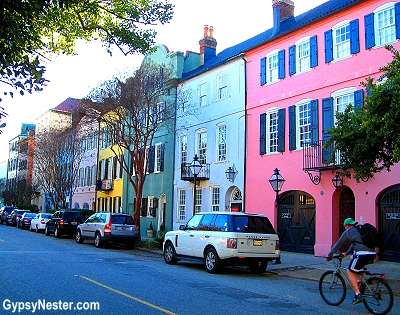
Remarkably, it looks much as it did back then.
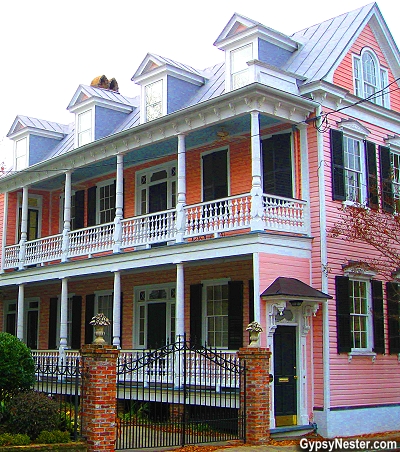
A phenomenal amount of the colonial structures remain, and most have been restored to like-new condition.
To get a closer look at these gems, we knocked the dust off of our trusty bikes and cycled into the heart Charleston’s historic district.
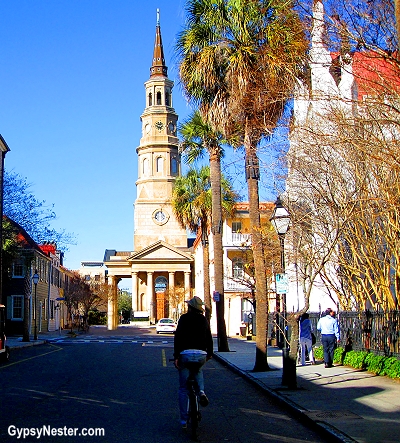
Highlights of the district included The Market Hall and Sheds, known simply as the Market, built in the 1830s, Battery Park with its cannons, the promenade, and a plethora of churches.
In Charleston steeples, not skyscrapers, form the skyline.
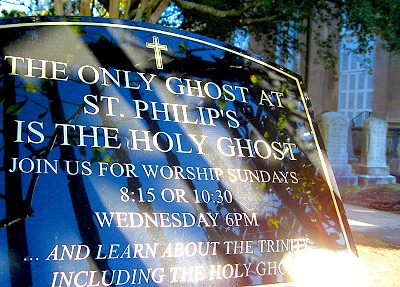
Charleston is sometimes called “The Holy City” in recognition of all those churches, as well as being one of the few cities in colonial America practicing religious tolerance.
In fact, it was one of the first to allow Jews to openly practice their faith and, until the 1830s, boasted the largest Jewish community in North America.
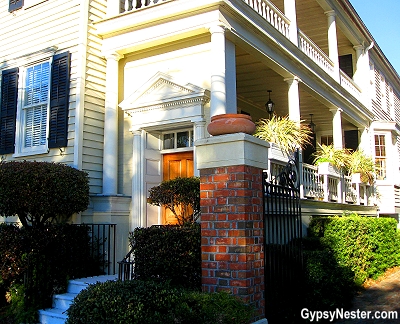
Something else stood out to us as we pedaled around – many homes had odd doors facing the street leading to outside porches.
Having never seen such before, we dubbed them “porch doors,” and tossed around quite a few theories as to why they existed before finding out their true function.
Known as hospitality doors, these portals were a way of communicating with friends and neighbors.
Leaving the door open meant the occupants were home and ready to receive guests and offer up some good old southern hospitality. Possibly with a mint julep on the veranda.
We would have been on the lookout for open doors if we had known this fact ahead of time – who knows what we missed out on.
Hospitality doors are a staple feature of the colonial style homes known as the Charleston Single, unique to the city.
The houses were situated perpendicular to the street with the porch facing sideways. This allowed for maximum outdoor living space, more cross ventilation and, more homes fit on longer, narrow lots.
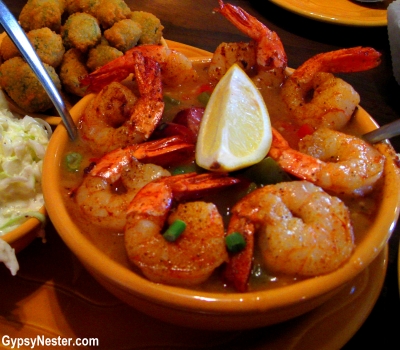
After a quick pit stop for some shrimp & grits, a Lowcountry favorite, we happened upon the campus of Charleston College, right in the midst of the historic old town.
Talk about historic – the college was founded in 1770 – C of C is the oldest municipal college, and 13th oldest college of any kind, in the United States.
Three of the school’s founders signed The Declaration of Independence and, three more, The Constitution.
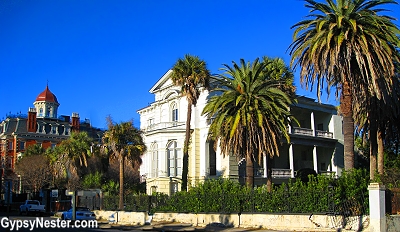
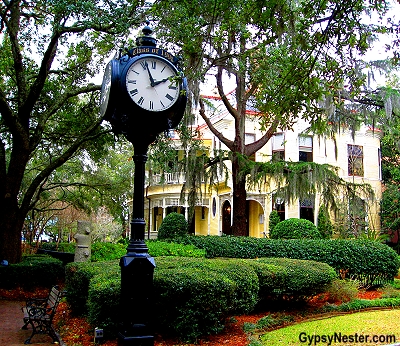
Through the years the campus has grown and now incorporates some amazing stately old mansions.
Hope these young whippersnapper students appreciate their surroundings – with its Spanish moss draped trees and elegant architecture, it is the most beautiful campus we’ve seen.
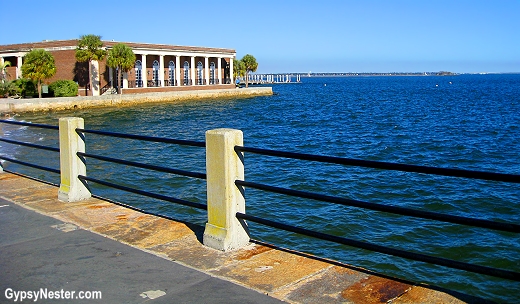
The old city is packed tightly onto a peninsula in the harbor, so to get to a good stretch of beach we needed to get out of town.
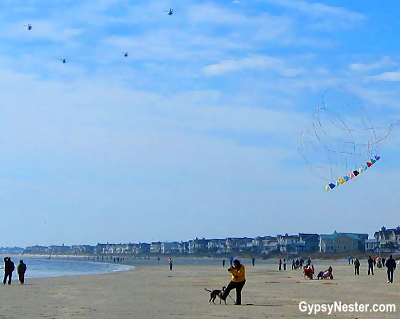
On the nearby Isle of Palms, it wasn’t warm enough for swimming, but plenty of folks were out enjoying the gorgeous day.
Turns out it was also the perfect day for military helicopter maneuvers and kite flying.
And we may have found the kite king. Anyone who can fly a dozen kites attached together has got to be royalty. He finds pure joy making the strangers around him happy!
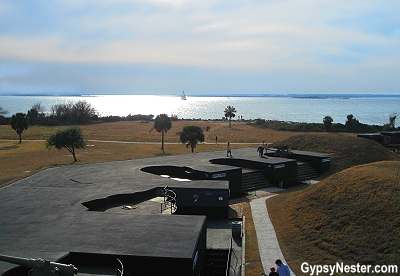
Just a hop, skip and a jump closer to Charleston from The Isle of Palms is Sullivan’s Island and Fort Moultrie National Monument – the best place to view Fort Sumter from dry land.
Fearing an impending attack from the Brits in 1776, Fort Moultrie was the first of Charleston’s many fortifications.
The fort was originally built of Palmetto tree logs because the trees were readily available and the colonists were in a hurry.
This turned out to be a stroke of incredible luck though, since the palm logs are soft and rubbery.
When the British attacked, their cannon balls pretty much bounced off the fort doing little damage. The King’s navy was held at bay, and South Carolina became known as The Palmetto State.
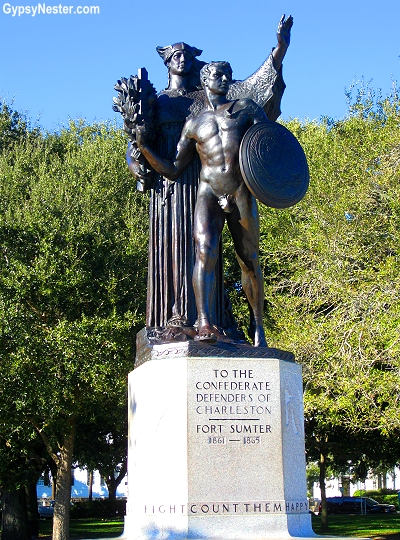
Fort Moultrie went on to see service guarding Charleston in every conflict through World War II, including firing some of the first shots of The Civil War, when General Pierre G. T. Beauregard fired on the Union.
In the Visitors Center, exhibits detail the nonmilitary history of Sullivan’s Island as well.
The Island was the largest slave port in North America, with over two hundred thousand shackled people passing through.
Almost half of all African Americans have an ancestor forced to disembark there, a kind of reprehensible version of Ellis Island.
Once onshore, the enslaved Africans were mostly left to themselves on these coastal islands, since the plantation owners feared diseases and wanted to live in the city.
A unique culture and language developed on these sea islands in The Carolinas and Georgia known as Gullah.









 We walked over the bridge and into a colorful collection of all kinds of blooming bulbs.
 Brought from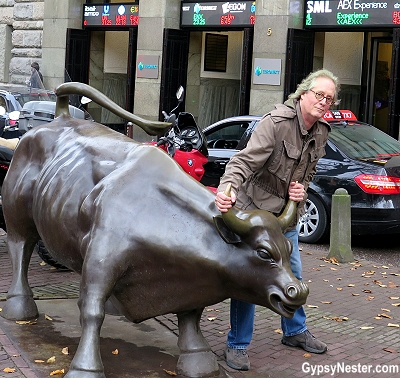
 To settle his debts, all of his belongings went on the auction block, but his misfortune made for a better museum because the auction list aided in reconstructing the house just as it had been.