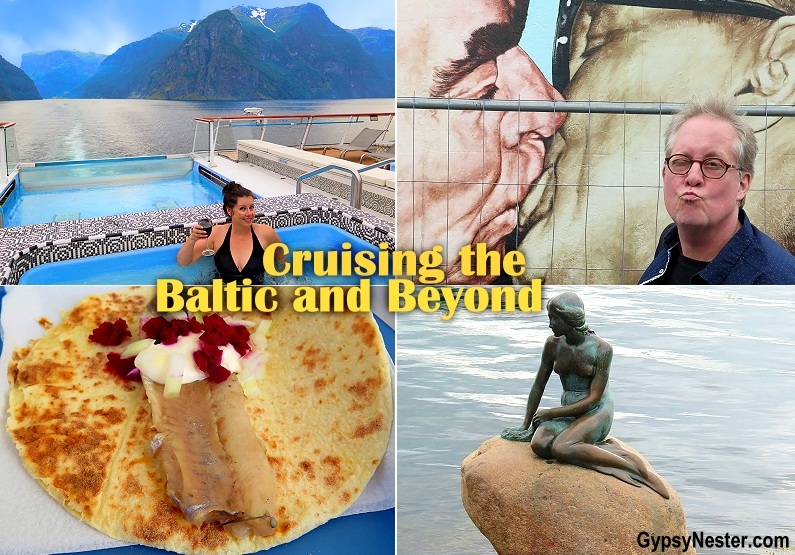
Written aboard the Viking Star on her voyage through Sweden, Finland, Russia, Estonia, Poland, Germany, Denmark, and Norway. Thanks to Viking Ocean Cruises for inviting us along and providing this adventure! As always, all opinions are our own.
DAY NINE: Berlin, in all Her History
See more about our time in Berlin here.
Morning: David the Train Nut is a Happy Guy!
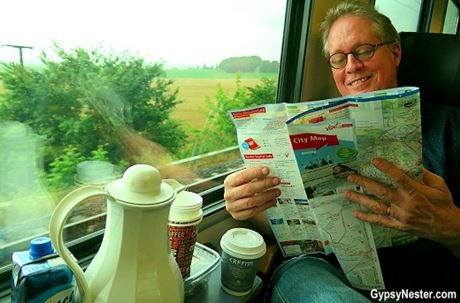
David heaven: A train, a map, a cup of joe
Wait, Berlin is not on the sea, is it? Correct, it is over a hundred miles inland, so we take a Viking chartered, two-hour train ride into Germany’s capital where we will explore Berlin on our own.
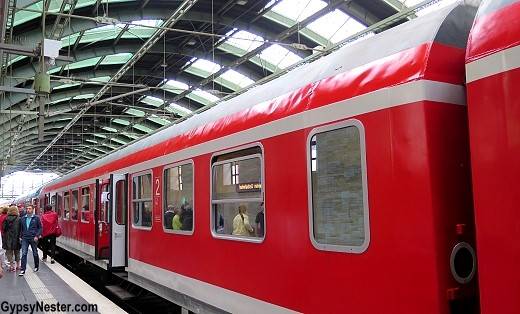
We enter the East Berlin train station
Our first stop is at the East Side Gallery of the Berlin Wall. This is a nearly mile-long section of the Wall that has been covered with one hundred and five paintings by artists from all over the world.
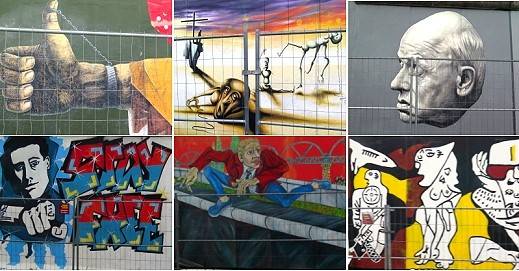
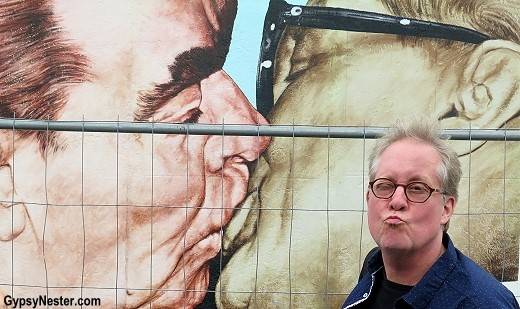
We immediately gravitate to perhaps the most famous of those, a picture by Dmitri Vrubel of Leonid Brezhnev and Erich Honecker kissing.
Afternoon: Things are Beginning to Feel all too Real
From the Wall, we go to Checkpoint Charlie, the best known passage between the two German states created by the partitioning of the city at the end of World War II. After the East Germans built the wall in 1961 the allies had three crossing points: Alpha, Bravo, and Charlie.
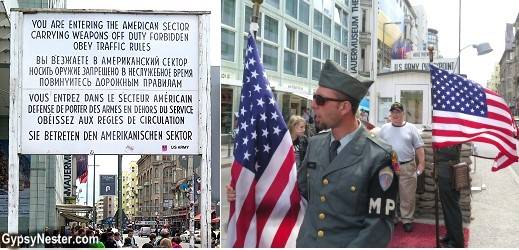
This was the only one in the middle of the city. Unfortunately, what we see now is only a replica. In October 1990, the real guard house was removed and put on display in the Allied Museum.
See more about our time in Berlin here.
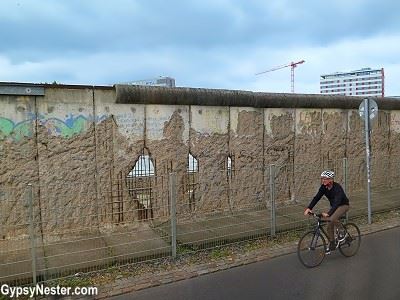
The barrier was built to keep people in, not out, after three and a half million East Germans had fled to the West between 1946 and 1961.
To stop the tide, an eight hundred and thirty-eight mile concrete border was erected.
The Berlin Wall was actually two parallel walls with a no-man’s land situated between them. We learned that towers were installed within eyeshot of each other and overseen by armed guards with orders to shoot to kill anyone who made it over the first wall.
Every morning, the dirt in the no-man’s land would be carefully raked, and if any footprints were found without a dead body nearby, the guards would be punished.
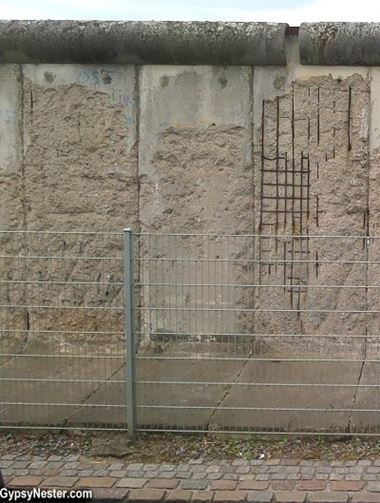
A few blocks from the checkpoint there is another section of the wall, one that is left without embellishment.
Finding the concrete surprisingly thin—and the overall height much lower than we had imagined—we look into the additional measures used to keep people from breaking through it.
In the patches where the concrete was worn we see tight interlacing of metal, making it impossible for tunneling. The top is rounded—then it was heavily greased—making it impossible to gain purchase with hands, or a ladder.
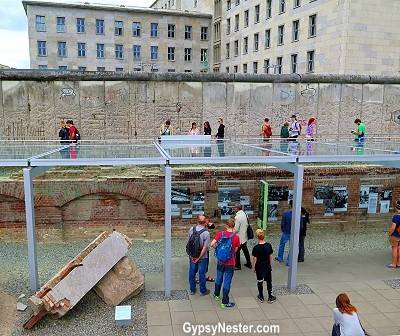
This section of the wall runs right along the place where the Gestapo and SS had their headquarters.
The buildings were completely destroyed by bombs at the end of the war, but the foundations have been used as a backdrop for a display detailing the history of repression under the Nazis.
The gravity of this site, along with the incredibly disturbing information unfolding before us, has us feeling overwhelmed and our next stop only adds to that.
Evening: We Press On
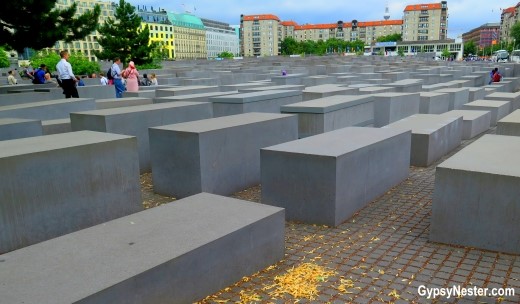
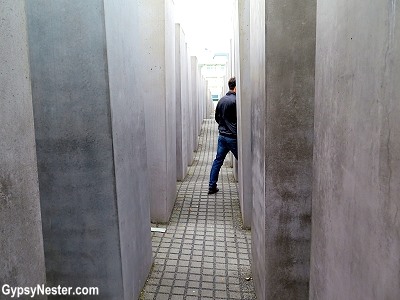
The stark reality of the Memorial to the Murdered Jews of Europe only increases the heaviness we are feeling.
The design of 2,711 concrete blocks of various heights is intended to show how a supposedly ordered system can lose touch with reason, but the creators also wanted the interpretation to be open to each individual.
To us it certainly captures the weight of the events that it memorializes.
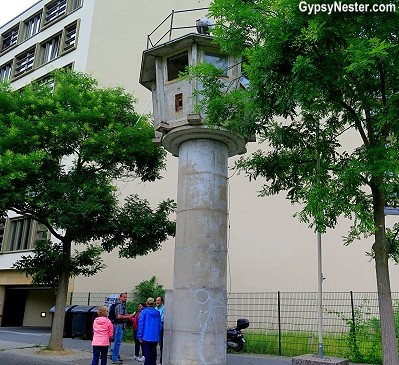
We stumble upon yet another reminder of this city’s darker days just off the main street nearby, the last remaining watchtower from the days of the German Democratic Republic, better known as East Germany.
Of course, had it been actually democratic, or a republic, towers like this would not have been necessary.
In an attempt to lighten up our mood we stop for a quick bite, and in Berlin that means a currywurst.

Just as the name implies, this is a twist on the typical German sausage by smothering it with catsup and curry powder.
The snack became popular after the war as street stands began to pop up around town.
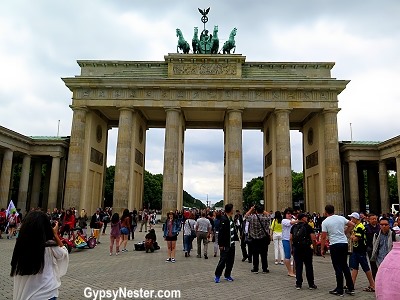
From the darker days of Berlin’s twentieth century history, we jump back to the more regal reminders of the imperial era of Prussia and Germany.
The most notable of these has to be the Brandenburg Gate.
As with almost everything in the city, the gate was damaged by bombing in World War II, but was restored at the end of the war, and again when the wall came down.
After that it became a powerful symbol of German reunification.
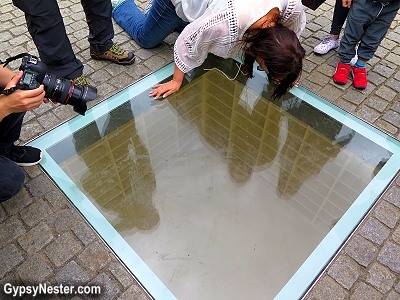
While walking through the heart of the city we come to Bebelplatz.
We stop at this seemingly insignificant plaza because this was the site of an infamous Nazi book burning.
A memorial is here but we have to look hard because it is easy to miss.
A window placed in the cobblestones looks down on empty bookcases that would have held the 20,000 destroyed books.
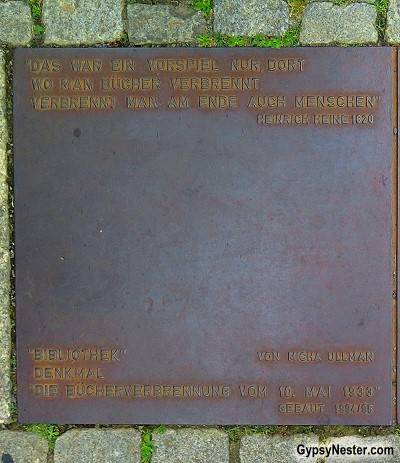
The effect is poignant, but by far the most powerful aspect of the memorial is a plaque with a scary, prophetic line from a play by one of the authors whose books were banned, Heinrich Heine.
He wrote: “Das war ein Vorspiel nur, dort wo man Bücher verbrennt, verbrennt man am Ende auch Menschen.”
Which means “That was only a prelude; where they burn books, they will in the end also burn people.”
Our train ride back to the Star was one spent in somber thought.
See more about our time in Berlin here.
DAY TEN: Mermaids, Free Spirits, and Sad Bears in Copenhagan
Morning: Hans, Weather Girls, and a short, fat, alchoholic
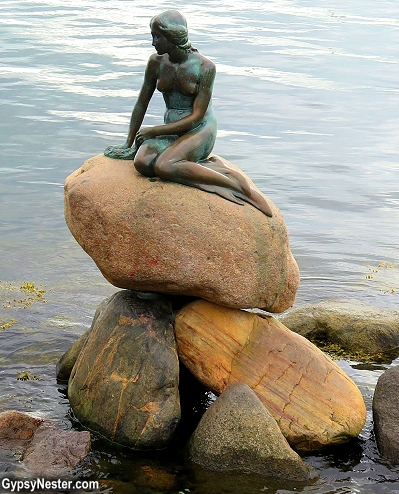
Pulling into Copenhagen this morning, we dock right by a little statue that has become a symbol for the city, The Little Mermaid.
Sitting on a rock in the harbor, the bronze figure by Edvard Eriksen has been a famous tribute to Danish author Hans Christian Andersen since 1913.
From the port we make our way to Amalienborg Palace, which is actually four identical palaces surrounding an octagonal courtyard.
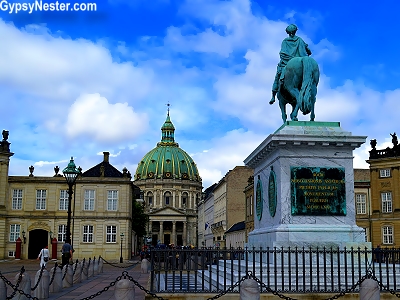
The royal family has been living on this site for about four hundred years, including the current Queen Margrethe II.
Our guide points out an equestrian statue of King Frederick V In the center of the square and explains how, even though this whole complex was his baby, it doesn’t really look like him.
It seems he wanted to be depicted as a Roman god-like emperor, when in the words of our guide, “the artist must have had quite the time of it; Frederick was a short, fat, alchoholic.”
We love hilarious honesty in a tour guide!
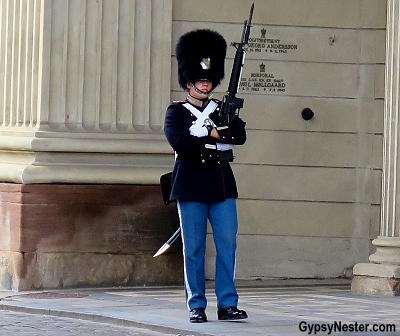
Much like Buckingham Palace, Amalienborg is guarded day and night by Royal Life Guards.
These sentries are from an elite infantry regiment of the Danish Army, founded in 1658 by King Frederik III, and are much more than ceremonial.
When they are not wearing funny hats, they serve in a front-line combat unit.
Deeper into the center of town we come to City Hall Square, but unfortunately a massive reconstuction project has most of it hidden.
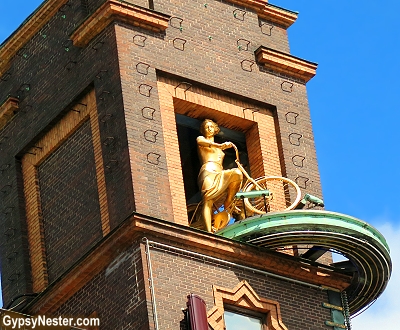
We do get to see The Weather Girls perched on top of the Richs building in one corner.
On a nice day, such as today, a sculpture of a girl with her bicycle rotates to the front, but when rain moves in another sculpture appears of her with an umbrella walking her dog.
Not exactly Accuweather, but fun nonetheless.
Another palace, Christiansborg Palace, is not far away. This spot has been the seat of Denmark’s government since 1167, when the first castle went up.
Two more castles and a couple of palaces later and we are looking at the home of the Danish Parliament, as well as the Prime Minister’s Office and the Supreme Court, making it the only building in the world that houses all three of a country’s branches of government.
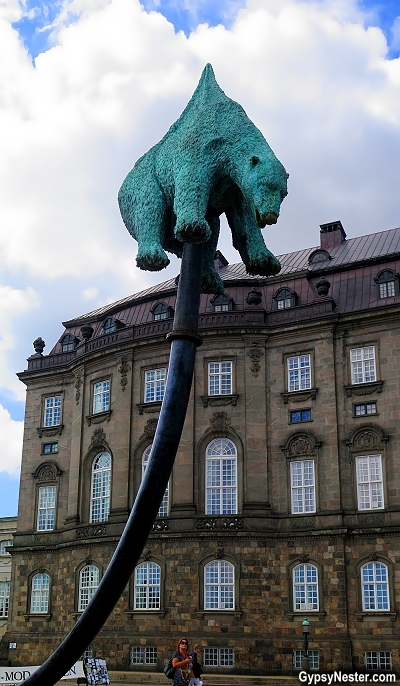
That’s a whole lot of history, but it is a new addition to the courtyard that catches our eye, the artwork entitled Unbearable was just placed this spring.
In it an iron pipe portrays the levels of atmospheric carbon dioxide sky-rocketing into the belly of a polar bear like a spear.
The sculpture is by Jens Galschiøt, and was created in collaboration with the World Wildlife Fund.
See much more about Copenhagen!
Afternoon: A Contact High, Our Favorite Spire so far, and Some Serious Munchies
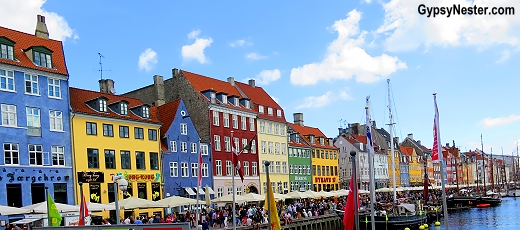
We pass through colorful Nyhavn – Hans Christian Anderson lived in this neighborhood
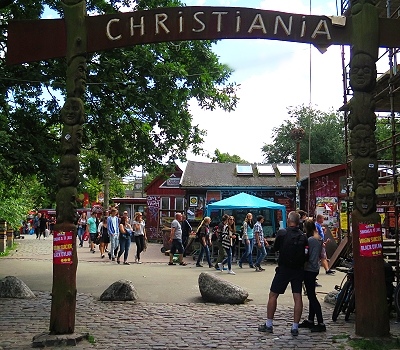
Breaking off from our tour group, we want to check out an area of Copenhagen that is not a part of the usual tourist programs, Christiania.
This unique oddity began back in 1971 when a group of oh, for lack of a better term, let’s call them hippies, moved into an abandoned military facility.
The counter culture squatters declared themselves an autonomous entity known as Freetown Christiania.
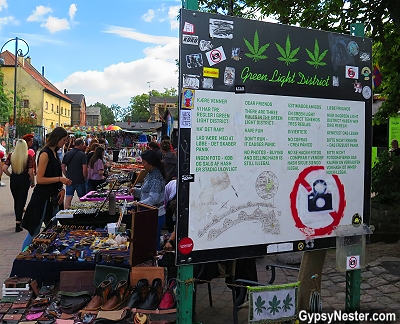
It didn’t take long for a thriving cannabis trade to develop, and the business was generally tolerated and overlooked by the authorities for years.
The attitude seemed to prevail that keeping things confined to this area might not be a bad thing, but in 2004 there was a crackdown and the practice went undercover.
Now things have relaxed again, but with some odd twists that we encounter as we enter Pusher Street in what is known as the Green Light District.
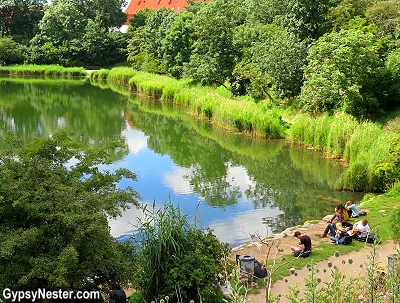
Booths are openly selling pot and hash but the proprietors are all wearing ski masks or scarves to hide their identities, and a no photos policy is strictly enforced.
Other than the somewhat dark underground feel of this small section, we find Christiania to be mostly groovy with folks enjoying the good vibes of the beautiful day while getting baked in a lovely setting.
Having dug the scene, we decide to split before we develop a serious contact high.
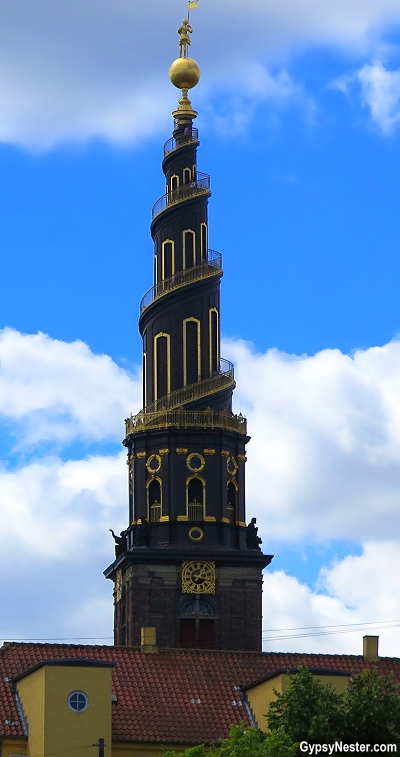
Besides, a very cool landmark had been guiding our path since we set out to find Christiania from across the bridge, the distinctive spire of the Vor Frelsers Kirke.
The church is just beyond the commune and tower stands out because the staircase to the top spirals around the outside.
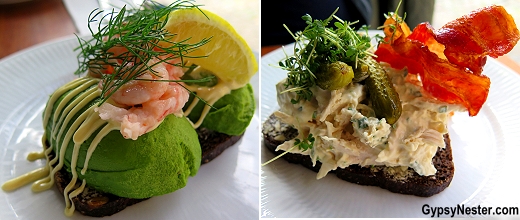
Having found both the commune and the tower we are ready to reward ourselves with a Scandinavian lunch treat, a smørrebrød.
These are open-faced sandwiches meant to be eaten with a knife and fork.
Toppings are artistically arraigned on brown bread to create an edible work of art.
We go with chicken salad and shrimp on avocado, two classics.
See much more about Copenhagen!
DAY ELEVEN: Messin’ with the Mayor—and the Nazis in Ålborg, Denmark
Morning: Sticking your tongue out at Mr. Mayor, and Talented Pidgeons
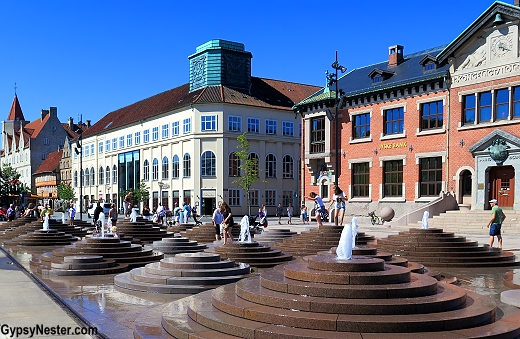
In the northern part of Denmark known as Jutland, we make a stop at Ålborg. For being Denmark’s fourth largest city, she sure has kept a small town feel. The Star docks right in the heart of town, so we simply step off the ship and find ourselves in front of the Utzon Center.
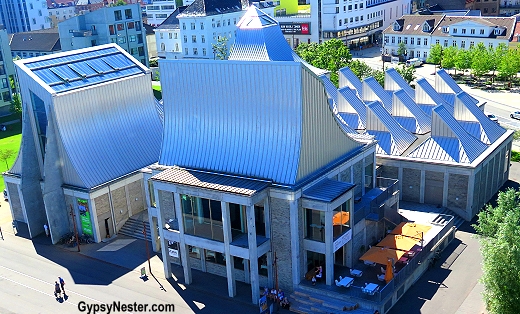
This captivating structure was the last building ever designed by famed architect Jørn Utzon, of Sydney-Opera-House-in-Australia fame.
Utzon grew up in Aalborg and intended the center to act not as a museum, but as a place for students of architecture to congregate and discuss ideas. Unfortunately he passed away before the project was complete, but his son Kim took the helm and finished up Dad’s vision.
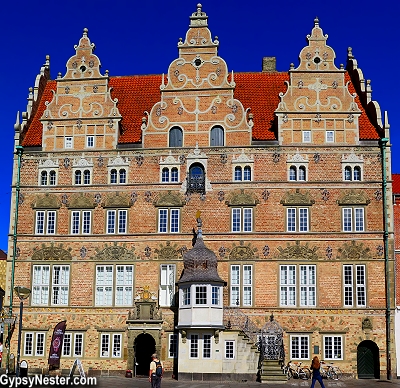
Moving into the city we stop by the Jens Bang House, said to be Denmark’s finest privately owned Renaissance building.
The ridiculously rich Bang, who was also a bit of an eccentric, built his home in 1624.
The story goes that he purposely put it next to city hall, where his half-brother the mayor worked, so he could maintain an ongoing feud.
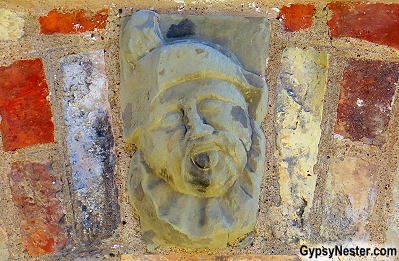
At some point Bang upped the ante with a sculpture of his face was added on the side facing city hall, with his tongue sticking out.
No doubt that went over with a bang.
Try to get along boys.
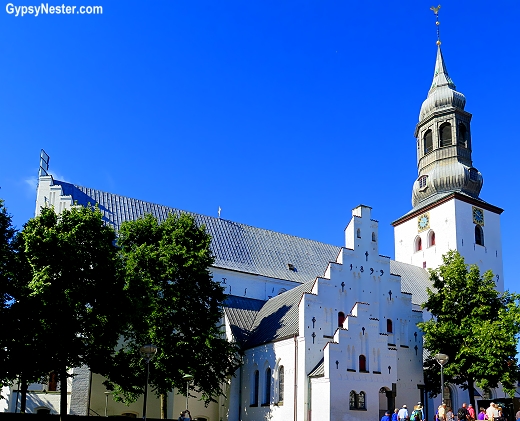
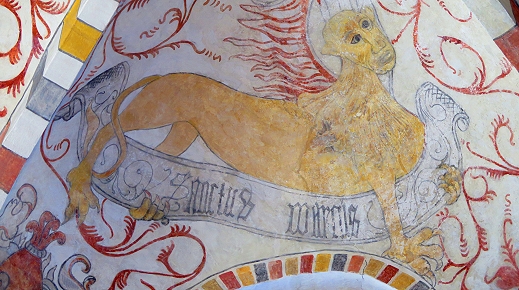
Around the corner we come to the Budolfi Cathedral, which is over six hundred years old and contains original artwork on the ceiling of the entry vestible.
Apparently the artist was unaware what a lion looked like. So he or she just jammed.
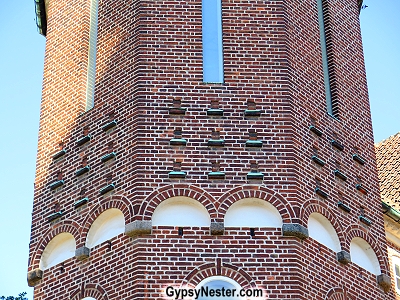
Our guide points out the old post office across the plaza.
OK, nice enough building, but wait:
“See those holes up on the tower?” she asks. “Can anyone guess what they were for?”
We don’t have a clue so she explains, “carrier pigeons.”
Yup, the homing birds were used to deliver mail up until the 1960s.
We could just imagine folks up there in the tower tying little letters to little birdy legs.
Afternoon: There’s More than one way to Resist the Nazis
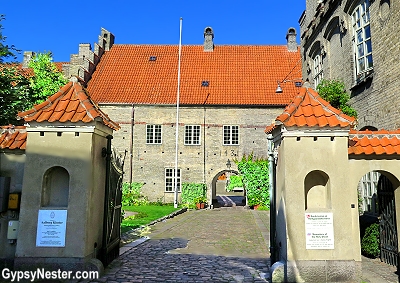
We continue on to the Monastery of the Holy Ghost, which was founded in 1451, making it the oldest social institution in Denmark.
It served as both a monastery and an abbey, and also as a hospital for some five centuries.
Our guide explains that it also had ties with the Churchill Club during World War II.
The club was a group of schoolboys from Aalborg Cathedral School who would sneak out at night to sabotage the Germans during the occupation of Denmark—on their bicycles.
Even after being caught and jailed, they still managed to escape at night and continue their covert activities before returning “home” for the day. These cheeky boys are Danish heroes now, with numerous books written about them (most recently, The Boys Who Challenged Hitler) and a movie based on their experiences.
Their exploits began a full-blown Danish resistance movement, and their hero and namesake, Winston Churchill, honored them after the war.
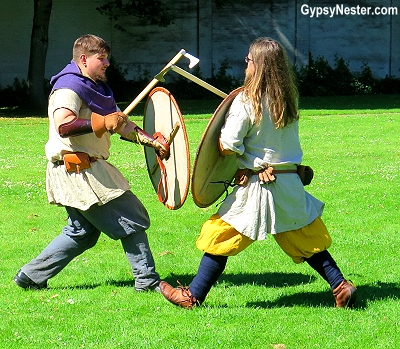
Working our way back toward the waterfront, we come to Ålborghus Castle.
Lacking the look of a traditional castle, when King Christian III built it back in 1539 he did so intending it to be a fortification.
But no one ever showed up to attack.
It became more of a palace than a protection.
The structure does include a classic dungeon, and we squeeze and skulk around the dank, dark basement tunnels.
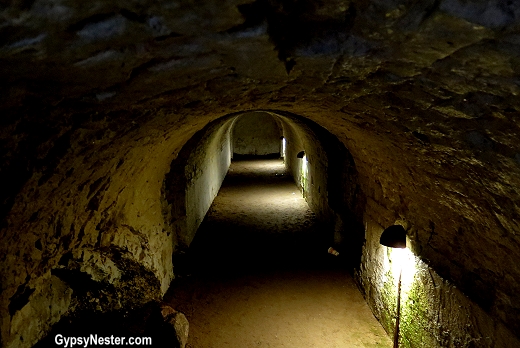
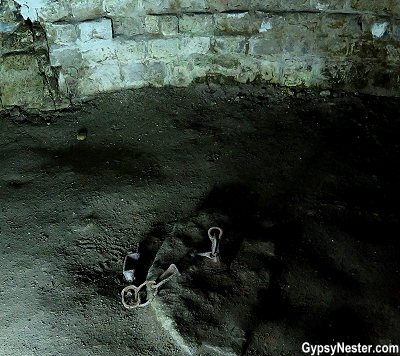
Whispering in our ears, our guide explains how one of the tiny cells was used to hold nine women who had been accused as witches back in the sixteen hundreds.
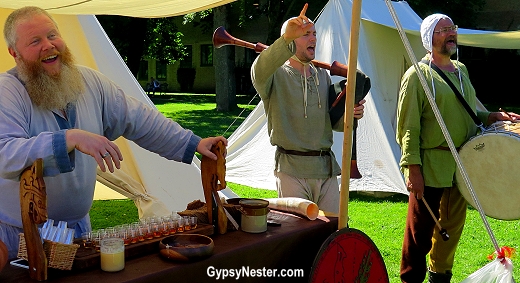
Next to the castle a group of modern day Vikings have set up a replica ancient market to show how the Norse traders lived, worked, played, and fought back in the days of yore a thousand years ago.
Oh, and drank – the mead and song is a flowin’.
DAY TWELEVE: Offshore Oil, Adorable Houses and Peaceful Footprints in Stavanger, Norway
Morning: Getting oily… and “the Colorful Street”:
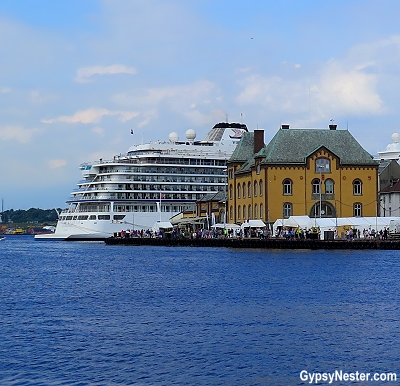
As with yesterday, once again we get to dock right in the center of the city, today in Stavanger, Norway.
We begin our exploration just a few steps away from the ship at the Norwegian Petroleum Museum.
The exhibits chronicle the history of off-shore oil operations on the Norwegian continental shelf since they began in the mid-1960s.
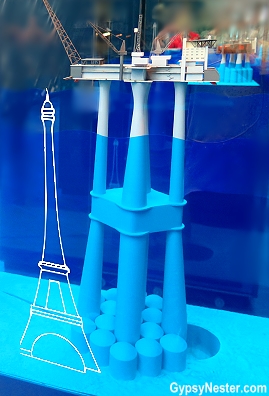
We walk through a timeline of models showing how drilling platforms were built as the technology progressed.
The first rigs sat on steel and concrete platforms permanently anchored to the North Sea floor, but over time flexible modern production ships and subsea systems were developed to allow exploration into deeper and deeper waters.
This can be dangerous work, as we see in a couple of the displays, with one showing the twisted wreckage of a support pipe from a platform that overturned, and another that has a real life boat open for us to crawl into.
We go inside and are shocked that it is meant to hold twenty-eight people in the cramped space.
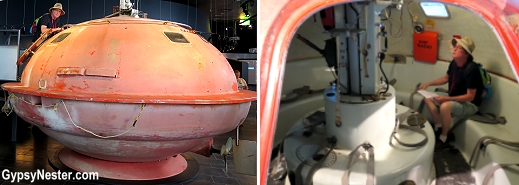
Proceeding through a walkway over the ocean, we enter a mockup of an off shore rig. This display shows the hand-on point-of-attack where the drilling takes place.
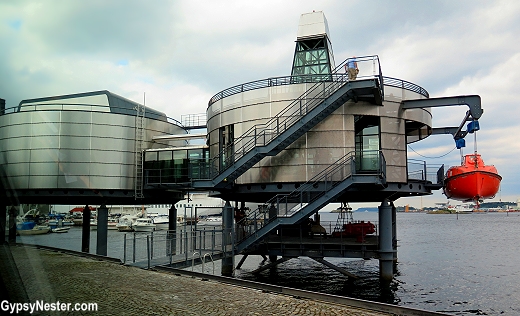
As we leave to go back on shore we have to choose between two doors as a way to vote on whether we think that the energy industry can find a way to address and reduce carbon emissions enough to combat climate change. We both, and most of the people with us, optimistically choose the yes door.
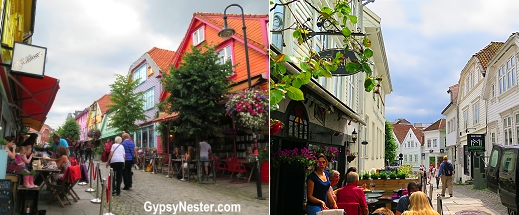
As we work our way into the city, away from the pier, we walk up a street lined with brightly colored buildings in a sea of white-only-by-ordinance old wooden buildings in a historical district.
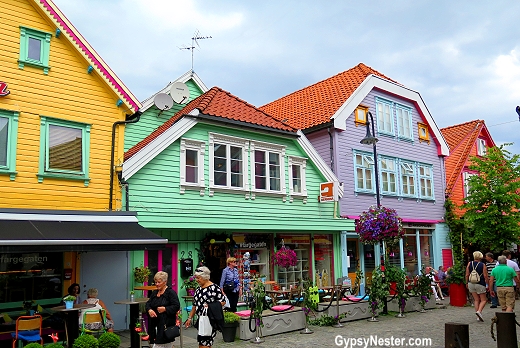
The cuteness factor is a happy over-the-top, and the strip has become quite a hangout with outdoor cafes being the order of the day.
When we asked what this hoppin’ little area is called, our guide simply says, “the colorful street.”
See more of wonderful Stavenger
Afternoon: Anything for the Children, and Little White Houses
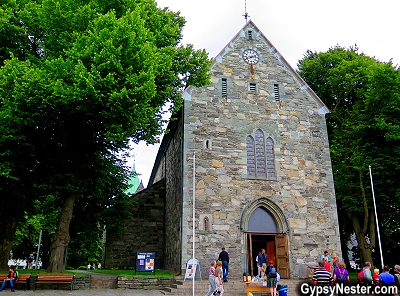
Next we stop at the Stavanger Cathedral, which is Norway’s oldest cathedral.
Construction is believed to have started around 1100, and finished about fifty years later.
That coincides with the founding of the city in 1125.
Unlike most of the old towns we have been visiting, Gamle Stavanger, or Old Stavanger, is not right on the waterfront.
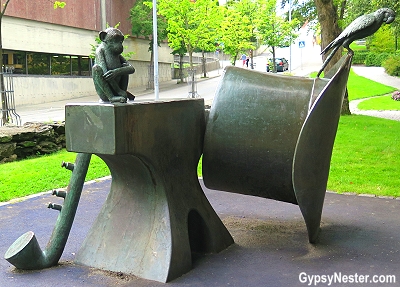
Instead we walk a little way up the hill from the church, but first pause to look at a couple of whimsical statues in a small park.
The first is a giant top hat next to an anvil, with a parrot and a monkey standing by.
Our clever guide walks ahead to the next one, a man with a pair of Shetland ponies, and asks us how we think the two are connected.
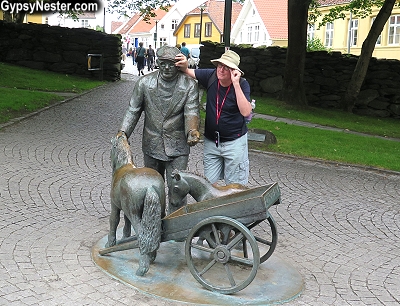
The man is Lars H. Lende, David’s new buddy, who was renowned for his inventive ideas to make the world a better place for children.
His motto, “Alt for barna” roughly translates to “Anything for the children,” especially pony cart rides.
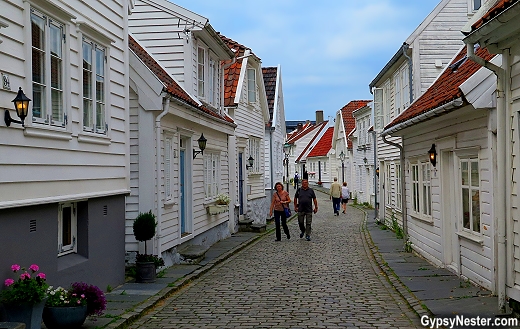
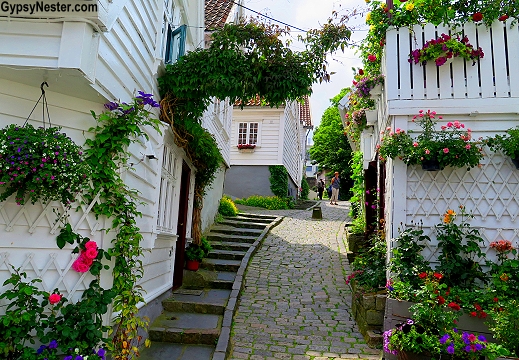
Through the gate at the end of the park we enter Gamle Stavanger, which has many of what are considered to be the best kept old wooden houses in Northern Europe.
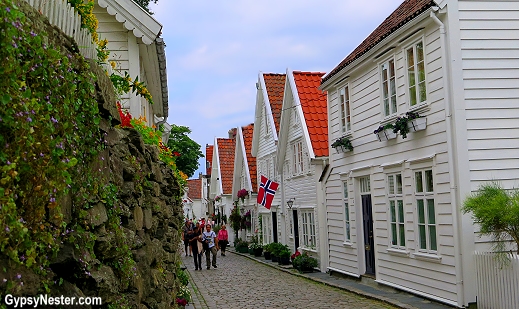
What is interesting here is that after several centuries, most all of the homes are still used as private residences.
See more of wonderful Stavenger
Evening: How Lucky are we? A Food Fest and Footprints
Our timing for our visit to Stavanger happens to be just about perfect.
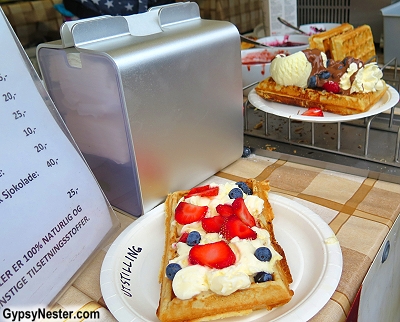
We have a wonderful summer day and Gladmat, Scandinavia’s biggest food festival, is in full swing along the bay.
Over 200,000 people, or make that 200,002 including us, visit during the four days of the festival each year.
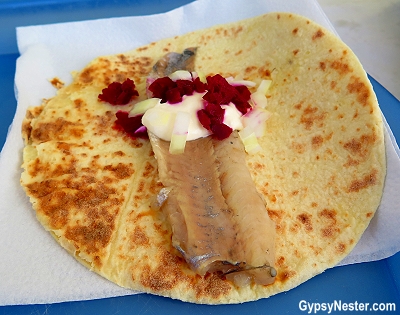
From the dozens of food stands and restaurants selling everything from gourmet fare to hotdogs, we decide to give some matjes i lompe a try.
This is a very traditional way of eating matjes, which is raw, slightly pickled herring, on lompe, a flat potato bread.
The fish is topped with sour cream, beets, and diced onions, then wrapped in the lompe.
While it may not be David’s new favorite food, Veronica loved it, and we can say it tastes better than it sounds.
As we wander through the festival, we stumble upon something completely unexpected, Al Gore’s foot prints. Yup, a bronze cast of the former Vice President’s bare feet is set right into the walkway along the harbor.

They are part of the Path of Peace, an ongoing project by the human rights foundation Point of Peace, which incorporates the footprints of several of Nobel Prize winners and peace advocates to form a pathway along the Vågen.
Word on the street is that Bishop Desmond Tutu left his mark here too, but we can’t find it on our way back to our Viking Star.
See more of wonderful Stavenger
DAY THIRTEEN: Deep Exploration of the Fjords of Norway
Morning: Breakfast IN the Fjords
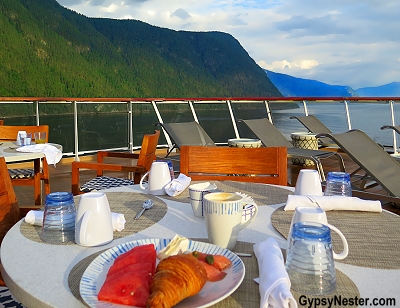
Breakfast outside on the Aquavit Terrace – in the fjords!
For a complete change of pace today, we will be visiting the tiny hamlet of Flåm, Norway.
The town of about four hundred people is not really the attraction here; it is the surrounding scenery that attract tourists from all over the world.
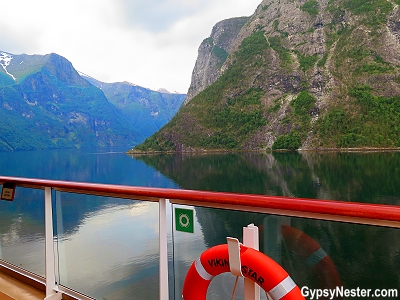
The village sits at the end of the Aurlandsfjord. This is a branch of the famous Sognefjord, which is the longest in Norway.
The spectacular morning mountains rising right out of the sea make for unbelievable views from our balcony this morning.
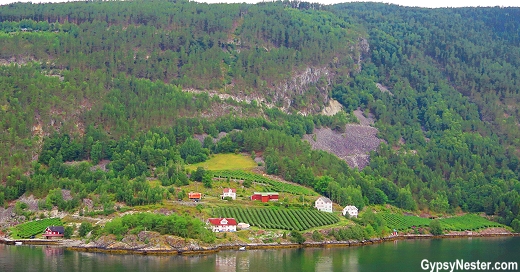
Afternoon: Seeing the Backside of the Fjords and Enjoying our Right to Roam
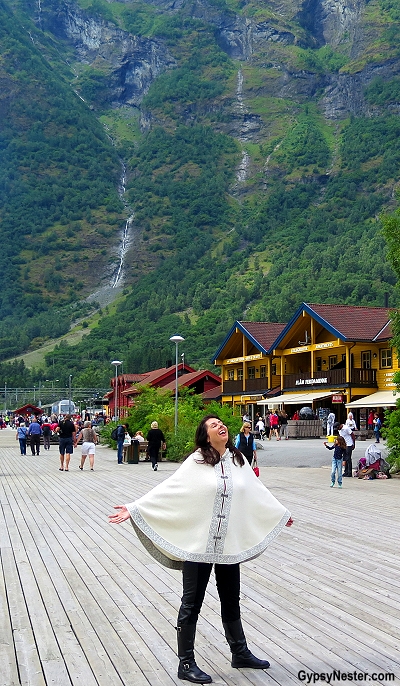
Many of the Viking Star passengers will be riding the spectacular Flåmsbana, or Flåm Railway, up the mountain to the town of Myrdal where it meets the mainline.
Obviously a good choice, since it has been dubbed “the world’s most incredible train journey” by Lonely Planet, and is on every railfan’s must ride list.
Since we did that on a previous visit here (in the wintertime, no less), we will be taking a hair-pinned-turned bus ride through the Laerdal River Valley to the Østerbø Mountain Farm.
We are fascinated to see what happens on the flipside of the fjords.
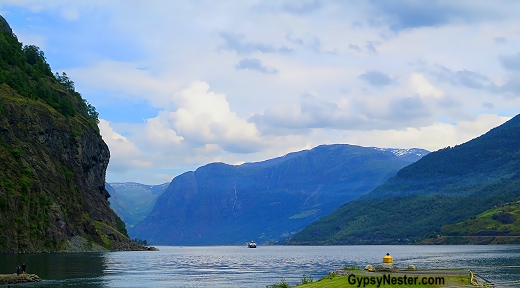
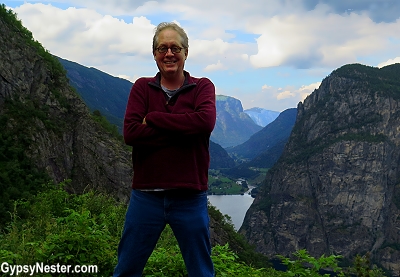
The trip up the incredibly steep slopes climbing from the fjord is truly a sight to see, with a constant conglomeration of towering waterfalls, beautiful lakes, impossibly long tunnels, and snowcapped peaks filling our windows.
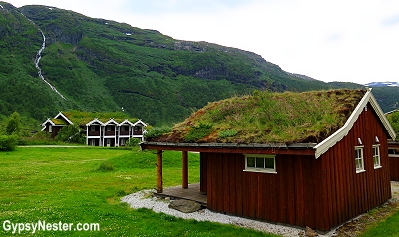
At the top we reach the farm, Østerbø Fjellstove, next to a picturesque waterfall-fed lake nestled among the majestic mountains.
Years ago this was a year-round farm, but now it is a summer haven for city dwellers to escape for a vacation in a cabin or camping out.
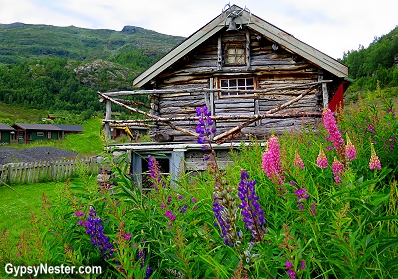
Our guide explains the very Norwegian concept for camping that they call the Right to Roam, or more formally the Right of Public Access to the Wilderness.
A law passed in 1957 allowing everybody in Norway the right of access to, and passage through, any uncultivated land across the countryside.
In practice it means that Norwegians can pitch a tent and camp almost anywhere they like, though it is based on respect for the land, and all visitors are expected to show consideration for farmers and landowners.
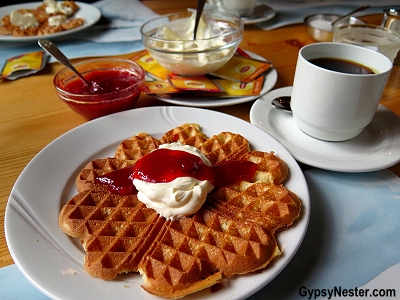
After a bit of exploring we head into the lodge for a snack of waffles, topped in the traditional way with sour cream and jam.
Evening: Not Gonna Lie, We’re the Luckiest People in the World Today
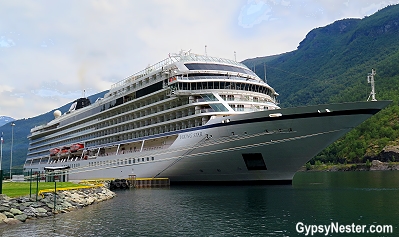
The sail away this evening should be one of the most breathtaking boat rides possible as we make our way back out of the Sognefjord to the North Sea.
This is the largest and best known fjord in Norway, and the second longest in the world.
It stretches well over one hundred miles inland from the ocean.
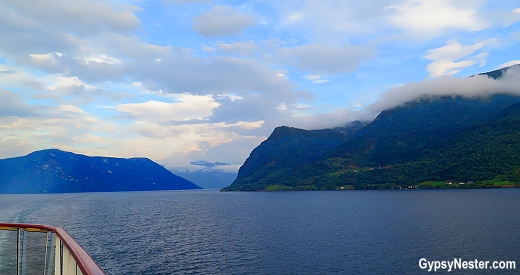
Large ships seem like they shouldn’t fit in these tight confines, but the fjord is over four thousand feet deep in some places.
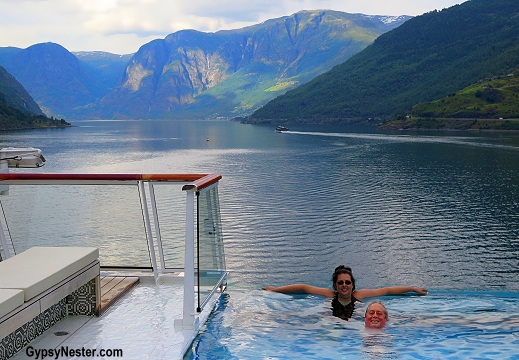
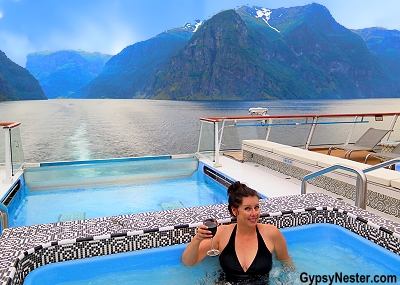
From those depths, cliffs form the soaring shoreline towering another three thousand feet or more above the water.
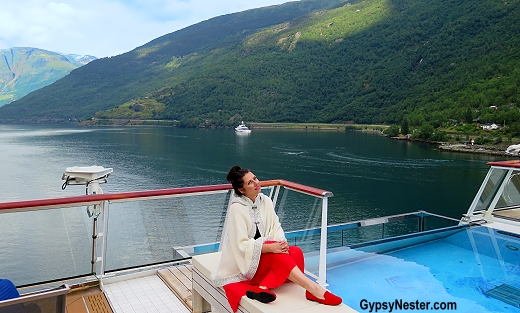
So seriously, just how insanely unbelievable is it to be watching this magnificent vistas go by from the infinity pool and hot tub on the back deck of the Viking Star?
Pretty damn ridiculously unbelievably cool is our only possible answer.
Night: Get up and Dance you Dancing Queens!
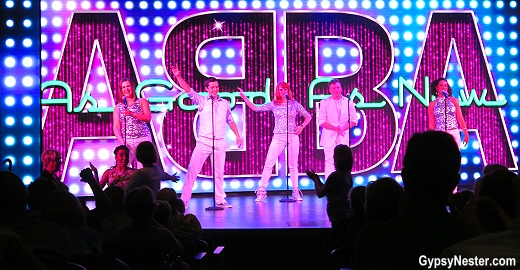
To finish off our nearly perfect day the Viking Star Performers put on a tribute to ABBA as a farewell and a salute to Scandinavia’s most famous musicians. Mama Mia!
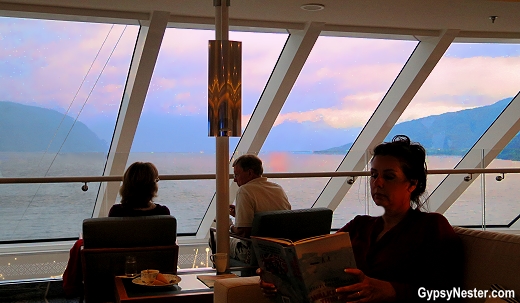
And because the sun never sets—and the fjords never end—we head to the very top of the Star to The Library to finish off our night in quiet bliss.
DAY FOURTEEN: Norway’s Harbor, Bergen
Morning: Hitting the Wharf
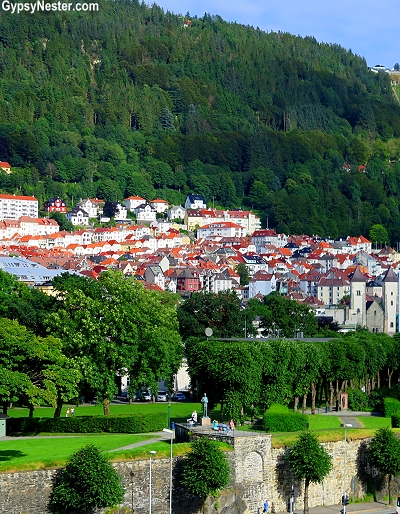
For the fifth straight day we get to dock right in the middle of it all—just step off of the ship and let the serious sightseeing begin!
Barely past the end of the gangplank, we find the Bergenhus Fortress standing guard.
This was the site of the royal residence dating back nearly a thousand years, but the surviving buildings are slightly newer, from the middle of the thirteenth century.
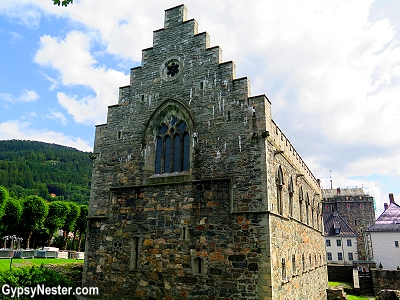
The Håkonshallen, named for King Haakon, is the largest structure in the complex, and though it looks like a church, it never was.
It was built as a festival hall, most likely for the wedding of the King and a Danish princess in 1261.
The Rosenkrantz tower next to it went up right after that, as Bergen was becoming a major shipping port and needed some protection.
Oddly, as time went on the canons were often not pointed out to sea but inward toward the Bryggen.
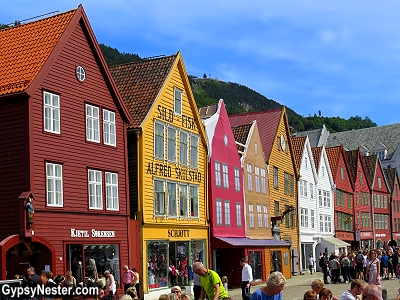
The name just means wharf, but in Bergen, Bryggen became synonymous with the area along the waterfront where German traders from the Hanseatic League set up shop.
Sometimes the Norwegian authorities felt that a little firepower pointed their way would help to keep the foreigners in line.
Afternoon: What’s this Bryggen Business all About?
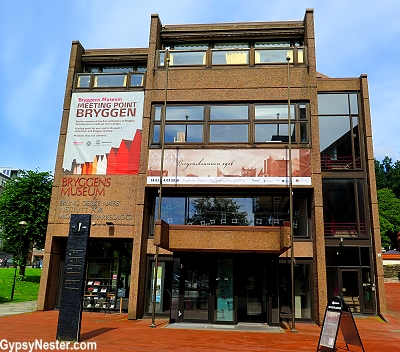
The society of Hanseatic traders formed a city within a city, which has been restored and preserved as a UNESCO World Cultural Heritage site.
It has had to be restored because fires have ravaged the wooden warehouses on several occasions through the centuries, as we see firsthand at our next stop, the Bryggen Museum.
In the museum, we see the excavations that have revealed layer upon layer of buildings on top of the charred remains of their predecessors. After each fire the debris would be pushed into the harbor, creating new land to build on and expanding the district.
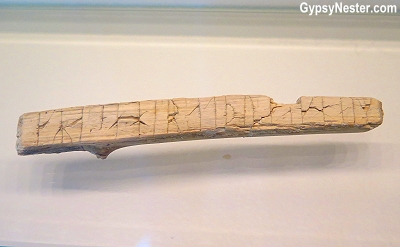
Upstairs there is a fascinating exhibit of runic sticks used by the Vikings.
These were ways of sending messages by carving letters on a piece of wood.
By for our favorite, and just about everyone’s it seems, is a small note that reads, “Gyda says go home.”
We can only imagine what may have been going on but it looks like even a marauding Viking may have had a wife to answer to.

The museum is right in the Bryggen, so we walk out and work our way through the maze of tiny alleys and walkways among the storehouses.
We begin to get a feel for what it must have been like seven hundred years ago when all of the fish and humans were piled in here on top of each other. More on the Bryggen here.
Thousands of pounds of fish were processed and shipped south from these cramped and chaotic buildings every season, and as we see when we reach the end of the Bryggen, selling fish is still a thriving business in Bergen.
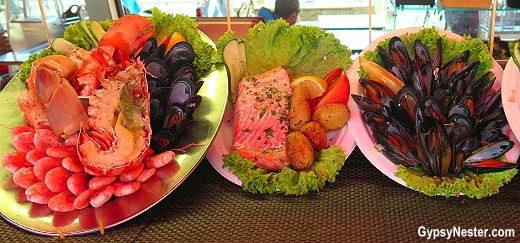
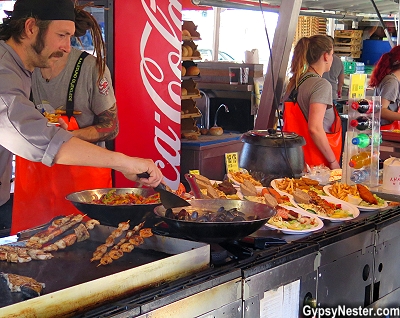
An open-air fish market has been a part of life here for hundreds of years.
We browse over booth after booth of delicious looking crab, shrimp, lobster, caviar, cod, scallops, and more, but at one the fish monger offers us a sample of something we have never seen before, smoked whale meat.
Now we know whale is not fish, but guess it must qualify as seafood.
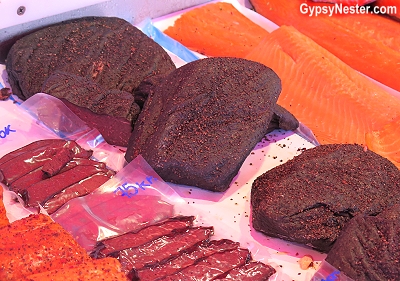
Norway is one of only a handful of countries where eating it is even legal, so we figure in the spirit of trying something once , we take a tiny sample.
Not as smoky as the beaver back in Estonia, but not resembling anything tasty. It had a slight organ-y taste.
However, for reasons much more important than the taste, this is the first, and last, time we will ever eat whale. The practice of whaling is banned nearly everywhere and we don’t want to support it.
Evening: Ducking into the Alleys
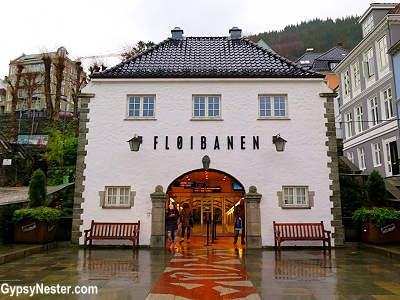
About two blocks up from the market is one of Norway’s most popular attractions, the Fløibanen.
This funicular railway carries people a thousand feet up to the top of Fløyen, one of the seven mountains that surround the city of Bergen.
As with the train in Flåm we have been there, done that (in the winter, nonetheless!), so we pass it by and climb the hill behind the station.
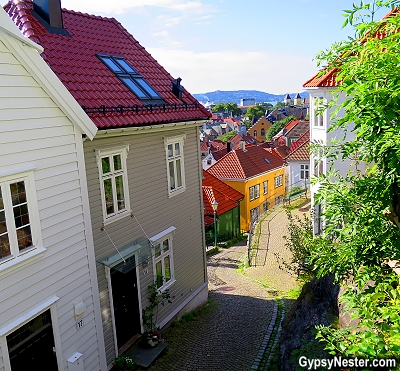
Earlier our guide recommended this neighborhood as his favorite part of town, and we have to say he didn’t steer us wrong.
He called the area The Alleys and we can see why.
The streets, more like paths and stairways, are mostly too narrow for cars and go up and down the steep slopes every which way.
The houses cling to the hillside in a way that makes the whole scene look almost like a cartoon. We keep climbing and are surprised to find a fairly large flat area about midway up the hill.
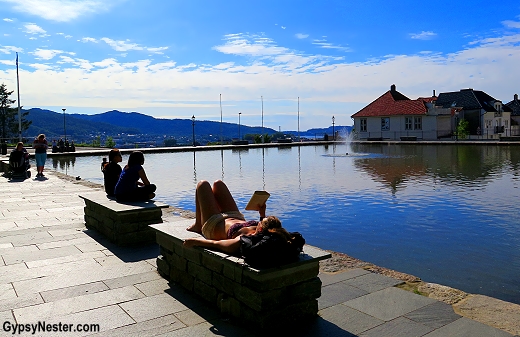
It strikes us as odd that this one piece of level ground anywhere to be found is taken up by a giant fountain, but on this warm, sunny day, a rarity in Bergen, lots of people are glad it is.
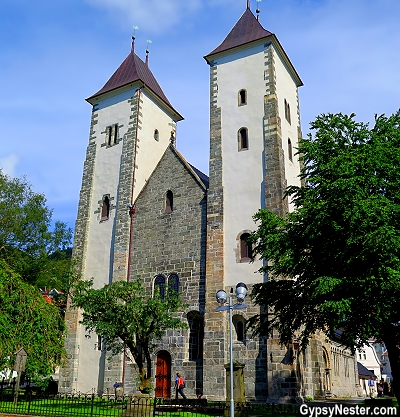
We try another way down since we can see the ship from up here as a homing device, and end up right in front of St. Mary’s Church.
At almost nine hundred years old, this is the oldest building in town and is the only one remaining of the twelve that were built at that time.
A far cry from the Viking Star that we have called home for over a fortnight, since she is barely over a year old, but we won’t hold her youth against her.
Quite the opposite, everything onboard went off like clockwork, with both ship and crew performing exceptionally.
This was our first time on a Viking Ocean cruise, but have found that they incorporate everything that we love about the river voyages, while adding some welcome extras such as more upscale dining choices and entertainment options.
We love it just as much as rollin’ on the river.
David & Veronica, GypsyNester.com
Written aboard the Viking Star on her voyage through Sweden, Finland, Russia, Estonia, Poland, Germany, Denmark, and Norway. Thanks to Viking Ocean Cruises for inviting us along and providing this adventure! As always, all opinions are our own.
YOUR TURN: Isn’t this a fantastic group of cities to visit? Any on your bucket list? What would you like us to report on?


 Click image to enlarge
 Click image to enlarge


 What luck! To our delight we hit town during the 30th annual Jazz Fest.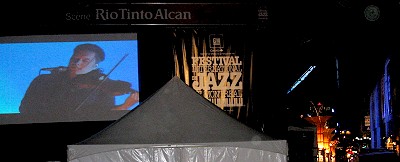
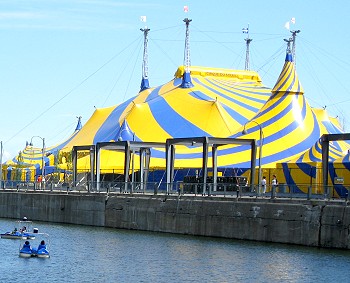 On a beautiful sunny summer day, the waterfront is the place to be in Montreal. The Vieux-Port (Old Port) is alive with activity. Several attractions are there along the river… cruises, jet boats, The Science Center and the original Cirque du Soleil.
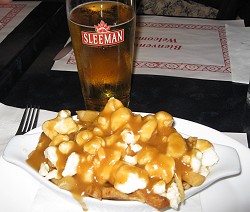
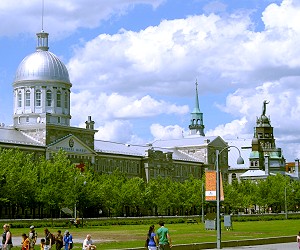 Bellies filled, we heard the call of the water. Montreal is and always has been a river city. The St. Lawrence is one of Canada’s busiest and most important port connections to the Atlantic for both passengers and cargo.
 The Ducks are amphibious buses that begin by touring the historic downtown area, then drive into the river and with a splash become boats.
 Next thing we knew we were driving along tiny back streets among the warehouses and docks, then right off the edge into the St. Lawrence River.
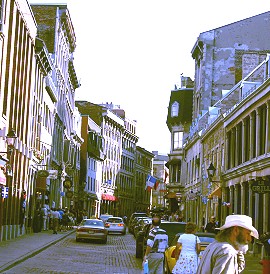 Back on dry land, we decided to seek some more serious sustenance. Vieux Montreal, the old town along the port, is filled with fantastic restaurants, many featuring the finest French fare this side of Paris.
 The great meal and relaxed atmosphere were an ideal segue to a night at the Casino de Montreal. The Boy, now of legal age to partake in gambling and drinking in Montreal, and The Piglet and Decibel wanted to be a part of these rites of passage.
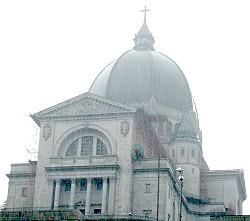
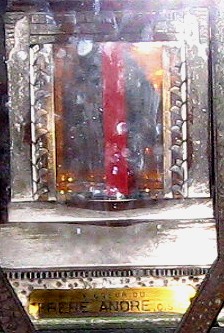
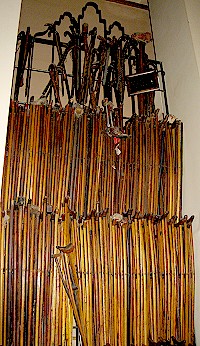 A larger church was completed in 1917 to accommodate the ever growing number of pilgrims in search of miraculous healing. This was still not large enough so, to honor St. Joseph whom brother André credits for all of the healings, the basilica was constructed from 1924 through 1967.
 Over 2 million visitors a year pass through this stunning structure, but to us perhaps the most striking thing about it was it’s