Search…

Gallivanting Across Generations in Galveston, Texas


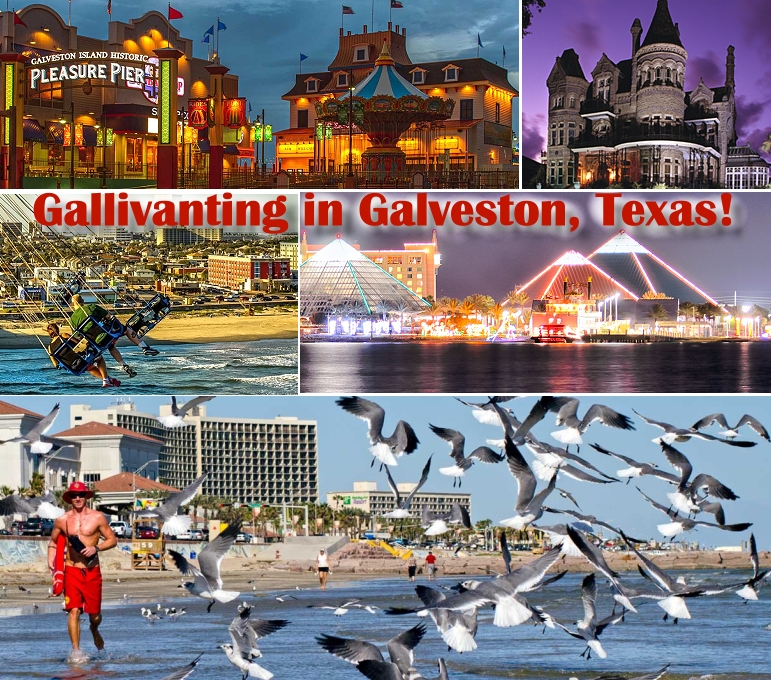
The wild and windblown story of Galveston began as a haven for pirates, just the kind of past that caught our attention!

A great way to merge a little history in with all of the water-soaked fun they we can stand.

Arrrgh mateys, I declare me-self king!.. CONTINUE READING >> 

Thanks to for sponsoring this post. As always, all opinions are our own.

Galveston, Texas

When we were recently asked about ideas for planning a family multi-generational vacation we remembered Galveston. Even though our visit a few years ago was an empty nest getaway, we recalled that it might just be the perfect place to accomplish the kid’s version of combining business with pleasure.  A great way to merge a little history in with all of the water-soaked fun they can stand.

The wild and windblown story of Galveston began as a haven for pirates, just the kind of past that catches the attention of any kid. After helping Andrew Jackson defend New Orleans in The War of 1812, the pirate Jean Lafitte set up shop on Galveston Island and proclaimed himself the head of the government of his new pirate kingdom, Campeche. Arrrgh mateys, I declare me-self king!

Galveston, Texas

But in 1821, the United States Navy ran Lafitte off and the Port of Galveston grew into one of America’s busiest ports. In fact it has become America’s forth most popular place to set out on a cruise with ships headed throughout the Caribbean and Central America.

A booming town sprouted up around the harbor, and the area known as The Strand became the city’s main business center. This National Historic Landmark District filled with Victorian era buildings is home to all of the restaurants and shops that any kid, parent, or grandparent could ever want.

We loved the nearby East End Historic District on our trip to the island, as we leisurely rode our bikes through row after row of incredibly ornate turn of the century homes.

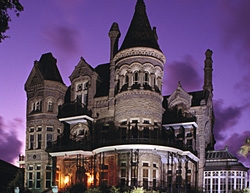
Returning with kids in tow might require reducing that to a quick pass to see the Bishop’s Palace and the Moody Mansion on the way to the beach, unless the kids get enthralled by the Galveston Children’s Museum in the basement of the Moody house.

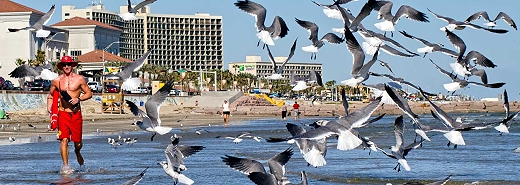
Still, the island really is all about the beach, thirty-two miles of it to be exact, and part of that sandy shore is lined by a Seawall that forms the longest continuous sidewalk in the world. Even if the wall’s real job is to protect the island from the fierce storms that sometimes blow ashore, the result is a gorgeous promenade along the Gulf of Mexico. Hey, there’s another example of combining function with fun.

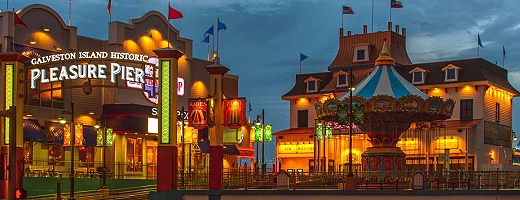
Speaking of fun, the Historic Galveston Pleasure Pier has reopened after being damaged by a couple of those storms. What began as a recreational facility for the United States military during World War II has become a spot for waterfront fun and entertainment like no other along the Gulf Coast.

Galveston Texas

If the rides at the pier aren’t quite exciting enough, the Schlitterbahn Waterpark has just opened the tallest watercoaster in the world. That alone is enough to inspire the fearless kids in our GypsyNester hearts.

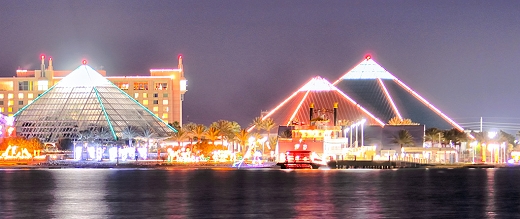
If we want to sneak a little more learning in with the fun, Moody Gardens is right next door with a fantastic aquarium and the Rainforest Pyramid. Both feature exotic wildlife from around the world with a focus on education, conservation, and possibly future breeding rare and endangered animals.

Galvestion Texas

Never fear though, it is certainly not all work and no play at the gardens, they also feature a five level Sky Trail Ropes Course towering over eighty feet high, and a five-hundred foot zip line.

So even though the younger generations won’t know they are learning, or have any idea what the Glen Campbell song we keep singing is, they will always remember Galveston.

David, GypsyNester.com

You Can Gdańsk If You Want To In Poland

A city that rose from the ashes of World War II to become glorious again. That’s Gdansk.

We love a story of strength, of overcoming odds, of finding one’s way back from overwhelming circumstances.

If a city can personify these traits, we saw it in Gdansk… CONTINUE READING >> 

A big thanks to Viking Ocean Cruises for inviting us along and providing this adventure through the Viking Homelands! Sweden, Finland, Russia, Estonia, Poland, Germany, Denmark, and Norway. As always, all opinions are our own.

Gdansk, Poland

Knock, knock. Who’s there? Gdańsk. Gdańsk who? Gdańsk, Poland, and that’s no joke.

Low humor at its worst.

We’re not sure why the people of Poland were so commonly the butt of cruel jokes back when we were kids, but it likely colored our expectations a little before visiting the country.

Our Viking Cruise of Northern Europe docked at the port of Gdynia, about fifteen miles north of Gdansk, our destination, and—in the back of my mind—I heard something along the lines of “How many Poles does it take to dock a ship…”

Gdansk, Poland

I told the devil-on-my-shoulder’s voice to shut up—we have docked further on the outskirts of cities in many countries.

A Jaw-dropping Organ

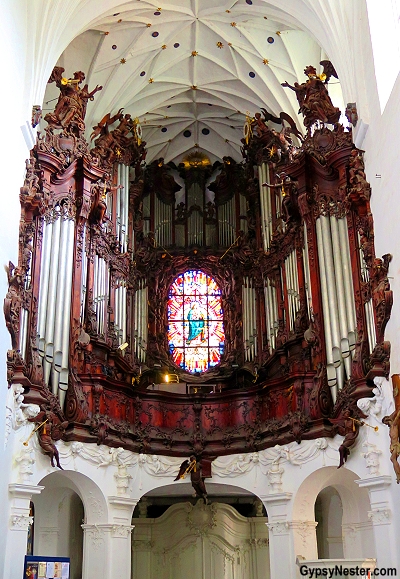
The Oliwa organ in Gdynia at the Archcathedral in Poland

So what if we would be bussing it down to the city, the ride gave us a chance to see a bit of the Polish countryside.

Right outside of town we stopped at the Gdańsk Oliwa Archcathedral, and the church itself was not remarkable.

Again the bad comic in my head started up; however, once we stepped inside we (including my personal Don Rickles) were blown away.

The famous great Oliwa organ, with over five thousand pipes, was impressive enough, but the woodwork around the pipes is an even more awe inspiring piece of art.

It’s Rebuilt and it’s Spectacular!

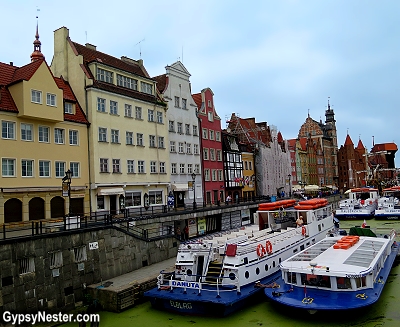
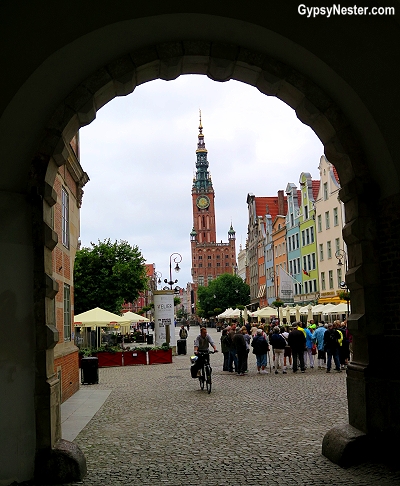
Entering Gdansk, Poland through the city gateAbandoning our bus outside of the historic old city of Gdańsk, we walked over a bridge and through the Green Gate.

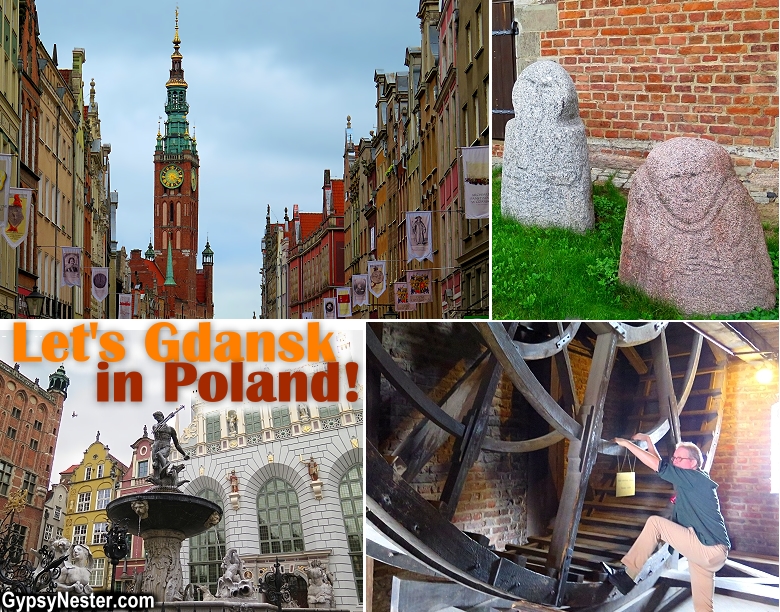
The portal in the ancient walls opens up on to the Long Market, a pedestrian only area that is the heart of the rebuilt town, and by rebuilt, we really mean rebuilt.

This city was completely devastated by World War II.

In fact, Gdańsk is right where the war began when Germany decided to take what was then known as the Free City of Danzig on September 1st, 1939.

Within a few weeks the Soviet Union had invaded Poland too, and after a couple of months the country was completely occupied by the opposing powers.

Gdansk, Poland

The fact that they were completely outnumbered, and their enemies had vastly superior weapons, may have been the source of some of the insults that came to bear on the Poles, but the situation in Poland was most assuredly no laughing matter.

Gdansk, Poland

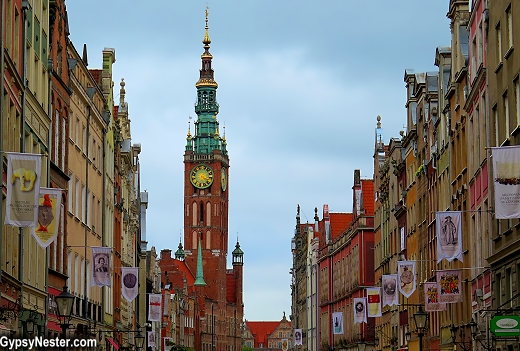
By the end of the war, Poland was devastated and Gdańsk was destroyed. Almost every structure in the city was damaged, so what we found now has all been reconstructed. Recreated or not, the Long Market has an almost magical quality about it.

Rising From the Ashes

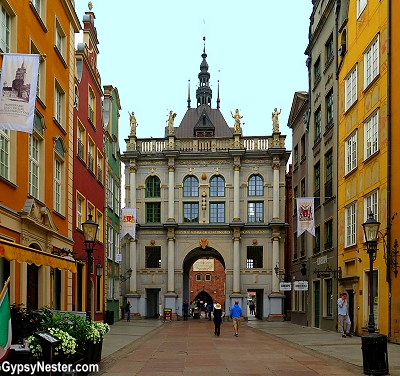
The Golden Gate of Gdansk, Poland

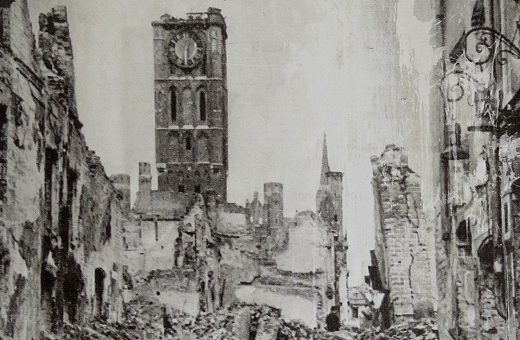
There are photos of the devastation on display inside the Golden Gate on the opposite side of the market, and seeing them made it hard to believe that the city ever survived.

The phoenix-like rise from the ashes is quite a testament to the Polish people.

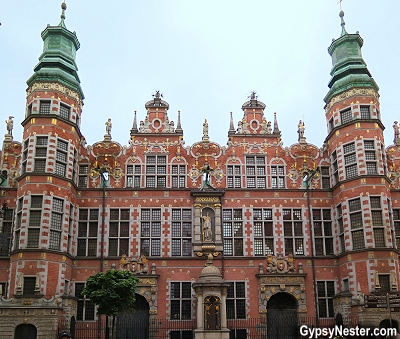
A fine example of this is the surprisingly ornate Armory Building, just off of the huge main square, which rivals most of the palaces that we have seen across Europe.

The Armory Building in Gdansk, Poland

The city is centered around St. Mary’s Basilica, which has stood as a symbol of the city since 1379.

Known as the largest brick church in Europe and third largest in the world, the interior can hold an astonishing 25,000 people.

Even though bombing nearly reduced it to rubble, not rebuilding was simply out of the question.

The biggest landmarks, especially the church, were restored as accurately as possible.

Gdansk, Poland

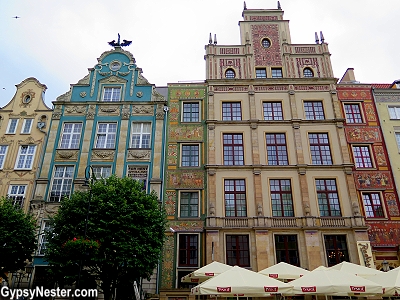
The same cannot be said for most of the houses that line the sides of Long Market.

It seems that when reconstructing after the war folks didn’t want to rebuild in the original German style, having suffered so much under them that they went with Dutch and Italian motifs instead.

Many of the fronts are actually clever facades, which have been embellished to various degrees, placed over communist era buildings that were hastily built in very basic, functional style.

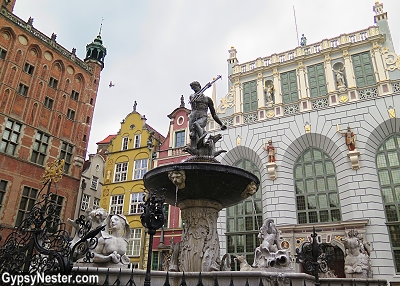
Neptune's fountain in Gdansk, Poland is one of the few things that survived World War ll

One icon that did survive intact was the Neptune Fountain.

In large part, its fame now stems from the fact that this nearly five hundred year old statue miraculously came through the bombings essentially untouched.

Guess the god of the sea got the last laugh.

Don’t Want to Meet up with These Ladies in the Dark!

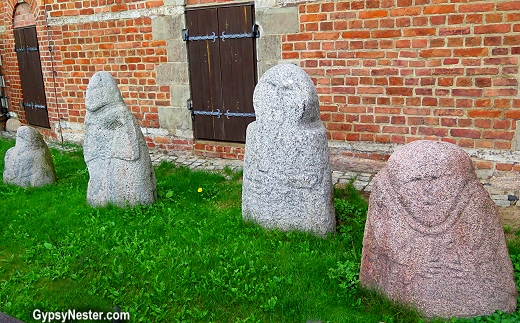
Going back through the Green Gate along the waterfront pier, we got stopped in our tracks by a row of baba pruska—Prussian hags.

Baby pruska—Prussian Hags lined us in Gdansk, Poland

These odd, early medieval anthropomorphic figures carved in granitoid were used to mark boundaries by the peoples of the Old Prussian culture.

Dang, we’d hate to be harnessed by a hag while accidentally wandering onto the neighbor’s farm after dark. That wouldn’t even be funny.

The Human Hamster Wheel

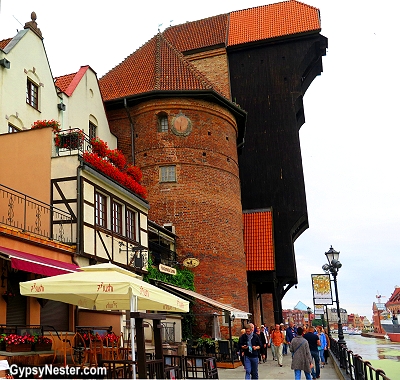
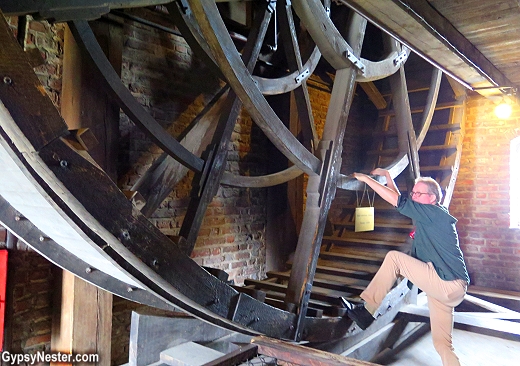
The human driven crane in Gdansk, Poland

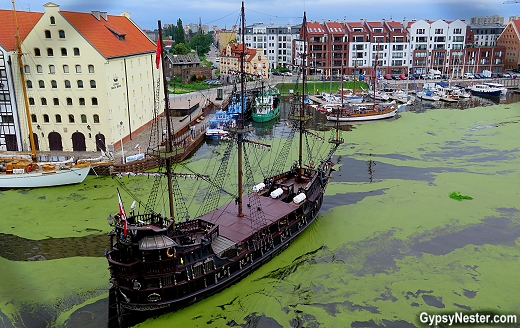
Our goal was to check out a huge crane, an intriguing artifact on the river bank going back to when Gdańsk was a bustling port within the Hanseatic League.

This 14th-century device operated on human-power, as treadwheels transferred the energy of walking workers to load and unload cargo from the Motlawa River.

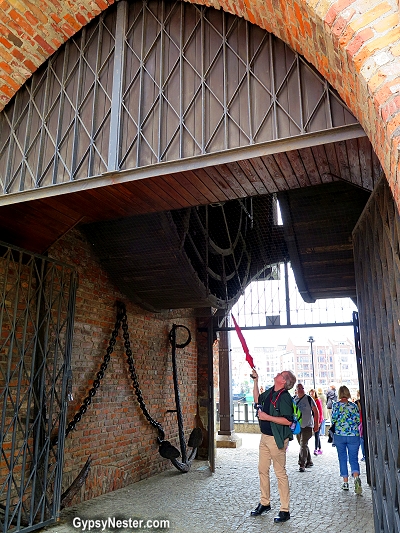
The human driven crane in Gdansk, Poland

We had seen pictures of the mechanics, but by seeing the giant wheels in person the ingenious machinery made sense to us.

Think people walking in a wheel, like hamsters.

The turning moves a rope through pulleys that transfer energy so that thousands of pounds can be lifted by simply striding.

Seems that it didn’t take very many Poles to lift thousands of pounds, but that doesn’t make for much of a punch line.

As we climbed higher and higher up the crane’s tower we were astonished by the clever design, and found ourselves happy that our walking skills weren’t needed to keep the ships below us stocked anymore.

The human driven crane in Gdansk, Poland

Still, it might’ve been fun to give the wheels a whirl, if only for a minute or two of rodent-like fun.

Lech Walesa’s Movement

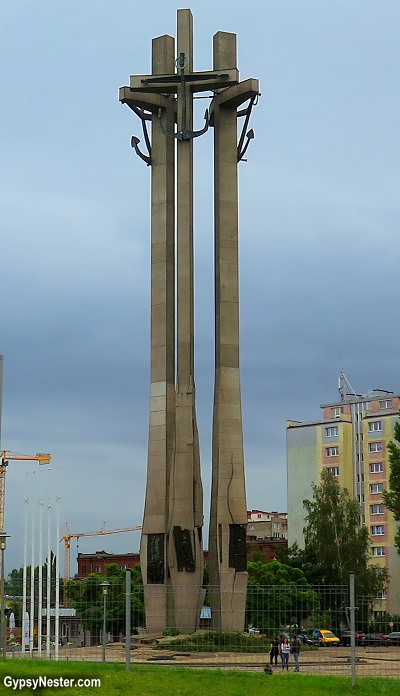
The monument to Lech Walesa and the Solidarity Trade Union Movement at the shipyard in Gdansk, Poland

A much more recent event in the city’s long history of shipping and ship building took place nearby.

On our way out of town, we passed the Gdańsk Shipyard, where Lech Wałęsa shook the world by leading the Solidarity Trade Union Movement.

That opposition to the communist regime led to the downfall of the party in 1989, which in turn played a huge part in the dissolution of the Soviet Union.

The monument that stands at the entrance to the yard is in honor of protesters killed in 1970, and was erected as one of Solidarity’s early demands in 1980.

Wałęsa described its significance to bringing down communist rule as “A harpoon driven through the body of a whale.”

Come to think of it, Mr. Walesa may have driven a stake through more than a whale. It was about that same time in history that we, thankfully, stopped hearing those awful Polish jokes.

David & Veronica, GypsyNester.com

A big thanks to Viking Ocean Cruises for inviting us along and providing this adventure through the Viking Homelands! Sweden, Finland, Russia, Estonia, Poland, Germany, Denmark, and Norway. As always, all opinions are our own.

YOUR TURN:

Walking the Basque Country of Spain (and a Wee Bit of France)—Live

Man, can the folks in the Basque Country throw a party!

Our live-blog continues along the Camino de Santiago (the Way of St. James).

See how we stumble into one of the most unique festivals we’ve ever seen, learn to cook like a Basqueman, and dip our toes into the French side of things… CONTINUE READING

A big thank you to VBT Bicycling and Walking Vacations for providing this adventure where we can tour AND eat all the delicious food we want without worrying about the calorie count!As always, all opinions are our own.

Click here for part one of this adventure!

DAY SEVEN: The Way of St. James—and a Way to Throw a Real Basque Bash

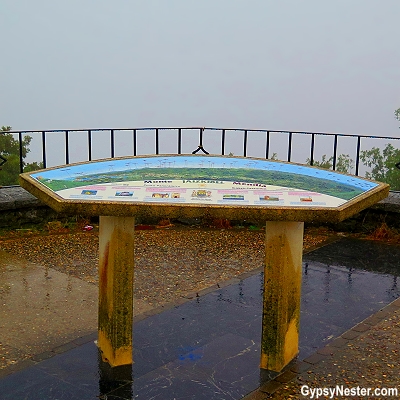
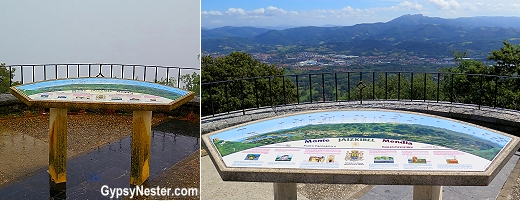
A marker show the view of the Basque Country on the Camino de Santiago
A marker shows us the view that we are missing

We begin our day with a short drive to a section of the Camino de Santiago, known in English as the Way of St. James.

Each year hundreds of thousands of pilgrims make a trek from all over Europe along several trails that all meet at Santiago de Compostela.

The tradition began over a thousand years ago because it is believed that the remains of the saint are buried at the Cathedral in the town.

Our tiny leg of the journey won’t take us anywhere near that end, as we plan to cover only a few kilometers.

See more about the Camino de Santiago.

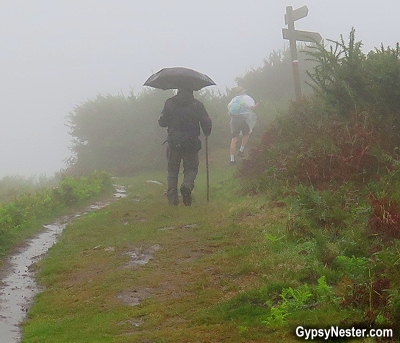
In fact, that small step is even shortened due to the weather turning downright blustery on us.

Being troopers though, we go ahead and trudge along the path and get to meet a couple of true pilgrims along the way—and, firsthand, begin to understand what an undertaking The Way truly is.

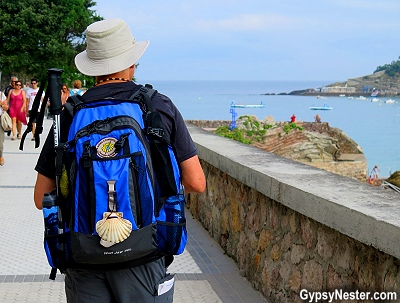
We had seen a pilgrim or two back in San Sebastián as well, identified by the scallop shells attached to their backpacks.

The shell has become a symbol for the saint and an identifying mark for pilgrims along the many trails that make up the Camino.

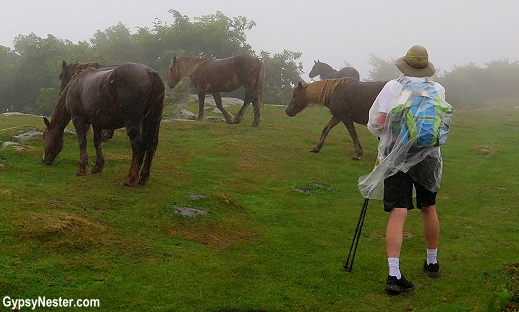
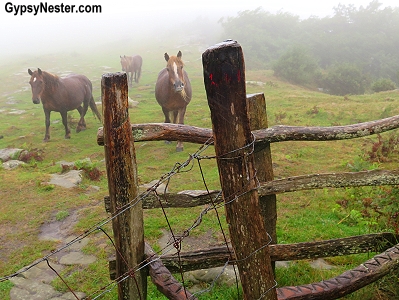
Horses along the Camino de Santiago on a blustery day. The Way of St. James

As we walk our guide, Txaro, tells us the story of The Way and how it incorporates several different parables about bodies washing ashore covered in shells (we’ll write about the entire story soon).

Accepting the way of the pilgrim, we embrace the symbolism rather than try to dissect it.

See more about the Camino de Santiago.

Not wanting to risk any slips or falls, we get back aboard our bus for a brief ride to Monte Jaizkibel above the town of Hondarribia.

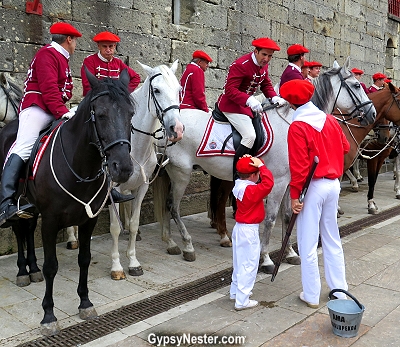
Horses and riders at Alarde in Hondarribia, Spain

Little did we know that a huge celebration to Our Lady of Guadalupe was taking place.

Actually, Txaro knew but she didn’t want to spoil the surprise.

It is all part of the Alarde, commemorating the city’s survival of a siege by the troops of King Louis XIII of France.

In the summer of 1638, Hondarribia was surrounded and the citizens swore to the Virgin of Guadalupe that if they managed to escape they would hold an annual procession to her shrine.

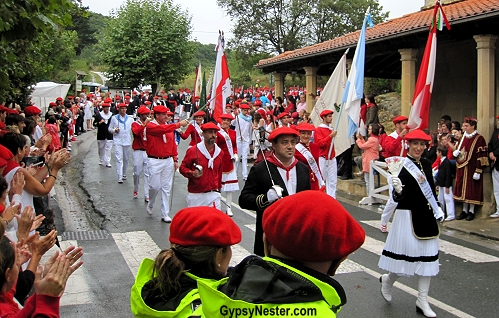
The Alarde in Hondarribia, Spain

Every year a special mass is held at the sanctuary of the Virgin of Guadalupe and we just happened to hit the day. On any other day her ancient statue inside the church would be the main attraction, but today it is all about the parade.

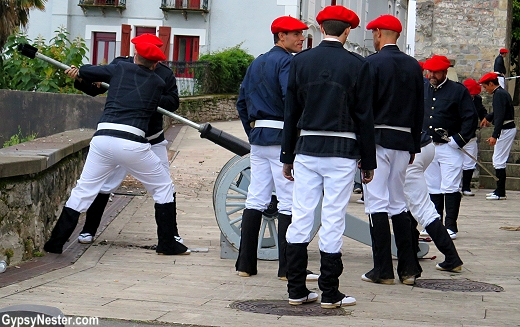
Firing the cannons at Alarde in Hondarribia, Spain

After cannon fire is coordinated to punctuate, and we do mean strongly, certain parts of the service and signal the end, the priest leads the congregation out into the streets.

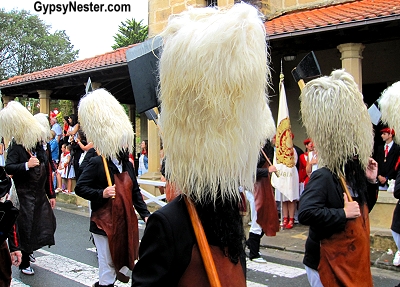
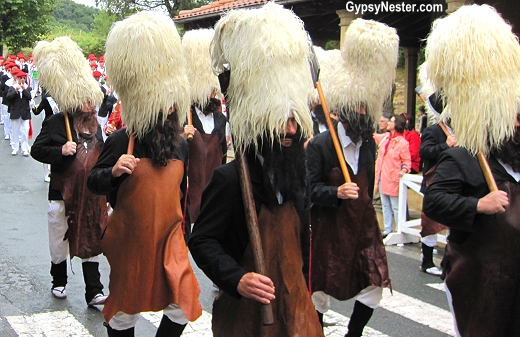
The Alarde in Hondarribia, Spain begins with men in tall sheepskin hats

First comes dozens of men in huge sheepskin hats and long black beards, a reminder of the townsfolk who snuck past the enemy disguised as sheep in order to seek help from neighboring villages.

They are the rock stars of the procession and the crowd goes crazy.

The Alarde in Hondarribia, Spain begins with men in tall sheepskin hats

The Alarde in Hondarribia, Spain

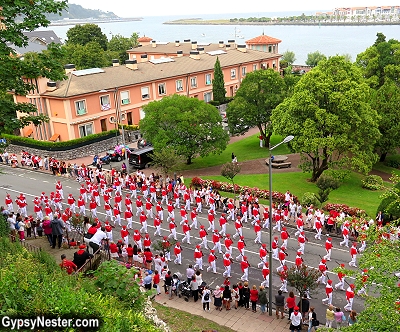
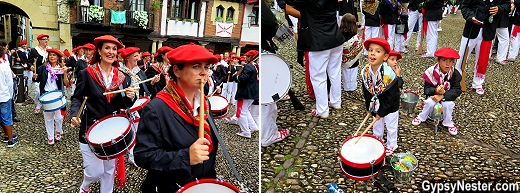
Next, several companies of fife and drum corps march past, followed by a huge troop of riflemen.

The armed contingent stops in front of the church to fire a salute, which seems to signal that it is time to make way for the main city below.

We walk down the path to Hondarribia and prepare for the scene to repeat, this time with a much larger crowd of spectators.

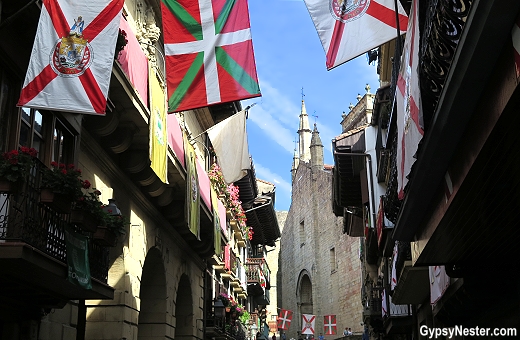
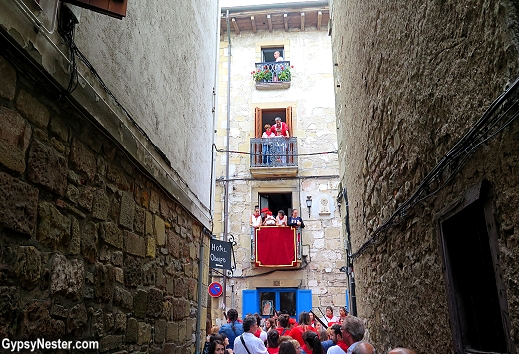
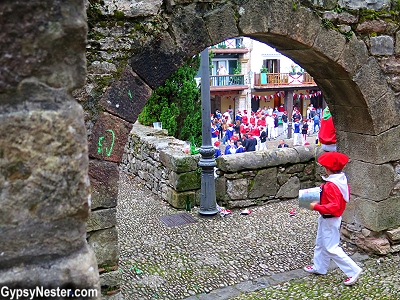
The entire old town within the medieval wall is wall-to-wall merrymakers.

The Alarde in Hondarribia, Spain fills the old town

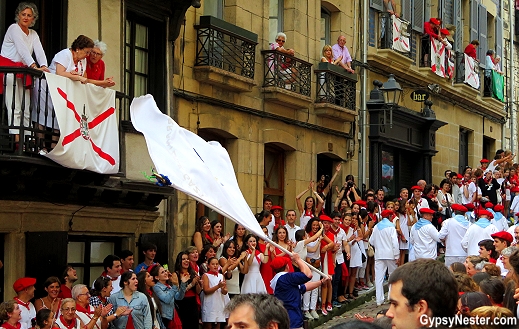
Every balcony is filled with spectators.

Every balcony is filled with merrymakers The Alarde in Hondarribia, Spain

This is Txaro’s hometown, and to help us fit in like locals she had instructed us to wear white shirts and then gives us all red bandanas to wear around our necks.

The Alarde in Hondarribia, Spain fills the old town

It was a wonderful touch that, even though most folks could tell we were visitors from afar, we were made to feel right at home.

We wade into the crowd and do as the Hondarribians do.

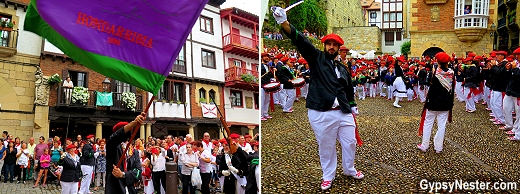
Our ears are filled as music, peals of church bells and cannon fire surround us; each square that we enter has revelers singing, waving flags, drinking beer.

The Alarde in Hondarribia, Spain

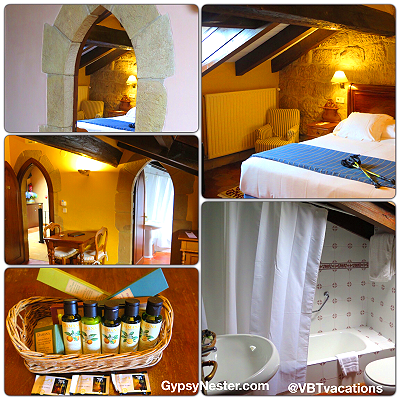
Hotel Obispo in Hondarribia, Spain

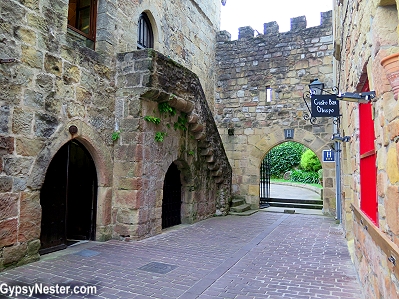
The afternoon turns to evening before we find our hotel, the Hotel Obispo, a palace built just inside the defense wall of the city in the fourteen hundreds.

We crawl into bed while listening to the celebration well into the wee hours…

DAY EIGHT: A Peek into Basque Life in France

Read more about the French Basque Country.

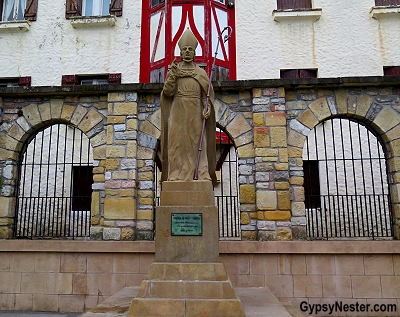
A statue of Don Cristóbal de Rojas y Sandova stands in Hondarribia, Spain

Since Hondarribia is the town where Txaro (pronounced Charo, by the way) lives, she will be our exclusive expert guide through the city this morning.

We begin at our hotel, Obispo, which means bishop.

The name is for the square that the hotel shares with the church of Our Lady of the Assumption and the apple tree.

A statue of Don Cristóbal de Rojas y Sandoval, who served as the Archbishop of Seville, and chaplain to King Charles V, stands facing the hotel.

Old town Hondarribia, Spain

The Hotel Obispo in Hondarribia, Spain incorporates the old city wall

Both the church and hotel date back to the fourteen hundreds, and are contemporary with the defensive city wall.

The hotel even incorporates the wall in its construction.

We move on through the town, amazed at how well yesterday’s mess has been cleaned up, and make stops at the city hall and a sixteenth century home where the wedding between Louis XIV of France and Maria Theresa of Spain was arraigned in1659.

King Louis will come into play again later today after we cross Txingudi Bay on the ferry and land in Hendaye, France.

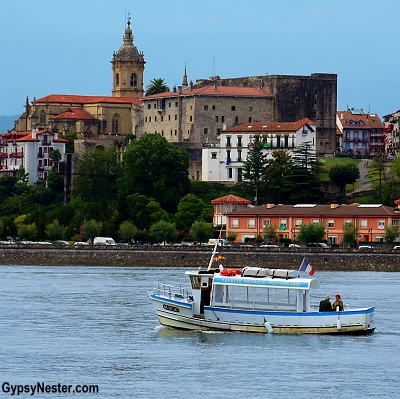
Old town Hondarribia, Spain from the water

From the water, the old town of Hondarribia shows us her best side, rising from Bidasoa River.

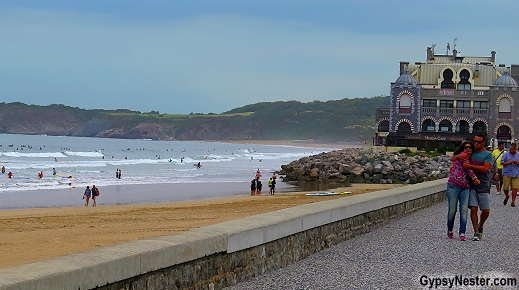
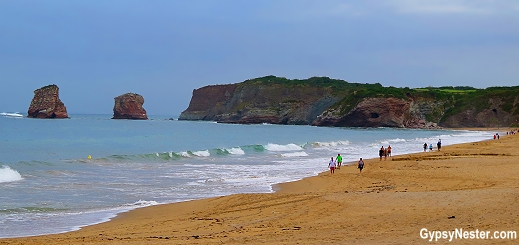
Once off the boat, it’s time for the serious portion of today’s walk, starting with a along the boardwalked beach.

Diligent urfers try their best to catch a ride on what appear to be inadequate waves. Children romp on the shore. Speedo guys soak up the sun.

The boardwalk in Hendaye, France

The beach in Hendaye, France

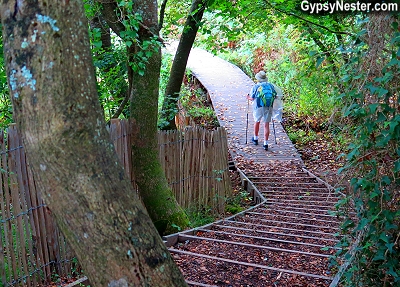
A walk through the French Basque woods

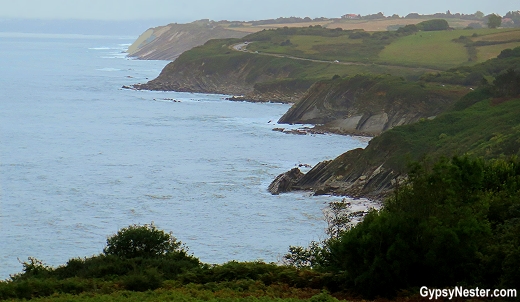
From the waterside promenade, we head into the woods and walk another couple of miles along the coastline, stopping only for the amazing views of rocky seashore—and to glance backward at an approaching storm.

We try to pick up the pace but—just a few steps from our meeting point with the VBT van—the sky opens up and lets us have it.

A walk along the French Basque coast

Shaking off like dogs, we climb gratefully into the truck, and practically kiss Txaro’s feet as she whisks us to dry land.

Read more about the French Basque Country.

Saint-Jean-de-Luz, France

Church of St. John Baptist, in Saint-Jean-de-Luz, France, King Louis and Maria Theresa tied the knot sealing the deal of the Treaty of the Pyrenees

Saint-Jean-de-Luz is a très French seaside resort town. Though we are only a few miles from the border, things have drastically changed.

The constant however, is that both sides of the border are culturally Basque.

The village’s main claim to fame remains the big wedding of 1660.

At the Church of St. John Baptist, King Louis and Maria Theresa tied the knot sealing the deal of the Treaty of the Pyrenees.

Peace reigned across the land… for a little while.

A txoko in Hondarribia, Spain. A txoko is a Basque cooking club that in the past were only open to men. These manly men would gather to cook, and of course eat, while trying out new recipes and ideas along with a healthy dose of socializing.

Our peace for the evening was to be found at a txoko back in Hondarribia.

A txoko is a Basque cooking club that in the past were only open to men.

These manly men would gather to cook, and of course eat, while trying out new recipes and ideas along with a healthy dose of socializing.

Sociedad Klink Elkartea

Times have changed, so now many of the clubs welcome women and Txaro just happens to be a member of the Sociedad Klink Elkartea.

This means that we get to spend an evening in a most quintessentially Basque fashion.

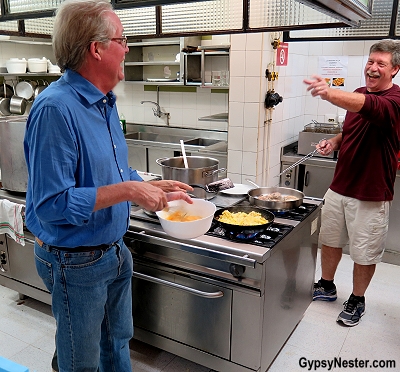
We all pitch in to make dinner, and stick to fairly simple dishes, beginning with salad.

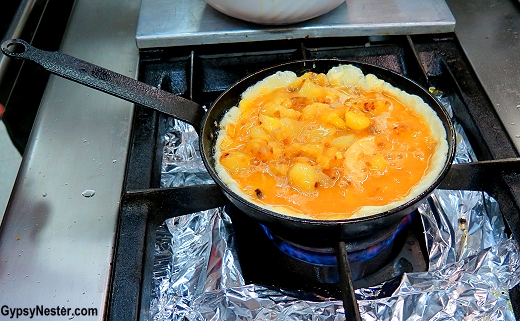
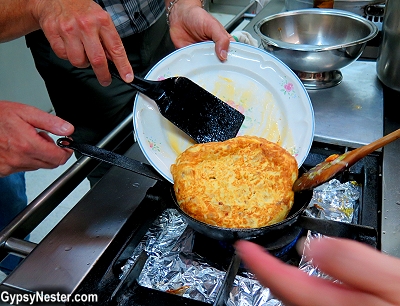
Cooking tortilla de patatas in the Basque Country of Spain

Cooking tortilla de patatas in the Basque Country of Spain
Believe it or not, too many cooks did NOT spoil the tortilla!

Then Txaro shows us how to make tortilla de patatas, egg with potatoes, that is much more like an omelet than what we North Americans think of as a tortilla.

We finish with two main courses, chicken with carrots, leeks, and garlic, and salt cod in a cream sauce.

None of our fare required being a gourmet chef to prepare, but like the old Shake-N-Bake commercials, it was delicious because we helped.

Read more about the French Basque Country.

DAY NINE: Wine, Scary Giant Heads—and a Better Shot at the Camino de Santiago


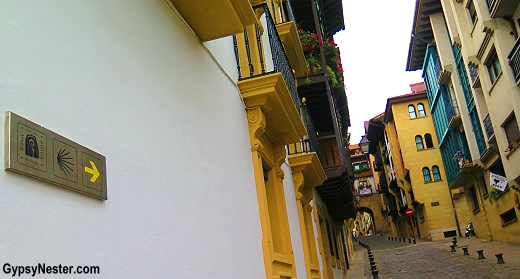
A sign points “The Way” through Hondarribia, Spain on the Camino de Santiago

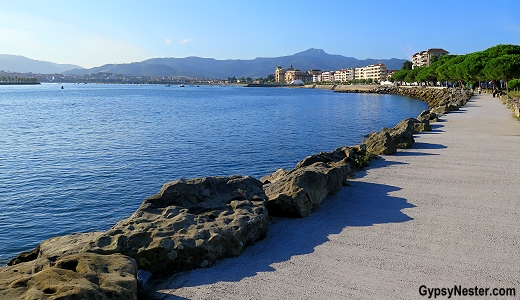
We begin our day with a walk to Hondarribia’s marina.

The boardwalk in Hondarribia, Spain

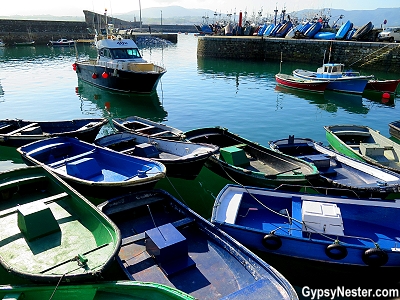
The harbor of Hondarribia, Spain

The beginning of the walk takes us past sites we have already seen during the parades, but it is cool because on this, our third day in Hondarribia, we are actually starting to know our way around and feel a bit like locals.

Txaro fills us in on the history that we had missed on our own and tells stories of the fishing and whaling traditions of the Basque region.

With a morning walk under our belts, it is time to get a little more serious and climb up to the Hiruzta Winery.

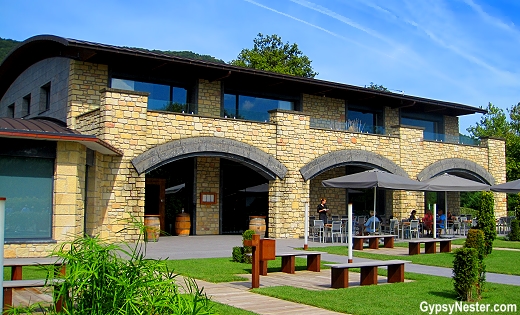
The Hiruzta Winery in the Basque Country of Spain

The Hiruzta Winery in the Basque Country of Spain

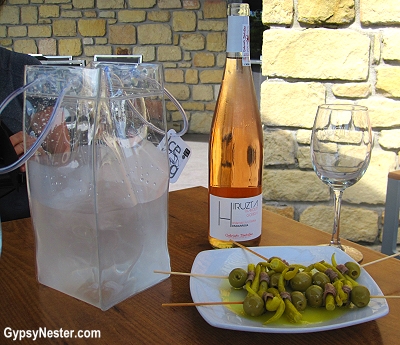
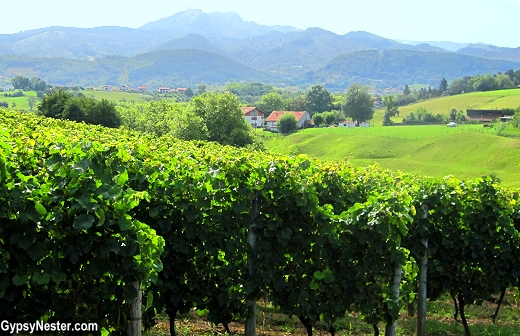
What better excuse for a chilled glass of rosé than a bit of a hike on a hot day? Perfect for gazing out across the vineyards down the valley.

So we sip and enjoy pintxos, especially the gilda—peppers, anchovies, and olives on a skewer—then switch to the most common white wine of the region, txakoli.

The Hiruzta Winery in the Basque Country of Spain

Unlike much of what we have been seeing, Hiruzta is quite new, only being here for about the last ten years.

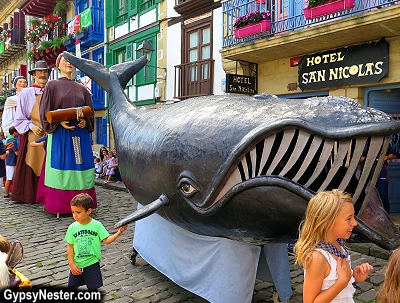
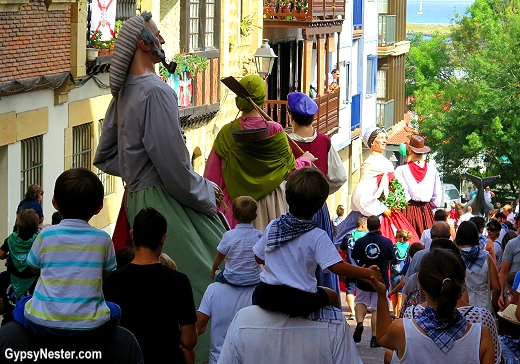
Gigantes y cabezudos march and dance through Hondarribia, Spain

Back in Hondarribia, we find ourselves in the midst of the most wonderfully weird part of the festivities that are still going on in the old town.

Engulfed in another parade, this time with giant dolls and creatures with enormous heads, the gigantes y cabezudos, we are delighted to be overrun.

Gigantes y cabezudos march and dance through Hondarribia, Spain

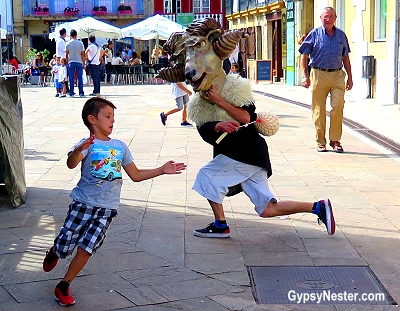
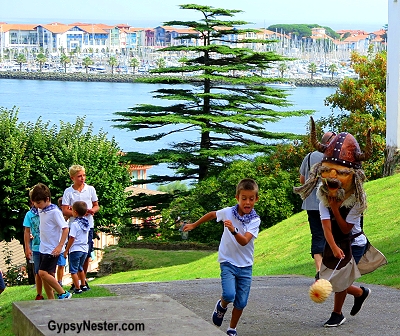
A cabezudo chases a child in Hondarribia, Spain

Taking our cue from the locals, we chase the odd figures into a large square, where hordes of children mock the scary looking cabezudos.

In return, the kids are chased around and “beaten” for their mischief.

Traditionally the cabezudos carry whips, but here in Hondarribia a netted, nerf-like ball is used.

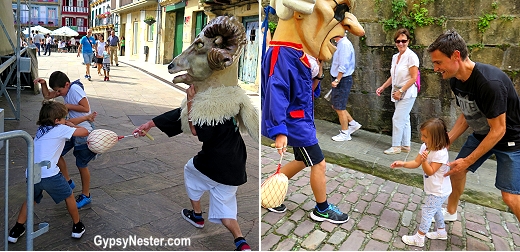
Cabezudos chase and beat children in Hondarribia, Spain

A cabezudo chases a child in Hondarribia, Spain

Though taken aback at first, we had to giggle at the pure fun of the atmosphere.

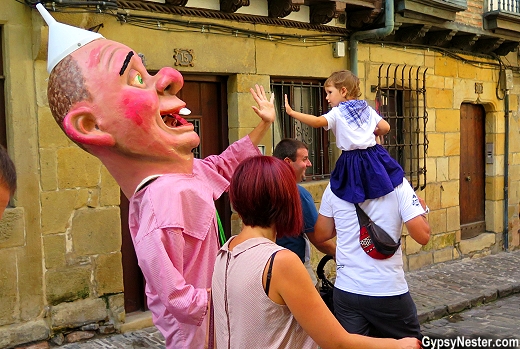
And were pleased to see that many of the cabezudos went out of their way to high-five the littler ones as they raced by.

A cabezudo high fives at toddler on her father's shoulders in Hondarribia, Spain

Because we have some free time this afternoon, Txaro and David work it out so that we can return to the section of the Camino de Santiago that we walked in the rain a few days ago.

See more about the Camino de Santiago.

On that day we could barely see our hands in front of our faces, but what a difference today!

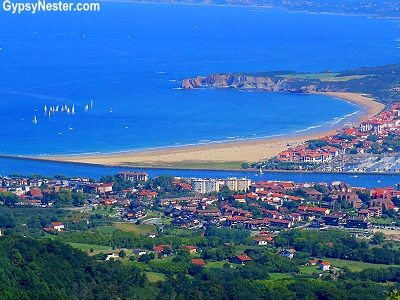
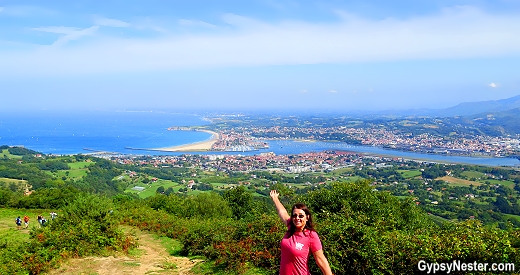
From the ridge we can look out all the way down the coast of Spain and see where it makes a hard left turn to the north, becoming the coast of France.

This “L” of shoreline is what forms the Bay of Biscay stretching out before us.

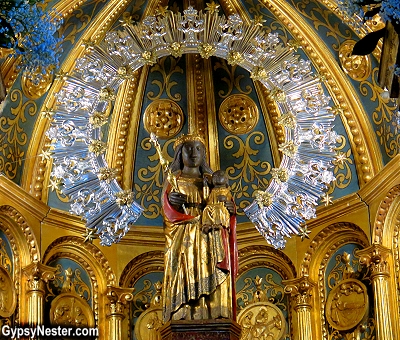
the sanctuary of the Virgin of Guadalupe, with the famous Black Madonna

We also get another chance to see the sanctuary of the Virgin of Guadalupe, with the famous Black Madonna inside.

This time we don’t have to squeeze through thousands of festival participants so we enjoy a peaceful moment inside of the church.

The statue of the Madonna was found centuries ago and is one only three so-called black Madonnas in Spain.

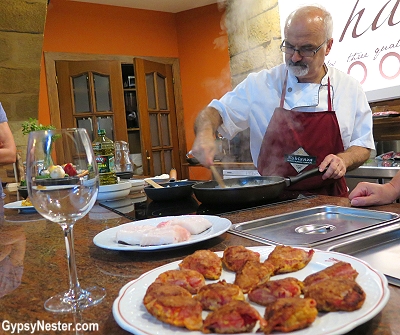
The owner of Hotel Obispo in Hondarribia, Spain, Bittor Alza, treats us to his open kitchen

As our journey is drawing to a close, just one more day, we celebrate with a farewell dinner tonight.

Bittor Alza, the owner of the Hotel Obispo that has felt like home for the last three days, treats us to an amazing meal by not only cooking it, but showing us how it’s done in his open kitchen.

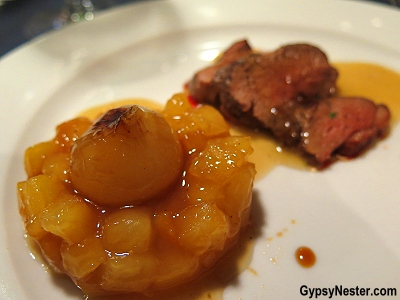
Duck dinner at Hotel Obispo in Hondarribia, Spain

We learn how to make the classic Basque green sauce for the hake we are having, and how to debone and skin the fish.

He also shows us a trick or two about sautéing onions just right, so that they caramelize evenly without burning any spots.

These will go with some duck breasts that turn out good enough to make us all daffy.

DAY TEN: Crazy Architecture, A Giant Flower Puppy, and an Epic Last Meal

Read more about Bilbao.

It is our last day so we say goodbye to Txaro this morning, so, so sad to see her go but so, so happy to have met her, and board our bus for Bilbao.

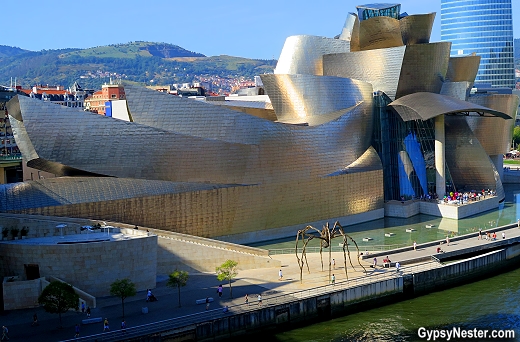
The Guggenheim museum in Bilbao, Spain

The Guggenheim museum in Bilbao, Spain

Our first stop, and the big attraction for the day, will be the Guggenheim Museum Bilbao, which is where David will be leaving us in the good hand of a hand selected VBT guide who knows art (and not just what he likes!).

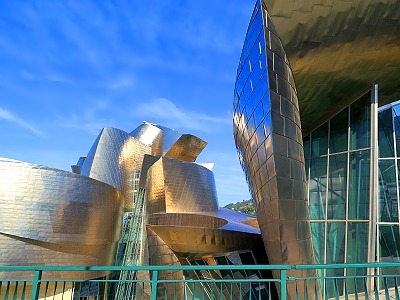
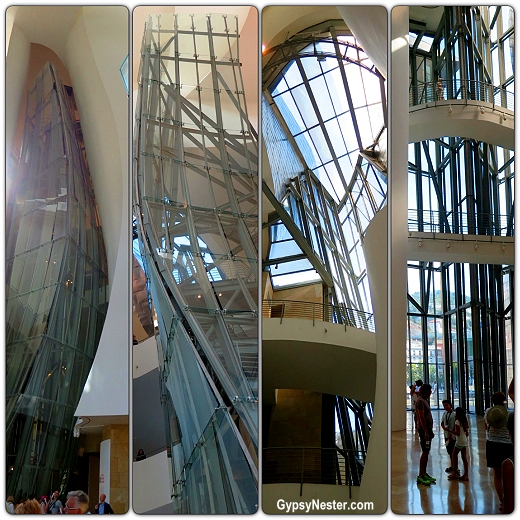
Unlike most museums, the Guggenheim’s most impressive work of art may be the building itself.

Acclaimed architect Frank Gehry designed spectacular space along the Nervion River to blend into the surroundings while standing out as the city’s signature landmark.

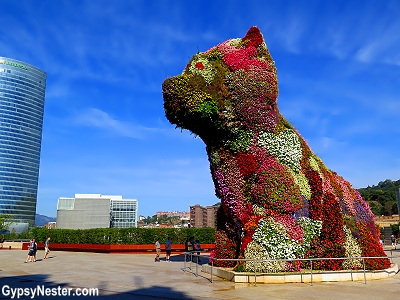
The Guggenheim's Flower Puppy in Bilbao, Spain

The gleaming titanium walls intertwine in shapes reminiscent of waves, or perhaps ship’s sails, and seem to flow right into the water.

Before we even enter we encounter one of the most famous works in their collection, the massive Puppy by Jeff Koons, better known to the locals as Flower Puppy.

That’s one big puppy!

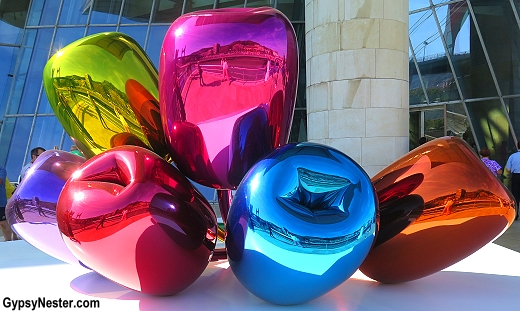
Tulips, by Jeff Koons at the Guggenheim in Bilbao, Spain
Tulips, or how to take seven mirror selfies at once!

Koons also has another work along the river, Tulips, and while we are admiring it our fellow traveler, Joe, realizes that he has built tables for the artist back in Pennsylvania.

Sometimes the world truly is small.

Inside the Guggenheim Museum of Bilbao, Spain
The art inside may not be photographed, but the fantastic architecture is fair game.

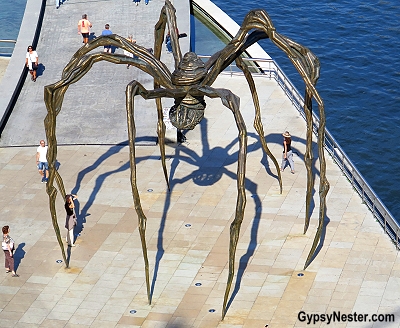
Maman by Louise Bourgeois outside the Guggenheim in Bilbao, Spain
Maman by Louise Bourgeois, an impressive giant spider and
a tribute to her mom who was a weaver

Browsing the works inside the museum we find several by Picasso, and Andy Warhol’s iconic One Hundred and Fifty Multicolored Marilyns, but are most impressed with the work of Richard Serra.

The scale of these sculptures is mind boggling.

All in all, there are eight sculptures as a collection entitled The Matter of Time.

These pieces are made with hundreds of tons of free standing solid steel sheets hundreds of feet long that fill a gallery the size of an aircraft hangar.

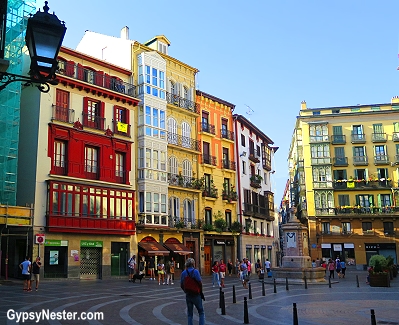
Bilbao, Spain

Bilbao’s other main attraction is Casco Viejo, the old quarter.

This ancient city was built within protective walls with narrow lanes leading to several churches, the main one being the Santiago Cathedral from the fourteenth century.

The name is in honor of the apostle Saint James the Great, Santiago in Spanish, because the northern branch of the Way of Saint James runs right through the old town.

The Camino has been a constant companion on our journey.

See more about the Camino de Santiago.

See much more about Bilbao!

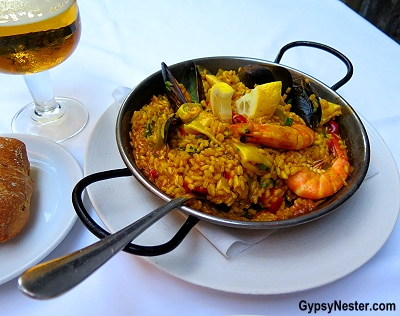
Paella in Bilbao, Spain

With dinnertime upon us, which even at eight is still about two hours earlier than the locals, we realize that we have been in Spain for two weeks and haven’t had any paella.

This must be remedied and tonight is our last chance.

With nothing more than luck to guide us we pick one of the many eateries available to us and happen to get a good pan of the classic seafood and rice dish. Mission accomplished.

Not a bad way to end our trip. All together we made a dozen new friends, walked about a hundred miles, ate what seemed like a thousand new dishes, and made about a million memories…Click here for part one of this adventure!

David & Veronica, GypsyNester.com

Read more about Bilbao.

See more about the Camino de Santiago.

See all of our adventures in Spain.

Read more about the French Basque Country.

See all of our adventures in France.

A big thank you to VBT Bicycling and Walking Vacations for providing this adventure where we can tour AND eat all the delicious food we want without worrying about the calorie count!As always, all opinions are our own.

Basking in the Basque Country of Spain, A Live Blog

One of the finer aspects of a walking tour is the ability to partake in incredible food without worrying (too much) about stepping on the scale when arriving back home.

We looked long and hard for the perfect pairing of spectacular scenery and incredible edibles—and believe we’ve found it!

Chase us as we eat massive amounts of tapas (they’re called pintxos here), roam around Madrid, make a pilgrimage along the Way of St. James, sleep in a palace, storm a castle, hit the beach… CONTINUE READING

A big thank you to VBT Bicycling and Walking Vacations for providing this adventure where we can tour AND eat all the delicious food we want without worrying about the calorie count! As always, all opinions are our own.

Click here for part two of this adventure!

Where We’re Headed and What We’ll be Doing
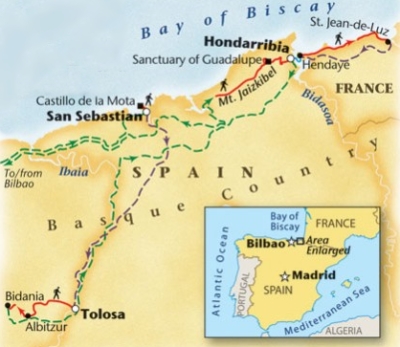
Map of the Basque Country of Spain

After our successful bike tour of Sicily with VBT last year, we were itchin’ to give a walking tour a go.

One of the finer aspects of an active tour like this is the ability to sample and eat incredible food without worrying (too much) about stepping on the scale when arriving back home.

We looked long and hard for the perfect pairing of spectacular scenery and incredible edibles—and believe we’ve found it!

A walking tour of the Basque Country of Spain (and a teeny bit of France) fit the bill. Seriously, melding Spanish and French cuisine—come on!
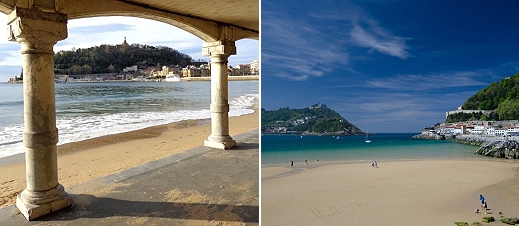
A walking tour of the Basque Country of Spain with VBT Bicycling and Walking Vacations

Chase us as we eat massive amounts of tapas (they’re called pintxos here),  make a pilgrimage along the Way of St. James, sleep in a palace, storm a castle, pig out at a txoko (no apologies for the amount of eating we’ll be doing!), hit the beach, visit the Sun King’s crib and roam around Madrid!

DAY ONE: Walking Madrid

See more about our antics in Madrid here.

For a city of over three million people, Madrid is surprisingly walkable. That’s good for us since we’re considering our two days here to be a warm up for our walking tour of the Basque country.
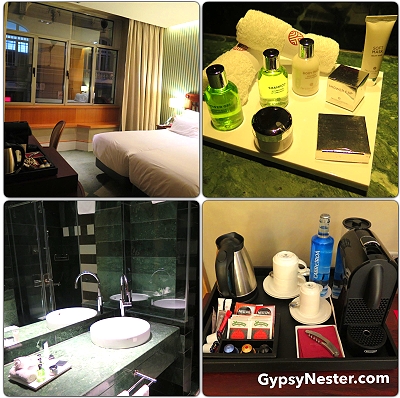
NH Paseo del Prado in Madrid

Also good, the hotel that VBT has chosen for our extension, the NH Paseo del Prado, is right in the heart of the best that the city has to offer.

The famous Prado Museum is directly across the street, and just beyond that the Parque de El Ritiro.

We begin our jet lag fueled first day explorations in the park, wandering the tree lined paths until we come upon the Palacio de Cristal.
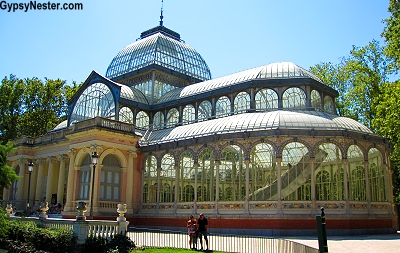
Just as the name sounds, this is a glass palace.
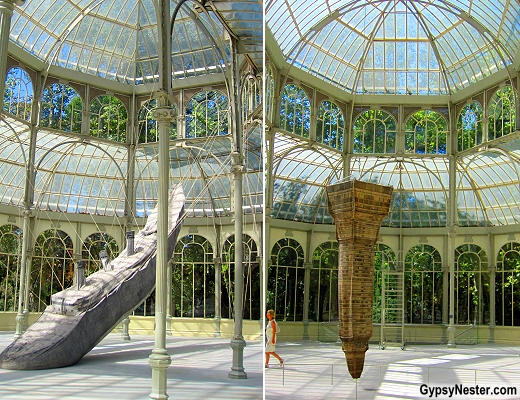
It was originally a greenhouse in this former royal retreat, but now plays host to an avant-garde art exhibit that includes a sinking Titanic and upside down Empire State Building.
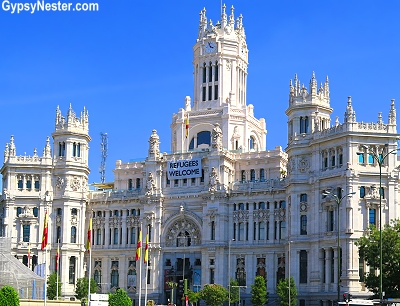
The Plaza Cibeles is dominated by what must be the most spectacular city hall anywhere in the world.

Built as the headquarters for the postal service in 1919, the Palacio de Cibeles now hosts the city council in high style.

Hope those guys appreciate their digs.

From here the main thoroughfare leads us to the city’s two main squares, Puerta del Sol and Plaza Mayor but first we take a slight detour down Gran Via, which Earnest Hemingway pronounces as a cross called Broadway and Fifth Avenue combined.
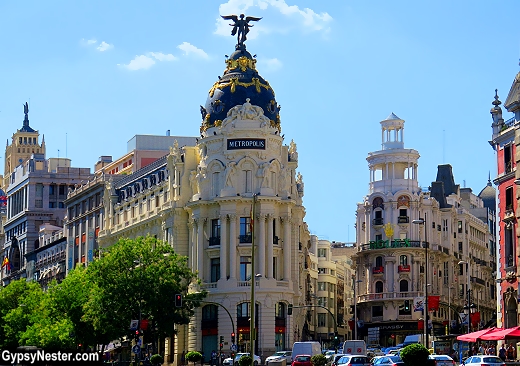
This is the high end shopping and entertainment strip and lives up to its name the Great Way.
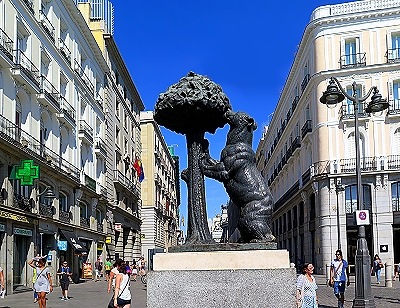
Plaza del Sol is truly the center of town, actually for all of Spain, since it is where the mile markers begin for all roads in across the country.

It is also known for its statue of a bear and madrono tree, which has been a symbol of Madrid for at least seven centuries.
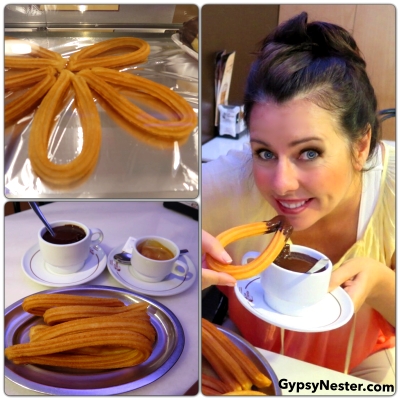
Just off the square we notice a churreria and recall our daughter, Decibel, describing the phenominal churros she had found on her trip to Madrid several years ago.

That was more than enough motivation for us.

Unlike the ultra-sweet donut–like versions we are used to, these are lightly fried crispy bread with almost no sugar.

A cup of melted semisweet chocolate comes for dipping and the result is subtle—yet out of this world.
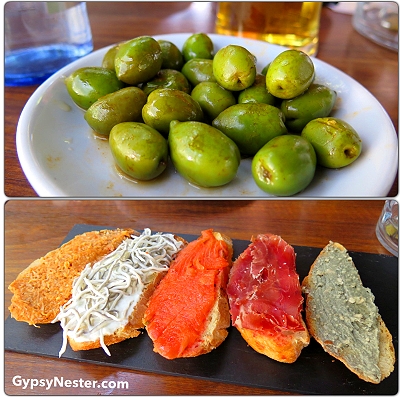
With a little more walking under our belts, we decide to take a low-key tapas break on our way back to the hotel.

We have noticed that many places have water misting over their outside seating areas and it feels heavenly to escape the hot Spanish sun.

See more about our antics in Madrid here.

We opt for a combination plate of five tapas and take our chances as to what might show up. Classic Iberian ham, fish with garlic, crab, salmon, and some ridiculously strong blue cheese arrive and we are thrilled.

Well, maybe not so much with the blue cheese—perhaps our paltes aren’t quite Spain-adjusted yet!

Oh, and we almost forgot, some of the best olives ever.

Time to sleep off the jet lag so we are ready to rock manaña!

DAY TWO: Following Hemingway’s Footsteps in Madrid

Our big plan for today is to make like Ernest Hemingway and have lunch at Sobrino de Botín In addition to being mentioned in his novel, The Sun Also Rises, the restaurant is certified by Guinness as the oldest continually operating restaurant in the world. They haven’t missed a meal since 1725.

To get ourselves in the mood for some serious eating we stop at the Mercado de San Miguel to browse the mouthwatering offerings.
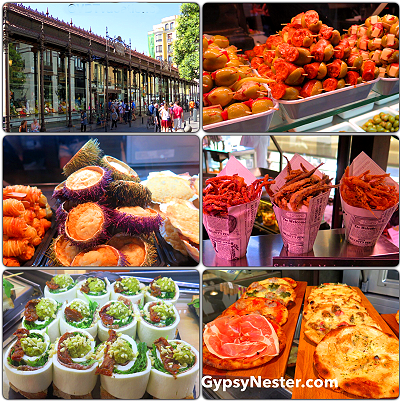
This classic, covered market is over one-hundred years old and is a favorite gathering place for both locals and visitors alike.

It is all we can do to save ourselves and fight back to urge to try every tapa we see in the vast array of meats, cheeses, olives, breads, and seafood.

Quick, we better get to Botín! It is imperative that we have their signature dish, cochinillo asado—roast suckling pig.
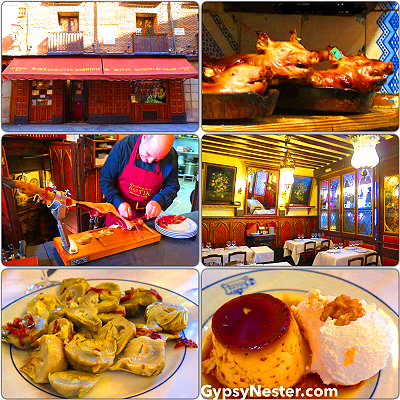
After all, that’s what Papa ate and wrote about.

Another specialty is sopa de ajo, a garlic soup laced with sherry and with an egg poached in the broth, and both are more than worthy of their fame and accolades.

For good measure, we also add some artichoke hearts with Iberian ham… unbelievable.

They must not have had this dish back in Hemingway’s day or it would have deserved a whole chapter.

After an easy walk from the restaurant—we are here for a walking tour after all—brings us to the Cathedral de la Almudena.
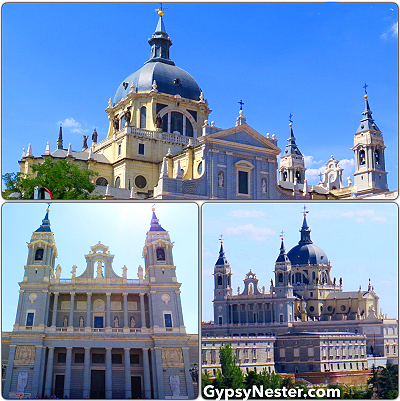
This massive cathedral was built directly across from the royal palace in order to bring seat of the Church in line with the government but it took some time.

Even though the capital of Spain was moved from Toledo to Madrid in 156, it took until well into the eighteen hundreds to get started on the church.

It seems that the monarchs were too busy with their vast overseas empire to get around to allocating the funds until then.

Looking across the huge courtyard, it sure doesn’t look as though they had any trouble finding the dough to build quite the house for themselves.
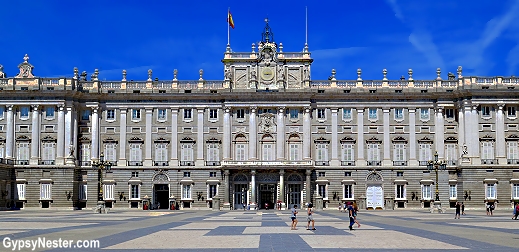
The Palacio Real is one of the biggest palaces in Europe and, even though it is the official residence of the Royal Family, they live outside of town and the palace is used for ceremonial functions.

As far as we are concerned, considering the afternoon sun and the stretch in our bellies, siesta back at the hotel is the only ceremonial function we are very interested right now.
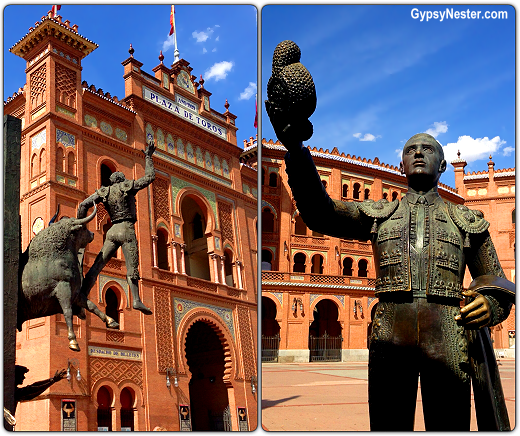
But we did suck it up to peek at the Bullfighting Museum—only because Hemingway loved the sport. We abstain from it every chance we get.

Refreshed after siesta—so civilized—we head next door to the Palace Hotel, another of Don Ernesto’s favorite haunts, and toast to Hemingway with a refreshing cava!
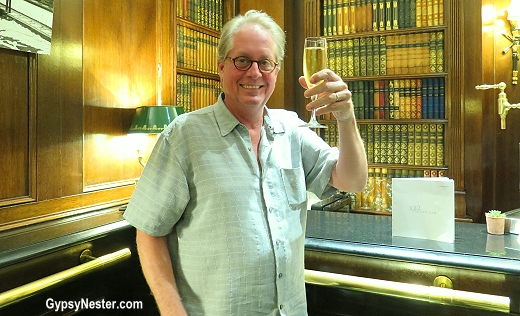
See more about our antics in Madrid.

DAY THREE: We’re Among the Beautiful People of San Sebastián

Read more about our visit to San Sebastián.

We leave Madrid this morning to fly to Bilbao, and then drive on to the seaside resort of San Sebastián. We’ve made it to Basque Country.
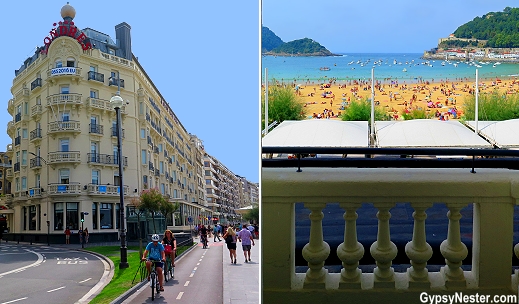
Our room at Hotel de Londresy de Inglaterra in San Sabastian, Spain

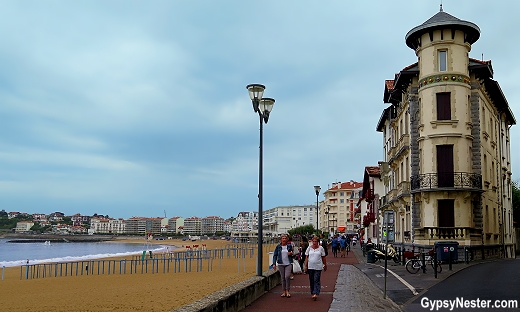
Our room at the Hotel de Londres y de Inglaterra  opens directly onto La Concha Beach…

…making for a view that is tough to beat anywhere in the world.
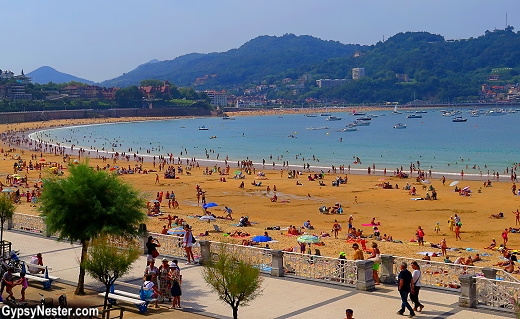
Our room at the Hotel de Londres y de Inglaterra opens directly onto La Concha Beach in San Sabastian

Figuring the beach can wait, we walk into the old town for a look around. First stop, the Ayuntamiento, or City Hall.
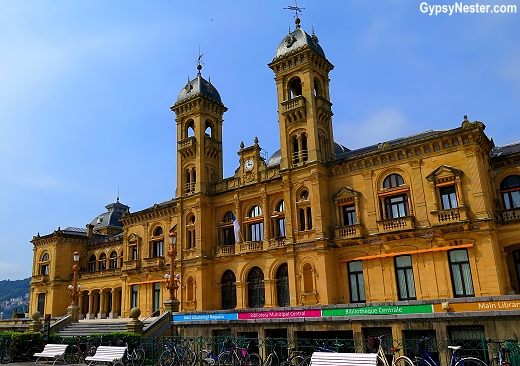
The stylish city hall in San Sabastian, Spain

This stylish building was originally built in 1882 as a casino hall, where Europe’s bourgeoisie and aristocracy came for parties during their summers in San Sebastián.
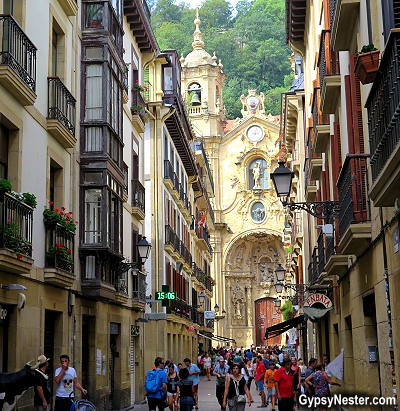
Rowing revelers in San Sebastian, Spain

As we wander through the narrow passages of the old town throngs of fans are busy carousing after the morning’s rowing competition.

It is among these revelers that we get our introduction to pinchos.

Pintxos, as is spelled in Basque, are a typical snack of the Basque Country and are generally made with small slices of bread topped with a mixture of ingredients.

A toothpick holds things together, which is where the name comes from, “pincho”, meaning spike.
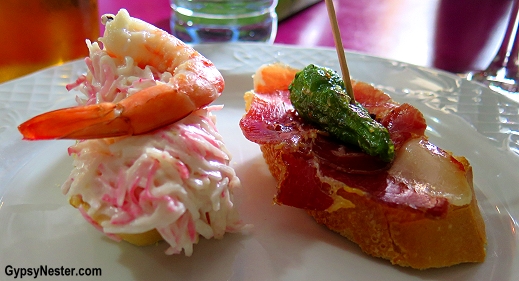
Shrimp and ham pintxos in San Sabastian, Spain

pimientos de Padrón in San Sabastian, Spain

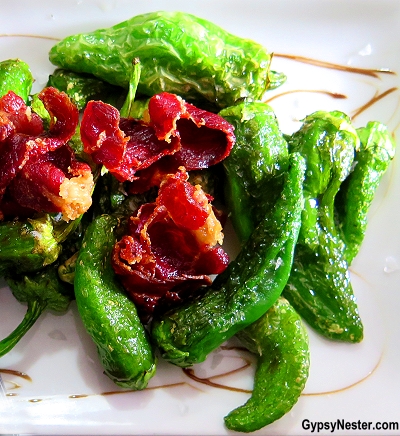
One thing we try is not spiked, but it can have a kick, pimientos de Padrón.

These pan fried peppers are to die for, and most are mild, but every now and then a hot one sneaks up on us.

As an added bonus, these are served with crispy, fried Iberian ham. Shut my mouth that’s some good eatin’!

A late afternoon beach visit tops off our day, and it is almost the perfect way to end a day.

Until we experienced sunset, THEN it was perfect.
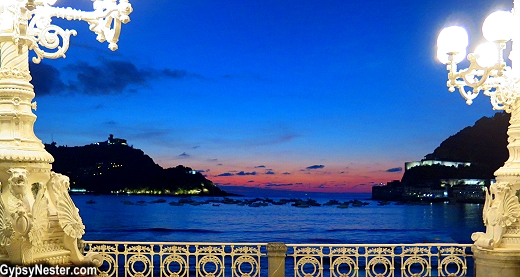
Sunset on the promenade of San Sebastian, Spain

We feel like we are definitely rested and ready to begin our walking tour tomorrow.

See more of fabulous San Sebastian!

DAY FOUR: Hoofin’ it Though San Sebastián

Today begins our official VBT walking tour, and we meet our leaders, Txaro and David, as we prepare for the morning’s walk.
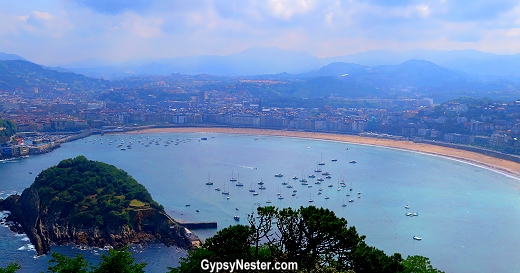
The arc of La Concha Beach in San Sabastian, Spain

The plan is to cover the entire arc of La Concha Beach as we go from Mount Igueldo on one end, to Monte Urgull on the other.

Along the way we pass by the Palacio Miramar, which is the former summer residence of the Spanish monarchy but now is used for summer classes of the Basque University.
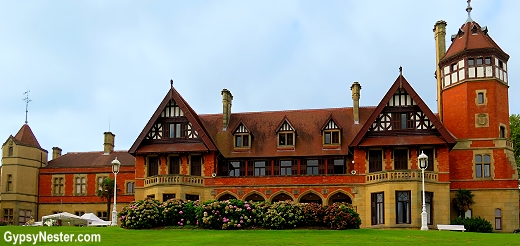
Palacio Miramar in San Sabastian, Spain

The palace was built in English style to give a nod to the help that the Brits gave in driving Napoleon out of the region, and the fact that the royal family was summering here helped turn San Sebastián into the popular resort that is today.

On the rocks at the base of Mount Igueldo we take a look at the Peine del Viento, which means the Comb of the Wind.
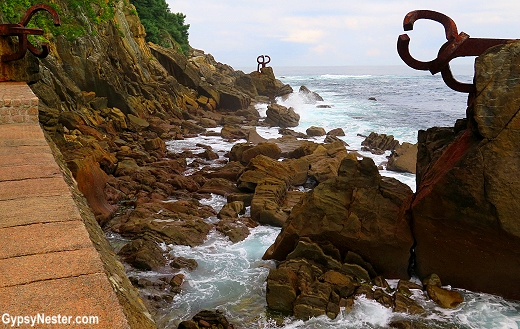
At the base of Mount Igueldo in San Sabastian, Spain, is the Peine del Viento, which means the Comb of the Wind.

The piece was designed by local sculptor Eduardo Chillida to interact with the wind and waves, making sounds from their vibrations. Unfortunately—or perhaps fortunately—since it means we get to stay dry, the seas and breeze are too calm to create any resonances.
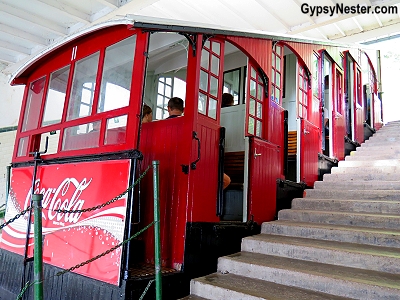
The old, wooden funicular in San Sabastian, Spain

The easy way to the top of the mountain is by funicular, so we vote for that.

The old, wooden cable car has been ferrying folks to the summit for over a hundred years.

At that same time an amusement park opened up there and it remains one of the oldest in the Basque Country.
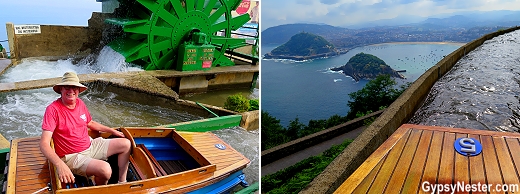
The flume boat ride at the top of Mount Igueldo in San Sabastian, Spain

We take a turn on the little flume ride that skirts the top of the mountain, but the real attraction up here is the panoramic view of Donostia, the Basque name for the city of San Sebastián, spread before us with the Pyrenees as a backdrop.
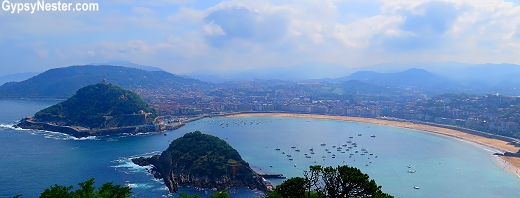
The arc of La Concha Beach in San Sabastian, Spain

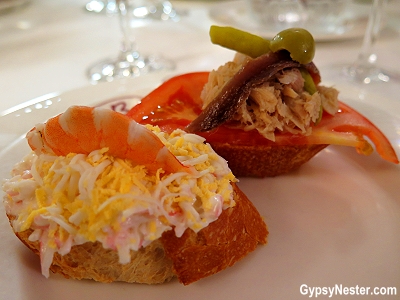
Shrimp and seafood pintxos in San Sabastian, Spain

The return walk takes us past our hotel and into la parte vieja, the old city, where we seek the reward of some pintxos.

Txaro leads us into Bernardo Etxea and introduces us to the first of what we expect to be many great Basque meals.

We begin with typical pintxos, made with several varieties of seafood on bread, and are off to a fantastic start.

This is followed by salad, and then an assortment of vegetables that are prepared to perfection with garlic, shaved almonds, and the new must-have ingredient of our trip, jamón Ibérico, Iberian ham.
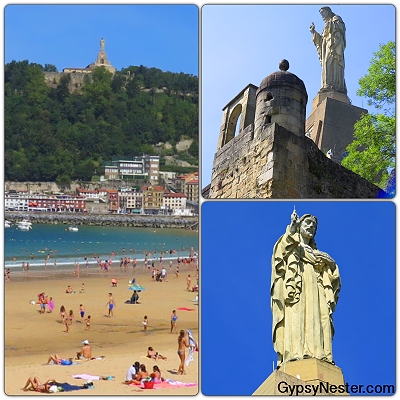
Sagrado Corazón, or Sacred Heart, a giant Jesus atop Monte Urgull in San Sebastian, Spain

Feeling fortified enough to make the climb to the fortifications at the top of Monte Urgull, we set out again.

La Mota Castle dates back nearly nine hundred years to when it was built by King Sancho the Wise of Navarre, the founder of San Sebastián.

Along with its surrounding battlements, the fortress played a major role in defeating Napoleon’s troops, so its place in history is held in high regard.

In 1950, in an effort to seize some of that good will, Generalissimo Francisco Franco commissioned a giant sculpture of the Sagrado Corazón, or Sacred Heart, to stand atop the ancient citadel. This has led to some mixed feelings among the residents, due to the overwhelming dislike of the deceased dictator in these parts, but the appreciation of the Christ statue overseeing the city.
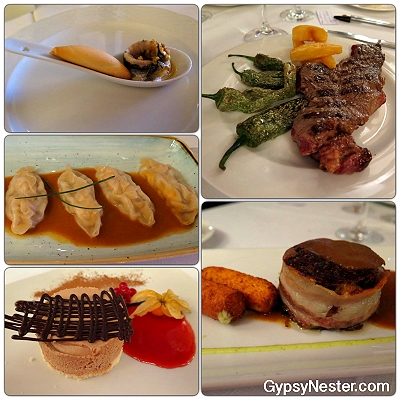
Incredible dinner at Hotel de Londres y de Inglaterra in San Sebastian, Spain

This evening we truly kick the tour off with a welcome reception and dinner at our amazing accommodations, The Hotel de Londres y de Inglaterra and learn a bit about its storied past.

Queen Isabella II hid away here during a revolution in 1868, and a few years later King Amadeus I of Savoy stayed a while.

This was before it officially became the Hotel de Londres in 1902, but since then Henri Marie de Toulouse-Lautrec and the notorious spy Mata Hari have also been guests.

We’re pretty sure (but can’t be completely certain!) that Helen Mirren is one of our fellow guests (who’d ever thought we’d ever say that?). Otherwise, she has a eerie doppelganger. More sneaky stalking is necessary to confirm our sighting.

See more of fabulous San Sebastian!

DAY FIVE: From the Pig’s Ear to the Horse’s Mouth in the Basque Countryside
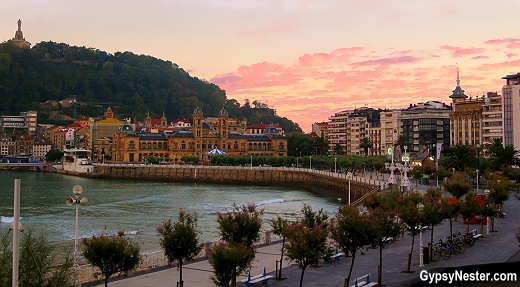
Sunrise over San Sabastian, Spain
The sun rises over San Sebastian

Catching the train in San Sabastian, Spain

This morning we are up and at ‘em to get to the train station for a ride up into the mountains to Tolosa.

A typical commuter train takes us the half-an-hour trip to the town that once was the capital of Gipuzkoa, one of the three Basque Provinces in Spain.

This honor is now held by the much larger Donostia, or San Sebastián, that we just left.
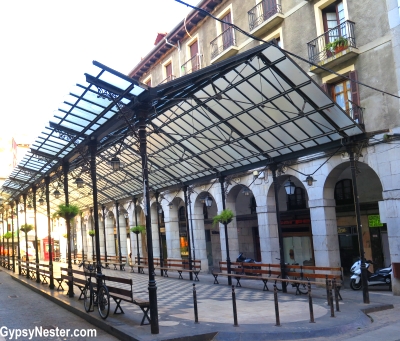
Covered market in Tolosa, Spain

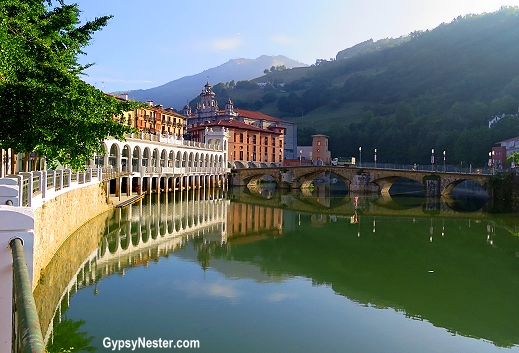
Our walk through Tolosa reveals an historic old quarter of wonderfully preserved buildings lining narrow passages, until everything opens up along the bank of Oria Ibaia.

We follow the river for a while, looking back often for incredible views of the town behind us.
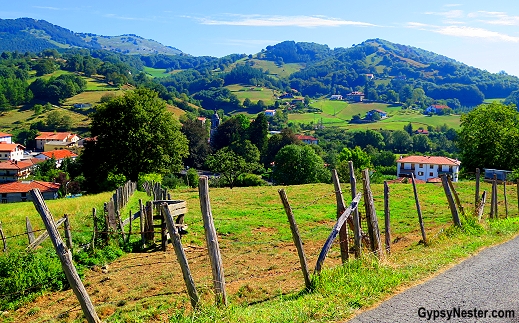
From the edge of Tolosa, we drive even higher into the Pyrenees.
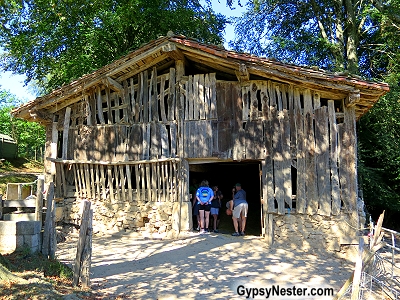
A pig barn in the Basque Country of Spain

Here we begin our journey up to a farm where the methods for raising pigs has remained the same for centuries.

These very special pigs, Euskal Txerria, are only found in the Basque region and the family we are visiting is integral in keeping tradition alive. And the pigs too, the other two indigenous pig breeds are now extinct.
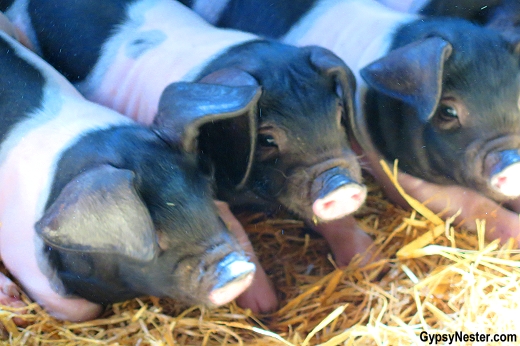
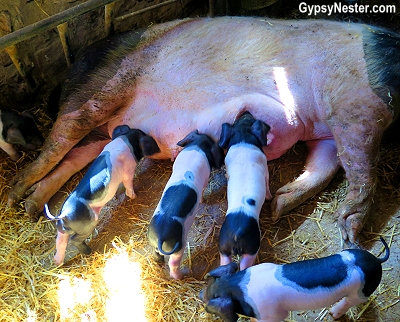
Basque piglets, Euskal Txerria

Basque pigs nursing in the Spanish Basque Country

These are free range pigs, allowed to graze at will. That’s right, graze.

Left alone, pigs will happily graze on grass and they especially dig the nuts and acorns that fall from the trees.

One of the farm’s owners, Maite, meets us at the barn and, through David’s translation, she explains the entire process from piglet to pork products.  (We mean our group leader David translating, otherwise the interpretation might have been complete nonsense.)
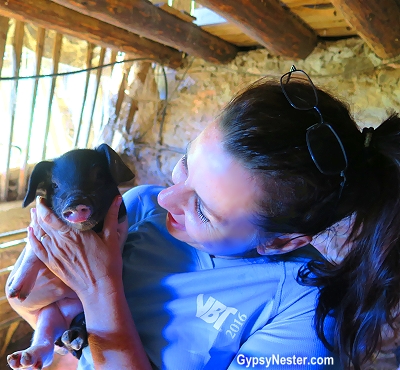
Veronica falls in love with a Basque piglet. GypsyNester.com

While we listen, Veronica has basically adopted one of the piglets as her own. It’s hard to argue with the fact that these two-month old guys are ridiculously cute.

From the barn we head inside the five hundred year old farm house for lunch.

Naturally pork is the star of the show, beginning with ham and two types of sausage.
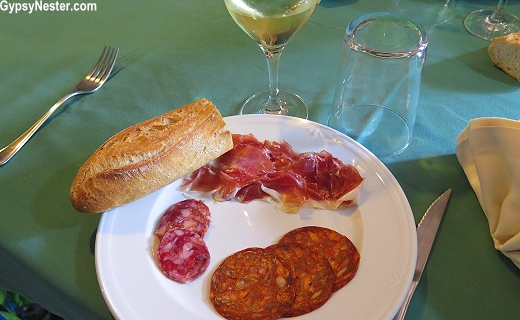
Sausage and ham from the Basque Country of Spain

Once again Maite describes the process, this time about the five years involved in producing the ham.

After a salad, a tray of pig’s ear pintxos is thrust upon us.
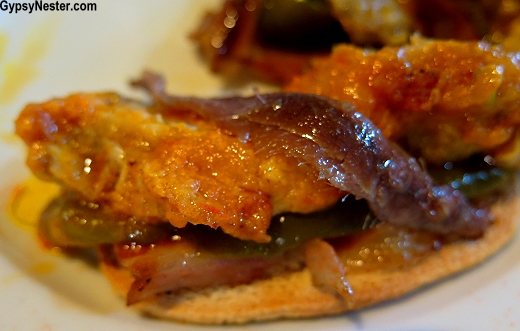
Pig's ear pintxos in the Basque Country of Spain

Known as oreja a la plancha, literally grilled ear, this is a specialty across Spain, with the Basque version being a bit spicier than others.

Rather than serving it alone, this ear was allowed to join forces with peppers and anchovies on toasted bread, which was music to our ears.
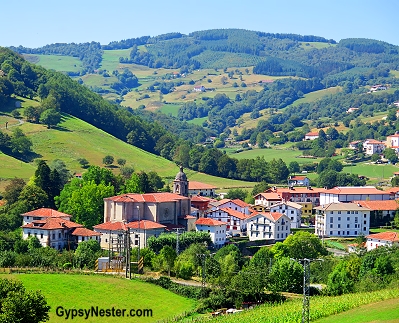
The landscape of the Basque Country of Spain

Post lunch, we walk back down the hill to our lodging for the next two nights, the Iriarte Jauregia Hotel, just outside of the tiny village of Bidania.

We meet up with the proprietor, Iban Munoa, and hear the story of the hotel from the horse’s mouth.
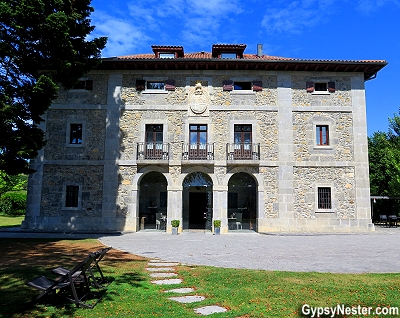
Iriarte Jauregia Hotel in the Basque Country of Spain

His family had been very influential in the area until all of their property was seized by the Franco regime and they had to flee to the French side of Basque country.

Once Franco was gone they could return, but without any of their previous possessions.

The family finally found this large manor house and moved in, and later Iban and his wife refurbished the old stone structure into the unique and elegant inn that we unexpectedly find today.

DAY SIX: The Day of Eating We Were Dreaming of
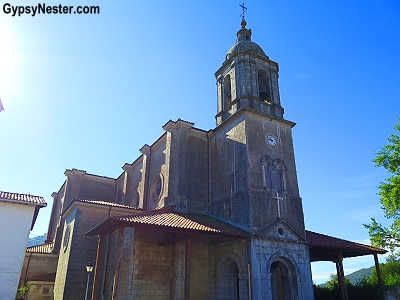
San Bartolomé Church in Bidania of the Basque Region of Spain

Our first order of business today is to meet Iban at the small parish church of Bidania.

It was built by his family before the civil war when they fled and at the same time, back in the late eighteen hundreds, his ancestors also built the first school that taught in the Basque language.
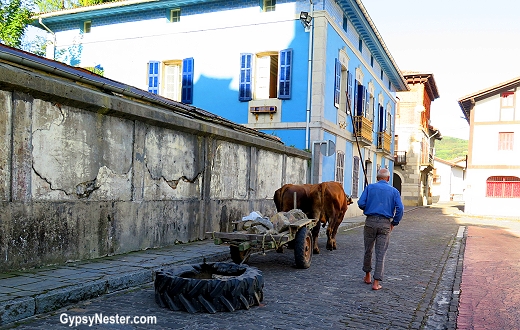
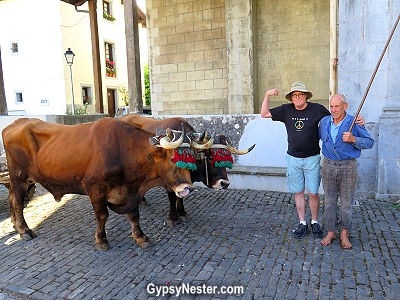
A man exercises his oxen in Bidania of the Basque Region of Spain

A man exercises his oxen in Bidania of the Basque Region of Spain

As a bonus, when we round the corner into the square we see a well-known and barefoot townsman, Miguel, exercising his oxen in front of the church.

He is keeping them in shape for an idi probak, which is Basque for oxen tests, a popular one of several Basque dragging games which are common throughout the region.
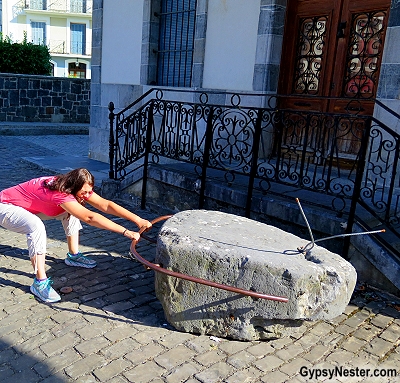
Veronica attempts to pull a idi probak stone in Bidania of the Basque Region of Spain

The game involves a team of oxen dragging an enormous chunk of rock from one side of a square to the other.

One of the stones is also in the square, however, this is a small one meant for a group of six or eight men to drag.

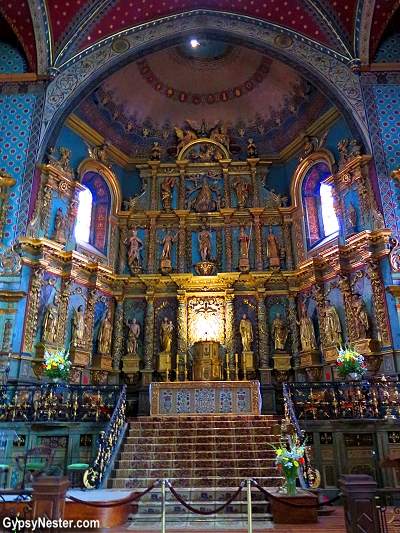
Entering San Bartolomé Church we are astounded, the humble exterior gives no indication of the elaborate interior we encounter.

The ornate alter is floor-to-ceiling covered in gold leaf and nearly knocks us off our feet.
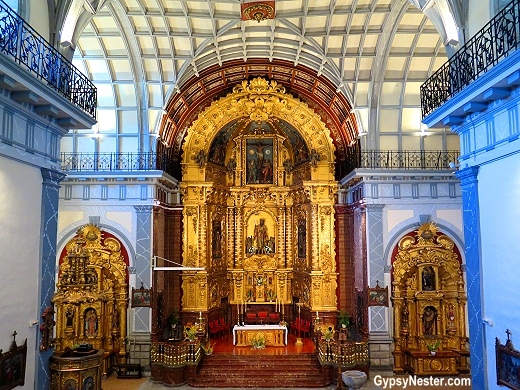
The alter at San Bartolomé Church in Bidania of the Basque Region of Spain is completely covered in gold

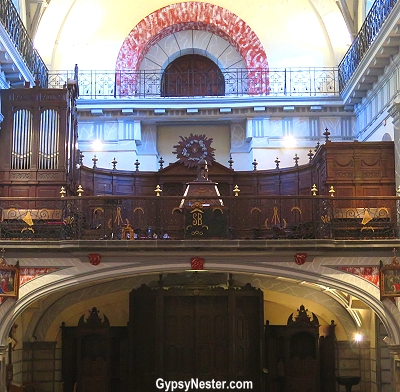
The choir loft in San Bartolomé Church in Bidania of the Basque Region of Spain

Iban takes us through the entire church; even the behind the scenes areas such as the sacristy that lay people like us seldom if ever get to see.

We finish in the choir loft, which is unlike most in that it is designed for priests, or monks, to sit in a semi-circle to perform their chants, as opposed to a full choir singing to the congregation.
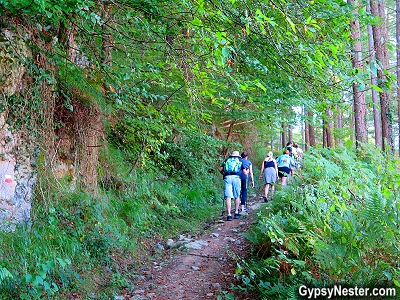
Hiking through the woods of Basque Country in Spain

The time has come to walk again, and today we are excited to be heading even more off-the-beaten path and into the woods.

The trail takes us through the forest while our guide, David, regales us with Basque mythology.

First he tells us about Mari, the Earth Mother and creation force of Basque legend, but as the woods thicken we hear the tale of Jentil.
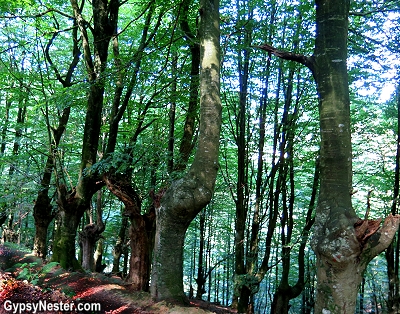
Jentil, a giant rock throwing beast, is said to haunt the woods of the Basque Region of Spain

Jentil is a bit more disturbing beast—giant in size and covered with hair.

He lives in these mountains and likes to throw huge boulders to block men’s paths, but is seldom seen by humans.

The woods are kind of creepy here and we are glad to report no monster sightings.

Having safely passed through the land of Jentil, we are ready for some lunch.
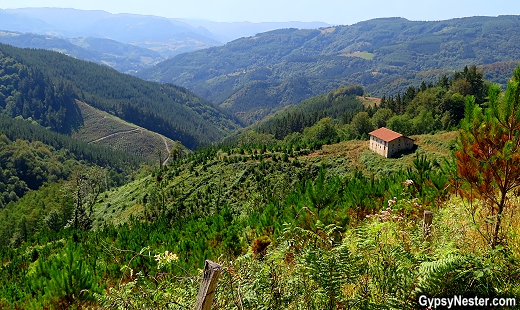
The Basque Country of Spain

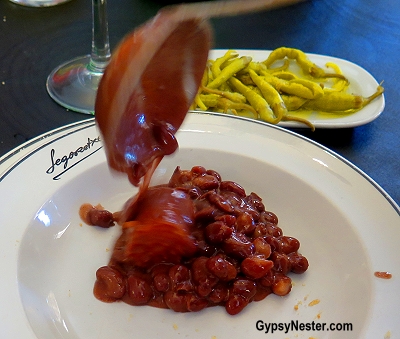
Tolosa beans in the Basque region of Spain

Today that means two of the Basque country’s most iconic foods, Tolosa beans and sidra.

The beans, known as tolosako babarruna in Basque, are only grown in this area, and have been protected by the Spanish Denominación de Origen.

They are black, but turn purple when cooked, and are traditionally served with spicy ibarrako piparrak, pickled peppers from the neighboring town of Ibarra.
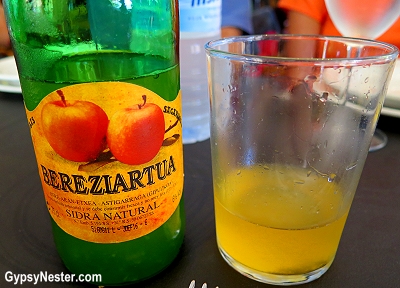
Sidra, Basque apple cider

Sidra is more of an apple wine than our idea of cider.

In fact, that would be a pretty accurate translation of the name, sagardoa.

The pour is of utmost importance, it must be from high up and allowed to splash into the glass.

This gives the sidra a chance to aerate and bring out the fresh flavor.
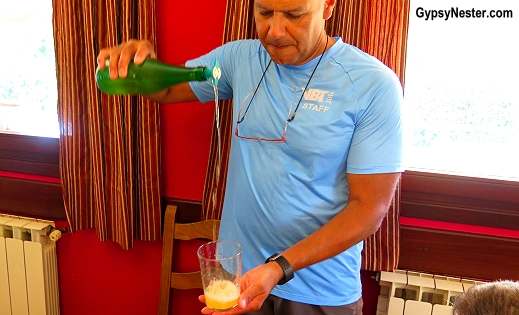
The proper way to pour Basque sidra, pour the cider from as high up as you can!

Our walk today planted our feet on the Camino de Santiago, the Way of St. James (more on this tomorrow)…
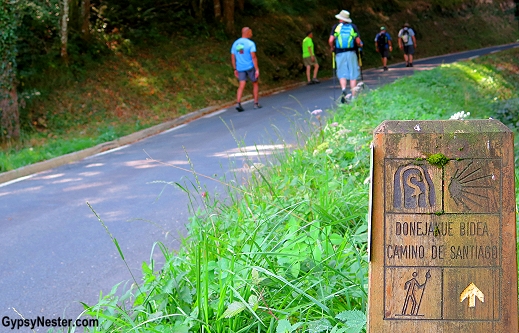
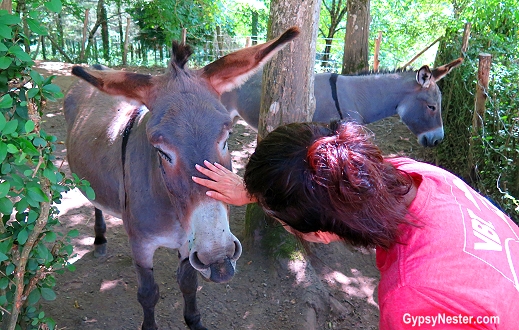
Donkeys along Camino de Santiago, the ... our hands on more furry friends... Way of St. James, in the Basque Country of Spain

… and our eyes on incredible vistas.
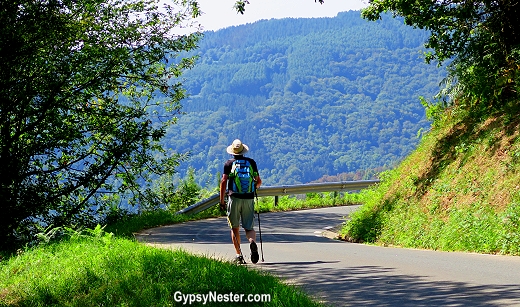
In what is turning out to be a day of food experiences, dinner tonight is specially prepared for us at the award winning Bailara Restaurant at our hotel, Iriarte Jauregia.
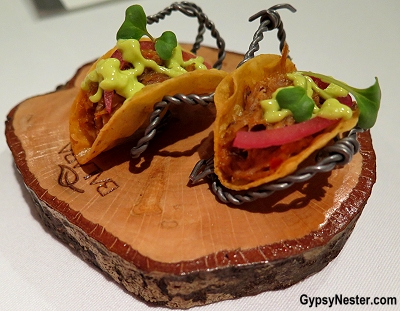
Duck tacos at Bailara Restaurant at Hotel Iriarte Jauregia in Bidania, Spain

Their goal is to use local products from nearby orchards and farms as much as possible and combine Basque tradition with innovative new ideas.
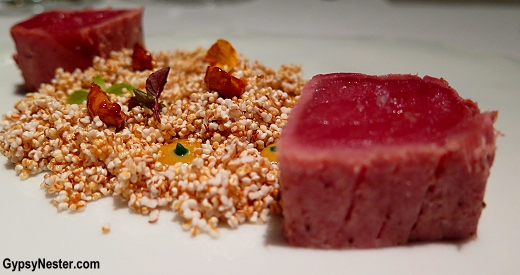
Seared tuna on a bed of amaranth with honey and mustard at Bailara Restaurant at Hotel Iriarte Jauregia in Bidania, Spain

The appetizers are phenomenal, seared tuna on a bed of amaranth with honey and mustard, duck tacos, and shrimp cookies served with avocado cream.

Shrimp cookies served with avocado cream at Bailara Restaurant at Hotel Iriarte Jauregia in Bidania, Spain

Our entrées of hake with Basque green sauce and Iberian pork cheek with oyster sauce and smoked shinkinbushi were outstanding as well.
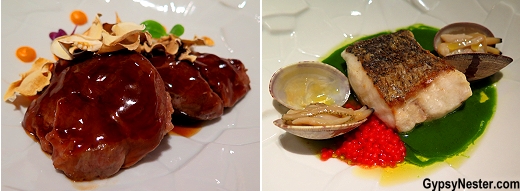
Pork cheeks and hake at Bailara Restaurant at Hotel Iriarte Jauregia in Bidania, Spain

But as we seem to be learning here in Spain, the small bites are often the best.
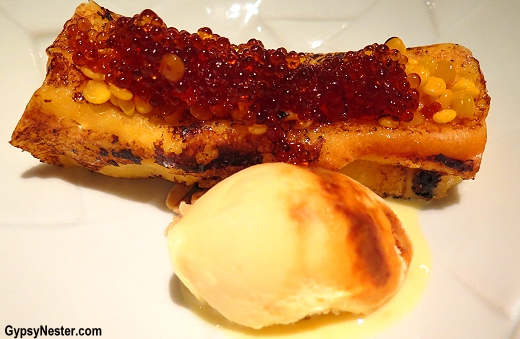
Basque French toast at Bailara Restaurant at Hotel Iriarte Jauregia in Bidania, Spain

Continue here for part two of this adventure!

David & Veronica, GypsyNester.com

See more about our antics in Madrid.

Read more about our visit to San Sebastián.

See more about the Camino de Santiago.

See all of our adventures in Spain.

A big thank you to VBT Bicycling and Walking Vacations for providing this adventure where we can tour AND eat all the delicious food we want without worrying about the calorie count! As always, all opinions are our own.


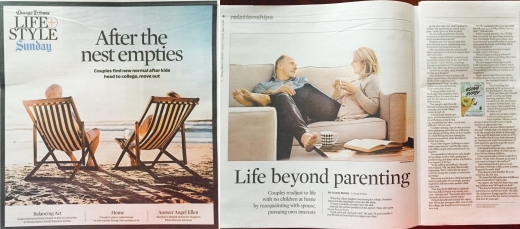
Whoa. We’re in the Chicago Tribune!

Okay, we’re not sure who the people are in the photos—but we’re uber-excited to be in the text!.. CHECK US OUT!

Pretty cool to be featured in one of America’s greatest newspapers, The Chicago Tribune! Okay, so we’re not sure who the people are in the photos—but we’re uber-excited to be in the text.

Click image to enlarge
The GypsyNesters in the Chicago Tribune

Click image to enlargeThe GypsyNesters in the Chicago Tribune!

David & Veronica, GypsyNester.com

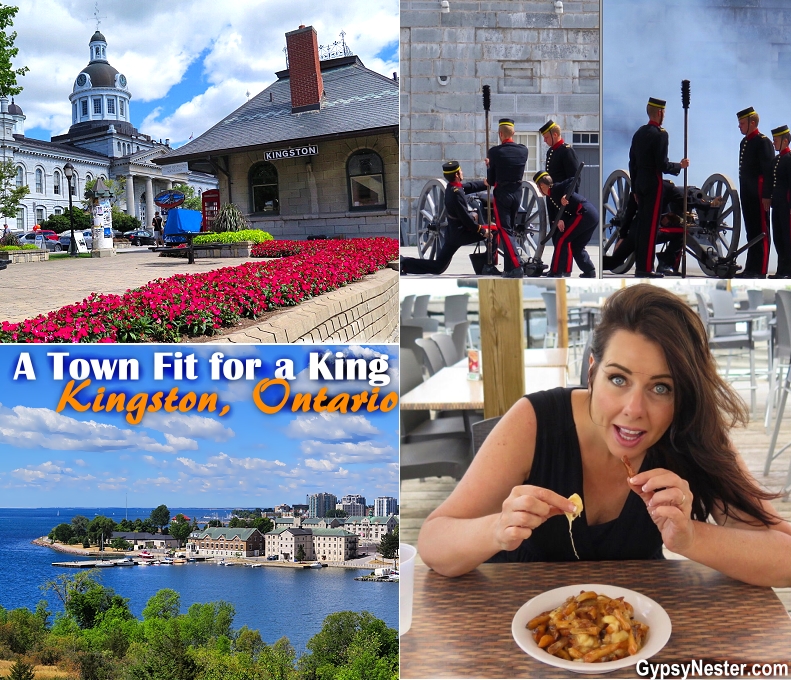
A Town Truly Fit for a King—Kingston, Ontario

While exploring Kingston, Ontario (the gateway to the 1000 Islands, yep, of salad dressing fame), we discovered that history, like beauty, can be in the eye of the beholder.  

Follow us as we gallivant through the coolest fort we’ve ever seen, eat at the safest restaurant in the world, unlearn what we learned in history class, and partake in a romantic, sunset dinner cruise through the 1000 Islands… CONTINUE READING

A big thanks to Ontario Travel and Visit Kingston for providing this historic adventure! As always, all opinions are our own.
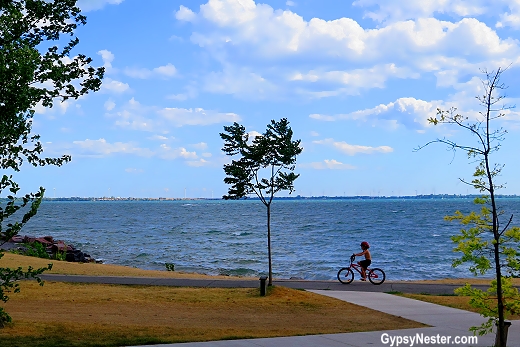
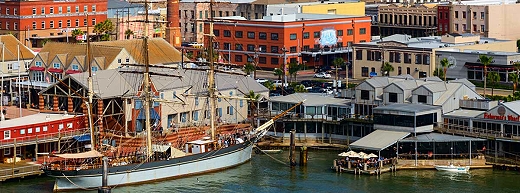
Kingston, Ontario, Canada

While exploring Kingston, Ontario (the gateway to the 1000 Islands, yep, of the salad dressing fame), we discovered that history, like beauty, can be in the eye of the beholder.

We also found that historic perspective can change drastically just by stepping across a border.

In general, our culture shock is minimal when visiting Canada—sure they might add an “eh?” at the end of a sentence—but we certainly don’t feel like strangers in a strange land.

While that was again true on our recent journey and, as always, the people of Canada were overwhelmingly welcoming, there was a revelation or two that reminded us we were indeed foreigners.

Kingston, Ontario, Canada

Kingston began as a French trading post called Cataraqui, but was taken by the British in 1758 during the Seven Years’ War—or what we Americans from south of the border call the French and Indian War.

The Brits renamed Catarqui The King’s Town or King’s Town, in honor of King George III, then over time the name was shortened and the words melded together.

During the American Revolution, the settlement became a refuge for British Loyalists fleeing north and grew into an important military stronghold as a base for the Great Lakes British naval fleet.

Kingston, Ontario, Canada

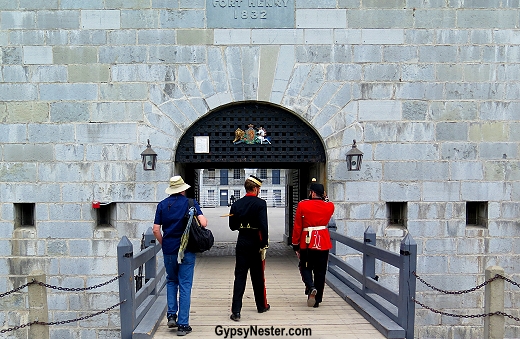
By the war of 1812, the crown considered Kingston to be of prime military importance and built one of the most impressive fortresses we have ever seen, Fort Henry.

This is where we began to find that the Canadian version of events didn’t quite jibe with our memories from history class. During this war, the British (Canada was still British territory at that time) were concerned about protection of the St. Lawrence River and hastily built protection where the river met Lake Ontario.

After defeating the Americans, they replaced the cobbled-together fortifications with a formidable stone version to ward off any future attacks.

Sunset in the 1000 Islands

Wait, what? Defeated the Americans? Yup, we lost the war of 1812, but nobody told us in school.

At least that’s the Canadian take on things.

Actually, both perspectives can be correct. It can be argued that Canada won, in that they held off an attempt by the Americans to wrestle them away from the British and have them join the Union.

Or it can be said that the United States won, in that they defeated the British and remained independent.

It’s all in the eye of the beholder.

The Most Impressive Fort We’ve Ever Seen!

Fort Henry in Kingston, Ontario, Canada

Our neighbors to the north remained pretty paranoid for the first part of the eighteen-hundreds, at least judging by the defenses built at Fort Henry (and we certainly understand why).

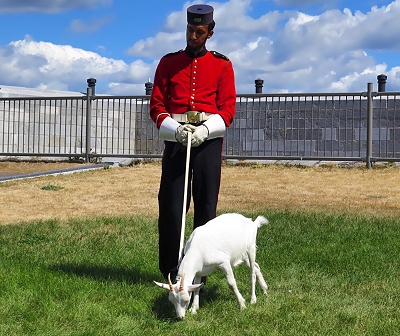
Fort Henry's mascot, David. In Kingston, Ontario, Canada
Meet David, Fort Henry’s official mascot! There have been oodlesof Davids over the years, but we are assured that THIS David isthe best ambassador yet. And he keeps the grass trimmed!

A moat and two huge walls, specially designed to allow strategically placed cannons in each corner to send scatter shot shrapnel ricocheting through the open area between them, protected the troops inside.

Hundreds of additional cannons covered every inch of water from six different locations along the coast and on the surrounding islands.

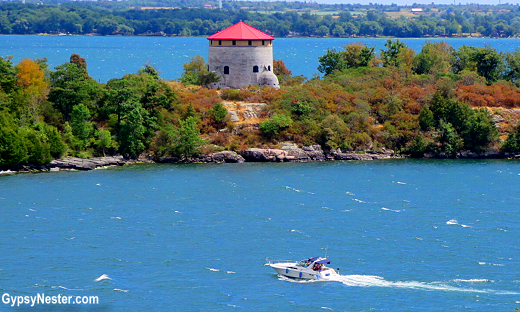
Fortification tours dot the islands surrounding Kingston, Ontario, Canada

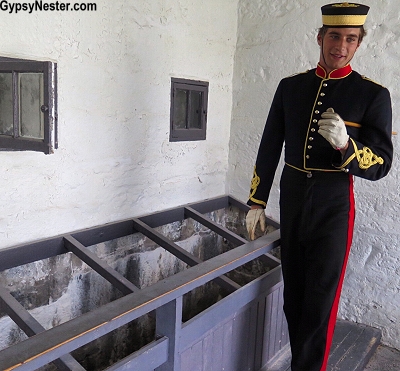
Our guide, fully decked out in authentic lieutenant’s regalia from the period, was rightfully proud of the fort’s history of never being attacked.

America was never crazy enough to try. It also helped that relations quickly improved over the latter half of the century.

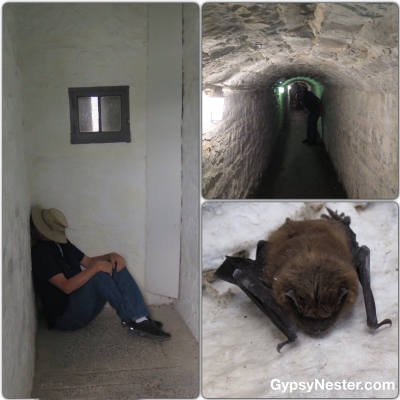
David got thrown in the brig at Fort Henry in Kingston, Ontario, Canada
David got thrown in the brig—with bats!

Several-greats grandfathers of our guide had served in the British army at the base, and asking around we found that many of the employees had long family ties to the fort.

We followed our lieutenant (pronounced leff-tenant in these parts) inside for a look at what day-to-day life was like.

Surprisingly, many of the soldiers were married, and their wives and children lived with them inside the fort.

Fort life had all the hallmarks of a full community.

Soldier life at Fort Henry in Kingston, Ontario, Canada

The vintage men's latrine at Fort Henry had no seats - so the soldiers didn't lallygag in there (reading the paper? playing games on their phones?) Bet it worked!
The vintage men’s latrine at Fort Henry had no seats – so thesoldiers didn’t lallygag in there (reading the paper?Playing games on their phones?) Bet it worked!

The accommodations were Spartan to say the least, unless of course one had the good fortune of being an officer.

And we do mean good fortune, as our lieutenant explained. The one and only way to become an officer was to buy your rank. No merit system involved.

The outpost was completely self-contained—it had to be, should a siege take place—so all of the necessities of fort life were handled in-house in a number of kitchens, bakeries, and workshops, all segregated by rank, of course.

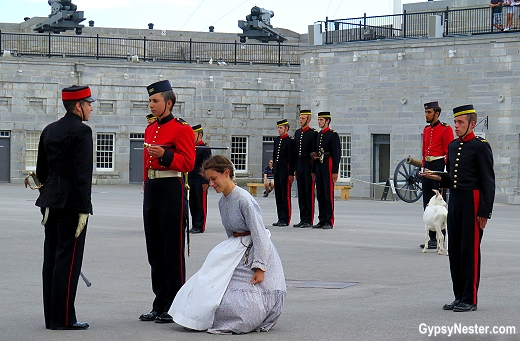
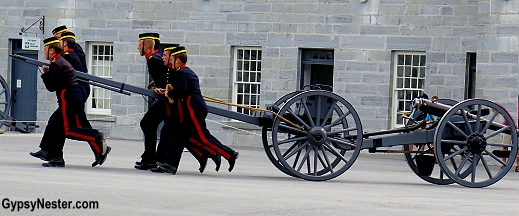
For a farewell salute a fully bedecked artillery team rolled a ten-pounder into the parade ground in the center of the fort.

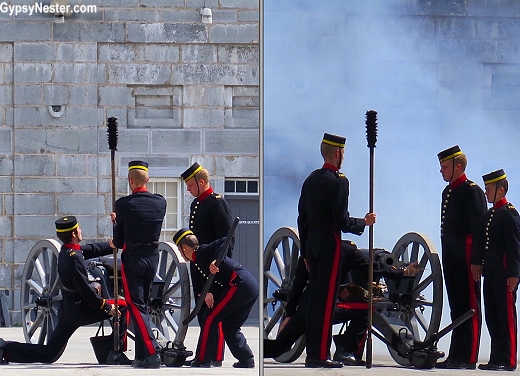
Firing of the cannons at Fort Henry in Kingston, Ontario, Canada

They loaded the cannon up, but only with one of the ten pounds of black powder she was designed to hold, and let her rip, not once, but twice!

Firing of the cannons at Fort Henry in Kingston, Ontario, Canada

Looking around at the gathered crowd, we had to come to the conclusion that the display was not only in honor of us, but first-rate none the less.

The Safest Restaurant on the Planet

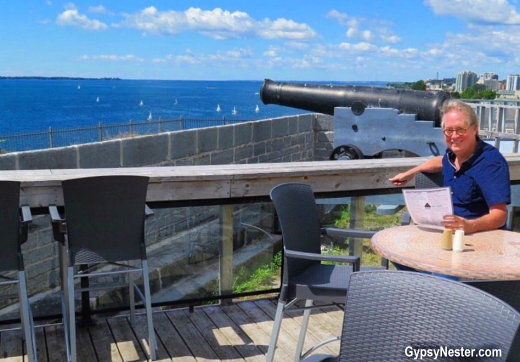
The Battery Bistro, he safest place to eat in Kingston, Ontario, Canada!
The safest place to eat in Kingston, under the cannons of the Battery Bistro!

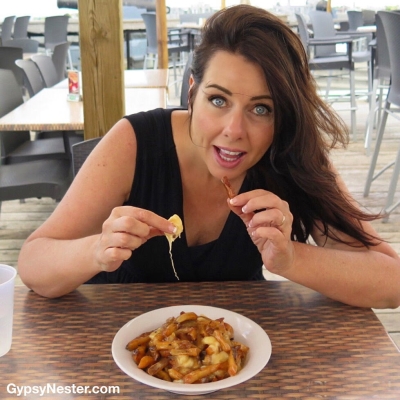
Veronica gets her mitts on poutine in Canada —a gloriously unhealthy dish consisting of french fries, gravy, and cheese curds GypsyNester.com

After grabbing a bite at the Fort Henry’s Battery Bistro, which was without a doubt the safest we’ve ever felt while eating lunch…

(we feel like we’re not officially in Canada until we’d had poutine—a gloriously unhealthy dish consisting of french fries, gravy, and cheese curds),

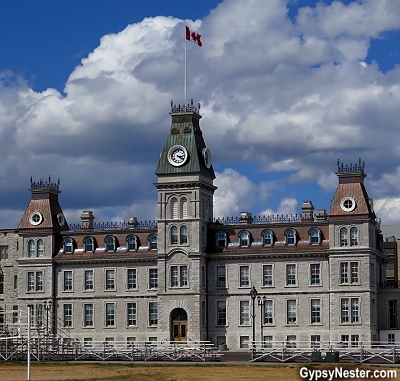
…we took a quick spin through the campus of the Royal Military College of Canada.

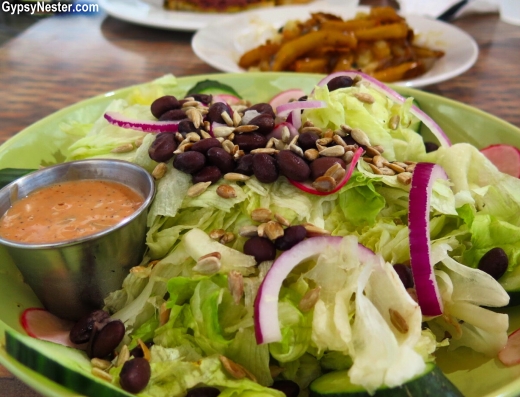
A 1000 Islands salad - with the proper dressing of course! At Battery Bistro in Kingston, Ontario, Canada
We knew about 1000 Islands dressing (soooo much better than what we get in the States!) but had to order the 1000 Islands salad.

The Royal West Point

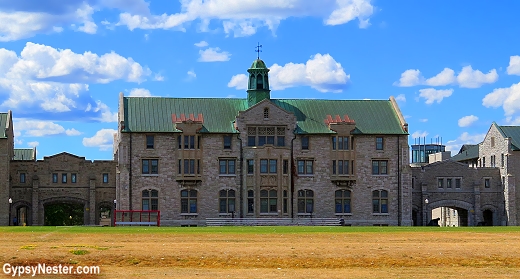
Royal Military College of Canada in Kingston, Ontario

As an offshoot of the fort, the college was founded in 1876.

This so-called West Point of Canada trains cadets for all branches of the military and is the only academy of its kind in the country.

Though our visit was in the dead of summer, we were regaled with tales of the college’s ice hockey team and their annual match with the United States Military Academy Black Knights in the annual West Point Weekend.

This series is the longest-running annual international sporting event in the world, going back to when General Douglas MacArthur suggested a game between the two schools in 1923.

Royal Military College of Canada in Kingston, Ontario

Army may currently lead the Series by ten games, mostly on the strength of recent victories, but the spirits of the Paladins remain high.

So Much History!

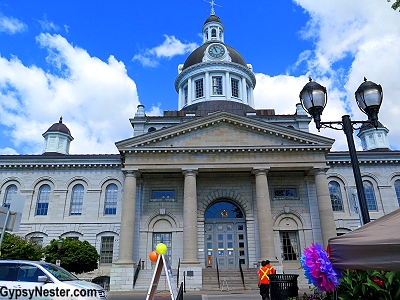
The city hall building in Kinston, Ontario, Canada

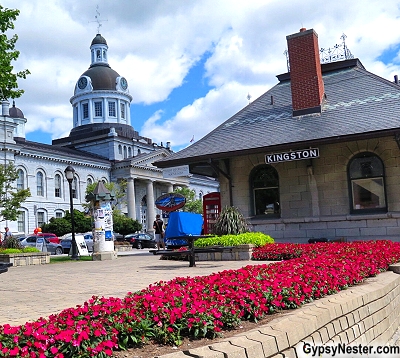
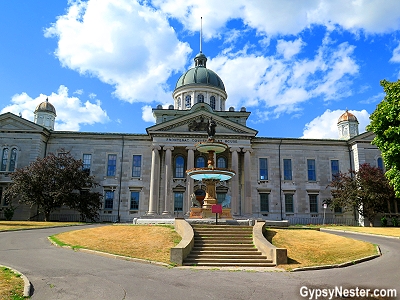
Crossing the St. Lawrence into Kingston itself, we were drawn to the focal point of the city, the Historic City Hall.

Since Kingston was the capital of the new Province of Canada when construction began in 1841, the structure was designed to reflect the city’s prominence.

Unfortunately by the time it was completed in 1844, the government had moved to Montreal. Still, the building holds the honor of being designated a National Historic Site of Canada.

Kingston, Ontario, Canada

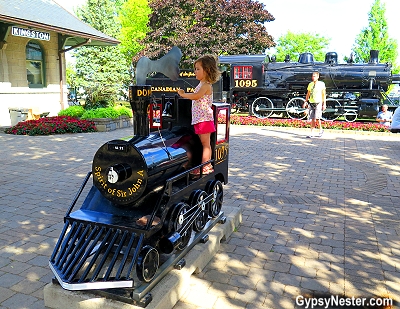
The Spirit of Sir John A train in Kingston, Ontario, Canada

Directly across the street from the hall, Confederation Park seemed to be the hub of the town’s activity.

A former Kingston and Pembroke Railway station serves as the visitor information center, with the giant locomotive the Spirit of Sir John A standing alongside.

There’s even a replica for the kiddies!

Good Ol’ Sir John A

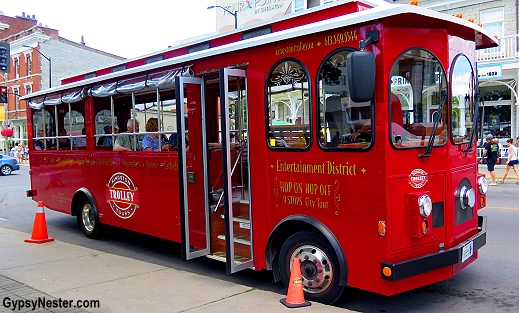
The Kingston Trolley heads to all the hotspots of Kingston, Ontario, Canada

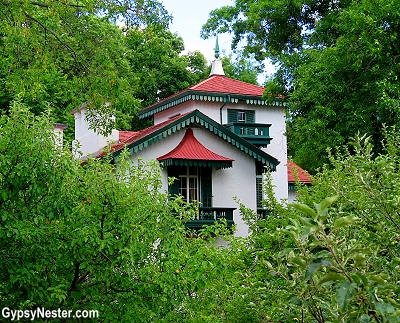
Sir John A McDonald's house in Kingston, Ontario, Canada

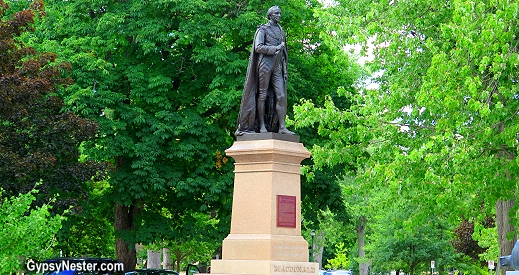
We would be hearing a lot more about Sir John A. MacDonald, Canada’s first Prime Minister, as our day went on—and as our journey across Ontario continued —beginning right away when we caught the hop on hop off Kingston Trolley Tour in front of the old steam engine.

Statue of Sir John A MacDonald in Kingston, Ontario, Canada

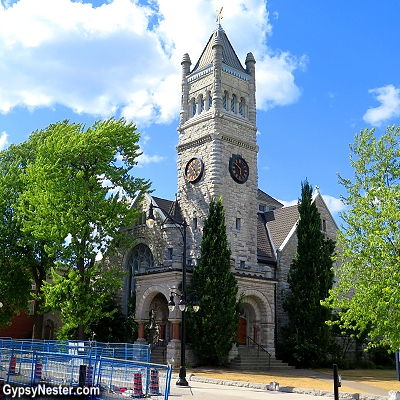
Sir John A's church in Kingston, Ontario, Canada

The route took us past a couple of more Sir John A related sites, including his one-time home, the Bellevue House, hidden behind a grove of apple trees, and the St. Andrew’s Presbyterian Church that he attended.

John A’s stay in Kingston may have been brief, but he certainly left his mark before moving on to lead the effort to create the Canada that we know and love today.

His spirit of tolerance and democracy certainly lives on.

Sunset Dinner on the Water

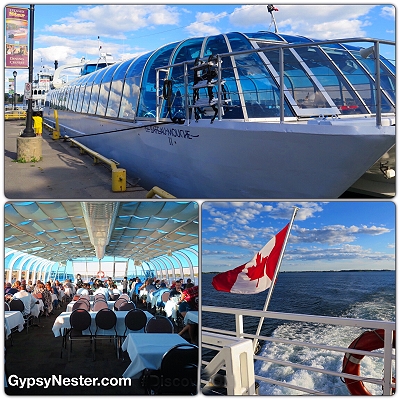
The Island Star Dinner Cruise of the 1000 Islands in Kingston, Ontario, Canada

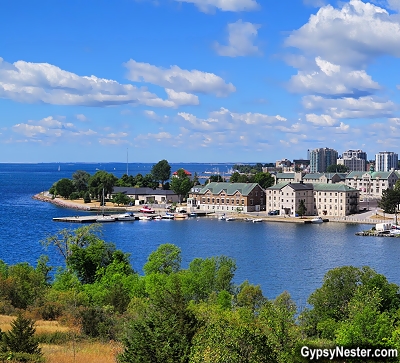
After passing through the campus of Queen’s University, established by a royal charter from Queen Victoria, and Kingston’s hopping shopping and entertainment district along Princess Street, we headed back to the waterfront and Confederation Park.

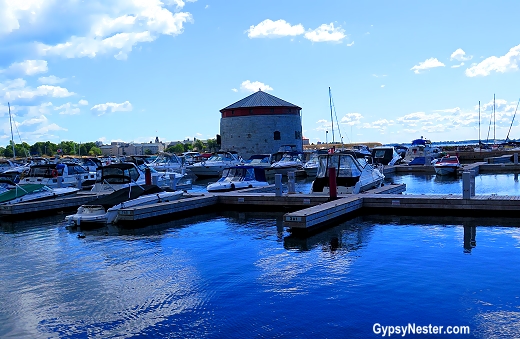
The park sits on the harbor, serving as the boarding spot for numerous ferries and tour boats, which worked out great for us since we were set to sail on the Island Star for their sunset dinner cruise.

We did our best to ignore the ominous sound of the description as a three-hour tour and boarded anyway.

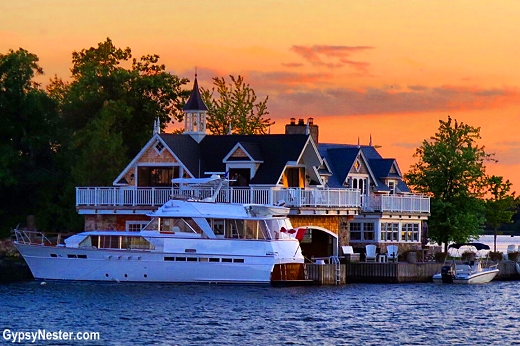
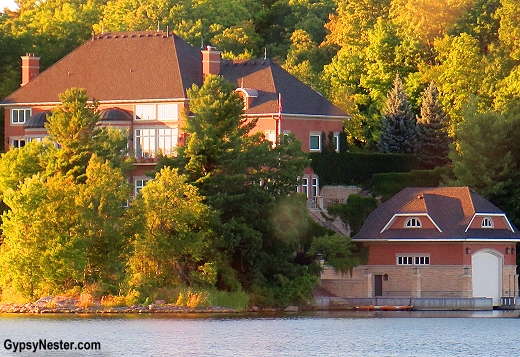
Some of the homes in the 1000 Islands take up every inch of the island!
Some of the islands are completely taken up with house!

The Island Star Dinner Cruise of the 1000 Islands in Kingston, Ontario, Canada

After all, they didn’t repeat the phrase like the song it invoked—and the ship was not named the Minnow—so the possibility of getting stranded on an uncharted desert isle seemed more than reasonably remote.

This mansion on one of the 1000 Islands was built by the inventor of the scented pine trees that hang on the rear view mirror of your car! That's a LOT of little scented cardboard trees!
Mansion built by the inventor of the scented pine trees that hang on the rear view mirror of your car! That’s a LOT of little scented cardboard trees!
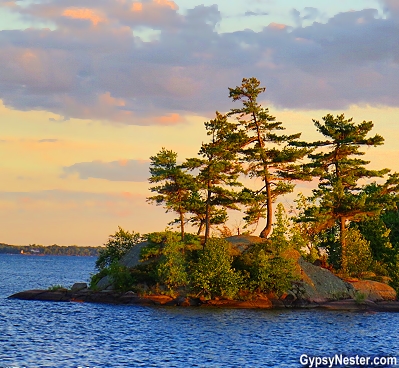
The criteria to be an island in the 1000 Islands is to have at least two trees, be above water year 'round, and no less than a square meter. Whew! This guy barely squeaks by!
The criteria to be an island in the 1000 Islands is to have atleast two trees, be above water year ’round, and no less thana square meter. Whew! This guy barely squeaks by!

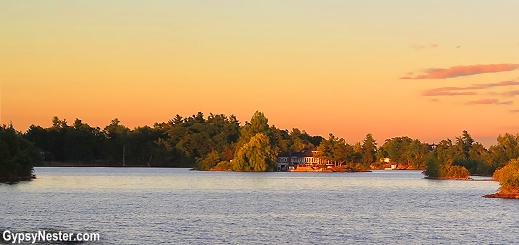
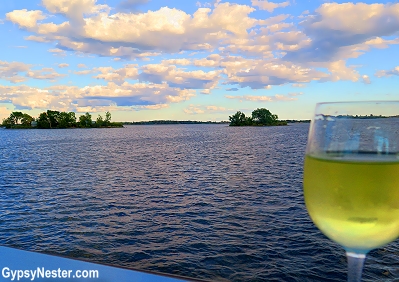
None were uncharted, or desert for that matter, but we did get our first look at the chain of islands in the St. Lawrence River known as the 1000 Islands.

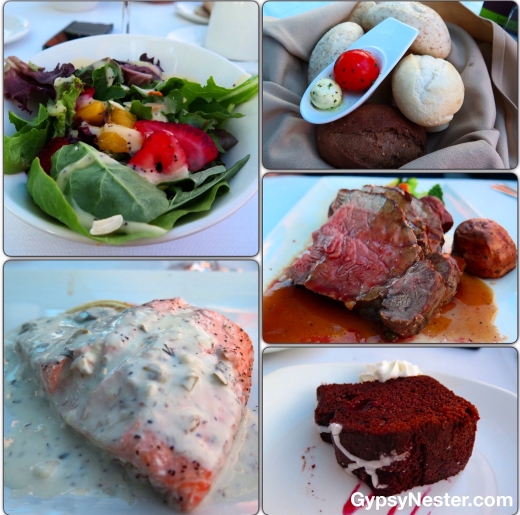
We wound our way through what seemed to be at least a 100 of the 1000 with the setting sun glinting off the water while munching of salmon and roast beef… and dessert.

Dinner on the cruise of the 1000 Islands on the Island Star in Kingston, Ontario, Canada

The Residence Inn, Water's Edge in Kingston, Ontario, Canada

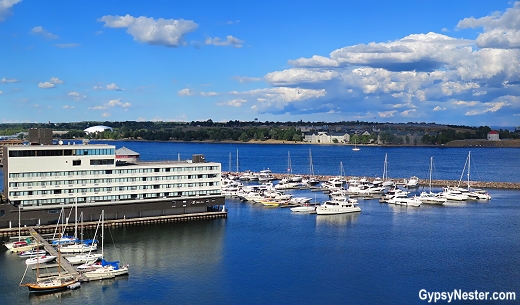
As twilight faded, we pulled back into Kingston and walked along the waterfront to our room at the Residence Inn Water’s Edge, happy to have been introduced to a new friend in the North.

Even if we don’t see our history eye-to-eye, eh?

David & Veronica, GypsyNester.com

See all of our adventures in Canada!

P.S. Here’s the view from our room in the morning:
The view from our room at the Residence Inn Water’s Edge in Kingston, Ontario, Canada

A big thanks to Ontario Travel and Visit Kingston for providing this historic adventure! As always, all opinions are our own.
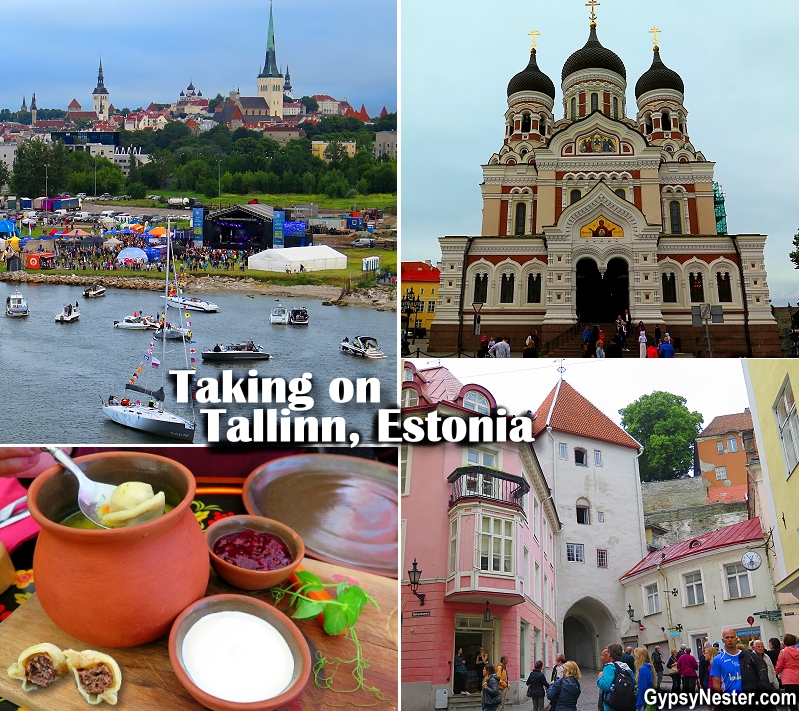
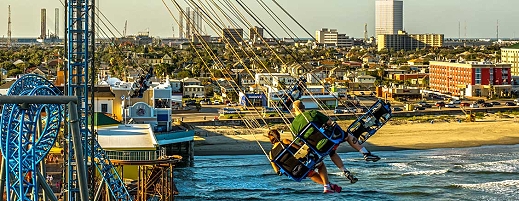
Taking on Tallinn, Estonia

While we can’t say that Estonia occupied a spot on our bucket list, we sure are glad that we checked it off anyway! 

You’ve GOT to love a country that sang its way to freedom, serves food you didn’t even know was edible and (in the past), used some freaky remedies to cure what ails ya… CONTINUE READING

A big thanks to Viking Ocean Cruises for inviting us along and providing this adventure through the Viking Homelands! Sweden, Finland, Russia, Estonia, Poland, Germany, Denmark, and Norway. As always, all opinions are our own.
Tallinn, Estonia

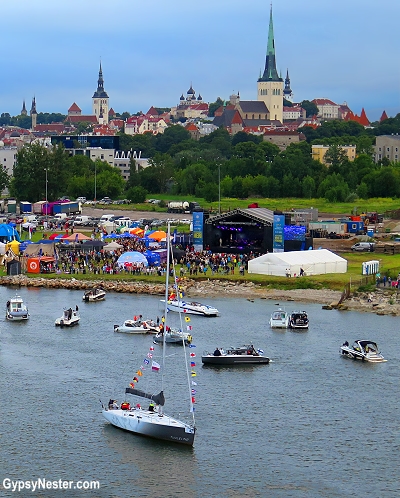
A festival in Tallinn, Estonia

While we can’t say that Estonia occupied a spot on our bucket list, we sure are glad that we checked it off anyway.

Starting with a drive through the modern business district of its newly-crowned European capital of Tallinn, we were immediately impressed.

The city has embraced this role and risen to the occasion as the center of one of the continent’s fastest growing economies.

The young country became independent a mere twenty-five years ago, yet it has jumped to the forefront with one of the world’s highest literacy rates and best access to the Internet.

Peter and Catherine’s Crib

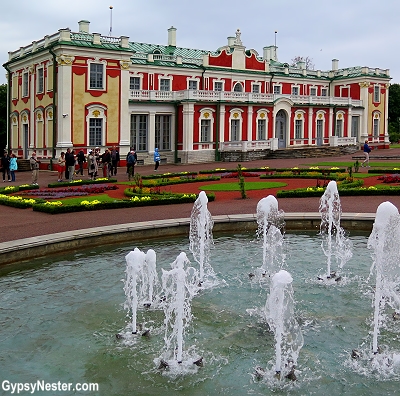
The Kadriorg Palace in Tallinn, Estonia

Passing through downtown, we made way to our first stop and stepped back into Estonia’s past as a Russian territory.

Peter the Great liked this spot on the Baltic Sea enough to build a small—by czar standards—palace for his wife, Catherine I, in 1718.

The Kadriorg Palace was used as a summer residence for the royalty, but now it serves as a museum and focal point of the beautiful Kadriorg Park.

How to Sing Yourself to Freedom

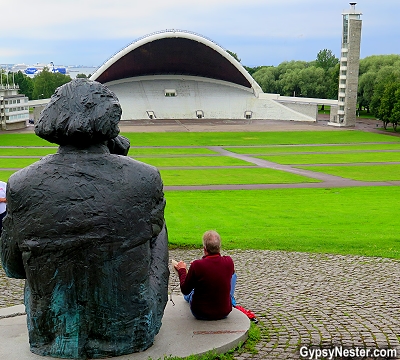
The Song Festival Grounds in Tallinn, Estonia
David waits for the show with Gustav Ernesaks, “Father of the Song”

From the palace, a short trip through the woods led to the Song Festival Grounds where every five years a huge singing extravaganza is held with choral groups from across the country.

The tradition of the Estonian Song Festival goes back to 1869, but has played an even more important role in history.

Believe it or not, songs helped to set Estonia free from Soviet control in what became known as the Singing Revolution.

Beginning in the nineteen-eighties, peaceful demonstrations—where thousands of citizens would defiantly sing banned songs—sprang up across the Baltic States.

David waits for the show with Gustav Ernesaks at The Song Festival Grounds in Tallinn, Estonia

After several years of these protests, the USSR gave in and Estonia declared independence on August 20, 1991.

One of the biggest musical gatherings of the movement took place on the Festival Grounds where hundreds of thousands of voices defiantly sang for freedom in an inspiring story of nonviolent rebellion.

The Singing Revolution in Estonia started at the Song Festival grounds

The venue’s fame has also has attracted some of the world’s biggest stars like The Rolling Stones, Tina Turner, and Paul McCartney to perform concerts.

The Domiest Church in Tallinn

Church of St. Alexander Nevsky in Tallinn, Estonia

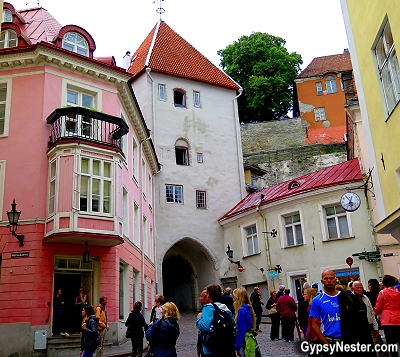
Leaving the middle aged rockers behind us, we moved on to the Middle Ages and stormed our way through the old city walls.

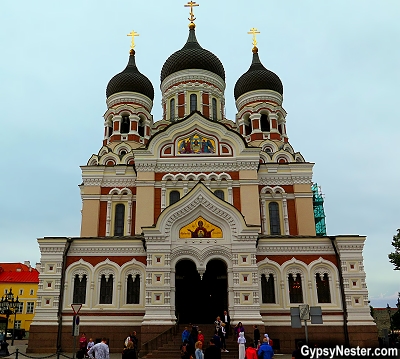
Beginning at the top, on Toompea, or Dome Hill, we stopped at the Church of St. Alexander Nevsky which put the dome in the name.

While St Alex’s may be the domiest, it is not the oldest church in Tallinn.

St. Mary's Cathedral in Tallinn, Estonia is decorated with family coats of arms

That honor goes to nearby St. Mary’s Cathedral.

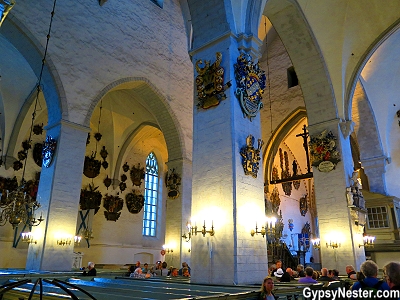
Originally built as a Catholic church in 1229, it became Lutheran in 1561 and has been renovated and expanded many times through the centuries.

The old church is often referred to as the “tomb church,” because so many of the early parishioners are buried beneath the floor inside.

St. Mary's Cathedral in Tallinn, Estonia is decorated with family coats of arms

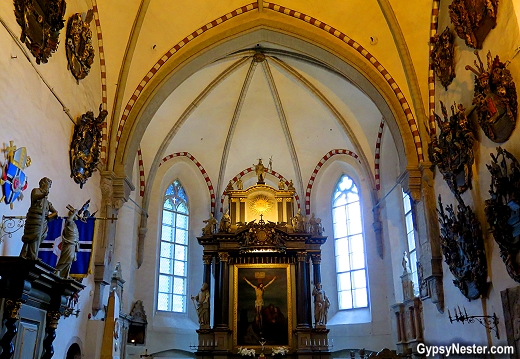
Lutheran churches are normally stark when it comes to decor. The odd St. Mary’s is coated with the entombed families’ coats of arms.

The View from the Top

Tallin, Estonia

Tallinn, Estonia

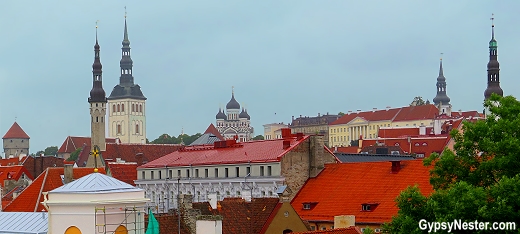
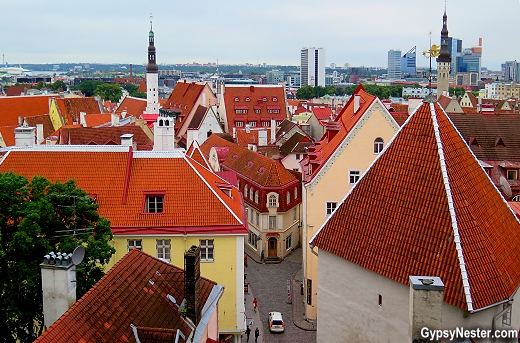
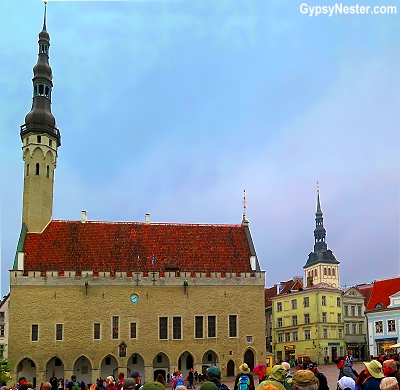
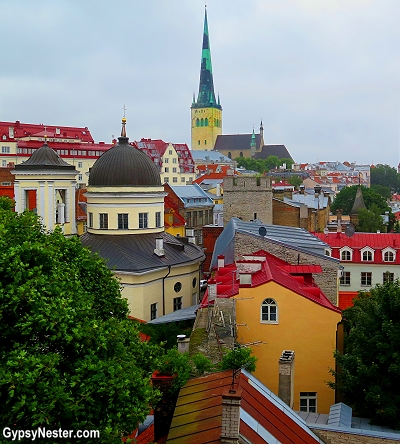
Viewed from the hill, there are three prominent pinnacles that form the medieval skyline in the town below.

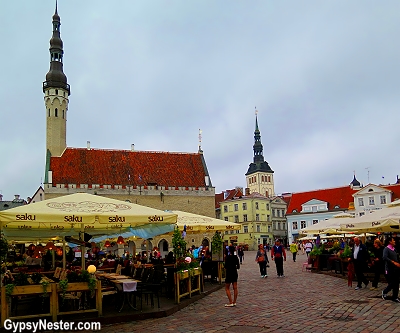
One of those spires doesn’t belong to a church, but rather to the Raekoda, or Town Hall dating all the way back to 1371.

Though it no longer serves as the seat of city, the structure still dominates the main square.

City Hall in Tallinn, Estonia

We headed down to the plaza, which is lined with restaurants, cafes, and bars, and looked for a spot to grab a bite of lunch.

Leave it to Your GypsyNesters to Ferret out the “Weird” Regional Food!

Estonian restaurants are known for offering interesting, perhaps even exotic, game on the menu and were not disappointed.

Tallin, Estonia

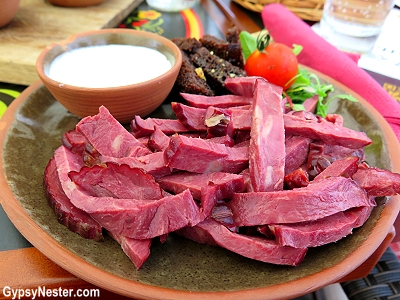
Among the many choices of oddities involving animals we have never dreamt of eating, we opted for bear dumplings and smoked beaver.

Neither is a new favorite, but also nowhere near the worst thing we have ever eaten and, on the bright side, we could count them as unexpected checks off the old bucket list.

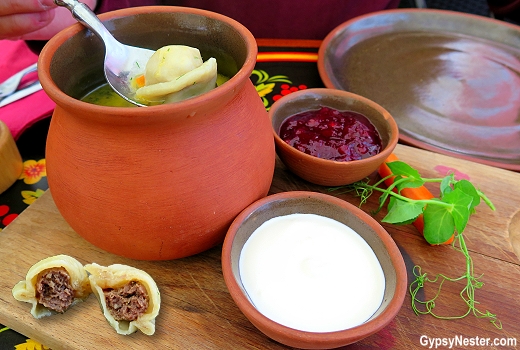
The bear came wrapped in little ravioli-type dumplings swimming in broth. This helped to cover the strong flavor and kept it from being over bear-ing (ba-dum-CHING).

Bear dumplings in Tallin, Estonia

There were some unknown—albeit delicious—red berries and a dish of sour cream served alongside, which the waiter instructed us to use “as you wish,” so we did, in every possible combination.

Going all in with the condiments seemed to be the best way to take a bit of the growl out of the bear.

Smoked beaver in Tallin, Estonia

The beaver arrived on a wooden board (sans teeth marks as far as we could tell) served with a stout garlic sauce and a hearty black rye bread.

It took several bites of the dam builder to come up with a description, a sort of dense meat yet tender, and very smoky.

Luckily the garlic, which Tallinn is also known for, won the flavor battle hands down.

Here’s to Your (Relative) Health

The old circa 1415 pharmacy in Tallin, Estonia

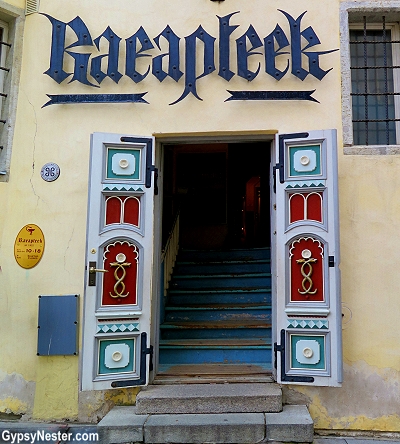
Tucked away in one corner of the square we found an old pharmacy, the Raeapteek.

No one knows the exact date, but it is thought to have opened in 1415, which makes it one of the oldest continuously running pharmacies in Europe.

It even stayed in business through the communist years, when it was nationalized.

In addition to the modern pharmacy, there is a small museum on the first floor.

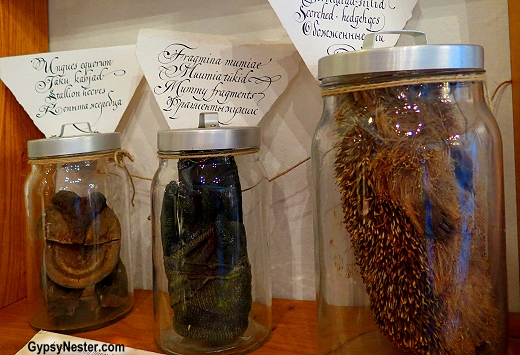
Just past the modern medicines we found medieval treatments like scorched hedgehog, mummy fragments, stallion hooves, and unicorn horn powder.

Crazy medicine in the pharmacy in Tallin, Estonia, like scorched hedgehog, mummy fragments, stallion hooves

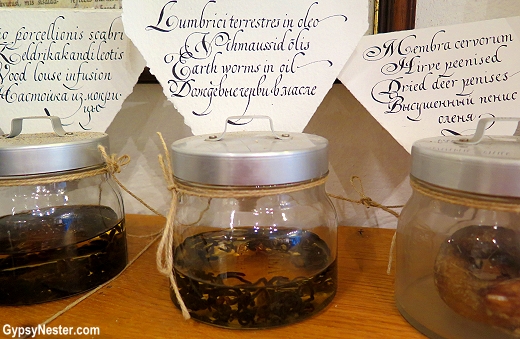
As time went on, dried deer penis, earthworms in oil, and wood louse infusion came onto the scene and became the medications of choice.

Crazy medicine in the pharmacy in Tallin, Estonia, like dried deer penis, and wood louse infusion

We decided not to ask about remedies for our bear breath or beaver fever.

Headed up again

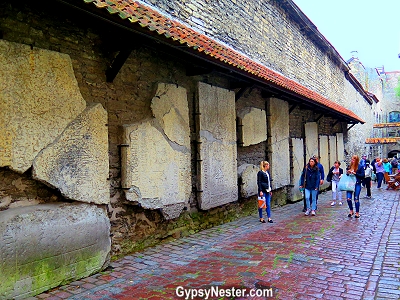
Ancient tombstones line Katarina Kaik, St. Catherine's Passage in Tallinn, Estonia

Just off the square we duck into the medieval Katarina Käik, St. Catherine’s passage, leading to the ruins of St. Catherine’s Church that give the passage its name.

Along the wall there are several large, ancient tombstones that were moved from inside of the sanctuary.

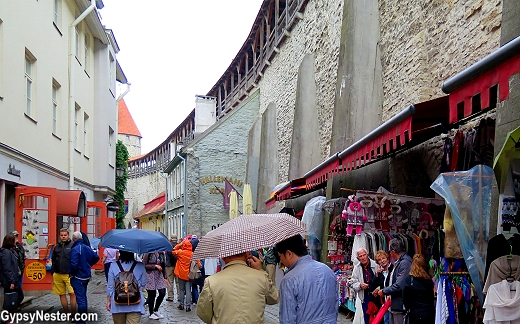
The city wall in Tallinn, Estonia

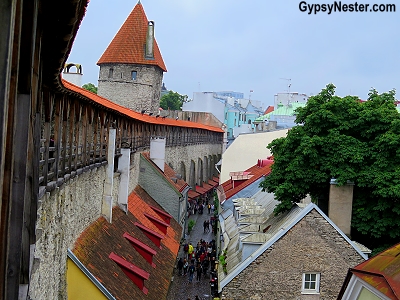
The city wall in Tallinn, Estonia

Just as when we visited the amazing old wall around Rothenburg in Germany, of course we had to climb.

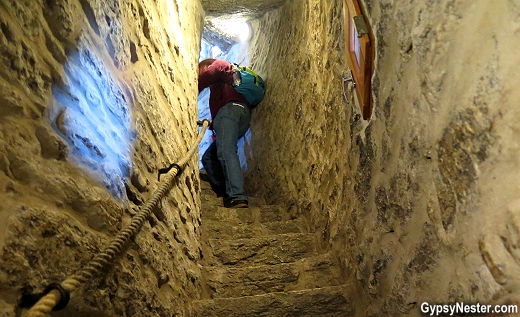
For a small fee, we were allowed to ascend the dark, steep, and head-banging steps up to the top for a walk along the ancient rampart.

The steep stairs up the wall tower in Tallinn, Estonia

The steeple of Tallinn, Estonia's St. Olaf's church was once the tallest building in the world

There were also two defensive towers open for even higher climbing and stunning views across both the old and new sections of the city.

It was here that the skull really got to know the stone personally, but it was worth it for the view of St. Olaf’s Church.

Back between 1549 and 1625 it was thought to have been the tallest building in the world, but records were somewhat less than exact back then.

No matter, even after the steeple had to be rebuilt after at least ten lightning strikes it still tops out at over four-hundred feet high.

Blackheads? Heh.

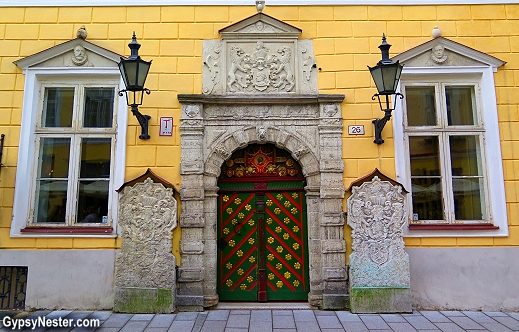
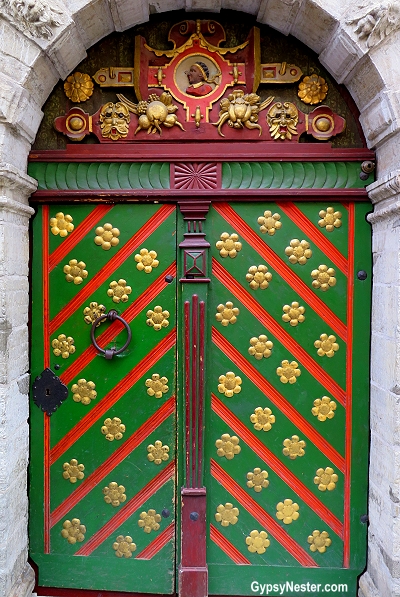
The distinctive door of The Brotherhood of Blackheads in Tallinn, Estonia

The distinctive door of The Brotherhood of Blackheads in Tallinn, Estonia

From the wall, we went in search of the distinctive door of The Brotherhood of Blackheads.

After walking right by it a couple of times because it was open, we figured things out and a guy with a film crew that was using the building let us in for a look around.

Founded as a military organization, the Brotherhood became an association for unmarried merchants and ship owners.

It was a sort of minor league for the Great Guild, where if you did well in business, and got married, you could move up to the big team.

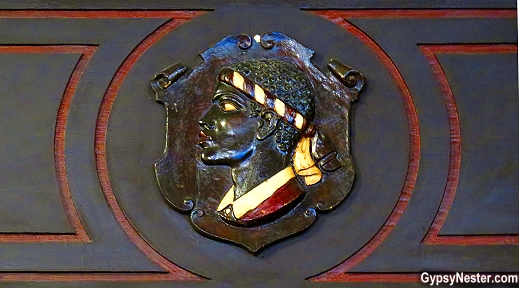
The insignia for the Brotherhood of the Blackheads in Tallinn, Estonia

A Stout Lady Guards the City

The time had come to make our way back to the good ship Viking Star.

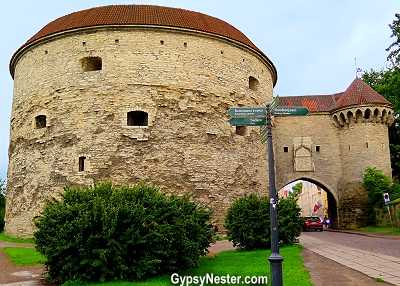
Fat Margaret in Tallinn, Estonia

On the way we passed through the walls at the Great Coastal Gate and found it guarded by the whimsically named Fat Margaret fortification.

The five-hundred year old tower was meant to keep invaders at bay, but also to impress any visitors arriving by sea.

Going up the gangplank, we were struck by how our day had been filled with new experiences that we never expected.

Who knew a bucket list could contain all sorts of items we didn’t even know existed?

Tallinn was definitely one of those.

David & Veronica, GypsyNester.com

A big thanks to Viking Ocean Cruises for inviting us along and providing this adventure through the Viking Homelands! Sweden, Finland, Russia, Estonia, Poland, Germany, Denmark, and Norway. As always, all opinions are our own.
YOUR TURN: Were you in the dark about Estonia like us? Is it now on your bucket list? How about those bear dumplings?