
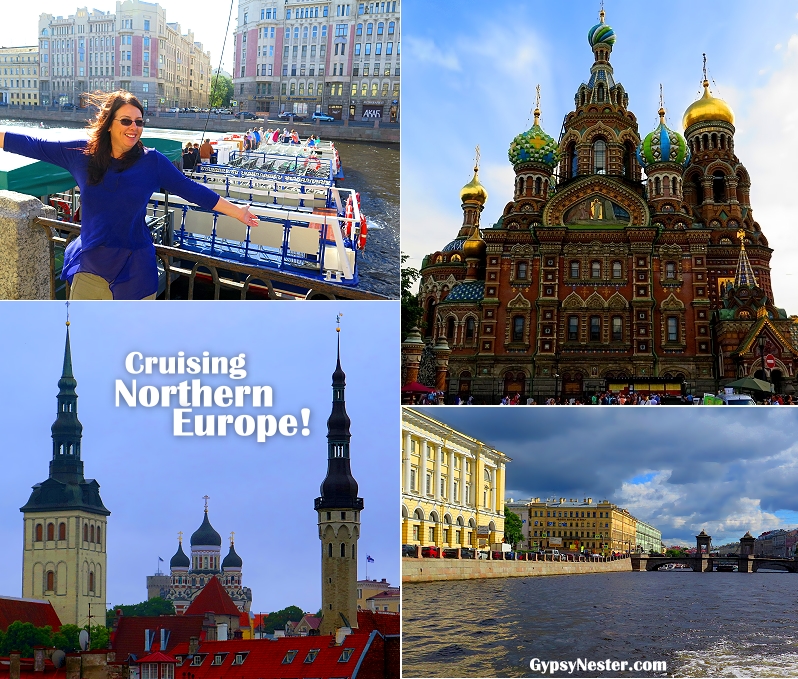
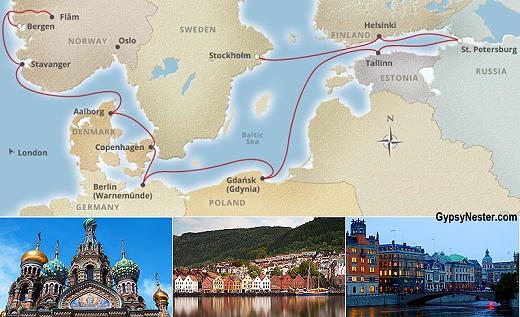
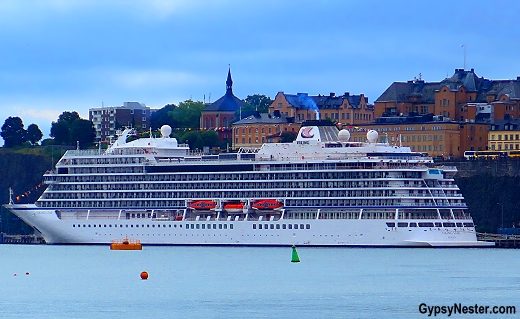
Written aboard the Viking Star on her voyage through Sweden, Finland, Russia, Estonia, Poland, Germany, Denmark, and Norway. Thanks to Viking Ocean Cruises for inviting us along and providing this adventure! As always, all opinions are our own.
DAY FIVE: St. Petersburg as it was Meant to be Seen, on the Water!
Morning: We can’t believe our luck! Our guide says St. Petersburg gets only thirty-two sunny days a year—and we got two of them!
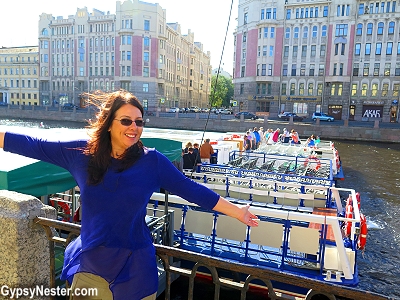
St. Petersburg is thoroughly connected to the sea.
The reason Peter the Great wanted this particular spot was based solely on his desire for Russia to have a sea port and to build a navy.
As a part of this maritime vision he also designed the city to be structured around a system of canals, an idea he brought with him from his time spent in Amsterdam as a young man.
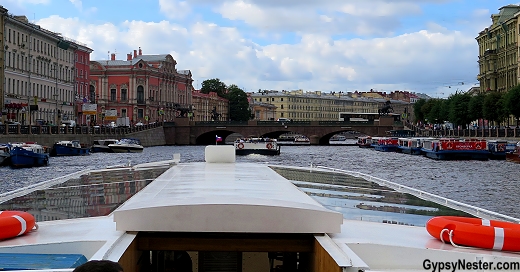
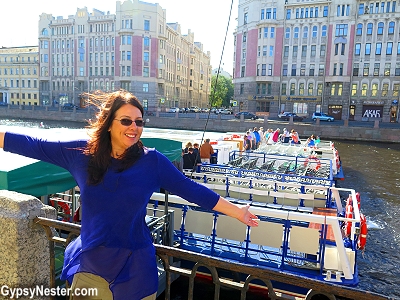
Today, hundreds of years later, we will get to see his city from those canals as we set out this morning on a boat tour. Even though we will be seeing many of the same highlights as yesterday, we are excited to be seeing them as Peter would have wanted us to.
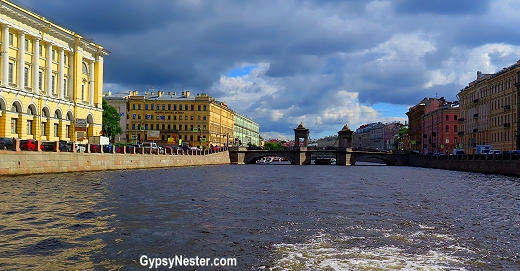
We begin on the Fontanka River which was once just a small stream known as Anonymous Creek. Then Peter contained it with stonework embankments and used it to supply water to the fountains in his summer garden. That is why it was given the new name meaning fountain river.
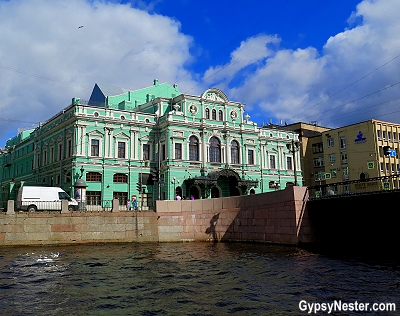
The Fontanka embankments are lined with the former lavish residences of Russian nobility.
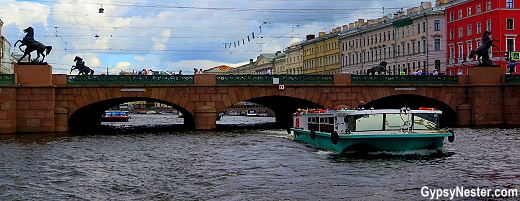
Anichkov Bridge is perhaps the most famous of St. Petersburg’s hundreds of bridges and just one of dozens of bridges we have to duck to get under, no standing up on this boat unless you are willing to lose your head.
Best known for the four bronze Horse Tamers statues on that frame the entrances, it was originally built of wood in 1715 and named after its engineer, Mikhail Anichkov.
Afternoon: Deeper into St. Petersburg
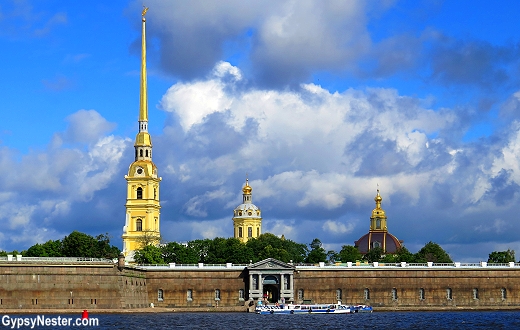
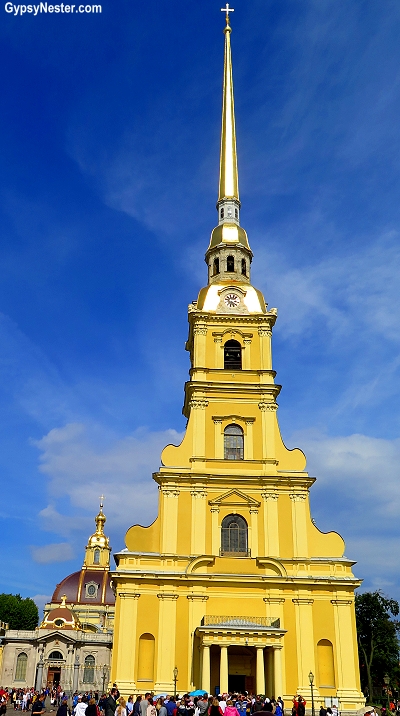
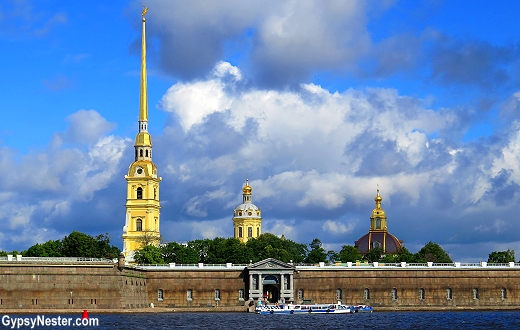
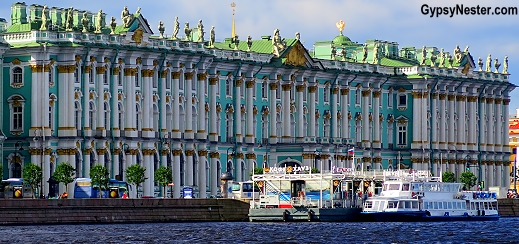
Leaving the canal, we enter the Neva River just opposite the Peter and Paul Fortress that we visited yesterday. From the water it looks much more like an imposing fortress than the view we had entering on the land.
This spot where the Neva splits and flows into the Baltic Sea is the heart of the city. From our vantage point in the water we get a perfect panorama of all of St. Petersburg before turning around to retrace our path back.
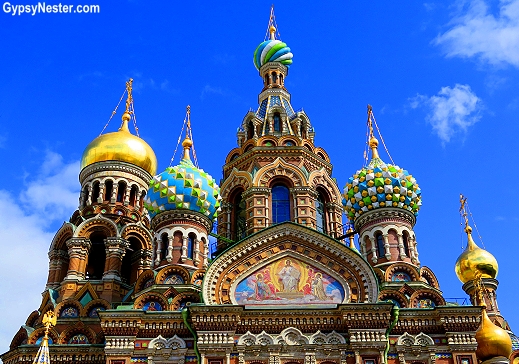
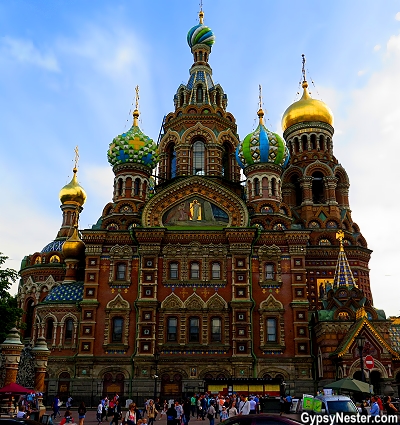
From the boat we make our way back to the Church of Our Savior on Spilled Blood.
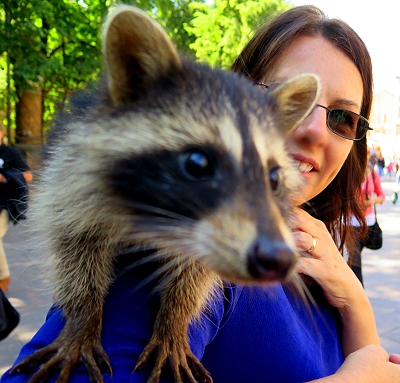
A festive atmosphere greets us as we wait to go inside, with performers and several animal acts working the crowd.
One curious raccoon especially takes a liking to Veronica.
As impressive as the outside of the church is, it is the interior that truly sets it apart.
The walls and ceilings are covered with over 7500 square meters of mosaic tiles, said to be the most in the world, although folks in Missouri dispute this, claiming that the Cathedral Basilica of Saint Louis has it slightly beat.
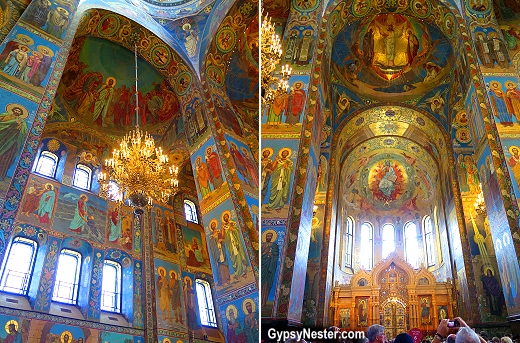
As with most all of the churches in Russia, during the soviet era this was stripped of any religious significance. The building was used as a storage facility and was even scheduled to be torn down before being saved and restored.
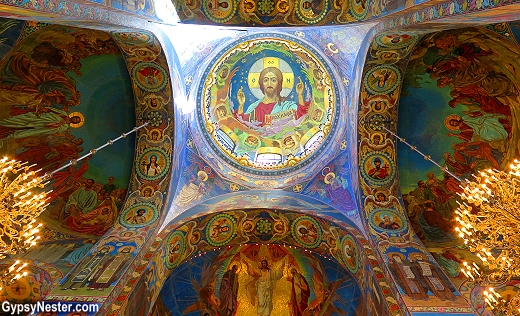
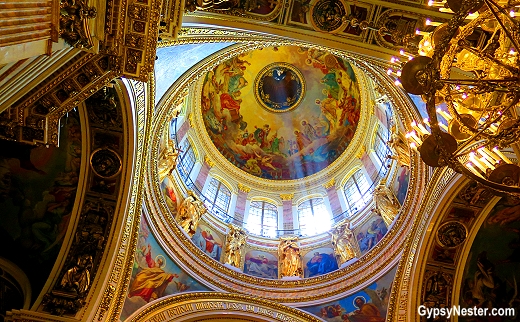
Looking up into the dome
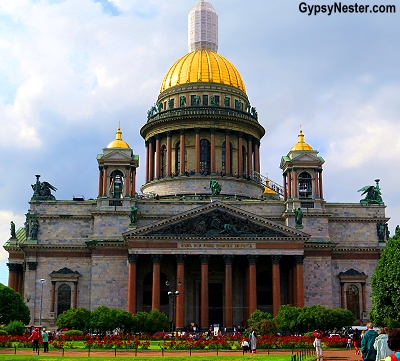
From the cozy confines of Savior on Spilled Blood we head over to the largest Russian Orthodox cathedral in the city, Saint Isaac’s. Unlike the smaller church (in fact, St. Isaac’s is MASSIVE!), this time perhaps the exterior is more impressive. Still, the incredible gold gilding inside is a sight to behold.
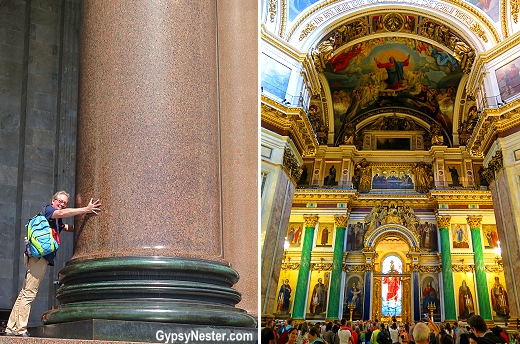
The cathedral is dedicated to Saint Isaac of Dalmatia, patron saint of Peter the Great who was born on his feast day, but more than anything stands as a monument to the czar that founded the city.
Evening: The Arts Come to us
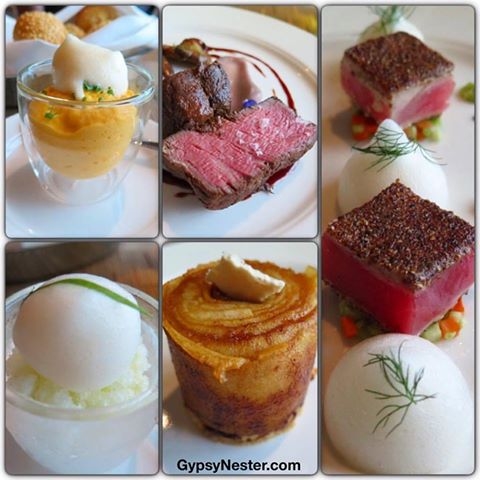
Tonight is the night to partake in Russian arts, and many of our fellow passengers remain in St. Petersburg to attend the ballet or visit folkloric dancers. We decide to have a quiet dinner and enjoy singers from the world-renown Mariinsky Opera in the theater aboard the Star. Whoa, just WHOA.
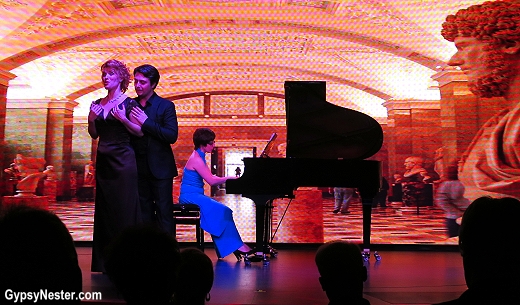
This ship is just so… civilized.
DAY SIX: Tallinn it Like it is in Estonia
Morning: How to Sing Yourself to Freedom
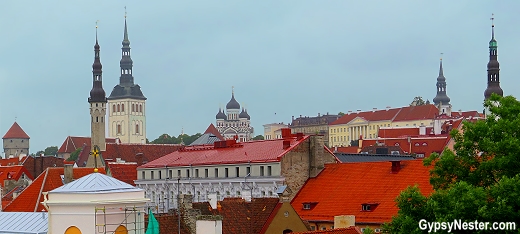
Can’t say that Estonia has ever occupied a spot on our bucket list, it’s barely on our radar and we knew woefully little about her, but today we are going to check it off anyway.
We start with a drive through the modern business district of this newly crowned European capital.
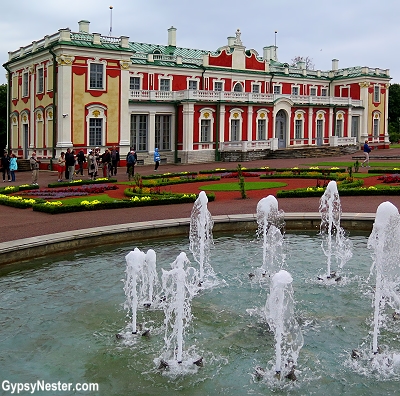
Tallinn has embraced the role and risen to the occasion, becoming one of the continent’s fastest growing economies.
The young country, only becoming independent twenty-five years ago, has one of the world’s highest literacy rates and best access to the internet, but our first stop takes us back to its past as Russian territory.
Good ol’ Peter the Great was here too, and built a small, by czar standards, palace for his wife, Catherine I in 1718.
The Kadriorg Palace was used as a summer residence and now serves as a museum and focal point of the beautiful Kadriorg Park.
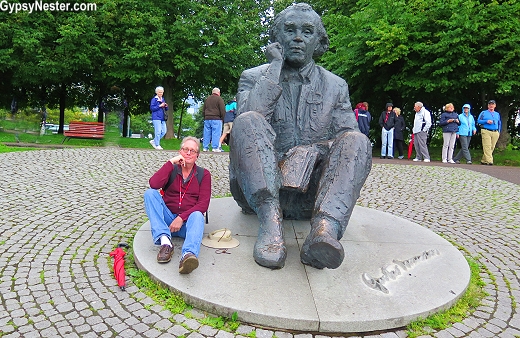
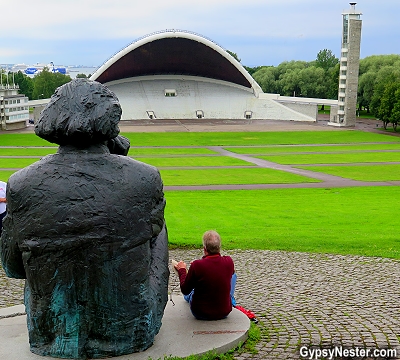
David waits for the show with Gustav Ernesaks,
“Father of the Song”
Not far from the park we come to the Song Festival Grounds where every five years a huge singing extravaganza is held.
The venue also has hosted concerts from some of the world’s biggest stars, but the most important event ever was the singing revolution.
Believe it or not, songs set Estonia free from the Soviet Union in what is known as the Singing Revolution.
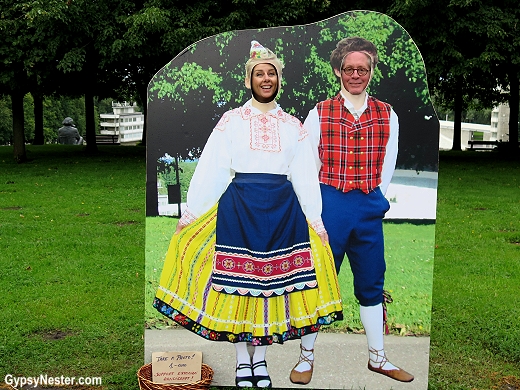
One of the biggest musical protests of the movement took place right here as hundreds of thousands defiantly sang for freedom.
After several years of these peaceful protests, Estonia declared independence on Aug 20, 1991 and Tallinn became its capital.
Afternoon: Eating Estonian – Old School
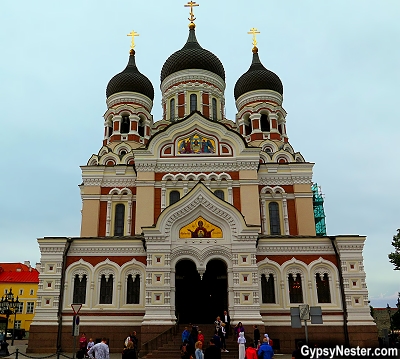
From this modern history, we head over to the old town to see what life was like here in the Middle Ages.
We begin on Toompea, or Dome Hill, with the Church of St. Alexander Nevsky that put the dome in the name.
While St Alex’s may be the domiest, it is not the oldest church in Tallinn.
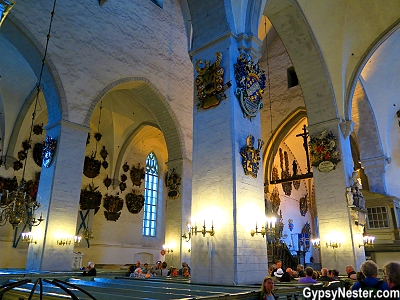
That honor goes to nearby St. Mary’s Cathedral.
Originally built as a Catholic church in 1229, it has been renovated and expanded many times through the centuries and became Lutheran in 1561.
It is often referred to as the tomb church because so many of the early parishioners are buried beneath the floor inside.
Oddly, for Lutheran churches are normally stark, St. Mary’s is coated with the entombed families’ coats of arms.
Before walking down to the main square we take a look over the lower old town from a vantage point that proves perfect for a photo op of the three spires that form the medieval skyline.
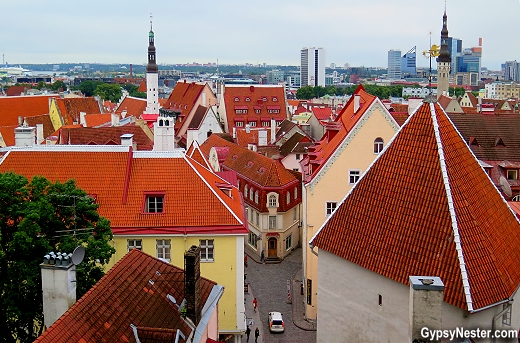
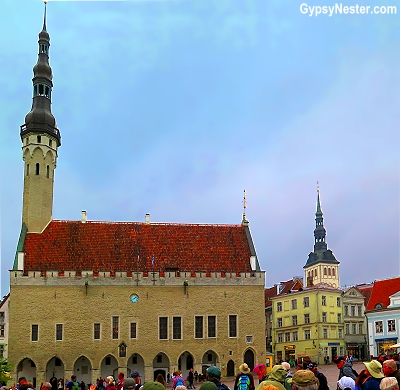
One of those prominent pinnacles doesn’t belong to a church, but rather to the Raekoda, or Town Hall.
The structure dating all the way back to 1371 dominates the main square.
No longer the seat of city government, it now houses the Tallinn City Museum.
The square is lined with restaurants, cafes, and bars, and looked to be the perfect spot for a bite of lunch.
We heard that Estonian restaurants are known for offering interesting, perhaps even exotic, game on the menu and we were not disappointed, ordering bear dumplings and smoked beaver.
Neither is a new favorite, but also nowhere near the worst thing we have eaten.
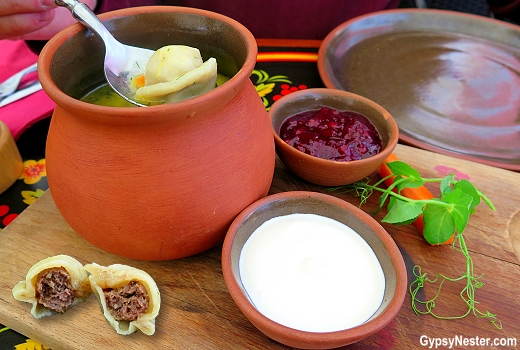
The bear comes wrapped in little ravioli type dumplings swimming in broth and has a strong flavor yet not over bearing (ba-dum-ching).
There are some unknown red berries and a dish of sour cream served alongside, which the waiter instructed us to use “as you wish,” so we did. They do seem to take a bit of the edge off.
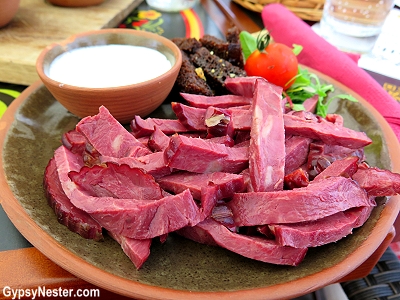
The beaver is served with a stout garlic sauce and black rye bread.
It is hard to describe, a sort of dense meat yet tender, very smoky but the garlic, which Tallinn is also known for, wins the flavor battle hands down.
The garlic follows us throughout our day…
Later in the Afternoon: Old Town
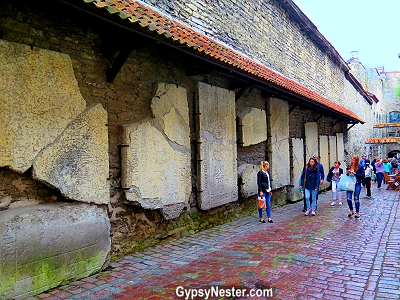
Just off the square we duck into the medieval Katarina Käik, St. Catherine’s passage, leading to the ruins of St. Catherine’s Church that give the passage its name.
Along the wall there are several large, ancient tombstones that were moved from inside of the sanctuary.
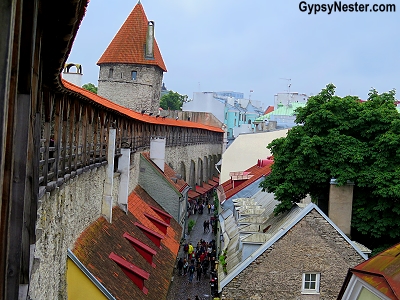
The passage ends at a section of the old City Walls and we discover that for a small fee we are allowed to climb the dark, steep, and head-banging steps up to the top for a walk along the wall.
There are also two defensive towers open for even higher climbing and stunning views across both the old and new sections of the city.
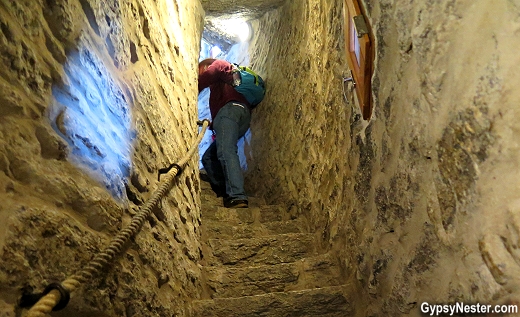
The rope came in handy, let us tell ya!
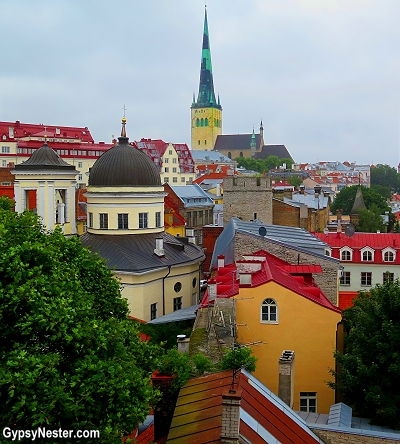
One sight we certainly can’t miss is the steeple of St. Olaf’s Church.
Back between 1549 and 1625 it was thought to have been the tallest building in the world, but records were somewhat less than exact back then.
No matter, even after at least ten lightning strikes and the ensuing rebuilds it still tops out at over four-hundred feet high.
Making our way out of the old city we pass through the walls at the Great Coastal Gate which is guarded by the whimsically named Fat Margaret fortification.
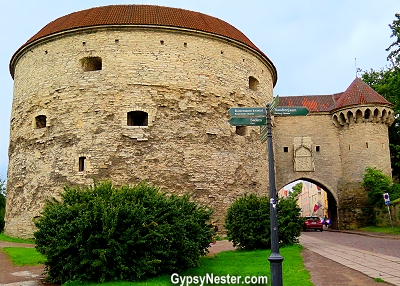
Built five hundred years ago, the tower was meant to keep invaders at bay, and also to impress any visitors arriving by sea.
Later the tower was transformed into a storehouse for gunpowder and weapons, then a prison, but these days it serves peacefully as the Estonian Maritime Museum.
Now and then we come upon a place that was never even on our radar and it turns out to be a gem just waiting to be found, Tallinn is definitely one of those.
Tea Time
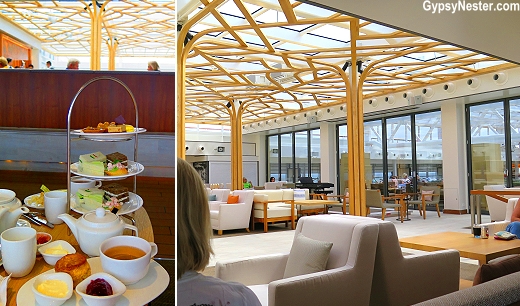
Tea time in the Wintergarden has become one of our favorite pastimes. Listening to the strains of Star‘s classical trio while sipping from a wide selection of teas, nibbling on dainty finger sandwiches, tasty scones, and tantalizing sweets in a the airy, open “forest” of wood and glass… bliss.
DAY SEVEN: Serendity at Sea
The entire slow, wonderful relaxing day
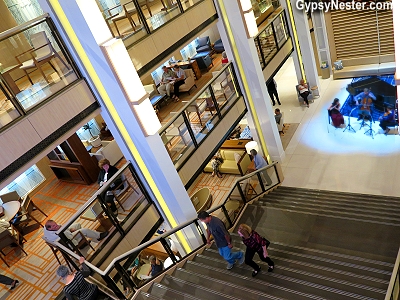
Levels of light living space, with live music wafting about
As we make our way from Estonia to Poland we will spend today day at sea.
We have been so busy visiting the fantastic ports of call that we haven’t had much of a chance to explore all of the inviting amenities of our ship, Viking Star.
We have of course noticed the understated elegance of the décor.
It’s not over the top—no Elvis at Graceland here—just very clean and classic Scandinavian lines.
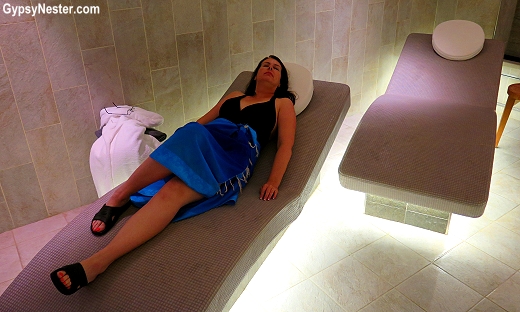
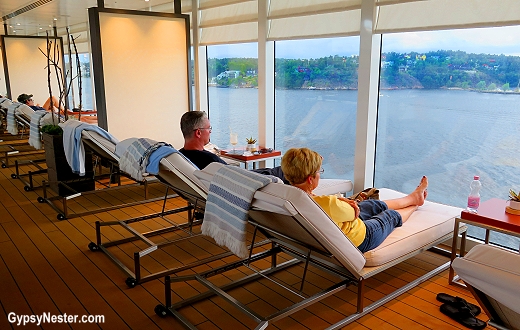
Heated lounges in the spa
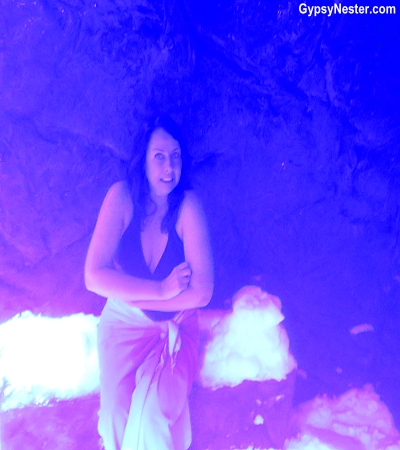
Serious brrrrrrrr
Speaking of Scandinavian, our free day gives us a chance to try out the Spa. We start off with a relaxing Swedish massage (mmmm, yeah), then move on to the Nordic hot and cold therapy of the steam room and snow grotto.
Yes, there is a room that snows on board, and yes it sounds crazy to go in it in nothing but a bathing suit, but it works.
After getting as hot as we could stand in the steam room we walk right in and sit right down on snow covered benches.
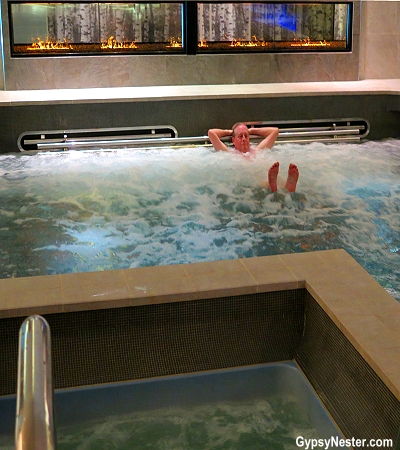
Spa manager Zsuzsanna explains to us that by repeating the process two or three times, our pores will be cleansed and our skin exercised.
From there, we move over to the much more relaxing bubble pool—which is kept at exact body temperature—and float away any remaining tension on the gentle jets stirring the water, before hitting the traditional hot tub.
Feeling like euphoric puddles of relaxation, we somehow find ourselves back to our stateroom for a nap.
There is a great deal of stimulation available for our minds as well.
Each evening our cruise director, Steve St. Peter (a fabulous name that we’re beginning to think is a pseudonym—the man is just SO well put together, we’re struggling for ways to find fault with him!), gives an informative talk about the next day’s port of call along with all of the tips we need to be sure not to miss a thing while ashore.
He even loves the quirky, as we do, and always has destination suggestions for quirk-lovin’ GypsyNester-types to root out. The man is a god. We must find a way to take him down a notch or two—lest we start kissing his feet.

There are also talks given by former Congressman Martin Frost, who served in as a Democrat in the Texas delegation from 1978 until 2004, about the changing demographics and partisan divide in American politics, and how it’s affecting the current election.
He is just one of several interesting lecturers that are traveling with us.
Geologist Dr. Helena Aves discussed plate tectonics, or continental drift, and how that created the Baltic Sea along with the effects of glacial ice on the landscapes we are visiting, especially the fjords coming up in Norway at the end of our cruise.
Tonight, after celebrating Veronica’s birthday at the upscale Italian restaurant onboard, we’ll be watching Bridge of Spies at the Theater Under the Stars to get us ready for Berlin in a few days.
We may even hit the dance club, Torshavn—or not. A person can only relax so much.
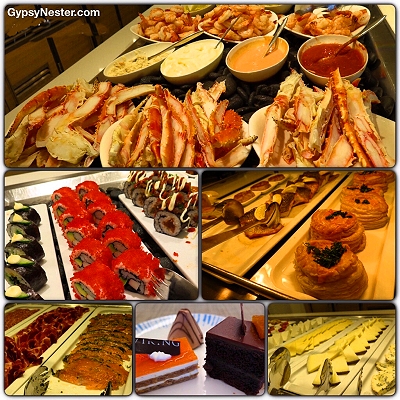
Night: Veronica’s Birthday Celebration at Manfredi’s
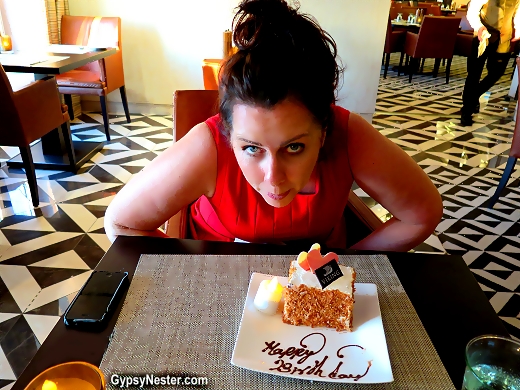
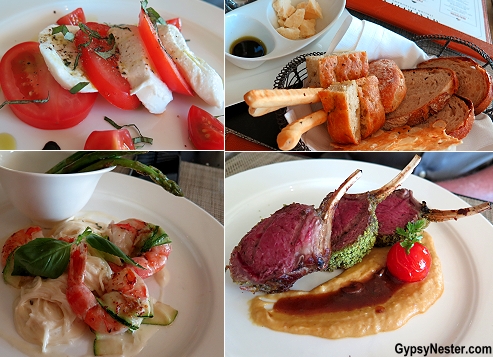
Make a wish—53 and counting! We headed to the Star‘s upscale Italian restaurant to celebrate. Here’s dinner:
DAY EIGHT: You Can Gdańsk if You Want to in Poland
Morning: Sad History of a Beautiful City
Today we visit Poland, and that’s no joke.
The Viking Star docks at the port of Gdynia, about fifteen miles north of Gdańsk.
The ride into the city gives us a chance to see a bit of Polish countryside and stop at the Gdańsk Oliwa Archcathedral on the outskirts of town.
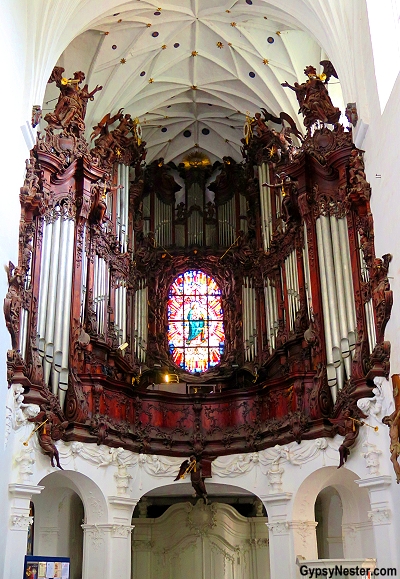
Without a doubt the most remarkable feature of the church is the famous great Oliwa organ.
The instrument itself, with over five thousand pipes, is impressive enough, but the woodwork around the pipes is an awe inspiring piece of art.
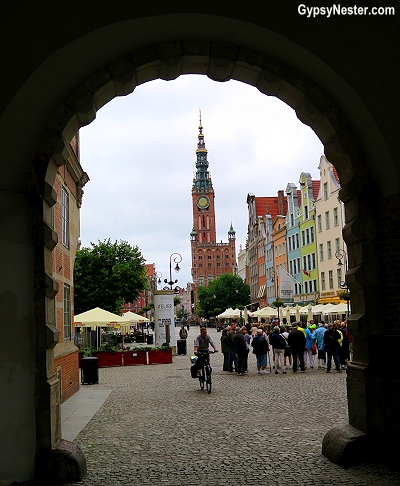
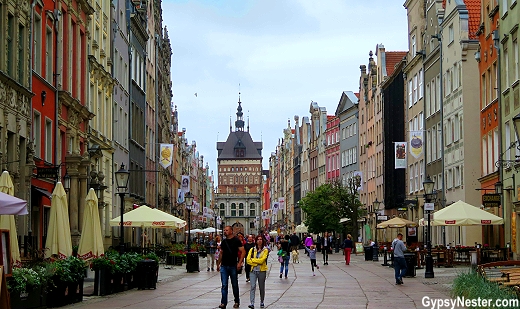
We enter the historic old city of Gdańsk through the Green Gate which opens on to the Long Market.
This pedestrian only area is the heart of the rebuilt town. By rebuilt, we really mean rebuilt.
This city was completely devastated by World War II.
In fact this is right where the war actually began when Germany decided to take what was then known as the Free City of Danzig on September 1st 1939.
Within a few weeks the Soviet Union had invaded Poland too and within a couple of months the country was completely occupied by the opposing powers.
By the end of the war, Poland was devastated and Gdańsk was nearly destroyed.
Almost every structure in the city was damaged, so what we see today has all been reconstructed.
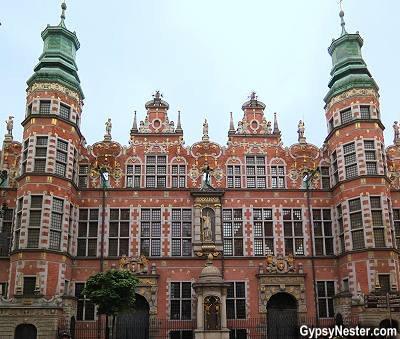
The biggest landmarks, such as the Green Gate and Golden Gate that mark the opposite ends of the square, and St Mary’s Church, which is known as the largest brick church in Europe, were restored as accurately as possible.
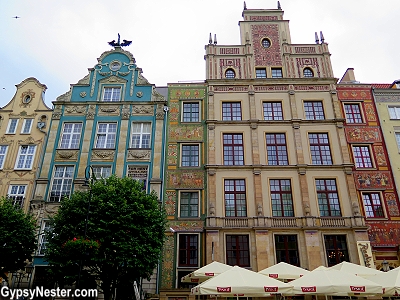
The same cannot be said for many of the houses that line the sides of Long Market.
Many of these have been embellished to various degrees.
It seems that when reconstructing folks didn’t want to rebuild in the original German style, having suffered so much under them, so they instead went with Dutch and Italian motifs.
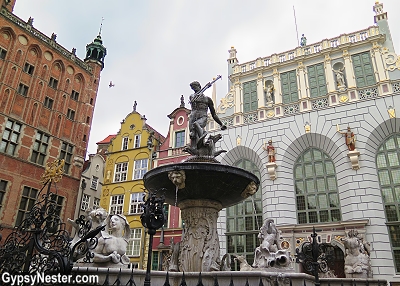
Many, if not most, of the fronts are actually only facades over communist era buildings.
One icon that did survive was the Neptune Fountain.
In large part, its fame now stems from the fact that this nearly five hundred year old statue miraculously came through the bombings essentially untouched.
Afternoon: The Human Hamster Wheel, Haunting Hags, and Lech Walesa’s Movement
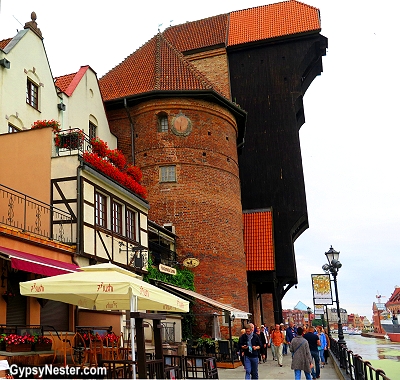
Just off of the main square there is an interesting artifact from when Gdańsk was a bustling port within the Hanseatic League, a huge crane.
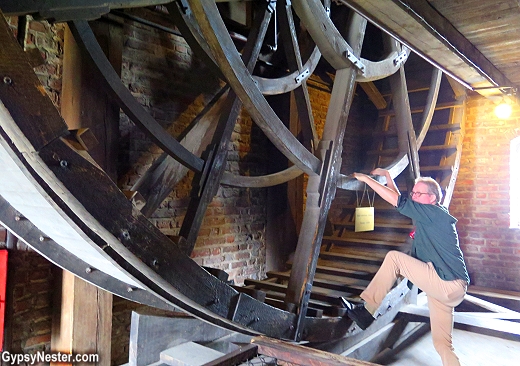
This 14th-century device operated on human-power as treadwheels transferred the energy of workers to load and unload cargo from the Motlawa River.
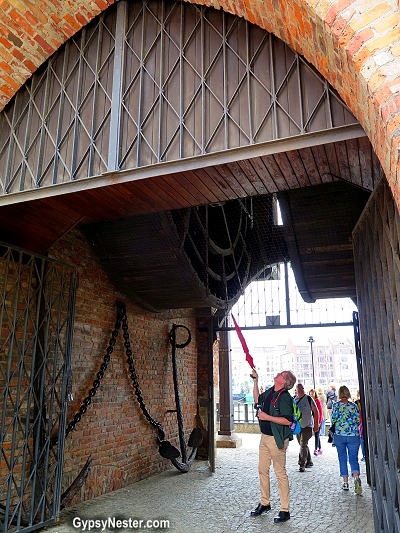
We had seen pictures of how this worked, but by seeing the giant wheels in person the ingenious machinery make sense to us.
Think people walking in a wheel like hamsters.
The turning moves a rope through pulleys that transfer energy so that thousands of pounds can be lifted.
As we climb higher and higher up the crane’s tower, we are astonished by the clever design and found ourselves happy that our walking skills aren’t needed to keep the ships below us stocked.
Though it might’ve been fun to give the wheels a whirl—maybe for a minute or two of rodent-like fun.
Walking further down the waterfront pier, we are stopped in our tracks by a row of baba pruska—Prussian hags.
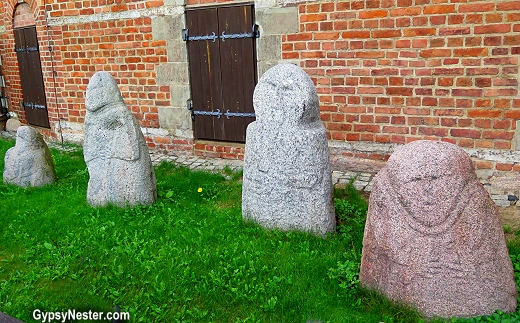
These odd, early medieval, anthropomorphic figures, carved in granitoid were used to mark boundaries by the peoples of the Old Prussian culture.
Dang, we’d hate to be harnessed by a hag after dark.
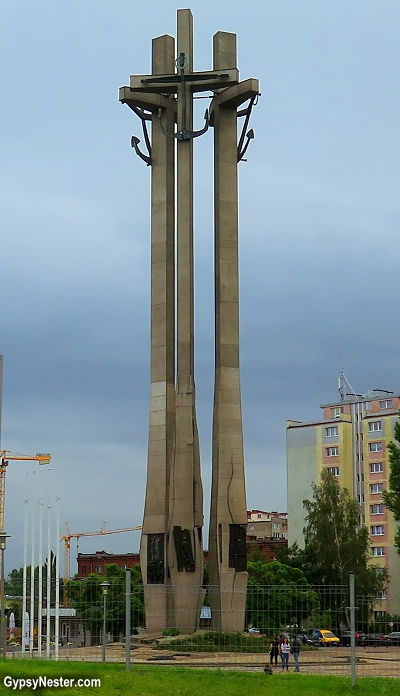
A much more recent event in the city’s long history of shipping and ship building took place nearby.
On our way out of town, we pass the Gdańsk Shipyard where Lech Wałęsa shook the world by leading the Solidarity Trade Union Movement.
That opposition to the communist regime led to the downfall of the party in 1989, which in turn played a huge part in the dissolution of the Soviet Union.
The monument that stands at the entrance to the yard is in honor of protesters killed in 1970, and was erected as one of Solidarity’s early demands in 1980.
Wałęsa described its significance to bringing down communist rule as “A harpoon driven through the body of a whale.”
DAY NINE: Berlin, in all Her History
Morning: David the Train Nut is a Happy Guy!
Wait, Berlin is not on the sea, is it?

David heaven: A train, a map, a cup of joe
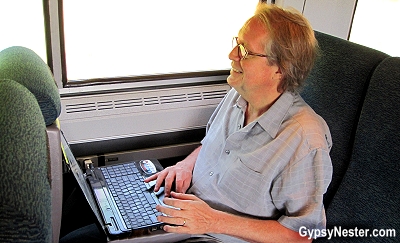
Correct, it is over a hundred miles inland, so we take a Viking chartered, two-hour train ride into Germany’s capital where we will explore Berlin on our own.

We enter the East Berlin train station
Our first stop is at the East Side Gallery of the Berlin Wall. This is a nearly mile-long section of the Wall that has been covered with one hundred and five paintings by artists from all over the world.

We immediately gravitate to perhaps the most famous of those, a picture by Dmitri Vrubel of Leonid Brezhnev and Erich Honecker kissing.

Afternoon: Things are Beginning to Feel all too Real
From the Wall, we go to Checkpoint Charlie, the best known passage between the two German states created by the partitioning of the city at the end of World War II. After the East Germans built the wall in 1961 the allies had three crossing points: Alpha, Bravo, and Charlie.
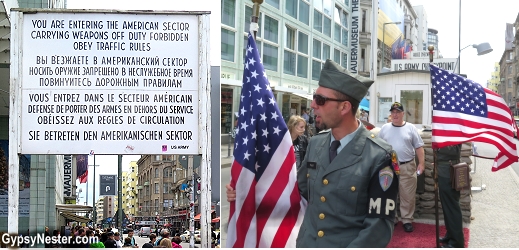
This was the only one in the middle of the city. Unfortunately, what we see now is only a replica. In October 1990, the real guard house was removed and put on display in the Allied Museum.

The barrier was built to keep people in, not out, after three and a half million East Germans had fled to the West between 1946 and 1961.
To stop the tide, an eight hundred and thirty-eight mile concrete border was erected.
The Berlin Wall was actually two parallel walls with a no-man’s land situated between them. We learned that towers were installed within eyeshot of each other and overseen by armed guards with orders to shoot to kill anyone who made it over the first wall.
Every morning, the dirt in the no-man’s land would be carefully raked, and if any footprints were found without a dead body nearby, the guards would be punished.

A few blocks from the checkpoint there is another section of the wall, one that is left without embellishment.
Finding the concrete surprisingly thin—and the overall height much lower than we had imagined—we look into the additional measures used to keep people from breaking through it.
In the patches where the concrete was worn we see tight interlacing of metal, making it impossible for tunneling. The top is rounded—then it was heavily greased—making it impossible to gain purchase with hands, or a ladder.

This section of the wall runs right along the place where the Gestapo and SS had their headquarters.
The buildings were completely destroyed by bombs at the end of the war, but the foundations have been used as a backdrop for a display detailing the history of repression under the Nazis.
The gravity of this site, along with the incredibly disturbing information unfolding before us, has us feeling overwhelmed and our next stop only adds to that…continue on for more Berlin (and Denmark and Norway!)
David & Veronica, GypsyNester.com
Written aboard the Viking Star on her voyage through Sweden, Finland, Russia, Estonia, Poland, Germany, Denmark, and Norway. Thanks to Viking Ocean Cruises for inviting us along and providing this adventure! As always, all opinions are our own.
YOUR TURN: Isn’t this a fantastic group of cities to visit? Any on your bucket list? What would you like us to report on?




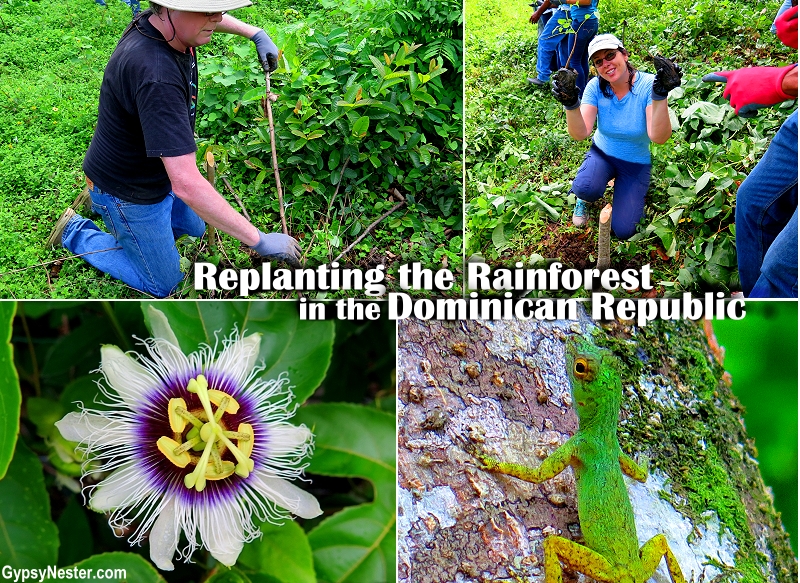
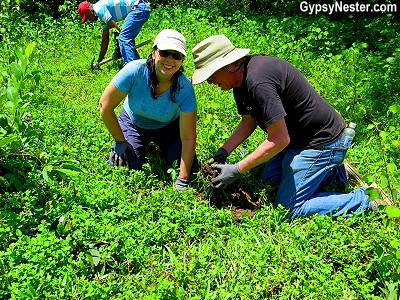
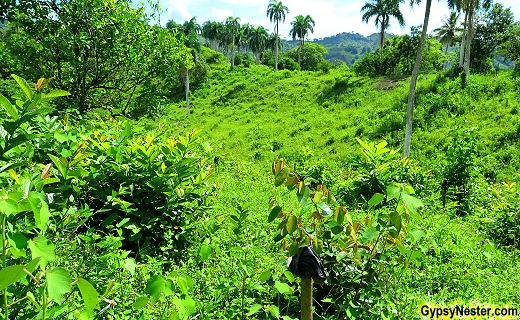
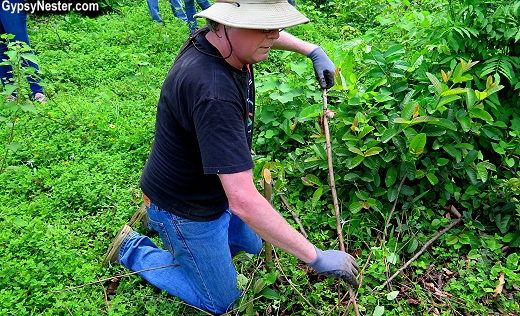
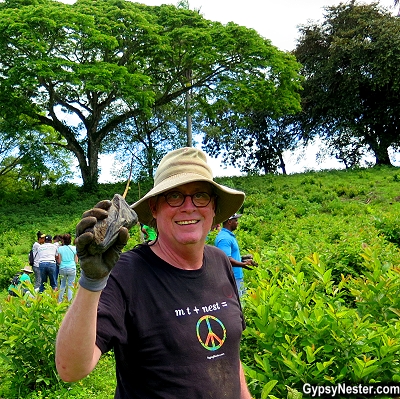 First we measured the distance between the spots for planting with a four-meter pole, so that the trees would not be too close together.