Crazy helicopter chase – what’s going on? We had just sat down for breakfast when, BAM! All hell broke loose. A new genre – Breakfast Theater! For more: https://www.gypsynester.com/cruise2.htm
Visit our GypsyNester YouTube Channel!

 ORDER NOW -
Wherever Books Are Sold!
ORDER NOW -
Wherever Books Are Sold!Boomer Travel. Food. Laughter. Breaking the Empty Nest Rules!
enlarge video
Crazy helicopter chase – what’s going on? We had just sat down for breakfast when, BAM! All hell… CONTINUE READING >>
Crazy helicopter chase – what’s going on? We had just sat down for breakfast when, BAM! All hell broke loose. A new genre – Breakfast Theater! For more: https://www.gypsynester.com/cruise2.htm
Visit our GypsyNester YouTube Channel!
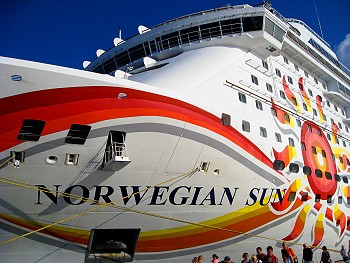 Heck yeah! It’s another GypsyNester flat-out, no-plans, on-the-cheap, get-on-a-mode-of-transportation-and-go live-blog! This time we’re storming a 7 night cruise – neither of us have ever been on a cruise before, so we have no idea what we’re in for.
We asked our readers to let us know what they wanted us to report on, and we’re going to cover as much of their suggestions as humanly possible.
Make sure you check in often this week – don’t miss a… CONTINUE READING >>
To see Part Two of this live-blog, click here
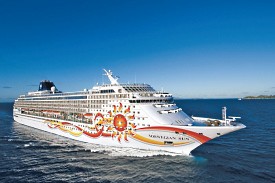
Heck yeah! It’s another GypsyNester flat-out, no-plans, on-the-cheap, get-on-a-mode-of-transportation-and-go, live-blog!
This time we’re storming a 7-night cruise – neither of us have ever been on a cruise, so we have no idea what we’re in for.
We asked our readers to let us know what they wanted us to report on (click here to see them all), and we’re going to cover as much of their suggestions as humanly possible.
Let’s talk money:
We’ve been stalking a number of cruise discount websites and found a fairly good deal. In our research, we discovered that the unbelievable deals are not given out in the timeframe that we chose, so being flexible helps. If you are a regular reader, you know we do things on the cheap. So we’re continuing the tradition:
| Tickets: | $479.00 per person/$68 per day |
| Taxes: | $ 99.00 per person |
| Excursions: | $89 per person. We normally don’t partake in the group tour stuff, but since we are stopping in four ports, we thought we’d do one for comparison purposes. |
So that’s $1334 for the two of us. $1156 if we take off the excursion.
$82 per day, per person includes (from what we hear) massive amounts of food, a stateroom and entertainment. We’re pretty sure we can eat at least fifty dollars a day in shrimp alone. Extras are booze, excursions, spa, and, of course, you’ve gotta tip.
The cruise line says they have Internet, but we’ve seen conflicting reports on how well it works. There is concern that this could be the worst live-blog ever.
10:45 AM: Our hotel insists we catch the shuttle at 11 AM to the pier for our departure at 4:00 PM.
Do we get to board when we get there or do they just want to get rid of us?
11:45 AM: We feel slightly herded through all of the pre-boarding stuff, but the staff is friendly and efficient. We are given key cards that serve as our room keys, onboard credit and proves who we are when we get on and off of the ship at port.
Our photos were taken so when we are pulled up in the system we will be able to be visually identified.
We start a bit of a running gag – we make funny faces so we crack everyone up when they pull up our file. So far it’s working – we get a laugh every time.
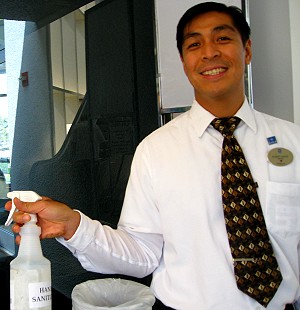
12:30 PM: Our first onboard greeting – a cute guy with hand sanitizer! Health first!
Getting a bit further in – there are hand sanitizer people everywhere.
Reminds us that prior to boarding we filled out a Public Health Questionnaire.
Two questions asked: “Do you have any ONE of the following symptoms: Fever AND Cough, Runny Nose or Sore Throat?” and “Within the last 2 days, have you developed any symptoms of Diarrhea or Vomiting?
Nope. We’re good to go.
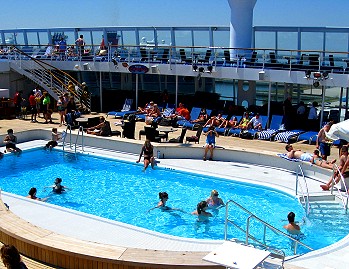
Newbie GN Cruising Tip #1: Wear a bathing suit under your clothes the first day.
Our luggage was taken by porters at the dock and we’re going to be onboard for a few hours before the staterooms are ready to be occupied.
The smart folks with their suits (mostly spring-breakers) have a jump on their vacation by immediately hitting the pool. We’re justifiably envious.
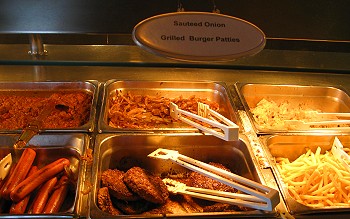
1:00 PM: Let the eating begin!
We decide on the outside dining – the first of many buffets, we presume.
Fare is a burger bar, fruit, fun bread selection, cold cuts – there are rumors of a pasta & pizza bar and table service lunch elsewhere.
Our cruise director – Sunny? – comes on over the intercom quite a bit and, while helpful, we hope the public service announcements slow down – it could become annoying. She has a great intercom voice, though.
2:00 PM: Staterooms are open!
Our luggage is in our room and we unpack, toast our cruise until our Cruise Director – we think her name is Shoney, that can’t be right – pipes into our room telling us about the safety drill. We’re beginning to think Shoney is canned, she’s even more slick sounding in the comfort of our stateroom. Hmmm…must be checked out – meeting Shoney is officially on our to-do list.
WATCH: Check out our stateroom!
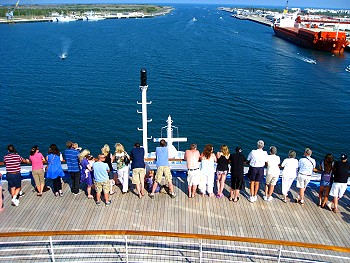
2:45 PM: Time to explore.
Finding our way around is a little tricky, we’re not alone in this, seems like everyone is lost in this maze right now.
Everything is referred to as “forward” or “aft” by the crew and signs, but since we are still docked, it’s hard to tell which is which.
First things first, up and down we can tell so we go to the very top deck, 12, to look around.
It’s like standing on top of a twelve story building, we can see for miles.
The Kennedy Space Center is off in the distance with the shuttle Endeavor waiting on the launch pad.
How cool would it be to see a launch from here? Ain’t gonna happen today.
3:30 PM: RED ALERT, RED ALERT! The alarm sounds for the mandatory life boat drill.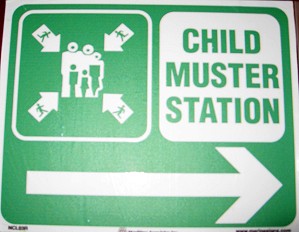
Upon arrival at emergency station “J” we discover that every member of the crew, and we mean every member, is involved in the safety and emergency procedures.
Our lifeboat organizer guy is one of the ship’s performers, Andrew, from the stage show cast.
Ah good, a highly trained and skilled professional is in charge. We will ignore the fact that his training is in dance from NYU. We decide that we are unlikely to need the lifeboats, and we’d much rather see Andrew dance than load us into one, so we tell him we’ll see him at the show tonight.
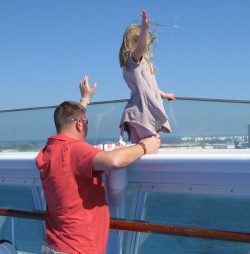
3:55 PM: We are scheduled to cast off at 4 o’clock so we head back up to the top to watch, but before we can get there we notice by looking out a window, oops, porthole, that we are already moving.
Very smooth, never would have known.
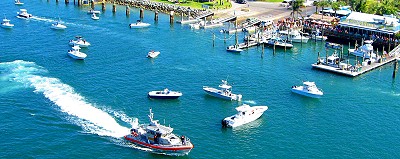
They don’t make a big deal out of leaving. No confetti or horns and bells. We thread our way out the narrow channel of Port Canaveral towards the open Atlantic. Two other cruise ships, Magic and Dream, are right behind us, because it turns out that this one of the busiest cruise ports in the world with 2.8 million passengers last year.
Tons of little boats scurry and scatter to get out of our way as we steam out. On our left, oh wait, port, side we pass the NASA docks and the ships they use to recover the solid rocket boosters when they fall off into the ocean.
6:00 PM: Our first prize drawing. Must be present to win, so we are at the spa. They are giving away $500 of spa services, including massages, we want to win this one.
6:15 Can’t believe we didn’t win!
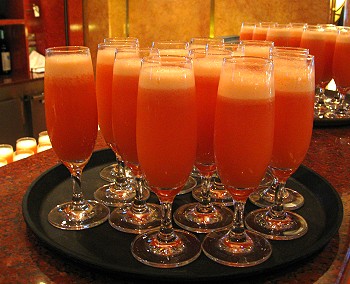
7:00 Next drawing, free entry into poker, blackjack and slots tournaments in the casino.
Must be present to win. Present in a casino generally means losing money.
They are giving away free rum punch though, and we’re pretty sure this is the only free drink we are going to get this week.
7:15 Didn’t win. How can this be?
We’re usually really good at raffles.
7:30 Dinner.
We decide to avoid the buffet. There are two sit-down restaurants on board that are included in the ticket price so we check them out. They have the exact same menu, so we will let the view decide.
The Seven Seas has windows all the way around the stern (loving these nautical terms baby) of the ship.
We have a winner. Huge bonus, we ask for, and get, a table on the side with a huge orange full moon rising over the Atlantic.
8:20 Wow, glad we skipped the buffet. The food is excellent.
Start out with a baby shrimp cocktail that is more of a remoulade, and a portabello and buffalo mozzarella farm tart. Both rock.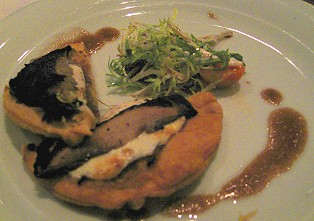
Next, grilled Mahi and leg of lamb that, while short of spectacular, are very good.
The star of the show is dessert, a vanilla bean souffle with a Grand Marnier cream. Go ahead and throw us overboard now, we’ll die happy.
8:45 Post dinner potty break, otherwise known as a trip to the head. Veronica encounters her first “It’s spring break, whooohoooo!” vomit. The ship is not packed with spring breakers, but there are a few and are keeping the place lively.
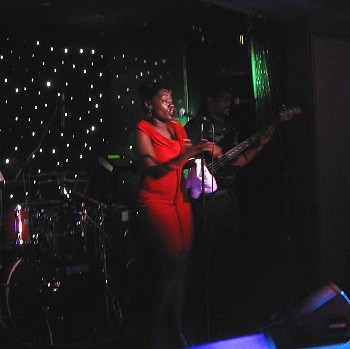
9:00 It’s showtime!
The Norwegian Sun gala song and dance spectacular!
Look it’s Shoney, our cruise director, whose name is actually Shona.
She looks like she sounds, waaaaay too perky. Think Julie from the Love Boat and then dial up the perk to 11 – but it works for her, we’re infected.
Hey look, it’s Andrew, our lifeboat muster guy, dancing his ass off.
Actually, the dance troupe is really, really good. As the show goes on we get a preview of all of the entertainers on the ship in cameo appearances. The standout is the group Sol Play that performs the dance shift at the shipboard nightclub Dazzles, their lead singer flat gets it.
10:15 Handed yet another raffle ticket while leaving the show. Must be present to win. We are getting the feeling that these might just be a ploy to keep us in the bar buying drinks.
Don’t know if we won, we weren’t present.
8:10 AM Wake up with absolutely no idea what time it is. Realize that by having an inside cabin it is incredibly dark no matter if it’s noon or midnight.
Newbie GN Cruising Tip #2: Bring a wind-up clock for your room. We generally rely on our cell phone to know what time it is in real life and the phone doesn’t know to adjust to ship time. Maybe someone should come up with an app for that.
8:20 AM Wander out in search of coffee, find some in the casino. Not sure what the hidden message is here, but we refrain from placing a bet and avoid looking at the folks who have been up all night doing that very thing. Feel like we’re stealing coffee from those who are more in need.
9ish AM After getting some joe in us, it must be time to start eating. We find a pretty standard breakfast buffet al fresco in the Garden Cafe, eat lots of fruit and some really good lox and capers.
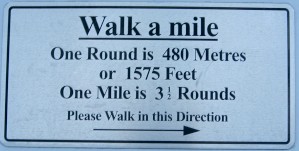
10:45 AM We can actually get from one place to another without getting lost AND without using the often crowded and exercise-reducing elevators. Right proud of ourselves.
This ship is so huge that we figure we can easily log a couple of miles a day by hoofing-it up and down the stairs.
11:30 AM Cleaned and coffeed up we find today’s Freestyle Daily, the ship’s daily newspaper telling all of the activities for our “Fun Day at Sea.” One thing jumps right out at us, Pub Crawl – 5 drinks in 55 minutes. Seems a tad overindulgent, but we ARE at sea all day today.
Wait, WTH? It’s at 1:15 in the afternoon! Are they trying to encourage more puking? We figure we’ll pass. We’ll just put in some pool time.
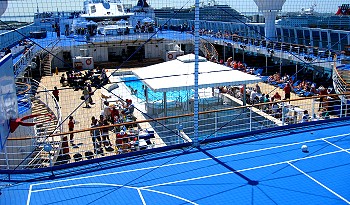
1:30 AM Pool time.
What was it that mom always said about no swimming after eating?
Slightly more disturbing is the information on our TV giving the pool water temperatures. For some reason the kiddy pool is two degrees warmer than other pools… wonder why?
Luckily, the pools are filled with luxurious saltwater and are drained every night. We opt for the adult pool and David has poolside ribs for a “snack” just because he can.
5:30 PM Trivia Time with The Crew in The Windjammer lounge. Being the cut-throat trivia players that we are, we stalked a intellegent looking older couple to team up with (finding a nice age span is crucial) and managed nine out of fifteen correct for second place.
Apparently, the two women that won dominated at yesterday’s trivia as well – the gauntlet has been dropped.
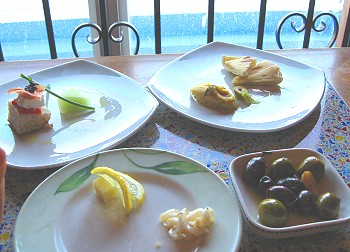
6:45 PM We find a little bar called Las Ramblas Pub way up on deck 12 all the way aft.
We have the place pretty much all to ourselves and they have Tapas.
It’s not really like eating more because they’re small, right?
This could be our new favorite place.
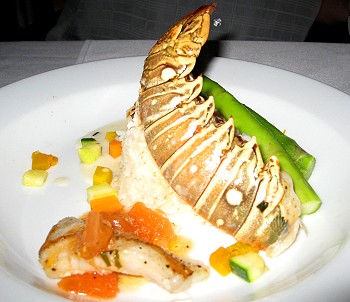
7:30 PM “Gee honey, I’m starving.”
It’s become a running gag today, but hey, it’s lobster night at the restaurants.
Hungry or not, here we come.
Walking through, we find the buffet nearly empty, no lobster here, but they have added a chocolate fountain.
Moving on, the line at The Seven Seas is crazy long so we opt for The Four Seasons. The line is much shorter.
We had devised a devious plan – going back and forth
between dining rooms and ordering anew each time until we had lobster coming out of our ears, but – alas – we’ve been foiled by the long lines.
We did sit by a couple who ordered two lamb entrees back-to-back last night, but we were too embarrassed to go that route.
We need to become more aggressive.
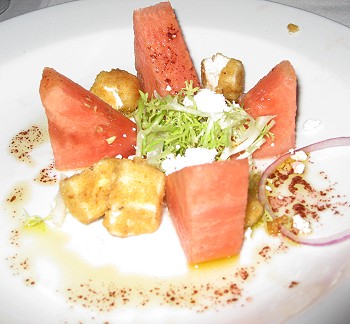
We started with a Watermelon and Grilled Feta Cheese Salad – so different and delish.
The Lobster and Grouper Extravaganza (actual name!) was billed correctly. The lobster, Caribbean Spiny variety, not Maine, is fine and dandy.
In fact, all of the food has been above expectations. The chefs took a well deserved victory lap as the entire place erupted with applause.
WATCH: Oh, the food!
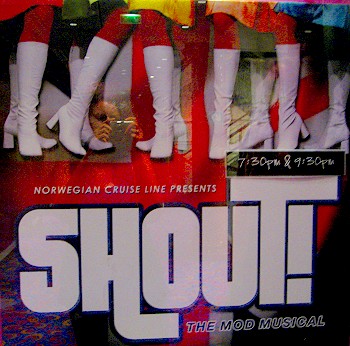
9:30 PM Tonight’s big show is SHOUT! – The Mod Musical.
We rolled our way over to the theater. And we’re blown away.
The level of talent of the singers and dancers is astounding. (No pictures or video allowed in the theater, so we’ll not be sharing any, sorry.)
A glance at the profiles of the performers in the lobby convinced us – many are Broadway, national touring and prestigious performing art school vets.
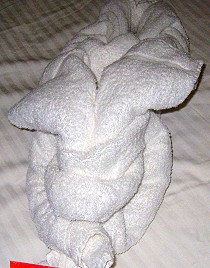
11 PM A fuzzy towel bunny created by our fabulous steward, Florence, greets us in from our bed when we come in bloated and exhausted after the show.
Next to fuzzy bunny guy, a schedule of tomorrow’s events is placed.
We are WAY to worn out to even look at it. Besides, we need to hit the hay, tommorow’s agenda starts early and we need to be up at 5:30 AM for our shore excursion.
We’ve got to slow down or we’ll never survive all the fun we’re having.
5:30 AM Yes, this is a crazy time to be getting up but we are scheduled to meet up with our fellow excursionists at 6:40. We’ll catch a ferry from the island of Cozumel, Mexico to the mainland of the Yucatán, then a bus to see the Mayan ruins at Tulum. We think it will be worth it. Our steward found us a coffee machine – the beautiful girl – so our groggy, early morning journey for coffee need not be.
4:35??? AM Wait a minute, the ship’s time on TV says it’s 4:35! It seems that they don’t go on daylight savings time here so our 5:30 alarm clock is now an hour early. Looks like we have plenty of time to get ready. And, yes the crew left us a note telling us to adjust our clock but we were so enamoured with Fuzzy Towel Bunny Guy that we neglected to do so.
Newbie Cruise Tip #3 – Check shore excursion leaving times ahead of time if you are a night owl and want to sleep in. Luckily we are in Mexico, so siesta falls during our the bus ride back this afternoon.
Also, booking the excursion online prior to the trip saved us from standing in a long line at the shipboard excursion desk. Hey, one less line to stand in… always a good thing.
6:20 AM Quick, more food!
Wouldn’t want to get hungry on the excursion.
As we disembark, we turn around and see the outside of our ship for the first time (she was blocked at the pier in Port Canaveral), and are slack-jawed by the enormity of her.
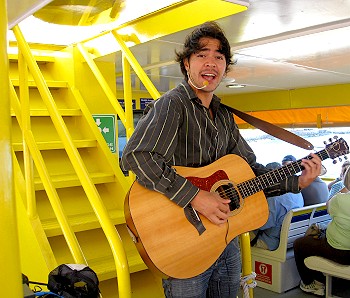
7:15 AM There is a very fun singer on the ferry, who’s name we missed in our early morning fog, but we were most impressed by his sea legs.
We could barely stand up, much less sing and play guitar, while bouncing over the six foot swells.
He deserves a good tip just for that, oops, don’t have anything smaller than a twenty, well then, a really good tip.
Gives him some walking around money to woo college girl spring-breakers with. Though we’re guessing by the reception he’s getting, he doesn’t need our help in that department. Besides, he’s training to be a pilot and we know how expensive that is – The Boy is in the midst of it himself – and, we’re suckers.
Newbie Cruise Tip #4 – Shore excursions are filled with tipping opportunities and should be planned for. Like a guy-who-just-broke-up-with-his-girlfriend headed for a strip club, bring lots of small bills.
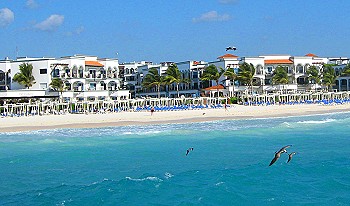
7:45 AM Arrive on the mainland at Playa del Carmen.
On the bus, our guide Carlos is great. He is a proud Mayan descendant and quite the scholar.
While we ride he gives us a comprehensive history of the Mayans.
The bus driver is selling beers for three dollars each. We pass, it’s quite a bit too early – even on cruisetime.
8:25 AM A “baños break.” While it is true there are bathrooms in Mexico that are olfactory adventures, this is really more of an excuse to herd us through a quintessential crap shop.
Hey, everyone has got to try to make a peso somehow, don’t they?
Actually, among the standard cheesy stuff, there are some impressive items made from the local obsidian. We loved a life-sized sea turtle, beautifully carved, but it weighed at least fifty pounds. Not dragging that anchor around all day.
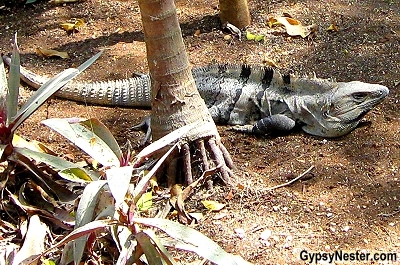
It’s starting to get thick with iguana around these parts. You can’t swing a cat without hitting a one of these spiny fellas.
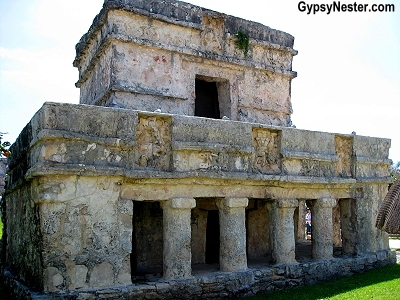
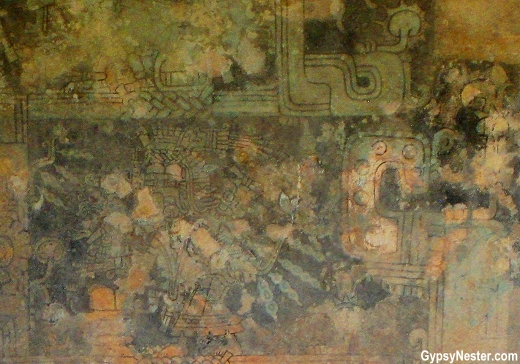
Carlos spends the most time showing us the details of the Temple of the Frescoes, since it is the most unique artifact to this site.
The figures of the Mayan “diving god,” their version of Venus, along the facade of the temple and the surviving frescoes inside are perhaps the finest examples of Mayan artwork remaining anywhere.
Archeologists discovered at Tulum that the Mayans painted their temples bright colors and Carlos showed us some of the remaining original coloring.
Click here to see more about of Tulum
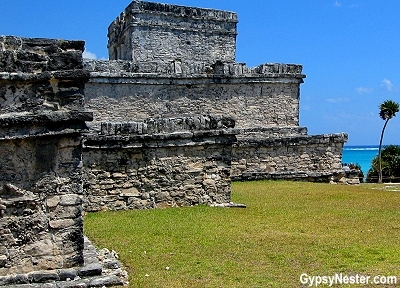
9:15 AM Arrive at Tulum and Carlos shows us around. He points out several interesting tidbits that we would certainly have missed if we were on our own.
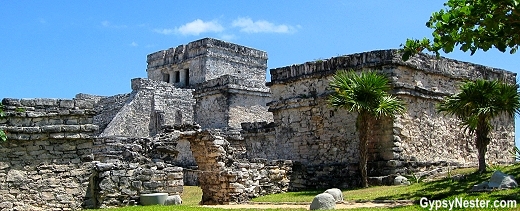
Tulum, the Mayan word for fence or wall, is a walled city that dates back over eight hundred years and served as a sacred site as well as a sea port.
The most prominent feature is El Castillo, al Mayan temple with steps leading up to a columned shrine on the top.
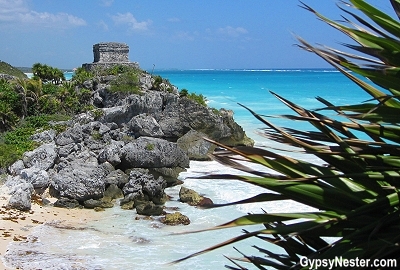
Off to one side is a smaller structure that has a tiny window that the sun rises exactly through on the summer solstice, the longest day of the year.
This is tré Mayan, as they were obsessed with the calendar and developed stunningly accurate versions thousands of years ago.
11:00 AM Carlos has finished his formal tour and we are free to roam the site. It is truly spectacular, perched on the edge of a cliff overlooking the Caribbean sea with a beautiful beach below.
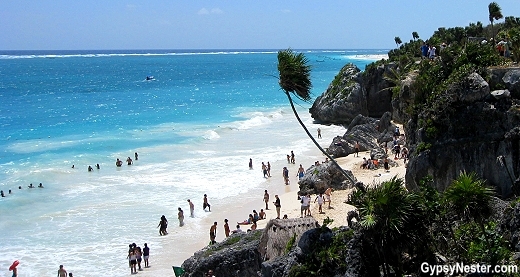
The Mayans sure knew how to pick a good spot. We’re having a magnificent time rambling among the ruins. It is definitely worth missing a little sleep.
12:15 PM We decide to chuck the box lunch provided by the ship and score some street tacos from one of the vendors that surround the entrance to the site. Mmm, mmm good, complete with chunky habenero-heavy pico di gallo. Our tongues will be burning for hours…mmmmm.
WATCH:
12:45 PM Back on the bus and a welcome siesta. Side note, the bus baño is truly a smell-o-rama, so maybe the earlier stop wasn’t only about tourist peso removal.
3:00 PM Heading back to the Norwegian Sun, but not before many more tipping opportunities, boat crew, drivers and guides, but now we have change. They all kept their clothes on.
Click here to see more about of Tulum
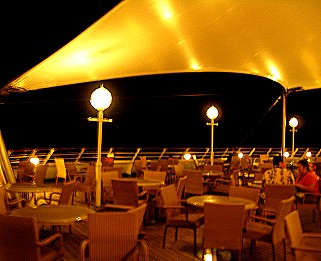
6:30 PM Ole! It’s Mexican night – we were in Mexico today, after all.
We belly up – no waiting – haul our plates outside and do a quick chow.
We’re not complaining but, all things considered, we’ll take the street tacos.
Newbie Cruise Tip #5 – Wear excellent shoes when leaving the ship. Today alone, we have boated, bussed, walked miles over level, yet rocky terrain, and got doused by a wave on the beach. We’ve dealt with dusty dirt and sand. Flip flops could not have handled the task.
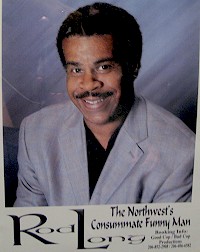
7:30 PM Passing on the 70’s Funkalicious Groove Party in the Dazzles Disco, we check out the comedy show with Rod Long in the showroom. He’s from Seattle and has done the circuit.
He’s hysterical, and incredibly adept at pushing the envelope right up to the edge without offending any of the more delicate of the cruisers’ sensibilities. Now that’s true talent.
6:30 PM For the first time, we are enormously grateful for the “FreeStyle” cruise concept.
We are bedraggled – sweaty, salty, windblown, dusty. Moreover, we are happy as clams and couldn’t care less.
So we ditch our backpack and drag our unshowered, unhairbrushed, smiling, nasty selves to the buffet.
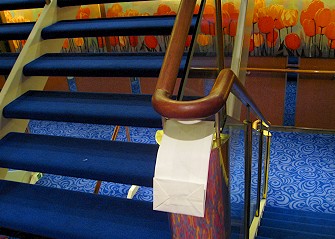
10:00 PM The seas are picking up a bit and walking back to the cabin we find strategically placed barf bags on all of the staircases.
Call us wacky, but they don’t look big enough to handle the food intake we passengers are consuming.
Luckily, living our lives in nearly constant motion has made us immune to motion sickness, and we will find it a rather pleasant way to rock off to sleep.
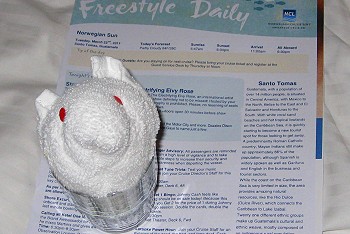
10:30 PM Florence the Fabulous Steward had left us another outrageously cute fuzzy towel animal!
This time it’s a little pink-eyed mouse tucked into a drinking glass.
Veronica ohhhs and ahhhhs, names him Herman before falling asleep, exhausted.
David types this and is not far behind.
10:55 AM The ship is docking and we want to get a jump on our time ashore so we are lining up to get off. No guided tour today, we are wading into Guatemala GypsyNester style.
We read up on it and there are little water taxis that run the locals back and forth from Puerto Barrios to the nearby fishing village of Livingston for fifty Quetzales, about eight bucks. Though it is on the mainland, Livingston can only be reached by boat and looks to be a very interesting place, so that’s our plan.

11:25 AM On the docks at Santo Tomás de Castilla, a freight container port that has just recently started having cruise ships come in.
We have encountered a small snag in our plan to taxi to the nearby town of Puerto Barrios where we can catch a small boat. There are no regular taxis here, they all want to take us on tours.
11:40 AM After much broken Spanish, English, Spanglish and the little Italian accidentally thrown in when David gets flustered, we have finally negotiated a cab ride into town for the wildly inflated price of thirty dollars.
A distinct disadvantage of arriving on a cruise ship, we all look like suckers I guess.
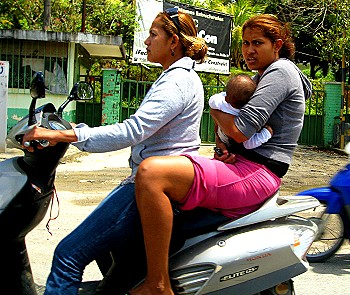
12:05 PM We make it to the docks at Puerto Barrios, our cabbie showed us a few sights along the way, but there is not too much to see in this somewhat rough seaport town.
Now he is trying to negotiate a boat tour for us.
We’re having quite the time getting our point across, we just want to make our way on our own, no tour. That request must not be made much in these parts.
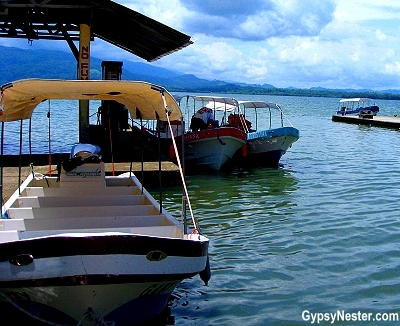
12:10 PM The cabbie’s tour operator friend wants $100 to take us to Livingston, ain’t gonna happen. They seem terribly confused, how could we possibly not want a private tour?
After overhearing this madness, our hero, Salvin, a local guy who has lived in The States says to us, “Just get on this boat, it is going to Livingston.”
We thank him and climb aboard the little open skiff. We haven’t managed to change any money yet, but the “captain” is fine with a good old American twenty for the two of us.
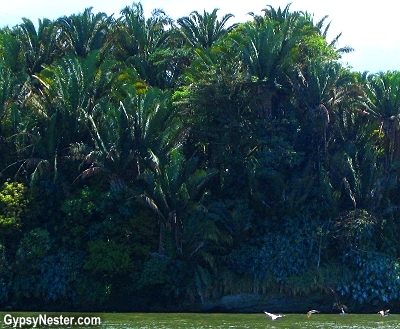
12:15 PM On our way, leaving a very confused tour guide behind.
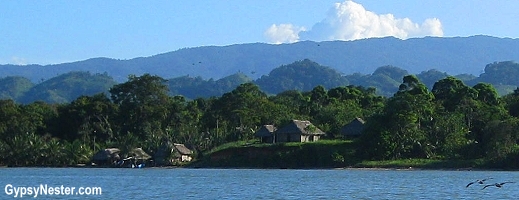
We chat, more like shout over the wind and engine noise, with Salvin and marvel at the incredibly dense jungle along the shore.
We’ve never seen palm trees this size. Fantastic.
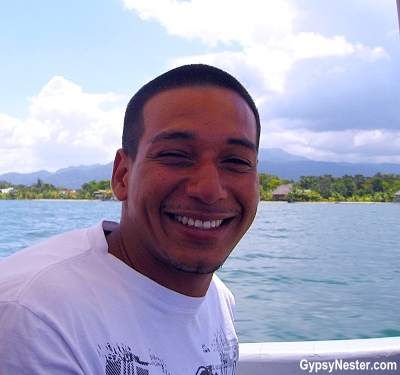
12:45 PM Our little skiff arrives in Livingston and we head up the hill to see what we can find. By being so secluded, the town has kept it’s unique culture.
It has Gautemala’s highest concentration of Garifunu, descendants of Carib, Arawak Indians and West Africans, that ended up here after multiple trials and tribulations.
In 1635, two Spanish ships carrying Africans to the West Indies for the slave trade shipwrecked near St. Vincent. The survivors swam ashore on St. Vincent and settled among the Carib and Arawak natives.
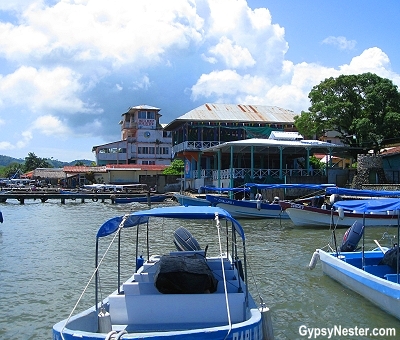
Known as Black Caribs, they became the dominant population of St. Vincent until the British invaded in 1763.
Over the following years they were killed and scattered by the Brits until 1798 when the remnants were exiled to the Island of Roatan off the coast of Honduras.
From Roatan the Garifunu migrated to the mainland of Honduras and settled all along the Caribbean coast of Belize, Guatemala and Nicaragua.
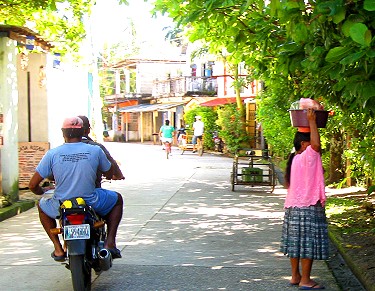
1:30 PM Livingston has an authentic, funky charm, we imagine it to be a lot like how the Caribbean islands must have been before they were so developed for tourists.
Other than the locals and a couple of British backpackers heading into Honduras, we seem to have the town to ourselves.
Wandering around, we find a very cool little hotel / restaurant built in a stair-step fashion up the side of the steep hill overlooking the bay.
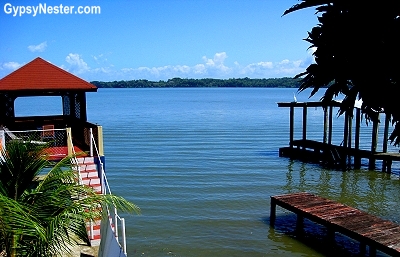
Veronica had noticed it from the boat on the way in. Inside each level has a terrace with tranquil Caribbean views and no one else is here.
It’s like our own private balcony so we order up a couple of the local brews, Gallo. Gallo is the best beer ever made, or maybe it’s just the surroundings, either way, it doesn’t suck.
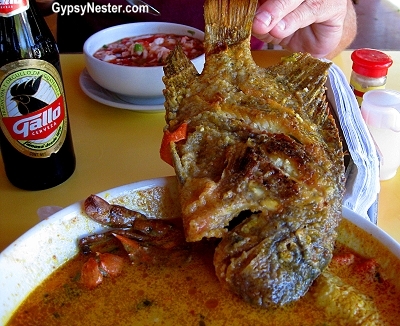
2:00 PM We are getting a little hungry and had read about the traditional Garifuna dish, Tapado, so we must find some.
It is a seafood soup with an entire fish, shrimp and whatever shellfish was caught lately, today it’s softshell crab, with plantain and / or green bananas in a coconut milk broth spiced with cilantro and a hint of hot peppers.
Most of the cafes in town offer it and Restaurant de Malecon looks as good as any.
(see more of our adventure in Livingston, Guatemala w/ more pics & video)
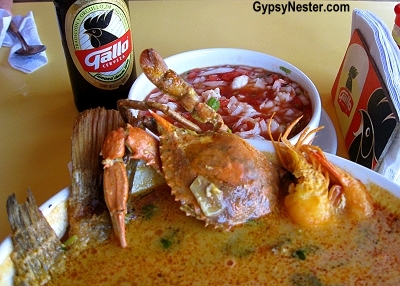
2:15 PM Our Tapado arrives with a couple more Gallos.
We’re still pretty sure it’s the best beer ever, but it has the good fortune of an amazing accompaniment.
We topped it off with a soup bowl of shrimp cerviche, also delicious, but could have easily shared the Tapado and been more than sated.
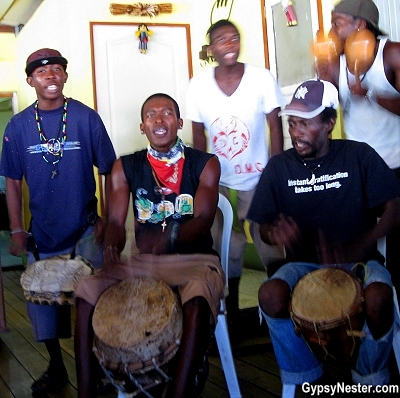
2:45 Uh oh, large crowds of tourists are invading, looks like the guided tour groups from the ship have arrived. On the upside, a traditional Garifuna band is brought in to entertain them.
The musicians play drums, a turtle shell, conch shell and maracas while chanting lyrics. It’s a very different sound, but entertaining as they are, there are just too many people here all of a sudden, so we bail.
4:00 PM There is no set schedule for the boats back to Puerto Barrios, they just go whenever they get a boat load of six or eight people, so we figure we’d better see about getting on one.
See more of our adventure in Livingston, Guatemala
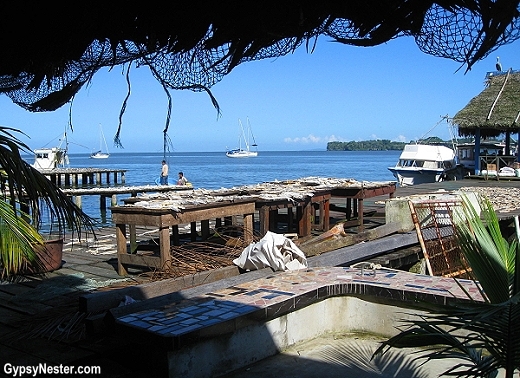
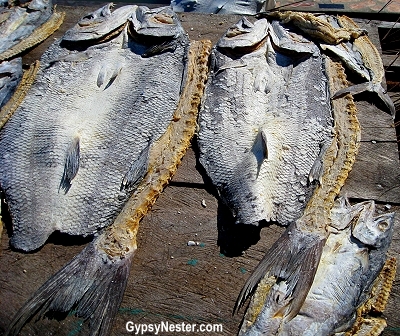
3:30 PM By wandering down a road along the water, away from the main part of town, we come upon the fishing docks.
Actually, the overwhelming smell of fish led us here.
Through a tiny alley and we pop out on a dock that is completely covered with fish drying in the sun. They’re making saltfish.
Looking around, every dock is covered, there are thousands of fish. They are cleaned, split open, salted and laid flat to dry while the fishermen hang out in the dockside watering hole and come out to flip the fish every now and then.
No telling how many centuries this routine has been taking place.
4:15 PM After waiting a while, there’s still nowhere near enough people, just us and one other woman, we decide to ask if they might take us directly to the ship so we can avoid another cab fiasco.
They agree, for twenty bucks each, a bargain in our book. We bring the other lady along and drop her in Puerto Barrios on the way.
6:00 PM Back aboard The Norwegian Sun just in time for some sunset tapas on the top deck while the ship pulls out of port. A person could learn to like this.
8:30 PM There is Jeopardy in Dazzles Disco tonight. We’re not sure how it works or what to expect but we love Jeopardy, so here we are.
8:35 PM Anyone wanting to be a contestant writes their name on a slip and puts it in a bucket and contestants are drawn.
8:40 PM Veronica is the first one called.
8:43 PM David is the last one called. Ah, some good old fashioned competition.
9:24 PM End of double Jeopardy. Score: Veronica,12,000. David, 8,000. Other guy, 4,200.
9:27 PM Final Jeopardy. “In Rome, you can stand in these two countries at the same time.” Too easy, looks like Veronica will win.
9:32 PM Italy and The Vatican of course. Everyone gets it right, but Veronica pulls a reverse “Cliff Clayborn” by betting zero when she wasn’t ahead by enough to win. David bets it all… and wins! Veronica sucks at math.
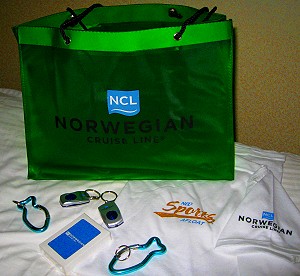
David won a tote bag, FOUR keychains, a deck of cards, a tee shirt and BINGO cards for the big $5000 giveaway. We weren’t planning on BINGOing, but now we can play for free.
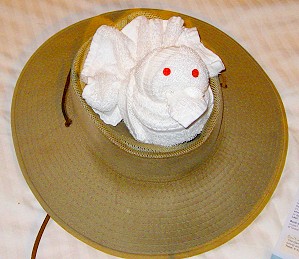
10:30 PM Last Jeopardy answer for the night: “This Fuzzy Towel Guy “quacked” us up.” Our response: “What is a duck?” Florence has lovingly nested him atop David’s hat.
10:00 PM Walking back to our stateroom we are stopped multiple times by members of the Jeopardy audience, we have become cruise stars. Heady stuff, this.
That’s not all! To see Part Two of this live-blog, click here
David & Veronica, GypsyNester.com
Your Turn: Feel free to leave a comment below or share a story about a cruise you have taken! Don’t forget to add your cruising tips!
enlarge video
Check out the amazing crew that not only met all our needs, but anticipated them! What a… CONTINUE READING >>
Check out the amazing crew that not only met all our needs, but anticipated them! What a talented group! For more: https://www.gypsynester.com/cruise2.htm
Visit our GypsyNester YouTube Channel!
enlarge video
The players may not be in mid-season form, but the fans sure are! You don’t have to be a baseball fan to have a blast at … CONTINUE READING >>
The players may not be in mid-season form, but the fans sure are! You don’t have to be a baseball fan to have a blast at Spring Training! Warning: Philly fans can be a little racy. For more: https://www.gypsynester.com/spt.htm
Visit our GypsyNester YouTube Channel!
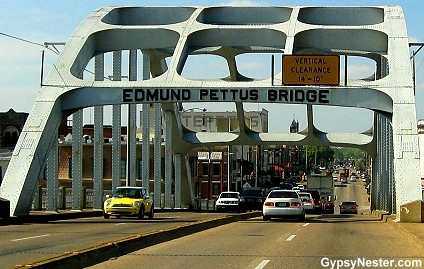
Obviously the atmosphere was pretty charged around here back in the early sixties when advocates began to arrive from around the country to stand up to segregation and register African Americans to vote. This led to some of the most extreme violence perpetrated during the entire movement… CONTINUE READING >>
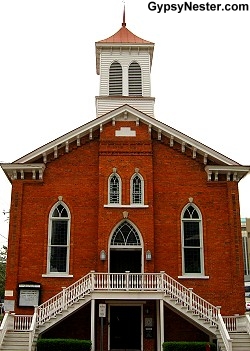
The Dexter Avenue Baptist Church, where Dr. Martin Luther King served as pastor, stands just around the corner, literally in the shadow of the capitol building that was the birthplace of The Confederacy and site of George Wallace’s famous “segregation now, segregation tomorrow, segregation forever” speech.
Obviously the atmosphere was pretty charged around here back in the early sixties when advocates began to arrive from around the country to stand up to segregation and register African Americans to vote.
This led to some of the most extreme violence perpetrated during the entire movement, most notably the beating of Freedom Riders as they arrived in Montgomery to integrate bus service and depots in 1961, and Bloody Sunday at the Selma to Montgomery Marches for voting rights in ’65.
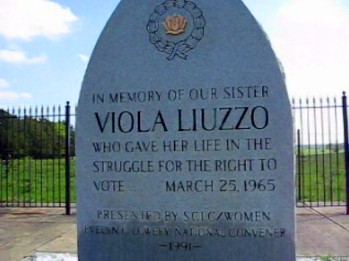
One of the lesser known participants in the marches was Viola Liuzzo. After the final march Viola volunteered to drive people back to Montgomery from Selma and committed the unforgivable act of being a white woman in a car with a black man. Nothing got a bigot’s blood to boiling like that.
So four Klansmen chased the car down Highway 80 and about halfway between the two towns, pulled up beside the car and shot Viola four times in the head. Even though one of the shooters was a known FBI informant, not one of the murderers was convicted by their all white juries. In 1991 the Women of the Southern Christian Leadership Conference placed a marker for Mrs. Liuzzo near the highway at the site of the shooting.
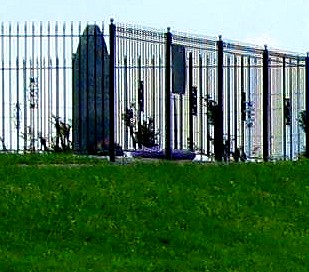
We felt that we should see it, so we stopped on our way to Selma. We wanted to cover the exact route of the Selma to Montgomery Marches (though we were going backward), to get a real feel for what happened there.
We had to watch closely, the marker can be easy to miss, as we did on our first pass. But after doubling back we found it. In a sad commentary as to how far we still have to go, the marker has been knocked down and defaced, often by painting Confederate flags on it, many times.
We entered Selma at the Edmund Pettus Bridge, scene of Bloody Sunday, when 600 marchers were beaten and gassed as they tried to cross the bridge on their first attempt at marching to Montgomery.
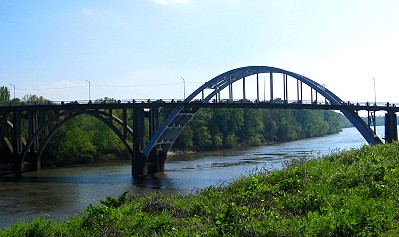
Two days later Dr. King led another march, this time only planning to go as far as the bridge, to prove the point that they had the legal right to do so on the authority of a Federal District Court Judge.
The third march left Selma two Sundays after the first try, with just over three thousand people. They walked about twelve miles a day, sleeping in fields along the way, until they reached Montgomery four days later. By the time they marched up to the capitol building the group had grown to 25,000. But later that night the murder of Mrs. Liuzzo marred the success.
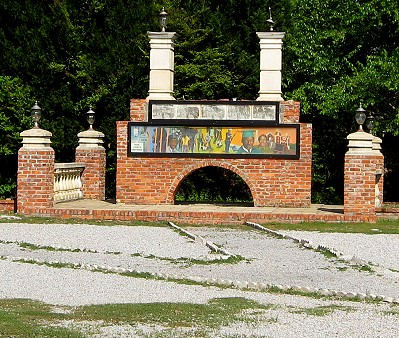
Before we crossed the bridge into Selma, we pulled off to see the small memorial below the eastern entrance, but it was in a sad state of repair.
Once across we were a little surprised by the lack of acknowledgement the town of Selma seems to have for these events and the civil rights movement in general.
With banners hanging from the lampposts reading: “Historic Places, Social Graces,” the city seemed to want to play up its Southern charm more than any of its more recent history. I guess we can’t blame them too much, it wasn’t pretty, but it still struck us as strange after seeing the beautiful tributes in Montgomery.
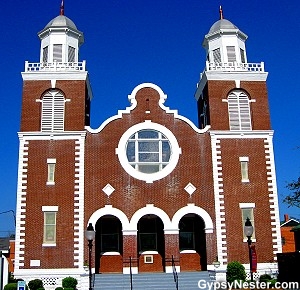
The two biggest landmarks from the movement in Selma, the Edmund Pettus Bridge and the Brown Chapel African Methodist Episcopal Church, have not changed much over the decades, so we parked and set out on foot to retrace the route of the marchers from the bridge back to the church that had served as the starting place for all three of the Selma to Montgomery Marches.
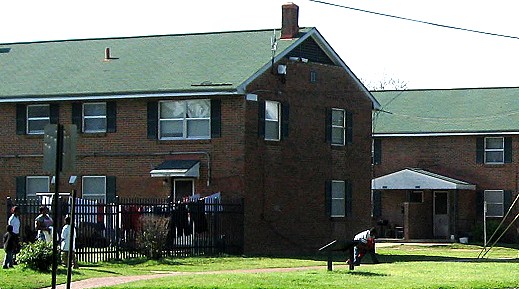
As we walked up Martin Luther King, Jr. Street we were struck by how much everything looked like the pictures taken fifty years earlier. Other than the street being paved, The George Washington Carver Homes where many of the marchers lived and took in participants from out of town, including Viola Liuzzo, looked exactly the same. Sometimes progress isn’t readily visible. We were ready to move on.
David & Veronica, GypsyNester.com
Read more about our trip through Birmingham, Montgomery and Selma with more photos and videos by visiting “Following the Freedom March in Alabama.”
 Ah Spring, when a young man’s heart turns to thoughts of… baseball. In late February thousands of athletes descend upon Florida and Arizona for the annual rite of Grapefruit and Cactus League baseball – Spring Training.
It was just like being on the bench with the players. We could almost taste the Gatorade and easily eavesdrop on everything they said to each other, as well as what the coaches had to say… It really was amazing access… CONTINUE READING >>
Ah Spring, when a young man’s heart turns to thoughts of… baseball.
In late February thousands of athletes descend upon Florida and Arizona for the annual rite of Grapefruit and Cactus League baseball – Spring Training.
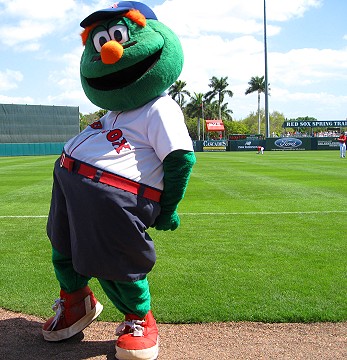
Finding ourselves in Fort Myers, Florida, naturally we had to “say hey” and make our way to the old ball yard.
The city of Fort Myers plays host to two major league training camps, The Boston Red Sox and Minnesota Twins.
Just twenty miles north, Port Charlotte is home to the Tampa Bay Rays, so we could get our fill of Grapefruit Baseball without much travel time.
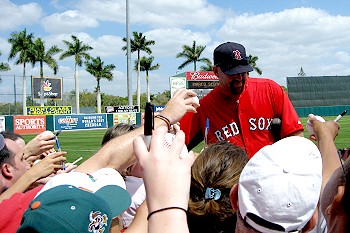
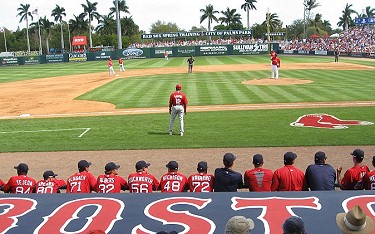
On a gorgeous Wednesday afternoon we caught a game between The Sox and the Philadelphia Phillies at City of Palms Park. These spring games are a completely different animal than the regular season variety.
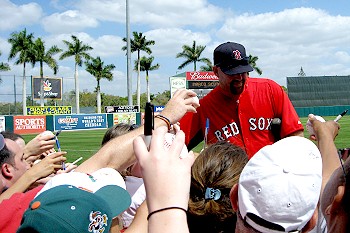
Everything about spring training is as close as an inside fastball. Spectators have up-close-and-personal access to the players – the famous and those fighting for a roster spot. Both stars and rookies walk right up to the railing after warm-ups to sign autographs or just shoot the breeze with fans.
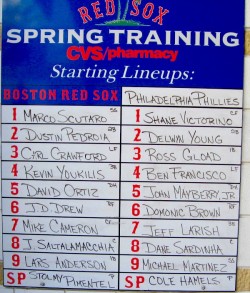
For well under half the price of a regular season ticket, we sat within a few feet of the field. Considering it’s nearly impossible to get a seat at Fenway Park in Boston for any price, we rated this beyond a bargain.
We got to see BoSox stars like Kevin Youkilis, David Ortiz, Dustin Pedroia, Mike Cameron, J. D. Drew, and Carl Crawford play about half a game, and a bunch of guys more likely to spend this summer in Pawtucket than Beantown finish up. A rare chance to see a future All Star in the making.
The Phillies used fewer of their everyday players, but Cole Hamels took the mound and brought the mustard, while starters Shane Victorino and John Mayberry patrolled the outfield.
The Philadelphia squad won the day – two to nothing – on one-hit pitching, but even the Red Sox partisans didn’t seem to mind too much. It was more-than-good enough to spend a beautiful day basking in the sun enjoying the great American pastime.
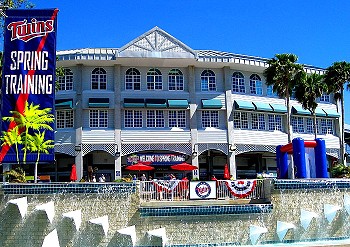
For an even closer experience, we stopped by the Twins training complex the next morning.
At these camps, fans are welcome to wander through the facilities while the up-and-comers fight to get noticed and the vets work out the off-season kinks. During the workouts, players, coaches, front office staff and scouts mix and mingle while evaluating strengths and needs for the upcoming season.
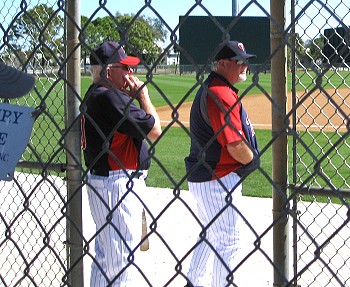
We listened in while Minnesota manager Ron Gardenhire shared his thoughts on the early season games and the Twins new stadium with some hard core fans from up north.
Once Ron finished up, we wandered over to the batting practice field to watch a few balls get scalded.
Minutes later, buses full of Tampa Bay Rays pulled up and, lucky for us, the teams had a full practice game just before the real game. On an unadorned diamond next to The Twins’ Hammond Stadium, the squads squared off – complete with umpires and in full uniform.
It was as if we stumbled upon a local little league sandlot where a major league game broke out. Just across a chain-link fence (there’s a lot of chain-link fence at a training camp) these guys were playing to win, just like they all have since they were kids.
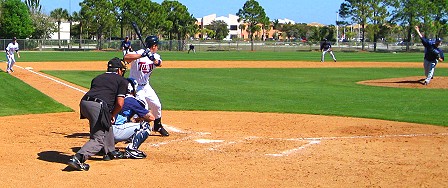
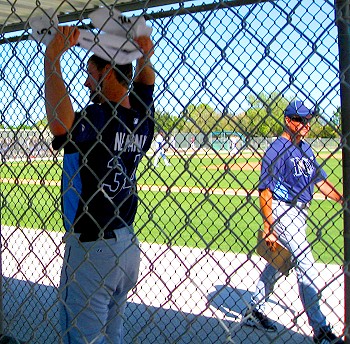
Since the starters were being saved for the later game, the scrimmage squads were made up mostly of backups fighting for roster spots.
Still, Twins middle infielders Trevor Plouffe and Matt Tolbert were in the lineup, hoping to get a few chances to turn two and were quite impressive with their bats. They both got solid hits off of one of the Rays top starters, Jeff Niemann.
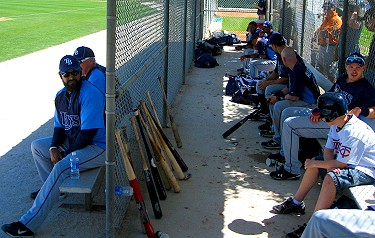
It was just like being on the bench with the players. We could almost taste the Gatorade and easily eavesdrop on everything they said to each other, as well as what the coaches had to say.
When Rays pitching coach Jim Hickey worked with Niemann after he got roughed up a bit, we were standing right next to them. It really is amazing access.
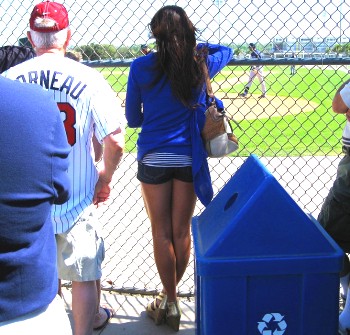
Fans thrive on this access – the die-hard fanatics, kids and groupies alike. Diehards get a few extra weeks of season and can chew some fat with an All Star.
Kids blissfully rub elbows and snag autographs from their heroes. And gussied-up young ladies hover near the plate like a hanging curve ball, hoping to get their mitts on a cute ballplayer.
Even for casual fans like us, being this close to larger-than-life athletes is a grand slam.
Spring has sprung.
David & Veronica, GypsyNester.com
enlarge video
It was almost like being on the bench with the players. We could almost taste the Gatorade. It really is… CONTINUE READING >>
It was almost like being on the bench with the players. We could almost taste the Gatorade. It really is amazing access. For more on Spring Training: https://www.gypsynester.com/spt.htm
Visit our GypsyNester YouTube Channel!