These aren’t your average outhouses, oh no, these are high performance porta-potties. Guess what happens at the after party in the Ozarks! For More: https://www.gypsynester.com/bf.htm
Visit our GypsyNester YouTube Channel!
 ORDER NOW -
Wherever Books Are Sold!
ORDER NOW -
Wherever Books Are Sold!Boomer Travel. Food. Laughter. Breaking the Empty Nest Rules!
enlarge video
These aren’t your average outhouses, oh no, these are high performance porta-potties. Guess what happens at the… CONTINUE READING >>
These aren’t your average outhouses, oh no, these are high performance porta-potties. Guess what happens at the after party in the Ozarks! For More: https://www.gypsynester.com/bf.htm
Visit our GypsyNester YouTube Channel!
enlarge video
Home of BeanFest, Mountain View, Arkansas! Check out how crazy it gets up in the mountains of the… CONTINUE READING >>
Home of BeanFest, Mountain View, Arkansas! Check out how crazy it gets up in the mountains of the Ozarks! Guess what happens at the after party? For about BeanFest: https://www.gypsynester.com/bf.htm
Visit our GypsyNester YouTube Channel!
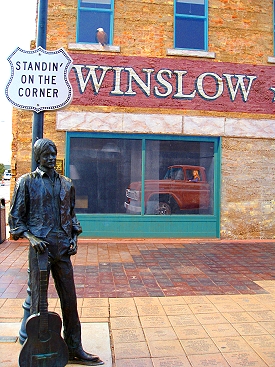 While we are firm believers in a “take it easy” philosophy, we have never been standing on a corner in Winslow, Arizona before. Call us wacky, we were pretty stoked about it.
The town of Winslow is pretty stoked, as well.
They built a little monument to the lyric, complete with a mural of a girl, my lord, in a flatbed Ford slowing down to take a look at the statue named “Standing On The Corner.” It’s painted as if it is a reflection in a plate glass window and really works. The mood is captured.
Cool as it was to climb inside an Eagles song, we… CONTINUE READING >>
While we are firm believers in a Take it Easy philosophy, we have never been standing on a corner in Winslow, Arizona before.
Call us wacky, we were pretty stoked about it. The town of Winslow is pretty stoked, as well.
They built a little monument to the lyric, complete with a mural of a girl, my lord, in a flatbed Ford slowing down to take a look at the statue named “Standing On The Corner.”
It’s painted as if it is a reflection in a plate glass window and really works. The mood is captured.
Cool as it was to climb inside an Eagles song, we wouldn’t rate it as trip-worthy to northeast Arizona by itself.
It happened to be right on our way to the Petrified Forest. Leaving behind the billboard that says “Winslow, Arizona says ‘Take it easy,'” we made our way through Holbrook.
Once known as “the town too tough for women or churches,” the feature that really caught our eyes was a little road along the railroad tracks named Bucket of Blood Street.
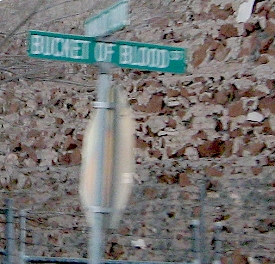
That’s not the kind of name that we could just let go by without some investigation.
Turns out that Terrill’s Cottage Saloon was the scene of one of the most notorious shootings in the old West.
When Grat Dalton of the notorious Dalton Gang shot two players in a card game, everyone said that the floor looked like someone spilled a bucket of blood.
The saloon and the street had a new name.
Unfortunately, after wetting the whistles of parched adventurous western travelers for a century or so, The Bucket has been boarded up.
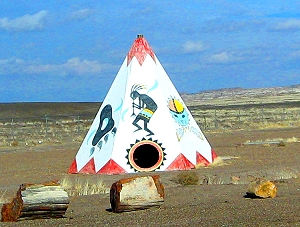
A few miles more and we spotted teepees in the distance.
Out in these parts that could only mean one thing, cheesy crap shop.
Sure enough, guarding the entrance to Petrified Forest National Park stood a classic.
In addition to the cement tents outside, the inside was stuffed with horrible fake headdresses, rubber arrows, polished rocks, Jackalopes, rattlesnake eggs, fools gold and of course, petrified wood.
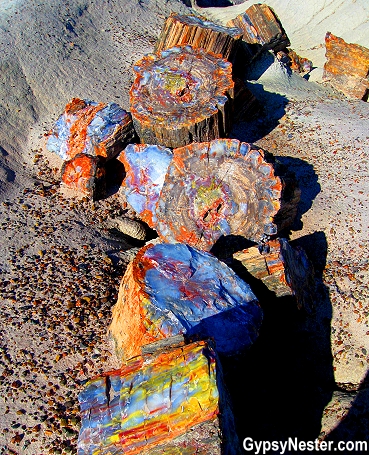
Once inside the park, things took a distinct turn for the more serious.
First, we were warned, multiple times, not to take any samples of the fossilized wood home with us unless we were willing to face a $325.00 fine.
While that may seem harsh, it obviously isn’t a strong enough deterrent, since an estimated twelve tons of petrified wood is stolen from the park every year.
Luckily, the big stuff isn’t going anywhere.
The Petrified Forest is definitely a drive-through park.
A road stretches twenty-seven miles north-to-south through the forest with numerous pullouts and side roads for viewing the sights.
Calling it a forest gave us the wrong impression. The petrified trees are all laying on the ground, left there about 225 million years ago during the Late Triassic period.
When we think forest, we expect large groups of upright trees. We felt kind of dumb.
See more photos and our antics in The Petrified Forest!
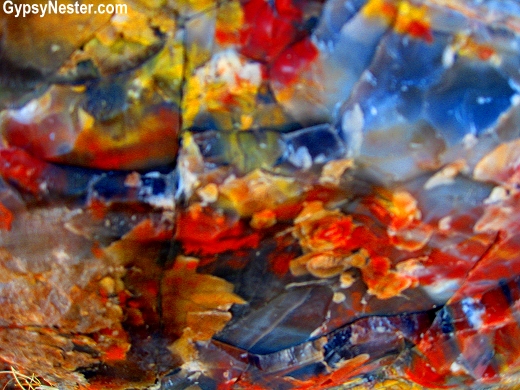
All those million years ago this area was an upright tropical forest.
Fallen trees accumulated in river beds and were buried by volcanic ash.
The silica in the ash dissolved and seeped into the logs, forming beautiful quartz crystals.
Other minerals combined with the silica to create the rainbow of colors in the petrified wood.
Buried for eons, it wasn’t until about sixty million years ago that the Colorado Plateau began to be pushed up, forming mountains and allowing erosion to expose this ancient lumber.
After a quick stop at the visitors center to grab a map and some info, we were ready to explore.
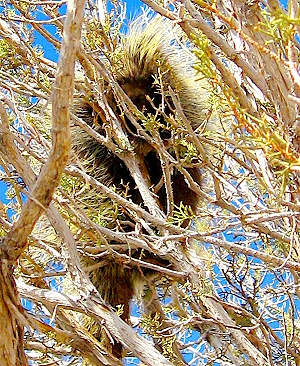
But before we could begin our adventure, the ranger pointed out a couple of porcupines in a tree by the parking lot.
Never having viewed one of the prickly little critters up close, we had to go in for a look.
Two big quill pigs were chowing down on the poor tree and pretty much oblivious to any strangers approaching.
Veronica dubbed them “cute” but I don’t think she’d feel that way if she tried to pet one.
Wildlife encounter completed, we drove up from the south entrance to our first stop, The Crystal Forest.
A walking trail leads through the hundreds of downed ancient trees in this forest, giving us our first up close look at the petrified wood. It’s amazing how the rock has retained the exact look of the trees.
The grain, rings and even the bark are perfectly preserved in stone.
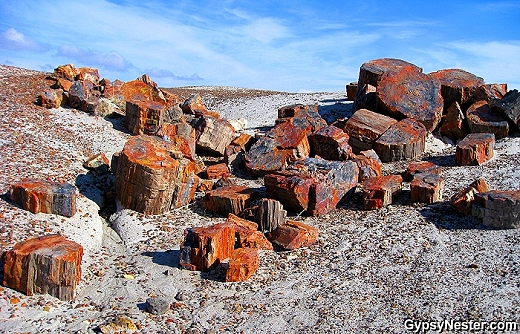
Our next stop was Blue Mesa. From the top of the mesa we got a great view of valleys filled with petrified logs. Many of them have rolled down and gathered in the canyons, while others are still being exposed by erosion that continues today.
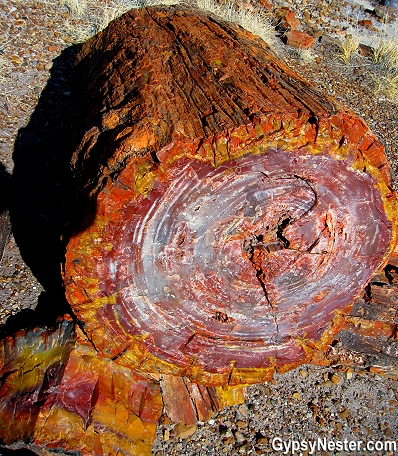
From the mesa, we continued on to Newspaper Rock.
A telescope is required to get a good look at the petroglyphs that give the rock its name.
Symbols and images were etched onto the rock by the original inhabitants of the park as far back as 2000 years ago.
Some of the rocks in this area are covered with “desert varnish,” a thin dark coating of minerals and microorganisms that the native peoples used to tell their stories by scratching pictures into the rock surfaces.
The meanings of most of these writings remain a mystery, but it is speculated that they may have been a part of religious ceremonies, story telling and just plain preserving information. Sounds a lot like what newspapers have always done.
See more photos and our antics in The Petrified Forest!
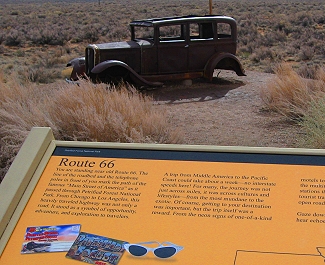
As we continued north, we crossed I-40 and took a quick look at the Route 66 marker.
When the old highway came through here in the twenties, tourists began discovering this unique fossil collection.
Unfortunately, they also began removing a lot of the specimens.
The park was preserved as a national monument by Teddy Roosevelt (who else?) back in 1906, but it wasn’t until the depression that Civilian Conservation Corps workers built infrastructure for the park and began to really protect it, slapping the hands of sticky-fingered tourists.
In 1962, the monument became Petrified Forest National Park.
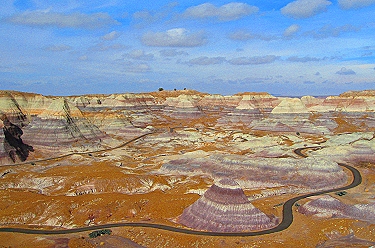
Beyond the new and old highways to the north, The Painted Desert stretches out for breathtaking miles.
This giant stretch of “badlands” is protected as the Petrified Forest National Wilderness Area.
Most of it has no roads and is accessible only by foot. We decided to view it from afar and found incredible panoramic views at several pullouts in this part of the park.
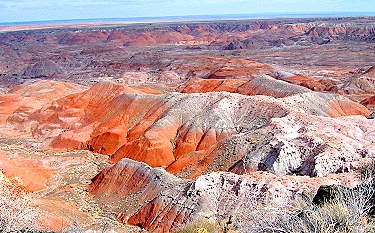
Our timing could not have been better.
The swiftly sinking sun highlighted beautiful Earth tones, reds, browns and orange that are layered in volcanic strata across the mountains.
The same minerals that give the petrified wood so much color, provide the “paint” for the Painted Desert.
Having enjoyed nature’s art exhibit, we were ready to call it another fantastic day. We were pretty sure that we should drive far enough away to spend the night at a safe distance from The Bucket of Blood.
Better to be safe than sorry.
David & Veronica, GypsyNester.com
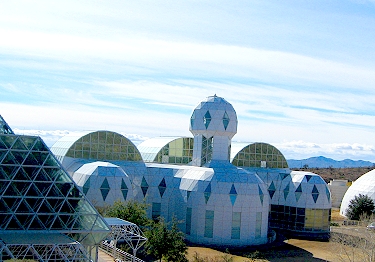 Near the little town of Oracle, Arizona, one of the world’s great experiments took place. When the Biosphere 2 experiment began, it caused such a stir that it became a part of pop culture, even getting a mention on Seinfeld, and nothing says “made it” like a Seinfeld reference.
These jokes… CONTINUE READING >>
Just outside of Tucson, near the little town of Oracle, Arizona, one of the world’s great scientific experiments took place.
When the Biosphere 2 experiment began, it caused such a stir that it became a part of pop culture, even getting a mention on Seinfeld, and nothing says “made it” like a Seinfeld reference.
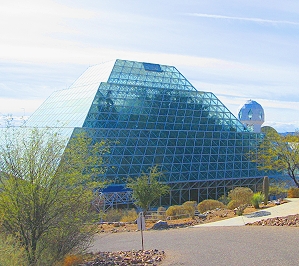
These jokes and news blurbs were all we knew about the Biosphere when we decided to check it out. We had no idea what to expect.
For some reason (we blame Mr. Seinfeld), we had a mental picture of a handful of hippies living underground in some sort of glorified bomb shelter. What we did find was somewhat more sophisticated than that.
As we drove up, it was plain to see that this was no storm cellar. The buildings scream space age, especially against the high desert landscape. We were greeted and led into a room that served as the eating area for the “biospherians” that lived here. This is where our tour would begin.
Our guide gave us the lowdown. He explained Biosphere 2 is so named because Earth is biosphere numero uno, and then went on to the vital statistics.
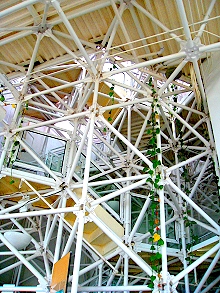
Over seven million square feet of glass covers 3.14 acres of five distinct biomes, creating the largest closed system ever created. Everything is kept in ecological balance by some incredibly high-tech mechanisms.
The original concept was to study the feasibility of space colonization, so this was build as the “tightest” building on Earth. It is even sealed underground with a five hundred ton welded steel liner. The final result is a building that’s even more airtight than the space shuttle.
Before we ventured into the sealed off biomes area, our escort filled us in on the human aspects of the Biosphere experiments. Two separate groups participated in the missions.
The first eight “biospherians” were sealed in for two years starting in 1991. There were a few glitches. It took the crew some time to adjust – mostly to the diet – but in time they gained back their lost weight and ultimately raised almost all of their own food.
Social differences arose and the team split into two factions, but managed to continue their duties. Sounds like it would have made an excellent reality TV show.
Considering the length of time they were confined, we thought anything short of murder should be celebrated as a resounding victory.
Oxygen had to be added to the system twice, due to unforeseen losses from curing concrete and microbes in the soil – not boding well for living in space – but overall the experiment was reasonably successful.
The same could not be said for the second attempt in 1994. A few days after being sealed in, some of the previous mission’s crew sabotaged the experiment by breaking the seal on the Biosphere.
It went downhill from there. Bickering among the personnel, and management differences, were so bad that the scheduled ten month mission was aborted after just five. Still, for those few months, the crew did manage to grow all of their own food, so there was a glimmer of success.
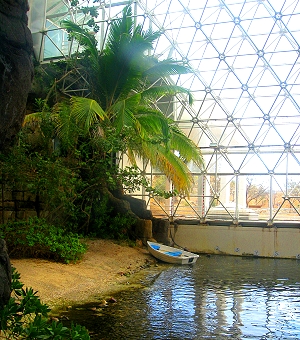
The next year, Columbia University took over the site as a research facility and campus. A few years later the University of Arizona began using the site as a climate change laboratory and is continuing with ongoing research today.
With our heads chocked full of knowledge, we were ready to go in for a look. The tour took us through all five of the distinct biomes inside the sphere, beginning with the mangrove wetlands that led us along the shore of the self contained ocean, complete a with coral reef. At nearly four thousand feet above sea level, this is by far the highest ocean in the world.
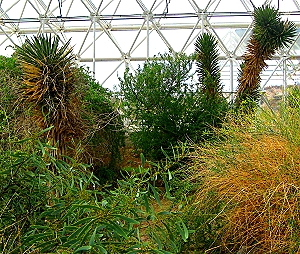
From the seashore, we made our way through the savannah grasslands and the fog desert biomes.
The savannah recreates African grassland while the desert is pretty close to what is going on outside the Biosphere, cacti, Joshua trees and scrub brush, but is really meant to recreate the foggy coastal areas of California and Baja.
In the middle of the desert there are stairs into the bowels of the building, where we got a first hand look at the operating systems known as the “Technosphere.”
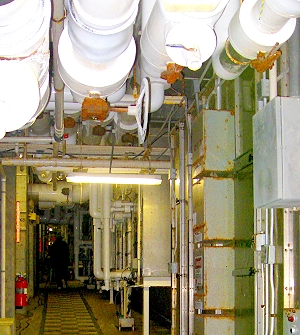
There is a baffling maze of hallways, water pipes and electrical wiring down there. Good thing we had a guide to follow as the place was getting a bit spaceshipy and creepy (think of the movie “Alien” and you’ll get the idea).
He stopped to show us one of the twenty-six “air handlers” which heat and cool the air as well as condense water from it to serve as rain or fog and replenish the ocean. That work is done on Biosphere 1 up in the atmosphere, but in number 2 it is accomplished underground.
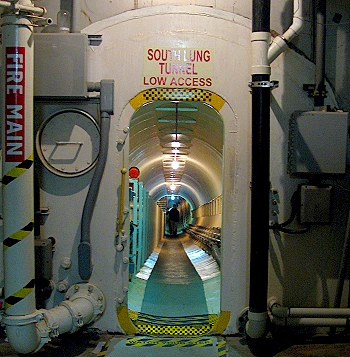
Another vital part of air maintenance for Biosphere 2 are the “lungs.” On a hot Arizona desert day, the air sealed inside the sphere would expand enough to blow the windows out.
Vents would normally allow for pressure equalization but Biosphere 2’s completely airtight system relies on these ingenious lungs.
When it gets warm in the sphere, the gigantic lungs are filled with the expanding air. Once it cools off, the lungs collapse to force the air back into the Biosphere.
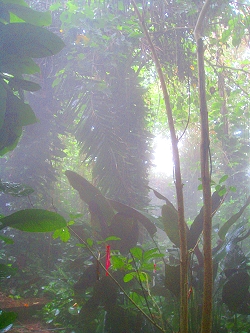
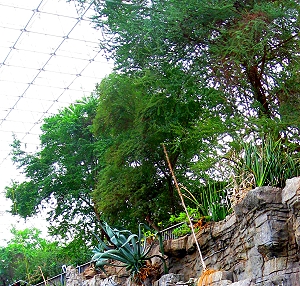
Back above ground, we found ourselves in a tropical rainforest. The biggest of the biomes, there are over 150 different types of plants living here, including several that once provided fruit for the occupants, as in pass me a banana.
With our tour complete, we decided to sneak a peek at some of the offices and labs in the old living quarters. I don’t think we were supposed to be there, but no one was around so we checked out the computer set ups and some of the ongoing experiments.
We were good, we didn’t touch anything. There is still a lot of real research going on, maybe even more than when they first locked those hippies inside. That makes this an even more exciting place to visit.
But two years locked in here? Neither of us were too big on that idea. Can anybody think of seven other people that they’re willing to be sealed in an airtight container with for two years?
We didn’t think so.
David & Veronica, GypsyNester.com
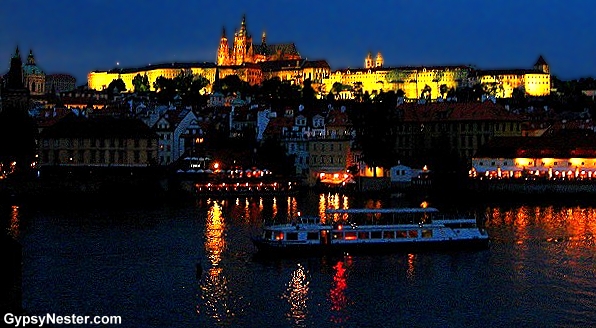
The castle has been the home of Kings of Bohemia, Holy Roman Emperors and presidents of both Czechoslovakia and the Czech Republic since the first fortress was begun here in the year 870… CONTINUE READING >>
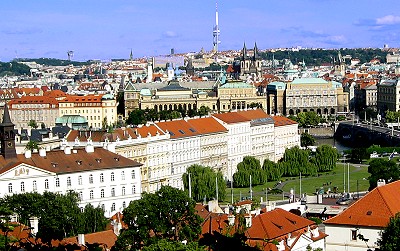
Upon a large hill, across The Vltava, the Prague Castle looms over the city.
The castle has been the home of Kings of Bohemia, Holy Roman Emperors and presidents of both Czechoslovakia and the Czech Republic since the first fortress was begun here in the year 870.
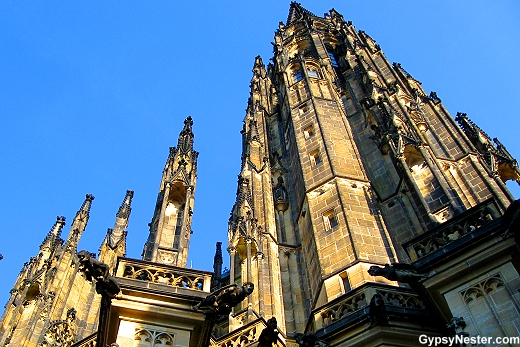
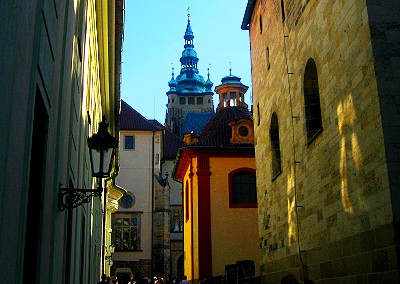
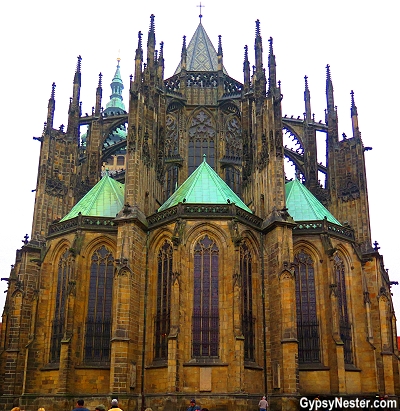
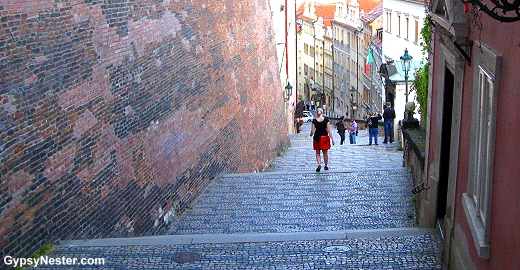
As we topped the hundreds of steps leading up the hill, we entered what The Guiness Book has heralded the largest castle in the world.
Inside, it felt more like a walled city than what we would normally think of as a castle.
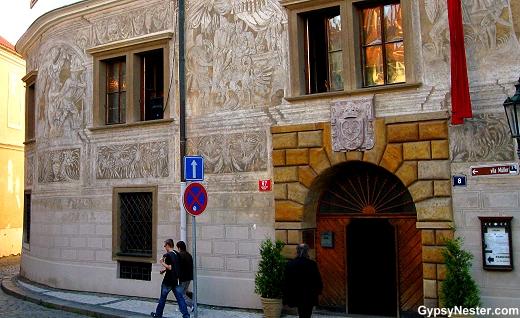
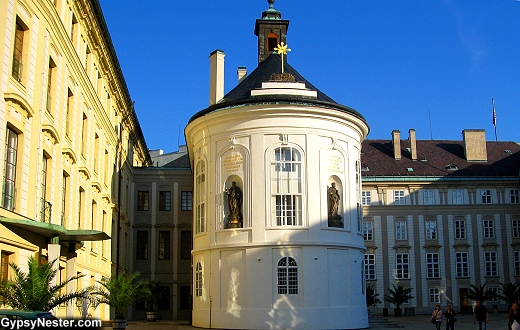
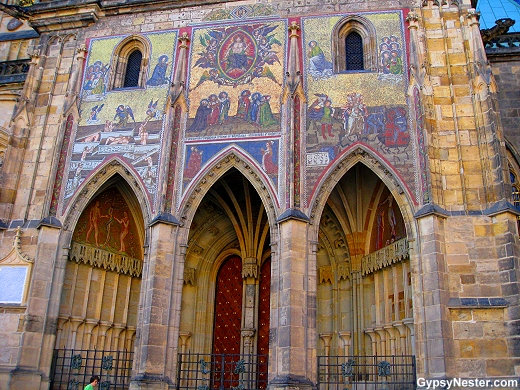
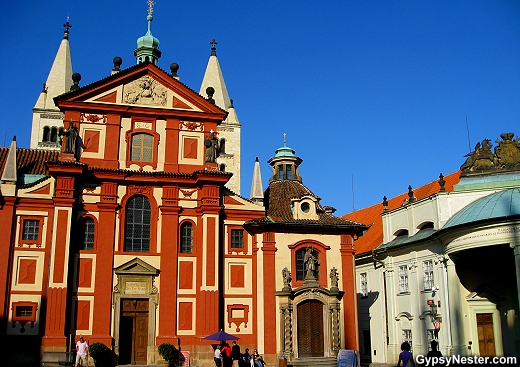
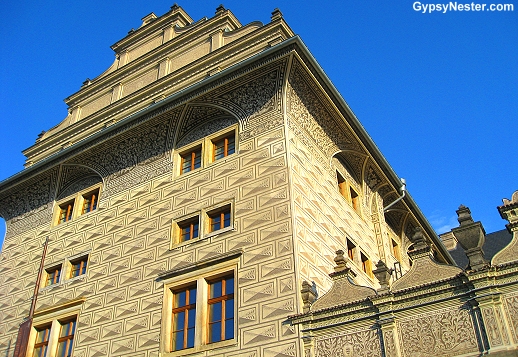
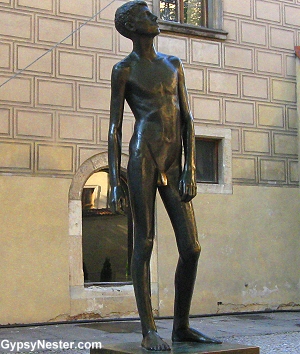
Two huge cathedrals, The Basilica of Saint George and the Basilica of St. Vitus, along with countless palaces and halls are within the ramparts. That made it hard for us to get a feel for being “inside” a castle.
Prague Castle remains the seat of government for the Czech Republic and there is a noticeable military and security presence.
Decked out in full-dress finest, the soldiers add to the overall fantasy-land feel of the place. We stumbled upon a military band, in full dress, welcoming dignitaries as we made our way out through the west gate.
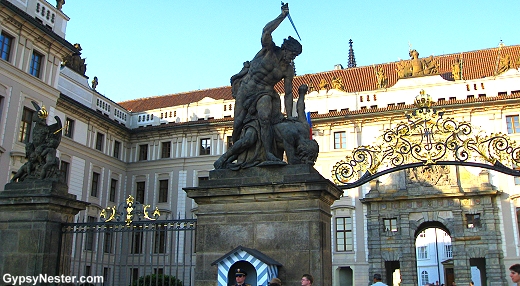
While the band played, the changing of the guards was enacted with much pomp and circumstance.
Pretending it was all for us, we mingled with the dignitaries and parade waved to the curious gathering before heading down another giant staircase.
David & Veronica, GypsyNester.com
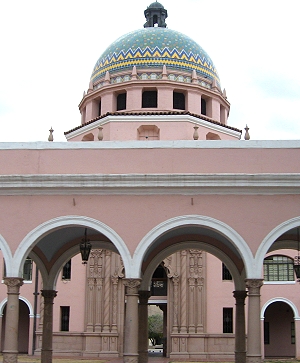 There seemed to be a crossroads to our Arizona fun, Tucson. We kept passing through on our way from one place to another, so we decided to stop and check it out.
We started our excursion at the Garden of Gethsemane. This odd collection is the work of Felix Lucero and some divine inspiration. Wounded in World War I, Felix thought he was dying and he called on The Virgin Mary to make a deal. If she would save his life, he would dedicate it to creating Christian art. Mary held up her end and so did Mr. Lucero.
Times were… CONTINUE READING >>
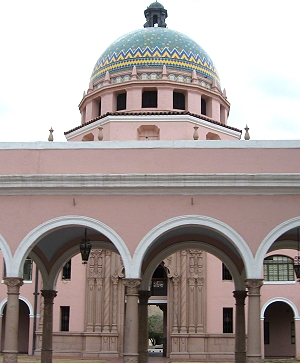
There seemed to be a crossroads to our Arizona fun, Tucson. We kept passing through on our way from one place to another, so we decided to stop and check it out.
Back in 1692 Jesuit missionary Eusebio Francisco Kino explored this area, and a few years later founded a mission near what became Tucson.
Soon after, the Spanish built a walled fortress, Presidio San Agustín del Tucsón, and the town was on its way.
Even though growth was slow out here in the arid boonies, Tucson became the largest settlement in Arizona. The territory changed hands between Spain, Mexico, The U.S. and even The Confederacy before becoming a state. But when Phoenix was named the capital, it quickly outgrew Tucson.
Several factors kept the town growing, most notably the establishment of the University of Arizona and then the Veterans Administration hospital, originally made for World War I gas victims to recover in the clean, dry air.
The fresh air and that famous “dry heat” have continued to keep both Phoenix and Tucson among America’s fastest growing cities.
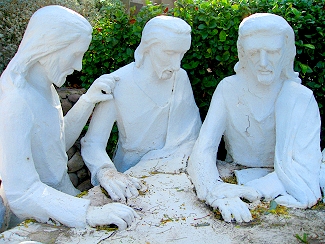
We started our excursion at the Garden of Gethsemane. This odd collection is the work of Felix Lucero and some divine inspiration. Wounded in World War I, Felix thought he was dying and he called on The Virgin Mary to make a deal.
If she would save his life, he would dedicate it to creating Christian art. Mary held up her end and so did Mr. Lucero.
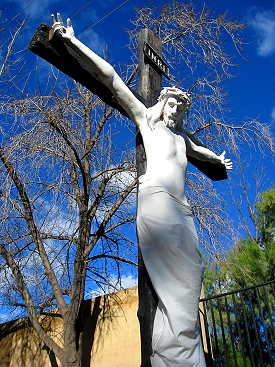
Times were tough in 1938 and Mr. Lucero found himself living under Tucson’s Congress Street Bridge, but he nevertheless decided that this was the place to hold up his end of the bargain with The Mother of God.
He started sculpting, using damp sand and debris from the Santa Cruz river. Over time Felix created his masterpieces, including a life sized crucifix and last supper.
It really is quite impressive.
The works have suffered over the years, since they were not made of the finest materials. But they have been restored several times and are now displayed in this lovely little park.
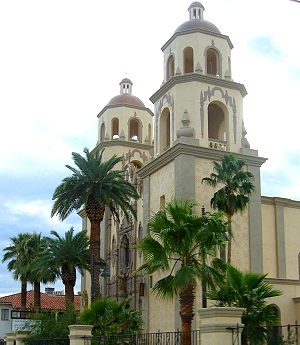
Across the river is the oldest part of Tucson and we figured that warranted a look. The historic district around the Presidio is home to some of the city’s finest examples of the adobes from days gone by.
The Cathedral of Saint Augustine shares this neighborhood with them as it has in one version or another for nearly three centuries. The latest incarnation, in a “Mexican baroque” style should stand for centuries because if it ain’t baroque, don’t fix it. Ba-da-ching!
Further into the heart of the city we found The 4th Avenue Shopping District, which basically everyone we talked to told us not to miss.
The area around Fourth Avenue was originally known as Barrio Tiburón and was once Tucson’s red light district. We found an artsy shopping strip, not a red light in sight, other than for traffic control.
We parked and walked along 4th between 9th Street and University Boulevard to take it all in before deciding which spots to hit.
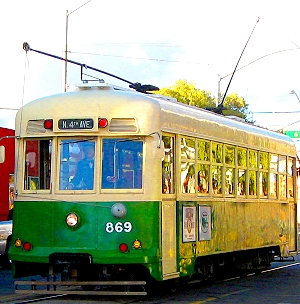
Several things grabbed our attention. It was impossible not to notice the clanging antique trolleys as they rumbled down the avenue.
We followed the tracks to an old garage just off 4th that houses the Old Pueblo Trolley Museum. The idea is for the museum to be an operating transit method and it is working. The restored old street cars run to the University on weekends, with a Sunday special of rides for just a quarter.
Tucson has a long trolley history, dating back to 1906 when the first electric street cars began to run here. Unfortunately, these aren’t those original cars, but ones of the same type that the museum has bought from all over the world to restore and put back into service.
We both agreed that they add to the overall groovyness of the district.
Back on Fourth Avenue catchy signs are the order of the day, but we were getting a little hungry so one “had to check out” sign really caught our eyes, Solar Pizza. That’s right, pizza cooked by solar power at the Brooklyn Pizza Company. Tucson is a very “green” city, so this doesn’t seem out of place at all.
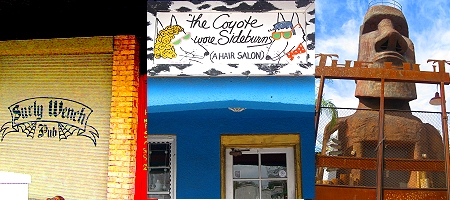
We had visions of an old science fair tin foil oven barely warming up some unlucky pile of dough and cheese, but the pie was quite good. It is not cooked in a solar oven, the electric ovens run on solar power.
Nearly 25,000 kilowatts of solar power per year generated by panels on the pizza parlor’s roof. This saves about 25,000 pounds of coal and 12,000 gallons of water per year. Now that’s pretty groovy, too.
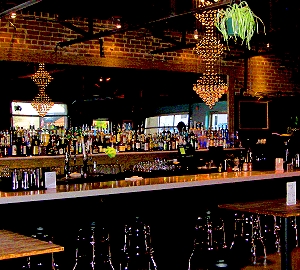
With our bellies filled, we dropped in next door at the Sky Bar. In the dry, clean air of the desert the stars are amazing. So much so, that even in the middle of a big city like Tucson, great views are obtainable on a telescope.
That’s what the Sky Bar is all about.
Inside, astronomy programs and deep space images from Sky Bar’s own telescopes are displayed on large screens. Outside on the patio, local astronomy buffs set up telescopes for live viewing of celestial objects.
While we waited for it to get dark enough for viewing, we grabbed a seat and a beer and caught a set from one of Tucson’s troubadours. Behind the stage, galaxies, nebulae and star clusters floated by. Before we knew it, it was viewing time.
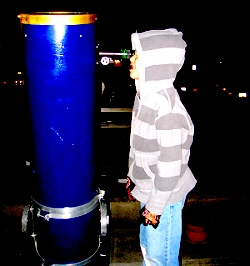
A six foot reflecting telescope was set up in a fenced in courtyard, not twenty feet from Fourth Avenue. Big polished mirrors inside the scope magnify the distant objects hundreds of times.
We waited for our turn at the eyepiece and in spite of streetlights and headlights, we got great views of The Moon and Jupiter.
Back inside we found that the coolest aspect of the viewing was the conversations about space, life, creation and our place in the universe that it sparked. Groovy. We went back out for another look.
The next day was the kind that draws the snowbirds to Arizona, warm, sunny and dry. The sort of mid-winter day that we could spend by a pool somewhere, but we had a different idea.
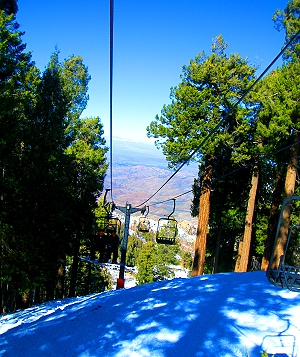
Skiing, not water, but snow. How could we do that on an eighty degree desert day? By driving the short stretch up Mount Lemmon to America’s southern most ski area, Ski Valley.
High enough in the Santa Catalina Mountains that it gets several feet of snow each year, the ski area opens whenever conditions are right. Fortunately a big storm had just dumped about three feet of the white stuff a few days ago.
So much that the road up the mountain had been closed for a while and this was the first day that skiers could get to the fresh trails. It was packed. But packed for Mt. Lemmon is not like most ski areas, it just means a few hundred folks showed up.
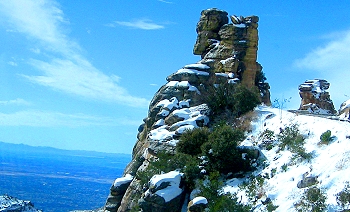
The drive up the mountain is gorgeous, going from hot arid desert to alpine winter wonderland in less than an hour. At the top, the views are spectacular, stretching out hundreds of miles.
Veronica could hardly wait to revisit her fear conquered skiing prowess but fate threw her a curve ball. At 9,000 feet above sea level, it can be a little tough to breath.
Never having done too well with high altitude, before she could finish her first run down the bunny slope she was dizzy and seeing stars. This time without a telescope. She decided that being a snow bunny with a toddy by the fire at the Iron Door lodge might be a good idea for her.
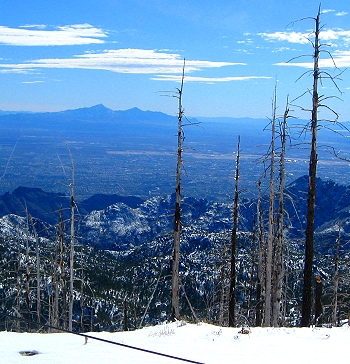
David, who grew up at over 8,000 feet high, didn’t seem to notice the altitude and took a run down the slopes.
It’s a small area, just one main lift and a half dozen runs, so he had covered the mountain in time to join Veronica back at the lodge for a late lunch.
The Iron Door takes its name from a legend that buried gold hidden by the seventeenth century Jesuit missionaries in an underground vault behind an iron door is somewhere in this vicinity. The treasure hasn’t been found yet, but we did find some pretty good soup.
David took one more schuss down the slopes before we headed back down the mountain and back into summer-like climate. It was like passing through all of the seasons in one day.
Now that’s groovy.
David & Veronica, GypsyNester.com
enlarge video
So Cute! Sonoran Desert Squirrel chows… CONTINUE READING >>
So Cute! Sonoran Desert Squirrel chows down!
For more on his habitat, see: https://www.gypsynester.com/ir.htm
Visit our GypsyNester YouTube Channel!