Back in 1941, on KFFA, King Biscuit Time, named for the sponsor King Biscuit Flour, began its run and has since become the radio show with the largest number of broadcasts ever. Everyday at 12:15, to coincide with worker’s lunch breaks, The Blues is still sent out across The Delta… CONTINUE READING >>
But the explanation did give us a good destination for our final stop on our Blues Trail tour. Helena has played a huge role in the history of The Blues, as a town where many of the musicians came to play, but mostly as the place where Blues found a home on the radio. (click here to see our full story on the Mississippi Blues Trail!)
Back in 1941, on KFFA, King Biscuit Time, named for the sponsor King Biscuit Flour, began its run and has since become the radio show with the largest number of broadcasts ever. Everyday at 12:15, to coincide with worker’s lunch breaks, The Blues is still sent out across The Delta.
At first this was the only station anywhere playing live Blues, with Sonny Boy Williamson and Robert Lockwood, Jr. performing in the studio, and what was known at the time as race records, but the show’s popularity inspired other stations to follow.
These days the show is broadcast from a studio in The Delta Cultural Center, so that the public can come in and watch. We made sure to be there a few minutes early and when we arrived “Sunshine” Sonny Payne was already behind the mic getting ready, just as he has done for over sixty years.
He was more than cordial and happy to greet us and answered questions from all of the visitors. Then with the signature phrase “pass the biscuits, ’cause its King Biscuit Time!” the 16,405th show was underway.
Figuring there was no way we were going to top that as a finale to our Blues Trail tour, we knew it was time to head even farther down south to dodge the cold up north.
Juke joints were extremely influential in the spreading of blues music and used to be everywhere across The Delta. With the rise of recorded music, the jukebox became the entertainment of choice… CONTINUE READING >>
That night we were in luck, one of, if not the last rural Juke Joint still going happened to be open. About twenty miles outside of Clarksdale, literally sitting on the edge of a cotton field, Po’ Monkey’s is only open Thursday nights. (click here to see our full story on the Mississippi Blues Trail!)
Juke joints were extremely influential in the spreading of blues music and used to be everywhere across The Delta. With the rise of recorded music, the jukebox became the entertainment of choice, and joints sprung up for nearby folks to hear the latest songs, have a few drinks, and dance the night away.
Willie Seaberry, known to one and all as Po’ Monkey, met us at the door and, since we were early enough to beat the crowd, gave us the lowdown on the joint.
Back in the early sixties, when Po’ Monkey was still a teenager, he turned his house, an old sharecropper’s shack, into a juke joint. Not much has changed since then, other than the myriad of stuffed monkeys people have stapled to the walls and ceiling and a DJ serving up tunes instead of a box.
When we asked the inevitable question, “Why do they call you Po’ Monkey?” He said they always had, since he was a kid, then grinned and added, “Look at this face!” After chatting, we shot a few games of pool, quaffed a couple cold ones and soaked up the R&B soundtracked ambiance before heading back to our own sharecropper shack.
The idea here is to show the progression of The Blues and how it gave birth to so much of our current music. This is accomplished by using a most amazing collection of records and memorabilia laid out as… CONTINUE READING >>
Bellies filled, we were ready to take on Clarksdale. Home to Sam Cooke, Ike Turner, The Delta Blues Museum, The Riverside Hotel, The Ground Zero Blues Club, and one of the funkiest dives anywhere, Red’s Lounge. (click here to see our full story on the Mississippi Blues Trail!)
But of all of the attractions we took in, The Rock & Blues Museum was our favorite. The idea here is to show the progression of The Blues and how it gave birth to so much of our current music. This is accomplished by using a most amazing collection of records and memorabilia laid out as a timeline.
From some of the earliest 78s ever made, to almost every classic from any baby boomer’s teenaged 45 and LP collection, to disco and then modern pop, this place is a trip down memory lane that anyone who’s ever owned a good old vinyl record can get lost in. Curator Theo Dasbach, who collected most of this himself, gave us an in-depth overview. But seriously, we can’t even begin to list the treasures displayed here, it would take page after page and we’d still leave something huge out.
A homemade Diddly Bow.
“Crazy Blues” by Mamie Smith was the first Blues record. It was recorded on August 10, 1920.
We love concert contract riders. Here’s one of Muddy Waters’.
The Rolling Stones were greatly influenced by the Blues, their first record covered a Willy Dixon song that was originally performed by Muddy Waters.
As was Eric Clapton. Here his band Cream covered Robert Johnson.
The Sacred Valley was formed by the Urubamba River and has a wealth of both natural and agricultural resources.
This, and the proximity to the Inca capital of Cusco, made the region the heart of The Inca Empire and the path to Machu Picchu.
Discover the best of The Sacred Valley with us – as we get photobombed by llamas, visit a weaving cooperative, walk the mysterious Ollantaytambo ruins, drink stuff we’d never dreamed we’d drink and, of course, David the Train Nut grins through an amazing rail adventure… CONTINUE READING >>
The Sacred Valley was formed by the Urubamba River, which is part of the headwaters of the Amazon, and has a wealth of both natural and agricultural resources. This, and the proximity to the Inca capital of Cusco, made the region the heart of The Inca Empire and the path to Machu Pichhu.
Take the Scary (and insanely beautiful) Flight into Cusco, Peru
Flying into Cusco, you don’t have to descend very far from your cruising altitude. Just make an insane hairpin turn between mountains and land at one of the world’s highest commercial airports, over 11,000 feet up in the Peruvian Andes.
In the small town of Chincheros, get a first hand look at every step in the weaving process of the people of the Sacred Valley of the Incas.
Learn about what goes into the dyes that create the brilliant colors (absolutely amazing and a “wee” bit off-putting!), the ingenious way the yarn is spun, and how the patterns are crafted. More on this weaving cooperative…
Learn How to (and how NOT to) to Deal with the Altitude
The locals swear by the leaves of the coca plant, the plant that produces cocaine, as an antidote to the thin air. Tea is made from the leaves and is easy to find. Other ways to get your fix is through candy or simply chewing the leaves themselves. For those hesitant to try the coca, we have more suggestions on how to cope (and NOT to cope) with the altitude.
Be on the Lookout for Shrines
On the roofs of most of the houses in the Sacred Valley are small shrines that include a cross indicating the family is Christian, ceramic bulls for strength and fertility, a cask of corn beer to tie them to their ancestors, and a vial of holy water to sanctify the house. (This shrine was in the town of Chincheros)
Explore Mysteries of the Enormous Ollantaytambo Ruins
One of the many mysteries of Ollantaytambo is how the massive rocks were hauled up the mountain without the use of wheels. It is also unknown how the stones were cut, because no metal hard enough to cut granite was available at that time. Since the Quechua language was not written, and the Spanish destroyed most evidence of methods used in construction, we may never know the answers. More Ollanyaytambo…
Drink Inca Cola
This popular, overly sweet, yellow beverage turned out not to be our cup of tea. BUT it’s a must for any adventurous visitor!
Ride the Train to Machu Picchu
PeruRail operates several trains a day to the town of Aguas Calientes, below Machu Picchu, along track originally laid in 1928. It’s the second highest railroad in the world, after the Qinghai–Tibet Railway. The narrow gauge ride down the Urubamba River showcases spectacular Andes mountain scenery and, with several events onboard, PeruRail turns the journey into an adventure on its own! More on the train to Machu Picchu…
Discover The Lost City of The Inca, Machu Picchu
Machu Picchu is not really the name for the city – that name is lost forever. When Hiram Bingham arrived in 1911, the locals told him of the ruins between Machu Picchu (old mountain) and Huayna Picchu (young mountain). When Bingham told the world of his “discovery,” (how does one discover something that lots of people already knew about?) the name stuck. More on Machu Picchu…
Get Photobombed by a Llama!
These cousins of the camel pretty much have the run of Machu Picchu. The nimble buggers are everywhere, hiking side-by-side with visitors, stubbornly blocking paths and standing around looking pensive.More on the pensive llamas of Machu Picchu…
Row after row of hundreds of columns hold up arches and domes this stunning work of architecture that was never meant to be seen.
Descend into the Basilica Cistern with us to see the upside-down Medusa and other hidden oddities… CONTINUE READING >>
Several hundred ancient cisterns lie beneath Istanbul, but The Basilica Cistern is the largest, and the only one we knew how to get inside.
Descending into the damp darkness felt pretty darn good on a hot August Mediterranean day and, once our eyes adjusted, we were dumbfounded by the sight.
The cistern was built during the reign of Emperor Justinianus in the sixth century, in the heyday of the Eastern Roman Empire.
Larger than a football field, there are three hundred and thirty-six surprisingly ornate marble columns in a strange mishmash of styles.
The huge space was built as a water storage facility which was used by the city for around fifteen hundred years.
Situated below the Stoa Basilica in Byzantine times, its twelve-feet thick walls of waterproof brick and mortar held water transported from the Belgrad Forest some twelve miles away.
Row after row of hundreds of columns hold up arches and domes in a stunning work of architecture that was never meant to be seen.
Those zany Romans hid all of this work under twenty-one million gallons of water.
The relatively small amount of water remaining in the cistern lends itself to some fun reflection photography.
For unknown reasons, they also chose to hide oddly-angled sculpted heads of Medusa at the base of two pillars in one of the corners.
In order to keep bad omens away, statues of Medusa were common in the late Roman period. Normally, they were found in buildings and homes of importance — not buried in cisterns — leading to the theory that the heads were brought in from elsewhere.
Research shows that the heads were set sideways and upside-down intentionally, but the the reason remains a mystery.
You’ve heard the word picturesque, right? Trust us, this is not a word we throw around lightly – it’s a bit fancy-schmancy for everyday use.
BUT there can be no other word to describe Prince Edward Island. Pretty and quaint, it’s as if you’ve wandered into a painted picture.
Join us as we explore this beautiful island, learn about her people, her seafood, her farms, and her famous bridge. Find out why PEI is called The Cradle of the Canadian Confederacy and how foxes built mansions… CONTINUE READING >>
You’ve heard the word picturesque, right? Trust us, this is not a word we throw around lightly – it’s a bit fancy-schmancy for everyday use.
BUT there can be no other word to describe Prince Edward Island. Pretty and quaint, it’s as if you’ve wandered into a painted picture.
We were pretty jazzed at the prospect of having PEI as our home base for exploration of The Canadian Maritime Provinces. Having just spent the better part of a month crisscrossing Newfoundland, we loved the idea of spending some more time on one of Canada’s Atlantic Islands.
We arrived late in the day, so heading off to explore the rest of the island would have to wait.
But we were excited to see our new surroundings, so we took a short walk over The Stanley Bridge to the tiny harbor in the picturesque fishing village of the same name.
On the bridge we were surprised by what looked to be the most popular way to while away a Sunday afternoon, jumping off the bridge.
Fearless kids from about eight to eighteen were excitedly checking for boat traffic, and then leaping into the water about twenty feet below.
Fun to watch but we weren’t about to join in, the possibility of a horrifying belly flop was just too high… as was the bridge.
French River
Over the following days we learned that nearly all of the island’s little coastal towns are postcard worthy. Perhaps none more so than French River, which claims to be the most photographed scene on the island.
New London Bay Lighthouse
Obviously fishing is a huge part of life on PEI. Perhaps we should clarify, not just fish that swim, but all types of seafood have long been crucial to the islander’s existence.
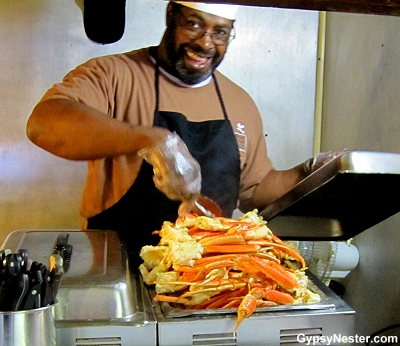
Crab fishermen unload their catch in Victoria-by-the-sea.
Hands down our favorite of those is lobster, and we got to see first hand every detail involved in the catching, processing, and shipping of them at the L & C Fisheries.
Loretta Jollimore, who puts the L in L & C, showed us every step of the lobster operation, from how the traps work, to determining the sex, to separating the smaller “canners” (under a pound) from the larger “markets,” to shipping them out around the world either live or steamed.
WATCH: Loretta shows us how a lobster trap works and explains the difference between the boys and the girls!
With millions of pounds of lobster landed each year, along with tons of mussels, oysters, and other delicacies, seafood has historically sustained life on the island. But agriculture is equally as important to the economy.
Prince Edward Island sits just eight miles off the mainland in the Gulf of St. Lawrence. Her green rolling hills – lush with fields of crops and berries – have also earned PEI the moniker of Garden of the Gulf.
Some of PEI’s offerings, Beach Chair Lager and Gahan Blueberry Ale.
Even though it is the smallest Canadian province by far, both in size and population, more than a quarter of all the potatoes grown in the country come from the island. PEI is famous for them, and from our sampling of them, rightly so.
Dairy, beef, pork, grain, and vegetables are common on the farms too.
David milks a “cow” at Green Gables National Historic Site.Anne’s bedroom, note the dress with the puffy sleeves!
Food and pastoral scenery are not the island’s only claims to fame, PEI was also home to Lucy Maud Montgomery, author of the iconic series of stories about Anne of Green Gables.
We stopped by Ms. Montgomery’s home and then the area of Prince Edward Island National Park where Parks Canada has restored and preserved the farm that inspired the books.
We stopped in for a Céilidh (pronounced Key-lee) in the town of Kensington. Stories and music keep the Scottish and Irish heritages of Prince Edward Island alive.Veronica attempts to model a fox stole, but is quite creeped out because the head is still on it!Fortunes were made as pelts and breeding pairs were sold for higher and higher prices, until war provided the pin to pop the bubble.
In Summerside, we learned about the turn-of-the-century fox business, a storied page in PEI’s history. When a viable way was discovered to breed silver foxes in captivity, a fur boom began.
A fox house in Summerside.
The prosperity gave rise to the term “fox house.”
This does not refer to a place where little furry fellahs lived, but the mansions that their owners built with the new found wealth.
Heritage Roads – paths free from asphalt covering the red clay – are scattered about the island.The Acadian Monument at Port-la-Joye.
While visiting Charlottetown, the provincial capital and largest city, we learned of the significant role Prince Edward Island played in the history of North America.
Certainly the tiny band of Acadians at the original French settlement of Port-la-Joye back in 1720 could never have imagined the future the island they named Île Saint-Jean would play in world affairs.
The British had their eyes on the continent as well, and attacked the French in 1745. The Brits were driven out the next year, but took the island for good in 1758.
Province House in Charlottetown
Following the victory General Jeffery Amherst ordered a second expulsion of the Acadians. Soon after, the island was renamed in honor of the fourth son of King George III, Prince Edward Augustus, the Duke of Kent, and the area around Port-la-Joye became Charlottetown.
The very room in Province House that hosted the Charlottetown Conference
History was far from finished with Charlottetown, as the city was destined to be known as The Cradle of The Confederation.
Back in 1864 the town hosted the Charlottetown Conference. This was the first meeting of representatives from the British North American colonies that didn’t participate in The American Revolution to discuss forming the new union that would become Canada.
The chamber where governmental duties are still performed. Hanging on a wall nearby is a painting of the ball that commemorated the signing of the confederation – same room!
In an ironic quirk, Prince Edward Island ended up declining to join the new country until several years later, in 1873.
In spite of that delay, the island fully embraces its role in the formation of Canada – even naming the bridge that connects it to the mainland The Confederation Bridge. The idea of a bridge had been bandied about for nearly 150 years, but didn’t become a reality until 1997.
During our exploration of The Maritimes we crossed the eight mile span three times, but only paid the toll twice. Wait, three trips would have left us still on the island, and no, we didn’t ever crash through a toll gate.
Before the bridge was built several ferries served the island – now only one is left – and that was how we made one of our crossings of the Northumberland Strait.
Returning to the island by ferry.
We only paid twice because tolls are charged only when leaving the island, even on the ferry. As scenic and serene as this prince of an island is, it seems like the payment method should have been the other way around.