
Our first ever excursion to Asia also involved our first time crossing the international date line, so when our sixteen-hour nonstop flight from Chicago to Hong Kong landed, we felt more than a little confused.
We had chased the sun around the globe, making for a full twenty-four hours of uninterrupted daylight, and not only were clueless as to the time of day, we didn’t even know what day it was.
We think it was tomorrow.
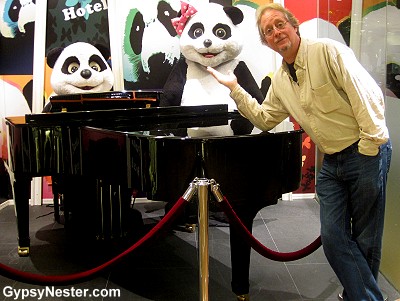
Lucky for us the Panda Hotel is one of the largest hotels in Hong Kong, so we easily found a bus that took us right to the front door, and the staff knew just what to do with a couple of seriously jet lagged GypsyNesters… put them in a room, stat.
Perfect, that way we could wake up in the morning and hit the ground running.
So would that be the day after tomorrow?
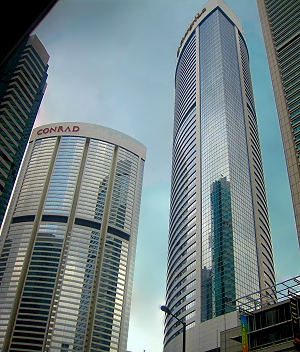
Exploring Hong Kong in Transit (really cool transit!)
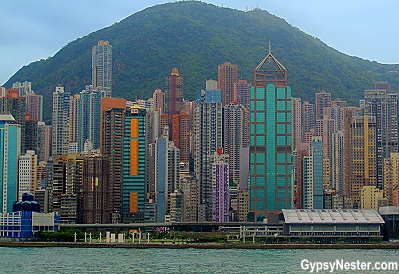
In the light of day, we were fully awakened by the towering height of the city.
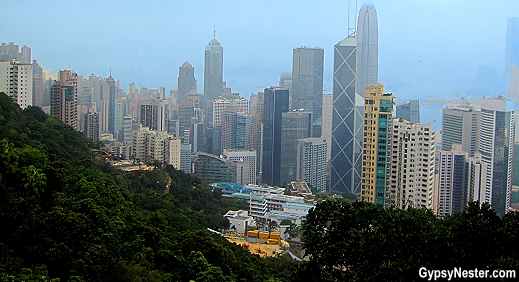
Hong Kong is the world’s most vertical city, with two hundred and ninety-three buildings higher than five hundred feet – sixty more than second-place New York City.
It is also the fourth most densely populated area on Earth, just behind Macau, — which is right across the bay — Monaco, and Singapore.
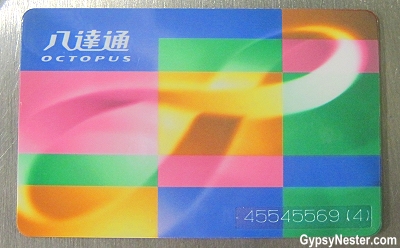
By all accounts, the best place to gaze upon all those skyscrapers and people is from the top of Victoria Peak.
For us that meant getting across the harbor to Hong Kong Island and then up the mountain. Great, that would give us a chance to experience three of Hong Kong’s transportation legends, the Star Ferry, the ding dings, and the Peak Tram Funicular. All three have been meeting the needs of the city for over one hundred years.
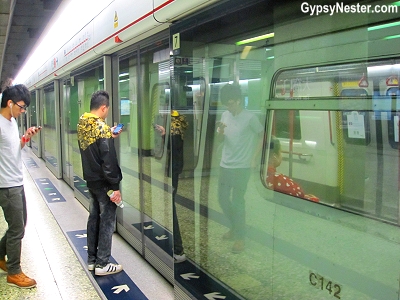
Mass transit is huge in Hong Kong, in addition to those three classic modes there is an extensive system of rail, subway and bus routes that combined carry eleven million people daily.
That’s ninety percent of all the city’s travels, which is the highest such percentage anywhere.
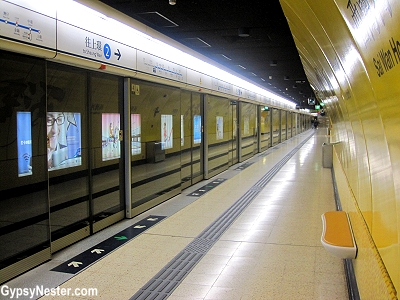
We began our public transport trek by hopping on the metro, a thoroughly modern subway system that we could have taken us all the way across the bay.
But going under the bay would have been a colossally dumb idea. We would have missed out on what travel writers have voted one of the ten most exciting ferry rides in the world, the Star Ferry across Victoria Harbor. We opted to disembark near the pier on the Kowloon side.
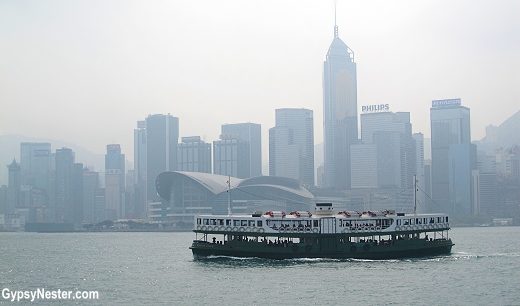
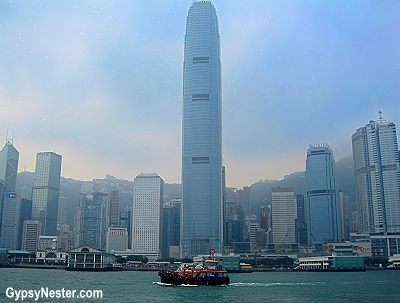
For a just over two Hong Kong dollars — that’s pocket change, about thirty cents U.S. — we climbed aboard the vintage 1965 Silver Star and enjoyed one of the most spectacular urban views on the planet.
No wonder the line’s dozen classic old boats carry up to twenty-six million passengers each year.
Getting Our Ding Ding On
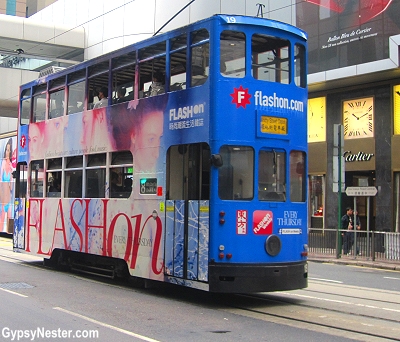
Once we were on the island, a short walk took us to the tram line.
The trolleys are affectionately known as “ding dings” for the bells they seem to be constantly ringing.
A whole fleet of double decker street cars rolls endlessly back and forth along the north shore of Hong Kong Island, which is the most bustling part of the city.
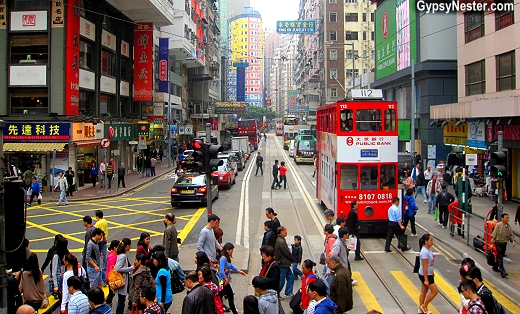
Because the fare for these wonderful old trolleys is also a mere pittance, we jumped on and off several times, whenever something caught our eye.
If You Don’t Have Your Health…
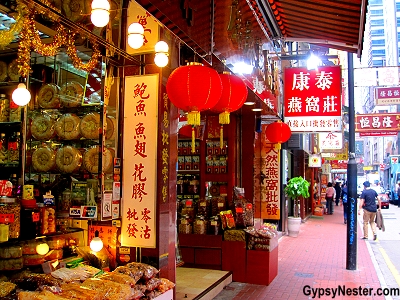
Toward the western end of the line, we bailed out at Queen Street.
This area is famous for ancient Chinese medicines, traditional herbal remedies, and tonic foods such as ginseng and bird’s nest.
These are real nests, taken from swiftlets, and can cost up to $5,000 a pound. Needless to say, we did not make a purchase.
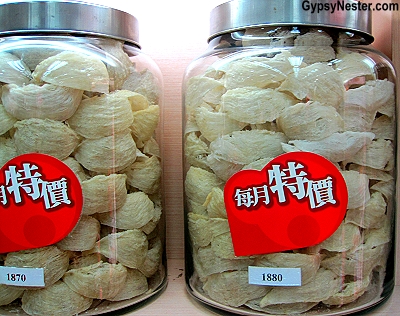
We wandered up and down Wing Lok and Ko Shing Streets looking into shop after shop filled with strange and exotic items that are believed to promote health, vigor, and long life.
With life expectancies in Hong Kong among the highest in the world, who are we to argue?
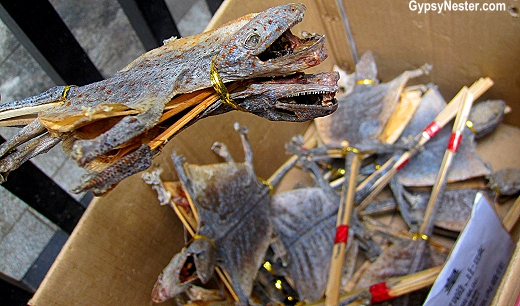
Close by is Des Voeux Road, known as Dried Seafood Street. We were amazed by the offerings, truly works of art, every one.
See more about the Tonic Food Street and Dried Seafood Street area and the extraordinary wares!
Climbing Our Way to the Top
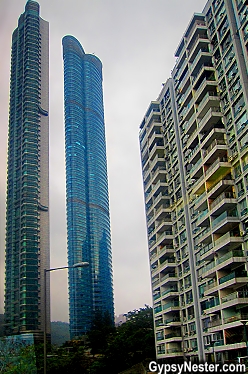
How do they do that?
We still had one more stop planned for the day and luckily we were near the terminal for the the tram that goes to the top of Victoria Peak.
Back in 1888 the tram began carrying passengers up to the exclusive residences on the mountain. The rich and famous lived up there to escape the heat of the city below, and the area is still home to many of Hong Kong’s high rollers, but more tourists than home owners ride this old funicular these days.
Unfortunately we had dilly-dallied around to the point where we were running out of time and decided to forego the lines at the tram and caught a bus up the mountain. The steep, narrow road with multiple switchbacks made this the second craziest bus ride of our lives, but the views along the way were well worth any anxiety.
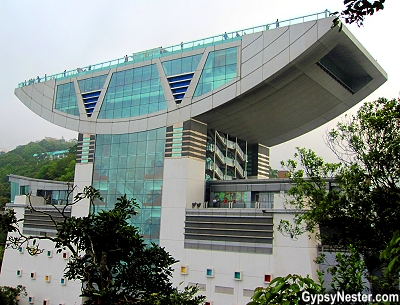
At the top we briefly checked out the Peak Tower and Peak Galleria, before taking a little stroll along the Peak Circle Walk.
We think that this trail offered the best views of the incredible cityscape below.
Ready for a rest, we snagged a table on the terrace at the Peak Lookout restaurant. It turned out to be one expensive afternoon snack, but as the old saying goes, location, location, location.
A Symphony of Lights
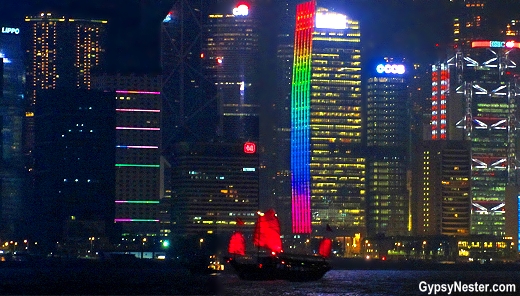
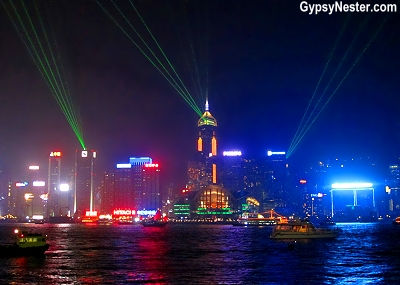
After working our way down and finding our way back across the bay, we set out to stake out a prime waterfront spot for viewing A Symphony of Lights.
Every night the skyline on both sides of the harbor comes alive in a spectacular musical laser light show that the Guinness Book of World Records has proclaimed the world’s largest permanent light and sound show.
It was quite an eye and earful but, with darkness upon us, that dazed-and-confused feeling of what day is it? was returning with a vengeance. All we could think about was shutting our eyes.
Plus we had big plans for the next day, really big, as in Big Buddha.
Who’s Your Buddha?

Bright and early we took a train to Lantau Island where we were supposed to catch an aerial tram up Muyu Mountain.
But our tram luck was not with us once again — it was closed for repairs — and busses were supplying transportation up the hill to The Tian Tan Buddha and Po Lin Monastery.
With one look there was no doubt as to why the nickname Big Buddha has stuck, he’s huge, well over one hundred feet tall. We also got our first look inside a Buddhist temple as we explored the monastery.
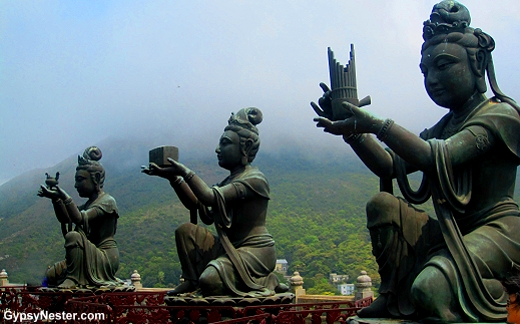
Jumbo + Floating + Hong Kong = GypsyNester Heaven
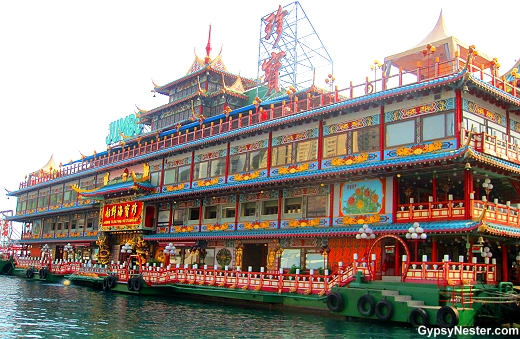
After another roller-coasteresque bus ride down the mountain, we had one more celebrated landmark on our to do list. Since 1976 one of Hong Kong’s top attractions has been Jumbo Kingdom, a floating restaurant. Wait, floating? Yes floating, as in a boat moored in the middle of Aberdeen Harbor.
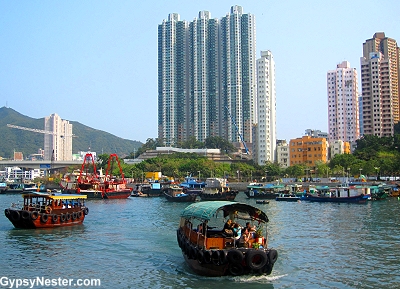
We had dim sum on our minds and luckily made it just in time, since dim sum is traditionally only served until mid afternoon.
If we had missed the food, although several other options were available at any hour, a visit to this recreation of an imperial Chinese palace set afloat was still not to be missed.
See much more about the fabulous Jumbo Floating Kingdom and Aberdeen Harbor!
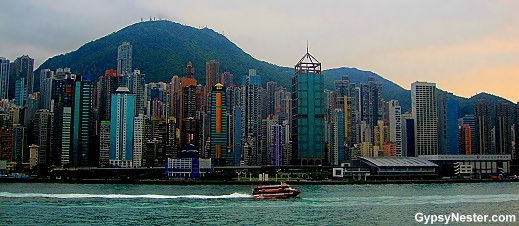
Though we never felt like we were anywhere close to living on Hong Kong time, as we steamed out of Hong Kong through the heart of Victoria Harbor aboard the beautiful Volendam we certainly enjoyed a satisfaction that we had been fully immersed.
Even if we still thought it might be tomorrow… or perhaps yesterday.
David & Veronica, GypsyNester.com
Delve deeper:
Explore the enormity (and beauty) of Big Buddha
Check out the celebrated Jumbo Kingdom in Aberdeen Harbor
View the wares on the Tonic Food & Dried Seafood Streets
Find out more about the whimsical Panda Hotel
Learn our tips on how (and how NOT to) fly to Asia
Continue along with us on our Amazing Asian Cruise though China, South Korea and Japan!