
Immerse yourself in the grandeur and beauty of the opera—this winter, let Italy’s music warm your heart… CONTINUE READING >>
There’s nothing quite like the enchantment of an Italian opera. Amidst the backdrop of Italy’s rich historical and cultural tapestry, operas come to life in a mesmerizing ballet of sound, emotion, and drama. Every note captures the spirit of a story, every performance a testament to the centuries-long tradition associated with such musicality. Italy, being the birthplace of opera, promises a spellbinding experience in every season. However, amongst all, one season tends to win the favor of opera enthusiasts – Winter.
The Charm of Winter and Opera
Winter might not be the most common time to go to Italy, but there’s a unique charm about opera concert tickets in Rome during winter. For one, it’s less crowded. The drop in tourist numbers means that you’ll find better seating options and a more intimate atmosphere when you head to the opera. It also leads to more interaction opportunities with locals, allowing you to fully embrace the Italian opera culture.
The beauty of the grand opera houses, such as the Teatro dell’Opera di Roma or the Teatro La Fenice in Venice, is magnified against the wintery backdrop. Their stunning architecture, enveloped in a mantle of snow or frost, creates an enchanting setting for an evening filled with music.
The Warm Embrace of Italian Opera
When considering why winter is the perfect season to see an opera in Italy, the warmth of the music comes instantly to mind. On chilly winter nights, nothing beats the feeling of stepping into a majestic Italian opera house, leaving the cold outside, and losing oneself in the passionate melodies and dramatic performances of a classic Italian opera.
Whether it’s the heart-rending tragedy of “Tosca,” the Romeo and Juliet-like storyline of “La Bohème,” or the vigorous tale of ‘Turandot,’ the emotive power of these performances cuts through the winter chill, demonstrating opera’s remarkable capacity to evoke and stir our deepest emotions.
A Chance to Celebrate Italy’s Rich Cultural Heritage
Winter opera season also coincides with several celebrations of Italy’s rich cultural and historical heritage. These include the Venice Carnival in February, where the spirit of the Renaissance is celebrated with masks, parades, and, of course, opera performances. There is also Saint Agatha’s Feast in Sicily, one of the biggest religious festivals in the world that blends faith and cultural traditions with grand processions and music.
Longer Nights and Cozier Stays
Italy’s longer winter nights set the perfect mood for the opera. The early fall of darkness heightens the sense of operatic suspense and drama, while the cozy, intimate hotels and cafés near each opera house offer warm, welcoming havens for opera-goers before and after performances.
Affordable Rates and the Serene Atmosphere
Winter tends to be off-peak for tourists, resulting in more affordable rates on flights, accommodations, and even ticket prices for operas. The serene atmosphere of Italian cities during winter adds to the lure of opera watching, allowing you to explore the inextricable link between the magic of the opera and Italy’s vibrant culture without the usual hustle and bustle of the tourist season.
In conclusion, there’s a true allure to seeing an opera in Italy during winter. Whether it’s the chance to engage with a passionate performance in the heart of where it all began, or simply the opportunity to soak up Italy’s rich cultural atmosphere at a quieter time, there’s no denying that winter sets the stage for an unforgettable operatic experience in Italy. Immerse yourself in the grandeur and beauty of the opera—this winter, let Italy’s music warm your heart.
Travelling is almost always really exciting, whether you’re on the road for work or finally taking that week-long vacation of a lifetime. Here are some travel sports or free time hobbies to try when you’re out on another jet-setting adventure… CONTINUE READING >>
Travelling is almost always really exciting, whether you’re on the road for work or finally taking that week-long vacation of a lifetime. Even if you’re a consistent traveller, landing in new destinations gives you plenty of opportunities to explore.
Here are some travel sports or free time hobbies to try when you’re out on another jet-setting adventure.
Rent a Bicycle or Road Bike
Depending on where you’ve landed, riding a bicycle around town on a bike rental in Aspen, or touring a bigger city on a road bike/scooter can be a great way to see an area. You can feel like a local as you take in the sights on a bicycle, all while getting in some daily exercise to maintain your health and fitness.
Meanwhile, riding a scooter through narrow city streets and alleyways not only saves you time and effort trying to get around town, but it also gives you the freedom of being in control of your trip without spending it stuck in traffic, locked inside of an isolated car.
Many European cities have rental options available, even offering helmets and proper shoes in the process, so you don’t need to stress about packing the right gear.
Go More Extreme With Kitesurfing
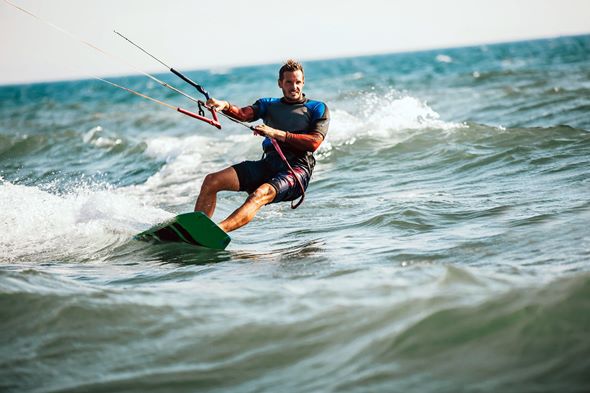
As far as travel sports go, you’re unlikely to find anything as fun or adventurous as kitesurfing. Thrill-seekers love the concept of kitesurfing, which uses a regular surfboard and a kite for a sail.
It forces the rider to truly become one with the water, activating his/her inner core muscles to gain a serious workout without even noticing, as you simply have fun gliding across the surface.
You can learn and indulge in kitesurfing anywhere there’s enough water and wind to catch some air, available off the Gold Coast of Australia or Poole Harbour in the UK. There are many different styles of kitesurfing you can explore, from intense racing to power jumping or basic freestyle.
Once you’ve collected the necessary board, harness, kite, bindings and power bar, you’re ready to experience some extreme fun out on the open water.
Try Your Hand at Falconry
Though perhaps considered a more olden-day sport in today’s modern world, this interesting and enjoyable hobby is still active in some areas of the world like California.
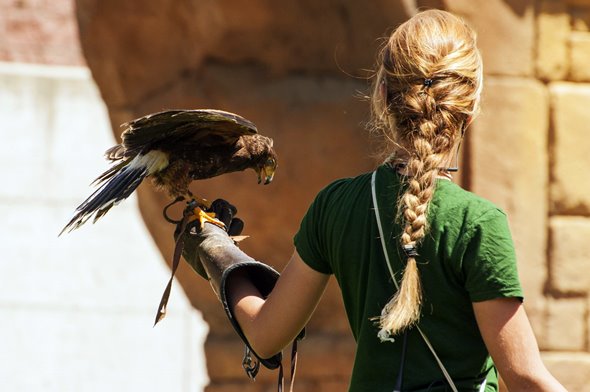
For animal lovers everywhere, this intriguing activity involves training with larger birds of prey, where a trained hawk will rest on your gloved hand with ease, while also returning to its same perch when called if it takes flight for any amount of time.
If you’ve ever wanted to get back to nature or experience majestic birds up close, this could be one of the best free time hobbies for you.
Enjoy simply lounging and lightly paddling on a board under the warm sun as it floats on the water’s surface, or make it more active by picking up speed as you stand on the board and paddle with a long oar.
Whatever you choose, you can feel at peace on the light, rippling water without exhausting yourself in the process.
Delight in Some Competition with a Round of Croquet
While this sport might be known to many as more of a rich man’s game, there’s no reason for any jet-setter to not learn and enjoy the fun of the game while travelling.
Widely available in areas like the UK and New Zealand, croquet is a multiplayer game that’s played on an open field or lawn. It requires players to drive colored, wooden balls through a line-up of goal markers, or wickets, by using hefty mallets that are akin to golf clubs.
It’s easy to learn and can be an effective and entertaining way to spend a few hours in the great outdoors.
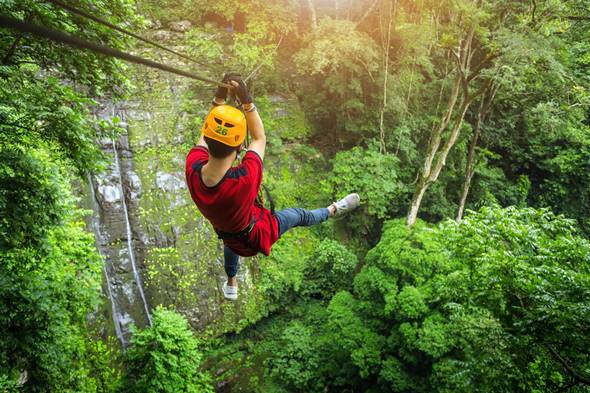
Fly High Above the Ground by Ziplining
Ziplining has become one of the more popular free time hobbies, especially in locations like Thailand, South Africa, New Zealand, the UK and the United States.
There are now a total of more than 700 courses to be found across the globe, making it easy for travellers to find somewhere to try it out. Ziplining is an enjoyable activity, giving adventure-seekers the chance to glide above vast forests and valleys while strapped into harnesses that are attached to galvanized steel cables.
Professional guides are always on site to help you get the most out of your experience, ensuring that any visiting tourists get the thrill of a lifetime during their stay.
No matter where you’re headed on your next destination, exploring any of these travel sports during your trip can make for some truly memorable moments that last a lifetime.
We are happy to present this collaborative post to offer valuable information to our readers.
Tulum is not the kind of place that even the most wandering GypsyNesting-type will stumble upon by accident. It’s not on the way to anywhere. But since we found ourselves on the Caribbean coast of Mexico’s Yucatan Peninsula, what’s known as the Riviera Maya, we hopped on a bus to the ancient Mayan site. We wanted to enjoy both a … CONTINUE READING >>
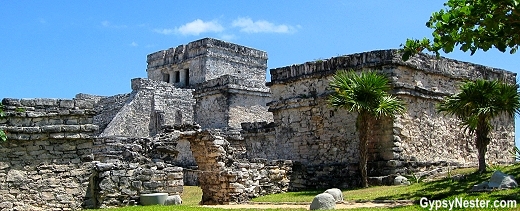
Tulum is not the kind of place that even the most wandering GypsyNesting type will stumble upon by accident. It’s not on the way to anywhere. But since we found ourselves on the Caribbean coast of Mexico’s Yucatan Peninsula, what’s known as the Riviera Maya, we hopped on a shuttle to the ancient Mayan site.
We wanted to enjoy both a guided tour and some free time to explore on our own and, since the site is not that large, and we saved time by taking a Cancun to Tulum shuttle, both could be easily accomplished in one day.
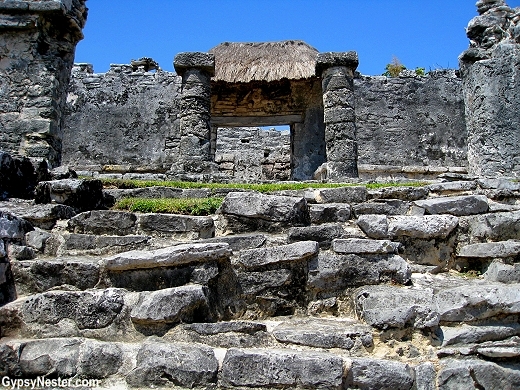
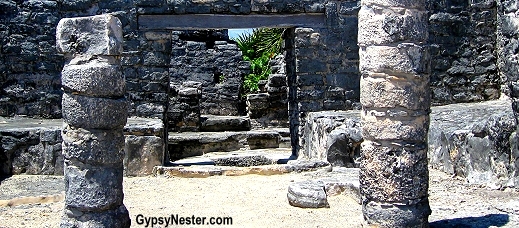
Tulum, the Mayan word for fence or wall, is a walled city that dates back around eight hundred years and served as a sacred site as well as a sea port.
The peak of the Mayan civilization was around the year 1000 and Tulum was occupied late in the Mayan era, in fact it was one of the last cities they built.
Soon after Tulum’s rise, the Spanish arrived and the Mayans, along with the Inca and Aztec peoples, were conquered.
The Mayans proved to be the most difficult conquest, since there was no single king. Their political structure was set up in a number of separate city-states with individual rulers that traded and interacted with one another.
Because of this, and the fact that they didn’t have gold, the Mayans and Spanish coexisted for two hundred years before Spain finally took control of the Mayan lands. Even then, the people, culture and language did not cease to exist. In fact most people in the Yucatan today are of Mayan and Spanish descent, including our guide Carlos.
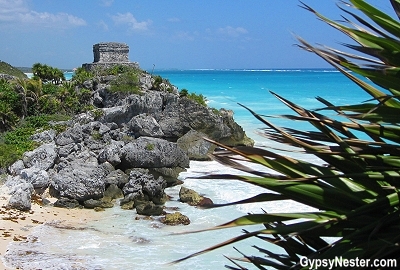
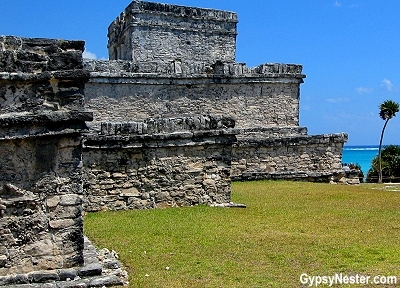
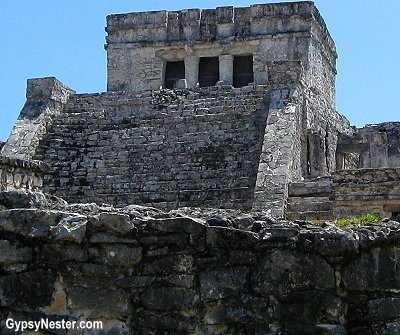
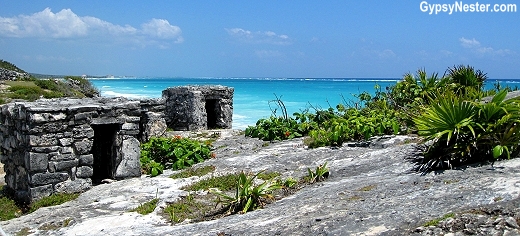
The most prominent feature of Tulum is El Castillo, previously presumed to be a simply a temple, with steps leading up to a columned shrine on the top.
However, in 1984, this structure was discovered to serve a more worldly purpose, a navigational signal to the large cargo canoes that the Mayans used in their trading with other civilizations up and down the coast.
The discovery, known as “The Secret of Tulum,” showed that small windows in the shrine line up perfectly with a gap in the barrier reef offshore. During daylight hours, the sky is visible through the windows so incoming canoes could line up by keeping equal amounts of light in each. At night another set of windows were lit to guide the vessels safely to the beach. A primitive lighthouse, as it were.
Pretty ingenious, we thought.
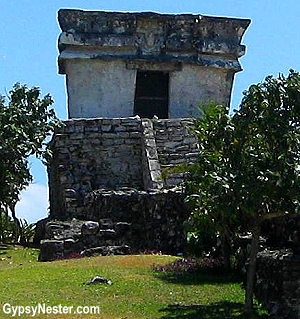
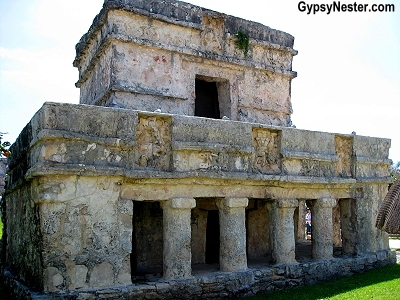
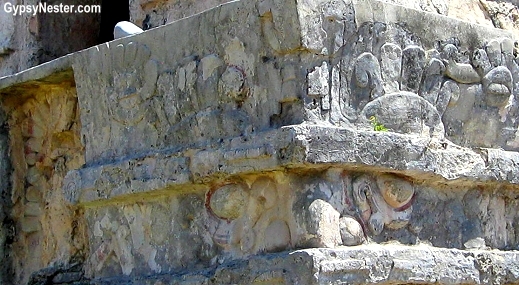
Off to the side of El Castillo is the Temple of the Descending God. Above the entrance in the western wall a stucco figure of the “diving god” is still preserved, giving the temple its name.
The sun rises exactly through the temple on the summer solstice, the longest day of the year. This is tré Mayan, as they were obsessed with the movements of the heavens and learned to mathematically predict almost every astronomical event.
The Descending God is also depicted in the Temple of the Frescoes.
Carlos spent a good deal of time showing us the details of this building, since it is the most unique artifact of Tulum.
The surviving frescoes inside are perhaps the finest examples of Mayan artwork remaining anywhere.
It was here that archeologists discovered that the Mayans also painted the outsides of their temples in bright colors, and Carlos showed us some of the remaining original coloring.
With the guided portion of our visit complete, we were free to wander among the ruins on our own, but not before we caught Carlos for a couple of one-on-one questions.
We asked about Tulum’s population, likely around 1,500. He also answered our inquiries about the interaction and trade with nearby settlements, and how the relationships weren’t always friendly.
Hence the walls that give Tulum its name.
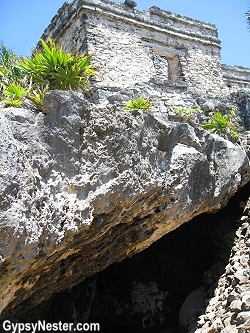
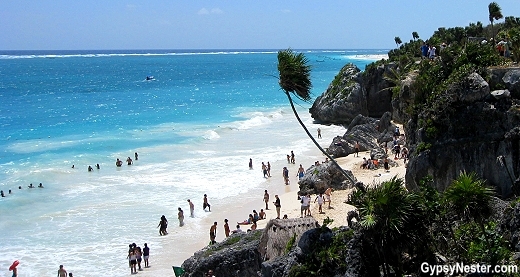
Looking out over the beautiful blue Caribbean we could see the island of Cozumel off in the distance, and behind us a sheer cliff with the ruins rising above.
The Mayans sure knew how to pick a good spot. We kicked off our shoes and splashed around in the surf for a bit, but soon our stomachs were more concerned with finding a bite.
Just outside the archeological site there is a small tourist village with food, crafts and, of course, the ever-present crap shops that crop up near any attraction like this. We found a little hole-in-the-wall shop that served up a pretty good street taco and proceeded to burn our mouths after not heeding the advice of the chef about the heat of the salsa.
While we ate, we watched as traditional dancers, acrobats and various barkers vied for the attention of the visitors.
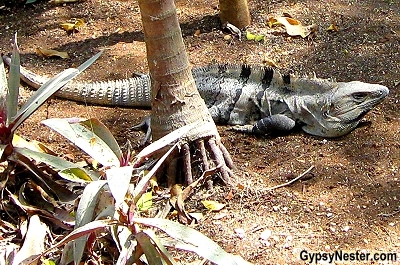
We couldn’t help but notice that Tulum is thick with iguanas. Not only rampant among the ruins, but in the tourist village as well. Veronica had the big idea to try and touch one, but the wild variety of these spiny fellas would have none of that.
Luckily, a guy happened to have a tame one of these prehistoric looking lizards available for touching, holding and photo ops… for a few pesos of course. Well Veronica had her fun, and we got the video to prove it. Worth every centavo.
WATCH:
As was a visit to this incredible piece of history.
Learn more about visiting the Island of Cozumel, Cancun, or Tulum on visitaxmx.org
When it comes to the best vacation spots in Latin America, Costa Rica is the one that has it all. From landmarks that tell the country’s story to its natural scenery, tourists are left in awe of the diverse places they can visit. In this article, you’ll learn some of the exciting things to do when traveling to Costa Rica.
What Fun Activities Can I Engage in Costa Rica?
There’s a ton of fun stuff to do when you travel to Costa Rica. It ranges from water sports to nature trekking. In this section, all the fun activities will be explained in a summarized format. Here are the activities you can try as listed:
1. Go for White Water Rafting
There are plenty of rivers when you travel to Costa Rica. It’s one of the most adventurous ways through the jungles of this country. Take note to inquire with the guides first regarding the intensity of the water current. You’d want to go white water rafting on a river that’s way too strong to handle to be safe.
2. Snorkel in their Diving Spots
Another way to enjoy the nature of Costa Rica is by snorkeling. There are plenty of diving spots on the country’s Caribbean and Pacific sides. Dive and catch a glimpse of the beautiful aquatic life living in Costa Rica’s waters.
3. Visit their Waterfalls
Waterfalls are another piece of what makes the nature of Costa Rica breathtaking. The country’s tropical landscape is home to a multitude of waterfalls. Regardless of where you hike, you’re sure to find amazing waterfalls where you go.
Take note to buy snacks at the local market before going on a day trip to these waterfalls. There are few commodities along the trails leading to Costa Rica’s waterfalls.
4. Zipline through Costa Rica’s Rainforests
Due to the varying elevations and vast amounts of greenery, Costa Rica is one of the best places for zip lining. Picture this, you are zooming high over the jungle, but strapped in safely. You get to see the vast jungles as you “fly” along the zipline path. The majority of these ziplining sites are near cloud forests.
5. Relax and Lounge at their Beaches
Swimming aside, you can relax and lounge at the many beaches andluxury resort of Costa Rica. There are a lot of beaches worth taking pictures or postcards of, where you can even engage in water activities. Your call is whether you want to simply lounge under the summer sun or join others in water sports.
6. Conquer the Cliffs by Canyoneering
For those who prefer a little more adventure in their Costa Rica trip, they can go canyoneering instead. Conquer the canyons by climbing them up with ropes and harnesses. Take note that this is a very risky activity so make sure you are in the company of an expert tour agency that can handle this.
7. Learn to Make Coffee/Chocolate
If you are a fan of coffee, then your Costa Rica travel will be even more interesting. Some plantations provide tours and even teach you how to make coffee. As you can see, Costa Rica is one of the world’s providers of Arabica coffee beans. You’ll get to learn how they harvest and roast the beans and the finest coffee that the world enjoys so much.
Coffee aside, some plantations provide tours and lessons on Costa Rican chocolates. They’ll teach you how it’s made and even give you a taste of it.
8. Paddleboard Among the Waves
When the waves are flat, paddleboarding is a fun activity to make use of the gentle waters. You can still enjoy yourself in the waters even if the waves aren’t standing up.
9. Surfing
Surfing is one of the most popular activities on the many beaches in Costa Rica. Experts and novices alike would challenge the rising waves and ride them while on surfboards.
10. Take a dip in their Hot Springs
Costa Rica is home to active volcanoes and that means there are natural hot springs that you can take a dip in. The majority of these hot springs can be found in the central part of Costa Rica since that’s where most of the volcanic activity takes place.
There’s one notable hot spring that’s not found in central Costa Rica though. The Vandara Hot Springs found in Guanacaste is the said hot spring. This hot spring is home to clay that’s rich in nutrients. People would rub this clay and mud on themselves as a form of natural skin care.
In Summary
The fun never runs out when you travel to Costa Rica. The many landscapes offer a multitude of activities that you can enjoy. Make sure though that the activity is something you are interested in and that you can stay safe in it. That way you can make the most out of your Costa Rican vacation.
FAQs
Q.) When’s the best time of the year to visit Costa Rica?
A.) It depends on your preferences but we’ll cover both:
If your preference is to be a little bit on the budget-friendly side then visiting Costa Rica from May to November is advised. This is the rainy season and tourist activity isn’t at its highest. As a result, commodities are cheaper. However, skip a trip during October because this is the wettest and rainiest month.
If your preference is hot and summery weather, then visiting Costa Rica from December through April is the best choice. This is their dry season when the sun is its brightest. Perfect for beach and outdoor activities. Do note that tourism peaks at this part of the year and commodities will be expensive.
Q.) Do I require a VISA to visit Costa Rica?
A.) Unless you are planning to stay longer than 90 days, there’s no need to have a VISA when going to Costa Rica.
Q.) How can I travel around Costa Rica?
There are three means of transportation in Costa Rica and they’re the following:
Through cars, can be either your car or through car rentals. Make sure to have a valid driver’s license when doing so.
You can also take the public bus when traveling around Costa Rica. This is the budget-friendly option to get around. Costa Rica has a huge network of buses that can take you where you want. Be prepared for a long journey though.
Last but not least is air travel. San Jose and Liberia are the two international airports in this country. You can also fly to local airports too. Take note that they’ll cost around $50 to $100 on average. Hope you are also ready to pay more if you’re carrying plenty of luggage.
Traveling solo definitely doesn’t have to be lonely. You can meet other people and socialize as much or as little as you want… CONTINUE READING >>
Traveling alone or even just as a couple can be a great experience. You have to find your own fun, without relying on other people to keep you company. It can be pretty intimidating at first, especially if you’re an introvert or a little shy, or you just struggle to be on your own.
However, if you make an effort to put yourself out there, you can turn your trip into whatever you want it to be. You might be on your own, but your travels definitely don’t have to be lonely. If you want to travel solo but avoid loneliness, here are some other ideas you can try:
Join a Group Tour
The simplest way to travel alone or as a couple but still have plenty of people to spend time with is to join a group tour. It could be a full, multi-day tour where you all get to know each other during that period. Or you might just choose to go on a day tour for a few hours or a whole day, where you can spend time with others for just a short while. There are all sorts of things you can do and types of tours that you might like, from active tours involving hiking or cycling to food tours, sightseeing, and plenty of other options.
Stay in Touch By Phone and Online
You don’t necessarily have to meet new people on your travels to avoid being lonely. Staying in touch with people back home or socializing online can be a great way to prevent loneliness and communicate with people on your own terms. You could even use a phone chat line to talk to new people when you feel like it. Use social media to update everyone on your travels or call home now and then to give your family and friends news about what you’ve been doing.
Pick Social Accommodation
Your choice of accommodation can make a difference if you want to avoid loneliness when you’re traveling. Some types of accommodation are much more social than others. Staying in a hotel could give you opportunities to meet new people, but many people choose to keep to themselves. Choosing a hotel in a resort can often give you more chances to socialize with others. Hostels can be a lot more social, especially if you share a room with others. Camping sites are often very social too or you might choose a B&B with good common areas so you can meet people.
Choose the Right Mode of Transport
There are different ways you might choose to travel, and some types of transport can be great for talking to other people. For example, traveling by train will often make it easier to strike up a conversation with others. This is particularly true on trains with shared tables and longer journeys when you have time to talk and admire the scenery. You might find that other types of shared transport are good for socializing too, such as ferries and other boats and ships or even buses.
Strike Up Conversations with Strangers
Learning how to start conversations with strangers is one of the best things you can do if you want to avoid feeling lonely when you’re traveling. Even if you just have a five-minute conversation and then go on your way, it’s still valuable social time that can raise your spirits. It can be really tough to start talking to people you don’t know, especially if you’re shy or you find socializing requires a lot of effort. But it’s something that you can learn to do so that it comes more easily and you feel comfortable talking to just about anyone.
Learn Something New
Your travels are the perfect time to learn something new, and it’s also a good way to get to know new people. Attending a course to learn the local language or learn how to cook the local food is a fun way to immerse yourself in the culture. It’s also a way you can meet fellow travelers from all over.
You already have a shared topic that you can talk about, and you can build new skills together too. It’s something that you could do for a day or you could find a longer course that lasts several days or longer. In your downtime you could even explore utilizing an ai character chat platform, conversing in the local language, and learning new phrases and ways to communicate.
Socialize When You Eat and Drink
Many people traveling solo for the first time worry about eating and drinking on their own. They feel awkward and like it’s perhaps a rather tragic thing to do. But it can actually be a fulfilling experience. You get to choose where to go and what you eat or drink without having to compromise. If you want to keep to yourself, you can read a book or something similar. But if you feel like socializing with others, consider choosing places to eat and drink that have communal tables or where you can sit close to others and strike up a conversation.
Frequent the Same Places
Visiting somewhere once gives you a chance to start talking to someone. Returning to the same place will mean you have more chances and you might start to get recognized. Going back to the same restaurant, cafe, store, or anywhere else means you might see the same staff or the other regulars who keep coming back. It might be something you do multiple times during one trip or if you decide to return to the same place on different trips, you can go back to your favorite spots.
Find Things to Do at Night
When you’re traveling alone, you might be reluctant to go out at night due to safety concerns. But there are ways you can keep yourself safe and enjoy yourself if you find the right things to do. Tell someone you know where you’re going and what time you plan to be back at your accommodation. Make new friends while you’re out but be cautious and avoid traveling elsewhere. Just like during the day, it can be a good idea to join an organized tour or event.
Traveling solo definitely doesn’t have to be lonely. You can meet other people and socialize as much or as little as you want.
We are happy to present this collaborative post to offer valuable information to our readers.
There are too many adjectives to describe the Baroque cities of Sicily’s Val di Noto to fit into one article (but we gave it our best shot!).
In an effort to recreate the grandeur of Sicily after a devastating earthquake, massive structures were constructed in what came to be known as Sicilian Baroque… CONTINUE READING >>
Sicily is a big island, the largest in the Mediterranean and forty-fifth in the world, so even though we rode over one hundred and fifty miles on our bike tour, we needed to focus on one region.
We couldn’t have picked a better one than Val di Noto.
When we saw the name on our itinerary we envisioned a valley, but the word val in this use dates back to the ancient form of Arabic spoken on Sicily and Malta a thousand years ago.
Val means province, and Noto is one of the three traditional divisions on the island, taking its name from the city of Noto.
These regions, and the islands triangular shape, are represented by the Trinacria that has become the symbol of Sicily.
The odd three-legged figure featuring the head of Medusa and three stalks of wheat is on the flag, coat of arms, street signs – you name it.
We ran into her almost everywhere we went as we pedaled across the island.
The City of Noto
Under the Greeks the city was known as Netum and, according to legend, Daedalus rested here after his flight over the Ionian Sea and Hercules after his seventh task.
In 866, the Arabs took control of Sicily and chose Noto as the capital of one of the three districts of the island.
A massive earthquake in 1693 destroyed the ancient city of Noto, so what we visited was a new version built about five miles away from the original.
In an effort to recreate the grandeur of the ancient city, in the mid-nineteenth century massive structures were constructed along a central thoroughfare, Corso Vittorio Emanuel, in what came to be known as the Sicilian Baroque style.
We entered the heart of the city through the monumental 19th-century arch, Porta Reale, and slowly worked our way along the broad boulevard to the Cathedral of Saint Nicholas of Myra.
The idea was to create a city worthy of the name, and we would have to say that they were quite successful.
We got a feeling almost like walking on the mall in Washington, DC, even if it was on a much smaller scale, because the major landmarks seem so well planned and laid out along the main road.
The Cathedral of Saint Nicholas of Myra is an impressive example of the rebuilding, and has suffered damage from several more earthquakes since being completed in 1776.
We also felt that the Palazzo Ducezio or Town Hall captured the importance of a capital city.
While we walked we couldn’t help but feel as though something was different about Noto. Then it hit us, unlike most Italian cities, Noto has a continuity to it, since almost everything was built at nearly the same time, using the same stone.
Ragusa Ilba
Another city devastated by the earthquake and subsequently rebuilt is Ragusa, or more precisely in our case, Ragusa Ibla.
This older part of the city remains on the original site, while the post-quake newer area is known as Ragusa Superiore, or Upper Ragusa.
We visited Ibla for an evening architectural walking tour and, as luck would have it, found the thickening darkness to be a plus as the buildings lit up against the full-mooned night sky.
Our guide, Lea, met us in the town garden…
… then led us up the Corso XXV Aprile while explaining how the baroque city was reconstructed.
Duomo di San Giorgio
Dominating the village is the Duomo di San Giorgio, designed by architect Rosario Gagliardi.
The cathedral was built from 1739–1775 to replace the original that had only one doorway left after the disaster.
Most impressive, especially at night while bathed in blue light, was the large neoclassical dome that was added in 1820.
Leaving Lea, we wondered on our own – getting purposefully lost in the narrow back streets of intricate, multi-layered Ragusa Ilba.
Modica
Before Ragusa was rebuilt and became the provincial capital, Modica held that position.
The city is truly ancient, going back over three thousand years, and while it was stuck by the earthquake, it was not completely destroyed.
The blend of old and new has earned the city the honor of being recognized as a UNESCO World Heritage Site.
The buildings packed in on the hillside made for an amazing sight, but without a doubt our favorite thing about Modica, was a tour of Sicily’s oldest chocolate maker, Antica Dolceria Bonajuto.
Chocolate and beef? It was weird, but it worked!
The family has been processing cocoa beans for six generations, since 1880.
But their secrets go back even farther, as they use the methods of the Aztecs brought to Sicily via Spain in the 16th century.
Luckily we sampled the finished product before entering the kitchen; otherwise it might have been impossible to keep our hands out of the cookie jar so to speak.
The rustic chocolate that we sampled and watched being made was a fantastic taste treat and the perfect reward at the end of our morning ride through the surrounding hills.
Watch: Uh, yum. A chocoholic’s paradise
Modica is also dear to our hearts for introducing us to our first Sicilian plate – a yummy array of bread, cheese, meat and veggies.
Thank goodness we were on our trusty steeds, we had to burn off the calories somehow!
Scicli
Perhaps our favorite of the cities we visited in Val di Noto was also the smallest, Scicli.
The city was founded by the Sicels, who gave the town and the island their names, all the way back around 300 BC. We had our share of trouble with the name ourselves, but finally mastered it as pronounced SHE-KLEE.
We rode into town down a steep winding road, stopping before we reached the bottom of the valley at the mountainside Cimitero Comunale, the cemetery of Scicli.
Unlike our typical notion of a graveyard, this is more like a small city built on a hillside.
The rows of mausoleums are arraigned in a grid along narrow street-like paths that stair-step down the slope.
Some are very plain, sort of the high-rise apartments of the cemetery.
Others are extremely ornate and command places of honor and attention, often at an intersection of two of the “roads” – for your guilded palace-types.
After meandering all the way to the bottom, we climbed back up and remounted our cycles to head into the main part of town.
Scicli was settled where the San Bartolomeo, the Santa Maria La Nuova, and the Fiumara di Modica rivers join; now many of the streets and plazas are actually built over the waterways.
Ducts run throughout.
We followed via Alearde alongside and on top of the Santa Maria La Nuova to Piazza Busacca.
The square honors the city’s biggest benefactor, Pietro Di Lorenzo Busacca – in all his pantalooned-and caped finery, thumb tucked jauntily into his belt — who left the city tons of money back in the fifteen hundreds.
Quite the snazzy dresser, David wanted to ask him for tips.
His statue stands in the center of the square between the family palace, Palazzo Di Lorenzo, and the Church and Covent of Carmine.
These days, well-dressed men still look out after the city.
This was not the main square, for that we rode up via Nazionale to Piazza Italia, but from there our attention was focused upward.
Scicli’s foremost attraction, the Church of San Matteo, overlooks the piazza from the top of the hill with the same name.
Even though it is no longer open, it is the oldest church in the city, with the foundations dating back well over a thousand years.
Looking closer, we could see the openings of caves dotting the hillside below.
Known as Chiafura, these were originally used as a cemetery, but became living quarters as people sought the safety of higher ground in the Middle Ages.
Oddly, there were still occupants inhabiting the cave houses until about fifty years ago.
But then, who are we to talk? We’ve been living in a twenty-two foot rolling house for nearly eight years now.
Fishing is a perfect sport to while away the time. Most beginners find it complicated, but angling is something you can master with time and practice…. CONTINUE READING >>
Fishing is a perfect sport to while away the time. Most beginners find it complicated, but angling is something you can master with time and practice and a little help from your friends, like those over at fishingforbig.com.
With the information on this guide, you can learn the art of angling, and you can try to catch some fish. You can start by getting the essential tools and invest in expensive tools once you become a pro. This article will cover spin fishing, where an angler uses a rod with a spinning reel and baits to catch fish. This method is the easiest for first-time anglers, and it requires minimal investment. Here is a guide to angling for beginners.
1. Basics. Before you begin your angling experience, you must acquire a current fishing license. The license may vary from state to state. Visit your local fishing shop, convenience store, or go online to buy a permit.
i. Where to Fish. As a beginner, you may not know where to go fishing. Talk to an experienced person about where to fish. Such people often have the most current information about local waters. Lakes are a great option to start since they usually have a ban or dock. Moreover, the larger volume of water is host to several hungry fish that will run for your bait.
ii. Etiquette. Fishing involves respecting other anglers, the fish you catch, and your environment. Avoid crowding a spot where another angler is trying to catch fish. Give about 60 feet between you and other anglers. Do not keep more fish than you can eat. Look for signs that indicate whether you in catch and release waters.
iii. Gear.Visit your local fishing spot or click on CallOutdoors to buy your first gear. A spinning real and a rod is the best for beginners since they are easy to set up. Your local fishing shop will help you determine the best rod for a beginner. Lures and bait are your next purchase. Live worms or PowerBait are an excellent starting point. You can also get some bobbers. Bobbers are small floating balls that sink or bob when you catch a fish. You will also need a rubber net, needle-nose pliers, and a tackle box.
2. Skills. With a license, the right gear, and an idea of where to begin your fishing experience, it is now time to learn some skills. The first thing to learn is how to make different knots. The clinch knot is the most important. This knot attaches your hook to the line. The Palomar knot is another option to connect your bait to your line, but it is more reliable and easier to tie. The double surgeon knot attaches two pieces of the line. For instance, if your lure gets caught on a rock and the line breaks, your fashion another line before attaching your hook. Another skill that you should master is reading the water. Reading the water will help you determine where the fish may be hiding so that you can target them better to make a good catch. In lakes, you will often find fish around weeds or downed trees close to the shore. Always look for places that fish may find suitable cover.
3. Catching your Fish. Catching fish involves three steps.
i. Casting. casting includes chucking your lure as far as possible, similar to throwing a baseball. Allow your line to be about 6 inches out of the rod, with the reel below your dominant hand. Spin the reel to create a bail that prevents the line from coming out of the spool. With your fingers holding the line, flip the bail, bring the rod tip up slightly behind you, and cast forward using your wrist and elbow. Allow the rod to remain vertical and release the line to send it flying. With the lure in the water, flip the bail back and start reeling.
ii. Hooking. Here, you have to take care to prevent your fish from spitting out of your lure and your line breaking. Once the fish has bitten your bait, ensure the hook is right into the mouth of the fish. When your bobber sinks, point the tip of your rod up and pull back while applying some pressure. At this point, focus on keeping your rod tip up and allow the fish to tire itself. Once it is tired, reel the fish in.
iii. Landing. With the fish hooked and reeled in close to shore, use a net to scoop it up and ensure that it does not flop on the rocks. Avoid squeezing its stomach or touching its gills when landing. If you intend to release it back into the water, do not keep it out of the water longer than you can hold your breath.
Keep on doing some research and practicing so that you can improve your angling skills.
We are happy to present this collaborative post to offer valuable information to our readers.