
Search…

Win a Canon Powershot A2300 Digital Camera!


Enter to win a

Canon Powershot A2300 Digital Camera

from your GypsyNesters!

CLICK HERE TO
ENTER TO WIN!

click to win!

AND THE WINNER IS…

Jackie McMahon from NJ!

Jackie says, “Thanks for the great giveaway!!  I can’t wait to use the camera this summer!

We have a GREAT new giveaway coming soon, so be sure to follow us here!: FacebookTwitterYouTubeGoogle+PinterestStumbleUponRSS


Canon Powershot A2300

Simple and stylish, this chic compact camera is packed with advancements that make it easy to get a great shot every time. Smart AUTO recognizes 32 predefined shooting situations, then automatically picks the proper camera settings for you. Saving memories in breathtakingly realistic 720p HD is as easy as pressing thededicated movie button. You’ll see extraordinary resolution and fast performance with the 16.0 Megapixel Image Sensor and DIGIC 4 Image Processor, and capture more dynamic, exciting images with the 5x Optical Zoom with 28mm Wide-Angle lensNew Digital IS greatly reduces blur by recognizing the main subject and applying the best camera shake correction.

Follow The GypsyNesters!
Follow The GypsyNester on Facebook
Follow gypsynester on Twitter
Add us to your circles!

OFFICIAL RULES
All contest entries must be submitted between March 1, 2013, 12:01 AM EST and April 30, 2013, 11:59 pm EST
– Entries are limited to once daily.
– Entrants will receive five bonus entries per Facebook friend they refer. To receive these bonus entries, the refer-a-friend feature on the entry page must be used.
– Winner will be selected in a random drawing from all qualified entries.
– Winner will be notified via email on May 2, 2013.
– To claim prize, winner must respond via email by May 9, 2013, 10PM EST
– Winner will be announced on GypsyNester.com on or before May 11, 2013 unless initial winner is not qualified and a new drawing must take place.
– One grand prize winner will receive a Canon A2300 digital camera.
– Approximate total value of the prize is $140.00, there are no other prizes.
– The prize is nontransferable. There may be no cash or substitutions.
– You must be over the age of 21 to enter.
– You must be a resident of the United States to enter. 
– By entering, each contestant agrees to be bound by these rules. 
– Failure of the original winner to meet official rules or claim prize within the specified time period will result in automatic forfeiture of any prize and prize will be awarded to an alternate winner. Alternate winner will be chosen in a new drawing in accordance to these same rules.

BigSweeps.com – Sweepstakes & Contests


Contest Alley Blog Giveaway Directory

Contest & Sweepstakes

SandysRealm.com Sweepstakes-FREE listing of Sweepstakes, Instant Win Games, Freebies & More! Sweepstakes Bug New Sweeps Daily at CashNet Sweepstakes! sweeptakes fanatics
 

About Sweepstakes

The Great Northern Bar, Whitefish, Montana

After a short drive out from Paris, we bypassed the waiting crowds and walked right in.

Folks in Whitefish have been satisfying their hungers and thirsts at The Great Northern Bar for nearly one hundred years, and we certainly weren’t looking to break with tradition…. CONTINUE READING >> 

The Great Northern Bar in Whitefish, Montana

Even without going all Grizzly Adams mountain man into the wilderness, slogging through knee deep snow can build up a powerful hunger.

Folks in Whitefish have been satisfying their hungers… and thirsts, at The Great Northern Bar for nearly one hundred years, and we certainly weren’t looking to break with tradition.

The Great Northern Railway

The Great Northern Bar has signs from businesses of old

Named for the railroad responsible for Whitefish‘s existence, The Great Northern has taken on the task of keeping local history alive.

The walls are covered with signs obtained from dozens of nearby businesses that have gone by the wayside through the years, as well as relics from the old GN Railway.

After checking out the menu, for some reason buffalo seemed like the right thing to order.

The Great Northern Bar has signs from businesses of old

To see more about the wonderful town of Whitefish, click here.

The Great Northern Bar has signs from businesses of old

Kokanee Glacier Fresh Beer

Yup, we were going plum Western.

When we washed it down with a Kokanee “Glacier Fresh” Beer, a new discovery for us that hails from the nearby neighbors to the north, British Columbia, we had some right rib sticking vittles.

The Great Northern Bar in Whitefish has an outline of Bruce Springsteen's shoes proudly displayed

Coolest of all is the square of carpet with an outline of Bruce Springsteen’s shoes proudly displayed.

The manager said that the hardest thing he’s ever done in his life was making The Boss stop playing when he jumped up to jam with a local band.

It was, after all, closing time.

David & Veronica, GypsyNester.com

See more:
Sled Dogs & Snow Ghosts – Whitefish, Montana in the Winter

A Winter Wonderland Aboard Amtrak’s Empire Builder

Cooking Class in Peru – YUM!


enlarge video

Chef Ricardo makes Causa Limeña, delicious mashed potatoes prepared with lime, onion, chili and… CONTINUE READING >>

Chef Ricardo makes Causa Limeña, delicious mashed potatoes prepared with lime, onion, chili and a little oil, layered with avocado and chicken salad, then formed in a round mold. Ricardo constructed this like an artist working on a masterpiece, after which we destructed it like hungry children.

To see more dishes – and a tour of lovely Lima, Peru, click here.

Visit our GypsyNester YouTube Channel!

Guayaquil, The Pearl of the Pacific

Join your GypsyNesters in Guayaquil, Ecuador!

Discover the steep Cerro Santa Ana, a colorful, dynamic neighborhood of 444 steps with amazing sunset visits from the top.

Delight in the Parque de las Iguana where the reptiles were so thick that we had to be careful not to step on them.

And stroll the beautiful, romantic riverwalk – the Malecón… CONTINUE READING >>

Santa Ana Hill, Guayaquil, Ecuador

As the gateway to The Galapagos, where every flight from the mainland begins or ends, it was easy to overlook Guayaquil on our way to see the enchanted islands.

But upon our return to the mainland we had the good fortune to take a look around Ecuador’s largest city.

This place, where the Guayas River meets the Pacific, has been an important sea port since before the Spanish Conquistador Francisco de Orellana arrived in 1538 and bestowed the catchy little title Muy Noble y Muy Leal Ciudad de Santiago de Guayaquil upon it.

Even though Most Noble and Most Loyal City of St. James of Guayaquil does have a certain ring to it, over the ensuing centuries the name got shortened. Sign painters throughout the land celebrated.

Guayaquil, Ecuador's Central Bank

Metropolitan Cathedral in Guayaquil, Ecuador

Since we were staying downtown, that was the obvious area to focus our explorations.

Guayaquil is a modern major metropolitan city of nearly four million, so there are plenty of glass and steel skyscrapers, but there are also plenty of fantastic old buildings with classic Spanish, Italian and French influenced architecture.

In the middle of all the hustle and bustle we came to a lovely small park in front of the cathedral and got a big surprise.

Known by several names, El Parque Seminario, or Plaza Bolívar, because of the statue of the independence fighter Simón Bolívar in the center, it is best known as el Parque de las Iguanas, the iguana park.

Veronica FINALLY gets to pet an iguana!

Why? Because right in the center of the city hundreds of iguanas have laid claim to this tiny plot of land. They are so thick that we had to be careful not to step on them.

Iguanas in Guayaquil, Ecuador

This is the oldest park in the city, and it looks like some of the resident iguanas may have been around for the entire three hundred years of its existence, but no one seems to know how or why they are here.

Iguana Park or Parque de las Iguanas, Guayaguil Ecuador

A couple rangers kept watch to discourage any iguana shenanigans, tail pullings or thefts, and one of them even gave Veronica a chance to feed one of the giant lizards.

Now our Spanish may be no muy bueno, but we were pretty sure that the sign behind her said “don’t feed the animals.” Perhaps we missed the part explaining “unless assisted by a ranger.”

A park ranger hangs out with an iguana in Guayaquil Ecuador

The Malecón in Guayaquil Ecuador

Just a few blocks from the park we came to the river and turned to walk along the Malecón 2000. The new riverwalk converted the old, funky waterfront into a Guayaquil’s main gathering place.

Lush gardens, fountains, and historical monuments are spread along the mile and a half walkway that teems with visitors, both locals and tourists, day and night.

The crowds have in turn attracted a number of restaurants, bars, and shops revitalizing the entire area.

The Malecon, Guayaquil, Ecuador

Torre Morisca, or Moorish Tower in Guayaquil Ecuador

Beginning at the Torre Morisca, or Moorish Tower, we turned north and headed toward Cerro Santa Ana, the hill covered with brightly colored houses a mile or so off in the distance.

While we walked we noticed a strange thing happening, the river was flowing uphill, away from the sea and back toward the mountains. The explain at ion was not supernatural though, just the tide pushing its way several miles inland.

On our way along the malecón we couldn’t miss La Rotonda, the monumental monument that commemorates the 1822 meeting in Guayaquil of the liberators José de San Martín from Argentina and Simón Bolívar from Venezuela, when plans for South American independence were laid out.

La Rotonda in Guayaquil Ecuador

But the highlight of our walk around Guayaquil had to be Las Peñas, the neighborhood on Cerro Santa Ana. Santa Ana Hill is in the oldest part of the city, and the stairs leading up the hill have become a community all to itself.

We must say, one of the most intriguing quarters of any city we have ever come upon.

Santa Ana Hill, Guayaquil, Ecuador

Santa Ana Hill, Guayaquil, Ecuador

Santa Ana Hill, Guayaquil, Ecuador

The buildings along the stone staircase are all recently refurbished, so the little homes, restaurants, and shops gleamed in brightly colored freshness, while children played up and down the steps, and folks milled about chatting or grabbing a bite to eat down every little alley.

Santa Ana Hill, Guayaquil, Ecuador

Chorizo with Chimichurri sauce on a stick!

Cerro Santa Ana in Guayaguil Ecuador

The vibrant barrio kept us completely enthralled until, before we knew it, we were at the top of the steps… all 444 of them!

Up there we found a small chapel and a lighthouse, but mainly the reward of a full 360 degree panoramic view of the entire city just as the sun was setting. Sometimes our timing just seems to work out.

Lighthouse atop Santa Ana Hill, Guayaquil

Sunset from the top of Santa Ana, Guayaquil, Ecuador

Historic Numa Pompillo Llona in Guayaquil Ecuador

Scurrying back down the stairs, in a race against darkness, we took a moment at the bottom to absorb the last drop of daylight and stroll up the historic street Numa Pompillo Llona for a block or two.

But soon the shadows on the cobblestones told us it was time to drag our tired feet back to the hotel.

They had covered a lot of ground, ground that we were glad we hadn’t overlooked.

David & Veronica, GypsyNester.com

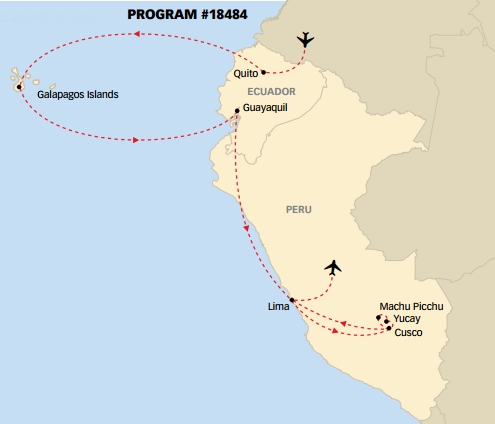
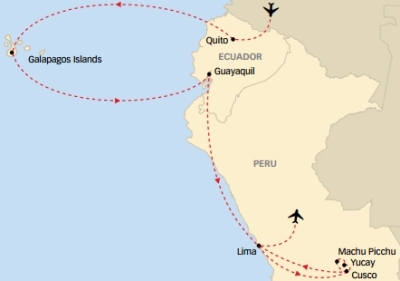
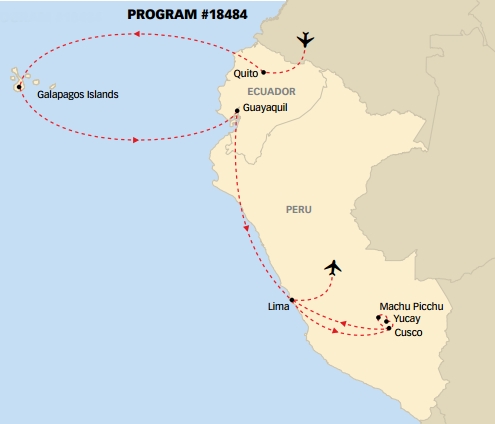
Click here to see our full adventure with Road Scholar – a not-for-profit organization – through Ecuador, Peru, The Galapagos Islands, Machu Picchu and much, much more!
If It Can Kill Me, It MUST Be Good

I like to flip through the channels when watching the evening news. The other night while practicing my thumb aerobics, I noticed that the exact same commercial was on two of the networks at the exact same time. That surprised me a bit.

What didn’t shock me was that it was an ad for a prescription drug.

So I decided to start paying attention. It seemed that at least half of the advertisements were for pharmaceuticals.

I also noticed that I must have at least half a dozen things seriously wrong with me and should be… CONTINUE READING >>

David Writes!

I like to flip through the channels when watching the evening news. The other night while practicing my thumb aerobics, I noticed that the exact same commercial was on two of the networks at the exact same time. That surprised me a bit.

What didn’t shock me was that it was an ad for a prescription drug.

So I decided to start paying attention. It seemed that at least half of the advertisements were for pharmaceuticals.

I also noticed that I must have at least half a dozen things seriously wrong with me and should be heavily medicated. If I could just learn to ignore the fact that I feel fine, I might have some hope for recovery.

No, seriously, we are being turned into a nation of neurotic hypochondriacs. From what I can, tell those of us who watch the evening news are really, really sick.

We need lots of drugs for our blood pressure, erectile dysfunction, depression, asthma, more erectile dysfunction, hair loss, blood clots, Alzheimer’s, chronic obstructive pulmonary disease, yet more erectile dysfunction, fibromyalgia, arthritis, bladder control, enlarged prostate, the dreaded chronic dry eye, even more erectile dysfunction and worst of all — the single most horrible scourge of our modern lives — short eyelashes.

Good thing some company spent years of research and testing to develop a cure for that!

Yes, I viewed advertisements for cures to all of these ailments in a matter of days.

I remember back when Walter Cronkite and Huntley-Brinkley didn’t peddle drugs. I always thought it was because it was illegal, but it wasn’t.

Because the FDA required full disclosure of all of a drug’s effects to be included in advertising, print was the only viable medium for all of that information. The pharmaceutical companies pitched their products in professional journals and magazines, focusing their campaigns toward doctors.

Mable is Unstable


In the 1980s
, money began to flow from the drug manufacturers into direct-to-consumer advertising.

Originally this was applauded by consumer advocates as a way for more information to reach patients, but then in 1997, the FDA relaxed the disclosure rules for ads.

Instead of requiring all details to be disclosed in an ad, now only what the FDA deemed as “serious” or “common” side effects had to be disclosed in a broadcast advertisement, the details could be made available elsewhere. This brought about the “See our ad in Horse and Hound Magazine for more information” disclosures.

Still, the ads sounded kind of bad with all of those nasty side effects included, so the drug makers used a loophole. Reminder ads use simple name recognition by repeating the brand name over and over again.

A common tactic was the “Ask your doctor if this drug is right for you” approach. As long as the commercial never stated what the drug was for, those pesky side effects need not be revealed. The pharmaceutical companies used them with a vengeance.

I suppose the theory was that people want what they see on TV, even if they have absolutely no idea what it is.

Once the names of the drugs were sufficiently beaten into our brains, the companies began revealing the vile consequences of consuming their products.

We’ve now been completely desensitized to the point that ads routinely mention “possible death” and “sometimes fatal events” as a side effect; we Americans continue to rush out and ask our doctors to give us these pills regardless.

Are the pharmaceutical companies no longer concerned about the public’s aversion to horrible side effects? These fast-talking laundry lists of the dismal things that might happen if we consume their products should put us off — but we continue to consume.

Even when the cure is worse than the disease, Americans seem convinced that we need more and more pills.

I believe an attitude of “it must be good if it’s strong enough to kill me” has developed. Personally, I’m not wasting any of my hard-earned money on a chronic dry eye potion that can’t at least put me in a coma.

The end result of this? Americans are now by far the most medicated people on the planet. Around 130 million folks take a prescription drug every month.

More than 125,000 Americans die annually from prescription drug reaction and mistakes each year, representing the nation’s fourth leading killer. That’s three times the number that die in car accidents.

Are the ads behind this? Pharmaceutical manufacturers do spend a surprising amount more on marketing than research.

We are taking way too many drugs for dubious or exaggerated ailments. What the drug companies are doing now is promoting drugs for long-term use to essentially healthy people.”

I didn’t make that up, Dr. Marcia Angell, former editor of the New England Journal of Medicine, said it.

A September 2010 report from the Center for Disease Control reveals some alarming statistics. In the month prior to the survey, at least one prescription drug was taken by:

48 percent of Americans
One of every five American children
9 out of 10 older Americans
88.4 percent of Americans age 60 and over used at least one prescription drug, more than 76 percent used two or more in the past month and 37 percent used five or more
In 2008, $234.1 billion was spent in the United States on prescription drugs — more than double what was spent in 1999

How could we possibly need all of these drugs? Are we that much sicker than we were a couple decades ago?

Wait, maybe taking all of these pills makes us more healthy. Not by a long shot. Chronic diseases are way up. All the better to sell more pills, to the tune of more than 4 billion prescriptions written in 2011 alone.

America is nearly alone in this insanity. New Zealand is the only other country on the planet that allows this direct-to-consumer advertising of drugs.

A side effect of direct-to-consumer advertising is the financial incentive to the pharmaceutical industry to market new drugs as remedies for all sorts of maladies, including ones they were never intended to treat. They are literally selling the side effects now.

For example, the drug Latisse — initially tested to treat glaucoma — is now being marketed to improve eyelash growth. To complicate the situation more, there are side effects to the side effect that is Latisse.

A while back I made up the dreaded Periodic Interrupted Sleep Syndrome (P.I.S.S.) in a sarcastic effort to point out the absurdity of the syndrome society that we have become.

Now, I seriously expect to see an ad for a new drug to treat it any day.

I’ll be flipping through the channels (which I’ve discovered means I have adult ADD and need immediate medication) and there it will be.

On two channels at once… right after a news story about a new drug.

David, GypsyNester.com

YOUR TURN: You’ve heard what I’ve had to say. What’s your take?

The GypsyNesters Discuss How Food Enhances Travel!

Thanks to KPAM Radio in Portland and the fabulous host Rod McLaughlin for giving us the opportunity to talk about one of our favorite things – food!

LISTEN:

Click here to leave a comment – let us know how we did!

KPAM

Thanks to KPAM Radio in Portland and the fabulous host Rod McLaughlin for giving us the opportunity to talk about one of our favorite things – food!

Click to listen!


YOUR TURN: How’d we do? Did we inspire you to try new things? Is food an important part of your travel experience too?

Islands of Fire

The Galápagos Islands. The name conjures up images of rare birds, giant tortoises and fearless sea lions, but there is another side to this archipelago. A side may appeal to a geologist more than an ornithologist or herpetologist, because the Galápagos are a classic example of a geologic hot spot.

A hot spot is where volcanic islands are formed as a… CONTINUE READING >> 


The Galapagos are a classic example of a geologic hot spot

The Galapagos Islands.

The name conjures up images of rare birds, giant tortoises and fearless sea lions, but there is another side to this archipelago.

A side may appeal to a geologist more than an ornithologist or herpetologist, because the Galapagos are a classic example of a geologic hot spot.

Sally Lightfoot crabs on the lava of The Galapagos Islands
Sally Lightfoot (grapsus grapsus) crabs crawl across jet black lava on the island of Santa Cruz.

Vocanic Galapagos

A hot spot is where volcanic islands are formed as a plate of the Earth’s crust slowly moves over a stationary magma source.

The molten rock is brought to the surface by what is known as a mantle plume, because it is thought to be rising directly from deep within the mantle. The result is a chain of islands that follows the direction of the plate’s movement. The further from the hot spot, the older the islands are, until they ultimately erode away into the ocean.

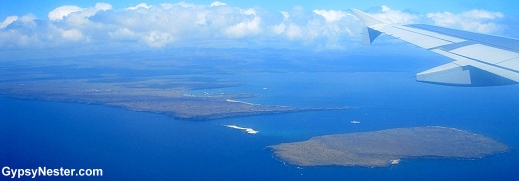
Our first glimpse of the Galapagos Islands

The Hawaiian Islands are the best known example of this phenomenon, but many other spots exist, some of which are not under water. Yellowstone is a prime example of a hot spot on land.

While the Galapagos are similar to these other spots, they are unique in that the hot spot occurs at a point between two of the Earth’s plates, the Nazca Plate, moving to the east-southeast, and the Cocos Plate which moves northeast.

This has caused islands to form in two directions instead of the straight line chain we see with Hawaii. The geology is further complicated by the Galapagos Spreading Center between these plates.

Prince Phillip's Steps, a narrow path in a fissure of the volcanic ridge
Prince Phillip’s Steps, a narrow path in a fissure of the volcanic ridge that forms Genovesa Island.

With The Galapagos being so active — the latest eruption was in 2009 –the landscape could serve as a textbook for identifying volcanic features.

Our introduction to these geologic examples came at Genovesa Island, one of the oldest islands, which is the rim of a giant, ancient caldera poking above the surface of the sea. T

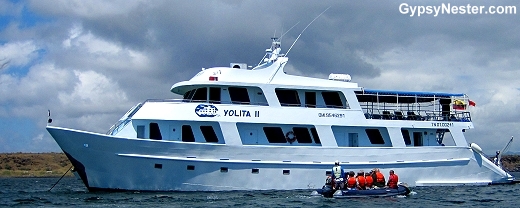
he captain sailed our boat, Yolita II, through the eroded opening in the crater and into the middle of the volcano. From our anchorage the shape was unmistakable.

Darwin's Bay, Genovesa Island, Galapagos Island, Ecuador
Darwin’s Bay on Genovesa Island. The island is one big crescent-shaped bay formed by the remnants of a large volcanic caldera.

As we moved southwest, toward the hot spot and the younger islands, we came to Bartolomé Island. Here formations such as Pinnacle Rock, known as “The Guardian of the Isles,” and a small submerged caldera that looks like a moon crater just off the coast, are obvious calling cards of more recent volcanic activity.

Pinnacle Rock, Bartolome Island, Galapagos
Pinnacle Rock, just off the coast of Bartolomé Island.

As we hiked to the top we found that much of the island’s topography looked otherworldly, with lava bombs and flows limiting the vegetation, and spatter cones leaving craters from slightly more explosive eruptions.

Cinder cones, Bartolome Island Galapagos

Lava Lizard in Galapagos Island
A Lava Lizard, one of the few creatures willing to call forboding Bartolomé Island home.
Bartolomé Tower takes on a gravity-defying angle from Santiago in The Galapagos
Pinnacle Rock takes on a gravity-defying angle from Santiago.

Just across a narrow channel, on the nearby island of Santiago, we found another barren landscape created by a very young, black basalt lava flow.

Young in this case meaning about 130 years, which may sound slightly older than young, but geologically speaking that is just the blink of an eye.

We were obviously getting very close to the hot spot itself.

Lava flows on Santiago Island, Galapagos

Molten rock formations on Santiago in The Galapagos

The molten rock that formed this new piece of land when it flowed into the sea a century ago left numerous types of mind-boggling patterns and designs. The differences in the ridges, waves, and bubbles are caused by varying speeds in the cooling process.

Barren landscape of a very young lava flow on the island of Sanitago

The tropical sun on the black basalt flow takes a toll on Veronica.
Cactus grows among the lava flows on Santiago Islands, Galapagos, Ecuador
Somehow, miraculously, life always finds a way.

Our next destination, the island of Isabela, is the largest of the Galapagos. Here the tops of the volcanos rise over a mile high above the sea. From our beginning at sea level on our boat we took a bus several miles inland, through dense jungle, up the slopes of Volcán Sierra Negra.

Volcán Sierra Negra, Isabella Island, Galapagos, Ecuador

When the road ended we hiked about two miles to the rim of the active volcano, above the clouds. From that vantage point we could look down on the floor of the caldera which is covered with black, freshly hardened lava from the last eruption in 2005.

That crust is still hot, warmed by the massive magma chamber lying just below the surface.

Volcán Sierra Negra, Isabella Island, Galapagos, Ecuador

Click here to see our entire Galapagos adventure!

To the north of the Sierra Negra Volcano, on the west coast of Isabela, we stopped off to check out the formations at Tagus Cove. By boarding small inflatable dinghies we could get up close views of tuff cliffs along the shore.

Tuff is a sedimentary form of volcanic rock that forms when ash is piled up in layers over the ages and compressed into soft stone. Because of its softness, tuff easily erodes into interesting and unique formations.

Peguins perched on tuff in the Galapagos

Tuff formations in the Galapagos

The various types of volcanic rock have also led to a peculiar situation where the beaches on the islands can range in color from black to white.

The crushed basalt of the lava flows makes for black sand, while the tuff creates deep reds and browns, and the classic white sand that comes from crushed coral and shells can be found throughout the islands.

The Galapagos Islands have many colors of beaches!

We were now nearly on top of the hot spot. Right next to Isabela is Fernandina Island, the youngest and most recently active of all of The Galapagos.

We dropped anchor and made our way ashore at Punta Espinoza. While the extraordinary barren landscape of this newborn land would be expected to be the main attraction, it was overshadowed once we noticed the lava was alive.

Thousands upon thousands of endemic marine iguanas have made their home at Punta Espinoza

Marine Iguana in the Galapagos

Thousands upon thousands of endemic marine iguanas have made their home here.

They have adapted to this harsh and lifeless environment by taking on the exact coloring of the lava and learning to go into the sea to find food.

They are the only iguanas on Earth that go under water, and that trait helped us spot them. They have a habit of sneezing out the salt from the seawater as they warm themselves and dry off in the tropical sun.

The sound, movement, and dried up, white salt residue tended to give away their otherwise nearly perfect camouflage.

Having been to the source of these wondrous islands, the time had come to make our way back to the mainland, but not without one final example of classic volcanic landscaping.

Just before we reached Baltra Island and the airport, the captain took us on a quick circumnavigation of Daphne Major. This perfect cone rising out of the sea has the quintessential volcano shape.

Daphne Major in the Galapagos

It really does look as if it should be in a geology textbook.

Click here to see our full adventure with Road Scholar – a not-for-profit organization – through Ecuador, Peru, The Galapagos Islands, Machu Picchu and much, much more!
Delve deeper:
See the incredible work done at Giant Tortoise Breeding Center
Cavort with Sea Lions!
The Birds of The Galapagos – wild!
The Underwater World of The Galapagos
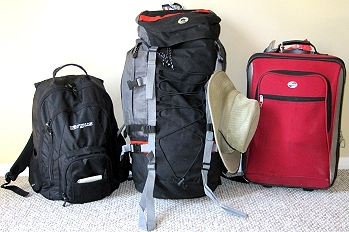
Our tips for visiting The Galapagos Islands – including what to pack

David & Veronica, GypsyNester.com

See our full adventure The Galapagos!