
Laura of Little House on the Prairie and Anne of Anne of Green Gables were my closest literary companions in childhood.
There was something about these girls’ feistiness and spirit that sparked “the scope of my imagination” – a bookwormish preteen girl who spent hour upon hour with her nose stuck in the pages of…CONTINUE READING >>
Green Gables, the house that inspired the novels.Anne’s bedroom, note the dress with the puffy sleeves!
Laura of Little House on the Prairie and Anne of Anne of Green Gables were my closest literary companions in childhood.
There was something about these girls’ feistiness and spirit that sparked “the scope of my imagination” – a bookwormish preteen girl who spent hour upon hour with her nose stuck in the pages of Laura Ingalls Wilder and L. M. Montgomery.
The dining room
It was through these ground-breaking authors that I learned how little girls can be brave, mistake-ridden, ridiculous and wonderful. I found authority figures that could sometimes be unfair in their well-meaning attempts at bringing up proper young ladies and, that being heard sometimes meant taking hard-knocks and picking yourself up, then repeating as necessary.
After almost forty (!) years, I reread Anne of Green Gables just prior to visiting the Green Gables National Historic Site. There is something comforting about visiting an old friend; a warm feeling deep in the soul.
The pantry
However, this time I found myself relating more to the “old” folks in the novel. Now I could see what a handful Anne was to raise, how hard life was for the inhabitants of Prince Edward Island, and I picked up on political aspects that completely eluded me as a child.
I also found that Rachel is still a total B. One of literature’s perfect antagonists.
Spotted the infamous raspberry cordial!
We spotted this all over the Island
Re-reading the book brought back the vision of Green Gables that I had created in my head, so I was a little hesitant to see another interpretation, but became excited when
I learned that the house that inspired the book is real. The home was owned by cousins of Lucy Maud Montgomery and young Lucy lived nearby.
In 1937, Parks Canada preserved Green Gables by adding it to the National Parks system. Authentic furnishings from the late 1800s have been used to lovingly recreate the rooms as they were described in the novel.
Matthew’s bedroomVictorian hair wreath in the parlor
The flora at Avonlea played a significant role in the Anne series, a kind of character in its own right, and this is a prominent feature on the surrounding grounds.
Walking through the Haunted Woods and along Lover’s Lane added dimension to my visit, smelling the smells, hearing the birds.
As part of the educational component to the site, outbuildings have been erected to demonstrate farm life on Prince Edward Island during Victorian times.
The birthplace of Lucy Maud Montgomery in nearby New London.
L. M. Montgomery was born and is buried within a few miles of the site. After visiting the house we found our way to both sites to pay homage to the remarkable woman who, through a precocious little girl named Anne, brought an island to the world.
Almost everyday we hear somebody say “I live vicariously through you” or “ I wish we could do what you’re doing.” As inviting as it may seem, it’s probably not the lifestyle for everybody.There is actually quite a commitment to chucking it all and becoming a gypsy. It takes a dash of nerve and a pinch of intestinal fortitude to get rid of everything you own except a handful of personal items that can be fit into a few boxes.
16 boxes to be exact. Close to 30 years of marriage and 3 kids later, we’re whittled down to 16 boxes, most them in storage. Many of these boxes are tagged to go directly to the kids… CONTINUE READING >>
Almost everyday we hear somebody say “I live vicariously through you” or “I wish we could do what you’re doing.”
As inviting as it may seem, it’s probably not the lifestyle for everybody.
There is actually quite a commitment to chucking it all and becoming a gypsy. It takes a dash of nerve and a pinch of intestinal fortitude to get rid of everything you own except a handful of personal items that can be fit into a few boxes.
16 boxes to be exact. 30 years of marriage and three kids later, we’re whittled down to 16 boxes, most them in storage. Many of these boxes are tagged to go directly to the kids when they are more settled, and some, containing photo albums and baby clothes will not be opened for years.
We no longer own a stick of furniture, an appliance or a bit of clothing we are not planning to wear in the near future (including those skinny jeans that were hanging around as incentive). It is amazingly freeing and, at the same time, a little bit frightening.
What is it about boxes, bubble-wrap and packing tape that drags us down Memory Lane?
Back when we were readying for our GypsyNester adventure, I was sorting through baby clothes that I couldn’t bear to part with; a sweet little black and white dress that our girls, The Piglet and Decibel, both wore; a jumper with an appliquéd Scottie dog, handmade by David’s mother, that each of her four sons and The Boy had donned on special occasions.
As I was packing, the boxes were taunting me. They had surrounded me with bubble-wrap, packing tape and intimidation. They made our upcoming adventure a bit too real.
“A change is ahead,” the boxes mocked, knowing I have issues with change.
I was no longer a Mommy, but a long distance mother. I no longer woke up in the middle of the night to breastfeed a sweet-breathed newborn, forced myself to stay awake waiting on an boundary-pushing teenager flirting with her curfew or had to be up at the crack of dawn to shuttle the brood to school. If I was up late – or early – it was merely because felt like it. Or I had to pee.
“Why is this so daunting?” I asked the boxes.
They simply sat there offering no answers. Apparently, boxes only pose questions.
The boxes continued to nag:
“You have no plans!” It appears that the boxes were also aware that I was the embodiment of preparedness.
Even though our plan as GypsyNesters is no plans, the boxes’ statement was thought provoking. Stupid boxes, making me think about stuff.
It is true that I am, deep down to my core, a planner. Years ago I came across a poem my mother wrote that beautifully, yet truthfully, described me. It spoke of a child who looked so forward to upcoming events, meticulously preparing for every moment, that when the big day arrived she was always let down. It’s high time that kid is sent to her room without supper.
I firmly believe this propensity for planning served me well in the parenting department. I made lists, charts and schematic diagrams to keep track of ballet rehearsals, baseball games, concert practices and flying lessons. I would scotch tape the kids’ schedule to the glove compartment of our minivan.
But the time has come, dear boxes, for the obsessive planning to end. The plan is for you to be in storage – no matter how much you whine, plead or intimidate.
“What about our precious cargo,” they asked as I bubble-wrap the living crap out of an heirloom teacup, “don’t you care about ANYTHING anymore?”
This answer was easy. The stuff in the boxes had been gathering dust on shelves or buried in drawers for quite some time. Not exactly daily-use-type stuff. This was the history of us, my husband and our children, our parents and grandparents, mementos of lives lived.
No one in our family is at a point where Memory Lane is a street in their city, much less neighborhood. And David and I certainly aren’t going to live there. I’ll revisit Memory Lane when I’m really old, surrounded once again by these mocking boxes, a crotchety old lady with too many stories to tell, willing to recount them to anyone who will listen.
I also know, beyond the shadow of a doubt, that the photo albums, grandma’s china and books I treasured as a child remain precious. Someday, perhaps one of my daughters, a grandson or a curious anthropologist – or space alien – will cherish my keepsakes just as I have.
But for now, you 16 boxes, it’s time for you to shut up and keep my memories safe in the dark, cool recesses of a storage building.
We’re live-blogging from the brand-spanking new Royal Princess on her maiden voyage across The Mediterranean and we’d love for you to come along for the adventure!
Follow along as we explore the nineteen incredible decks of the newly christened ship (by THE Royal Princess Kate herself – WITH the yet-to-be-born Prince George along for the ride!). We’ll be taking you “backstage” to show you the amazing amenities not found anywhere else, GypsyNester-style…CONTINUE READING >>
Before we board The Royal Princess for our journey across The Mediterranean, we join up with some of the other passengers for a tour of some of Istanbul‘s most beautiful and historic sites.
First stop, The Blue Mosque, which is perhaps Istanbul’s best known landmark. With a main dome, eight secondary domes, and six minarets, it is considered the pinnacle of two centuries of Ottoman mosque development. On viewing the amazing sight, we had to wonder about the name… we didn’t see any blue but the sky. Built in 1609 by Sultan Ahmed I, it’s actually called the Sultanahmet Mosque, and we soon see that the blue refers to the tiles on the walls inside.
If you can’t find it here, you don’t really need it – The Grand Bazaar
Istanbul’s Grand Bazaar ranks among the oldest, and certainly largest covered markets in the world. With sixty-one covered streets and over 3,000 shops, it attracts up to 400,000 visitors each day. As we add ourselves to those numbers, we are blown away by the sheer amount of merchandise on display.
Everything from cheesy souvenirs, to all sorts of clothing, to fine silks, to myriads of carpets, to dazzling jewels are for sale in the little booth-like shops that line the “streets” that are more like alleyways.
WATCH: A romp through the Grand Bazaar – Veronica learns to haggle!
After adjusting to the spectacle of product overload, we can focus the architecture. When the market was built in 1455, Istanbul was very much the crossroad between Europe and Asia, and the bazaar soon became the hub of trade between the continents, so it had to be spectacular.
But over the course of four and a half centuries things had changed, fires and earthquakes nearly dealt a death blow to the already declining bazaar. After fading and falling into in disrepair until the 1950s, it staged a comeback. By the 80s, restorations had taken place and now the name “grand is” fitting once again.
Hagia Sophia is one of the most impressive structures we’ve ever seen, not so much for the building itself, although it is spectacular, but for the fact that this massive cathedral was built in the year 532, and finished in only five years.
The Roman Emperor Justinian wanted to build the largest church in the world, and succeeded… by a long shot.
It remained unchallenged for almost one thousand years, until the Renaissance cathedrals of Europe finally caught up. Like many of the churches in Istanbul, it served first as a cathedral, then as a mosque. Now it is a museum showing both of those pasts.
Our tour continues at The Topkapı Palace, where the sultans and their courts lived for four hundred years. When the Ottoman Empire ended after World War I, The Palace became a museum of the imperial era.
Jaw dropping jewels, a gold box full of emeralds, ruby handled swords, and the seventh largest diamond in the world are all on display. Across the courtyard there are perhaps even more valuable treasures, holy relics from Islam, Judaism, and Christianity, including Muhammed’s cloak and sword, the staff Moses carried, and bones of John The Baptist.
Welcome to our stateroom – we’ve escaped from steerage!
Evening: Aboard The Royal Princess
The first thing we notice walking into The Atrium on The Royal Princess are the faces on almost everyone, ourselves included, looking up. The open space, three stories high, feels like an Italian-style piazza, right down to the gelateria. We opted for a glass of vino at the wine bar, Vines.
That put us in the mood for an Italian dinner and lucky thing Sabatini’s is right around the corner. Artichoke soufflé, lobster risotto, lobster tails… and for dessert, a Napoliton of Three Mousses – chocolate, coffee and Cointreau. Bravissimo!
Don’t think we can top that even when we stop in Italy in a few days.
Day Two: Whitewashed Beauty and the Birth of a God
Morning: Mykonos, in the Greek Islands
With our first glance we see that Mykonos is everything a Greek Isle is expected to be. Bright whitewashed buildings, gleaming in the Mediterranean sun, surround the busy bay with fishing boats and ferries scurrying to and fro. Little chapels with colorful domes, where prayers have been offered for the fishermen for centuries, dot the coast.
Behind the bustling harbor, tiny cobble stone streets wind up the hill through neighborhoods that allow the pace of day to day life to slow down, giving us the urge to stop and smell the bougainvillea.
From Mykonos we take a short ferry ride to Delos, the mythological birth place of Apollo, god of the sun. On a day like today we can certainly see why, the solar power is strong on this island. Much of the ancient city was destroyed before archeologists found it just over one hundred years ago, but with the continuing excavations, we can get a good idea of how this was once a major Mediterranean port.
Perhaps the most famous of the remaining relics are the lions that were presented as an offering to Apollo by the people from the nearby island of Naxos. Back around 600 BC, when the shrine was erected, there were at least a dozen big cats keeping watch along the sacred path, but now only five remain.
As a special treat we are invited to The Winemaker’s Dinner hosted by Master Chef Alfredo Marzi and Professor Diletta Frescobaldi.
Ms. Frescobaldi is an absolute font of information about Tuscan wines, in fact the Frescobaldi family has been producing wine since the early 1300s, even supplying royal and Papal courts. If that wasn’t enough to complete her education, she holds a doctorate from Florence University.
Paired with our main course, Tournedos Rossini – a filet mignon topped with a foie gras terrine and truffles – was Lucente della Vite, a Frescobaldi Super Tuscan blend of Sangiovese and Merlot.
The ensuing taste explosion was no accident, Chef Marzi knows how to match Super Tuscans – the Royal Princess carries the largest collection of these wines at sea.
We’re excited to try out our newfound knowledge when we visit Tuscany a bit later in the voyage.
Day Three: The Ship’s at Sea– time for some serious relaxing
Morning: Meet the Captain
Spending the day at sea gives us a chance to meet Captain Dino Sagani, and have a tour of the bridge. Starship Enterprise jumps to mind when we get a look at the expanse of high tech navigation and guidance systems. Huge touch screen computers and joy stick type controllers have replaced the good old sextant and wooden wheels that say… Cap’n Crunch might’ve used.
Captain Sagani goes on to show us the Safety Center, a kind of war room with instant access to every inch of the ship so that reaction to any emergency takes only seconds. Plus the entire system is linked to the onshore offices of Princess in California, so they can aid in solving any situation. This is a first of its kind vessel, with redundancies in every system, designed to be able to return to port from up to one thousand miles out to sea no matter the situation.
With no port of call today, what better to do than go into full pamper mode? We hit the Lotus Spa for a couples massage, followed by a stint in the The Enclave.
After some hot stones and a deep tissue rubdown, The Enclave offers a Turkish-style steam room – and a place for a hot bath or shower – to finish off the serious relaxation.
Honestly, we forgot we were on a boat. Though why anyone would not want to be on a boat simply eludes us. 😉
Evening: Really? There’s even MORE relaxing to take care of?!
Just in case we weren’t complete tension-relieved blobs, we give The Sanctuary a try.
This adults-only escape, complete with food and beverage deliveries from “Serenity Stewards,” pretty much finishes us off.
In keeping with the peaceful atmosphere, the pool adjacent to The Sanctuary offers a nice escape from…
…the high-energy excitement of the main pool.
Nap time. Or maybe we’ll just sleep through the night. Wake us up when we get to Pompeii, dah-ling.
Day Four: Pompeii and the Sea Villages Near Naples
Morning: How’d they do this?
Though our port today is Napoli, Naples to the English speaking world, we chose to check things out on the outskirts of the city, beginning with Positano.
The way Positano clings to the cliffs along the Amalfi Coast is unbelievable. It’s hard to imagine a more unlikely spot for a town, but it makes for sensational views.
Speaking of Mount Vesuvius, Pompeii, tragically buried by the volcano in 79 AD, is our last stop of the day. Because the city was nearly perfectly preserved when it was covered, it is one of the most important archeologic discoveries of all time.
We find it quite striking how little city life has changed in two thousand years, there are rows of shops and homes, a public square, a bakery, and even a corner restaurant.
There is also the stark reality that thousands of people perished here.
People who were just going about their day to day lives when disaster struck, then were immortalized in surprising detail by the volcanic ash.
Evening: It’s great – as long as we don’t look down!
Back on board, we manage to jolt ourselves back to the modern world on the SeaWalk.
Nothing like standing on a glass floor over a hundred feet above the waves below to perk up the senses.
WATCH: It’s crazy high – and the bartenders are just plain crazy!
Day Five: Ciao Roma!
Morning: Everywhere you look – there’s something old!
We dock at Civitavecchia, which serves as the port for Roma, for a day in the eternal city. Rome wasn’t built in a day, and we will not see it all in a day either, but we are going to do a whirlwind pass of the highlights. We also discover a hidden gem in San Pietro in Vincoli, a remarkable statue of Moses, the first of several works by Renaissance master Michealangelo we will see today.
The church takes its name, meaning Saint Peter in Chains, from chains said to be used to hold Saint Peter when he was imprisoned in Jerusalem that are displayed below the main alter.
To get a feel for the ancient city in the days of The Roman Empire, we move on to Foro Romano, The Forum.
Unfortunately, over the centuries much of the stone and marble has been taken away and used to build newer buildings. But with a little imagination we can reconstruct in our minds this epicenter of the western world’s most important city from two thousand years ago.
a href=”https://www.gypsynester.com/colosseum.htm”>
It takes a lot less imagination to see the Colosseum, one of the most famous landmarks anywhere on Earth. While it has suffered significant damage, with some restorations over the years it is still remarkably intact for a structure built in 72 AD.
Looking closely, we notice numbers written in Roman numerals above each of the archways leading into the seating area, exactly the same system as stadiums use today. In addition to the numbered sections, it struck us just how similar many aspects of the Colosseum are to modern arenas. The stairways, seating, colonnade, even the toilettes, look familiar to anyone who has attended a sporting event.
Evening: St. Peter’s Basilica – the larger St. Peter
In contrast to the small St. Peter church we visited earlier in the day, spending the afternoon in The Vatican gives us a chance to explore the big one, Saint Peter’s Basilica.
Perhaps the greatest cathedral of all time, it is the final resting place for over one hundred popes, including the very first, Saint Peter.
It’s hard to wrap our heads around the size of the church so we ask our guide how tall the letters, backed in gold and surrounding the entire space, are. We are astonished by the answer, “seven feet.”
The Basilica also houses a vast array of art treasures, such as one of Michelangelo’s best known works, The Pieta, showing Jesus just after his crucifixion laying across Mary’s lap. The master sculptor captured emotion in the figures in a way that seems impossible.
Absorbing ancient vistas all day can work up quite an appetite, but a huge hunk of beef ought to fix that, and there just happens to be a first rate steak house right on board, The Crown Grill. And we learned on our tour of the ship a few days ago that this is no prefab, frozen food operation. We were surprised to find a full scale butcher shop in the galley area, where meat that is specifically raised for the Princess line is cut.
Food & Beverage Director Francesco shows us around
In fact, The Royal Princess brings in an incredible amount of fresh fruits, vegetables, meat, and seafood every week… an average of about 180 tons! All of this is cleaned and prepared on the ship, no prepackaged microwave meals. Every single baked good is made from scratch on board, timed to come out of the oven right before each meal.
Day Six: Florence, a city of art. And goofy Pisa antics
Morning: The Other David and Italy’s amazing artists
The center of the Italian art universe has to be Firenze, and if there is one must see work in Florence it is Michelangelo’s masterpiece David. So that is where we start our day, at the Accademia, where David stands sixteen feet tall in a special rotunda.
There is nothing to do but stare for as long as possible, hoping to permanently imprint him onto our brains. Unfortunately, photographs are not allowed, so we snapped some of a replica David that stands in Piazza della Signoria, the location the original held until being moved inside for protection in 1873.
Any attempt at an art tour of Florence must then proceed to the Uffizzi gallery. Once used as the ruling Medici family’s offices, The Uffizi now houses renowned works by Botticelli, Leonardo da Vinci, Raphael, and Michelangelo. The gallery is set up with rooms dedicated to each artist off of a huge hallway. Almost every room we enter has a priceless masterpiece that we recognize instantly. Once again photos are not allowed, so we have to settle for the great human statues out front. And, of course, the Ponte Vecchio.
Our final port of call is La Seyne-Sur-Mer, just outside of Toulon, in the Provence region of France.
Instead of exploring the big city, we went up the Côte d’Azur (Blue Coast) to the village of Bormes-les-Mimosas.
It is named for the mimosa flowers brought to the area by Captain Cook a few centuries ago, but they bloom in the winter so we had to settle for the dozens of other flower varieties that were blooming all over town.
Without any world-famous landmarks that we feel obligated to see, we can meander through the cobblestone streets and absorb a typical slice of life in the south of France.
The quiet little community was a welcome change of pace after the crowds in Istanbul, Rome, and Florence, so we spent most of our time just enjoying the view of Lavandou Bay and the French Riviera.
With our last stop behind us, we climb back aboard The Royal Princess for our last evening on The Mediterranean and a fond farewell to all of our new friends we met along the way.
The author of “The Benefits Of Being A Boomerang Kid” lists three reasons that full-grown adults should continue to force their parents to support them and, consequently, avoid contributing to the economy and society at large.
On the top of his list, spending Mom and Pop’s money instead of his own.
“Saving Up- With no rent or utilities, you can build up your nest egg as long as you’re disciplined.”
Gee that’s right Kid, no worries. Has it occurred to you that while you’re “building up your nest egg” that you’re depleting your parents’… CONTINUE READING >>
We recently wrote about an article that pointed out the economic benefits to America when Boomerang “Kids” leave the nest.
Then, lo and behold, we found this gem: “The Benefits Of Being A Boomerang Kid” under the heading, “Growing Up Is Hard To Do.” (Phil Villarreal, for The Consumerist)
The author lists three reasons that full-grown adults should continue to force their parents to support them and, consequently, avoid contributing to the economy and society at large.
On the top of his list, spending Mom and Pop’s money instead of his own.
“Saving Up- With no rent or utilities, you can build up your nest egg as long as you’re disciplined.”
Gee that’s right Kid, no worries. Has it occurred to you that while you’re “building up your nest egg” that you’re depleting your parents’ nest egg in the process?
Boomerang Boy’s second point is “Going to School.” We can at least understand and don’t necessarily disagree with this point, sometimes it does make sense for an adult student to bunk with the parents. However, we thought that the way he worded his explanation had an air of spoiled brat to it:
“While persuing [sic] all-consuming graduate degrees, sometimes it’s not realistic to hold down a job that pays well enough to make ends meet. Living with your parents can minimize distractions.”
Yes, Junior, being responsible and having a work ethic can be very distracting. But people do it everyday and do not die. It’s nourishing and builds character.
The third point is the one that really brought brat to mind for us, “Becoming an Entrepreneur.”
‘When you have less overhead, you can be more daring with your time and money. If you launch a business and it fails, you can’t lose your house because you don’t have one to lose.”
We could almost hear him thinking, “Hey, I have a great idea, I could put up Mom and Pop’s house as collateral.” Careful Sonny, where are you going to live when your big idea goes bust?
But wait, maybe we were being too hard on Boomerang Brat, so we checked out other articles he has written. The top of the list? “One-Stop Shopping For Beer Pong” which includes this literary gem:
“Beer pong players, where do you stock up on the equipment for your athletic endeavors?”
Never mind about that “too hard on him” stuff.
But we can’t heap all of our scorn on this author, he was actually referencing another blog in his article, The Well Heeled Blog, where a young woman has a change of heart about moving back in with her parents.
She has been on her own for several years but now thinks it would have been “nice” if she had stayed at home. What brought about this change of heart?
One of her contemporaries had the gall to write this:
“I don’t think anyone should live at home after the age of 20. I don’t care if you’re a student or saving up for a house, or whatever other ridiculous excuse you think justifies leeching off your parents. Everyone needs the experience of being independent in order to become self-sufficient. If you do not have enough money to pay rent, you have to find a way to make more money — this is called problem solving, and it’s an essential skill for coping with that scary thing called ‘real life’ so it’s better to learn it sooner rather than later.”
How dare a full-grown, twenty-something adult state such radical thoughts! Somehow this statement lead the author of Well Heeled Blog to write this (giving Beer Pong Boy a run for his parent’s money):
“One of my friends was a manager making $80K. She lived at home because it was 15 miles from her work, and there was no point in renting an apartment when she can save that money for something else.”
Wonder how much Mom and Pop were making? On the plus side, after scanning the comments sections of both blogs, there were some “kids” who wrote in that were highly opposed to sponging off of mom and dad with sentiments like this:
“I would only do it if one of my parents needed care, or I just didn’t have any other options available. I don’t think I would do it to merely save up extra cash. For me, it is fine to live with the rents during school or a move or tough financial times. that is what family is for. But using your parents as a crutch or your personal maids? No. No matter how nice and great the parents are, you have to learn to stand on your own two feet! Except in times of crisis/illness, I think parents’ jobs are done at 18 or after schooling is complete. After that, they are for emotional support only–my parents have enough to deal with already; i’d never add my problems to the mix.”
Nice to see that some of these young adults get it. However, for every one of those there seemed to be at least two of these:
“Though I said I never would, I moved back in with my parents after college to save money for a big trip I was taking. I was able to sock away $6,000 in six months by working full time and living on a really small budget. That money allowed me to travel Europe and America for six months.”
Good for you, Little Man – wouldn’t want Mom and Dad to be able to do any of that pesky traveling themselves! But this statement truly defined Boomerang Brat for us:
“CB lived at home for 2+ years after he graduated, and during that time he was able to squirrel money away (some of which to his retirement funds!).”
Yes Budro, building up your retirement fund at twenty-two is really quite admirable… but not if you’re draining your about-to-retire parents’ funds while you’re at it.
Had we blazed up the highway we would have missed some things that ended up being among the highlights of our visit, beginning with the town of Port aux Basques where we came ashore… CONTINUE READING >>
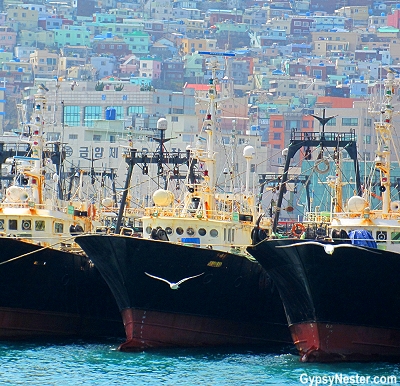
Our first glimpse of Newfoundland! Entering the harbor at Port aux Basques.
Most everyone we talked to on the ferry to Newfoundland was heading straight from the dock to Gros Morne National Park, Newfoundland’s best known attraction. The fine folks at the province’s Go Western Newfoundland had other plans for us though, and boy are we glad they did. They had several stops before the famous park on the itinerary they set up for us.
At The Railway Heritage Centre we found a narrow gauge train. One of the last vestiges of the Newfoundland Railway that ran from 1898 to 1988. No doubt that huge snowplow got plenty of work.
Inside the recreated depot there are displays about the railroad’s history, but perhaps the most interesting item has nothing to do with trains.
An astrolabe from the early 1600s, found by Wayne Mushrow near Isle Aux Morts, is on display. The rare old sailor’s navigational instrument is still in working order making it nearly one of a kind.
Had we blazed up the highway we would have missed some things that ended up being among the highlights of our visit, beginning with the town of Port aux Basques where we came ashore.
Once again that good ole GypsyNester dumb-luck played in our favor, as Canada Day celebrations had been postponed for a night due to weather, and were just kicking off as we entered the town.
A crowd was gathering as a band set up in Scott’s Cove Park by the harbor, and vendors had booths with crafts and treats.
We ambled about for a few minutes, getting introduced to Newfoundland, then walked up the hill for dinner at the St. Christopher’s Hotel. We were greeted like old friends by Lloyd Whitehorn at the front desk. Lloyd also gives tours of the area, so he was the perfect guy to give us a few pointers.
We had heard about fish and brewis before arriving on the island, and understood that this was a must-have meal if we were to get the full Newfoundland experience.
Salt cod and hardtack are soaked, then boiled, chopped up, and combined for a plate of stick-to-your-ribs seafaring rations. The menu listed Fisherman’s Brewis, but we figured it must be the same thing.
But first we had to try the true delicacy of the North Atlantic, cod tongues. Fried tidbits straight from the fish’s mouth, served with scrunchions, deep fried pork fat bits.
The tongues just tasted like cod, with a very slight gelled consistency. And everything’s good with a little pig fat on it. Scrunchions were also used to dress up the fisherman’s brewis.
Might not sound like gourmet dining, but it sure hit the spot after our crossing. Later in our trip we discovered that St. Christopher’s kept the fish and bread in bigger pieces than the more traditional versions.
It seems that can be the difference between calling it fish and brewis, or fisherman’s brewis.
After dinner we watched the Canada Day fireworks over the bay, then drifted off dreaming of what awaited us on this intriguing island at the edge of North America.
Sunrise found us learning much more about the island over breakfast of cod cakes and eggs with Stella Pittman, manager of St. Christopher’s.
She explained how so many folks miss the incredible beauty of the southwest portion of Newfoundland by driving through without stopping. She, and several others, told us about visitors who thought the island was small enough to see the whole thing in three or four days.
Considering it is over six hundred miles from top-to-bottom, and end-to-end, that would mean non-stop driving.
We’ve been wanting to see Newfoundland for years, but we wanted to do it in our motorhome.
Wait a minute, Newfoundland is an island, and our little RV may do a lot of things, but driving across the North Atlantic is not one of them. Yet there is a way to get a motorhome — or any other vehicle — onto the island... CONTINUE READING >>
Our first glimpse of Newfoundland! Entering the harbor at Port aux Basques.
We’ve been wanting to see Newfoundland for years, but we wanted to do it in our motorhome.
Wait a minute, Newfoundland is an island, and our little RV may do a lot of things, but driving across the North Atlantic is not one of them.
Yet there is a way to get a motorhome — or any other vehicle — onto the island… Marine Atlantic operates two ferry routes from North Sydney, Nova Scotia.
We began our journey with the shorter of the two passages, a daytime six-hour cruise of about one hundred miles, leaving from the northeast edge of Nova Scotia and arriving at Port aux Basques on the southwest tip of Newfoundland.
Our ship, MV Blue Puttees, was more than big enough to carry any motorhome. In fact, at over six hundred feet long and a whopping 28,000 tons, it can carry hundreds of motorcycles, cars, big rigs and RVs with ease — and did.
Above the vehicle decks we found big, comfortable reclining seats and were ferried across the Cabot Strait smoothly and in style.
After lunch we found a spot in the panoramic lounge where we discovered a Newfoundland original, Iceberg beer. Beer made with water from melted icebergs — we felt pretty darn special drinking that.
Back to our seats for a comfy nap, and next thing we knew we were driving off the ship on to Newfoundland.
Sure glad we had our little home on wheels with us, it made it so we could stay just about anywhere.
We weren’t sure what to expect as far as availability of services, but it turns out that Newfoundland is extremely RV friendly.
There are tons of Provincial and National Parks, and private campgrounds, as well as lots of free services like dump stations and places to boondock.
The locals call it gravel pit camping, named for the roadside gravel areas left over after highway construction, but it applies to overnight parking almost anywhere that it isn’t expressly forbidden… often in amazing, picturesque oceanside spots.
We ended our trek in the southeast corner of the island, so we could catch the other route that Marine Atlantic serves, from Argentia back to North Sydney in Nova Scotia.
This is a good-bit-longer crossing, almost three hundred miles, so we booked a stateroom where we could sleep away the bulk of the overnight trip aboard the MV Atlantic Vision.
The largest ship in the fleet, Atlantic Vision is designed with passenger comfort for longer voyages in mind, including roomy cabins featuring full baths and satellite TV.
This is no typical ferry, she is more like a cruise ship, with several dining options, from a snack bar, to The Atlantic Vision Buffet, to the elegant Flowers A La Carte Restaurant. There was even entertainment in the lounge.
WATCH: David shows you around our cabin aboard the Atlantic Vision!
So after stuffing our faces at the buffet, we slept like babies rocking on the waves. In the morning, we drove back on to the good old North American continent rested and refreshed.
And with mountains of amazing memories that will last a lifetime from our visit to Newfoundland.
Traveling by motor vehicle is great and allows you to experience certain freedoms that you couldn’t with the demands of air travel. However, getting in a wreck can leave you with serious damages. If someone else causes a crash, it’s best to speak to a trusted car accident law firm as soon as possible.