Watch us hunt for the Big 5 in South Africa – and come nose to nose with an angry rhino!.. SEE MORE >>
Watch us hunt for the Big 5 in South Africa – and come nose to nose with an angry rhino!.. SEE MORE >>
In the end, our safari experience went beyond our expectations, as we were immersed in the heart of Africa’s wilderness and treated to an intimate encounter with its most iconic creatures. We realized that Kruger National Park is not a zoo – it’s a realm of unpredictability, where nature reigns and surprises await at every turn. As we reflect on our journey, we are grateful for our exceptional luck and the incredible memories we’ve captured in our cameras, forever cherishing the beauty and majesty of best safari South Africa wildlife.
We’ll be teaming up with Alex Sheshunoff and Scott Dannemiller to regale you with our tales of “Ditching the Daily: Chronicles of Simple Living, Finding Joy, and Letting Go.”
For us, that meant selling the house and hitting the highway – it’s been over seven years now, can you believe it?
We will be expounding our adventure and the journey from empty nest to no nest at all (and the crazy antics that pop up when a decision like that is made!).
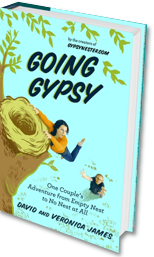
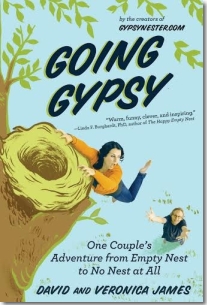
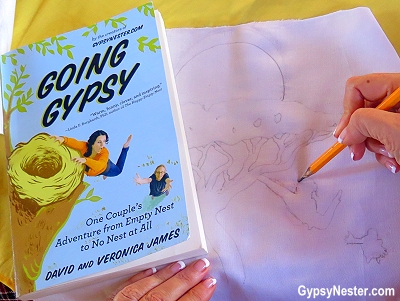
Here’s our book, click on the cover to learn all about it!
Alex’s book (which has a real mouthful of a title, soooo, deep breath)…
A Beginner’s Guide to Paradise: 9 Steps to Giving Up Everything So You Too Can: Move to the South Pacific, Wear a Loincloth, Read a Hundred Books, Diaper a Baby Monkey, Build a Bungalow and Maybe, Just Maybe, Fall in Love!
…is a hilarious account of, well, the subtitle pretty much tells it all. If diapering a baby monkey while wearing a loin cloth doesn’t pique your interest, something may be very, very wrong with you. 😉
Scott’s book…
The Year without a Purchase: One Family’s Quest to Stop Shopping and Start Connecting
… shares the wit and wisdom of a couple (and their kids!) who gave up buying all the stuff they really didn’t need and gained… hold on, we don’t want to spoil the fun, so we’ll let Scott fill you in on that at the Festival!
Here’s all the details you need to meet up with us at the Southern Festival of Books in Nashville!
Our session is Saturday, Oct. 10 at noon, in the Legislative Plaza, Room 12 (enter the building at the corner of 6th and Union), and we’ll be signing books at 1:30 in the Signing Colonnade
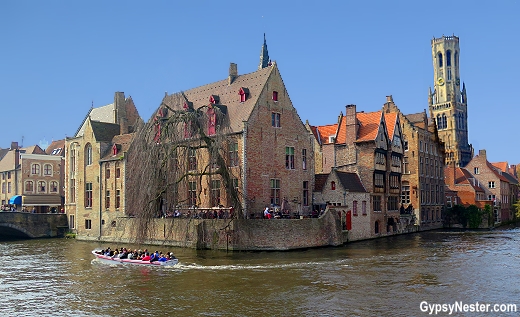
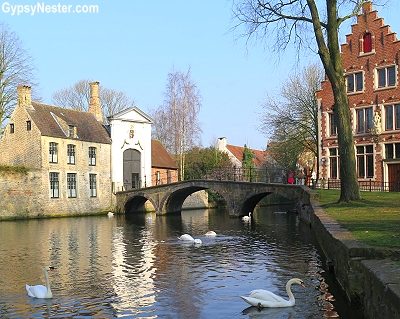
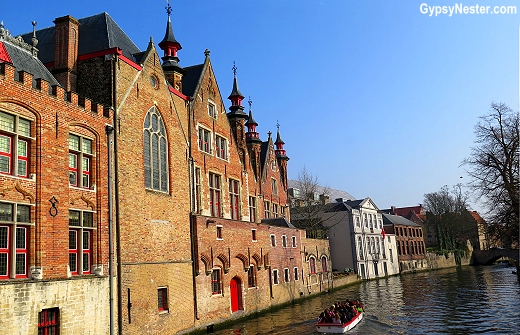
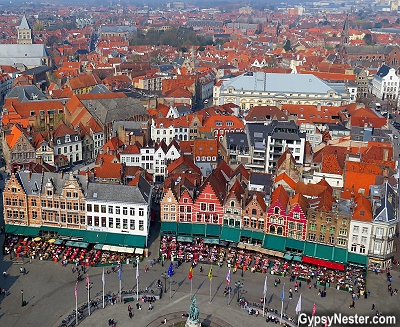
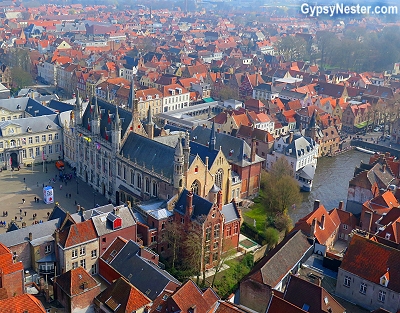
Her beautiful old town has been designated a UNESCO World Heritage Site.
All of the buildings — even businesses and private homes — can only be renovated according to strict rules that maintain the authenticity of the city, creating a wonderful time capsule… CONTINUE READING >>
Though it is no longer accessible by ship, Bruges was one of our favorite stops on our Viking River Cruise through Holland and Belgium.
Centuries ago the river was deep enough for ships and reached out to the sea. With her strategic location at the crossroads of the Hanseatic League trade and trade routes to the Mediterranean, Bruges was once the chief commercial city in the world.
Around the year 1500 sand deposits filled in the channel to the sea and the city declined, but happily much of the medieval architecture was preserved.
In the last century or so, efforts at preservation became a priority and the old town has been designated a UNESCO World Heritage Site.
All of the buildings — even businesses and private homes — can only be renovated according to strict rules that maintain the authenticity of the city.
This also means that vehicle access is restricted, so we walked along the ancient canals from the old city wall toward the two towers that dominate the skyline.
March of the Beguines
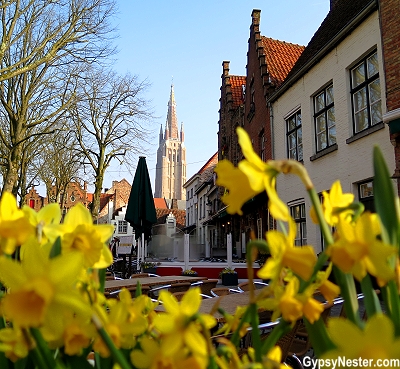
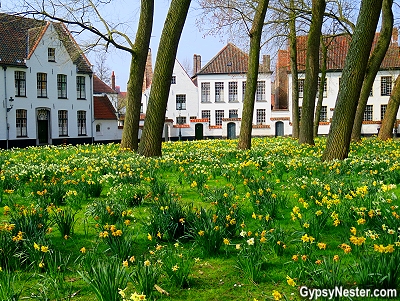
Just as we entered the city walls we came to a field filled with daffodils surrounded by what looked to be a campus.
The compound was home to Beguines, a religious order of women similar to nuns, but technically lay people.
They devoted themselves to a life of prayer and good works, but without taking vows.
The communities sprang up during the Middle Ages because there were more women than men – husbands were in short supply and being single was not terribly socially acceptable.
Following the towers
Wandering through the narrow streets and small plazas, it was easy to keep our destination in sight – we just looked for the towers.
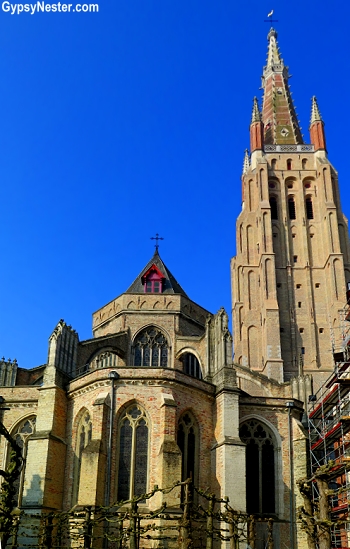
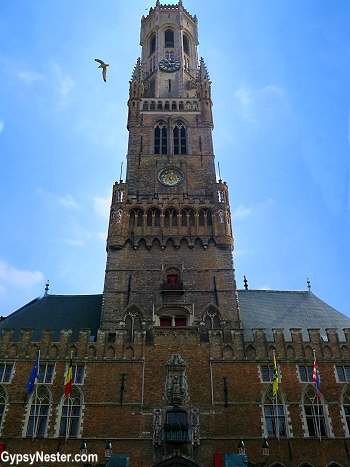
Soon we were standing in front of the city’s main church, the Church of Our Lady, beneath the first of the towers.
The spire rises over four hundred feet high, which makes it one of the world’s tallest towers made of brick.
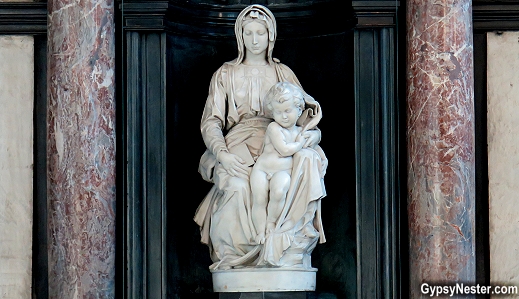
In addition to noteworthy tower, the church is home to Michelangelo’s sculpture of the Madonna and Child.
The work wasn’t originally intended for this church, but the Italian master sold it to a couple of Belgian merchants who brought it to Bruges in 1514. It was the only work by Michelangelo to leave Italy during his lifetime.
Chalk that up as one of the advantages of being a trade giant in those days.
Blind Donkeys
Leaving the church we turned on Blinde Ezel Straat, which we had to love because it translates to Blind Donkey Street.
And who doesn’t love a blind donkey?
The name likely stems from the practice of blindfolding donkeys to prevent them from getting dizzy while turning a mill, although there are a few more colorful legends as to its origin floating around.
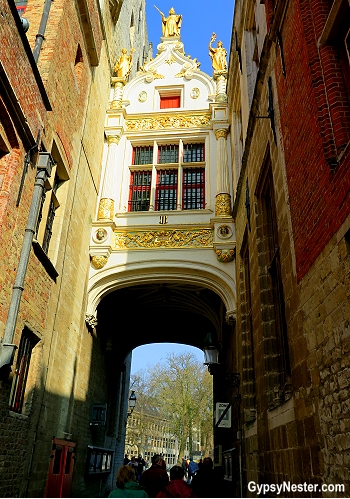
At the end of the short street we passed under an ornate arcade that opened up into into a large square.
Just like the old saying about blind squirrels and acorns, it seems that even a blind donkey can find an incredible town square.
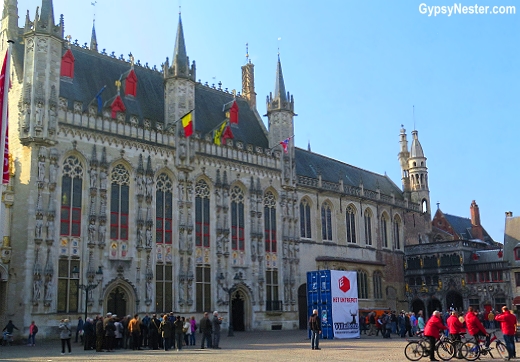
Turning around to face Blind Burro Boulevard, we see that the archway we came through connects the justice hall with the city hall, both of which are decorated with some serious statuary.
As is often the case, Justice holding her scales stands on the peak of the courthouse.
Spying Holy Blood
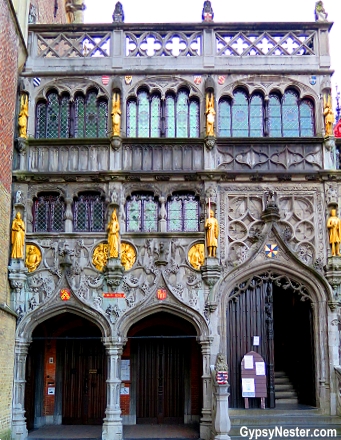
Next to the city hall there is a small chapel, but it looms large in the life of Bruges.
The tiny church is home to the relic of the Holy Blood, reputed to be a sample of the blood of Christ allegedly collected by Joseph of Arimathea.
Thierry of Alsace, the Count of Flanders, brought the vial back from the Second Crusade in 1150.
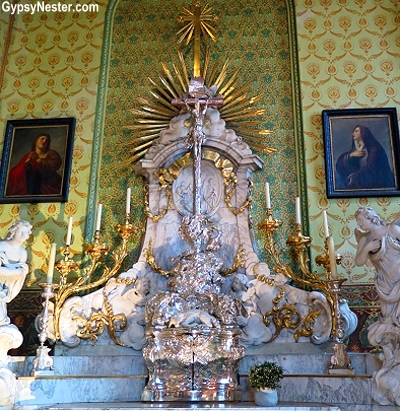
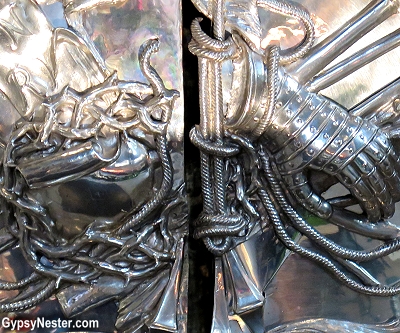
We went in with high hopes of seeing the amazing artifact, but the relic is kept inside a silver tabernacle.
But wait, perhaps it was just wishful thinking, but we thought we caught a peek at the vial through a sliver between the silver doors.
With no good way to corroborate our possible vision, we’re going to say yes, we saw it.
To be certain of a sighting we would have to be back in town for the annual procession through the streets celebrated on Ascension Day.
Celebrated forty days after Easter, it is always one of the city’s biggest events.
Since returning that soon felt unlikely, we figured that when in doubt, go with the better story.
Showing our mussels… and a Kwak attack
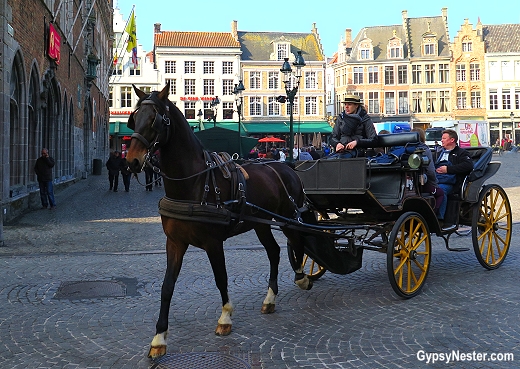
The second of the two famous towers of Bruges, the Belfort, loomed over us behind the Basilica of the Holy Blood so we walked over to the next plaza where Markt Square spreads out in front of the belfry.
We were determined to climb to the top of the tower, but the square is lined with restaurants, so first we grabbed an outdoor seat for a midday meal.
The spot we picked also happened to be a good place to delve into some Belgian beer research.
Belgium is known for beer, with a history of brewing going back nearly a thousand years.
Originally monks made the beer — and some still do — but the art has become an integral part of Belgian life.
Bruges plays a big part in that past, so to fortify ourselves for a climb up the three hundred and sixty-six steps to the top of the town’s famous bell tower we needed some traditional Belgian food and, of course, a bit of beer.
Being ignorant in the ways of the country’s brews, we chose to rely on our waiter to recommend the ultimate local beverages.
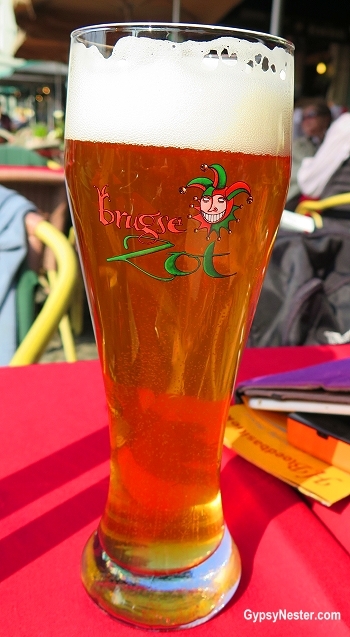
A Zot Blond is a must in Bruges; we had passed the brewery on our walk into town.
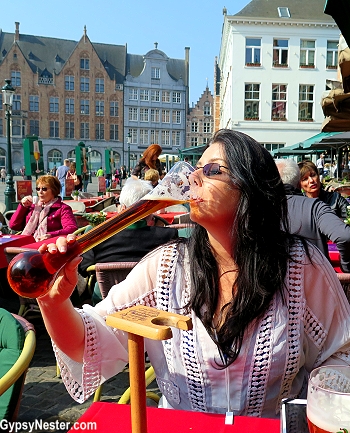
Kwak, came with the server’s endorsement as “a special beer.” We like special, so we ordered a Kwak too.
And judging by how it arrived, the Kwak must be special indeed!
The Kwak arrived in a giant glass bulb held up by a wooden stand – making the entire presentation quite the show.
It looked like something from a mad scientist’s laboratory ( or in this case pronounced lab-or-a-tory).
Folks at nearby tables were snapping pictures and asking about the Kwak – making us feel like movies stars.
The Kwak lived up to its hype – delicious.
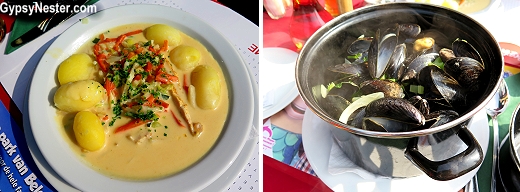
To dilute our giant beers, we went with two of Belgium’s most typical dishes, a creamy chicken stew known as waterzooi and moules frites, which is mussels with french fries.
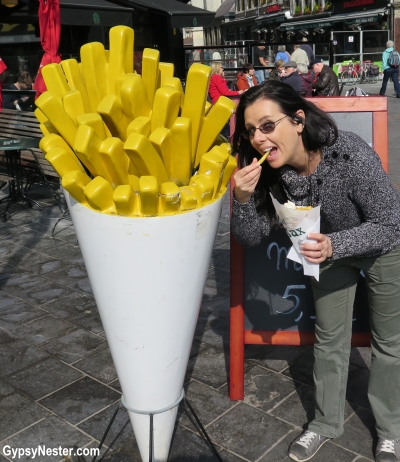
Never, ever called them french fries!
Oops, we must correct ourselves, it is strictly taboo to ever call fried potatoes “French” in Belgium.
Fries are without a doubt the national food, and Belgians claim to have invented them.
The French tag was supposedly due to mistaken identity by GIs from the USA during World War I.
Strengthened by our repast, we were ready to ascend the tower.
Burning off the calories by getting our bells rung
We could see where we had lunch from here!
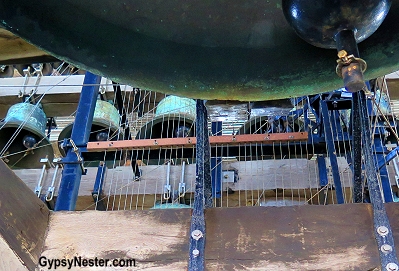
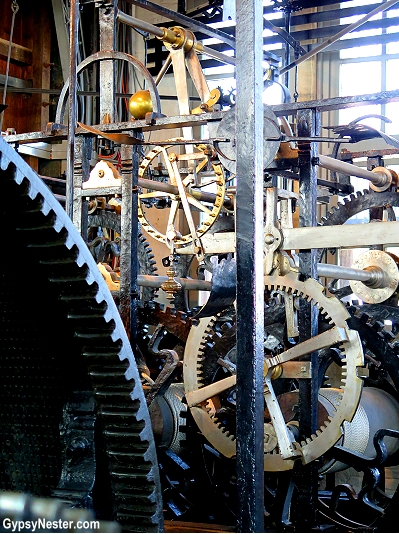
We waited in line with high hopes that seeing the clockworks, bells, and the carillon drum that controls the bells, and the view from the top, would be worth the sore legs that the seemingly never ending stairway would deliver.
We were not disappointed.
The forty seven bells of the carillon toll every fifteen minutes, so we made our first goal to go all the way to the top and wait for the next round.
Within a minute or two of making it the bells were pealing. It was certainly an eye, or more appropriately an ear, opening experience, but not as loud as we expected.
As the last of the bells reverberated, we took in the view from all angles before heading down one level to the drum room.
This is where the clockworks tick away, which also triggers the musical mechanics.
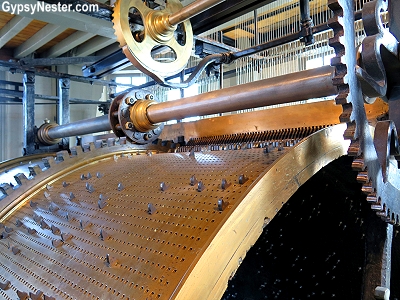
Soon the nine-ton brass drum (the largest in the world!) that controls the ringing of the bells began to turn.
The mechanism is like a giant music box. The cylinder has more than 30,000 holes where pins are arraigned to operate the hammers that strike the various carillon bells.
The huge wheel rotates and the bells ring out, but it only moves about a quarter of a turn.
Four songs are placed onto it, one for each quarter hour, and the pins can be moved and replaced to play different songs whenever it is desired.
We were simply fascinated, but time was running short.
We had to scurry, but not too quickly, down the spiral staircase to catch our bus back to the ship.
Haste needed to be combined with care because if we started rolling down the stairs, we might not have stopped until we tumbled into the middle of the square.
Bad way to end a day.
The only good thing about it would be the opportunity for another Kwak attack. Hmmm… maybe not such a bad thing after all.
Our volunteer vacation continues as we explore East Africa…
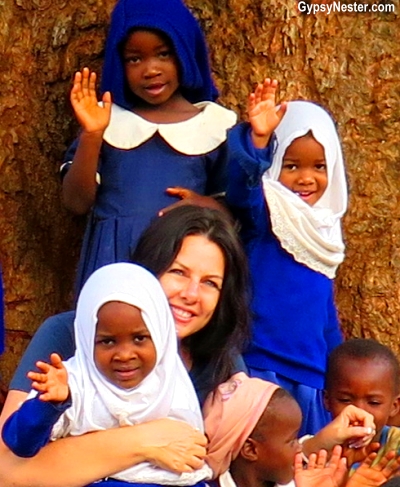
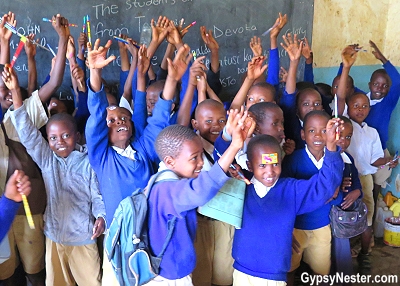
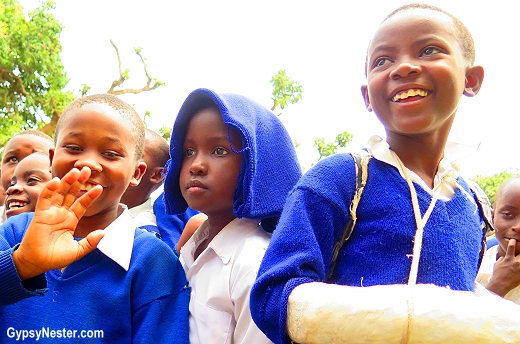
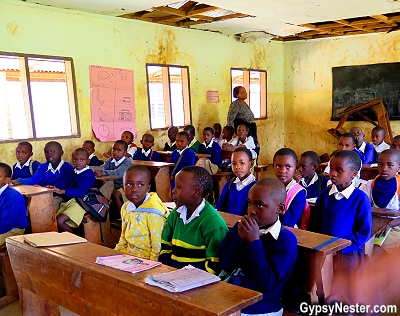
We’ve completely fallen in love with our students at our school!
Check out how our service projects are progressing and join us on an incredible photo safari in beautiful Tanzania… CONTINUE READING >>
A big thank you to Discover Corps for providing this moving voluntourism opportunity so we can share their good work.As always, all opinions are our own.
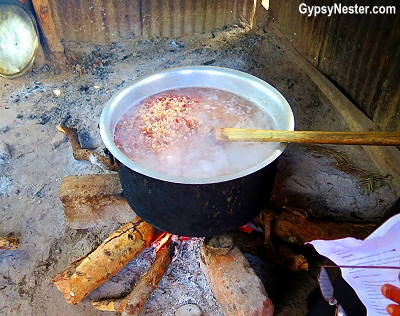
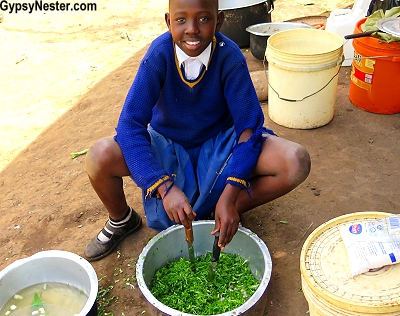
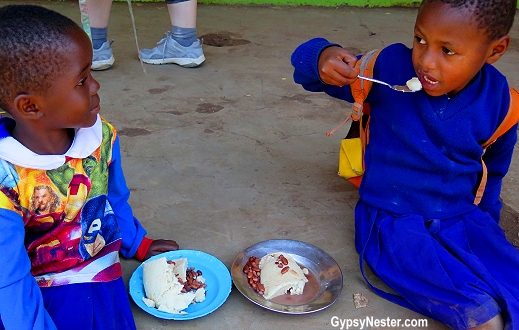
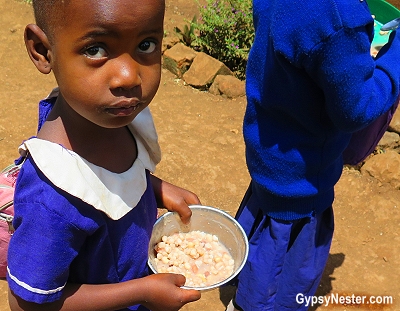
This is served with stew or beans and is sometimes supplemented with vegetables from the school garden.
However, most of the produce that the kids help grow is sold to raise funds for the school’s operation.
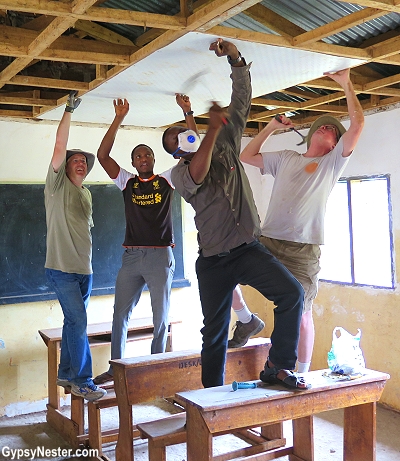
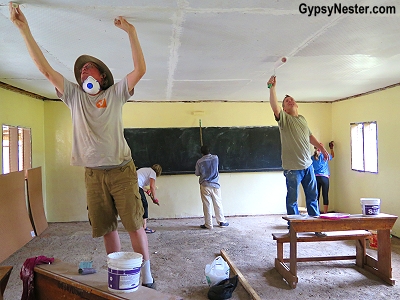
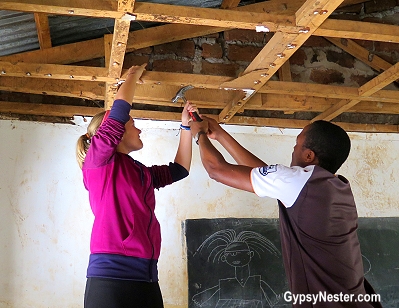
Back at the school we are all excited for a big day as we start putting up the ceiling panels and painting inside and out of the classroom.
At last we feel like we are making some real progress, not that the prep work we did before wasn’t necessary, but today’s work is much more visible.
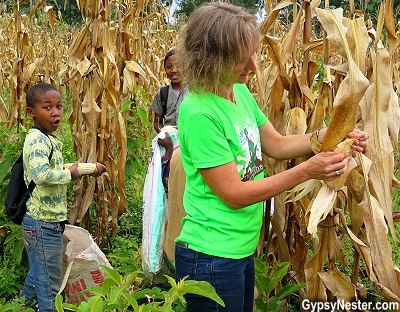
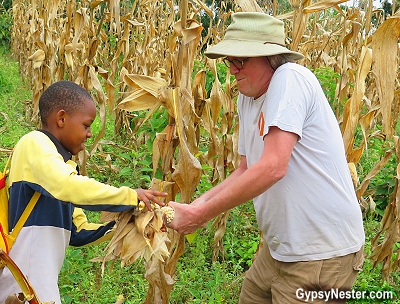
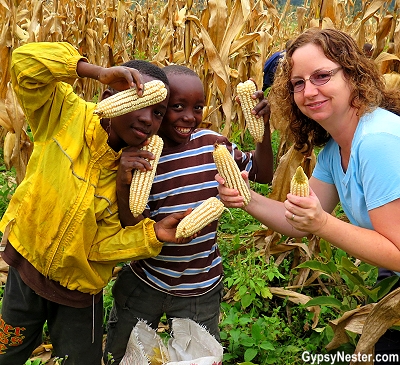
Just as we are getting ready to leave the truck with all of the corn that the children harvested arrives and the excited little workers boisterously unload their cargo.
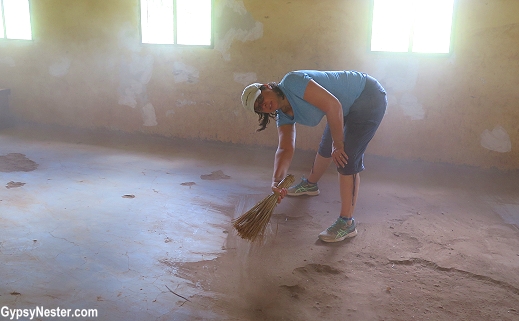
After some serious cleaning up and chowing down on Mama D’s good cooking, we are free to spend the rest of the day socializing, checking out the town of Moshi, or visiting The Tuleeni Orphans Home again.
We manage a quick run into town, and then an early evening return to the orphanage.
Some treats are passed around before a makeshift game combining soccer (football in these parts), keep away, and dodgeball breaks out.
After three visits we have become very friendly with several of the residents so we exchanged information with a few of the older kids and hope to keep in touch.
DAY TEN: Head and shoulders above it all, raising the roof, and a gorgous hot spring!
Morning: Teachers are hilarious!
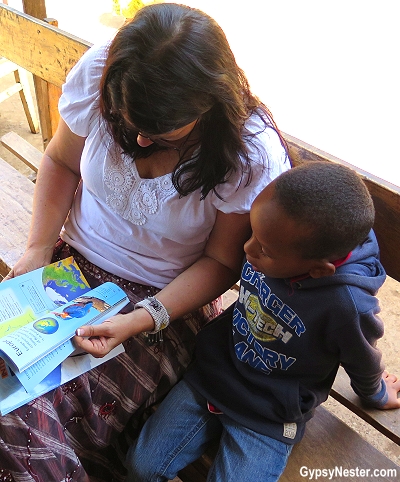
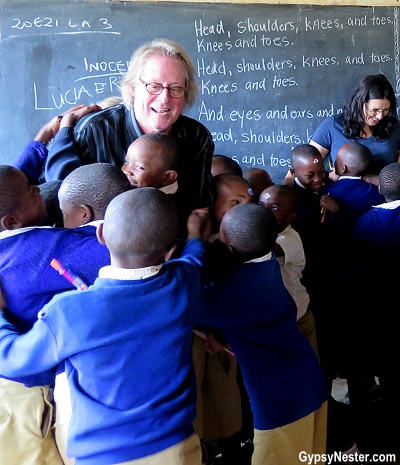
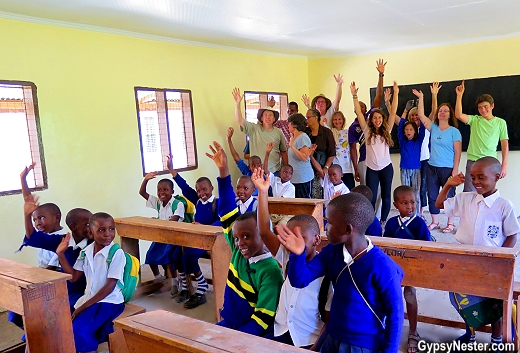
The kids are back in the classrooms this morning so we get to don our teaching caps again and try our best to impart a bit of English while adding a dash of fun. Head, Shoulders, Knees & Toes is a big hit.
We start by making sure that everyone knows all of the body parts, then sing the song slowly while touching each bit of anatomy.
After a couple of choruses the kids seem to have it down pretty well so we start to speed up.
We go faster and faster until the kids, and certainly us old teachers, are panting for breath.
Desperate for a breather, Veronica comes up with the notion to do it in slow motion.
The kids think that is hilarious!
A little bit slower now, a little bit slower now… then, a little bit faster now, a little bit faster now, and everyone is grinning ear to ear while gasping for air.
We change clothes and head back to our classroom project.
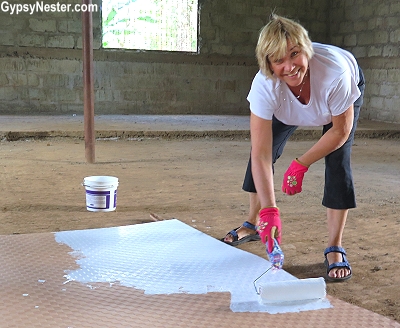
With the first coat of paint dry from yesterday it is time to finish the main part of the painting. Our team members attack it with a vengeance.
We’ve nicknamed our one hired carpenter “Nail Gun” because we have never seen such a machine when it comes to driving a nail. Without him we might never finish.
Late Afternoon: A glorious hot spring
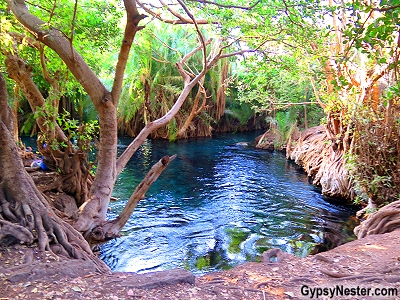
We feel confident enough that we will finish our classroom renovation to take the afternoon off for a swim in the Chemka Hot Spring.
It is fairly remote, hidden away down a sloshy, sandy road, but that makes it a perfect secluded getaway – a true oasis.
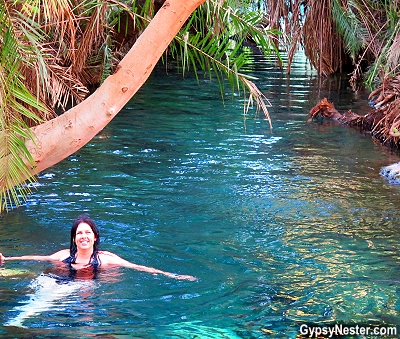
After the dusty drive, the impossibly blue water looked way too inviting to pass up and almost everyone is in the pool within minutes.
The water is not exactly hot, more like warm, but in the heat of the day that’s a welcome misnomer for the spring.
We bob and splash in the luxurious natural spa for about an hour, but don’t dare dally longer because we want to get home before dark. Mama D has dinner waiting.
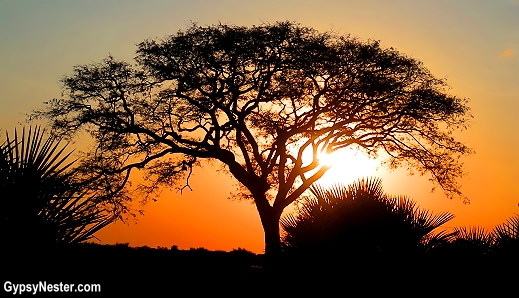
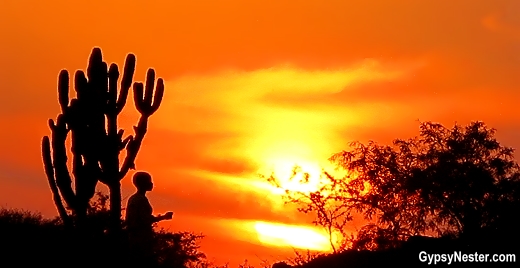
On the way back to basecamp we are treated to one of those African sunsets that heretofore we could only dream about.
DAY ELEVEN: A bittersweet day at our school, and an obese Massai
Morning: Bittersweet emotions and a job well done
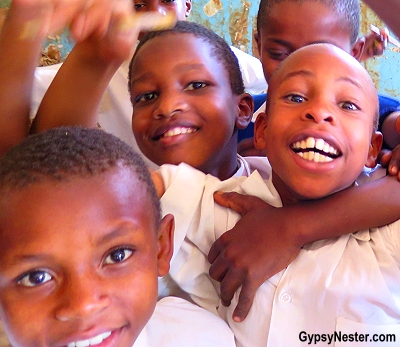
We enter into our last day of teaching with a bittersweet combination of emotions, sad to be leaving, but glad to have had the opportunity to meet and get to know these bright, fun-loving youngsters.
We are all certain that we learned more from them than they did from us in our stint as teachers.
Perhaps our biggest lesson: appreciate the simple things. These little guys absolutely light up when receiving the simplest gifts. A colorful pencil, a pen, or some cute little stickers bring smiles that would rival any Christmas morning grin on other children.
Our throats are lumpy and eyes moist as we say goodbye to the students and teachers, but we still have a few tasks left to complete before our project is finished.
So one last time we slip into our grubby work clothes and head over to our nearly renovated classroom project.
Our classroom “before”
The Discover Corps-ers fans out to put on the final touches.
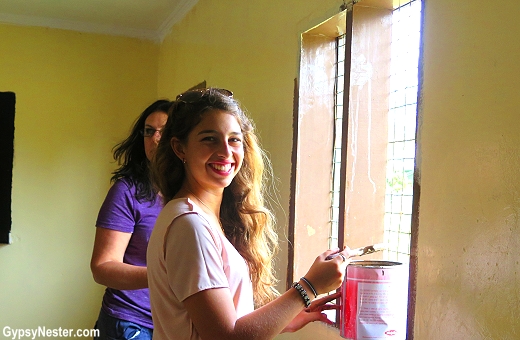
With brushes in hand we spread the last of the paint on the windows and… oh, wait, don’t forget the door!
The last thing we do is put up a couple of maps that Jeff found in Moshi. They give the room a dash of color and offset the blackboards that we renewed with special blackboard paint.
We take our “after” photos with big smiles.
Afternoon: Attempting art in Moshi
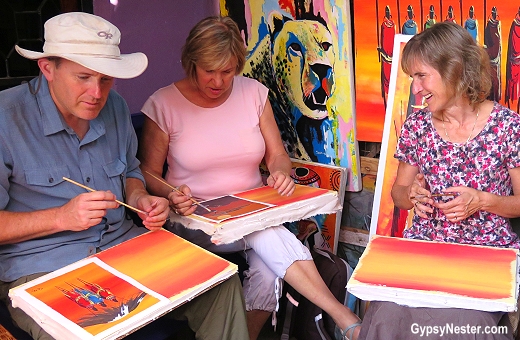
We hit Moshi town again this afternoon to take a stab at painting.
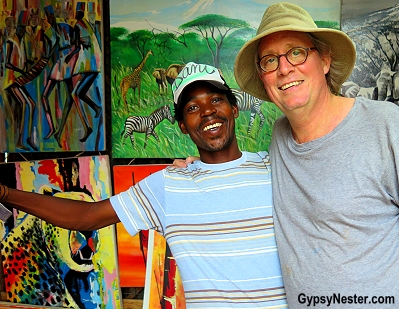
Our teacher is the artist Secy, whose paintings capture African life and wildlife in vibrant colors.
The idea is for us to choose one of his works and do our best to recreate it.
Like with our batik lesson, we start off rather unsure we can pull this off!
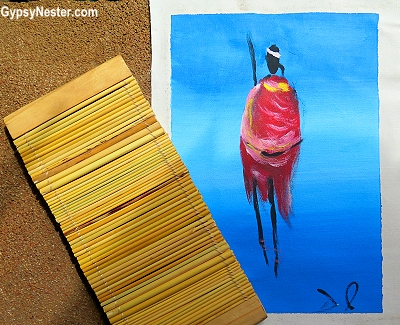
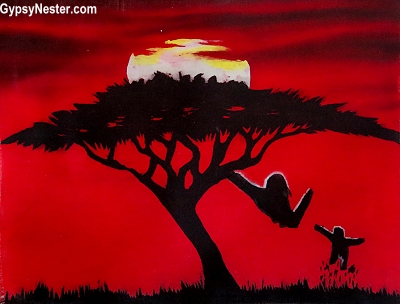
David chooses a Maasai man in red on a vivid blue background, mostly because he thinks that it is the only thing he has any chance of pulling off without total embarrassment.
His finished product looks a bit obese for a Maasai, but we are posting his effort without comment for all to judge whether he was successful or not.
Next door to Secy’s studio is a shop filled with ebony carvings, knick-knacks, and traditional African musical instruments.
David is intrigued with an intrument he has never seen, a kayamba, a rhythm shaker made from reeds and filled with seeds. Trying it out leads to an impromptu drum jam session with Secy and his drum teacher.
We head back to homebase for an early night… for tomorrow we go on safari…
DAY TWELVE: Tarangire National Park has sooooo many elephants!
Early Morning: An early start, a scary looking guy and life at the watering hole
Boarding Mama Simba’s bus bright and early for our trip to Tarangire National Park and Ngorongoro Conservation Area, we are filled with excitement at the hope of seeing lions, and tigers, and bears, oh my! Not really, there are no tigers or bears there, but we do hope to see elephants, zebras, giraffes, and especially lions.
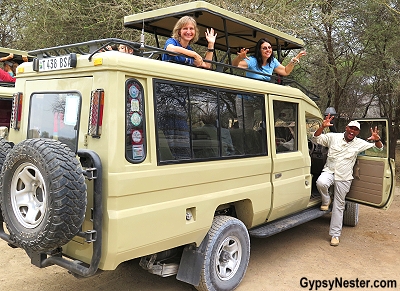
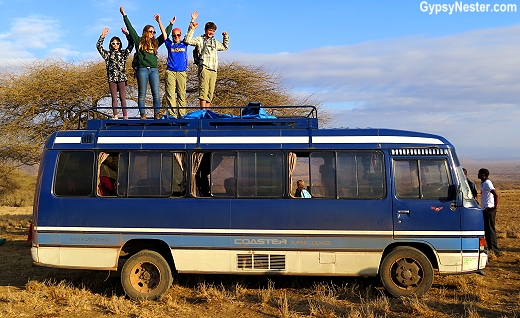
We stop in the city of Arusha to meet our guides and transfer over to the safari wagons that will be our transportation for the next two days.
The Discover Corps crew splits into two groups, with Alan guiding ours, Felix the other, and Raymond serving as team leader.
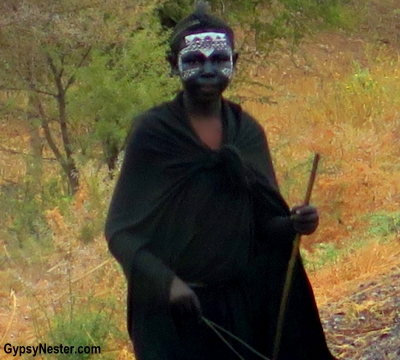
Along the road we see several young Maasai men dressed all in black.
A closer look reveals that they have painted their faces too.
Alan, who is Maasai, explains that this is the ritual after circumcision and initiation into manhood ceremony to dress this way for several months as they heal. The face paint is to ward off the evil eye.
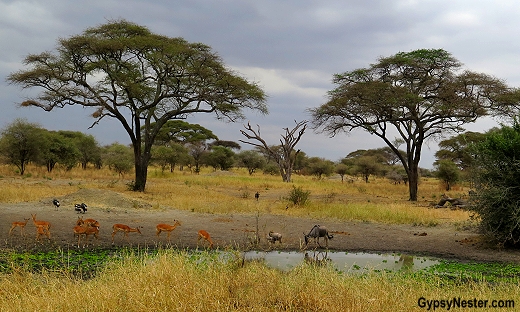
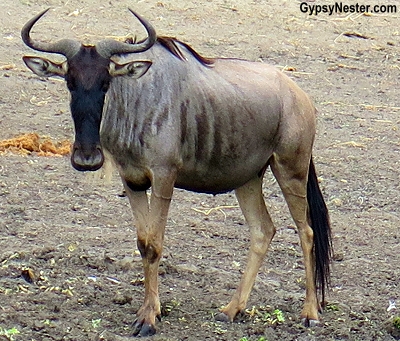
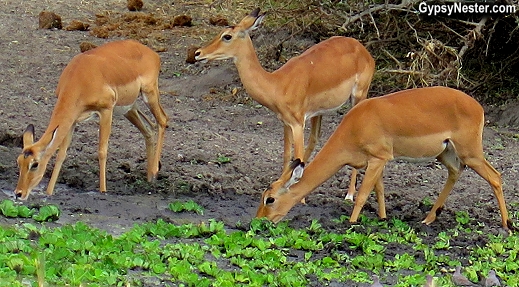
We enter Tarangire and almost immediately come upon a watering hole where impalas and wildebeests are getting a drink.
There is a bit of scuffling for position, with the wildebeests running off the others, but it looks as though everyone at least gets a sip.
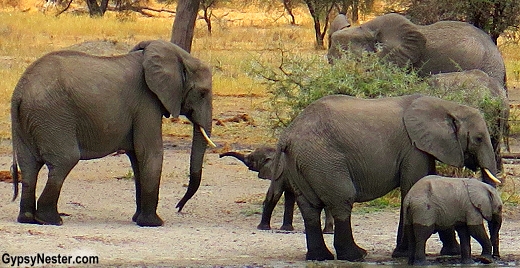
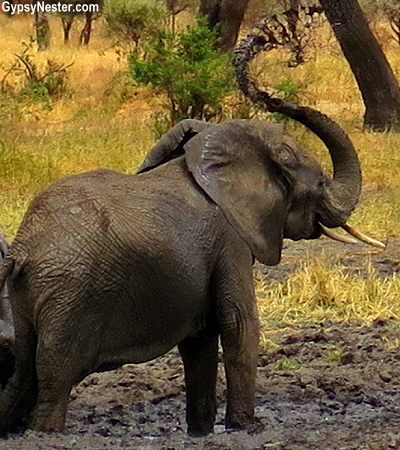
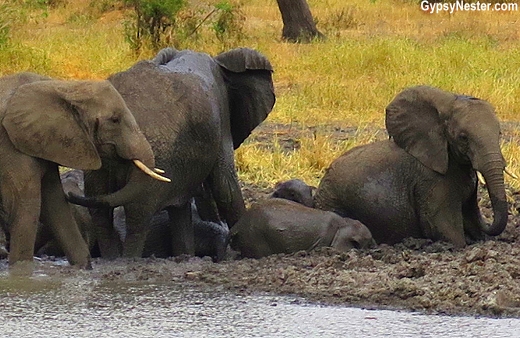
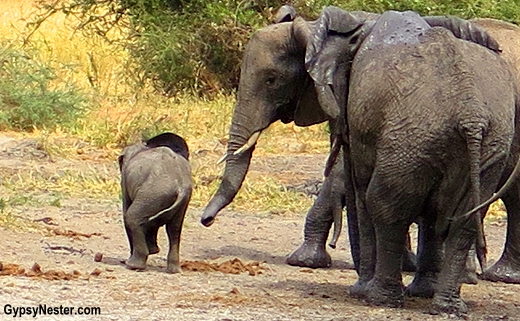
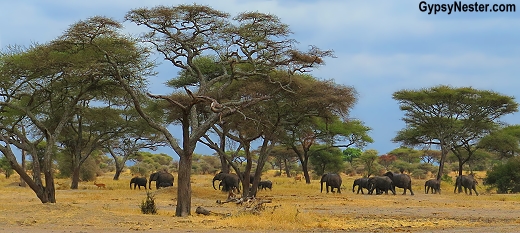
Rounding a bend we come up on about twenty elephants.
They have also found a water source, but it looks as though socializing and cooling down is more the order of the day than drinking.
We watch mesmerized for quite a while, until one of the young calves does something that the elders don’t approve of and gets a quick chastisement.
The minor ruckus puts the entire herd on the move.
Allen explains that the punishment might not have come from a parent since, with elephants, any adult can discipline any baby in the group.
WATCH: Watch as this little guy gets in trouble – and how the herd responds!
Morning: And the hits just keep on coming
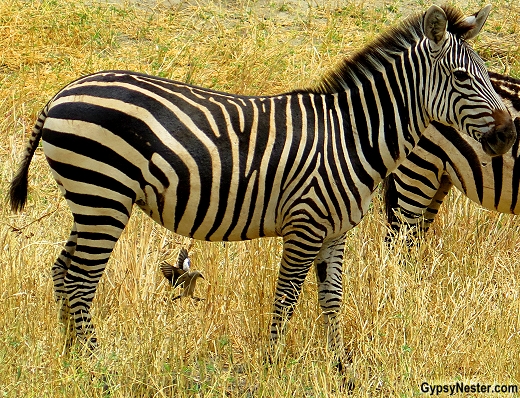
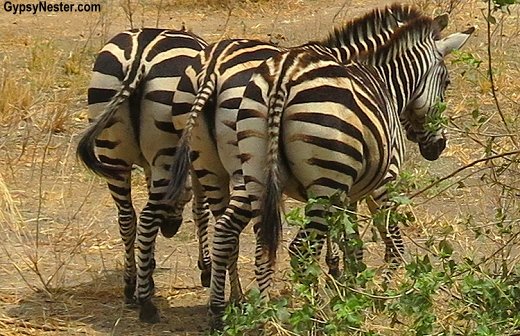
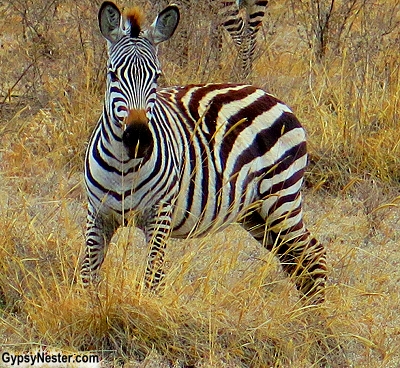
Our next close encounter is of the zebra kind.
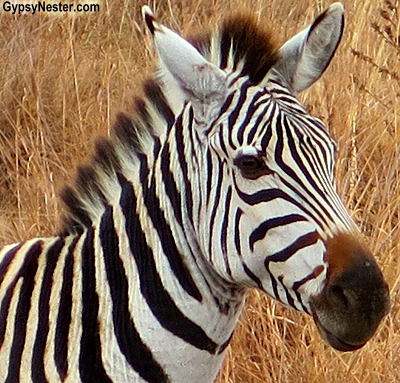
We LOVE how their manes stick straight up!
A couple of questions pop into our heads upon being so near to them.
Are they more like horses or donkeys?
Are they black with white stripes or white with black stripes?
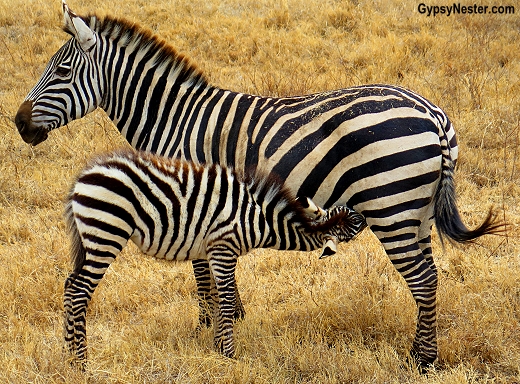
WATCH: Cutest thing ever! This baby, fuzzy zebra has lunch and a romp!
We decide on donkeys and, upon viewing them from behind where the black strips don’t quite meet up, black on white. Mystery solved.
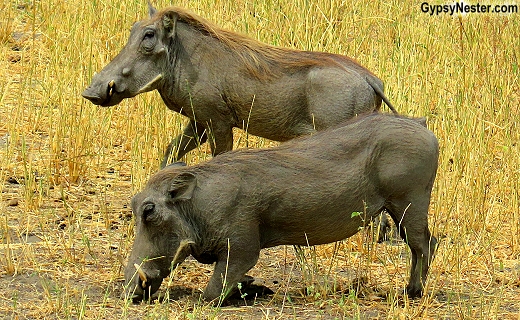
As we make our way deeper into the park, we notice a couple of warthogs rooting in the ground for bugs and grubs. They are such odd looking creatures, we’re finding it hard to wrap our minds around what we are seeing.
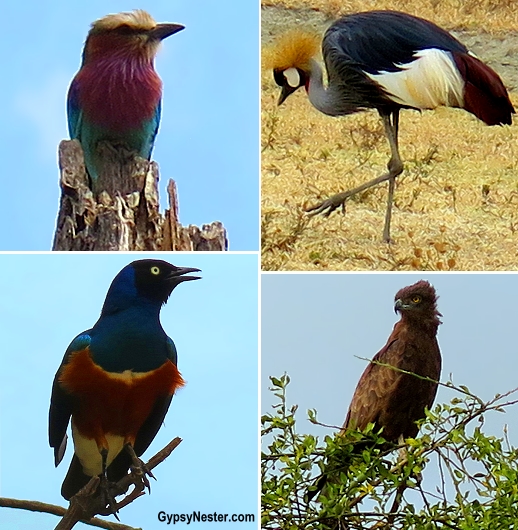
There is a vast variety of birds in the park. Along the way we see a lilac-breasted roller, a crown crane, a superb starling, and brown snake eagle.
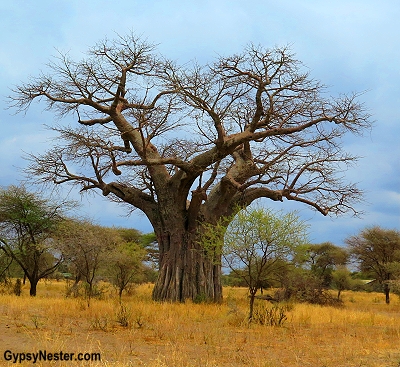
Throughout the park we are intrigued by the huge baobab trees. They look dead this time of year, because it is the dry season so the branches are all bare.
They can’t afford to waste the water involved in producing leaves, but as soon as the rains come their foliage will burst forth.
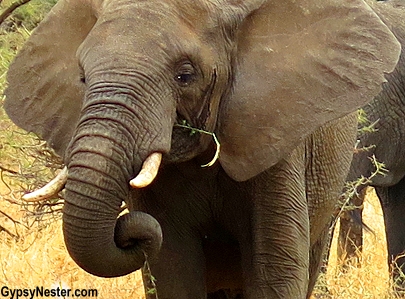
Many of the trees have big scars where elephants have been eating the bark. It is a good source of water this time of year and the gnawing doesn’t harm the trees.
Afternoon: The stars of today’s safari
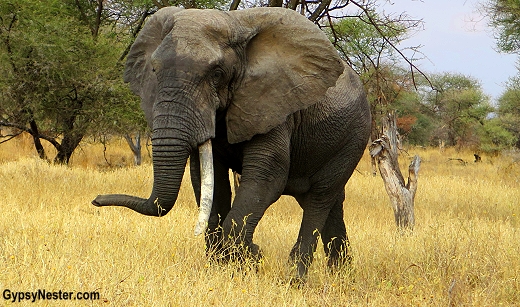
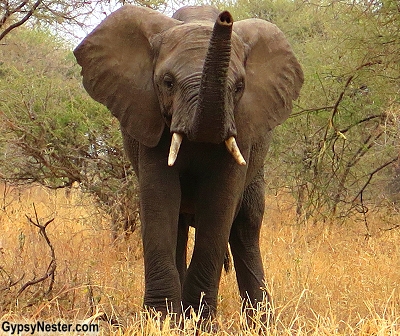
As the day goes on, it becomes very apparent that elephants are the stars of Tarangire.
They are everywhere!
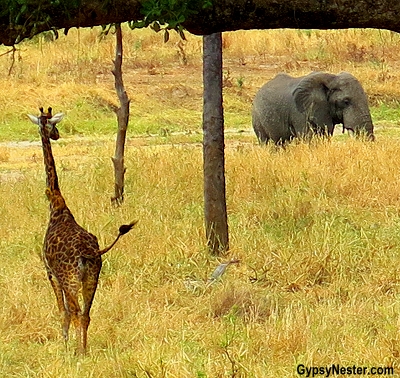
Not so much with giraffes, but we do find one lurking in the trees as we are turning back toward the entrance.
Of course a large pachyderm is also nearby.
As a day ending bonus, a large herd of the giants walk right in front of us just before we exit the park.
We never in a million years imagined that we would get this close to these mammoth creatures in the wild.
We spend the night in the town of Karatu, so we can be close to the Ngorongoro Conservation Area and get an early start in the morning.
Early in the day is the best time to see lions and we are certainly hoping for a sighting…
DAY THIRTEEN: Ngorongoro Conservation Area is chuck full of wildlife!
Early Morning: You ask for lions – you get… lions
We enter the refuge just as a foggy dawn is breaking, and begin the climb up to the rim of the Ngorongoro Crater.
This is a huge volcanic caldera, about fifteen miles across, which serves as a natural enclosure for many species of animals, concentrating them into a fairly small area.
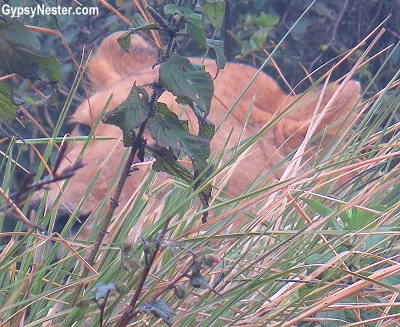
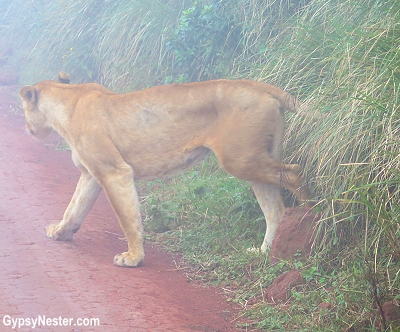
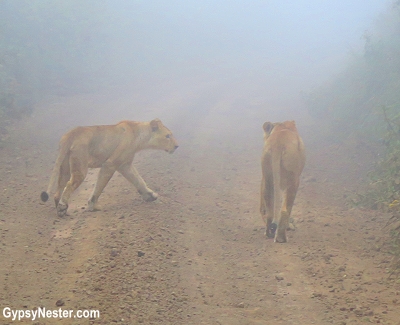
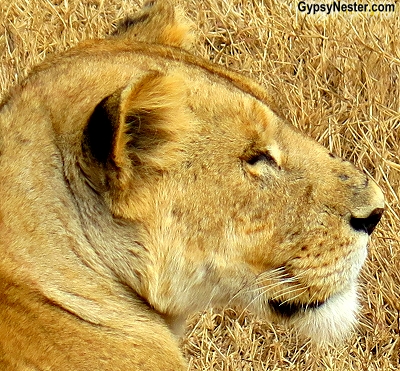
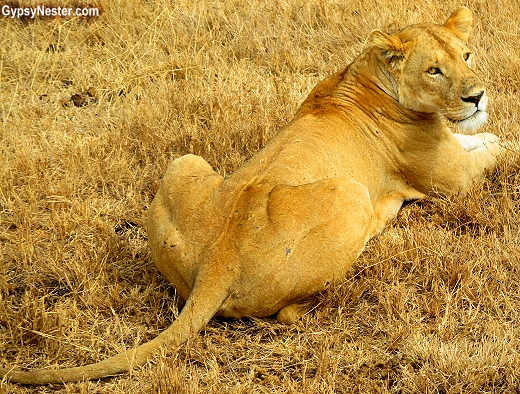
In the morning mist at the top of the crater Alan spots a lioness in the brush along the side of the red dirt road.
We hoped to see a lion, but had no idea it would be the very first sighting of the day!
We watch in stunned silence, and another appears behind her, and then another.
The trio walks through the bush, and then pops out onto the road directly behind the safari wagon.
Wow, this day is already high on our list of best ever, and it just started…
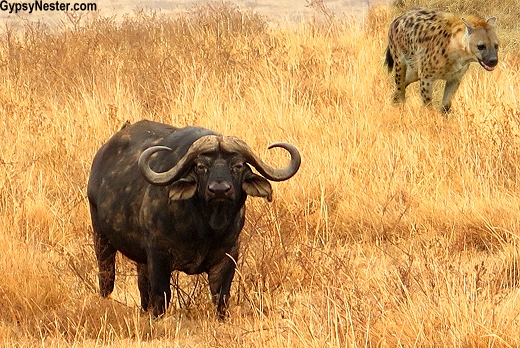
As we descend into the crater, we pass several herds of cape buffalo, along with many zebras.
They graze comfortably, seemingly without a thought about the many predators nearby.
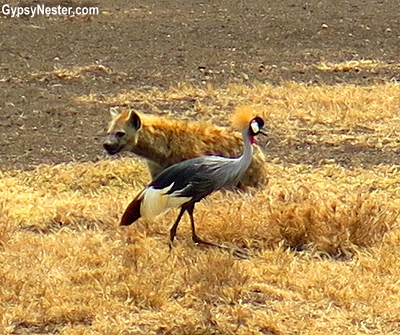
In fact, several times we see hyenas walking very close to zebras, gazzelles, wildebeests, and birds with the prey paying no mind to the hunter whatsoever.
Alan says that they can tell when the hyenas are hungry and in hunting mode.
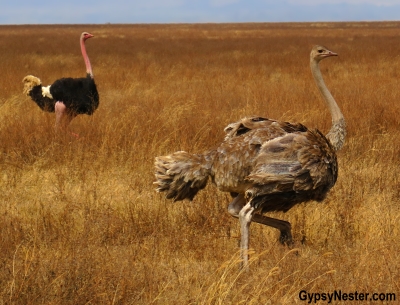
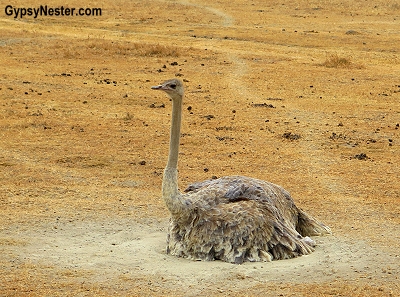
Next we find something unexpected, an ostrich. For some reason we didn’t think about the big birds as something we would see here, but there are a few.
This particular male, Alan identified him as such because of his black feathers as opposed to the grey of the females, has a very red neck.
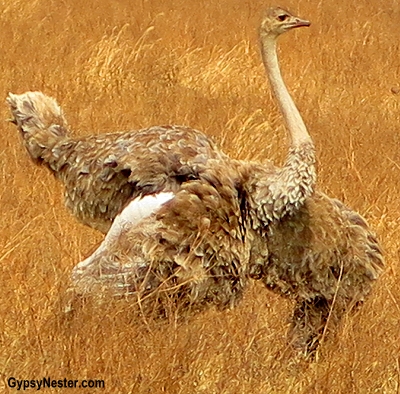
This shows that he is ready to mate, and as if on cue, here comes a female doing her dance.
It is easy to see the obvious difference in the plumage.
The two do their thing, very quickly we might add, and then go their separate ways.
p> Not for long though, as we learn when we see a mommy ostrich sitting on her nest.
Alan explains that the mother will sit on the egg all day, then it is dad’s turn at night.
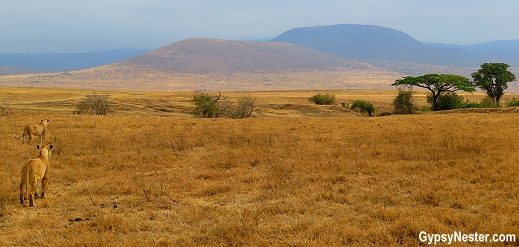
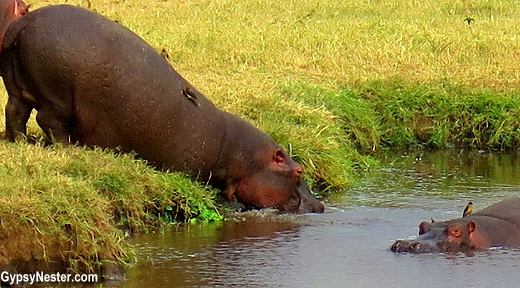
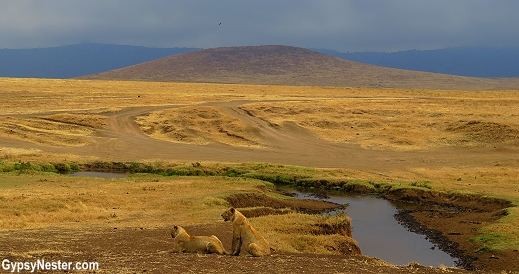
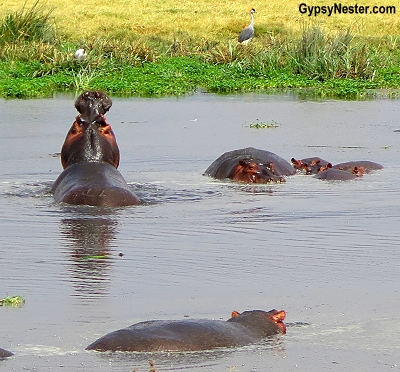
Just beyond the ostrich lovefest we come to a hippopotamus pool and, as if that’s not cool enough, there are also five lions hanging out.
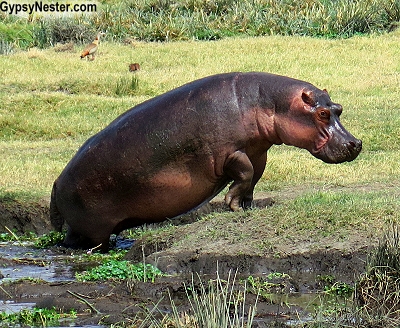
After a few minutes one of the hippos decides that three of the lions are too close, so he climbs out of the water, no easy task for the big boy, and chases them off.
They retreat about a hundred yards and then lay back down, which is great for us because it put them right next to the road.
We pull up a bit and are within just a few feet of the big cats.
Incredible!
The lions keep watch and decide to go back to their original spot, in a move that most certainly looks to have a “we’ll show those hippos who’s boss around here” attitude. The hippos pretend not to notice.
We finally tear ourselves away from this scene, confident that something equally exciting must be up ahead. We are not disappointed either, as Alan spots a black rhino way off in the distance. Even though the rare creature, there are only about five thousand left in existence, was too far away to photograph, we did get a pretty good look at it through the binoculars.
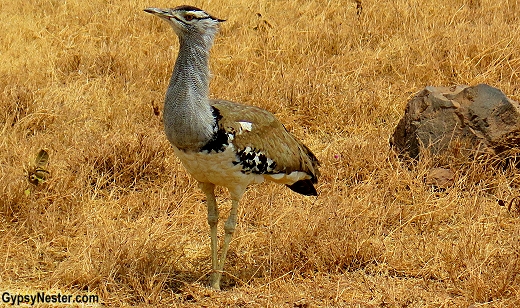
The kori bustard, however, was not so shy. As the largest bird in the world that can fly, we suppose he wouldn’t have to be!
Afternoon: Where there’s water, there’s wildlife!
We spot a group of safari vans in the distance and go to check out what they are up to.
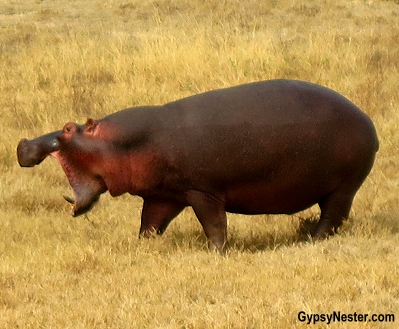
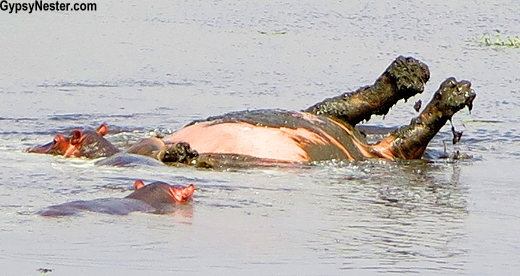
It is a large herd, or bloat, of around twenty or thirty hippopotamuses.
The hippopotami are doing what they always do when the sun is out, hiding in the water.
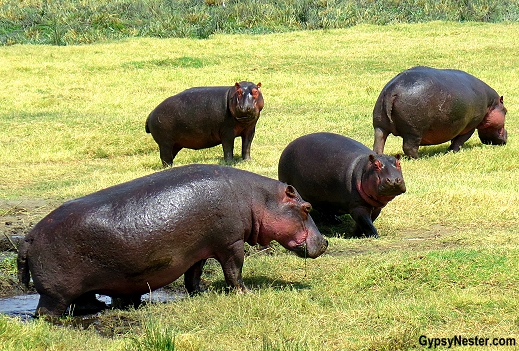
Their skin is very sensitive, so all day they stay in the pool and come out to feed on grass at night.
This behavior made us think that we were not going to see the group walking on land, but for some unknown reason one decides to climb out and walk over to another pool. Next thing we know the whole bloat is following.
We are amazed as we watch the three thousand pound beasts lumber across. It is somewhat like watching whales, which happen to be a close relative, take to the land.
Often birds hang out near, or sometimes on, the bigger animals and this pond is no exception with egrets and ibis all around.
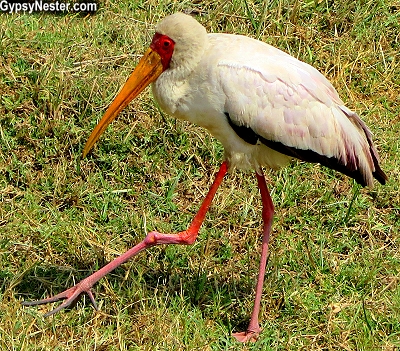
We also see a new feathered friend for us, the yellow-billed stork. Their humorous walking style has us humming Puttin’ on the Ritz.
A little top hat would have completed the scene nicely!
Another of Ngorongoro‘s most common residents are the zebras.
We see them everywhere and have been able to observe many of their behaviors.
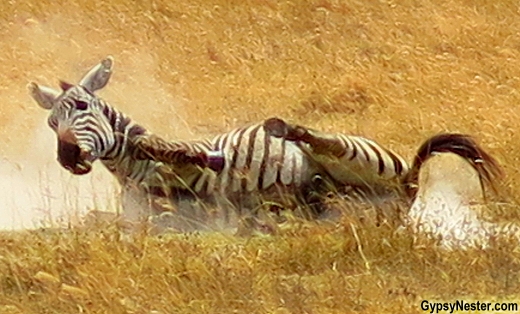
As a herd crosses in front of us watch one after another rolls around in the dirt for a good scratching, and to get rid of parasites such as fleas and ticks.
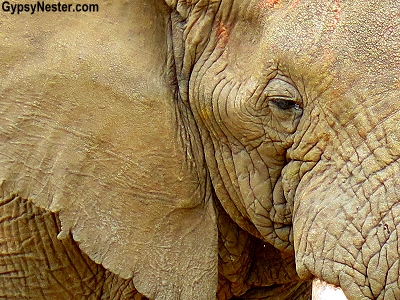
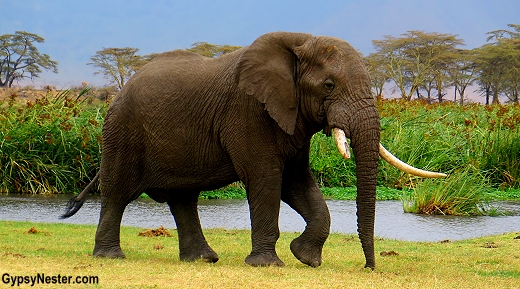
After lunch, a ginormous bull elephant decides to walk right through the area where we were eating.
From the dung scattered around, obviously this is not something unusual.
Elephants pretty much go where ever they want, with no concern for humans, lions, or anything else.
With this absolutely amazing morning behind us, we load back into the safari wagons and begin to make way for the climb back up the crater rim.
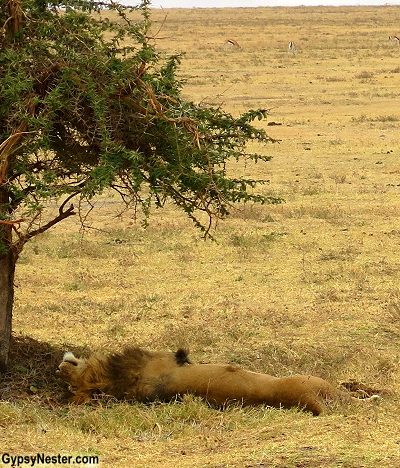
As with yesterday though, we get an incredible bonus just before leaving, a big male lion completely laid out in the shade of a small tree.
Like the elephant, this guy obviously has absolutely no fear from any predators and can sleep peacefully out in the open.
As we approach the rim the habitat changes, it is no longer grassland.
The forest thickens until it becomes more like jungle.
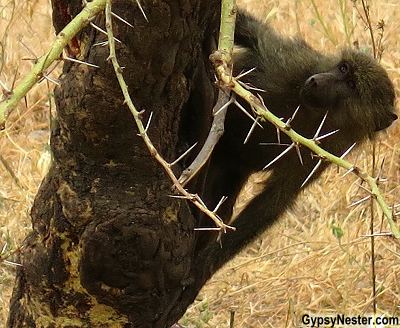
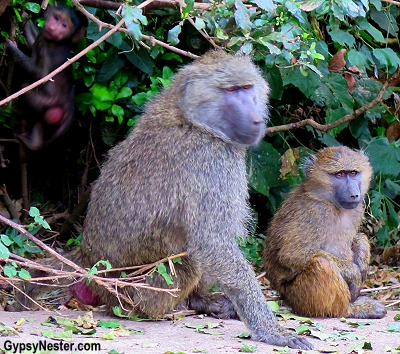
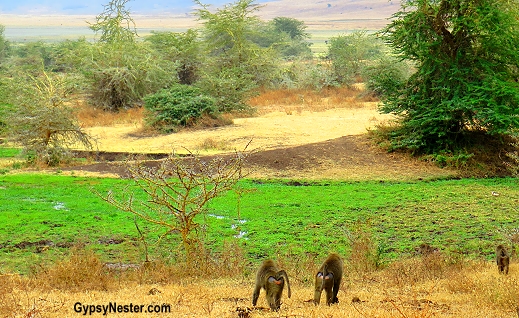
A large troop of olive baboons finds this to be a perfect place to do a little snacking, picking at the trees for a bit of sap.
They don’t stop long though, and neither do we.
The time has come to say our farewell to these two phenomenal wildlife sanctuaries, Tarangire National Park and Ngorongoro Conservation Area.
We’re pretty sure that most of us thought that this was just a nice way to greet us and make us feel welcome, but over the past couple of weeks our way of thinking changed.
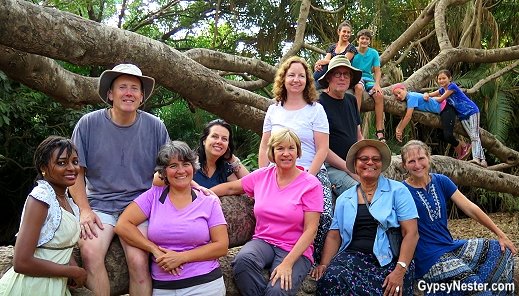
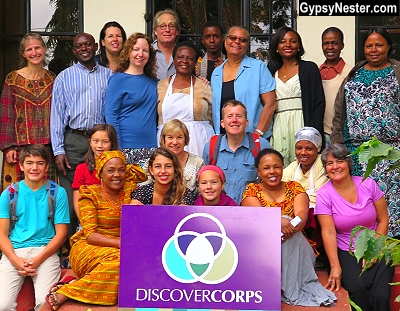
Now that we are bidding adieu to all of these wonderful people that we have lived, learned, worked, and explored with for the last fortnight, it really does feel like saying goodbye to family.
We have the same lumps rising up in our throats, the same desire to find a way to get back to see them as soon as we can, and the same lingering for one last hug before we go.
We certainly hope so, but we know beyond a shadow of a doubt that they certainly left a life-changing impression on us.
We also know that our Discover Corps teammates will be a part of our lives for years to come. They are people with giving spirits that make them fun to be around.
People who see a need and look for ways to address it.
The engaging and openhearted people of homebase and the village of Rau captured our hearts and we will carry them with us forever, and the experiences of Tanzania they shared with us can never be forgotten.
These experiences, and countless more, have left mental imprints that we won’t need photographs to recall.
Let’s just hope that the folks back home don’t get too exasperated with our telling and retelling of the myriad of memories that we are bringing back with us.
A big thank you to Discover Corps for providing this moving voluntourism opportunity so we can share their good work. As always, all opinions are our own.
YOUR TURN: What are you most excited to see about this adventure? Let us know and we’ll do our best to report about it! Have you taken a volunteer vacation? Tell us about it!
“Traveling throughout retirement may not be everyone’s idea of simple living, but David and Veronica say ditching the house was one of the best moves they ever made. ‘We are in a state of nearly constantly pinching ourselves… CONTINUE READING >>
“Traveling throughout retirement may not be everyone’s idea of simple living, but David and Veronica say ditching the house was one of the best moves they ever made. ‘We are in a state of nearly constantly pinching ourselves… CONTINUE READING >>
Our volunteer vacation continues as we explore Tanzania…
Your GypsyNesters continue to explore Africa in the best way possible – by helping as we go!
We’re continuing our service project to village children by teaching and fixing up their school, meeting the colorful Chagga people, and going deep into seldom seen Massai lands where we’ll encounter a world we’d never dreamed we’d experience… CONTINUE READING >>
A big thank you to Discover Corps for providing this moving voluntourism opportunity so we can share their good work.As always, all opinions are our own.
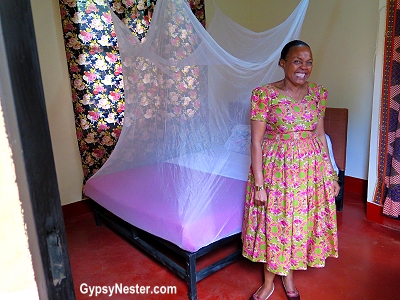
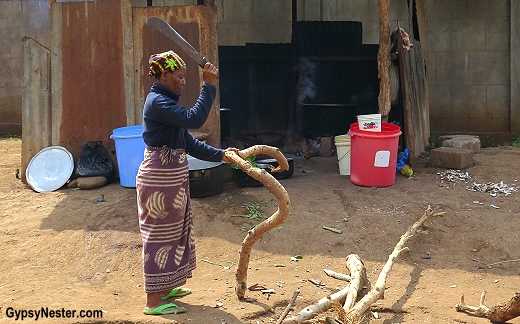
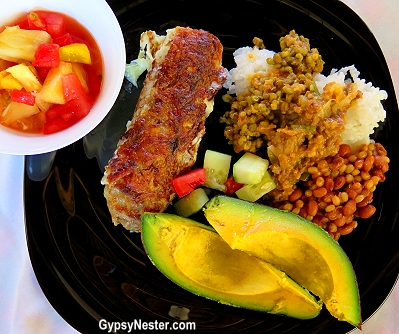
Mama Dinga, our extraordinary chef for the homebase, has introduced us to it, along with many other traditional specialties like cassava, cooked green bananas, stewed chicken, curry peas with coconut, and an absolutely incredible hot cucumber soup with ginger called supu ya tango.
Thinking back to our children at the school, we are reminded of how lucky we are.
Our afternoon is set aside for free time. Some of us work on lesson plans, others visit in the village and some of us head into Moshi to find supplies for the school.
We head to bed early. We have a 3AM wake up time for our visit deep into the seldom seen Massai lands…
DAY SIX: Meeting the Maasai, a man with 11 wives, and giraffe!
Early morning: A journey into the living past
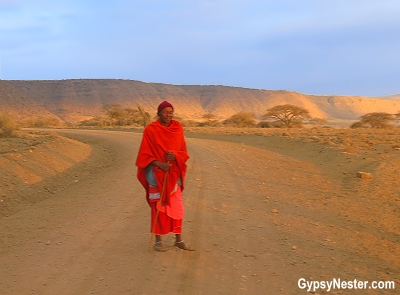
We are up well before the sun today because we have a three-hour drive to visit the Maasai people.
This region was home to homo habilis, likely the first early human species, about two million years ago, but the Maasai are relative newcomers, having migrated south from Kenya through the Nile valley over the past few centuries.
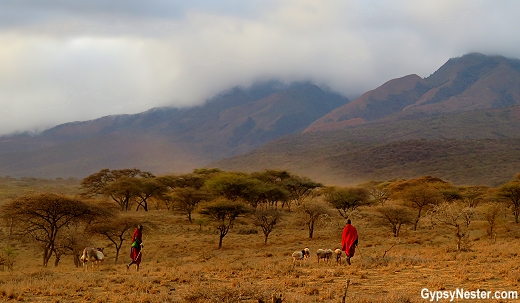
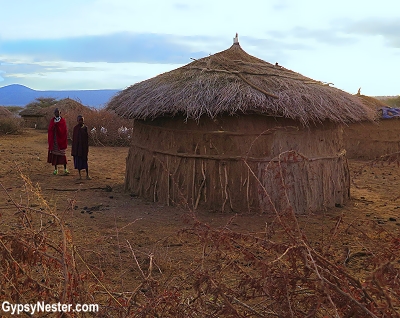
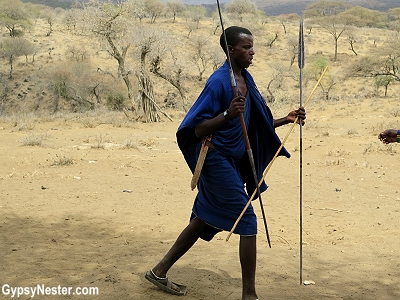
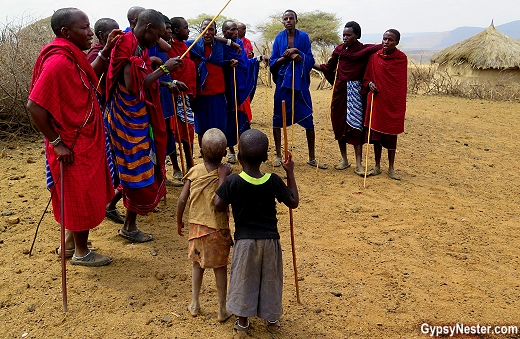
Driving along we see many of the distinctive huts, known as Inkajijik, that these nomadic herders use for shelter.
Several of these belonging to one family are grouped inside a protective barrier made from the thorny branches of the acacia tree to form a small village called an Enkang.
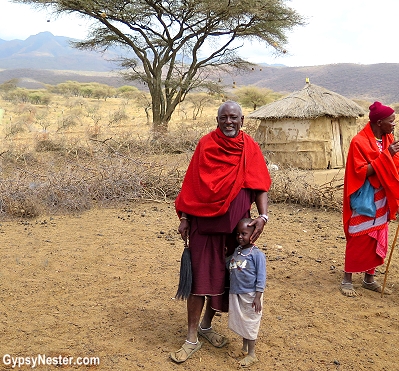
We drive the bus off the road to take advantage of a small patch of shade near an Enkang that is headed by a man with eleven wives and over seventy children.
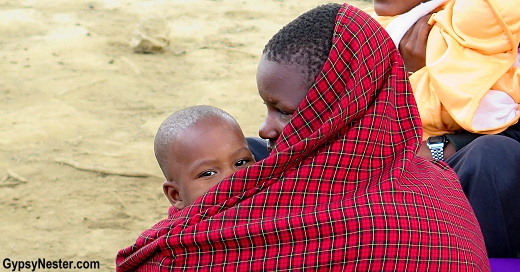
Many of these family units of Maasai have fought to retain their way of life against the encroaching modern world, continuing to herd cattle, sheep, and goats on their ancestral lands.
WATCH THIS VIDEO!: It’s impossible to fully capture the Maasai through words and photos!
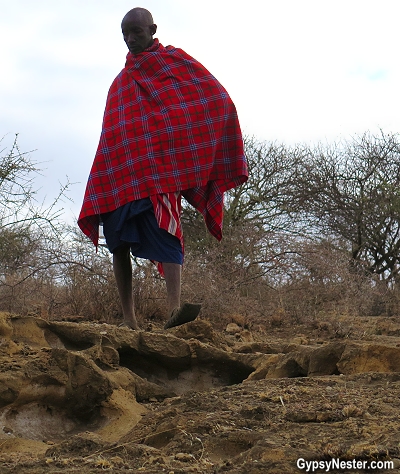
With introductions made, we follow two of the Maasai men who are acting as our guides away from the encampment and into the bush.
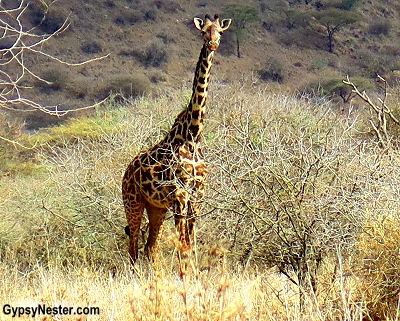
We are only expecting to see the stark country of the valley and learn more about their lives, but there is also a large measure of hopeful excitement at the prospect of seeing giraffes in the wild.
After nearly an hour of hiking through the barren, dusty landscape, our anticipation is waning, but then a guide points out some poop. It is giraffe, and it is fresh.
Let the tracking begin…
Morning: A walk with warriors and giraffe
<
The next step is to find some tracks, and the fine soil made from ancient volcanic ash is perfect for that.
In no time we are in hot pursuit, making sure to do our best Elmer Fudd impersonations… be verwy verwy quiet, we’re hunting giraffes.
They blend in well but we spot our quarry in some distant trees and pick up our pace in an effort to catch up to them.
Soon we are within a few hundred yards, and while they are wary, they allow us to observe for quite a while.
We have also come upon a small herd of zebras nearby. The moment is magically mesmerizing and no one in the group moves or makes a sound.
Suddenly, the spell is broken, and both herds of animals break into a run.
Wow! We watch them run and it is as if they are in slow motion. Hearing and feeling their hoof beats as they pass makes the entire experience so tangible.
Then they are gone and our entire party stands in stunned silence, we can hardly believe we are actually living what we have only seen on film before. The walk back to camp is filled with excited chatter about what we just witnessed.
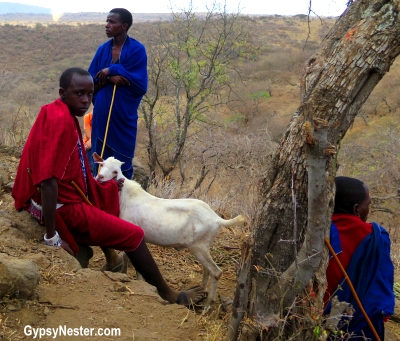
Back at the Enkang, the Maasai men are preparing to slaughter and eat a pair of goats…
Early Afternoon: A world away… or maybe two
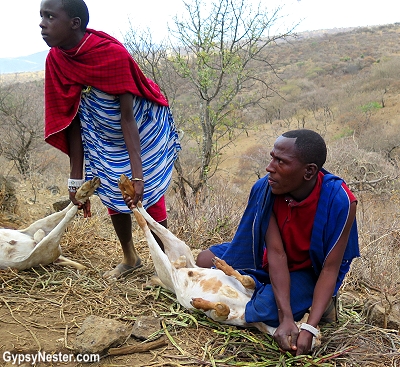
Back at the Maasai encampment the men are preparing to slaughter a pair of goats.
This is only done on special occasions, since both the goats and cattle are used more for their milk than meat.
The women stay behind, they have never been down the hill where the slaughter takes place, even though it is just feet from the encampment.
We’re more than a little freaked out about what is about to happen, yet also know that it is a privledge that few are afforded to see.
Two men hold each goat down and clamp their hands over the animal’s nose and mouth to suffocate it.
Not only was this easier on our delicate sensibilities, but there is no blood spilled in the killing.
Nothing is discarded; every bit of the animal is used in one way or another.
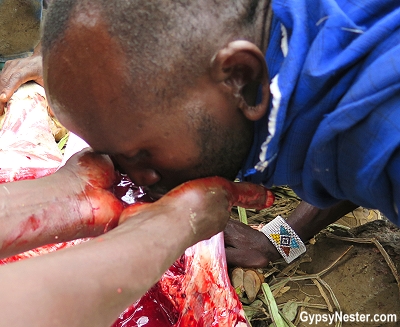
It is at this time that several of the men take turns drinking some of the blood directly out of the cavity.
The blood is an important source of liquid and nutrition in this incredibly harsh and dry environment.
WATCH: Learn about the Massai’s ritual goat slaughter and blood drinking (if you’re squeamish, you may want to skip it)
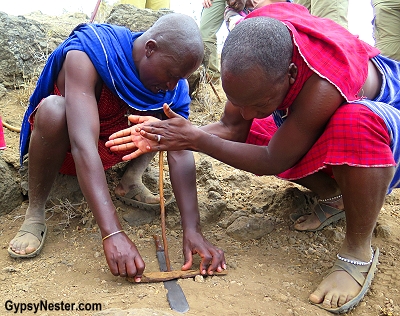
The next step is an obvious one; build a fire to roast the goat.
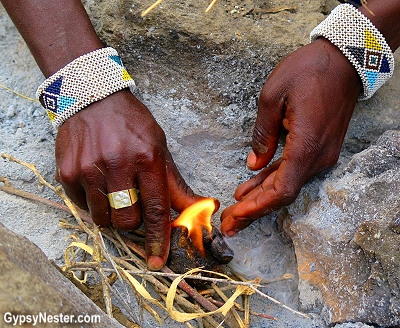
No matches necessary, the men make fire by spinning a stick placed on a dry branch.
The friction generates enough heat to create embers that are placed in dry donkey dung.
With a bit of blowing, flames appear.
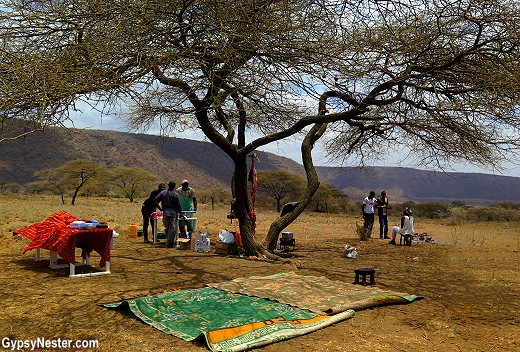
Leaving the Maasai men to their eating of raw internal organs and medicinal soup preparations, we head to our own camp and enjoy an incredible outdoor bar-b-que prepared for us under the spreading acacia tree.
Appetites appeased, we walk back within the fencing of the enkang for a look inside an inkajijik.
Each of the huts is occupied by one of the wives of the village leader; in this case there are eleven.
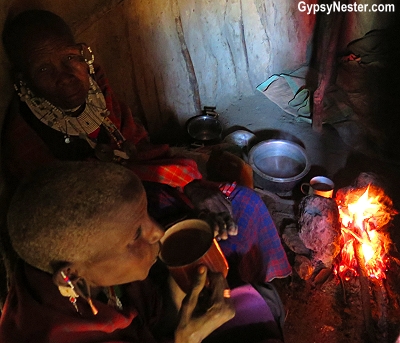
The small round building is divided into three rooms, and we sit in the main area while the chief explains the design and Mama Simba translates.
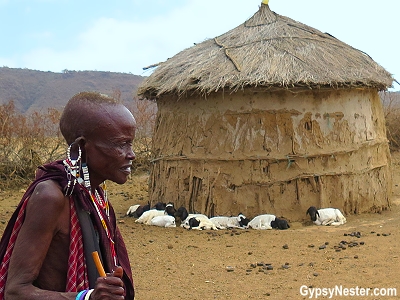
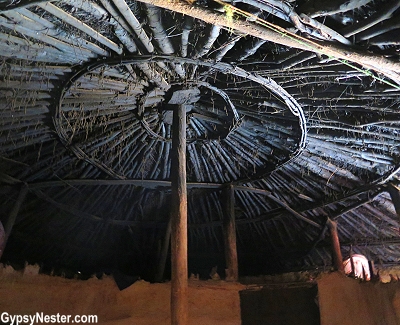
The construction is mostly wooden, large support poles hold up a thatched roof, with walls made of branches plastered over with adobe-like cement made from dirt, urine, cow dung, and ashes.
The main room serves as kitchen and meeting area with some storage space and an area where baby goats are brought inside each night.
The other two rooms are bed chambers, one of which is occupied by the wife, the other by the children.
The husband does not live here, he has his own hut and the wives take turns accompanying him there.
We are told that there is a set schedule and that the wives hold no jealousy.
Since the Maasai are a nomadic people, the entire structure is portable.
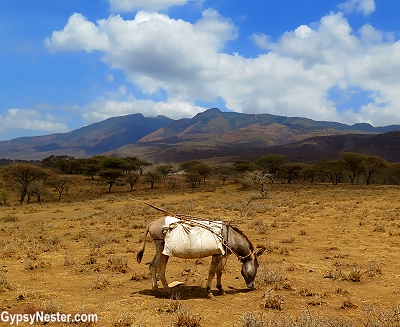
It can be dismantled and strapped to a donkey whenever the group needs to move to a new area for grazing the cattle.
Surprisingly, as important as cattle are in the lives of the Maasai, we never see a single cow. They are all away grazing, being tended by about half of the group’s members.
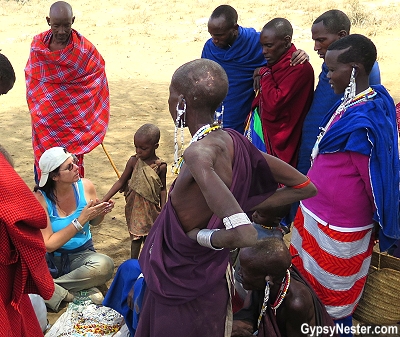
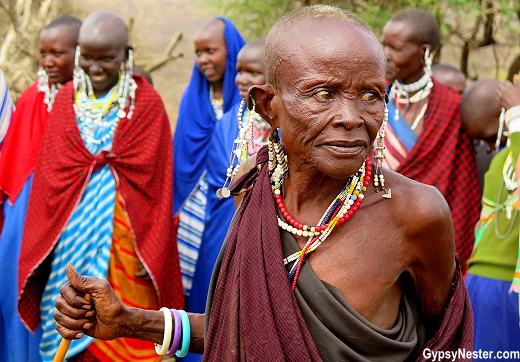
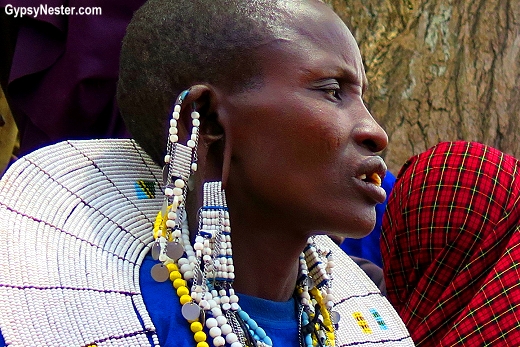
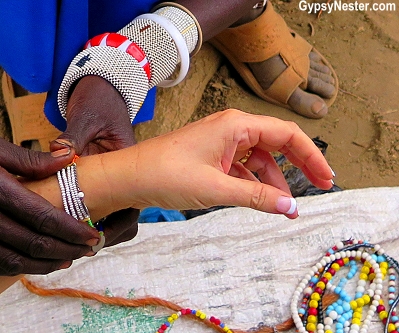
Just outside of the enkang the women have laid out jewelry that they have made.
Making beaded necklaces, bracelets, and earrings has long been a tradition for the Maasai.
Originally they made their own beads, then they began trading with European colonists for them.
Veronica chose a wide beaded bracelet with bangles. The colors represent peace and water.
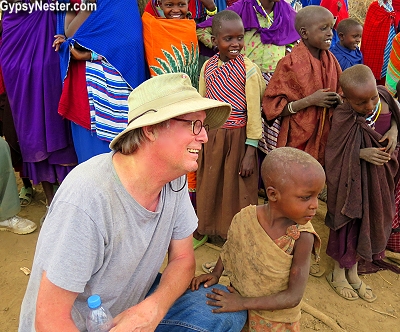
As a farewell, we are given a send off song and dance.
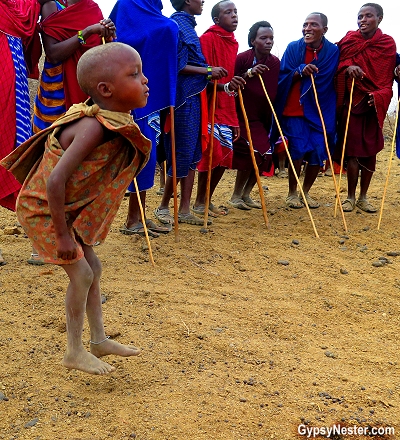
The men enter first and perform what is known as the jumping dance while chanting and vocalizing a sort of low pitched drone.
The women follow with a call and response song where one sings a line and the rest of the group answers in unison.
The two groups continue simultaneously, almost as if they are competing with one another, and then simply stop.
DAY SEVEN: The little ones of Rau, and learning to batik like a Tanzanian
Morning: An incredible woman doing incredible things
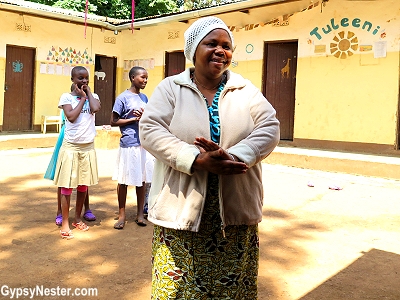
With all of yesterday’s excitement we are ready for a low-key day so, after a leisurely breakfast, we walk just a few blocks (even though we are fairly certain that they are not called “blocks” here) to the Tuleeni Orphans Home.
The children greet us warmly and then we all sit down for a little bit of a chat with Mama Faraji, who has been helping orphans for over thirty years.
She has dedicated her life to the orphaned babies of Rau and sees this as her home (the infants and toddlers actually live in her home) and the kids as family.
As a teen she was orphaned herself and she raised her siblings, then others began to bring children to her and she took them in too.
She simply couldn’t refuse a child in need. Today the home serves about one hundred youngsters.
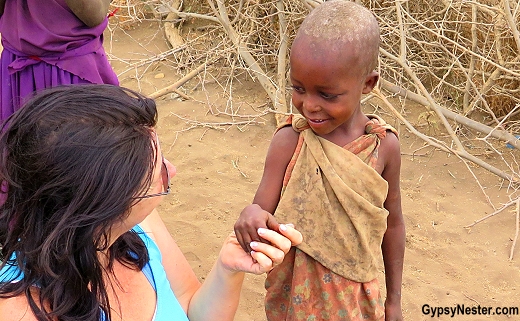
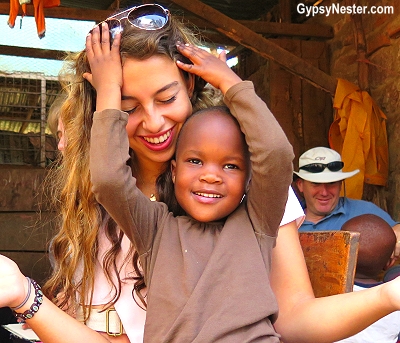
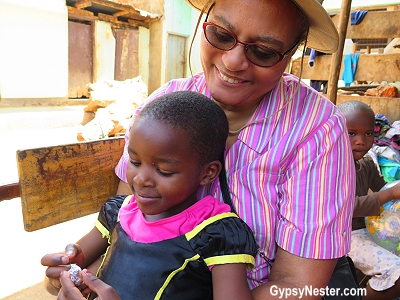
We immerse ourselves into the throng of kids, introduce ourselves, read stories, play games, and share a treat or two.
As we have found throughout this corner of the world, the Tuleeni Orphans Home and its residents have adapted to getting along on very little while maintaining an inspiring, and bright outlook on the future.
Afternoon: Wax on, wax off
Our afternoon is dedicated to bringing out our artistic qualities, which seem to be fairly well concealed.
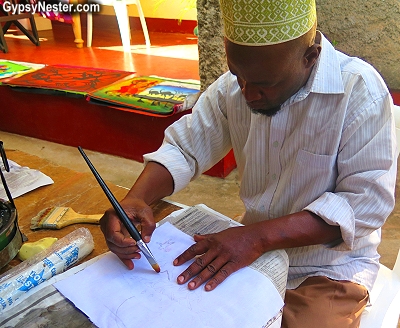
A group of artists come to visit at the homebase and we will attempt to teach us the art of batik.
The process uses colorful dyes, controlled by wax on cloth to create images.
We are each issued a piece of fabric and a pencil and begin our attempts at sketching a picture that will then be dyed into the material.
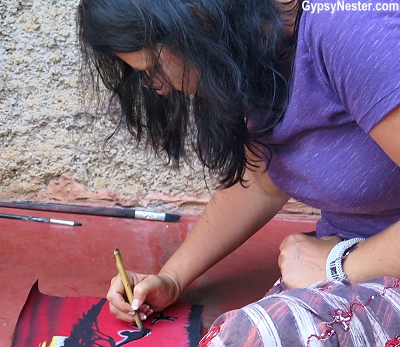
Looking around the table we see many somewhat pained expressions on the faces of our Discover Corps mates, some with the classic tongue hanging out and slightly bitten.
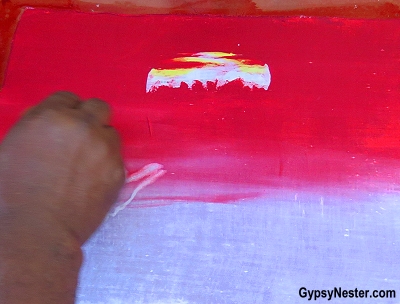
Once we manage something resembling a drawing, wax is applied to the areas we want to remain white.
First the background colors we have chosen are laid on.
Once dried over an open fire, another round of wax is applied everywhere but the areas we want silhouetted.
Now we are able to color the areas without wax free from the worry of the dye going where we don’t want it.
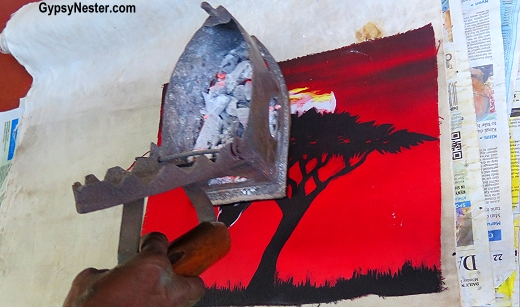
Next we rub the fabric together vigorously to remove the wax and then run a hot iron over our cloth to melt any remnants.
Viola! We have our masterpieces.
Many members of our group made very impressive scenes, however David’s elephant’s head looks more like a cassowary than a pachyderm.
DAY EIGHT: Climbing Kilimanjaro, Banana Beer and a Chagga Apology
Morning: Nature is an uphill battle
Our entire Discover Corps team is all atwitter as the sun rises this morning.
We have been catching glimpses of Kilimanjaro over the past week and a half, but today we get to set foot upon the massive mountain.
We will not be getting anywhere near the top though, after all, we’re talking about the biggest freestanding mountain in the world here, rising over nineteen thousand feet!
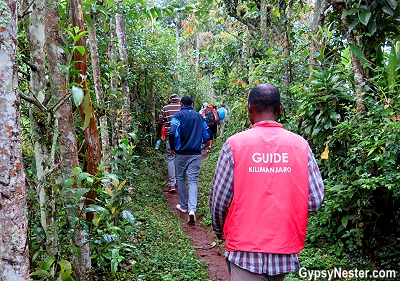
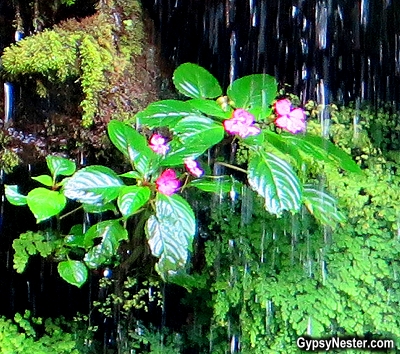
We drive up to an elevation of about five thousand feet to begin our trek. At this altitude the terrain is classic rain forest, and the misty precipitation shows us why.
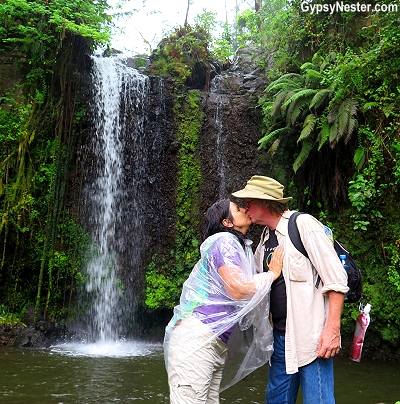
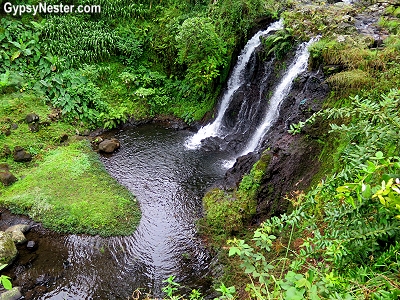
The trail leads us to the first of the three waterfalls we will visit today. Gingerly walking across a span of wet, slippery rocks allows us to test the water.
Considering we are within a few hundred miles of the equator, it is surprisingly cold. On the other hand, there is quite a bit of snow and ice above so maybe we should have expected it.
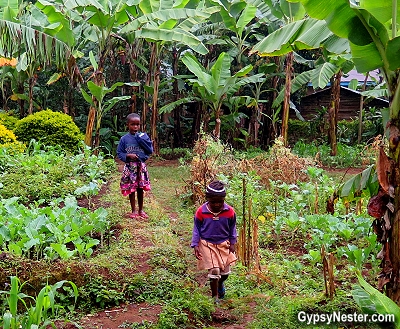
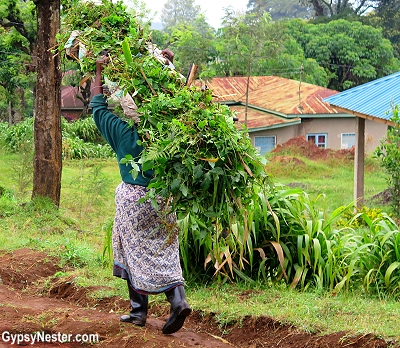
As we climb higher we pass through a couple of secluded villages and the small, terraced farm fields that are typical of the Chagga people who inhabit the southern and western slopes of the mountain.
For centuries they have been growing corn, beans, squash, coffee, and mainly bananas in this region.
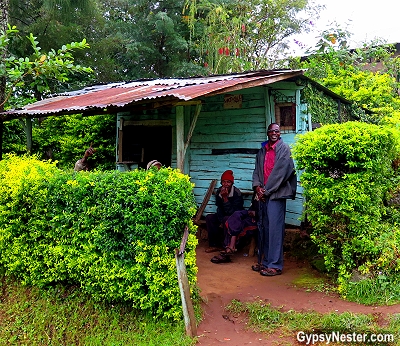
We stop at a little shop / bar to have our lunch and an ongoing conversation picks up again. We have been asking Mama Simba, and locals that we meet, about a favorite traditional brew in Tanzania called mbege for several days. It is a type of beer made from millet and flavored with banana, but it is not sold in stores, only homemade.
Richard from homebase, who has joined us on our climb, feels like we might be able to find some in this village, so he heads out to scout.
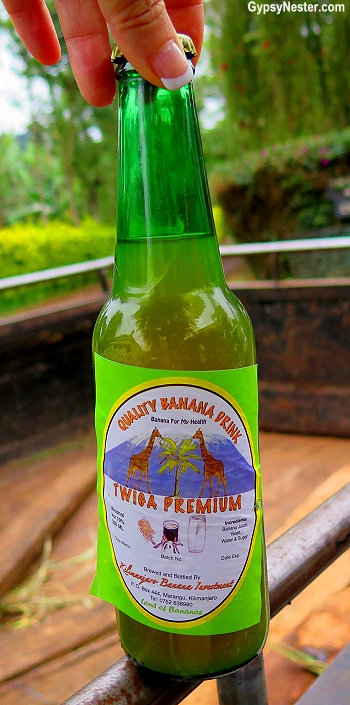
When he arrives back, he could only find a different beverage which the label proclaims to be “Quality Banana Drink” and “Banana for my health.”
Popping it open, the bouquet was bad, but not even close to the taste.
After a sip we begin to speculate on the recipe. Our best guess is that they begin with a grimy bucket filled with giraffe urine (we surmised this from the pictures of giraffes and a bucket on the label), add a burnt log (for that smoky flavor) and let that steep for a few days.
Next add some old, rotten, black banana peels (for your health) and a dash of diesel fuel, and set aside again to ferment for a week or two.
Now the cocktail is ready to be strained through a dirty sock into used beer bottles (keeping the original user’s backwash is optional), but notice that a good amount of sediment makes it through.
Serve lukewarm… oh, and we highly recommend keeping water handy to chase it down. Lots of water.
When we told Mama Simba about the drink her comment was, “people drink this and go crazy.”
Setting out after lunch our guide, Alfred, regales us with stories of his many triumphant assaults on the summit of Kilimanjaro.
He says that has conquered the mountain more times than he can count, including trips guiding Sylvester Stallone, Ice Cube, Martina Hingis, and many other celebrities from around the world.
He also demonstrates the bushman click language, which is his native tongue. His attempt to show David how to speak it can be described as futile, at best.
He also explained how burnt giraffe bones will draw the poison out of a snake bite, and how this method saved him from a green mambo strike.
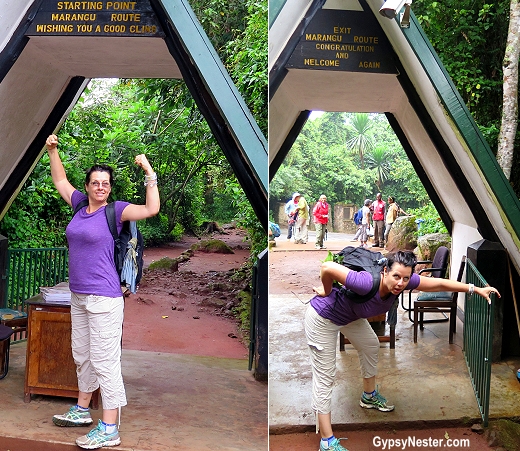
After climbing nearly a thousand feet, we reach the third waterfall. This puts us just a hop, skip, and a jump away from our destination, the Marangu Gate into Kilimanjaro National Park.
Along the way Alfred gives us one more story.
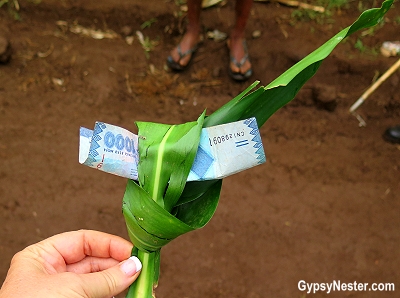
He picks a leaf from a palm-like plant, ties it in a knot, and places a one thousand shilling note inside the knot.
Local Chagga legend has it that if anyone offers this to someone they have wronged, the slighted party is expected to forgive and forget. We couldn’t decide if it is a lovely way to keep the peace, or an overly simple get-out-of-jail-free card.
Next thing we know we are at the gate where most climbers begin their assault on the summit.
Even though it seems like we put in a pretty good hike to get here, completing the climb is another thirty-four kilometers up over thirteen thousand feet.
A big thank you to Discover Corps for providing this moving voluntourism opportunity so we can share their good work. As always, all opinions are our own.