Help by providing supplies through Operation USA. Send AID to 50555 to give $10 now.
Text REDCROSS to 90999 to give $10 to American Red Cross Disaster Relief, which helps people affected by disasters such as hurricanes, floods, earthquakes, wildfires and tornadoes.
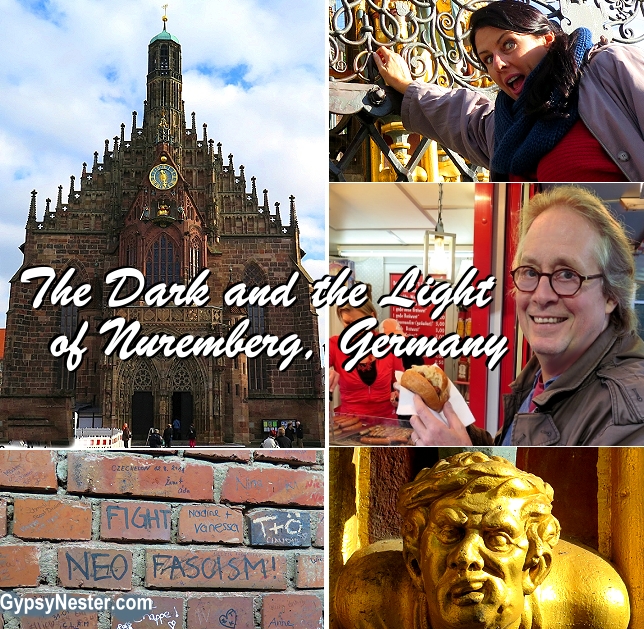
Most of us know the name Nuremberg, because of the trials held after World War II.
We explored the dark and Nazi side of Nuremberg but, thankfully, discovered ourselves charmed by her light side first.
To understand why the city was so significant in recent history, we had to travel back centuries earlier to learn about Nuremberg’s place as one of the Holy Roman Empire’s most important cities… CONTINUE READING >>
Most of us know the name Nürnberg, or Nuremberg, because of the trials held after World War II.
We explored the dark and Nazi side of Nuremberg but, thankfully, discovered ourselves charmed by her light side first.
In order to understand why the city was so significant in 20th century history, we had to travel back centuries earlier to learn about Nuremberg’s place as one of the Holy Roman Empire’s most important cities…
Beating the Clock
To get a better grip on things, we went to see a clock.
Yes, a clock. One that can turn back the hands of time.
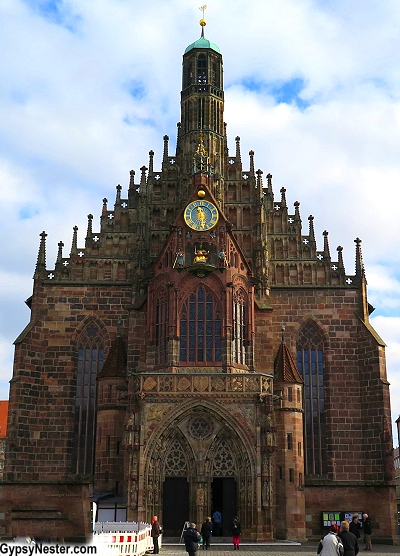
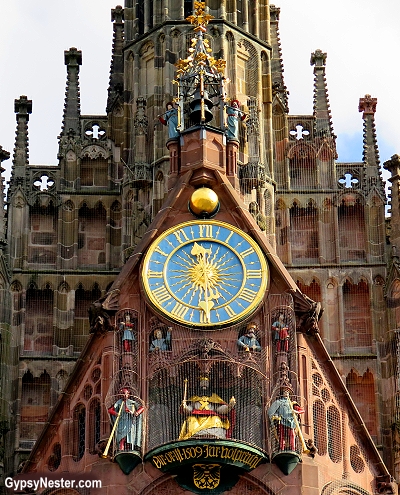
Every day at the stroke of noon the tower of the Frauenkirche, the Church of Our Lady, in the main square comes to life to commemorate one of the most notable events in the history of the Holy Roman Empire, the Golden Bull of 1356.
No, we’re not talking a male cow here.
This bull, as in a decree sealed with a bulla, stated the rules for selecting a new emperor and mandated that the ruler must spend his first day in office in Nürnberg… and that’s no BS.
In order to see the spectacle of the clock, we had to get to the church on time.
The mechanical Männleinlaufen, meaning running men, begins its song-and-dance history lesson precisely at midday and it is a one-time only event.
Luckily we made it with minutes to spare.
As the crowd was gathering we staked out a spot right in front, just before the church bells began to peal a dozen times.
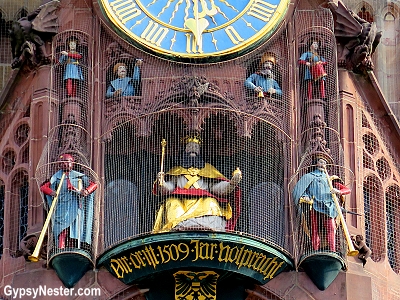
Beneath the clock the Holy Roman Emperor sat between two trumpeters, and above them a drummer and several bell ringers were standing at the ready.
As the bells finished tolling the trumpeters raised their horns, or at least tried to.
They must have been tired, because they barely lifted them at all.
We decided to cut them some slack since they are over 500 years old. After blowing their herald, the drummer drummed and the bell ringers rang.
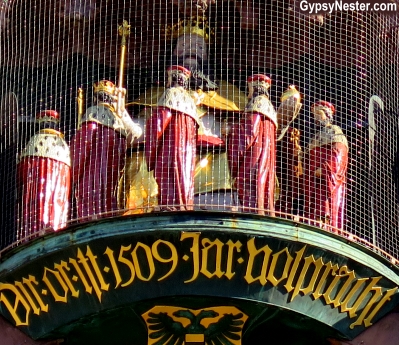
Then doors opened on either side of the king, allowing seven guys to come out and do a little circling around the big kahuna.
Those were not just any old dancing dudes; they are the seven electors who choose the new emperor.
After three laps, the doors slammed shut — end of show.
Although it might seem a bit cheesy to our twenty-first century eyes, we could only imagine how amazing the performance must have been to folks back when it was installed in 1506.
Whoa. That’s a Giant Fountain!
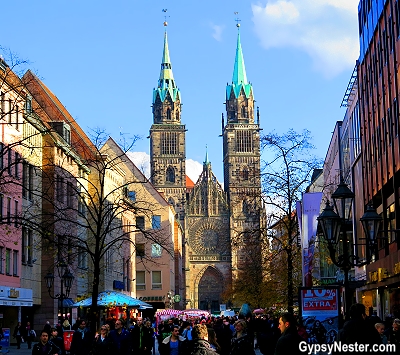
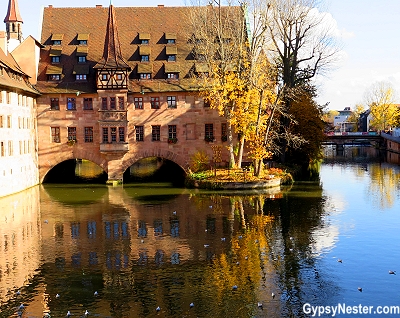
As the crowd dispersed, we set out to explore the old town center as well.
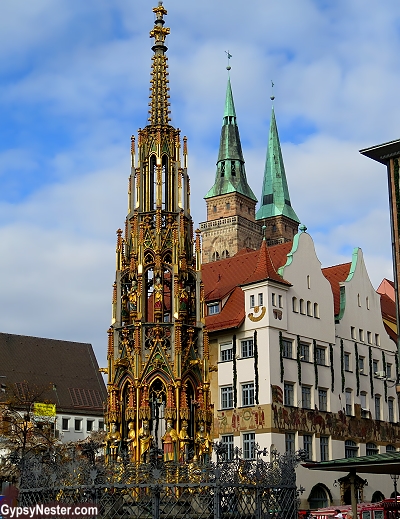
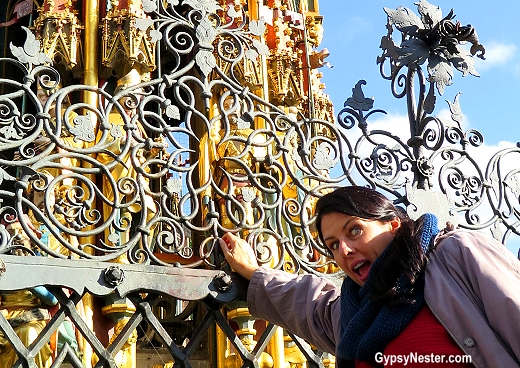
We began with the Hauptmarkt, the large square in front of the church, and the huge sixty-foot tall fountain.
It is known only as Schöner Brunnen, which simply means beautiful fountain, however this beautiful version is actually a replica of the original from 1385.
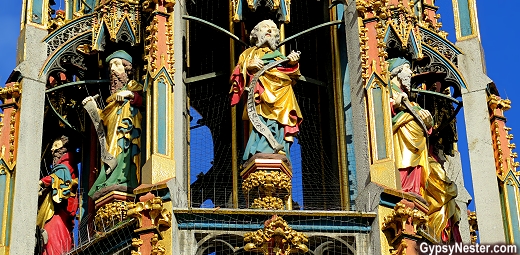
There are forty figures adorning the fountain representing philosophy, the liberal arts, the four Evangelists, the Church Fathers, Moses, the Prophets, and the seven Prince-electors, which pretty much summed up the world as they knew it at the time of the Holy Roman Empire.
Pressing (and Spinning) our Luck
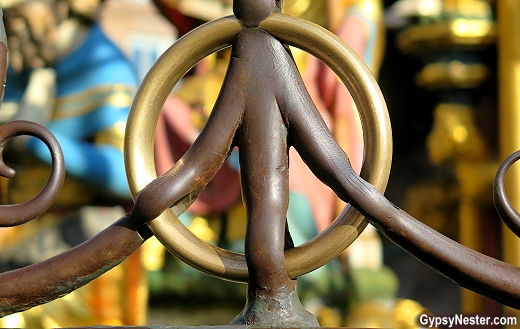
As with many landmarks like this, there is good luck to be gained if a task is properly performed. We located one of the two brass rings embedded in the ornate fence surrounding the fountain, and gave it a good spin.
So far so good on our ensuing good fortune — who are we to argue and say it didn’t work?
Our next artistic encounter featured folks who were certainly not lucky.
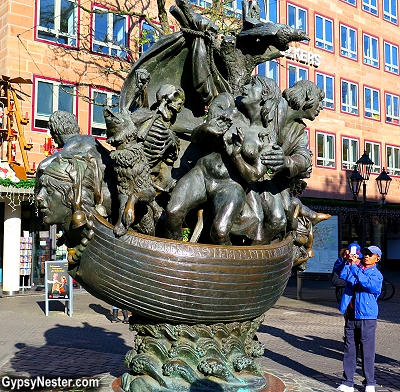
At the center of a crossroads we found the Ship of Fools.
This disturbing boatload of misfits floating through the streets is based on Sebastian Brant’s 1494 satirical book, Das Narrenschiff.
We found ourselves grateful that we were experiencing a much different fate aboard the trusty Longship Odin.
Stealing Away for a Sausage
Seeking something a little more uplifting, we wandered into an open air market for a look at some of the local fare.
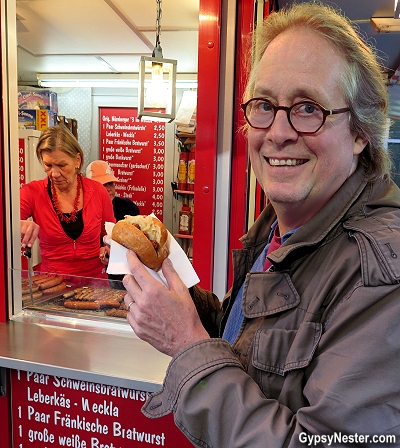
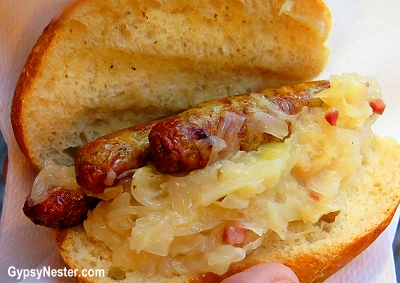
In Nuremberg that meant the Nürnberger Bratwürste.
These famous little sausages differ from the usual würste mainly in size, and the fact that they are always served in threes.
3 im Weckla, or Drei im Weggla — there seemed to be some variation of the spelling — were advertised everywhere, and either way three little links were ending up in a bun with some sauerkraut.
While we were more than happy to participate in this local tradition of three small sausages on a roll, we felt the need to look into the story a little deeper.
Since the European Union has passed legislation designating the “original Nuremberg bratwurst” as part of Bavaria’s culinary heritage, and about a billion brats are produced each year, we figured this just might be a serious subject.
They do take sausage seriously here, and strict rules must be followed during production.
As so often seems to be the case, there is also a legend about the Nürnberger Rostbratwürst.
Centuries ago, a man named Hans Stromer was sentenced to life in prison.
He accepted his fate, asking only that he be allowed one brat a day.
To accommodate him, the local sausage makers began to make sausages small enough to fit through the keyhole of the jail.
Hans went on to live long enough to consume 28,000 of the little links, and we can only guess he died happy.
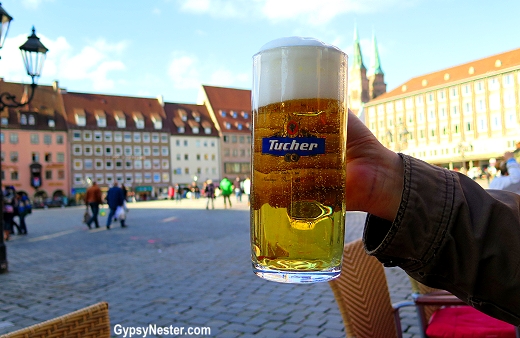
We washed our brats down with a Tucher!
The Dark Side of Nuremberg
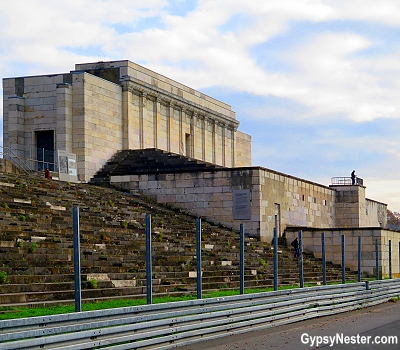
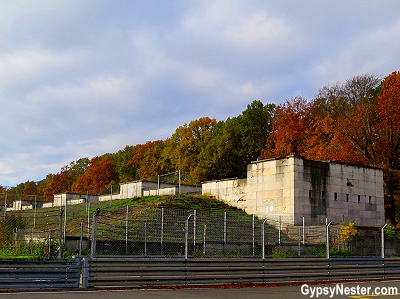
Moving out of the city center we made our way over to the enormous open stadium known as the Zeppelinfeld, where the Nürnberg rallies were held during Nazi rule.
We wandered silently around the eerie grounds and — we’re not gonna lie — felt completely creeped out by being there.
The place looked straight out of those fuzzy films of Hilter’s angry speeches that we’d viewed on the History Channel.
A big part of why Hitler chose Nürnberg was because of his obsession with the Romans, and the Holy Roman Empire. In his mind he was creating a comparable realm, so the city that was of such importance to past emperors became home to six huge Nazi Party conventions.
The field is obviously big enough to hold several blimps, but the name is actually slightly deceiving, the only zeppelin to ever touch down on the field was back in 1909 when Ferdinand Graf von Zeppelin landed one.
Instead it was used as a parade ground and demonstration area to show off Nazi troops to the public.
The stadium became best known to those of us across the Atlantic after American troops took the city in 1945 and blew up the huge swastika that stood atop the grandstands. The event was captured on newsreel footage and became an iconic image of the end of the war.
Hall of Horrors
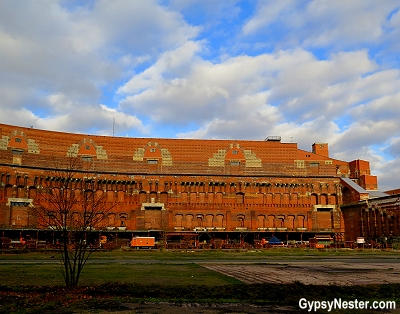
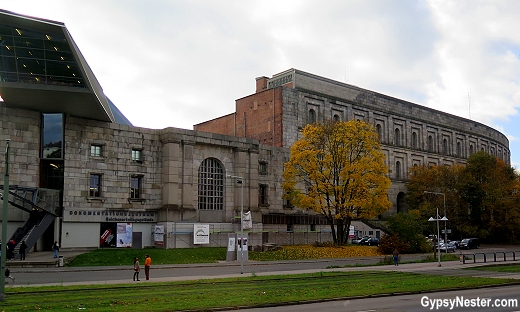
Next to the field Hitler began constructing what was planned to be the biggest indoor hall ever, the Kongresshalle, or Congress Hall.
Once the war broke out work was halted, and never resumed, but even half finished the place is huge… and creepy.
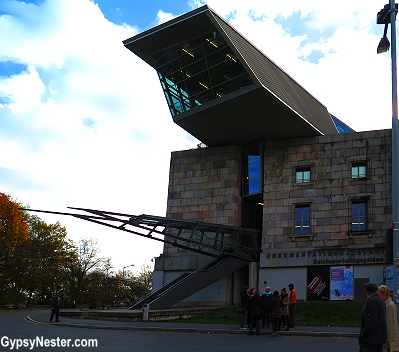
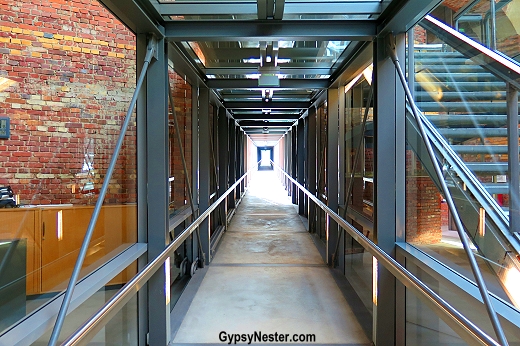
The entrance to the museum is a spear that fully impales the Nazi Era building.
We couldn’t help but notice a cosmetic similarity to the Coliseum in Rome, but on closer inspection the beauty was only skin deep.
The structure lacks any of the classic nature, or architectural strength of the original, and comes off as a weak copy.
Still it is impressive just for the sheer size.
The “spear” continues through the very heart of the building.
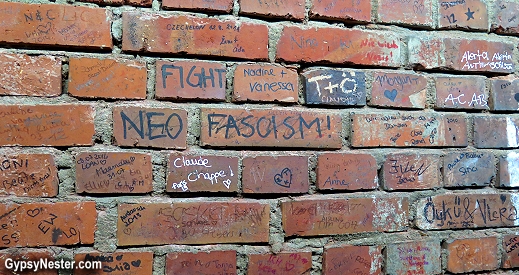
Since 2001, parts of the hall have been put to good use as home to the educational museum Dokumentationszentrum Reichsparteitagsgelände (Documentation Center Nazi Party Rally Grounds) featuring a permanent exhibition called Faszination und Gewalt (Fascination and Terror) concerned with the causes, connections, and consequences of Nazi Germany.
Sobering stuff no doubt, but important in light of the adage, those who fail to learn from history are doomed to repeat it.
The name Sacsayhuaman is pronounced very much like sexy woman if the sexy is articulated the way witchy is sung in the song Witchy Woman.
(Which proved easy to implant in our memory banks.)
And there is definitely something witchy about the site.
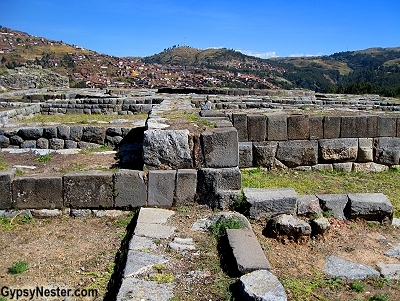
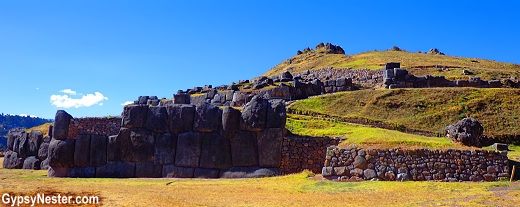
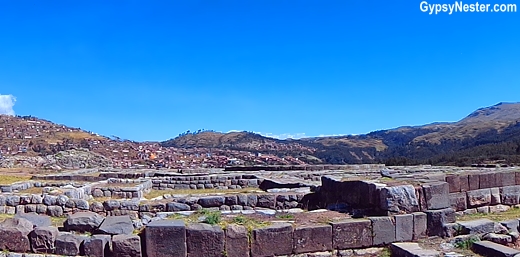
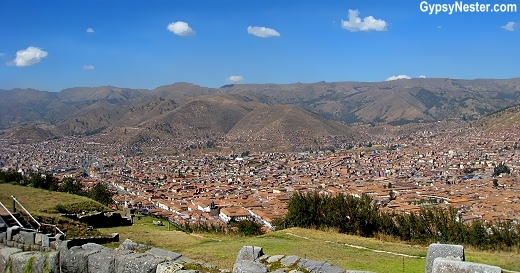
Built as a citadel, starting in the year 1100, to overlook the city of Cusco, Peru and as a refuge for the Inca to seek surroundings safer than the palace in case of attack.
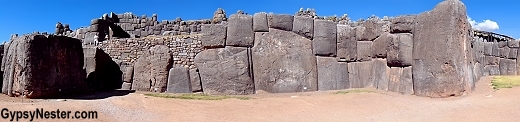
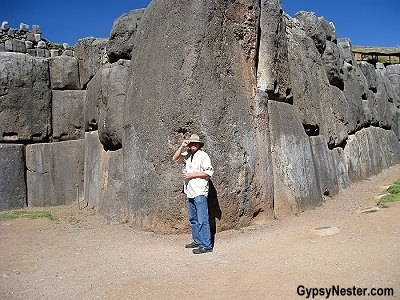
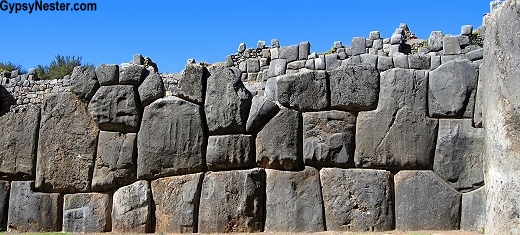
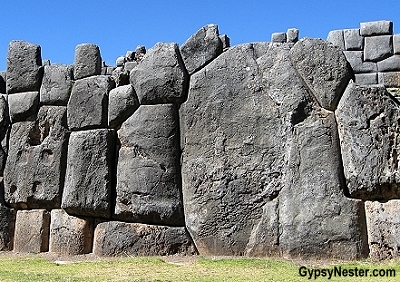
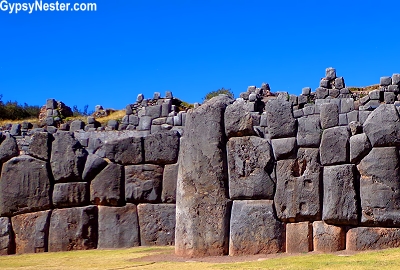
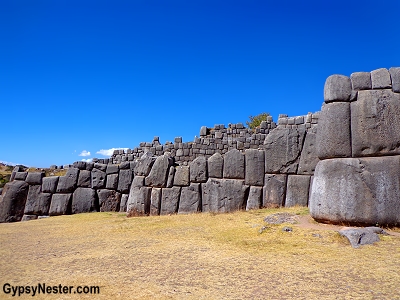
The first thing we, or anybody else, noticed was the gargantuan size of the stones used in the protective walls.
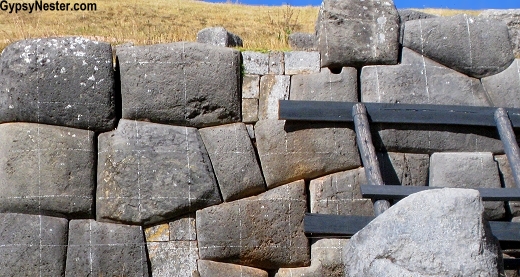
Some of the blocks weigh in at around 200 tons and they are expertly carved and placed.
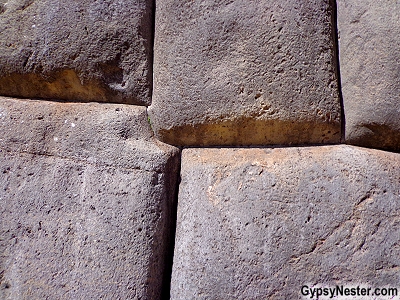
These behemoths were so tightly positioned that no mortar or concrete was ever used to hold them in place, yet even after hundreds of years there is not even room for a piece of paper to fit between them.
Most of the site was destroyed by the Spanish after their conquest, and the stones removed to be used in constructing new buildings down below in the city of Cusco.
Rock foundations in Cusco
Now only the largest rocks remain.
Our guide gives us an excellent explanation as to how the builders used the force of gravity to set the stones into each other and strengthen the structure.
Each piece is cut to fit exactly in place and distribute the weight to hold everything in place. Some of the gigantic stones have a grid laid out over them to lend a better understanding to the wonkiness.
A chalkline grid shows the wonkiness of the placement of the gigantic stones.
That certainly begged the question, how is it that they were not too large to be moved by the the builders, the Quechua, up to the top of the hill in the first place?
We struggled for logical explanations, some bit of evidence to help us comprehend the incomprehensible.
The facts we there; huge stones were cut out of the mountains, moved across fairly large distances and up steep hillsides, cut to precise but highly varied shapes and sizes, and then fit perfectly together using no mortar.
Adding to the seemingly impossible—no tools or equipment of any kind has ever been discovered at any of the archeological sites.
Nor was our curiosity quelled by any of the theories that we had read so far.
Some speculated that the stones were cut using water, and sure, water can cut through rock. We see it every day in valleys and canyons.
Good old H2O can do a fine job cutting solid granite, except that it takes a few million years to do it.
Another opinion speculates that stone tools were used, since no metal hard enough to cut granite was available at that time.
The big drawback to that theory is the blocks being cut are composed of the hardest rock in the region, granite, so at best the tools would only be as strong as the blocks they were being used on.
Needless to say, we were having a hard time buying into these assumptions, and our confusion only multiplied with every new idea or theory.
We were beginning to understand why some people think aliens from outer space had something to do with it. It seemed as good of an explanation as any.
We scrambled up to the top and found a fantastic view of the city.
Sadly, what we didn’t find were any remnants of the once splendid temples that used to stand atop Sacsayhuaman.
Only the foundations are left. Along with a foundation of (slightly witchy) knowledge that would serve us well as we made our way through the Sacred Valley of the Incas to Machu Picchu.
Ready to “get on with your life” but have an adult kid who needs a little nudge from the nest?
Do you have a Boomerang that seems permanently parked in your basement, and you feel it’s time for your chick to take wing and begin embracing all that life has to offer?
With tongues firmly in cheek, your goofy GypsyNesters have developed some silly (and stealthy) solutions to wink-wink-nudge-nudge even the most stubborn fledgling from the nest — and they may even think it’s their own idea!
10. Greet him at the door naked with a bottle of Viagra and a can of whipped cream and shout, “Honey, I guess we can’t use the kitchen, our baby’s home.”
Ready to “get on with your life” but have an adult kid who needs a little nudge from the nest?
Do you have a Boomerang that seems permanently parked in your basement, and you feel it’s time for your chick to take wing and begin embracing all that life has to offer?
With tongues firmly in cheek, your goofy GypsyNesters have developed some silly (and stealthy) solutions to wink-wink-nudge-nudge even the most stubborn fledgling from the nest — and they may even think it’s their own idea!
10. Greet him at the door naked with a bottle of Viagra and a can of whipped cream and shout, “Honey, I guess we can’t use the kitchen, our baby’s home.”
9. Set his computer so all his porn and poker sites go to GoArmy.com.
8. Invite your friends over to have a party in his room, trash it and smoke all of his dope.
7. Buy him a chauffeur’s hat and start calling him “Jeeves”.
6. Hack into his Facebook page and change his profile picture to a slug.
5. Say “I’m glad to have you home but I’m afraid dad might miss using your bed for ‘our quickies’ “.
4. Throw a bridal shower for his high school girlfriend on Super Bowl Sunday.
3. Decorate his old room as a nursery and say “Won’t it be great to share your room with your new baby sister?”
2. Secretly sprinkle all the leftovers with Metamucil.
1. Ask him to stay home one evening and say “Dad’s been awfully frisky lately and I’m worried about his heart. You don’t mind listening in on the old baby monitor, do you?”
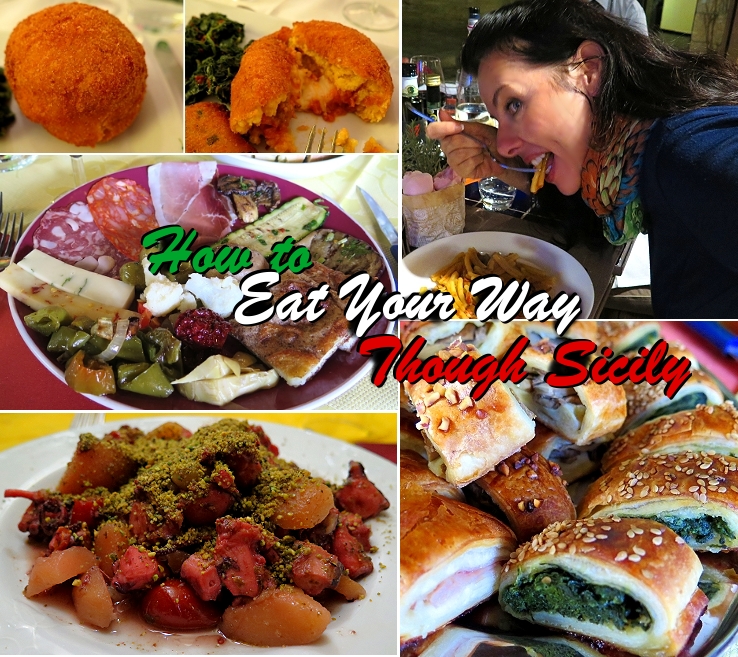
A highlight of any trip to Sicily is the food, but for those of us who grew up thinking Chef Boyardee represented Italian food, discovering real Italian cuisine can be quite an eye opening experience.
Buon appetito! A highlight of any trip to Italy is always the food, but for those of us who grew up thinking Chef Boyardee represented Italian food, discovering real Italian cuisine can be quite an eye opening experience.
Pacing Ourselves
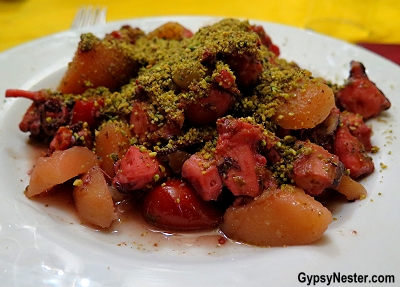
Sicilian polpo con patate: Octopus & potatoes, topped with pistachio.
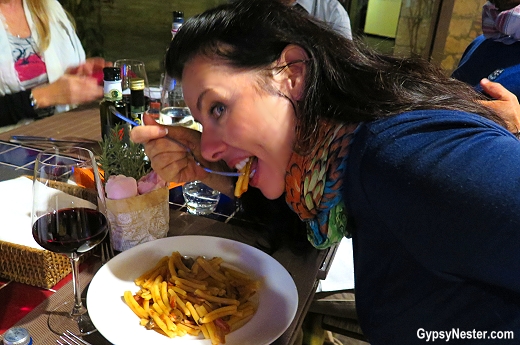
David fondly remembers the first night of his first trip to Italy. We all sat down to a family style dinner and they brought out spaghetti Bolognese.
It seemed like good old spaghetti to us, so we chowed down, even ordering up seconds.
Not knowing prima piatti from prime rib, we thought this was the whole meal. There was surprise, and a bit of embarrassment, when they brought out a big platter of veal, potatoes, and vegetables for the main course, then salad, and finally dessert, but we learned.
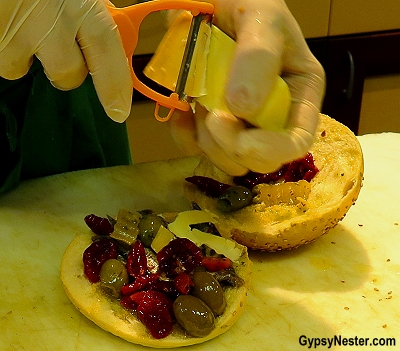
Muffalettu: Sardines, olives, sundried tomatos and ricotta salata.
Over our many ensuing visits to Italia we have also learned that there are as many different styles of Italian food as there are regions in the country, so traveling to Sicily for the first time we weren’t exactly sure just what to expect.
We did know that we could eat our fill guilt free on this visit since we were touring Sicily on bicycles.
As with most places, the food in Sicily is primarily based on local ingredients. That means that seafood is a big part of the menu, but the long, sunny Mediterranean growing season makes for an abundance of fruits and vegetables too.
A new favorite, and something we had never seen before, was an apple and hybrid called caco mela. Mela, is the Italian word for apple, and caco for persimmon. The taste is very similar to a persimmon, but the fruit is more hearty and easier to slice. Perfect for a quick bike snack.
Watch: Our expert guide, Edoardo, shows off his energy-producing al fresco spread—including caco mela!
The Importance of Olives
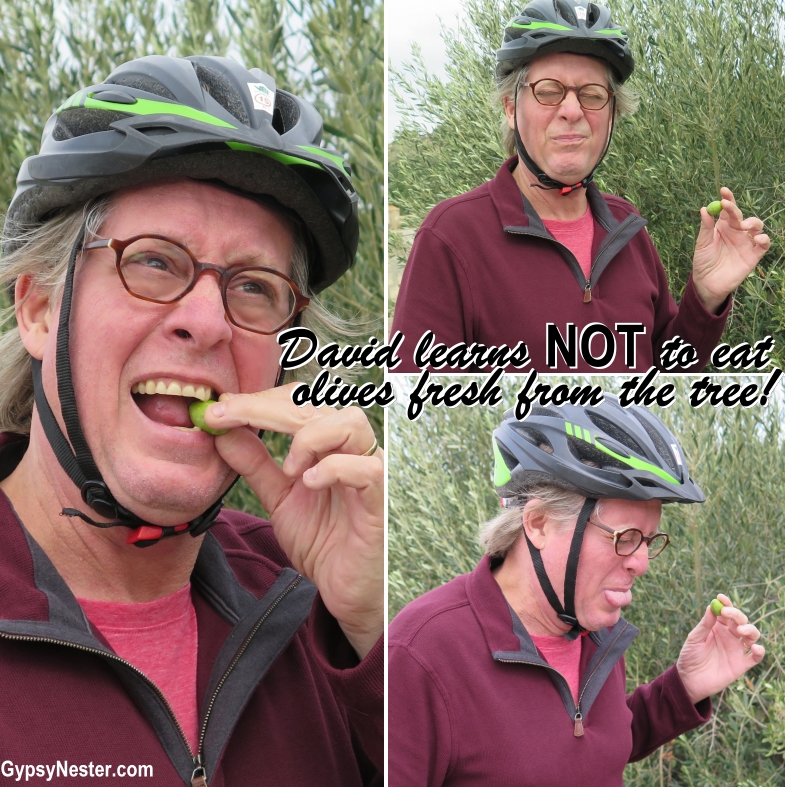
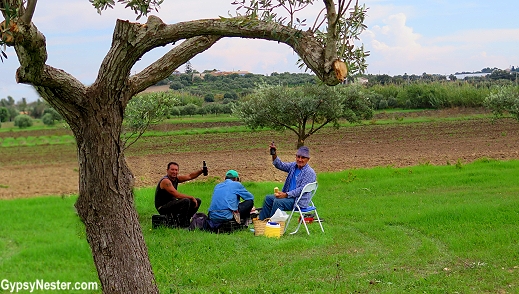
One of the main crops on the island is olives, and as we rode along we saw trees laden with them. At some point David decided that if cured olives are good, ones fresh from the tree must be great.
All we can say is ladies and gentlemen, do not try this at home! An uncured green olive could be the most bitter thing on the entire planet, perhaps even the universe.
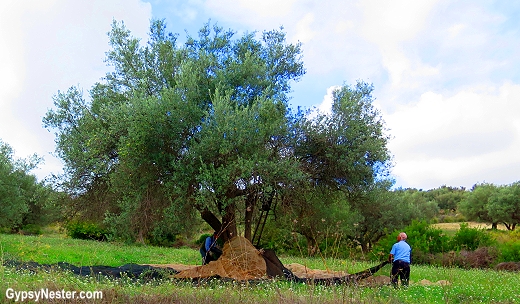
It happened to be olive harvest time in Sicily while we were visiting, and we passed through numerous groves while farmers were knocking the fruit off of the trees into nets waiting on the ground. These were then cased up and trucked to the nearest mill.
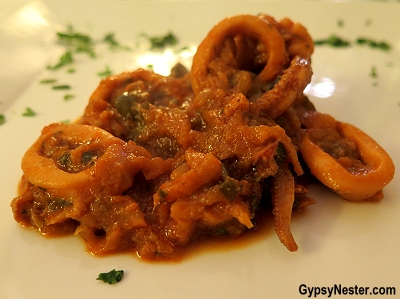
Calamari alla Luciana
We had the chance to stop at a mill and see the olives squeezed into the finest olio di olive.
The process is actually fairly simple, once cleaned the olives are crushed, then pressed, then run through a centrifuge to separate the oil from the pulp and water.
It all happens in just a few minutes on one assembly line. Fresh olives go in one side and extra virgin oil comes out the other.
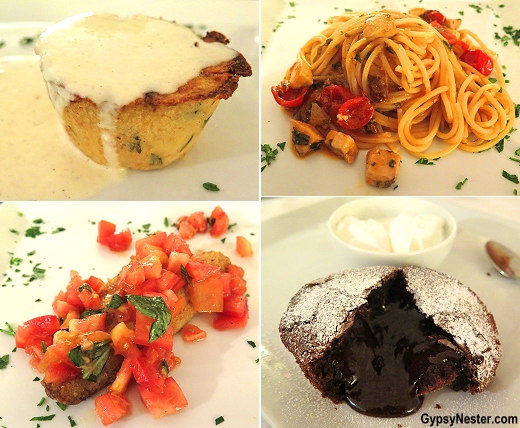
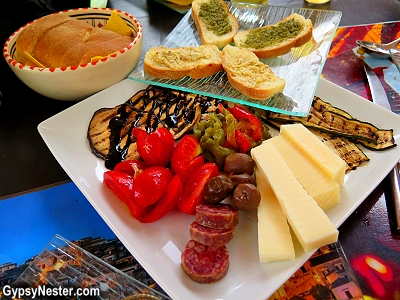
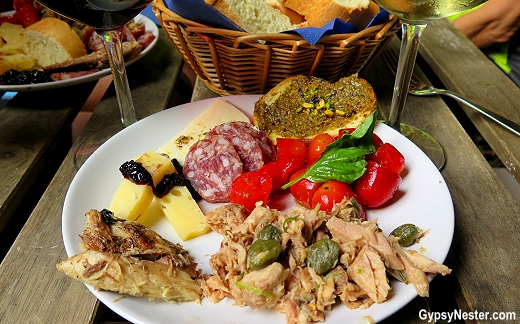
This oil will then be used in almost every dish, and we found no better way to sample several of them than by ordering a Sicilian Plate.
The Sicilian Plate
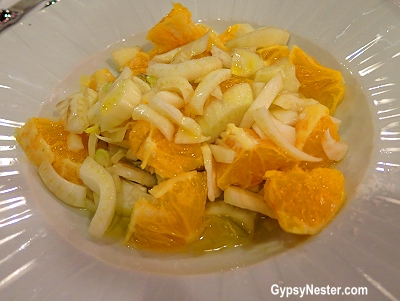
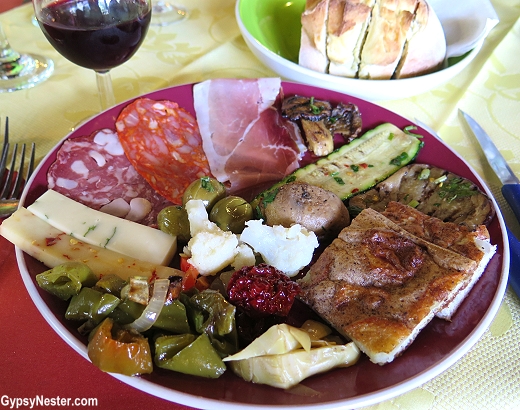
Most every eating establishment had their own version consisting of a mixture of salamis, cheeses, peppers, tuna, olives, and tomatoes, but there were always variations.
The many different plates that we sampled along the way included combinations of the above along with mackerel, grilled zucchini, artichokes, and panella, a fried bread made from chickpea flour.
Each time we ordered a plate was a delicious surprise.
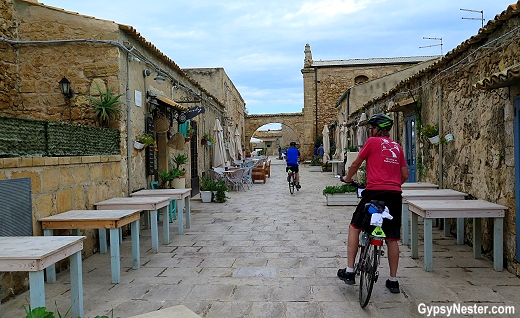
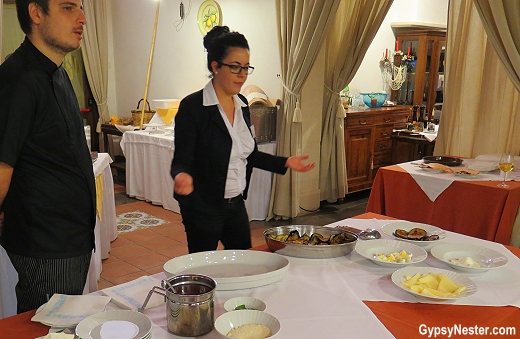
In the seaside village of Marzamemi, the Restaurant Liccamuciula set up their ingredients for a classic Sicilian Plate in the form of a buffet.
Each item was from nearby, local food, or as our Italian friends like to call it, Kilometer Zero.
The specialties featured tuna, cheeses, tomatoes, salami, mackerel, and of course, red and white wine.
Because, as they proclaim in these parts, “a meal without wine is called breakfast.”
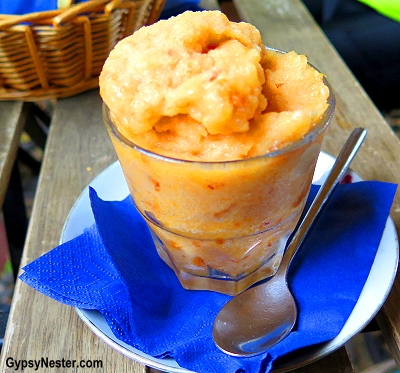
We finished up our feast with a refreshing peach granita – fruit and crushed ice. YUM.
Pulling Out All the Stops
A few days later we stopped for lunch at Agriturismo Agri Milo, a farm up in the hills of Monte Iblei. In addition to running an animal rescue focused mainly on donkeys, the farm prepares fresh locally grown and sourced meals, more Kilometer Zero.
We began with another Sicilian Plate.
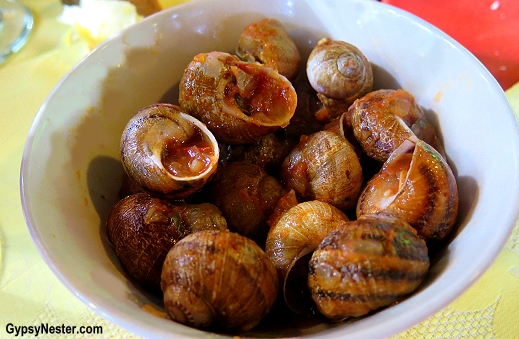
Next came babbaluci, snails that are similar to escargot but smaller, and prepared with celery, parsley, and garlic lightly sautéed in olive oil. Magnifico!
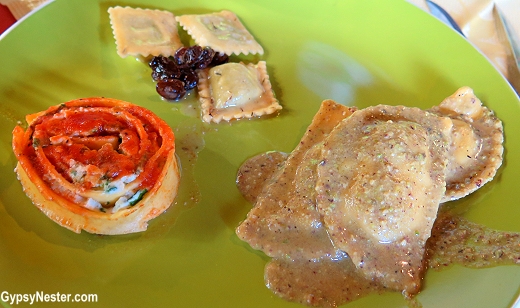
These little guys of goodness were followed by a selection of ravioli…
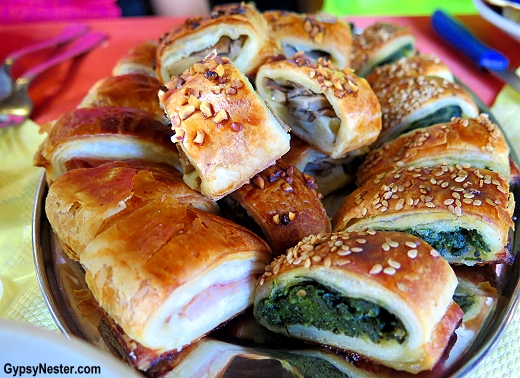
then rollatini, tasty rolled sandwiches that we saw many places around the island…
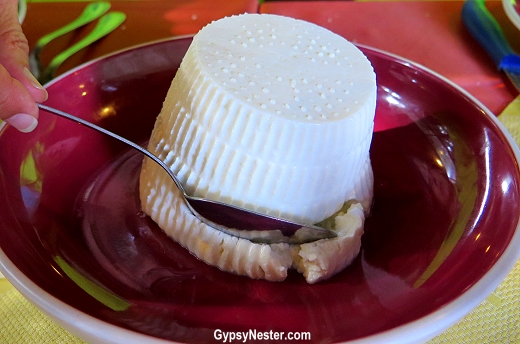
… and fresh ricotta.
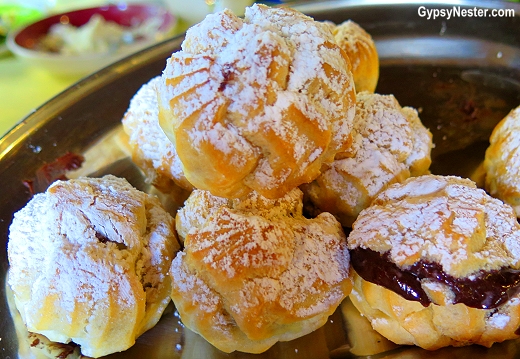
As any real headliner should, the true star of the show came out last. The beignets brought out for dessert were light, fluffy pastries filled with the best chocolate crème ever to come anywhere near our taste buds!
We were forced to double check to see if St. Peter had just let us through the pearly gates.
Balls of Goodness
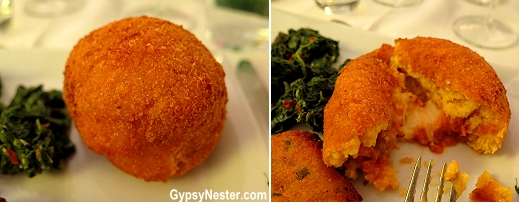
We discovered another classic traditional Sicilian dish in our travels, arancino. These are balls of risotto filled with ragù, beef, and mozzarella deep-fried to a golden brown.
They are thought to date back about a thousand years to when the Arabs ruled the island, and are especially popular in Palermo, but seem to be available most everywhere.
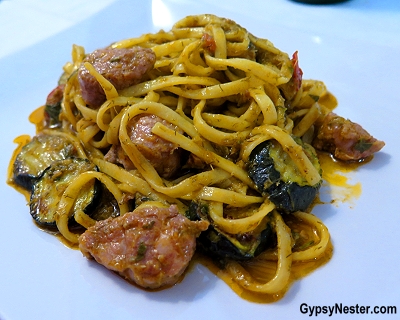
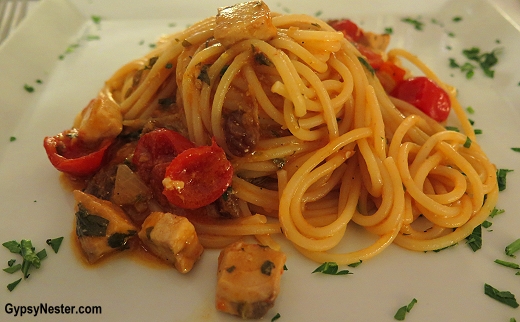
Another dish that we found in many places was the Spaghetti alla Sicilian.
We can only assume that like the plates the recipe varies from place to place, because the two versions we tried were quite a bit different.
Both were good, but our favorite was made with rustic sausage, sun-dried tomatoes, and zucchini.
The other featured a variety of seafood, almost like a frutti di mare.
Wait. Eggplant Parm has WHAT in it?
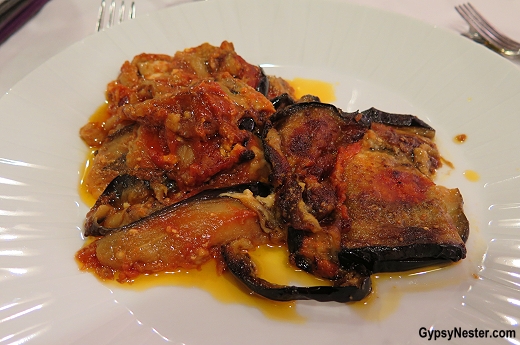
At the Kallikoros Country Resort in Val di Noto, which features farm-to-table dining, and we had the chance to see a true Italian classic, eggplant parmigiana, prepared step by step.
The resort’s chef, Andre, demonstrated the proper Sicilian way to layer the ingredients and gave us some valuable tips such as soaking and pressing the eggplant to take the bitterness out.
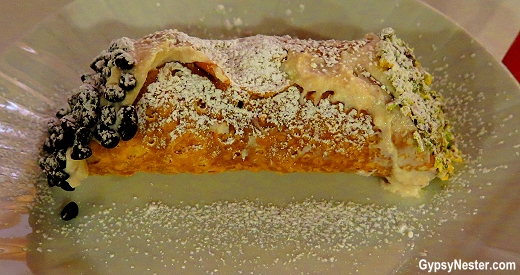
With the main dish safely in the oven, he proceeded to show us how to stuff a cannoli.
Our hostess, Francesca, passed along some info that we filed under you learn something new every day, the name comes from the piece of cane that the shells are formed around.
Oh. And Chocolate.
Modica
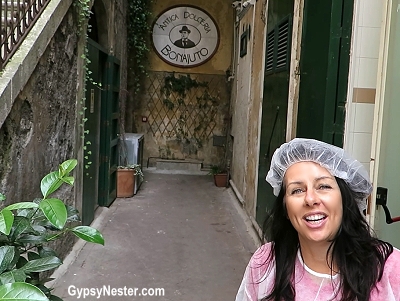
Speaking of sweets, as a reward at the end of one of our morning rides we stopped for a tasting and tour of Sicily’s oldest chocolate maker, Antica Dolceria Bonajuto in Modica.
They have been processing cocoa beans since 1880, using methods brought to Italy from the Aztecs.
Watch: Uh, yum. A chocoholic’s paradise
After watching a demonstration of the entire process, they invited us to give it a try.
A big thank you to VBT Bicycling and Walking Vacations for providing this adventure where we ate all of this delicious food without worrying about the calorie count!As always, all opinions are our own.
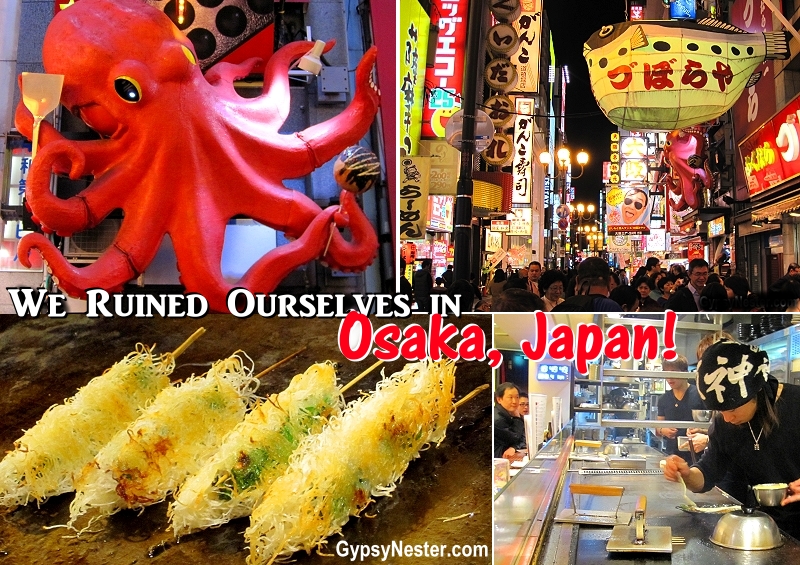
Kuidaore, a Japanese word meaning “to ruin yourself with extravagant food,” has become synonymous with the city of Osaka.
How could we possibly not love this place?
Osaka is the undisputed culinary center of Japan, in fact several writers have proclaimed it the food capital of the world, but we were determined to find the heart of the center.
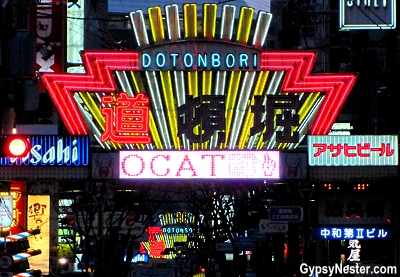
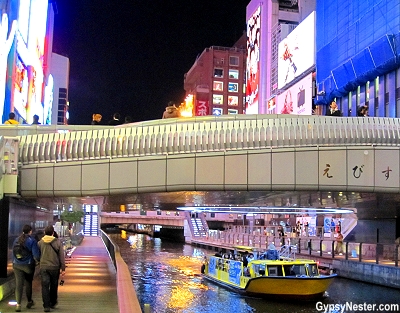
That could only be the small downtown district known as Dōtonbori.
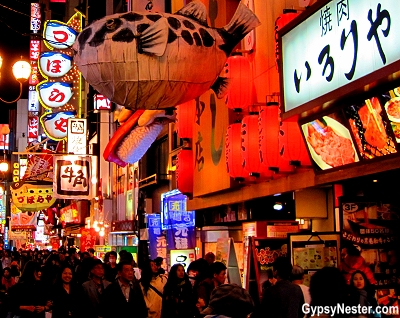
Named for the seventeenth century canal that runs through it, Dōtonbori has become the epicenter of kuidaore.
For hundreds of years the area was famous as the place for Kabuki theatres, but they are all gone now.
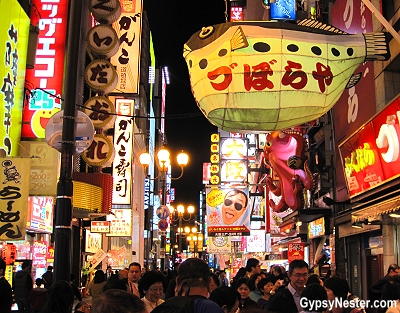
Restaurants began replacing them after World War II, and with their arrival came some creative signage.
Signs that Foretold a Big Night Ahead
In fact, the competition for most eye-catching advertising extravaganza is nearly as much of a draw as the food.
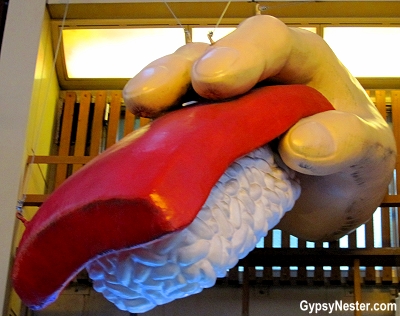
Several signs are tourist attractions in their own right, especially the giant neon Glico Man (see him in the video below), famous for being the first on the block.
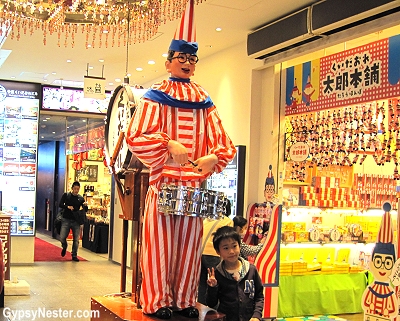
Almost as popular is the mechanical drumming clown, Kuidaore Taro, who stood guard in front of the Cui-daore Restaurant for years.
Since the restaurant closed he has been enshrined at the Nakaza Cuidaore Building, where he draws crowds into the shopping center.
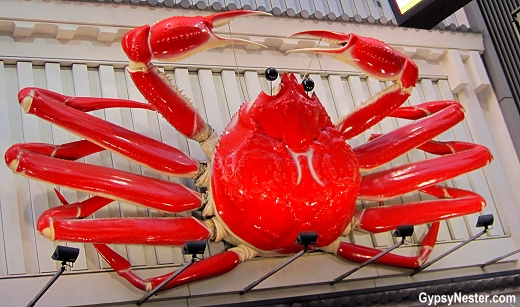
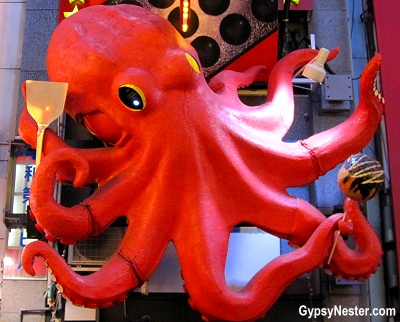
When the crab restaurant Kani Doraku erected their giant mechanized crab sign back in 1960 they kicked off quite a craze of giant animated seafood signs.
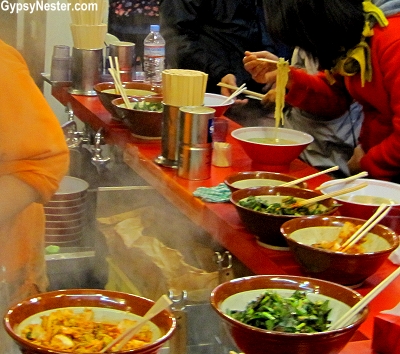
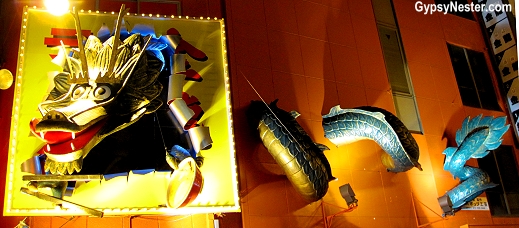
Even fire breathing dragons beckoned us in for some noodles, but we had that other Osaka signature dish, Udon, for lunch so we passed up their flaming invitations.
Eating Octopus Balls (we know what you’re thinking, you dirty bird!)
As overwhelming as the displays could be, we were not going to allow ourselves to be distracted from our primary goal… kuidaore, and the obvious starting point had to be with takoyaki.
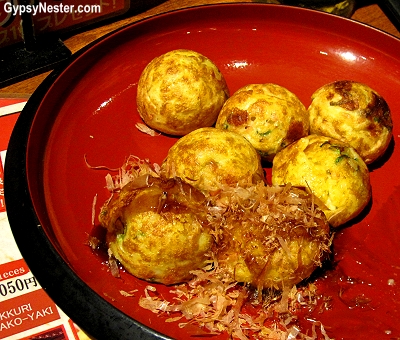
No food says Osaka more than these hot octopus-stuffed balls of deliciousness. Takoyaki, which translates to fried octopus, is said to have been invented in 1935 by a street vendor named Tomekichi Endo, and has become the definitive Osaka snack.
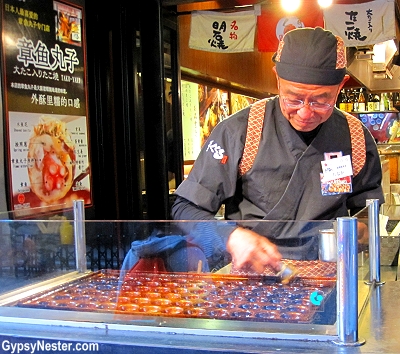
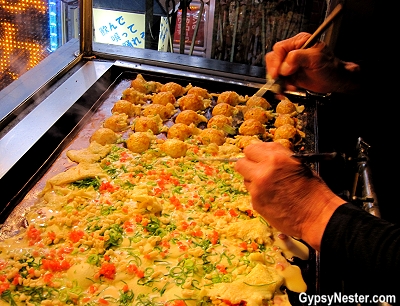
We were captivated by the expert cooking demonstration going on beneath one of the giant cephalopod signs and stopped to observe.
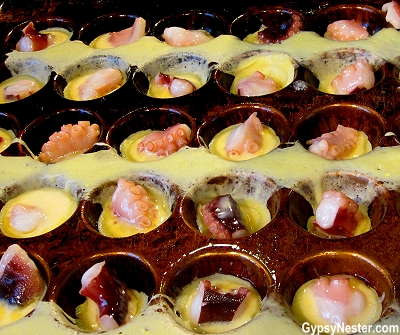
The chef began by pouring batter into a specially designed pan with dozens of round indentations.
Once the batter was bubbling he dropped chunks of octopus into each hole, added more batter on top, and some chopped spring onion, red ginger, and tempura for crunch.
Then, with the most skilled use of chopsticks we had ever seen, he flipped each ball in its socket for perfectly even frying.
Watching the creation of the golden brown balls, we knew we had to have some, even if neither of us is that big a fan of octopus.
WATCH: How to make (and EAT!) Octopus Balls! YUM!
So in we went and with the first taste we understood why takoyaki is so popular, it’s freakin’ delicious.
The nugget of tentacle in the center was tender and tasty, and the coating hot, crispy, and just plain good.
By watching the other customers we learned to add some of the smoked, shaved bonita, along with the rich, semi-sweet brown sauce that were on the tables.
The combination gave the balls of eight-legged wonder an almost barbecue flavor.
We certainly could have gone through another order, but we knew there was more food to discover.
So we fought off the urge and hit the street again to see what might strike our fancy.
While walking along the canal side of the street one of the many barkers that try to persuade every passerby to come into their establishment caught our attention.
In this case our guy wasn’t exaggerating, there really was quite a spectacle taking place inside.
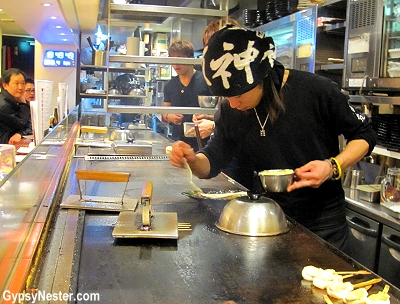
One whole wall of the narrow basement restaurant was an open kitchen, so the food preparation was also the entertainment.
A seemingly choreographed ballet between about a half dozen chefs was taking place before our eyes while every imaginable meat, seafood, fungus, vegetable, egg, or combination thereof, was being whomped onto the enormous grill with flair and panache.
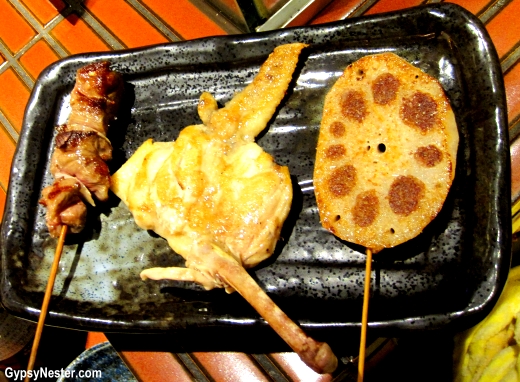
Periodically a sort of cheer, rallying cry, or chant type of unison yell would engulf the staff. We were clueless as to the meaning but completely enthralled. We opened our order with beef kalbi (ribs), chicken wing, and lotus root stuffed with shitaki mushrooms.
All of these were grilled right in front of us by our own showman / chef and served directly over the counter the moment they were done. Fantastic! We immediately ordered more.
WATCH: Dinner AND a show! Fantastic!
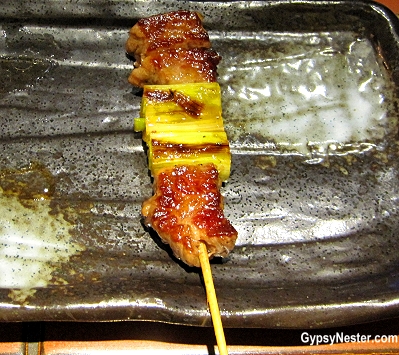
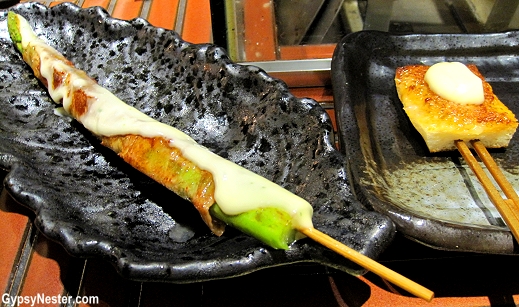
This time we went for beef neck, asparagus wrapped in pork, duck with scallions, and shrimp bread.
Again, perfection, sizzling hot from grill to plate.
By the time we had finished we both agreed that this evening had introduced us to some of the best food we had ever eaten.
Kuidaore!
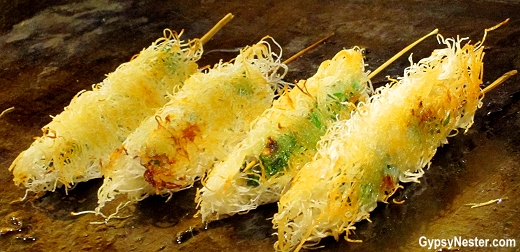
Snow crab wrapped in kadaif.
Waddling Back to Our Hotel
But between the lights, the food, the crowds and a couple beers, we had had about all the fun we could stand for one night.
Plus the trains stop running before midnight on a Monday, yes Dōtonbori was this crazy on a Monday.
So we wandered down a few side streets back to the station, confident that it was a good thing we were leaving in the morning or we would surely be back to live up to the old saying of kuidaore.
Ah yes, to be ruined by food. But what a way to go!




 The resort’s chef, Andre, demonstrated the proper Sicilian way to layer the ingredients and gave us some valuable tips such as soaking and pressing the eggplant to take the bitterness out.