
Search…

Changing of the Guard on Parliament Hill in Ottawa, Canada

Drawn from the Governor General’s Foot Guards and the Canadian Grenadier Guards, to a man, or woman, no doubt these soldiers consider the honor… YOU’VE GOTTA SEE MORE ABOUT THIS! >>

As we waited on the enormous lawn in front of the Parliament House in Ottawa, with the soldiers of the outgoing guard standing at attention, we began to hear the sound of approaching drums.

Soon we saw troops, led by their regimental band and pipers, marching up Elgin Street.

The entire force was decked out in their royal finest for the Changing of the Guard Ceremony.

The Ceremonial Guard, even on this hot August day, wore heavy scarlet wool tunics and black bear fur hats.

Now that is dedication.

Drawn from the Governor General’s Foot Guards and the Canadian Grenadier Guards, these soldiers to a man, or woman, no doubt they consider the honor more than worth it.

Also, it almost never gets this hot up here, so this was a rare hardship.

Check out everything we did in Ottawa!

See all of our adventures in Canada!

In Estonia We Traveled from Modern to Medieval

Evidence shows that people have been living here for over five thousand years, establishing it as one of the oldest seats of power in Northern Europe.

But it has only officially been the capital of the Republic since 1991 , making one of the youngest… CONTINUE READING >> 

Thanks to Visitestonia for sponsoring this post. As always, all opinions are our own.

toompea-castle

Estonia is filled with contrasts, and nowhere is that more on display than the capital city of Tallinn.

Evidence shows that people have been living in Estonia for over five thousand years, establishing it as one of the oldest seats of power in Northern Europe, while it has only officially been the capital of the Republic since 1991, making one of the youngest.

Passing through the modern business district, we easily understood why this has become known as the Silicon Valley of Europe.

Seems like we should have Skyped the folks back home, since this is where the Internet video chat app was invented.

tallinn-estonia

Moving beyond the glass and steel towers, we discovered they only tell half of the story of the city’s skyline.

The other half belongs to the UNESCO World Heritage Site that has been called one of the best preserved medieval cities in Europe, Tallinn’s Old Town.

The ancient settlement is divided into two distinct areas. Toompea, or Dome Hill, is the original fortified city on a hill, which overlooks All-linn, the lower town below. Even though this high ground is home to Toompea Castle, the name is derived from the domed churches of St. Alexander Nevsky and St. Mary’s Cathedral.

homeland-estonia-dome

The hilltop site of the castle has been a military stronghold for well over a thousand years, but now provides political protection for the people of Estonia as the home of the Parliament, the bright pink painted Riigikogu.

In a small park just a few steps from the refurbished palace we noticed a small crowd peering over a stone wall.

From this stunning hilltop overlook we got a great view of the three prominent pinnacles of St. Nicholas’ Church, the Town Hall or Raekoda, and St. Olaf’s Church, that form the medieval skyline of the town below. Even long ago this city was cutting edge, since the tower of St. Olaf’s is thought to have been the tallest building in the world between 1549 and 1625.

Eating Wild Game

After exploring the cobblestone streets, we stopped off for an unusual snack of beaver and bear at Raekoja Plats, the main square in the heart of the Old City.

homeland-estonia-bear

Afterwards, we ducked through the dark and narrow ancient St. Catherine’s Passage that leads to a section of Tallinn’s old defensive walls and climbed up for a walk along the top of the ancient ramparts.

Wait a minute, beaver and bear?homeland-estonia-beaver

Yup, that’s what we said.

Estonians have a long tradition of eating what we might consider exotic game, and many of the restaurants are more than happy to accommodate adventurous patrons willing to partake.

I guess we fell into that category.

Escaping the Urban

homeland-estonia-palaceEscaping from the urban area we entered the lush, green scenery of Kadriorg Park.

Hidden away inside is a small, by czar standards, palace built by Peter the Great for his wife Catherine the First in 1718.

The park is only the beginning of the unspoiled natural beauty that extends throughout Estonia’s countryside.

bog

With five National Parks, and dozens more protected Nature Reserves, the array of outdoor exploration possibilities can be anything from island hopping among the thousands of isles that dot the Baltic coastline, to a day at the beach, to hiking through ancient forests, or paddling through bogs.

Little did we know Estonia had been declared Lonely Planet’s best value destination for 2016 when we visited, but we certainly learned why it won the honor.

To learn more visit

Thanks to Visitestonia for sponsoring this post. As always, all opinions are our own.

The Real Cost of Medical Treatment Around the World

This post is sponsored content.

Staying healthy isn’t always easy – especially if you’re from a country where healthcare isn’t free. While the NHS has ensured people in the UK are able to get help on demand, the same can’t be said of some of these countries.

Here’s the real cost of medical treatment in five different nations from across the world.

1. Germany

The Germans are an efficient bunch, having earned notoriety for their ability to get the job done swiftly, regardless of what it is.

Despite that, they’re actually surprisingly high up on the capita list – coming in as the 13th most expensive country in the world per person.

alpsThe costs extend all across the country, with even the Alps in Bavaria seeing sums rising to crazy levels. In that region, it costs $120,000 for every air-rescue helicopter that’s used.

Cost per capita: $5,006

2. Indonesia

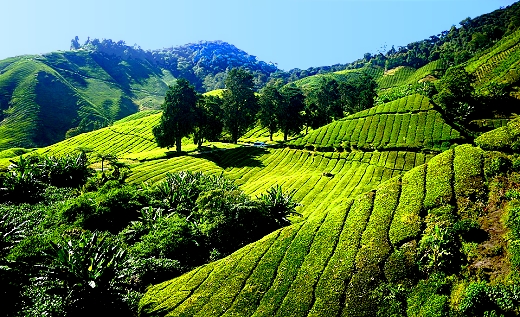
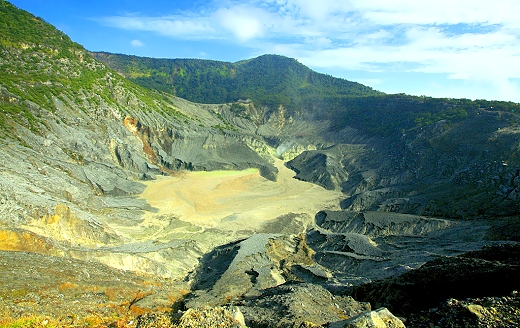
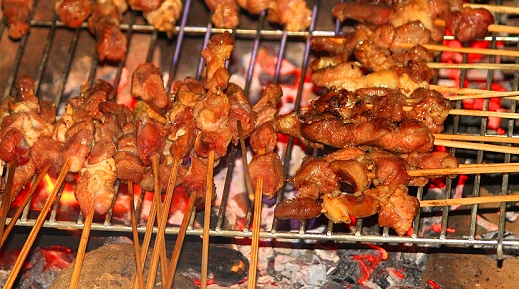
Things are very different when you hop over to Indonesia, with the Asian nation suffering a cost of just $107 per head for annual medical expenses.

The situation is a little different in Bali however, where hordes of monkeys are found to populate the area. The Ubud Monkey Sanctuary might be a wonder to behold, but the little furry fellas do bite.

The cost of one rabies vaccination can rise as high as $2,000 – so try your hardest to avoid letting one of these simians sink their teeth into you.

Cost per capita: $107

3. USA

It’s been well documented across the past few decades, perhaps no more apparently than by documentary maker Michael Moore in his film “Sicko”, that the US has a slightly flawed system when it comes to healthcare.

hospitalPrices are at times extortionate, with patients finding themselves in immense levels of debt for anything more than a couple of days in hospital.
Shockingly, an 18-day stay in hospital will see you wrack up costs in excess of a mind-boggling $800,000 in Houston, Texas. The moral of the story is: don’t get sick in America.

Cost per capita: $9,146

4. Japan

The Japanese healthcare system is probably one of the “fairest” around, with citizens being asked to pay for 30% of their medical costs and the government for the remaining 70%.

That’s a good thing if you’re facing a trip to accident and emergency, with a visit, a broken arm and follow-up surgery totting up to an overall cost of $25,000.

It’s not unlikely to snap the odd bone or two when you’re young, so it’s fortunate you don’t have to fork out for most of these costs.

Cost per capita: $3,966

5. Ghana

Concluded our list is a nation which is often devastated by the ravenous disease, Malaria. While healthcare in Ghana is one of the cheapest in the world, costs still mount up when dealing with this deadly bug.

An eight-day stay in hospital will set someone back as much as $8,000 – prices which, naturally, no natives in the country will be able to afford at any point of their lives.

Cos per capita: $100

You’ll now hopefully have a better understanding of how medical expenses compare around the world. Bear some of these in mind when you’re next out in any of these countries.

To Helsinki, Finland and Back

Blue skies above the White City of the North!

Explore with your GypsyNesters a church carved inside a gigantic rock, a huge sculpture that proves music is a visual art, lovely domed architecture, and what has to be the most surprisingly elegant Burger King on the planet… CONTINUE READING >> 

A big thanks to Viking Ocean Cruises for inviting us along and providing this adventure through the Viking Homelands! Sweden, Finland, Russia, Estonia, Poland, Germany, Denmark, and Norway. As always, all opinions are our own.

Helsinki, Finland

We began the day greeted by a rainbow as we enjoyed breakfast on our stateroom balcony while the ship pulled into port of Helsinki, Finland.

With Somewhere Over the Rainbow popping into our heads, we prepared for our trek into the Emerald, no wait, they call this the White City of the North, confident in the belief that there would be no wicked witch encounters awaiting.

The rainbow proved to be a good omen, since the skies cleared just in time for us to head into the city from the docks.

This Church Rocks!

The rock church in Helsinki, Finland

Our first stop was the unique Temppeliaukio Kirkko (Rock Church), which is carved into a block of underground granite and covered by a domed copper roof.

The rock church in Helsinki, Finland

The rock church in Helsinki, Finland

The idea for the church was first proposed in 1939, but the project wasn’t finished until 1969.

The end result was something that definitely came from an imagination out of this world, and it looks to be tornado proof too.

Leaving the temple we came across a more normal landmark with a quick drive by of the Olympic Stadium.

The arena was originally built for the 1940 Olympics, but those games were cancelled due to World War II, so the field became the site of the 1952 Olympics.

The Olympic Stadium in Helsinki, Finland

Music as Art

Our detour from the whimsical didn’t last long though, since our next stop looked as if it could have been right out of Oz.

The Jean Sibelius monument in Helsinki, Finland

The Sibelius Monument, with its conglomeration of six hundred pipes reminiscent of an organ, is dedicated to Finland’s most famous composer Jean Sibelius.

The Jean Sibelius monument in Helsinki, Finland

Oddly, he didn’t play organ, but the twenty-four ton sculpture has been embraced by Fins as a fitting tribute to the man who became a national hero when his music helped to inspire Finland’s fight for freedom from Russia.

The Jean Sibelius monument in Helsinki, Finland

Senate Square

The green domed Cathedral of Helsinki, Finland

We spent the rest of the day exploring the center of the city on foot, beginning at the massive Helsinki Lutheran Cathedral. As we walked toward its gleaming white with gold topped emerald domes, it certainly made us feel as if we might have wandered into the land of Munchkins and flying monkeys.

The stunning church is flanked by matching mirror images of the University of Helsinki and the Government Palace buildings. These form the outline of Senate Square, surrounding a statue of Czar Alexander II.

Statue of Russian Czar Alexander ll in front of Helsinki Cathedral in Finland

The Finnish National Theater in Helsinki, Finland
The Finnish National Theater

The Russian ruler, who became known in Finland as The Good Czar, is credited with building Helsinki into the grand city that it is today after Russia took control in the early eighteen hundreds.

No word on whether he arrived by balloon or ever hid behind a curtain.

The train station in Helsinki, Finland

What has to be the Most Surprisingly Elegant Burger King on the Planet

Working our way out from the square, we were stopped in our tracks by the Helsinki Central railway station.

It’s no wonder that this was chosen as one of the world’s most beautiful railway stations by the BBC.

The most surprizingly elegant Burger King on the planet!

The impressive exterior concealed a curious secret we never expected, a Burger King.

Not that strange you say?

It is to find a fast food joint with such elegance and style.

A huge fresco designed by Eero Järnefelt dominates the wall above the counter.

The most surprizingly elegant Burger King on the planet!

The entire restaurant project was done in cooperation with the National Board of Antiquities, taking special care to protect the artwork from kitchen grease and fumes with powerful air conditioning.

The most surprizingly elegant Burger King on the planet!

The idea was to preserve as much as possible from the original historic building, including no structural changes and incorporating some of the original furniture into the décor.

The magnificent golden-domed Eastern Orthodox Uspenski Cathedral in Helsinki, Finland

Like Dorothy and friends drawn to the wizard we returned to Senate Square, but noticed a magnificent golden domed structure perched on a hill across a small bridge.

We followed the road, sans yellow bricks, and discovered that it was the Eastern Orthodox Uspenski Cathedral.

Built a hundred years ago, this is the largest Orthodox church in Western Europe.

The red bricks, taken from the Bomarsund Fortress after it was destroyed in the Crimean War, provide a striking contrast to the thirteen green and gold onion domes representing Christ and the twelve apostles.

Now we were really starting to think that they should have nicknamed this the emerald…­ and gold, city.

Finnish Street Food!

Below the cathedral on the edge of the harbor we found a big open air market set up in the very aptly named Market Square.

Summer outdoor market in Helsinki, Finland

Since we arrived in the short summer season, fruits and vegetables were the big attraction and the vendors were happy to offer free samples.

We snacked on fresh cherries, strawberries, and peas while strolling through the rows of stands.

Clothing and trinkets were popular too, but food tents seemed to be the big favorites of tourists and locals alike.

The choices ran the gamut of traditional Norse country comfort foods, such as reindeer steaks and sausages, moose (which they are known as elk in these parts), and a wide variety of seafood.

Stirring up muikku vendace, whole fried fish, in an outdoor market in Helsinki, Finland

One curiousity we spied at several booths was a local specialty called muikku, fried whole small fish.

Acting as adventurous as always, we ordered a plate, along with some salmon soup, before bothering to ask exactly what sort of fish they were.

Luckily they were a delicious little fresh water variety known as vendace, a cousin of the salmon, but basically a sardine.

Pan fried and served with garlic sauce, they are considered a summer-time delicacy in Finland, eaten basically like French fries.

Muikku vendace, whole fried fish, and salmon soup in an outdoor market in Helsinki, Finland

With the afternoon slipping away our brains told us that it was time to make our way back to the ship, but our hearts didn’t want to go, so we had to summon our courage to bring ourselves to walk back.

Along the way we comforted ourselves by deciding that we wouldn’t want to stay here forever, but Helsinki certainly challenged the notion that there’s no place like home.

David & Veronica, GypsyNester.com

See all of our adventures in Finland!

A big thanks to Viking Ocean Cruises for inviting us along and providing this adventure through the Viking Homelands! Sweden, Finland, Russia, Estonia, Poland, Germany, Denmark, and Norway. As always, all opinions are our own.

Our Year in an RV – What We Spent & How We Did It

So how do committed boat people end up in an RV? Easy. On a spur of the moment whim.

Since we headed off into GypsyNester territory, BAMF has taken us to thirty-four states, three Canadian provinces, fourteen National Parks and a beautiful seaside town in Mexico. It was an amazing journey. We had no idea what we were doing, but we sure learned a lot, so we’d like to share some of what we discovered along the… CONTINUE READING >>

So how do committed boat people end up in an RV? Easy. On a spur of the moment whim.

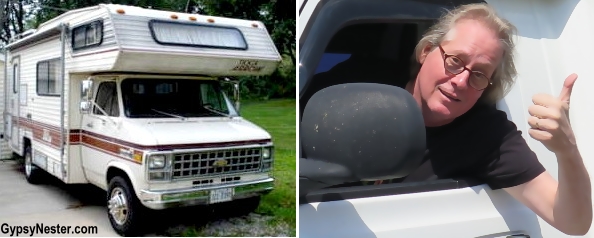
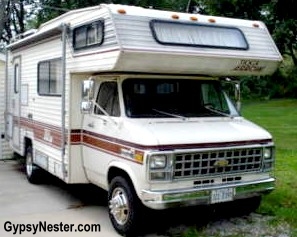
BAMF the RV MoterhomeWhen we headed off into GypsyNester territory, we kissed our friends good-bye — telling them we were on our way to sail the seven seas.

So what happened?

After nearly a decade of living on a tiny rock in the Caribbean we had been fairly isolated from folks up in the mainland. We hadn’t seen our stateside friends and family in ages.

We figured we should catch up with everybody before we unfurled our sails. But how?

Yosemite National Park

Planes, trains and automobiles, not to mention hotels, motels and restaurants would bankrupt us before we managed to see half of our neglected kinfolk.

They are literally scattered from sea to shining sea.

One day David blurted out, “What about an RV? We could take our time, hit the hotspots in between visits and we’d have our bed with us everyday.”

Had a blast at Mt. RushmoreOur GypsyNesting pact was that we wouldn’t tie ourselves up with plans. We wanted spontaneous adventure.

This seemed pretty damn spontaneous, so Veronica enthusiastically said YEAH!A bit of research was needed since we knew less than squat about the RV lifestyle.

We made a list of things essential:

    • David has to be able to stand up in it. It’s not like he had to ward off offers from the NBA — but everyone deserves a couple yards of vertical space.
    • It has to have one of those over-the-cab sleeping quarters thingys so we wouldn’t have to make up and tear down the bed everyday, because we both knew that we wouldn’t.
    • It can’t be so long that we can’t get into cities or park in regular parking lots.
    • It has to be old enough that David could tweak the engine. No on-board computers or fuel injectors for David.
    • It can’t have any weird smells. Smells mean damp — and damp is not your friend in a motorhome.

David took our list and did what we always do — he Googled (though we wouldn’t suggest Googling “weird smells” — not pretty).

After a few days of studying up, David had a pretty good bead on the situation. Veronica, for her part, ooohed and awwwed over his finds.

There are amazing amounts of RV buying resources on the web, but sometimes the best deals are on eBay.

Again, when you have no plans you end up doing things unexpected — really, what sort of idiot buys an RV on eBay?

A seller in Chicago had a listing that fit the bill perfectly. We emailed Chicago Dude and set up a test drive for a couple of hours before the auction closed.

It was love at first sight — twenty three feet of rolling luxury. It was an oldie but a goodie — an ’83 model Tioga on a Chevy chassis
with a good old 350 V-8.

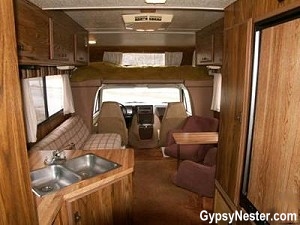
Funky, ugly neutral “earthy tones” with wheat stalks on the “wall paper.” But he was well laid out, everything worked and the weird smell issue was nonexistent.

We figure we stole it for $3,200 — Chicago Dude cut us a great deal during the test drive, “I like you two, you remind me of old hippies — you should have this motor home,” he said.

Uh. Okay. Thanks.

We spent about a thousand dollars more on prettying up the interior and a once over for safety’s sake. A little grease and a brake job and we were on our way.

We didn’t delude ourselves, we knew were engaging in a race against time. We fully expected to be stranded on the roadside at some point — but figured we could see a bunch of loved ones

The stranding never happened. Thirty thousand miles later, our funky home on wheels is still running like a scalded dog.

A few months into our new venture, we rounded up our offspring, The Piglet, and Decibel and The Boy, for a jaunt up to Montreal.

Decibel instantly fell in love with our “good old coach” (a description his “once over” mechanic had used).

She dubbed him BAMF. Please keep in mind that Decibel hails from NYC before Googling “BAMF.” The name stuck.

Flash forward a year. BAMF has taken us to thirty-four states, three Canadian provinces, fourteen National Parks and a beautiful seaside town in Mexico. It’s been an amazing journey.

We had no idea what we were doing, but we sure learned a lot, so we’d like to share some of what we discovered along the way.

Having invested less than five grand in BAMFy, we were inspired to do the whole year on the cheap.

We procured a Good Sam membership card and a National Parks annual pass and blindly hit the road.

Let’s start with what we spent:

Gas $7,413.97
Campgrounds $4,317.39
Vehicle
Maintenance
$2,483.23
Interior
and systems
$867.43
Oil
Changes
$436.45
Propane $352.55
Tolls $40.50

For a grand total of $15,911.52. That comes to just $1325.96 a month. Considering we had no mortgage, no utility bills, no cable, no yard — it was one heck of a deal.

Now the nitty-gritty:

BAMF is old. He doesn’t have all the pretty bells and whistles found on those newfangled behemoths. He averages about 8 miles to the gallon — not exactly aerodynamic. But he does have a stove, a refrigerator, a sofa, a dining table and even a bathtub. And we learned to adapt.

Veronica dubbed the toilet and mirror bathroom combo her “vanity.” Everything had to be stowed each morning to avoid deadly projectiles when rounding corners or applying brakes.

We learned how to heat things up without a microwave. We made coffee on the stove. And we arose each morning to a new scene out BAMFy’s windows. It was heaven.

Campgrounds were an every-other-day luxury. The off-days were spent at free sites known in RV lingo as boondocking or dry camping. Wal-Mart parking lots, casinos, government lands and, in a rare pinch, truck stops were utilized.

As with so many aspects of living on the road, the Internet was incredibly helpful in finding these locations. There are several websites dedicated to listing these places.

If you don’t have a secure internet signal right now, get connected somewhere else and check this out as well. You can get roaming internet if you look up internet near me and find a provider that goes everywhere you do. Make sure you shop around if there’s more than one suitable connection, however, as the cost per month can vary widely. 

For days spent boondocking we carried two battery packs and an inverter. This gave us enough electricity — combined with our laptop batteries — to write, catch up on correspondence, plan routes and watch movies. Frozen water jugs were placed in the fridge to keep food fresh. On campground days we charged our battery packs and froze our jugs.

Wal-Marts:

“ARE YOU FREAKING NUTS?!” Veronica exclaimed the first time David suggested staying at a Wal-Mart. Apparently ole Sam Walton was a big time camping nut and many, but not all, stores allow overnight stays.

Sites on the Internet list the stores that accommodate overnight stays — but their accuracy is less than stellar. We learned to make alternate plans — just in case.

It’s very rare to be alone in a Wal-Mart parking lot. Usually there are quite a few fellow blacktop bivouackers. One particular SuperCenter in Bozeman, Montana was a veritable RV rodeo.

Because of its proximity to Yellowstone, we met people from all over the world at the Bozeman Wal-Mart — our favorite was a German couple in a VW bus with a two-year-old son. Their goal was “drive” around the world in their little pop-top hippie wagon — they were headed for Washington State and then all the way down the coast to the tip of South America. There they would catch a boat to New Zealand. Somehow, we didn’t feel so crazy anymore.

Campgrounds:

Campgrounds vary wildly in size, price and amenities. Basic hook-ups… water, electricity, sewer service and, increasingly, wireless
Internet are standard.

Like real estate, prices are based on location, location – and location.

A parking spot packed in inches from your neighbor might run fifty bucks if it’s near a popular tourist attraction. Beautiful wide open spaces can be as little as ten or fifteen dollars out in the sticks.

Sometimes we paid strictly for the view. State Parks in California, with no hookups at all, run thirty-five dollars a night, but were worth every penny to sleep in the shade of the redwoods or wake up gazing out over the Pacific Ocean.

The best campground on the continent!Our choice for the bargain of the continent has to be the RV park in Puerto Peñasco, Mexico.

Everything we could ask for — Internet, full hookups and a site on prime beachfront property for twenty bucks a night.

We also had the exotic pleasure of fresh shrimp delivered right to BAMF’s door.

KOAs are usually very nice. They have all the stuff vagabonds need like Internet, laundry and a little store that sells everything you need to make s’mores — but they cost a bit more than your Mom ‘n Pop campsites.

We joined their “club” for the discounts and the convenience of a great online reservation system. On the KOA website, we could prepay, gather info on each campground and best of all, not have to worry about getting there before they closed for the night.

They can be a bit TOO “family friendly” for us old heathens. The mayhem of hay rides, dance parties and crazy youngsters aboard bikes is not really where we’re at these days. BUT — if we ever have grandkids, we’ll be there in a heartbeat.

Internet Access:

Many campgrounds offer free or very cheap wireless service. Generally these were the ones we sought out.

When boondocking or on the road we surfed a lot on our iPhone and made good use of our laptop connect wireless card. The card plugs into a USB port and connects through a cell phone signal. It works amazingly well on 3G, so-so on Edge and not at all in the boonies.

We spent scads of hours in coffeehouses and libraries to utilize their wifi services. These are great places to meet people and feel the pulse of the towns we visited.

Phone service:

Since we have an iPhone with AT&T this is all we can speak about.

The pros:
Internet right in the palm of our hands for Googling on the go.

GPS! Nevergetting lost — okay, getting lost less often. Don’t know how we ever got along before GPS.

There’s an ap for that! Cheap gas, restaurants, coffeehouses with free wifi, Wal-Marts, campgrounds, sewer dump stations, movies and just about anything else under the sun.

The cons:
Huge areas without service when off the beaten path, especially out west and the upper midwest. Outside of the cities there’s no rhyme nor reason to the coverage. We had five bars and 3G service on a little boat in the middle of the Atchafalaya Swamp yet no service at all blocks away from a major university. Go figure. We learned to adapt.

Mail:

The Internet makes taking off in a BAMF so much easier than a few years ago. All of our bills are paid online, most automatically, so mail is much less of an issue.

We have a post office box where The Boy is going to college. He picks up our mail once a week and throws 90% of it straight in the trash. We had him forward the very few important things to us when we were with family, otherwise he just hung on to it until we saw him next.

David & Veronica, GypsyNester.com

Did we miss something? Please feel free to ask us questions or make suggestions by leaving a comment!

The Joys of Bathing

Traveling the world you may not always get the benefits and comfort of home.

But regardless of where you are taking the time to relax and enjoy a leisurely soak in the tub is something that anyone at any age would relish… CONTINUE READING >> 


We are more than happy to endorse this sponsored post from American Tubs because there is almost nothing we like more than a good soak in a nice tub.

Traveling the world you may not always get the benefits and comfort of home but regardless of where you are taking the time to relax and enjoy a leisurely soak in the tub is something that anyone at any age would relish. American Tubs takes the joy of bathing so much further than you could ever imagine possible by designing and manufacturing walk in tubs that are customizable with specific attention to safety and superiority.

Each detail put into the design ensures that you are getting a safe and comfortable tub that allows for the user to relax amongst it jet-system and air bubbles that are placed in just the right locations to hit those pressure points and not cause excess water waste (added features). Hydrotherapy eases compression on joints and muscles. Correspondingly, water works on internal body parts. It also improves the flow of blood in the body and helps with the pain. Chromotherapy has a long history of therapeutic properties by using the appeal of various colors to enhance one’s’ mood or alleviate pain.

One of the biggest claims against walk in tubs is that no one wants to sit in a cold tub waiting until the water drains.

The key item that really puts American tubs in the top of their class is their patented HurryDrain© Fast Drain and overflow kit that is guaranteed to drain the tub in 110 seconds.

Unlike other drains that claim they use a “faster” drain, American Tubs ADA approved HurryDrain© uses a gravity-fed process and fits nearly all residential plumbing, so no extra power source or construction is necessary when installing.

The benefits of walk-in tubs run the gamut of benefits for individuals that are living independent senior lives, living with handicaps, or simply a lover of luxury. Besides all these personal benefits, the bathtubs are a long-term financial investment. The safety inclusions that come with these bathtubs make them suitable for abiding use. You can use it in your youthful years all the way to sunset years. It serves its purpose and more so with the passage of time.

Receive a Free Estimate Today!
Looking for more information about walk in tub prices, request that a local walk in bath tub dealer contact you.

It is always a wise decision to request a free estimate because it provides the most accurate pricing quote for up-to-date prices of walk in tubs.

Call us now at (800) 577-8475 or visit us @ americantubs.com we would love to go over the options we have.

Mermaids, Hippies, and the Spires of Copenhagen, Denmark

A truly colorful town!
Race around Copenhagen with your GypsyNesters as we check out her art and architecture, her quirks and colors, and successfully dodge a contact high in a real live hippie colony (and though we don’t partake, we used it as an excuse to satisfy our munchies anyway)… CONTINUE READING >> 

Colorful Nyhavn - Hans Christian Anderson lived in this neighborhood in Copenhagen, Denmark

Copenhagen, Denmark

It certainly seemed fitting to sail into Copenhagen from the water, aboard a Viking ship no less.

The city exists because of the harbor, which is basically its name, København, from the original Køpmannæhafn, meaning merchants’ harbor.

The Little Mermaid in Copenhagen, Denmark

Before that, over a thousand years ago, Vikings used the port and established a fishing village.

It’s hard to imagine what the hard-charging Vikings would think pulling into the port now, being greeted by a serene statue of The Little Mermaid.

The bronze tribute to Danish author Hans Christian Andersen by Edvard Eriksen has become a symbol for the city as she sits wistfully on a rock.

She’s completely unViking-like, but very welcoming to us modern-day Viking cruisers.

The Gefion Fountain in Copenhagen, Denmark
Near the harbor, the huge Gefion Fountain depicts the Norse goddess Gefjun and her four sons-turned-oxen pulling the island of Zealand out of Sweden to form Copenhagen.
Did our Guide Just Say the King was a “Short, Fat, Alcoholic?”

Amalienborg Palace in Copenhagen, Denmark

From the port, the easiest place to begin our exploration was at Amalienborg Palace, which is actually four identical palaces surrounding an octagonal courtyard.

The royal family has been living on this site for about four hundred years, including the current monarch, Queen Margrethe II.

Our guide pointed out an equestrian statue of King Frederick V in the center of the square and cheekily explained how, even though this whole complex was his baby, it doesn’t really look like him.

It seems he wanted to be depicted as a god-like Roman emperor, when in the words of our guide, “the artist must have had quite the time of it; Frederick was a short, fat, alcoholic.”

Got to love hilarious honesty in a tour guide!

A soldier of Amalienborg Palace in Copenhagen, Denmark

Much like Buckingham Palace, Amalienborg is guarded day and night by Royal Life Guards.

No, they aren’t keeping an eye on the swimming pool, these sentries are from an elite infantry regiment of the Danish Army, founded in 1658 by King Frederik III, and are much more than ceremonial.

When they are not wearing funny hats, they serve in a front-line combat unit.

Fredrick's Church, known as the Marble Church in Copenhagen, DenmarkKing Roman god want-to-be also wanted a church built in his honor, so Frederik’s Church construction began in 1749.

Soon money got tight and the church was left incomplete and stood basically as a ruin for almost a century and a half.

When the church finally opened in 1894 it became known as The Marble Church.

So much for his big monument.

Going deeper into town we came to the Rådhuspladsen, or City Hall Square.

Normally this is a central gathering place for the city in the shadow of the impressive Palace Hotel and City Hall; unfortunately a massive reconstruction project had most of it hidden.

Checking the Weather

The Weather Girls in Copenhagen, Denmark - statues the tell the weather!

But it wasn’t a total bust, we did get to see one of Copenhagen’s quirky charms, The Weather Girls, perched on top of the Richs building in one corner of the square.

On nice days a sculpture of a girl with her bicycle rotates to the front, but when rain moves in another sculpture appears of her with an umbrella walking her dog.

Not exactly Accuweather, but fun nonetheless.

Government and a Sad Bear

The Christianborg Palace in Copenhagen, Denmark

Since we had missed one landmark due to renovations, we high-tailed it to another one nearby, the Christiansborg Palace.

This spot has been the seat of Denmark’s government since 1167, when the first castle went up.

Two more castles and a couple of palaces later, and we were looking at the home of the Danish Parliament, as well as the Prime Minister’s Office and the Supreme Court.

A rare sight indeed, since this is the only building in the world that houses all three of a country’s branches of government.

Unbearable statue - an impaled bear by Jens Galshiot in Copenhagen, Denmark

That’s a whole lot of history for just one spot, but it was a new addition to the courtyard that caught our eye, a work of art entitled Unbearable.

In the somewhat disturbing piece, an iron pipe portrays the levels of atmospheric carbon dioxide sky-rocketing into the belly of a polar bear like a spear.

The impact of the sculpture by Jens Galschiøt was immediate and unsettling.

It certainly made us want to investigate the work and what it was saying.

No doubt that was the idea when it was created in collaboration with the World Wildlife Fund.

There are Hippies in Copenhagen? Yes, Serious Ones.

Freetown Christiania in Copenhagen, Denmark

With our thinking being pushed a little outside of the box, we broke off from our tour group to check out an area of Copenhagen that is not a part of the usual tourist programs, Christiania.

This uniquely odd community began back in 1971 when a group of oh… for lack of a better term, let’s call them hippies, moved into an abandoned military facility.

Christiana in Copenhagen, Denmark

The counter-culture squatters declared themselves to be an autonomous entity known as Freetown Christiania.

It didn’t take long for a thriving cannabis trade to develop, and the business was generally tolerated and overlooked by the authorities for years.

The attitude among civil authorities became one of begrudging tolerance, deciding that keeping things confined to this area might not be a bad idea.

Christiana in Copenhagen, Denmark

Freetown Christiania in Copenhagen, Denmark

But in 2004 they decided to crackdown, and after that the dealings went undercover, but didn’t stop.

Now things have relaxed again, but with some odd twists, one that we encountered as we approached Pusher Street in what is known as the Green Light District.

Booths are openly selling pot and hash, but the proprietors are all wearing ski masks or scarves to hide their identities and a no photos policy is strictly enforced.

Freetown Christiania in Copenhagen, Denmark

Other than that somewhat dark underground feel of this small section we found Christiania to be mostly groovy, with folks enjoying the good vibes of a beautiful day while getting baked in a lovely setting.

Having dug the scene, we decided to split before we developed a serious contact high.

But we figured we’d check out some places nearby where folks go to satisfy their munchies anyway.

The City of Spires

The Spires of Copenhagen, Denmark

Vor Frelsers Kirke has an outside staircase in Copenhagen, Denmark

A very cool landmark had been guiding our path since we set out to find Christiania from across the bridge, the distinctive spire of the Vor Frelsers Kirke.

Copenhagen is sometimes called the City of Spires because of all of the towers on its churches and castles.

But of all of them, this one on the Church of Our Saviour had been intriguing us all day with its external spiral stairway climbing all the way to the top.

Talk about getting high!

Uberfancy Sandwiches

Having found both the commune and the tower, we were ready to reward ourselves with a Scandinavian lunch treat, smørrebrød.

These are open-faced sandwiches meant to be eaten with a knife and fork. Toppings are artistically arraigned on brown bread to create an edible work of art.

We went with chicken salad and shrimp on avocado, two classics.

Shrimp and chicken smorrebrod in Copenhagen, Denmark

Coffee truck in Copenhagen, Denmark
How do we get our hands on one of these little coffee trucks?
Once again we found ourselves wondering what a Viking might think.

It’s hard to imagine one of the burly warriors accepting these dainty delicacies as a meal, but then we’d venture a guess that we might be less than enthusiastic about eating most of their fare too.

With that in mind we headed back to our ship content with our place in history… just as we suspect those Vikings of old were with theirs.

David & Veronica, GypsyNester.com

A big thanks to Viking Ocean Cruises for inviting us along and providing this adventure through the Viking Homelands! Sweden, Finland, Russia, Estonia, Poland, Germany, Denmark, and Norway. As always, all opinions are our own.

YOUR TURN: