enlarge video
The old Vegas is alive and well! The Neon Museum Las Vegas has restored many of the classic bygone signs from The Strip and displayed them… CONTINUE READING >>
Neon rules the night. The old Vegas is alive and well down on Fremont Street. The classic cowboy Vegas Vic lives on among the bright lights of The Fitz, The Fremont, The Four Queens and The Golden Nugget.
There’s no question about it that party neon signs are enchanting. With their glamour vibes, you can get lured thanks to just about any bar lights and signs on the street. They keep the aura alive at night.
The Neon Museum Las Vegas has saved and restored many of the classic bygone signs from The Strip and displayed them as a gallery along Fremont Street. Many others that wouldn’t fit on the street have been stored for posterity in The Neon Boneyard.
enlarge video
We needed a good Elvis, the best Elvis, the biggest Elvis… that could only be Pete “Big Elvis” Vallee at Bill’s Gamblin’ Hall & Saloon. 400 pounds of Elvis, 3 shows a day… CONTINUE READING>>
We needed a good Elvis, the best Elvis, the biggest Elvis… that could only be Pete “Big Elvis” Vallee at Bill’s Gamblin’ Hall & Saloon. 400 pounds of Elvis, 3 shows a day… now THAT’S real. The scuttlebutt around Bill’s was that Pete used to be an even bigger Elvis, twice as big they say. Girth aside, the boy could whomp down a pretty mean My Way. More: https://www.gypsynester.com/vegas.htm
San Diego could have a massive inferiority complex, being overshadowed by its giant neighbor to the north — like a redheaded stepchild, but it doesn’t. No need to — the beauty and attractions have so much to offer.
We discovered San Diego while driving down from that sprawling metropolis above, our buddy Juan Rodríguez Cabrillo found it by sailing up from Mexico.
Although Portuguese by birth, Johnny C. was working for Spain on a find-a-shortcut-to… CONTINUE READING >>
San Diego could have a massive inferiority complex, being overshadowed by its giant neighbor to the north — like a redheaded stepchild, but it doesn’t.
No need to — the beauty and attractions have so much to offer.We discovered San Diego while driving down from that sprawling metropolis above, our buddy Juan Rodríguez Cabrillo found it by sailing up from Mexico.
Although Portuguese by birth, Johnny C. was working for Spain on a find-a-shortcut-to-Asia gig when he cruised into San Diego harbor in 1542 and dubbed it San Miguel.
Though he failed rather miserably on the Asia route routine, he “found” a whole bunch of California.
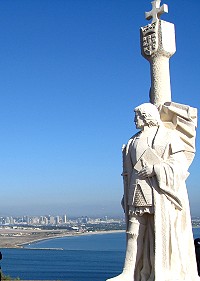
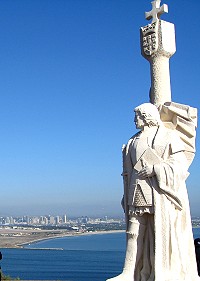
We’d been encountering his endeavors all along the coast. In fact, the National Monument in his honor declares that he GAVE THE WORLD CALIFORNIA.
No mention of whether he smuggled the state with him over from Spain or just lugged it up from Mexico but we strongly feel geologists should look into that.
Archeologists seem to think several tribes of Native Americans were happily living in the area before Señor Cabrillo stumbled upon it on his way to Asia — so perhaps they gave us California. Either way, they picked a mighty fine spot to bestow upon the world.
The National Park Service picked an absolutely awesome spot to erect the monument to Capitan Cabrillo, right on the tip of Point Loma at the mouth of the harbor.
The views are incredible from the top of the Point — all of San Diego before us at one side and the largest ocean in the world on the other. What an inspiring place to kick off our day.
We took a short hike down the trail that parallels the Pacific coastline in search of the perfect perch for a picnic brunch.
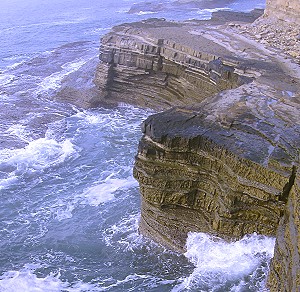
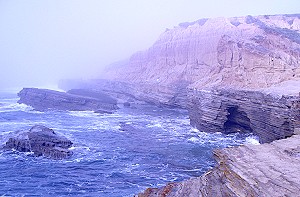
Waves crashed on the rocks as seals sunned themselves and birds rested their wings along the shore. We found our spot on an outcrop jutting into the ocean.
Munching our cheese and bread in the shadow of the old lighthouse and under the watchful eye of a crazy seagull, we scanned the water for passing whales.
Alas, the whales that day were wily or maybe it was just the wrong time of year. Aspiring nature photographer Veronica was dying to snap a pic of a fluke or a spout but it was not to be.
The only break in the serenity of the wind and waves was the fairly frequent drone of multiple types of military aircraft on their way to the Naval Air Station in the harbor.
Things are rockin’ down in the bay — San Diego is the birthplace of naval aviation and home to one of the largest naval fleets in the world. Nearly every kind of ship in the service calls this port home, including two of the ginormous supercarrier aircraft carriers.
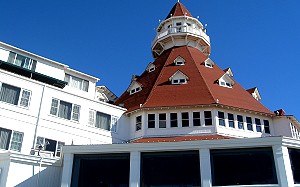
Just beyond the Naval Yards, on Coronado Island, are some pretty dad-blame fancy digs, the Hotel Del Coronado.
Over fourteen hundred San Diegans turned out for the gala grand opening back in 1888 and soon after the Coronado was hosting princes, presidents and prominent people from that place up north that shall remain nameless.
Edward, Prince of Wales, seventeen presidents from Harrison to Obama, as well as Hollywood-type royalty have all graced the Coronado with their presence.
Since our access to the royal treasury has thus far been denied, we would not be staying the night. We hoped no one would mind if we took a stroll around the well manicured grounds.
The trick is to blend in, act like we belonged in the place.
Nonchalant, incognito…how we didn’t get tossed out we’ll never know.But seriously folks — the place is fantastic and non-royalty are more than welcome to take look around, bang down a few bucks at the shoppes, or grab a sip or a snack.
We bugged out before formal attire was donned by the fashionista set. We try to avoid seeing people dressed so uncomfortably — it gets us all itchy.
We were dressed more for a trip to the zoo anyway and Veronica happily noted that she’d have a better shot at filming animals in captivity.
The San Diego Zoo is an amazing place, no animals in concrete cages here — that just makes us sad — so it was off to Balboa Park and its world renown facilities.
The zoo was buzzing with the news that the baby panda, Yun Zi, was to be introduced to the public, unfortunately for us, the following day.
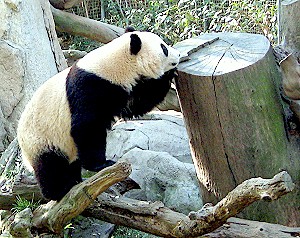
No worries, we were just as beside ourselves at the prospect of seeing his sisters, so first stop… panda’s pagoda.
Actually they call it Panda Canyon and lucky for us, both Su Lin and Zhen Zhen were out having a bite of bamboo when we got there. Only four zoos in America have giant pandas, Memphis, Atlanta, The National Zoo in D.C. and of course, San Diego.
All pandas are citizens of China, even the babies when they are born abroad, like Yun Zi.
Five of the eight cubs born in the USA popped out in San Diego, the oldest two having been returned to their motherland.
There is so much more to The San Diego Zoo than just pandas though, over four thousand animals from more than eight hundred species are housed here.
And the best part? The animals are well exhibited — we got to view monkeys monkeying around, elephants exercising and pygmy hippos swimming from above AND below the waterline.
These guys have room to be who they are and it is obvious they are loved and taken care of. Really a joy to see.
Some of the coolest exhibits are the walk-through aviaries in The Lost Forest, where birds of all sorts and sizes fly semi-free.
Ambling along the raised walkways, they flew over, in front of and even underneath us. We miraculously managed to avoid the bowel movement bombings that covered the area.
As far as we could tell we did anyway, since some of our feathered friends were quite small in stature. Extreme caution was exercised whilst looking up.
Closing time was fast approaching as we tried to find our way out of the forest and soon surmised how it became known as Lost.
We seemed to be going in circles and it was getting pretty dark. After encountering a few other wandering patrons who were just as disoriented as us, we trudged on.
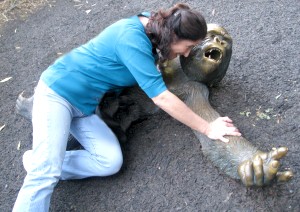
At one point a gorilla tried to block our progress, but was easily dispatched when he turned out to be bronze.
Shouldn’t some employee be rounding us up and herding us out of the park?
Wait, what was that growl behind us? They don’t let the big cats out to roam at night and feed on the stragglers, do they?
Is this how they save on Purina Puma Chow? We quickened our pace as it became full blown dark in the jungle, listening intently for any rustling in the bushes while searching for an exit.
The hours of operation had long ceased by the time we reached what seemed to be a main path through the one hundred and seven acres of wildlife.
At least a few dim lamps lit the way. We hurried along it, almost certain that we felt hot jaguar breath on the backs of our necks.
Look, lights! Gates, buildings, a way out!
We made it.
Maybe our ordeal was meant to be part of the adventure. A little fear certainly added to the OUR great experience of the zoo — and San Diego can certainly claim one of the best in the world.
Oh yeah… and they still have an NFL football team too.
enlarge video
Lucky for us, both Su Lin and Zhen Zhen were out having a bite of bamboo when we got to Panda Canyon. Only four zoos… CONTINUE READING>>
Lucky for us, both Su Lin and
Zhen Zhen were out having a bite of bamboo when we got to Panda Canyon.
Only four zoos in America have giant pandas, Memphis, Atlanta, The
National Zoo in D.C. and of course, San Diego. All pandas are citizens
of China, even the babies when they are born abroad, like Yun Zi.
Five of the eight cubs born in the USA popped out in San Diego,
the oldest two having been returned to their motherland.
“I love LA” certainly has a better ring to it than “I love El Pueblo de Nuestra Señora la Reina de los Ángeles de la Porciúncula.” Maybe that’s why the name has been shortened over the years to the point that now it’s just two letters. This gives Los Angeles… CONTINUE READING >>
“I love LA” certainly has a better ring to it than “I love El Pueblo de Nuestra Señora la Reina de los Ángeles de la Porciúncula”.
Maybe that’s why the name has been shortened over the years to the point that now it’s just two letters.
This gives Los Angeles the distinction of having both the longest and shortest name for a city in the US and fourth longest in the world.
Prior to being dubbed that mammoth moniker by Don Fernando Rivera y Moncada (his own name a mouthful) and his band of forty-four Spanish settlers back in 1781, the area was inhabited by the Tongva.
The Tongva territory covered all of what we now think of as Southern California and the Channel Islands including Catalina.
While journeying through The Golden State, we reckoned we ought to see where The City of Angels got its start and that meant a trip into the heart of downtown.
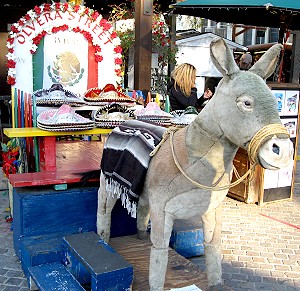
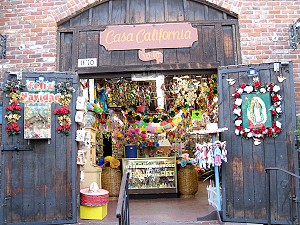
Nestled among the skyscrapers, train stations, bridges and parking lots we found Olvera Street, the “Birthplace of Los Angeles.”
A tiny block of mixed up Spanish-Mexican-Anglo heritage right in the middle of modern America.
This spot has been the center of LA since the 1820s when the plaza was built on the edge of what was then known as Wine Street. The road was officially renamed Olvera Street in 1877 in honor of Augustín Olvera, a Judge for Los Angeles County.
Nowadays we find a lively tourist area and historical district. Apparently the place rocks during Cinco de Mayo and El Dia de los Muertos, a weeklong celebration of joyful remembrance of lost loved ones.
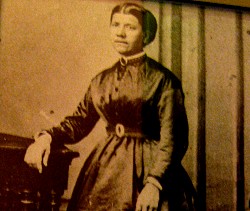
Our Olvera Street explorations began at Sepúlveda House. Eloisa Martinez de Sepúlveda arrived here in Alta California with her family at the age of eleven.
They had come from the State of Sonora, Mexico, which at that time was a move from one state to another within the country.
Five years later, her family found themselves living under the rule of the United States. Luckily Eloisa’s family were landholders and didn’t suffer the fate of many early inhabitants of the new American Southwest after the Mexican-American War.
Eloisa was one tough cookie. In 1887, widowed and left without the property given as her marriage dowry, she built a commercial building known as the Sepúlveda Block on land that her also-widowed mother owned, quite a feat for a woman of her day.
The two story Victorian-style building cost Eliosa $8,000 and featured businesses, a boarding facility and her private residence.
Beautifully restored, Sepúlveda House remains today as the Plaza District’s Visitors’ Center and mini museum providing a taste
of life in late nineteenth century Los Angeles.
Armed with information from The Center, we took to the street. The street is flanked by twenty-seven historic buildings dating back to the 1800s, blending Mexican and the newly adopted Anglo architectures.
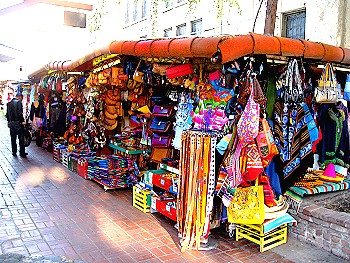
The original adobe structures from the late 1700s no longer remain. Most buildings are refurbished as restaurants or the ever present tourist area crap shops but we nevertheless got a feel for how LA rolled before Hollywood came to town.
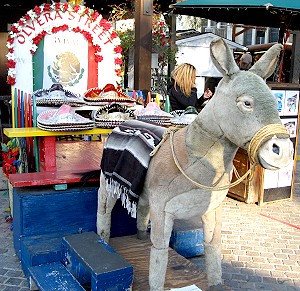
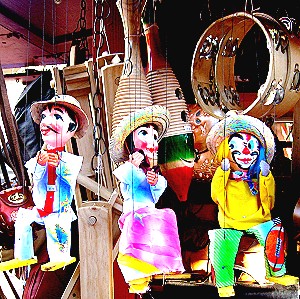
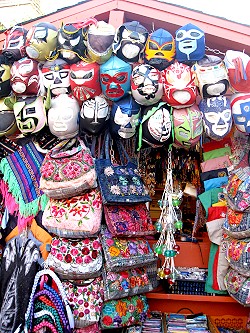
Down the center of the narrow street small carts have set up shop to ply their Mexican wrestling masks, paper flowers, cup and ball toys, sarapes, cheap guitars, puppets and even an Elvis on velvet or two.
Browsing the souvenirs amidst the aromas of the many authentic cafes was killing us, so before we could make the last few exhausting steps to the plaza, a sustenance stop was necessary.
There are plenty of culinary choices on Olvera Street– from table cloths adorned with fine china to walking-around-with wrapped tacos.
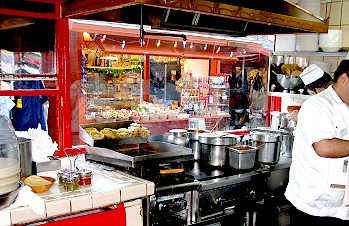
We chose an in-between — a sit down and eat from a basket establishment, La Noche Buena, with its colorful atmosphere and tables in full view of the tortilla flinging in the kitchen.
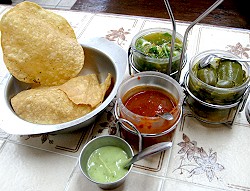
Salsas are generally a good yardstick when sizing up a Mexican restaurant and La Noche Buena did not disappoint.
Four varieties — muy mild mannered to aye carumba! — served with whole fried corn tortillas. Everything else was gravy after that.
After a few tacos al carbon and some killer taquitos, we had regained the strength to manage the last fifty yards or so to the plaza.
The circular plaza in front of the old church is ringed with historical markers depicting the founding of the LA and its counterpart
settlements up and down the west coast.
Turns out the Spanish had a well governed system of missions and presideos all across
the southwest.
Veronica, a native California girl, was well versed in the mission chronicles, but David was not taught about the Spanish and Mexican side of things while growing up on the prairie in the 1960s.
Bull elephant seals fight for territory on the Elephant Seal Beach near San Simeon, California. More seal video here: https://www.gypsynester.com/bs.htm
enlarge video
Baby seal born on the Elephant Seal Beach. Baby and mother have a visit from a bull and things get… CONTINUE READING >>
Baby seal born on the Elephant Seal Beach near San Simeon, Ca. Baby and mother have a visit from a bull and things get all stirred up! More seal video here: https://www.gypsynester.com/bs.htm

 .
.