enlarge video
At the western end of the Atchafalaya Basin Bridge of Interstate 10, an 18 mile run over Cyprus and gators, we met Ernest Couret and his little 16 ft swamp boat. After the usual “How y’all are?” greetings we climbed… CONTINUE READING>>
At the western end of the Atchafalaya Basin Bridge of Interstate 10, an 18 mile run over Cyprus and gators, we met Ernest Couret and his little 16 ft swamp boat. We pulled off and parked directly under the causeway, traffic zooming by overhead. After the usual “How y’all are?” greetings we climbed aboard and headed out into the dense, wet wilderness. For more: https://www.gypsynester.com/swamp.htm
enlarge video
Enter the strolling mariachi. Their timing could not have been better. We asked for a lively tune in the hopes… CONTINUE READING >>
Enter the strolling mariachi. Their timing could not have been better. We asked for a lively tune in the hopes of removing Guantanamera from our heads. The song had been beaten into our brains by those evil El Pollo Loco commercials to the point that we were now singing One Ton of Mayo on a regular basis.
The marvelous mixture of guitar, vihuela, guitarrón, accordian and harp, which is a rare special inclusion, was more than enough to remove the dreaded ditty… at least for a while. Hey! More: https://www.gypsynester.com/mx2.htm
A huge part of how we acquire knowledge about new locales is by exploring their culinary fare. On our expedition to Mexico’s Puerto Peñasco we continued in that tradition.
As is often the case, we found that the typical food of an area is not what we Americans expect when we think of “ethnic” food. Italian pizza is not even remotely comparable to the Dominos version and real Mexican food ain’t no Taco Bell. In fact, “real” Mexican food varies drastically depending on the region in which the meal is prepared. In Puerto Peñasco real means … CONTINUE READING >>
A huge part of how we acquire knowledge about new locales is by exploring their culinary fare. On our expedition to Mexico‘s Puerto Peñasco we continued in that tradition.
As is often the case, we found that the typical food of an area is not what we Americans expect when we think of ethnic food.
Italian pizza is not even remotely comparable to the Dominos version and real Mexican food ain’t no Taco Bell.
In fact, real Mexican food varies drastically depending on the region in which the meal is prepared. In Puerto Peñasco real means shrimp, shrimp and, yup, more shrimp.
Ah yes, sampling all of those tasty treats was a dirty job — but somebody had to suffer through it!
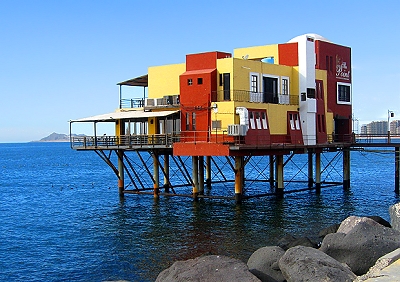
We started our crustacean consumption at the Point, an interesting establishment that is not on the water as much as it’s out in the water. At least until low tide.
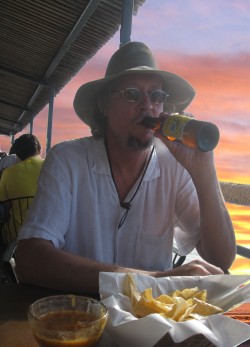
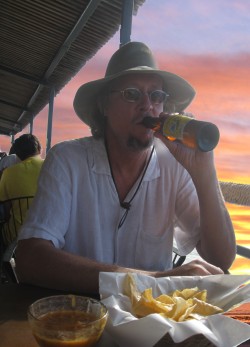
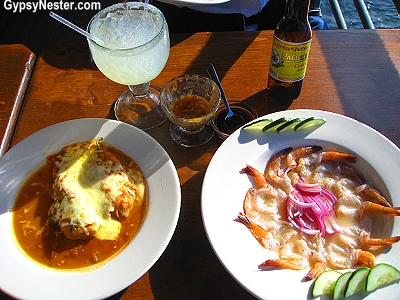
Stopping in for a late lunch/early dinner, snack ‘n cocktail/sunset watching on the deck suspended over the Sea of Cortez to take-a-load-off-our-feet-after-walking-around-town kind of thing didn’t suck – add a cold Pacifico and what the menu called a Mexican shrimp cocktail and we certainly felt like we were settling in for some true Mexico cuisine.
Unlike the dish we’re accustomed to, Mexican shrimp cocktail lacks cocktail sauce and the shrimp is not boiled.
Marinated in lime juice, the shrimp cook the same way as ceviche — in the acid of the lime.
To properly pull off this dish, the shrimp must be exceedingly fresh, and ours were straight out of the water.
Served fanned out like a flower with onions and cucumbers, it looked almost as good as it tasted… almost.
To round out our “snack,” the Point’s chili relleno, a pablano pepper stuffed with shrimp and white cheese, was spot-on spicy, ooey-gooey, muy, muy bueno.
The next day, after scouting about town, we returned to the waterfront. Large bodies of water seem to have a magnetic effect on us. As do the delicacies that dwell there.
For a quick lunch we chose Mary’s Sea Food Restaurant. As a rule in tourist towns, locals avoid the places where travelers congregate.
Not so at Mary’s. Located right in the thick of the tourist traps, this eatery is just too good and too much of a bargain for full-time denizens to resist.
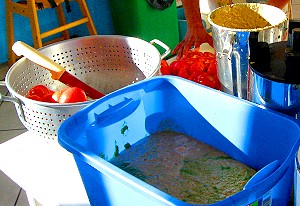
Mary’s lower level has the hustle and bustle of an active fish market and kitchen — all happening right in front of the customers.
Talk about watching what you eat!
The upstairs is an open air picnic-style feeding ground overlooking Cortez’s old cruising course. The day was gorgeous and sunny so up the stairs we went.
We ordered the Special Seafood Combo for two, a mix of breaded, grilled and garlic shrimp with breaded, grilled and garlic fish arranged around salad and whomped out on a gigantic platter. Each variation was fantastic.
There’s no telling which two people could ever eat this humongous platter — it certainly wasn’t us. Mary doesn’t send anyone away hungry.
We stopped by Mary’s the next day for a couple scallop tacos — at two dollars each — snarfed down quickly on the ground floor.
If we had been wearing any socks they would have been knocked right off.
We could have stuffed ourselves silly trying one of everything that Mary had to offer but we had eatin’ plans for later…
Up a rutted, rocky, steep dirt road perched atop Whale Hill stands The Lighthouse. Overlooking the old port, it really is a lighthouse — at least on top. Underneath the signal lantern is a restaurant with a view to rival any found under the sun.
The food may not quite be as spectacular, it would be hard for any grub to be, but wait… the best was yet to come. We began with a plate of Queso Frito.
Sliced Queso Chihuahua, a mild Monterrey Jack-like cheese, lightly fried and covered with salsa verde.
Delicious… off to a good start.
The entrées were fairly standard fare. Meat and potatoes with a little Mexican flair and of course, shrimp.
An especially intriguing menu item was the “Divorced Fish.”
Normally, we would be all over a weird item like this, but somehow we didn’t want to spoil it with explanations — the possibilities as to why a dish would be called Divorced Fish were simply funny enough.
But the pièce de résistance was still to come. It’s not often that coffee is the highlight of the meal, but it is at The Lighthouse. Famous for the flashy preparation of their Mexican Coffee, patrons are provided with dinner AND a show.
Take tequila, Kahlua and coffee, add a flame and viola… magic!
With skill, flair and daring our waiter / performer extraordinaire cascaded the blazing liquid from one silver salsera to another.
Gravy boats everywhere must be mighty jealous of these two sparkling showboats. After a bit of grandstanding, the fiery fluid was poured into cups with a bold double waterfall technique.
Watch: A Flaming Waterfall of Mexican Coffee
Cinnamon is added for a light show that rivals the 4th of July. Then for a sensational finale, fresh cream — hand whipped at our table no less — was added before a burning cherry was lovingly placed atop the concoction.
Singed eyebrows were a distinct possibility so we made very sure that the beverage was extinguished before going in for a sip. Delicious!
Considering the amount of booze involved, somewhere between a pint and a gallon, it’s not very strong, just flavorful. The flames burn off most of the alcohol but leave the deliciousness behind. A pleasing potent potable if there ever was one, maybe we should have a little music to go with it.
Enter the strolling mariachi. Their timing could not have been better. We asked for a lively tune in the hopes of removing “Guantanamera” from our heads.
The song had been beaten into our brains — by those evil El Pollo Loco commercials back in the States — to the point that we were now singing One Ton of Mayo on a regular basis. Damn you El Pollo Loco and your obnoxious, catchy jingle!
The mariachi’s marvelous mixture of guitar, vihuela, guitarrón, accordion and, lucky for us, harp — a rare special inclusion — was more than enough to remove the dreaded ditty… at least for a while.
Hey!
By the time we were headed back up to the States, a chorus or two of One Ton of Mayo, I Don’t Need One Ton of Mayo had reinvaded our craniums.
We were hoping the customs agent would take away all of that mayo as undeclared — but were content that he didn’t confiscate that
bottle of hooch we brought back as a gift for David’s father.
enlarge video
This is CRAZY! Watch as our waiter, with skill, flair and a bit of daring, creates a cascade of blazing liquid in a bold double waterfall technique! Tequila, Kahlua and… CONTINUE READING >>
This is CRAZY! Watch as our waiter, with skill, flair and a bit of daring, creates a cascade of blazing liquid in a bold double waterfall technique! Tequila, Kahlua and coffee in a blaze of glory! For more info on flaming coffee and The Lighthouse: https://www.gypsynester.com/mx2.htm
Everyone in the United States has heard the horror stories about Mexico, especially the border region, but the idea that our southern border is an open, unchecked thoroughfare for illegal activities is patently absurd.
Driving along the US-Mexico border from California to Texas, we never went more than a few minutes without seeing the United States Border Patrol doing what they do best, patrolling… CONTINUE READING >>
Everyone in the United States has heard the horror stories about Mexico, especially the border region, but the idea that our southern
border is an open, unchecked thoroughfare for illegal activities is patently absurd.
Driving along the US-Mexico border from California to Texas, we never went more than a few minutes without seeing the United States Border Patrol doing what they do best, patrolling.
There are checkpoints, lookouts, fences, trucks, Jeeps, electronic surveillance setups, airplanes, helicopters, boats and no doubt many other invisible resources — all working vigilantly to secure the frontier.
It’s a dusty, dangerous, dirty job with few accolades. Each time we were pulled over our brave men in uniform were always thorough, efficient and polite.
This being said, I wasn’t keen on the idea of actually driving down into our neighbor to the south. Veronica was a little more willing to take the plunge. Perhaps it fell under her fear conquering people do it everyday… mantra — or her Southern California upbringing — but I needed more information before running for the border.
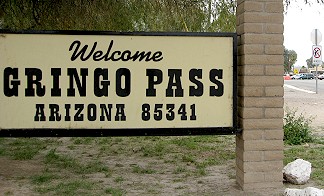
We chose Gringo Pass, Arizona to take a peek across the border — mainly because Gringo Pass is a really funny name. After parking at a gas station, I took a little stroll to check out the tiny outpost.
I found myself wishing I had spurs on ’cause the chinking sound would have accompanied the dust I was kicking up perfectly. In lieu of said spurs, I shook my keys as each footfall landed and imagined myself in the wild west.
Less than a block down the only side street, I attracted an SUV driving border guard. After the usual where were you born and what are you doing here questions, I chatted him up a bit. He understood my border crossing apprehension.
He explained how most of our fears were unfounded — at least at this crossing –because the media tends to play up the bad stuff.
I suppose Border Patrol Does Fine Job Protecting Americadoesn’t make for an attention grabbing headline.
Our new border patrol buddy explained that there are certainly parts of the border that better judgment would call for avoiding, especially the big cities like Tijuana and Juarez, but Gringo Pass wasn’t one of them.
He went on to fill us in about a beautiful seaside oasis just an hour south of the border, Rocky Point — Puerto Peñasco in the native tongue. He literally said, Go — it’s great down there. We had no reason to think he was trying to send us off to meet our maker so we decided to head on down.
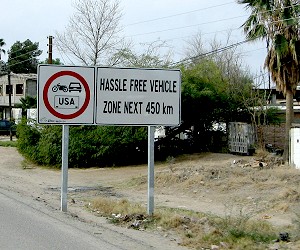
Our preparations for the excursion were minimal since, in a concerted effort to attract tourists, the Mexican government has declared about half of the state of Sonora, including Puerto Peñasco, a Hassle Free Zone.
It’s a bit of a strange name, perhaps a translation twist, but it means that vehicle permits are not required within the zone and, for visits up to three days, a tourist card need not be acquired. Badges? We don’t need no stinking badges!
We did purchase Mexican insurance for our vehicle since American policies are not recognized south of the border. Coverage only cost a few dollars a day so there was no reason to take chances.
In chatting with the incredibly helpful agent, Sandy Rogers, at the Why Not Travel Store in Why, Arizona we learned that all traffic incidents are treated as a crime in Mexico and, as such, our vehicle could be impounded and we could find our butts in a Mexican pokey.
Sandy further recommended the Legal Aid addition to our policy. It was a peace-of-mind expense to assure that a lawyer would spring us from jail should something go terribly awry.
Policy in hand and passports (not necessary for entering Mexico but extremely important for getting BACK in to the good old U.S.A.) in our pockets, we headed into Sonoyta, Sonora. The typical bordertown begins the barren sixty mile run across The Sonoran Desert down to Rocky Point.
This piece of highway –which, by the way, is in much better shape on the Mexican side of the border — is straight out of an old western movie. The harsh landscape is strewn with classic Saguaro cacti standing arms-up as if some bandito got the jump on them. It made us feel like we might be seeing The Duke or Clint riding by any time.
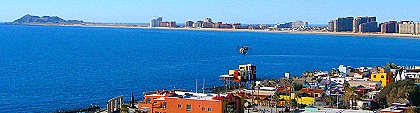
The hype on Puerto Peñasco was not overblown. This little fishing village on The Gulf of California is one rockin’ Rocky Point.
In an odd quirk, the English version of the name, Rocky Point, was actually the original form, given by the British Lieutenant Robert William Hale Hardy while sailing the area back in 1826.
Over a century later Mexican President Lázaro Cárdenas renamed it Puerto Punta Peñasco, or Port Rocky Point. Through the years the Punta got dropped, hopefully not on anybody’s toes.
Once entering the city, we followed the main road until we hit water — always our general approach when entering an unfamiliar waterside town.
At the waterfront we found a public parking lot and proceeded on as pedestrians.
The original section of the town is bunched up on a few square blocks of crowded narrow streets by the harbor — better explored on foot.
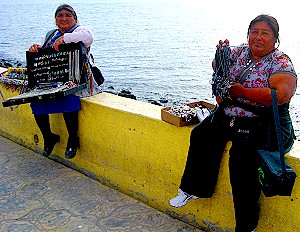
Along the packed little main drag is an array of touristy shops mingled with bars, restaurants and fresh seafood shops. The fishmongers brandished gigantic raw shrimp — fresh from the gulf — in our faces about every twenty paces.
Mixed in with the barkers from every crap shop and cafe, the street is a gigantic jumble of Spanglish with a mariachi soundtrack. It’s beautiful, quintessential Mexico.
Hats, shirts, stickers, mugs and glasses all sporting clever crustacean catch-phrases designed to remove the pesos from the pockets of passersby.
Vendors along the streets and beaches have coolers filled to the brim with the fresh caught buggers and offer up bags to every possible
prospective buyer.
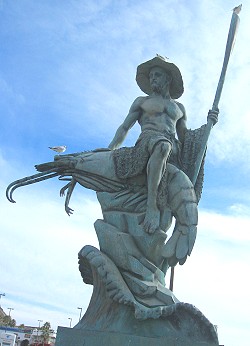
At the end of Malecón Avenue is a plaza with a tribute to the local seafarers. A statue of a fisherman riding a giant shrimp (an oxymoron if there ever was one) dominates the square.
A tribute to all of the adjoining states and their governors, both Mexican and American, proudly lines the yellow seawall.
The plaza is a popular meeting place for locals and a great place to watch the shrimping fleet as they line up waiting their turn to drop off the day’s catch or head back out for another boatload.
Along the waterfront stretch there are a bunch of great spots for a relaxing sunset libation overlooking the Sea of Cortez.
Over the span of our stay we tried several of them but our favorite had to be The Point. It juts clear out over the water — at least
when the tide is in — for an up close look at the dolphins that came by every afternoon.
Another highlight of our visit was The Tequila Factory in the newer part of town. Not actually a factory, it serves as a storefront for La Cava de los Compadres tequila brewers.
After a brief but highly informative program about the history and process of making tequila we sat at a little bar and tried about a dozen varieties of the agave juice in a procedure very much like a wine tasting. Luckily the samples were just a small taste so we didn’t do any “drunk bicycling” on our way back that afternoon.
A fifth of the golden liquid aging in the lobby was purchased as a gift for my dad, a tequila connoisseur. An empty bottle was filled from the barrel, corked, scotch taped shut and wrapped up in newspaper for safe keeping. Good thing we didn’t get stopped by customs because it easily could have passed for moonshine. I can’t imagine that being good scenario.
Speaking of moonshine, a full moon graced our stay — adding magic to the Mexican nights and creating some amazing tide fluctuations. Huge stretches of beach, a hundred yards or more, would appear and disappear during the course of the day.
It made for some great seashell and tide pool exploration as outcrops of volcanic rocks, usually part of the seafloor, became exposed. We had quite the time examining the critters left behind by the receding water.
Whether we were poking around on the beach, wandering the dusty streets or sipping a mariachi-serenaded ice-cold Pacifico at sundown, it’s hard to imagine how a getaway so close could have felt any farther away.
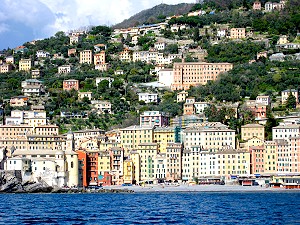
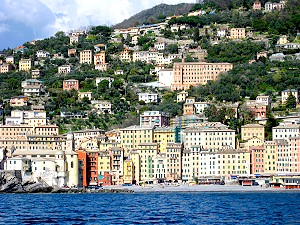
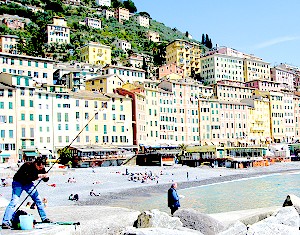
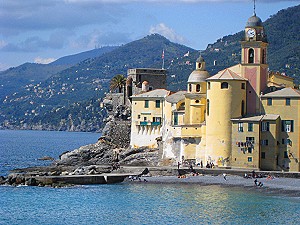
Just a few kilometers down the Ligurian Coast from the bustling burg of Genoa –and at least a million mental miles away — is peaceful Camogli, Italy.
Jet-set types like Charles Dickens, Lord Byron and Percy Shelley have been slowing down and kicking back along these shores of the Italian Riviera for nearly two centuries, back when they were “jetting” about in carriages and … CONTINUE READING >>
Just a few kilometers down the Ligurian Coast from the bustling burg of Genoa –and at least a million mental miles away — is peaceful Camogli, Italy.
Jet-set types like Charles Dickens, Lord Byron and Percy Shelley have been slowing down and kicking back along these shores of the Italian Riviera for nearly two centuries, back when they were jetting about in carriages and on boats. Excellent company for GypsyNesters — even ones arriving via rented FIAT.
Camogli is literally married to the sea — her name translates to house of wives in honor of the brave women waiting for their sailors to return home.
We were itching to get out on the water but restrained ourselves for a bit to get a feel for the town.
While strolling the smattering of small shops that line the shoreline, we decided to map our day over a cup of Joe. Grabbing a seat at one of the outdoor establishments, we ordered up due cuppucci and scoped out the surroundings.
Ah, Riviera Ligure, a beautiful spring Mediterranean morning and the nectar of the coffee bean. We felt like the beautiful people.
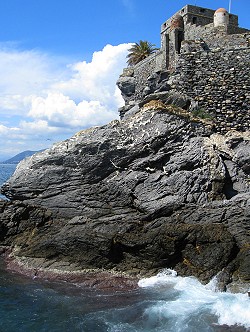
Caffeined up and ready to rock we headed out to the end of the seawall for an ocean’s eye view of the town and a better look at Castello Dragone.
The castle has been standing guard at the entrance of the harbor since the early 1200s and looks like it has another 800 years left in it, easy.
Walking the seawall also gave us a chance to scout out the fleet from a different angle. The marina at Camogli is filled with small fishing boats, both private and commercial, but we did spot a couple bigger vessels ready to ferry passengers to points unknown.
As usual we didn’t have any plans other than the desire to get out on the briney deep… next stop, the ticket booth. Not wanting to go back toward Genoa, we booked passage on the next boat going the other way. That turned out to be a stroke of incredible luck because we ended up heading for San Fruttuoso, one of the coolest places we’ve ever stumbled upon.
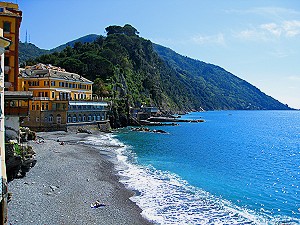
From the moment we left the harbor it became obvious why locals call this little corner of the Mediterranean Golfo Paradiso. With its lush, green haphazard mountains rising right out of the crystal blue water, paradise might not be a strong enough word for this clear, blue heaven.
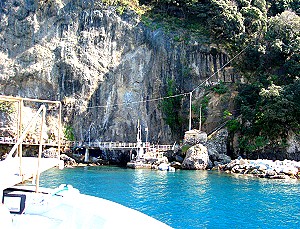
The first stop on the ferry was a secluded dock to drop off hikers heading into Portofino Regional Nature Park. The entire peninsula that forms this side of the gulf is protected land.
The park safeguards about three thousand acres of undisturbed wilderness, with neither roads nor vehicles allowed.
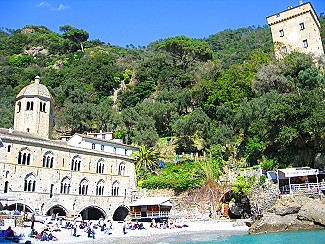
Around a point and tucked away in a turquoise inlet, hidden from view until we were right up on it, was San Fruttuoso di Capodimonte. The picturesque little village is dominated by the Benedictine monastery that gives it its name.
The site, chosen by the monks over a thousand years ago for its seclusion and safety, is only accessible by sea or footpath over the mountains.
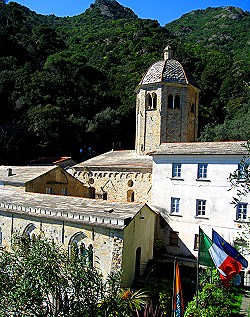
Throughout the years an abbey, church, cloister and tower were built and rebuilt on this isolated spot. The octagonal church tower, Torre Nolare, is famous as an incredibly well preserved example of tenth century architecture and one of the oldest standing structures in Liguria.
In 1141 the Doria family bought the entire complex and the Benedictines allowed them to use the lower level of the cloister as tombs for the next few centuries.
The family is best known for the sixteenth century sea captain, Andrea Doria, who eventually led the entire navy for Genoa in conquests throughout the Mediterranean. Centuries later a sinking ship bearing his name would become even more famous than the Genovese Imperial Admiral.
We disembarked and made our way up the beach past the soaking-up-the-sun bathers to the abbey situated directly on the sand. A small path lead us through an archway leading inside to the courtyard and church.
Ducking under the arches we began to explore. The inside of the buildings are dark, damp and felt just plain ancient — because they are — but outside, things are meticulously landscaped with lush gardens lining winding, narrow footpaths.
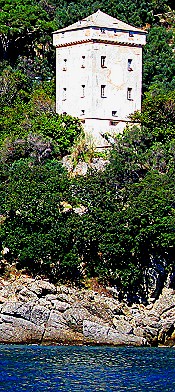
After poking around the musty old monastic buildings for awhile, we followed a trail and steep staircase for a better view of the village and a look at the Doria tower.
Back in 1562, it seems pirates had taken a shine to this beautiful inlet so defenses were called for. The Doria family built the tower and named in honor of The Admiral.
As we were enjoying the view the boat blasted its horn to signal departure. Oops! This was the last vessel leaving for the day. Miss it and we’re sleeping on the beach. We scrambled down the stairs and around the path, found a shortcut to the beach over a ledge and then up the gangplank. Good thing it was all downhill.
We jumped aboard just as the good ship Paradiso was casting off. Our luck was holding, why waste any time sitting on a boat that’s not moving?
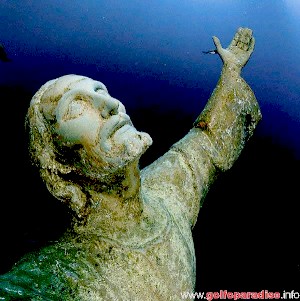
However, we were NOT lucky enough to catch a glimpse of The Christ of the Abyss, an eight and half foot bronze sculpture submerged at the mouth of the little inlet.
At over fifty feet deep, it’s safe to say that SCUBA gear is the best bet for getting a good look at the Sunken Savior, though it is said when the water is especially clear it may be viewed from the surface.
Dedicated in 1954, the subaquatic statue protects the safety of divers in the name of Dario Gonzatti, the first Italian to ever use SCUBA equipment.
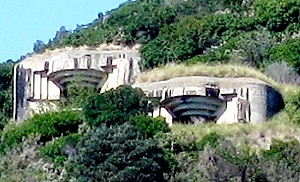
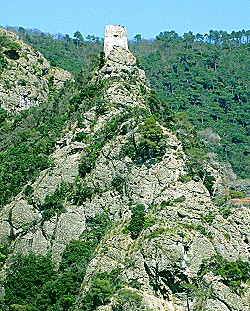
Heading back in to Camogli, we noticed a couple of structures along the shore that we had missed on the way out. A medieval lighthouse and several World War II era bunkers dotted the hills overlooking the gulf.
The lighthouse dates back to medieval times while the bunkers were built by Nazi Germany in an effort to protect the entrance to the Genoa harbor, an important supply port.
Between these fortifications and those at San Fruttuoso we couldn’t help thinking that as long as men have sailed these seas they have battled for control of this area.
Back on dry land we sought out a proper spot to watch the sun go down, count our lucky stars as they came out and toast another charmed Italian adventure.
There’s something bewitching about a day on the water, cares just dissolve away. No doubt our day was infinitely more serene than those of the ancient sailors but still, they must have loved the sun, the salt spray and the rocking of the waves.
Wonder if they also knew the joys of shellfish washed down with a Pinot Grigio to celebrate a successful voyage?
For many of us, if over a certain age, Las Vegas conjures up images of The Rat Pack tuxedoed up at The Sands, others immediately see Elvis straining the seams of a rhinestone studded jumpsuit. Personally, we can’t help but love them both. However Las Vegas today bears little resemblance to either of those eras. Other than a few impersonators there is not much left that The King or The Chairman of the Board would recognize. Is it better? We’re here to find out.
For many of us, if over a certain age, Las Vegas conjures up images of The Rat Pack tuxedoed up at The Sands, others immediately see Elvis straining the seams of a rhinestone studded jumpsuit.
Personally, we can’t help but love them both. However Las Vegas today bears little resemblance to either of those eras.
Other than a few impersonators there is not much left that The King or The Chairman of the Board would recognize. Is it better? We’re here to find out.
Since our first foray into Sin City, back in the late seventies, most all of the famous names of The Strip have been demolished.
The Sands, The Desert Inn, The Dunes, The Stardust and The Silver Slipper have all given way to way-high-rises and parking lots. The Landmark was demolished in a blaze of glory and all the drama was captured in the movie “Mars Attacks” — now there’s something for
posterity!
The new Strip goes for flashy/classy over the old splashy/trashy, but like most everything here, it is all an illusion.
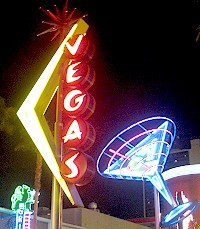
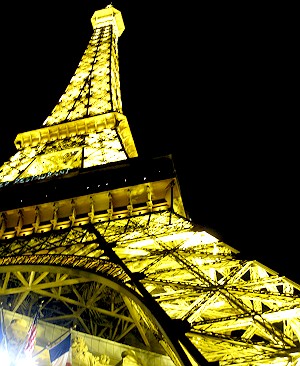
Gone are the innumerable flashing neon signs, replaced instead by false skylines and Eiffel Towers. No more $2.99 buffets and cheap rooms to lure in the gamblers, now it’s fine dining and five star hotels.
Not quite sure what to make of all the changes, we decided embrace the new Vegas with gusto. Why not go out for a fine French dinner our first night out?
After all, Paris is right down the street.
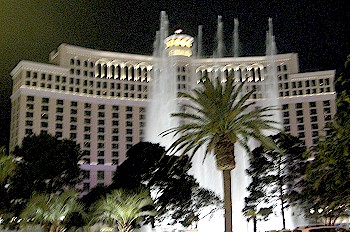
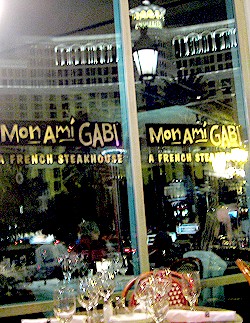
Mon Ami Gabi offers al fresco dining under The Eiffel Tower and right across Las Vegas Boulevard from the famous fountains at The Bellagio. Gallic cuisine and top-notch people watching…dinner and a show.
Mon Ami Gabi prides itself on its wines and with a fanciful twist the by-the-glass selections are served from a rolling cart that circulates the restaurant.
The food was French, Vegas French. Pâté, escargots, beef Bourguignon, crêpes and quiche share the menu with an All-American cheeseburger.
Even offering a choice of brie, blue or gruyere on the burger didn’t help to convince us we were on the left bank of the Seine, still, the food was très bon and the service fantastique.
Veronica’s soup du jour, chestnut bisque, was deemed fabulous, the bread was surprisingly authentic and David’s pork tenderloin in port-wine cherry sauce with pommes puree certainly met or exceeded our expectations.
One of the evening’s highlights was a discovery made in the bathrooms. Piped in over speakers were the most useful French lessons we’ve ever come across. Won’t it be helpful to know how to parlez-vous:
“Is that an éclair in your pocket or are you just happy to see me?”
“Oooh La La, Are those real?”
“Can I buy you a drink or should I just give you the
money?”
or the pee-in-our-pants funny:
“If you were a McDonald’s hamburger you’d be McSexy with Cheese.”
These lessons prove indubitably that everything sounds better in French. Next time we really are on the Champs-Élysées, we’re bringing some of these gems out. Sure hope we can remember them all.
After dinner we went for a real show… wait, The Strip IS the real show, what with any number of feeble Elvis wannabes sharing the road with an array of freaks, drunks, fish-out-of-water tourists and a never-ending supply of lowlifes snapping hooker’s calling cards (complete with full-color naked photos of the entrepreneurs) at the unsuspecting fanny-packers who pass by.
Enough of the street theater — Penn & Teller were at The Rio so we made the short trip over from central Europe to South America. Only in Vegas, baby!
Amusing AND amazing properly describes these guys. It’s not the typical Vegas show. Very little glitz, no T & A, but a whole lot of laughs and some very interesting insights into how many magic tricks are accomplished.
Plus a dash of Libertarian politics tossed in for good measure ( a metal credit-card-sized “Bill of Rights” to trigger metal detectors at airport security was available for purchase after the show).
Even when Penn explains a trick (Teller can’t, he never speaks) it’s still astonishing to watch them pull it off. The boys have style.
The next morning… (Yes, we said morning. The age of staying up all night at the craps tables and counting the olives in the bottom of dirty martini glasses is sadly behind us.) …we checked out the monorail that runs behind the hotels along The Strip. Très modern, almost like Disneyland.
Seriously, it’s quite convenient and saves wear and tear on the old dogs, since the new casinos are HUGE and spaced pretty far apart.
Getting off from time to time to stroll through several of the swanky spots, we noticed another change.
Back in the day, the only way to get to from Point A to Point B in Vegas was through a casino. The powers-that-be figured your money would leap out of your pockets and land in a machine or on a table.
Not anymore. These days we were instead forced to walk through never ending mazes of cleverly disguised stores filled with every sort of over-priced product known to man.
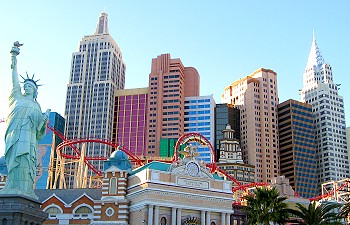
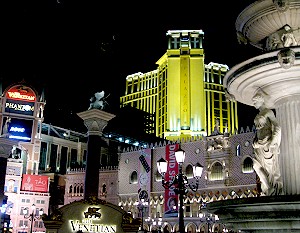
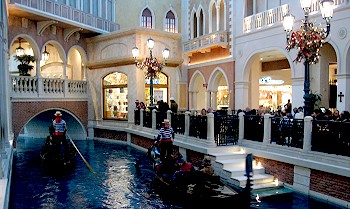
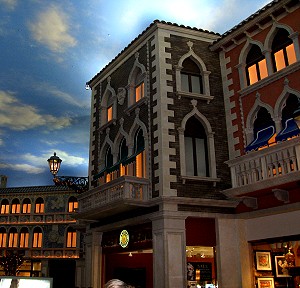
Under fake indoor skies that maintain a permanent dusk, we strolled the streets of Venice, ancient Rome, Rio, Paris and New York… anywhere BUT Las Vegas.
To some degree, we found it working on us. Not the marketing of costly crap but the disconnect from reality. We really HAD forgotten the outside world and embraced the fantasy.
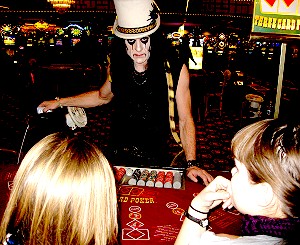
That happens here. Once the brain accepts things like Marilyn Monroe and Alice Cooper dealing blackjack as reasonable, anything seems normal.
Constant noise, flashing lights, free drinks, never ending sunsets, no clocks, dead celebrities everywhere, continuous sex on display… it’s all part of the plan.
Surreal replacing real — until money becomes nothing but a colorful cache of chips — who really cares if those get taken away by the nice dealer?
We needed a big dose of realism and nothing says real in Vegas like Elvis.
We needed a good Elvis, the best Elvis, the biggest Elvis… that could only be Pete “Big Elvis” Vallee at Bill’s Gamblin’ Hall & Saloon. Four hundred pounds of Elvis, three shows a day… now THAT’S real.
The scuttlebutt around Bill’s was that Pete used to be an even bigger Elvis, twice as big they say. Girth aside, the boy could whomp down a pretty mean My Way.
Properly Hound-Dogged-up and with our feet back on the ground, we were ready for an immersion into the old school Las Vegas. The one that harkens back to the days when Bugsy Siegel and his merry mob of mobsters still ran the joints.
Back to the time and place that earned this place the name Sin City. It was time for a trip downtown to Fremont Street. The old Vegas is alive and well down here, neon rules the night.
The classic cowboy “Vegas Vic” lives on among the bright lights of The Fitz, The Fremont, The Four Queens and The Golden Nugget.
The Neon Museum Las Vegas restored many of the classic bygone signs from The Strip and showcases them in an outdoor gallery along Fremont Street. Many others are stored for posterity in The Neon “Boneyard.”
No trip to Glitter Gulch is complete without an evening under these lights.
Revisiting our own good old days, we allowed The Fitz to buy us drinks while we studied the intricacies of Switch, a two handed version of blackjack that we’d never seen before.
We didn’t quite greet the sunrise like the old days but it’s a good thing The Deuce double-decker shuttle buses run all night. As for those colorful little chips — by the time we turned them all back into legal tender, we found that we had almost as much as we started with.
Not bad, but we weren’t out of the woods just yet. The airport is also a casino.


 Unlike the dish we’re accustomed to, Mexican shrimp cocktail lacks cocktail sauce and the shrimp is not boiled.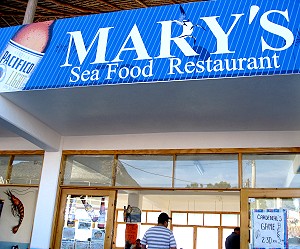
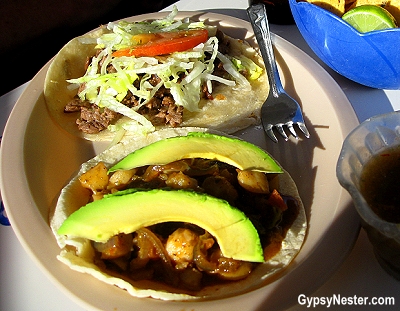 We stopped by Mary’s the next day for a couple scallop tacos — at two dollars each — snarfed down quickly on the ground floor.
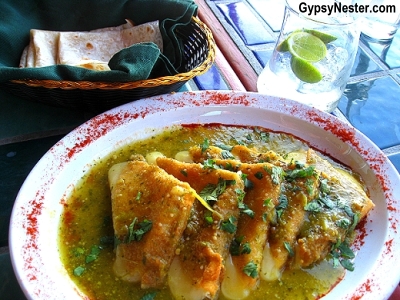 We began with a plate of Queso Frito.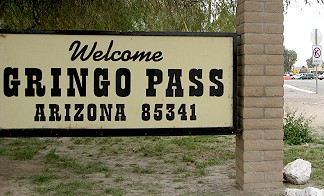

 Wonder if they also knew the joys of shellfish washed down with a Pinot Grigio to celebrate a successful voyage?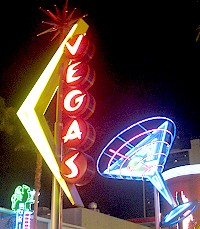
 The food was French, Vegas French. Pâté, escargots, beef Bourguignon, crêpes and quiche share the menu with an All-American cheeseburger.
 Properly Hound-Dogged-up and with our feet back on the ground, we were ready for an immersion into the old school Las Vegas. The one that harkens back to the days when Bugsy Siegel and his merry mob of mobsters still ran the joints.