enlarge video
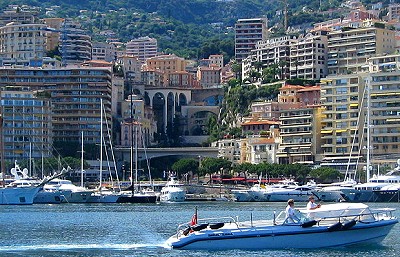
Riding through Port Hercule in Monaco, the richest country in the world! Check out the megayachts! Just below the casino … CONTINUE READING>>
Riding through Port Hercule in Monaco, the richest country in the world! Check out the megayachts!
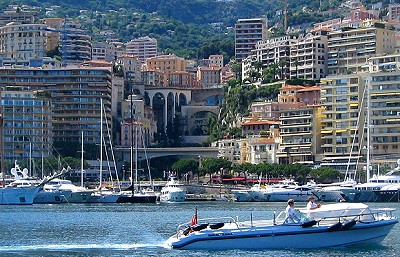
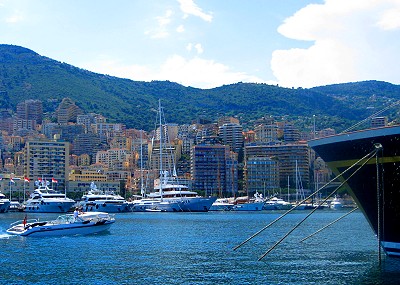
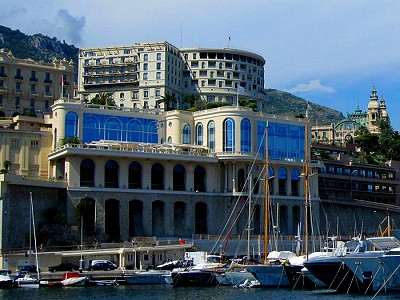
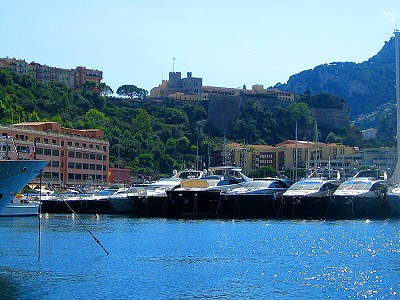
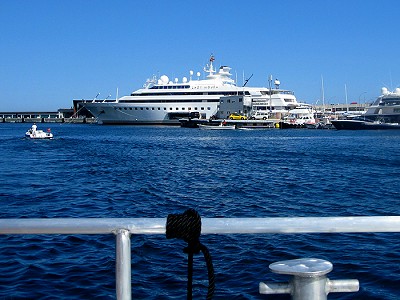
Just below the casino, the Bateau Bus Electrique Solaire de Monaco runs right through the thick of the bevy of bodacious yachts filling the harbor. Far and away the richest country on Earth, it’s no wonder these incredible private luxury liners are attracted to Monaco’s harbor.
For just one Euro, without a doubt the best deal in the whole country, the little electric boat took us smoothly past the giant status symbols to the dock by the Prince’s Palace on the other side of the port.
Our “low to the ground” style of traveling enables us to uncover unique regional fare. Right near the top of our list would have to be the bouillabaisse on the French Riviera.
While the city of Marseille traditionally lays claim to being the birthplace of bouillabaisse, the fact is that fishermen all along this rocky coast invented the soup as a way… CONTINUE READING >>
Our “low to the ground” style of traveling enables us to uncover unique regional fare.
By renting a car and driving through, rather than flying over, the French countryside, we have stumbled upon all sorts of delicacies.
And right near the top of our list would have to be the bouillabaisse on the French Riviera.
While the city of Marseille traditionally lays claim to being the birthplace of bouillabaisse, the fact is that fishermen all along this rocky coast invented the soup as a way to use the boney fish and leftovers that they couldn’t sell.
The seafood was cooked over open fires in seawater seasoned with garlic and fennel. After a while, restaurants in Marseille ran with the recipe, adding saffron, orange peel, basil and bay leaf to the seasoning – and tossing in a better class of fish.
We weren’t really up for fighting our way through the traffic of France’s second largest city to sample the soup at one of the many establishments in Marseille that claim to be the original home of bouillabaisse.
So we ventured down to the coast to the little hamlet of Six-Fours-les-Plages and struck gold with the restaurant Au Royaume de la Bouillabaisse.
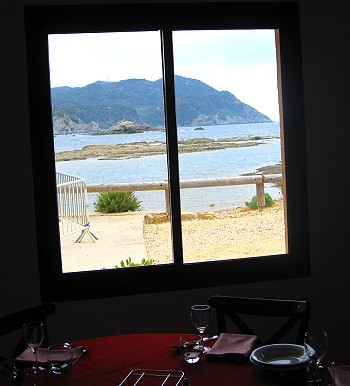
Perched on a point overlooking the beautiful Mediterranean, perhaps this was the very spot where a fisherman first filled a pot with seawater and set it to boil, or “bouillir” in French, and reduce, or “abaisser,” his catch.
We’re not saying it was, but it certainly would have been the perfect place for it.
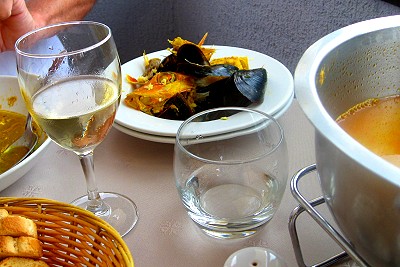
While we discussed this possibility, sipping our feather-light white wine and awaiting our order of Bouillabaisse de Gaou for two, we noticed that several tables had enormous platters of fish placed in the center.
Everyone was diving in for a communal supper.
Veronica, overcome by curiosity, bopped over and asked a group what they were eating.
Their answer had a certain “duh” quality to it, as in “it’s bouillabaisse, duh.”
But it sounded okay since it was in a heavy French accent. And everything sounds better when you’re hearing it in French.
We have had bouillabaisse all over The States, from New York to California, but this wasn’t remotely similar to any of our previous experiences.
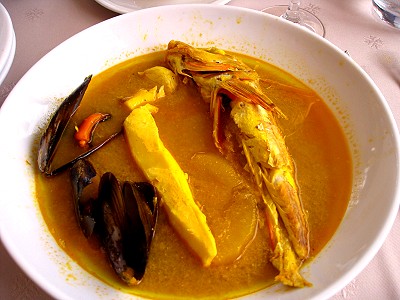
Everything was always in one big bowl, but here in the Provence-Alpes-Côte d’Azur region of France, that’s not bouillabaisse.
While these fish were boiled and reduced in the broth, they were not served in it.
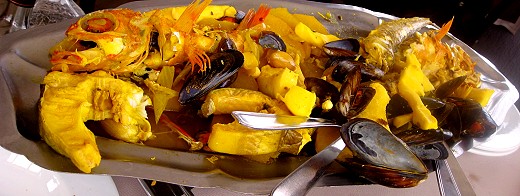
Our server brought a ridiculously huge platter and placed it on a tray over a warming flame in the center of the table.
This was accompanied by a large urn of broth, also placed over a flame.
Looked like they were expecting us to take our time, good thing too, considering the amount of food delivered.
There were several varieties of seafood sharing the ample platter, so we set about trying to identify them. The waitress pointed out each of the participants, but the French names still left us pretty confused as to what we were about to consume.
The mussels (moules in French) were easy enough to recognize, we also found the octopus without too much trouble.
Then things got a little more difficult but, by Google, we were going to figure it out.
Traditionally bouillabaisse includes sea robins (grondin), a type of eel called conger and scorpionfish (rascasse) and as near as we could tell these were all present on our platter.
Luckily we had video documentation to go back to, and we are fairly confident that those guys were our dinner. Along with the fish, the platter was laden with veggies. Leeks, onions, tomatoes, celery and potatoes were all intermingled between the fins and shells.
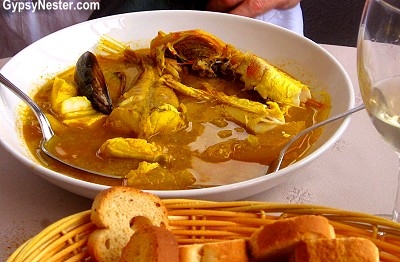
After visually stalking what the other patrons were doing, it looked as though the proper method of consumption seemed to be filling a bowl with broth and then adding the fish and vegetables.
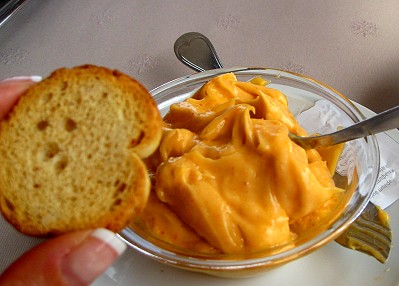
Once the desired mixture was attained, toasted bread topped with rouille, a thick mayonnaise-like spread made from of garlic, peppers and tomato, should be floated atop the stew.
This combination was so spectacular that we had to take a moment for our eyes to roll back into their proper positions.
Speaking of eyes, after we had torn into enough of the fish that shells, bones and fins were left dominating the platter, Veronica noticed a couple little white balls. “What are those, peppercorns?”
I told her that I thought they were fish eyes. I had seen these little buggers before, when cooking trout with the head still on, but she didn’t buy it. “No, they’re too hard, must be pepper. Eyeballs are squishy.”
Whatever you say honey, go ahead and try one. She did… and immediately spit it out into her napkin with a face of pure shock. “It’s horrible, all hard and chalky! It’s like eating flavorless Pez! What is it?”
Obviously she wasn’t going to believe my theory, so we asked our waitress.
Without the benefit of English, our server got the point across with incredible clarity… by simply pointing.
Luckily we had just enough wine left in our bottle for Veronica to rinse the eyeball residue out of her mouth.
Stuffed to the gills, we were thrilled to find that right outside of Au Royaume de la Bouillabaisse a trail led over a bridge to an island.
It looked perfect for a little walk to settle our meal.
We discovered quickly that it is also very popular with the locals as a swimming spot.
We also couldn’t help but notice that these zany French don’t much care for bathing suits.
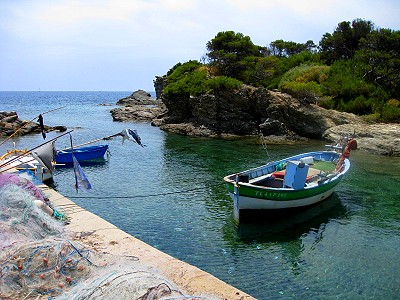
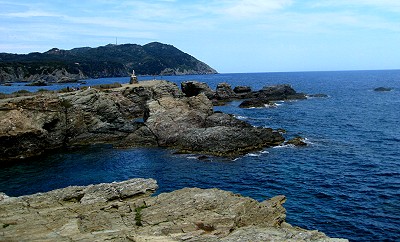
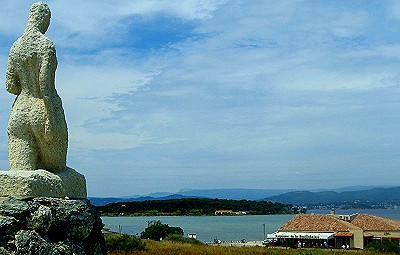
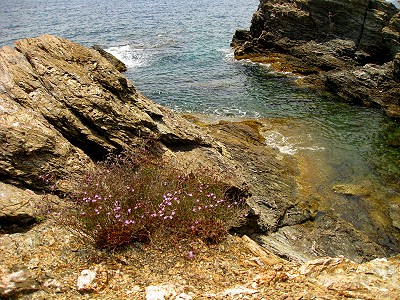
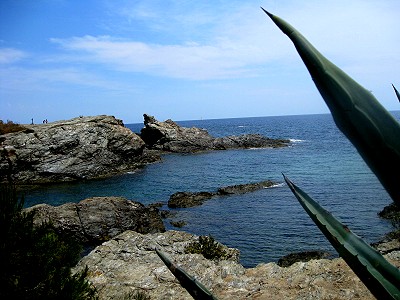
Beyond the swimming hole, The Isle of Gaou is a nature preserve with trails all around the perimeter that skirt right along the tops of some vertigo inducing rocky cliffs.
The unbelievable views of our dinner’s home habitat seemed like the perfect finish to this perfect experience.
enlarge video
Unbelievable deliciousness! Veronica accidentally (?) eats an eyeball (?)! While the city of Marseille traditionally lays claim to being the birthplace of … CONTINUE READING>>
Unbelievable deliciousness! Veronica accidentally (?) eats an eyeball (?)!
While the city of Marseille traditionally lays claim to being the birthplace of bouillabaisse, the fact is that fishermen all along this rocky coast invented the soup as a way to use the boney fish and leftovers that wouldn’t sell. They cooked them in seawater seasoned with garlic and fennel. After a while, some restaurants in Marseille ran with the recipe, adding saffron, orange peel, basil and bay leaf to the seasoning and often using a better class of fish.
We weren’t really up for fighting our way through the traffic of France’s second largest city to sample the soup at one of the several establishments in Marseille that claim to be the site of the original bouillabaisse, so we ventured down to the coast in the little hamlet of Six-Fours-les-Plages, and found the restaurant Au Royaume de la Bouillabaisse.
Economic recovery gets a boost from emptying the nest!
“About 20 million adult children in the U.S. live with their parents, and most are eager to move, says Peter Francese, a demographic analyst for advertising agency Ogilvy & Mather.”
Could kicking out boomerang “kids” pull us out of this recession?
“When people move into a new home, they tend to spend. A typical new… CONTINUE READING >>
We have made our opinion on boomerang “kids” pretty clear here at GypsyNester.com.
We personally feel it is best for our offspring (and us!) to move onward and upward with our lives. Cultivating an adult-to-adult relationship would be extremely difficult if we were still living on top of each other in the old family home. Those conditions would only work to continue a parent-child relationship.
So we were pleased to find this article in Bloomberg Businessweek entitled “Kids Moving Out Are a Boon to the Economy” (Steve Matthews). It adds yet another reason to give those chicks a nudge out of the nest… it’s good for the economy.
“About 20 million adult children in the U.S. live with their parents, and most are eager to move, says Peter Francese, a demographic analyst for advertising agency Ogilvy & Mather.”
Shelby Webb was one of those twenty million until a few months ago, when she rented her first apartment after landing a job translating ads for a Spanish-language newspaper in Chattanooga.
“‘I love my parents, but I didn’t want to live with them anymore,’ says Webb, 22.”
By moving out, Shelby is doing more than making the move into a full adult life and allowing her parents to move on to the next phase of theirs, she is stimulating consumer spending. If more boomerang “kids” do this it could have a big impact on our economic recovery, because consumer spending accounts for some seventy percent of the American economy:
“When people move into a new home, they tend to spend. A typical new renter spends $600 to $1,900 on furniture, appliances, and other stuff related to setting up housekeeping in the first six months, says C. Britt Beemer, chairman of America’s Research Group in Charleston, S.C.”
So how big could this impact be? Well, quite large according to UBS Securities:
“This year, nearly 1 million new households will be created, UBS predicts, up from the 357,000 in the year ended March 2010.”
The article goes on to point out that increased consumer buying may not be the only positive effect on the economy. Those new households will not only stimulate spending, but could even breath some new life into the struggling housing industry.
“New households will help increase housing starts to about 648,000 this year and to nearly 900,000 in 2012, vs. 586,800 last year, estimates researcher Metrostudy.”
This alone should be enough incentive to start nudging those chicks out of the would-be empty nest. But it’s not just the economy that could feel the effects of un-boomeranging.
Self esteem could get a significant boost too, since…
“‘Most guys who live at home beyond some young age walk around with a great big ‘L’ [for “loser”] on their forehead,’ Francese says.”
We wouldn’t wish that on anybody. Good thing there’s an cure… that could also help pull us out of the recession.
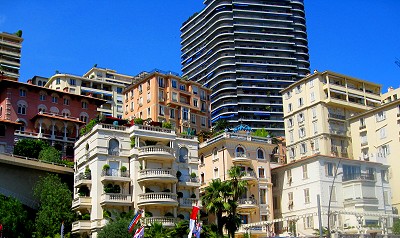
Monaco. The richest country in the world – and the second smallest. Home of the Grand Prix and megayachts. So what could we possibly afford to do there?
Our little rented car, that we affectionately dubbed Benny, was quite a champ on our five thousand kilometer trek across Europe, but a Formula One car he was not.
Still, we had an experience to remember driving him along the very same roads that those fantastic machines race in the Monaco Grand Prix.
Truth is, we happened upon the course by accident. Monaco, the second smallest country in the world, is tucked tightly on a hillside that drops right into the Mediterranean.
All we did was follow the road down toward the water, and the next thing we knew we were in a tunnel under a building, which turned out to be the famous Monte Carlo Casino.
That’s when things started to look familiar. We are a little embarrassed to admit it, but we actually recognized this spot from a Grand Prix video game, wait, that makes it even more cool to be driving it in real life.
Anyway, there we were on one of the world’s most famous race tracks, which is actually laid out using the city streets. How could we possibly pass up a pit stop?
We couldn’t. So we followed the race course to the sea, which brought us to Port Hercule.
The port got its name because, according to mythology, Hercules stopped by here and ran off all of the other gods.
A temple was built to him and named Hercules Monoikos, meaning Herc’s single house. This lead to the name Monaco.
Through the centuries Monaco has been passed around as a part of Genoa, The Aragon Kingdom, The Kingdom of Sardinia and France before becoming an independent principality.
Throughout most of that time it was well known as a gambling center. The Monte Carlo Casino could very well be the best known in the world.
Ian Fleming was probably most responsible for this when, in his first James Bond novel in 1953, he used The Monte Carlo as the basis for his Casino Royale.
Later, several of the Bond movies were shot in Monaco.
Luckily – for our wallets – we hadn’t packed evening wear, so we would not be allowed to go in and have our money removed. A little boat trip across the harbor would suit us just fine.
Just below the casino, the Bateau Bus Electrique Solaire de Monaco runs right through the thick of the bevy of bodacious yachts filling the harbor. Far and away the richest country on Earth, it’s no wonder these incredible private luxury liners are attracted to Monaco’s harbor.
For just one Euro, without a doubt the best deal in the whole country, the little electric boat took us smoothly past the giant status symbols to the dock by the Prince’s Palace on the other side of the port.
After a quick gawk, we were on our way back. Also included in the single Euro fare. Unbelievable.
Back on our side of the bay, we were beginning to feel the urge to take a pit stop in the middle of our pit stop.
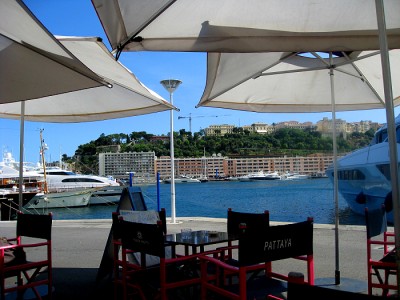
The Restaurant Le Pattaya was right by the dock and, while not gourmet by any stretch of the imagination, it included several factors high on our list of desires.
A place to sit, something to drink, a quick bite, a great view of the harbor, wifi, and, perhaps most important, a bathroom.
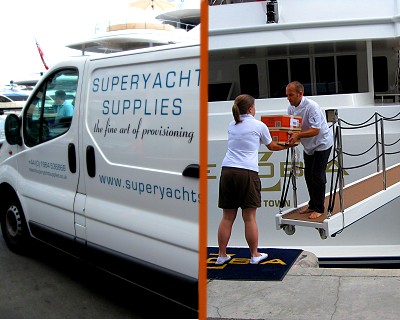
From our Pattaya perch on the seawall we watched the megayachts being provisioned while we munched on a passable pizza pie.
It must have been just the right time of the afternoon because a steady stream of trucks were pulling up and unloading box after box of supplies. Each floating mansion’s uniformed crew stood at the ready to stow the goods below deck.
Since this was only intended to be a quick pit stop for us, the time had come to work our way back up the hill to the main highway.
The maze of tiny, one way streets didn’t make this an easy task. We couldn’t go back the way we came, but in Monaco, as in all of Europe, the trick is to look for signs pointing the way to the next town on the desired route.
Well that’s Nice.
No, not nice like ‘have a nice day,’ Nice, like the city in France. Hmmm, maybe that should be their city slogan, Have a Nice Day.
enlarge video
The GypsyNesters drive the route of the Grand Prix! Hold on to your scooters! Truth is… CONTINUE READING>>
The GypsyNesters drive the route of the Grand Prix! Hold on to your scooters!
Truth is, we happened upon the course by accident. Monaco, the second smallest country in the world, is tucked tightly on a hillside that drops right into the Mediterranean. All we did was follow the road down toward the water, and the next thing we knew we were in a tunnel under a building, which turned out to be the famous Monte Carlo Casino. That’s when things started to look familiar. We are a little embarrassed to admit it, but we actually recognized this spot from a Grand Prix video game, wait, that makes it even more cool to be driving it in real life. Anyway, there we were on one of the world’s most famous race tracks, which is actually laid out using the city streets. How could we possibly pass up a pit stop?