Did the Mayans know something we don’t? Does their calendar predict our eminent doom?
We had no idea where these ideas came from and, being lovers of this kind of stuff, set out on a quest for the truth.
We even went as far as traveling to the ancient and mysterious ruins at Tulum in Mexico to ask a REAL Mayan (with a great sense of humor!) what the official scoop is. Here’s what we found:
Did the Mayans know something we don’t? Does their calendar predict our eminent doom?
We had no idea where these ideas came from and, being lovers of this kind of stuff, set out on a quest for the truth.
We even went as far as traveling to the ancient and mysterious ruins at Tulum in Mexico to ask a REAL Mayan (with a great sense of humor!) what the official scoop is. Here’s what we found:
In 1957 professor Maud Worcester Makemson wrote that “the completion of a Great Period of 13 b’ak’tuns would have been of the utmost significance to the Maya.” A b’ak’tun is a measure of time equaling 144,000 days, (almost 395 years) on the Long Count calendar developed by the Mayans.
But what to make of that statement? Are “the completion of a Great Period” and “utmost significance” necessarily bad things?
Michael D. Coe seemed to think so nine years later when he wrote in his book, The Maya, “There is a suggestion…that Armageddon would overtake the degenerate peoples of the world and all creation on the final day of the 13th b’ak’tun. Thus…our present universe would be annihilated when the Great Cycle of the Long Count reaches completion.” He calculated that completion to occur in late December 2012.
Since Coe was held in high regard as an expert on all things Mayan, this theory got some people’s attention. The idea bubbled under the surface for the next few decades, but as the date grew closer lots of folks began jumping on the end-of-the-world bandwagon.
The movie 2012, predicting catastrophic earthquakes, giant tsunamis, and massive volcanic eruptions brought huge publicity to the notion of impending doom.
Not wanting to miss out on the public’s desire for disaster, The History Channel’s Decoding the Past series featured episodes entitled “Mayan Doomsday Prophecy”, and “Doomsday 2012: The End of Days,” spewing forth incredible fear mongering misinformation about the Mayan calendar and a galactic alignment. The apocalypse will occur if the Sun and the black hole at the center of our galaxy line up just right it will create all sorts of gravitational chaos on Earth.
But the real good stuff can always be found on the Internet. Horrifying prophecies are flying through cyberspace. Feel free to choose from Planet X colliding with Earth, a geomagnetic reversal where the north and south poles switch places, or massive solar flares sizzling the world. Anyone with a computer can see we’re all doomed.
Think Y2K was scary? This is Y2K plus a dozen!
We needed a dose of reality to calm our nerves, so we went straight to the source, the Mayan ruins at Tulum. Our guide Carlos fielded the big question and, since he’s a direct descendent of Mayans, we felt sure we’d get a straight answer… or not.
But seriously, a little humor is called for because the entire proposition is laughable. Mayan scholars say there are no predictions of impending doom in any written accounts, and the notion that the calendar ends in 2012 is a misrepresentation. There have even been Mayan writings discovered that refer to dates well past this feared end of time.
All we are facing is the end of the thirteenth cycle and the beginning of the fourteenth. That should be cause for celebration, so I think we can all start making New Years plans.
Oh, and this year we can say Happy New B’ak’tun too.
YOUR TURN: Isn’t Carlos great? Did he calm your fears?
Is 2012 really the end of the world? We asked Carlos, a real Mayan, for his take on the… CONTINUE READING >>
Is 2012 really the end of the world? We asked the fabulous Carlos, a real Mayan, for his take on the situation!
He got in a zinger when we asked about the coming end of the world according to the Mayan calendar! He explained how the official word is that the calendar ending only means another era will begin, but when Veronica asked “so you’re sure we aren’t all going to die,” he added “I don’t know what you’re gonna do, but the Mayans, we will be…
We have discussions about the parent / adult “kid” relationship quite frequently here at GypsyNester.com, but it’s quite rare that we get to hear the young adult point of view on our site, other than a few cherished comments in our discussion section.
We don’t kid ourselves, we are aware that there aren’t a lot a twenty-something people who get up in the morning and think, hey, let’s see what the geezer set is up to this days.
So we felt pretty good when we came across “The Drawbacks of Being A Boomerang Kid” at YPULSE. In this story a recent college graduate affirms our position on adult offspring returning to the nest.
We have discussions about the parent / adult “kid” relationship quite frequently here at GypsyNester.com, but it’s quite rare that we hear the young adult point of view on our site, other than a few cherished comments in our discussion section.
We don’t kid ourselves, we are aware that there aren’t a lot a twenty-something people who get up in the morning and think,hey, let’s see what the geezer set is up to this days.
So we felt pretty good when we came across “The Drawbacks of Being A Boomerang Kid” at YPULSE. In this story a recent college graduate, Casandra Liggin, affirms our position on adult offspring returning to the nest.
“Could it be that some parents may be doing their children a disservice by allowing them to wave their hands in defeat and retreat to the safety of home before giving it the old college try at adulthood?”
It certainly could! Ms. Liggin points out something we insisted our adult children learn before leaving home — work.
“Millennials are pained by the idea of settling for a less than ideal occupation rather than pursuing their passions. I think passions are wonderful, I truly do. But I also believe in working until one can draft the desired path to achieve their passion. Work experience of any kind is extremely valuable as it teaches you what you like and dislike in a job and how to communicate with diverse personalities… I would argue that one could learn more behind the counter of a Starbucks than sitting in front of a laptop sipping a caramel macchiato at their local coffee shop pondering their next professional move.”
Precisely! Ms. Liggin has noticed that many of her peers choose to play it safe by never really trying — our offspring have seen the same thing — and that often it’s the parents who are enabling this lack of effort.
“Maybe today’s parents are too quick to provide a soft landing for fear that their child will get bruised by life or dare I say it, rejected. From my experience, the sooner you experience disappointment, the quicker you learn to pick yourself back up, dust yourself off, and get back in the game.”
Obviously this is a lesson Ms. Liggin learned well,
“…resourcefulness is a skill I’m most proud of and wouldn’t have attained unless put in a sink or swim situation. Luckily, I’ve learned to swim many times over.”
We feel strongly that this sort of independence doesn’t just happen, it is a product of parenting, and Ms. Liggin sees that too.
“Sure, my parents would have let me come back home if I had experienced a major medical emergency, but anything short of that was pushing it. They had been prepping me for independence from the time I entered high school.”
This goes to show that strong parenting, even if it sometimes takes the form of helicopter parenting, can lead to happy, independent, self-sufficient young adults.
But as Susan Engel’s New York Times article “When They’re Grown, the Real Pain Begins” shows, sometimes letting go can be difficult. Especially when things get rough for your children.
“Last year, one of my sons went through a series of devastating setbacks. Almost everything bad that could happen to a young person happened to him. He had a catastrophic accident at work that permanently damaged one of his fingers. He will never use it again, though almost everything he loves to do requires the precise and flexible use of his hands. He endured a devastating break-up with a longtime girlfriend. And he got fired from a job he cared about, without any warning or rationale. He seemed just about as broken as a young man can be.”
Any parent is going to want to jump in at this point and Ms. Engel was certainly no exception.
“I wanted to be by his side constantly, I wanted to go out and hurt those who had hurt him, arrange new work for him…”
But her son understood that he needs to stand on his own two feet.
“‘Mom,’ he said, ‘when I tell you what’s wrong, I don’t want you to tell me how to fix it, and I don’t want you to tell me it’s not as bad as I think. I just want your sympathy.'”
That is one of the keys to creating a true adult-to-adult relationship with your adult children, love them, care about them, but allow them to solve their own problems.
A couple of the comments on Ms. Engle’s piece hit the nail on the head:
“As the mother of three and grandmother of six all I can offer is – keep your mouth shut and your arms open. If they want advice, they’ll ask for it.”
and
“There’s no magic to this. It’s the golden rule of parenting. Treat your kids the way you wanted to be treated when you were their age. When you were 28 did you want your Mom to fix everything for you?”
The unexpected surprises that lurk around the next corner are one of the things that can make travel so interesting.
Boy, did we get one of those in the mountains of northern Georgia when we came upon the old fashioned Bavarian village of Helen. Tucked into a valley on the banks of The Chattahoochee River, we suddenly found ourselves driving through an anachronism of epic proportions. Every building, down to the gas station… CONTINUE READING >>
The unexpected surprises that lurk around the next corner are one of the things that can make travel so interesting.
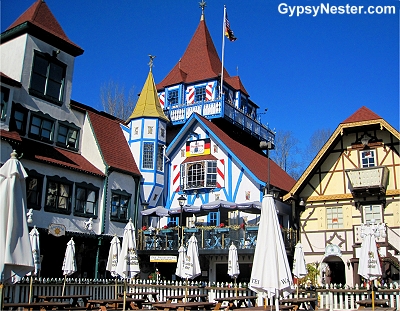
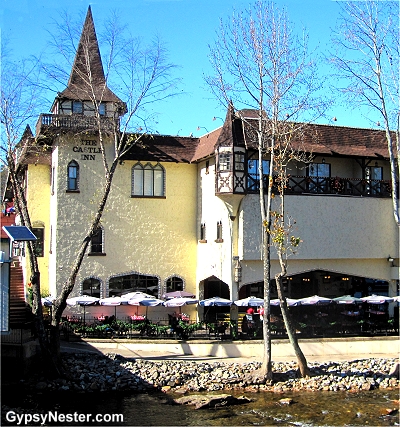
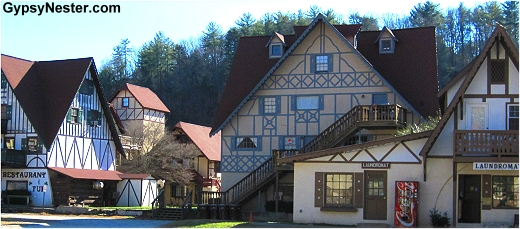
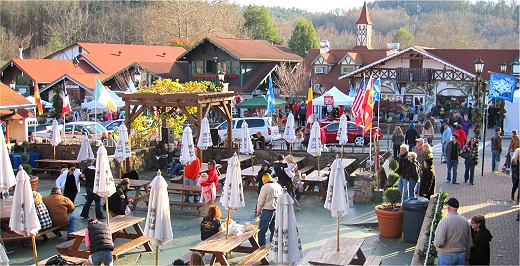
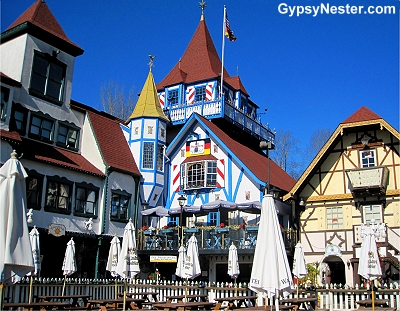
Boy, did we get one of those in the mountains of northern Georgia when we came upon the old fashioned Bavarian village of Helen.
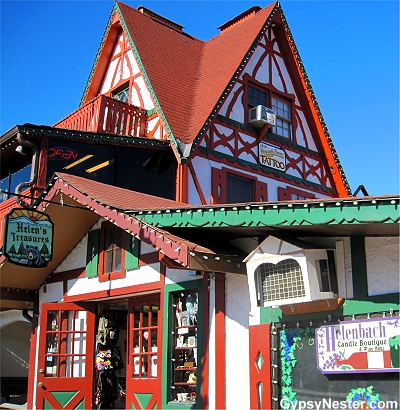
Tucked into a valley on the banks of The Chattahoochee River, we suddenly found ourselves driving through an anachronism of epic proportions. Every building, down to the gas station (and tattoo parlor), looked like Heidi ought to walk out the door any second.
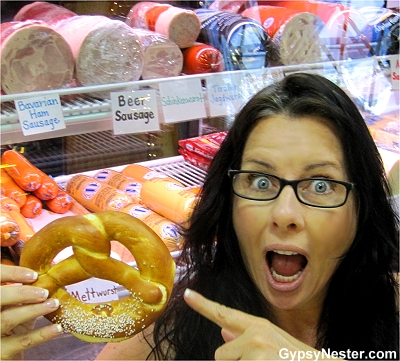
Two thoughts leapt to our minds… how did this happen, and I’ll bet we can get a good bratwurst.
Our initial theory on the first point was that a bunch of immigrants must have moved here long ago and, because of the isolation, the town took on characteristics of their native country. We’d seen similar situations before, in Holland, Michigan and Solvang, California, but that’s not what happened here.
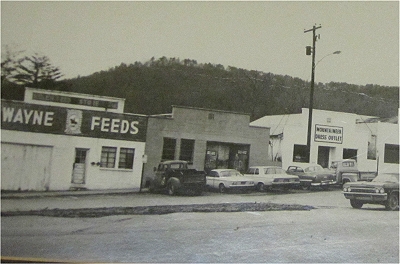
Helen began as a mining town when gold was discovered in them thar hills back in 1828. After the gold dried up, timber was king and a huge sawmill dominated the town.
But during the depression that went bust too. By the sixties, ghost town status seemed eminent. Then, in 1968, some local businessmen had a big idea to remake the entire town into an alpine Bavarian village. The next year a zoning law was passed.
Their gamble paid off as Helen now hosts over a million tourists a year.
A huge portion of those visitors come in the fall for Oktoberfest, which has been celebrated for forty-two years.
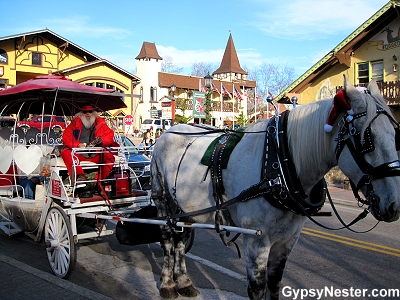
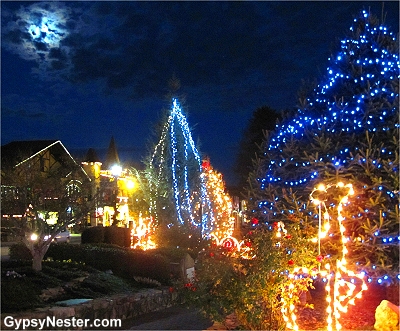
The holiday season is becoming quite popular too, with a Christkindlmarkt, a parade, and The Festival of Trees.
On the warm December Saturday that we arrived, the Christkindlmarkt — an open air Christmas market tradition that began in Germany and Austria over five hundred years ago — was swarming.
After a bit of browsing it seemed like a good time to check on the other of our two thoughts, bratwurst.
Across from the market, overlooking King Ludwick’s Biergarten, we found the Old Heidelburg, an excellent replica of a typical Gasthaus.
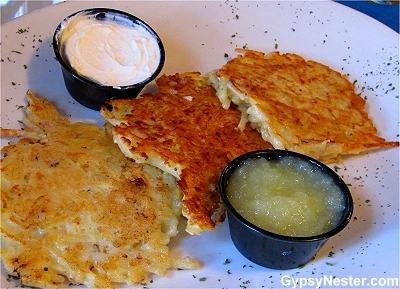
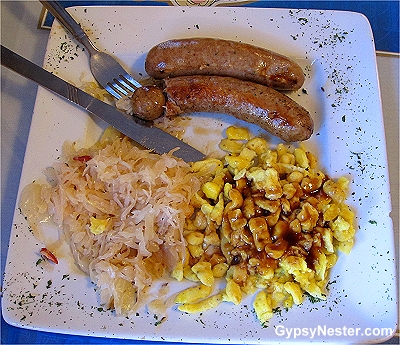
With a quick scan of the menu we put in an order for a couple sausages, sauerkraut, and some potato pancakes.
As wrong as we were with our initial theory about why Helen looks like a hamlet in Deutschland, we were right about our likelihood of finding a bodacious brat.
Oh, yeah, and the pancakes were delicious too.
Whilst chomping away, we discussed a couple of curious attractions involving animals that we had noticed on our first pass through town, and decided they were both on our after lunch “must see” list.
Note:We’ve been notified that this “attraction” has closed.
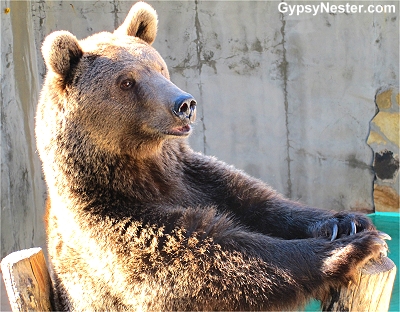
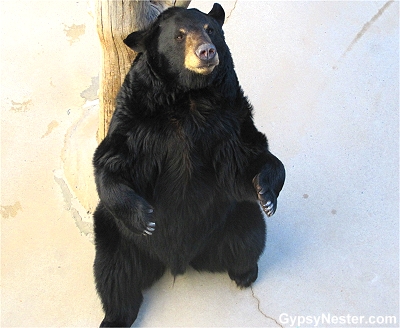
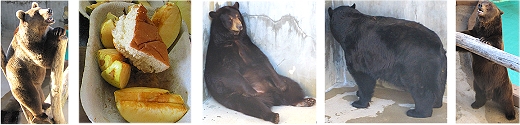
After forking over five dollars each, we were told about the different types of bears in the “park,” black, Asian, cinnamon and even grizzlies (grizzlies!), then were pointed in the direction of some stairs.
At the top there were plates of apples and bread for feeding the bears, one dollar each please. We grabbed one and walked over to look down into the bear enclosures.
This was hardly a park, bunker would be a better term.
While it was interesting, and likely the only chance we’ll ever get to feed a full grown grizzly, there was an overall pitiful air to the place.
In their defense, the park has rescued orphaned and injured wild bears, and the animals seem well cared for, but seeing these massive creatures confined to concrete cells and reduced to begging tourists for a morsel of food didn’t feel too good.
And it certainly didn’t conjure up any visions of Germany’s famous Schwartzwald.
Looked like if we wanted to get some real forest time we would need to head out of town.
Lucky for us Anna Ruby Falls is just a few miles up the road.
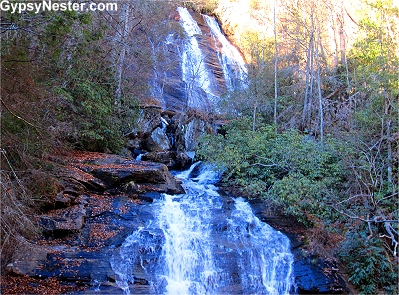
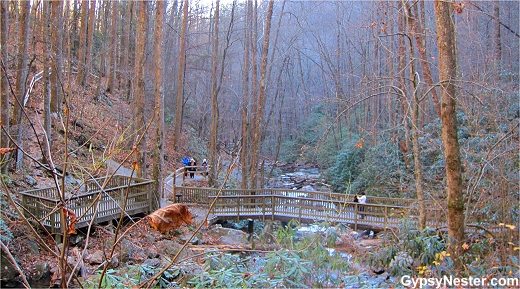
From the visitor center it is a half mile hike, through a real
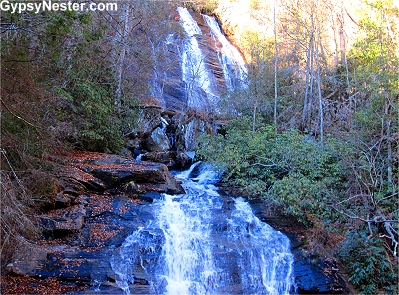
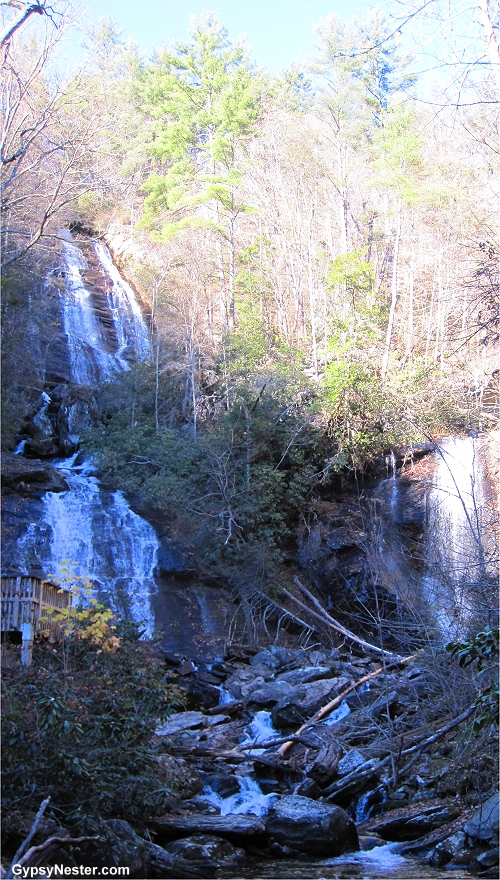
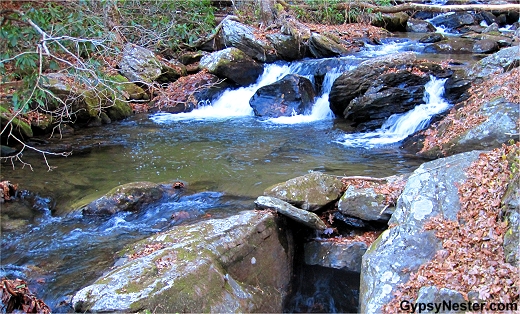
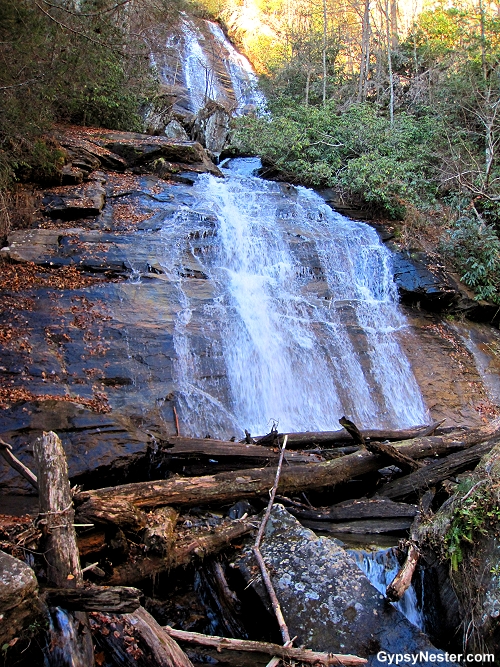
forest, up to the beautiful twin waterfalls. Cascading down Tray Mountain, Curtis Creek drops one hundred and fifty-three feet and York Creek falls fifty before they join at the bottom of the cliffs to form Smith Creek.
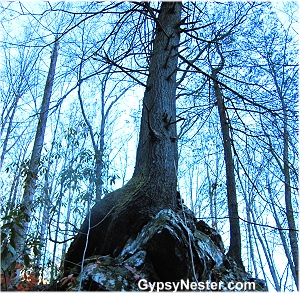
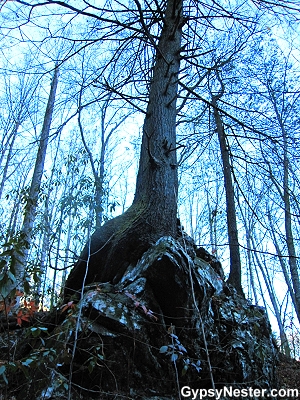
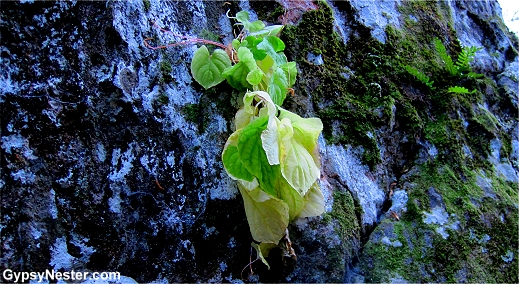
Along the trail we found an incredible examples of the tenacity of life.
This tree was not to be denied by a minor detail like a lack of soil, so it grew to full size from within a crack in a boulder.
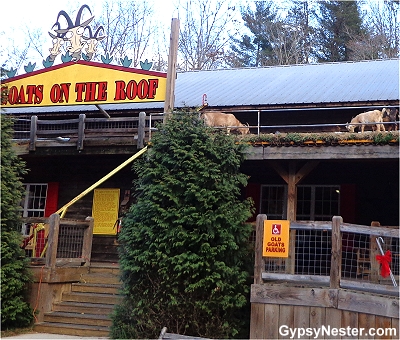
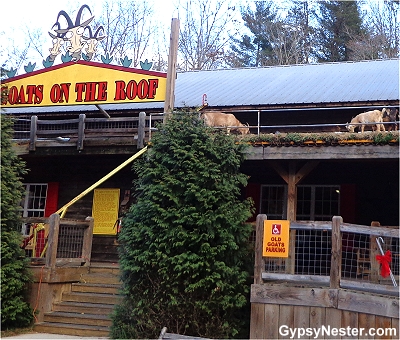
We had high hopes that the second of the animal acts would be more uplifting than the bear exhibit. It seemed likely since these critters were alleged to be living the high life as Goats On The Roof.
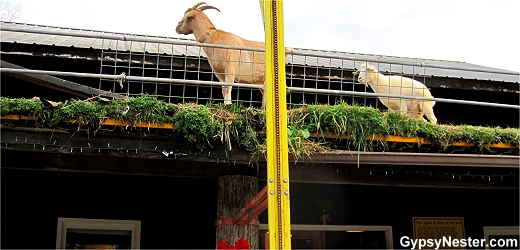
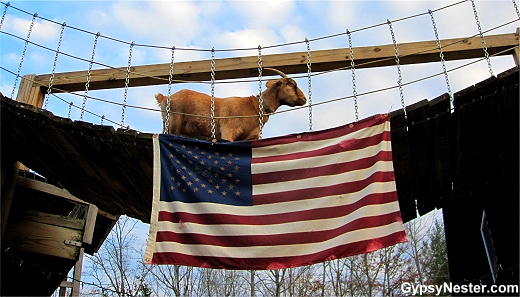
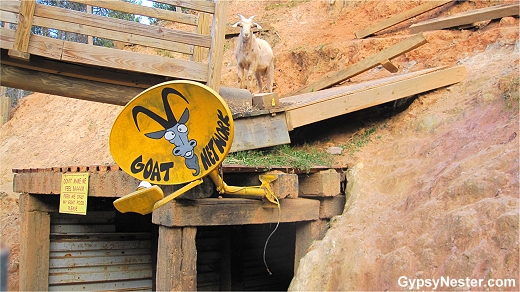
When we pulled in and checked the top of the building, there they were, as advertised, a bunch of goats grazing on the roof.
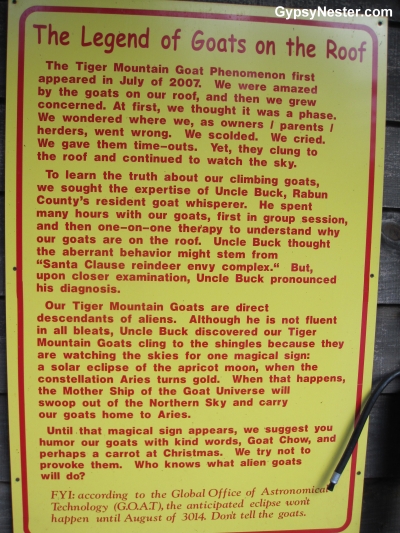
A sign indicated that the goats might be hanging out up there because they are actually aliens waiting and watching the sky, but we think that the fact that the roof is made of sod and hay could have more to do with it.
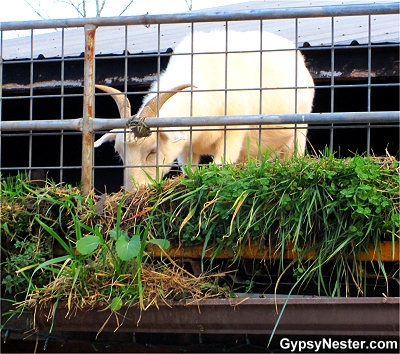
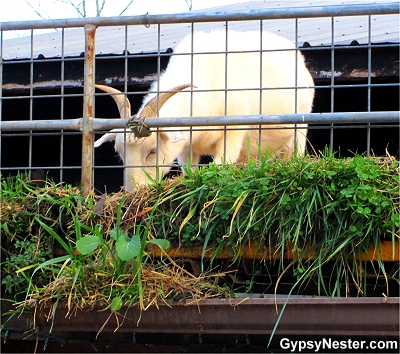
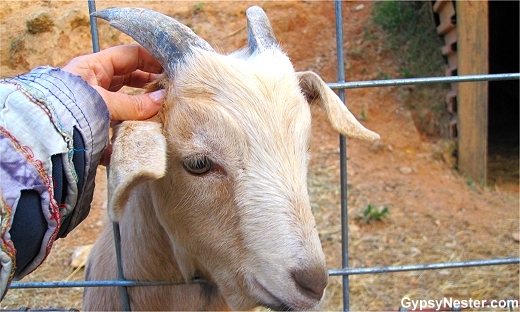
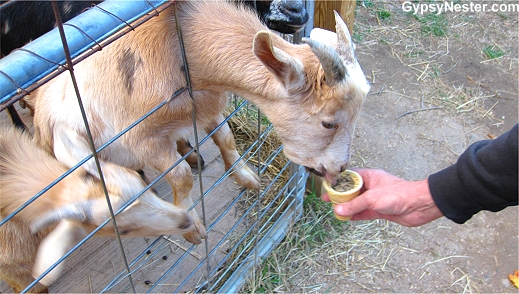
Perhaps in an effort to keep the goats from eating clear through the roof, for a mere fifty cents we were given an ice cream cone filled with goat chow. The goats knew the drill and made their way down a walkway to ground level where they ate right out of our hands. Not something recommended with those thousand pound grizzlies.
All of this feeding had us ready for something a bit more substantial than our midday sausage snack.
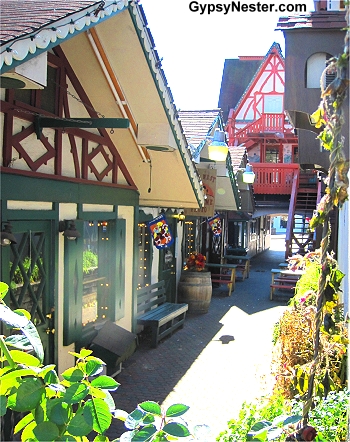
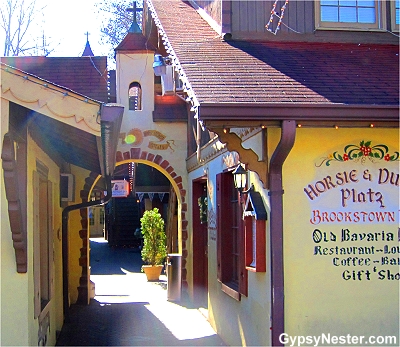
Back in the center of town, hidden in a quaint little alley, we found The Old Bavaria Inn.
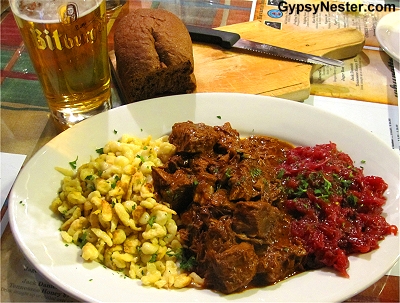
While a schnitzel seemed the obvious choice, we opted instead for sauerbraten and goulash, both served with red cabbage sauerkraut, and the specialty of the house, spatzle.
Sauerbraten means sour roast, so the meat has been marinated, or more accurately pickled, for several days before cooking. Tender and delicious, we had no complaints, but the highlight of the meal was the spatzle.
These little egg dumplings stole the show, especially when introduced to the gravy from the goulash and sauerbraten.
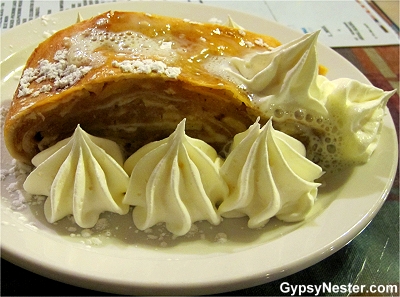
But their time at the top was short lived because an apple strudel, flown in from Munich no less, and a cup of glühwein arrived to take the spotlight.
Glühwein, meaning glow wine, takes its name from the red hot irons once used to heat, or mull, the mixture of red wine and spices, and is a traditional drink for the holiday season.
We could sure taste the cinnamon, cloves, and especially the star aniseed that gave it a hint of licorice flavor. Really warmed the cockles of our hearts, which we then learned is very strange saying since cockles are a type of shellfish. What did we do before Google?
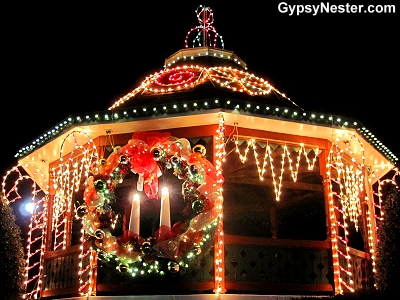
With hearts warmed and bellies filled, we finished our day with a stroll through the decorations and lights of our merry surprise discovery and bid Helen “gute nacht und auf wiedersehen.”
Cascading down Tray Mountain, Curtis Creek drops one hundred and fifty-three feet and York Creek falls fifty before they join at the bottom of the cliffs to form Smith Creek… CONTINUE READING >>
Anna Ruby Falls was just a few miles up the road from downtown Helen, Georgia.
From the visitor center it is a half mile hike, through a serious forest, up to the beautiful twin waterfalls.
Cascading down Tray Mountain, Curtis Creek drops one hundred and fifty-three feet and York Creek falls fifty before they join at the bottom of the cliffs to form Smith Creek.
Along the trail we found an incredible example of the tenacity of life.
This tree was not to be denied by a minor detail like a lack of soil, so it grew to full size from within a crack in a boulder. Amazing.
Helen Ruby Falls is located in the beautiful and surprisingly Germanic town of Helen, Georgia.
A great way to see all of the fantastic attractions in beautiful Georgia we suggest looking into some of these great Georgia Tour Packages.
When we pulled in and checked the top of the building, there they were, as advertised, a bunch of goats grazing on the roof. A sign indicated that the goats might be hanging out up there because they are actually aliens waiting and watching… CONTINUE READING >>
Note: Sadly, this wonderful place has closed.
In Helen, Georgia we had caught wind of critters alleged to be living the high life as Goats On The Roof.
When we pulled in and checked the top of the building, there they were, as advertised, a bunch of goats grazing on the roof. A sign indicated that the goats might be hanging out up there because they are actually aliens waiting and watching the sky, but we think that the fact that the roof is made of sod and hay could have more to do with it.
Perhaps in an effort to keep the goats from eating clear through the roof, for a mere fifty cents we were given an ice cream cone filled with goat chow.
The goats knew the drill and made their way down a walkway to ground level where they ate right out of our hands.
enlarge video
Massive San Bernardino tunnel, huge scenic Alps, dairy cows & waterfalls! For more on our drive through the Swiss Alps, including a stop in the tiny, wealthy country of Liechtenstein: CLICK HERE >>
The massive San Bernardino tunnel, amazing scenic mountains, waterfalls and Swiss dairy cows!
For more on our drive through the Swiss Alps, including a stop in the tiny, wealthy country of Liechtenstein: https://www.gypsynester.com/alps.htm