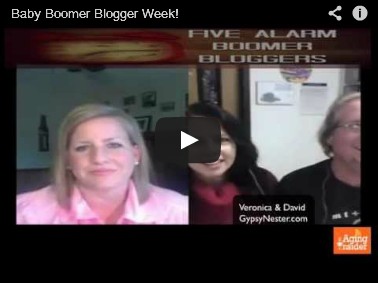
Becca at Aging Insider calls us “5 Alarm Boomer Bloggers” and in this episode of her fabulous show, she says:
“Richard Branson says, ‘Screw it, lets do it!’ and this is a couple who is embracing that motto. The kids left for college and this rockstar couple left for the world… CONTINUE READING and watch the video >>
Becca at Aging Insider calls us “5 Alarm Boomer Bloggers” and in this episode of her fabulous show, she says:
“Richard Branson says, ‘Screw it, lets do it!’ and this is a couple who is embracing that motto. The kids left for college and this rockstar couple left for the world by way of RV. And when they are not in an RV visiting friends and family, they are on trains, planes and cruising thru this great big planet.”
How this fly-by-the-seat of their pants couple sold their house and travels the world
What happened when a buck deer decided to do this (13:50)
The only way to see Glacier National Park is by doing this (find it at 14:52 in video)
Why David thinks Becca will most likely end up in prison if she does this with The GypsyNesters (20:47)
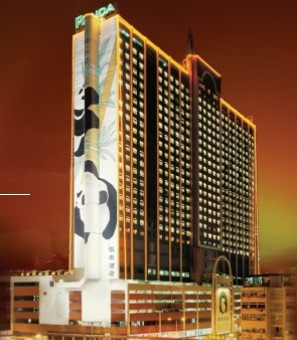
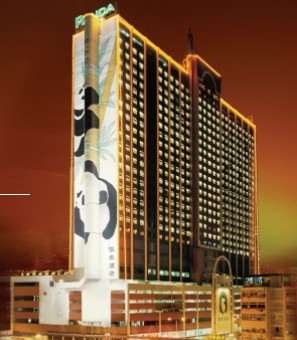
Would you stay in a Panda Hotel? We did and we loved it!
During our whirlwind stay in Hong Kong, we were treated like royalty, stayed in a suite that looked like a movie set and ate the most amazingly delicious food.
When we began planning our stay in Hong Kong finding a hotel was the first task. Of the several we looked into, the intriguing Panda Hotel was our top choice – mainly because Veronica is crazy nuts about animals.
Though Panda Hotel is one of the largest hotels in Hong Kong, with nearly a thousand guest rooms, they most certainly managed to keep a personal touch to their friendly service, starting with our jet-lagged arrival.
We were greeted warmly and the check-in was fast, efficient and personalized. VERY welcome after a sixteen hour flight.
That first night we basically collapsed into bed, but the next day we got to know the Panda.
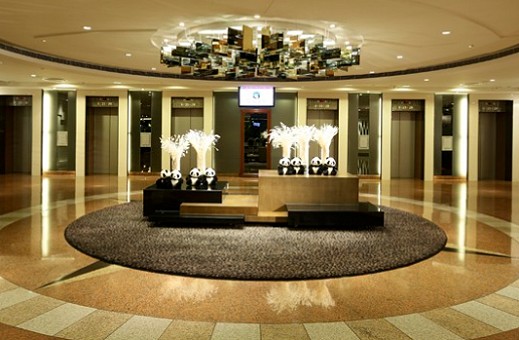
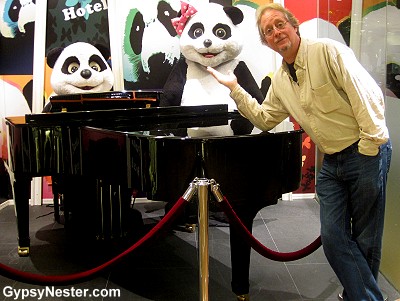
The iconic namesake “bears” are everywhere… one might even call it Panda-monium! Actually, quite fittingly, Pandamonium is the name of the gift shop.
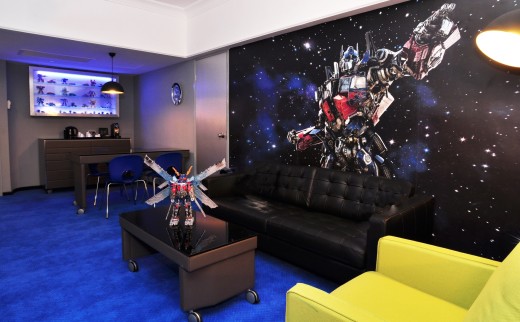
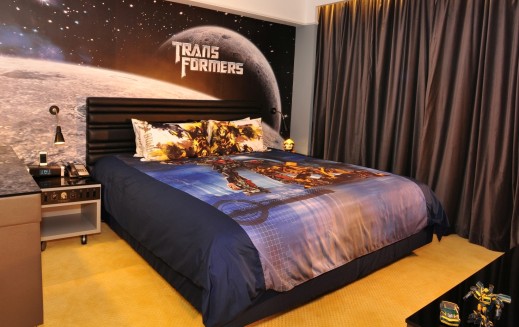
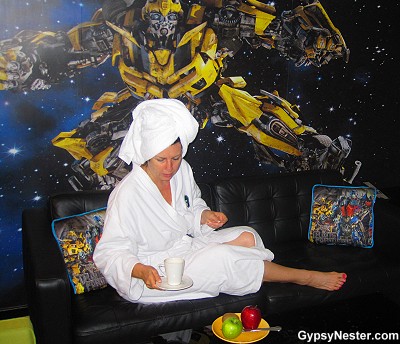
The lighthearted atmosphere continued in our Transformer-themed suite. Based on the movie series and the Hasbro toys, the room was sleek, shiny and futuristic.
We felt like we were sleeping on a movie set – a REALLY comfortable movie set. Like the rest of the hotel, every need we had was met – and then some.
We had a high-tech coffee machine at the waiting in the mornings and fluffy terry cloth robes and towels were most appreciated at night after running around Hong Kong like maniacs.
But as fun as the whimsical decor of the lobby area and our Transformer suite was, the service was serious.
The Panda staff went out of their way to be sure our stay in Hong Kong was perfect – we tapped into their vast knowledge of the city, receiving sightseeing tips, restaurant suggestions and transportation hints.
When we needed a taxi, we were given cards with tailor-made, handwritten Chinese translations to give to our drivers, insuring worry-free travels about the city.
Our days began in the Panda Café, where we poured over our guidebooks and maps, charting out our upcoming adventures.
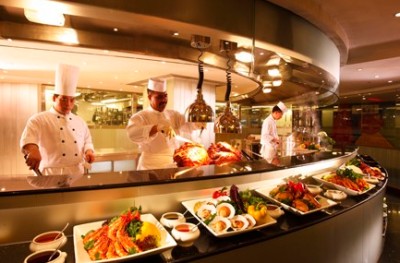
Breakfast was served buffet-style and included dim sum, a ramen station, as well as western world favorites.
When we came “home” exhausted from our sightseeing, the buffets offered a sensational selection of appetizers, soups, main entrées and desserts well into the night. The seafood was amazing – carefully prepared works of art, each morsel.
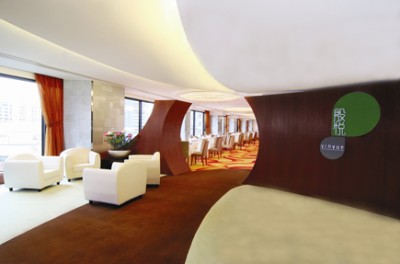
As suited as the Panda Café was for exhausted-GypsyNester, casual dining, we wanted a special night on the town on our final evening in Hong Kong. That’s where the fabulous YinYue filled the bill.
On the top of the high-rise hotel, YinYue commands dazzling panoramic view of the world’s most vertical city through floor-to-ceiling windows.
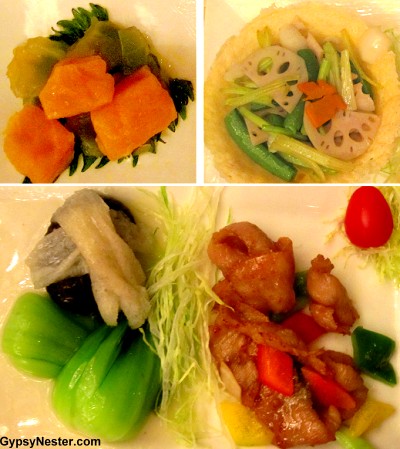
We were more than happy to let the chef decide our culinary fate, so we ordered the special menu.
Each course arrived at the table with flair and elegance. We even got to try jellyfish!
Follow along LIVE with us as we discover China, South Korea and Japan. We’ll be bring you The Great Wall and Forbidden City in Beijing, Dalian, Busan, Nagasaki and all the fabulous entertainment, the activities, the food and fun aboard the ms Volendam!…CONTINUE READING >>
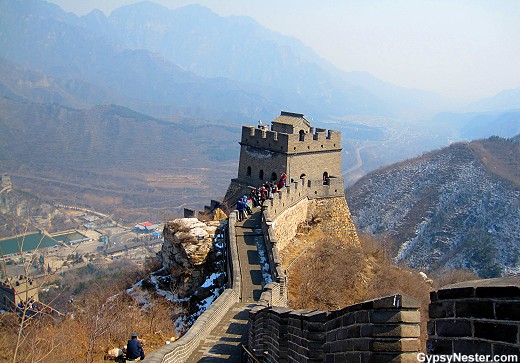
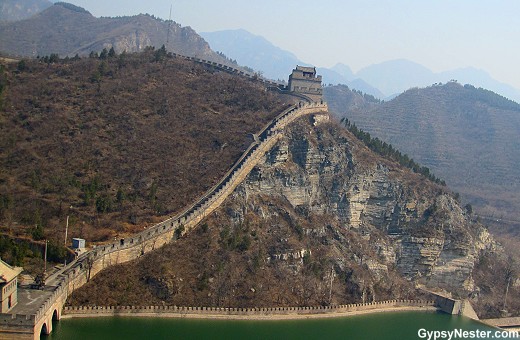
Time to check off a big bucket list item today as we head to The Great Wall of China about an hour outside the capital city of Beijing.
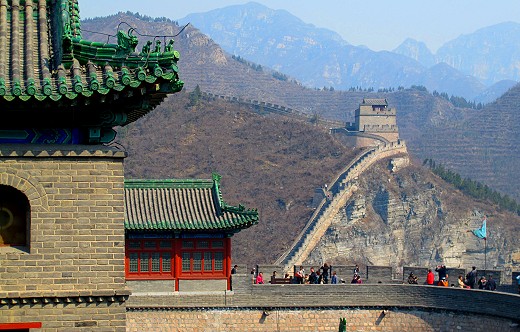
The section of the wall that we are visiting is actually only one piece in the series of several walls begun several centuries Before Christ and built over a span of nearly two thousand years by many different emperors. Combined these make up what is known as The Great Wall.
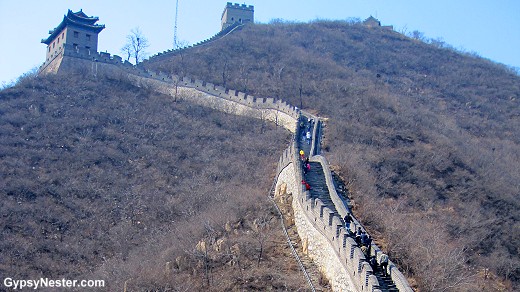
During The Ming Dynasty, in the mid 1300s until the late 1500s, this part of the fortification was built to protect the seat of power from the Mongols to the north. Then after the fall of the dynasty in 1644, the wall was deemed unnecessary and left to decay.
Over the next few centuries it had nearly fallen apart until restoration was undertaken in 1984. Because of those efforts we found this incredible landmark in condition to climb hundreds of feet up the incredibly steep side of the mountain, where we got amazing views of the world’s most famous wall on both sides of the valley.
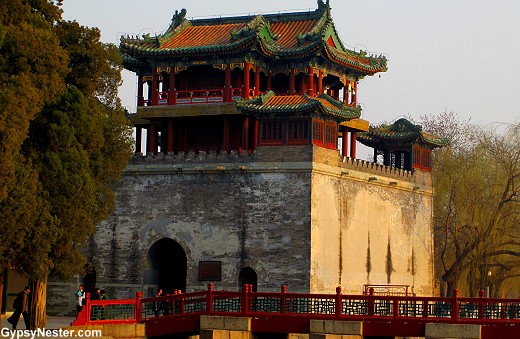
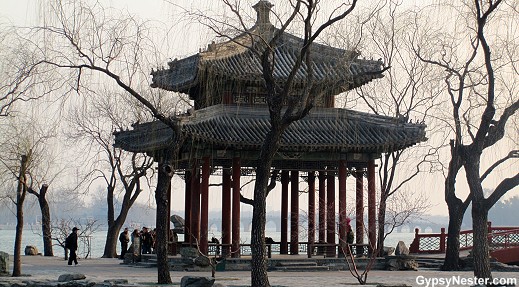
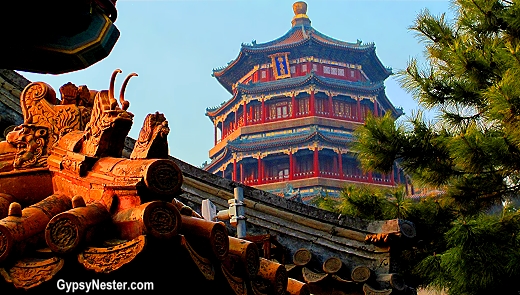
From The Great Wall we head back into Beijing to the Summer Palace and the Garden of Cultivated Harmony. The palace and man-made lake it overlooks, were built around 1750 by the Emperor Qianlong during the Qing Dynasty, which was last of the dynasties, as a birthday gift for his mother.
But 150 years later Empress Dowager Cixi made it home and proceeded to instigate all sorts of political skulduggery using her son, and later her nephew, as figureheads for her reign.
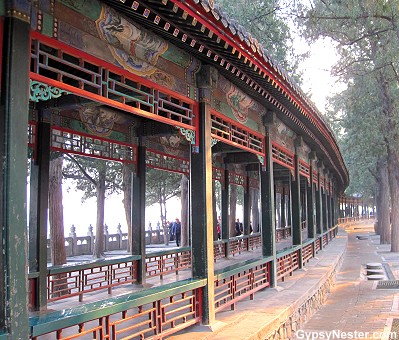
By walking about a mile around the shore of Kunming Lake and the amazingly ornate covered walkway, we got a great vantage point for looking up Longevity Hill at the palace. The landscape here is very flat, so the hill is actually made from the earth that was removed while digging out the lake.
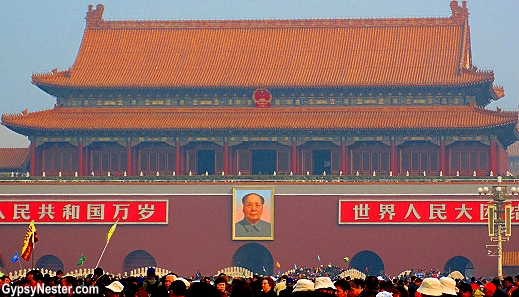
Day two in Beijing, formerly known as Peking because of a mispronunciation by early European visitors, begins in Tiananmen Square. The square is the third largest city square in the world and gets its name from the Tiananmen Gate (Gate of Heavenly Peace) on its north side, that separates it from the Forbidden City.
An interesting tidbit we learned from our guide… there is an artist who’s only job is to make sure that the iconic picture of Chairman Mao is always in perfect condition.
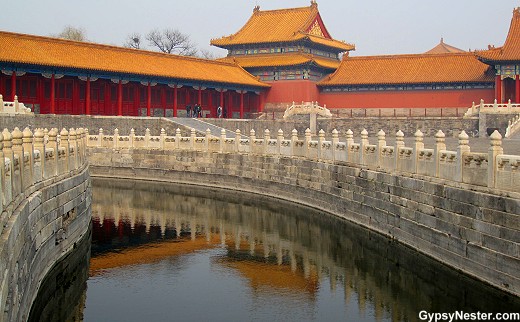
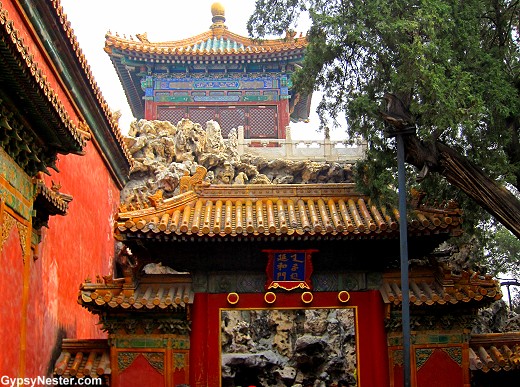
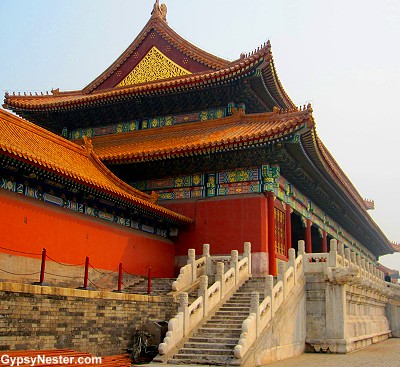
In the Forbidden City we are blown away immediately. The incredible architecture is mostly wooden, but the massive doors at each gate are made of solid stone.
As we pass through each successive gate it just gets more and more incredible. Covering some two hundred and fifty acres, the complex is truly enormous.
The name comes from the fact that everyone except the emperor’s wives, concubines, and eunuchs were forbidden from entering.
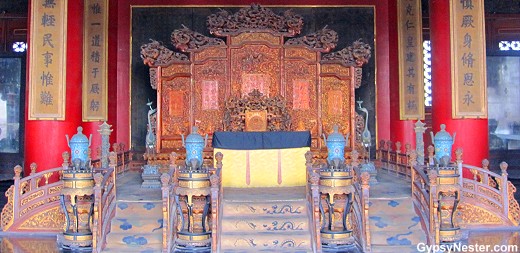
Finally we make it through to the emperor’s palace behind the ninth gate, it certainly looks like it was good to be emperor.
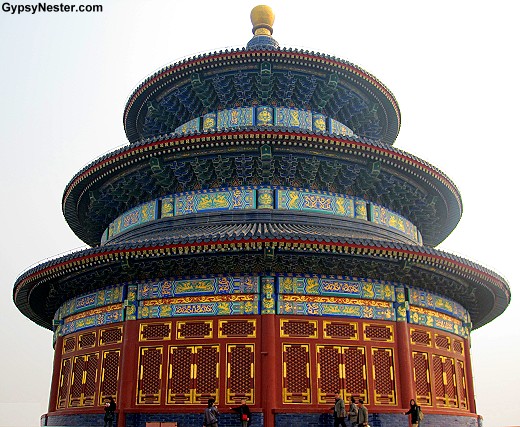
In the afternoon, we head over to the Temple of Heaven in the southern part of the capital city.
A Heavenly Temple
The most famous of the temples is the Hall of Prayer for Good Harvests, which is said to be the largest wooden building in the world that is constructed without using any nails. Fantastic.
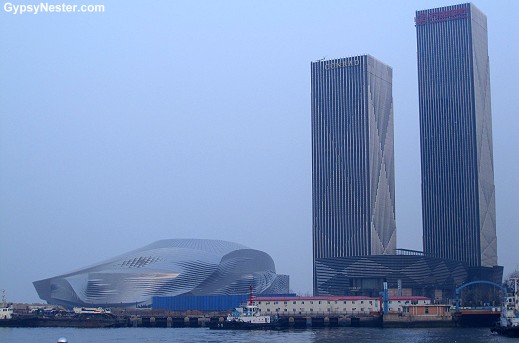
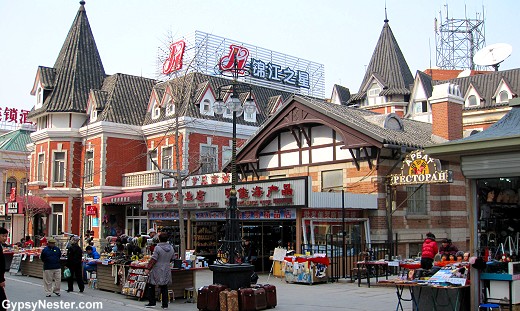
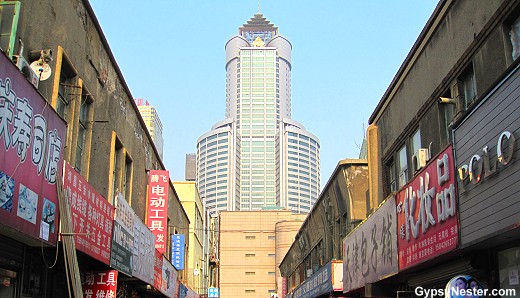
Our last port of call in China, Dalian, is a northern port city that reflects a history from Russian and Japanese occupation.
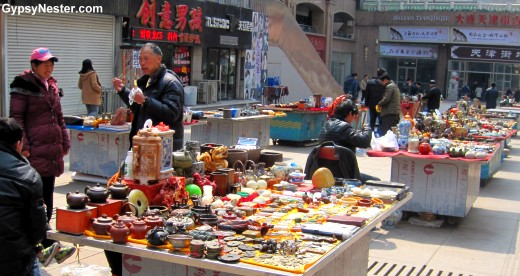
Historically a part of Manchuria, we found many different and exciting foods. We came upon a downtown market place where boiling broth is used to cook noodles, vegetables and seafoods that are served into bowls while sitting at a tiny kiosk.
WATCH: The best street food we’ve ever had!
By pointing, nodding, and gesturing we managed to get all sorts of fantastic tidbits into our bowls.
When the bill for this absolutely unbelievable meal came we thought there must have been some mistake, twenty yuan, about three dollars for both of us, including drinks!
After three glorious days of seeing the wonders of China, we are more than ready for a restful day at sea while heading to South Korea.
As comfy as our stateroom is, we’ve found some fantastic places on the ship to rest our tired feet, relax our awed minds or stay in touch with the world and loved ones.
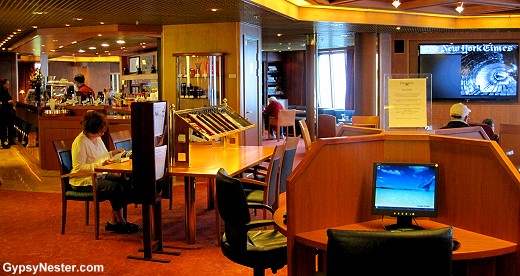
The Explorations Cafe offers computers with free access to The New York Times, or connect to email and websites through the ship’s wifi. And like any good internet cafe, there is a complete coffee bar to keep us surfers properly caffeinated.
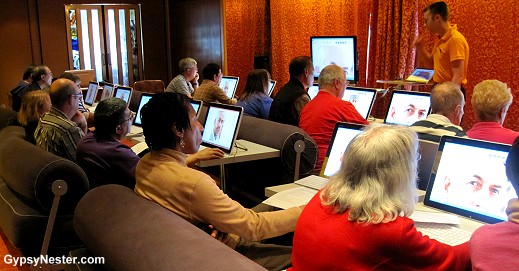
There are also seminars in The Digital Workshop with tips on everything from the latest version of Windows to making the most of the loads of photos and videos everyone is shooting.
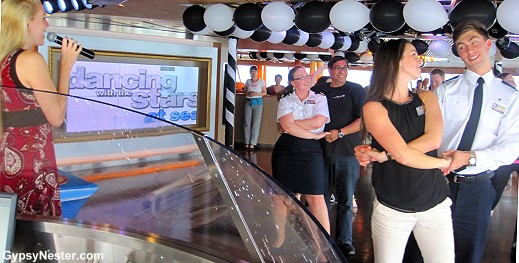
In the afternoon on days when we aren’t in port, the showroom dancers and members of the crew team up with passengers for Dancing With The Stars on the high seas.
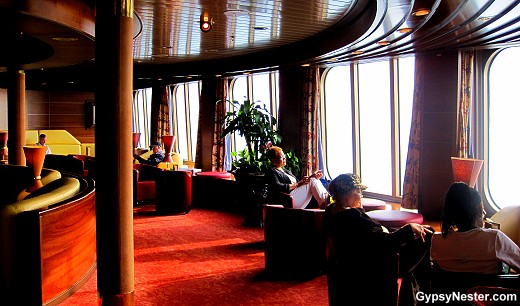
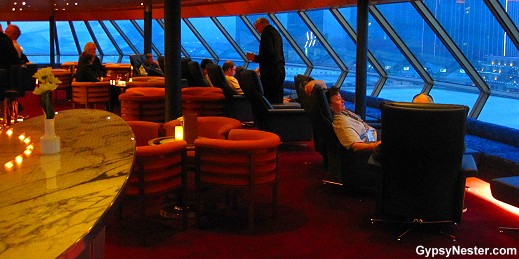
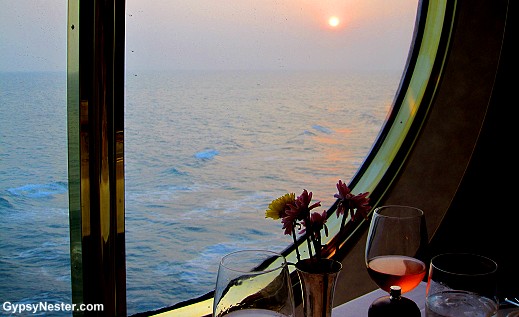
Our evenings are spent in the Crow’s Nest – the highest and most forward spot on the Volendam – the perfect place for watching the sunset in comfy chairs through the floor-to-ceiling windows. We’ve gathered a group of fantastic regulars here, sharing an evening cocktail and our day’s experiences, then matching wits against other groups in the surprisingly spirited ongoing trivia matches.
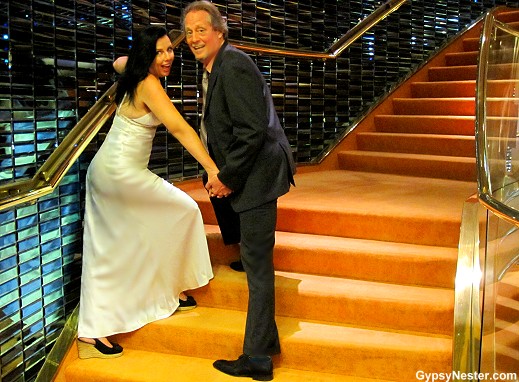
Ready for another formal night, we got a perfect spot in the elegant Rotterdam Dining Room for another fantastic meal.
After dinner, we make our escape to our stateroom.
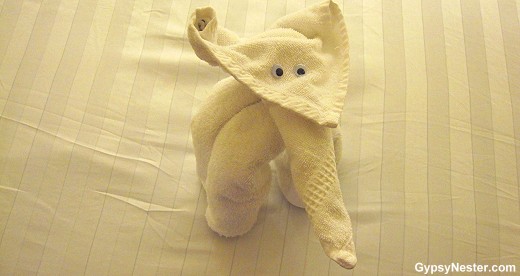
This little guy was waiting to greet us when we got back to our cabin. Who knew there were elephants in these waters?
DAY THIRTEEN: Something’s Fishy in Busan
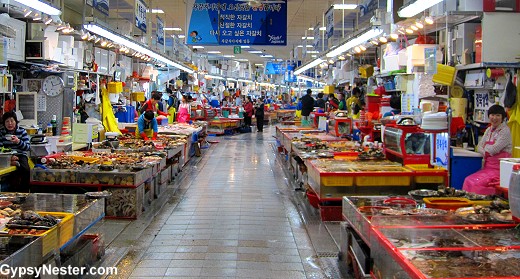
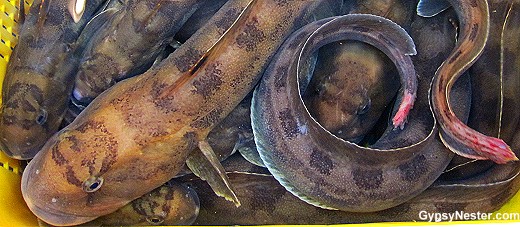
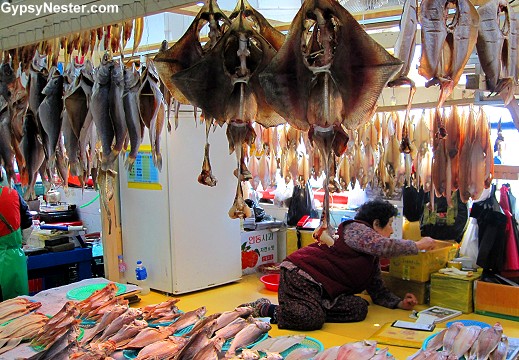
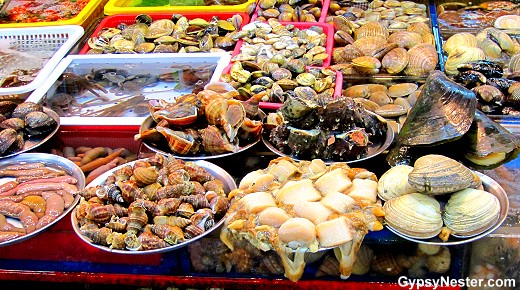
Busan is the busiest port in South Korea and fishing is a big part of all of this maritime activity. This has led to one of the biggest fish markets in all of Asia. We couldn’t think of a better place to start our day.
The enormous Jagalchi indoor market covers three floors but the fish selling spills out into the surrounding streets too.
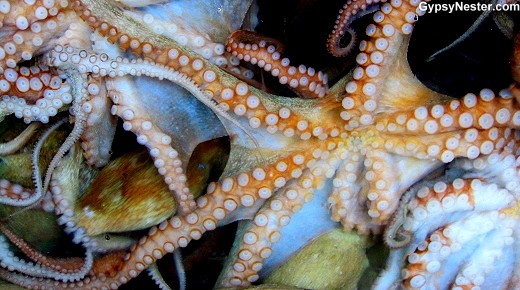
Both inside and out are jam packed with every sort of sea creature imaginable, many that we not only had never seen before, but we couldn’t even begin to identify.
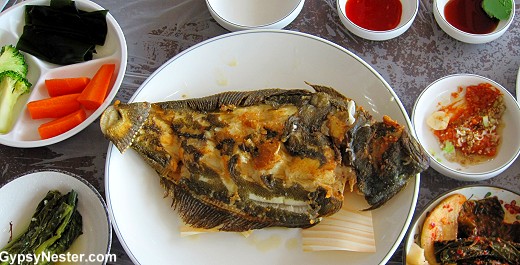
The second floor also houses a traditional restaurant – complete with no shoes allowed – that serves up freshly caught specialties. Where else could we dream of having lunch?
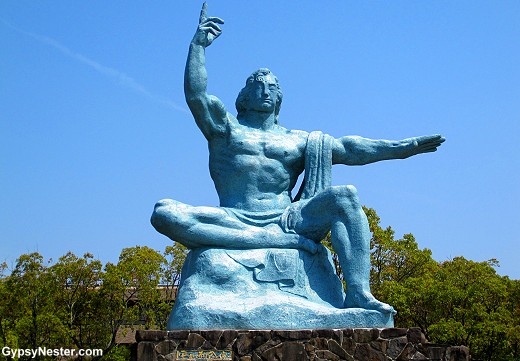
Nagasaki, Japan is no doubt best known as the site of the second atomic bombing on August 9, 1945. This is commemorated at The Peace Garden which is dominated by a large statue of a man pointing skyward, where the bomb came from, and the other arm extended in a sign of peace. His eyes are closed in prayer.
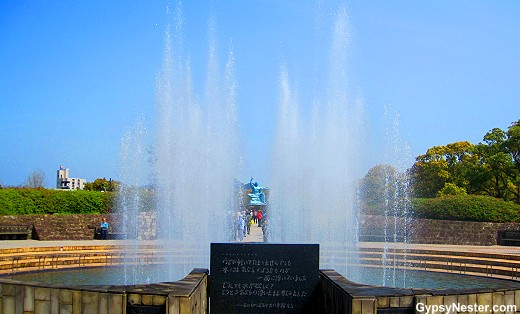
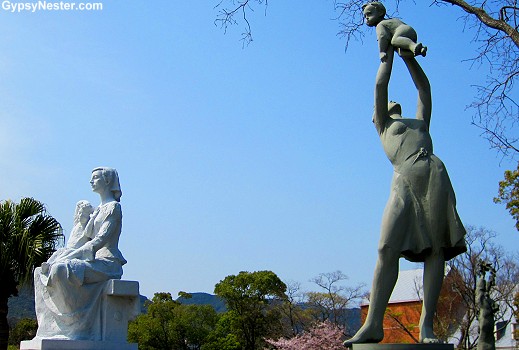
We walked through the park from the Fountain of Peace past the many artistic gifts sent from countries around the world proclaiming the hope that these horrible weapons will never be used again.
Water is used as a poignant part of the park because the casualties of the bombing suffered unbearable thirst.
This quote from a young victim really brought the suffering life for us, “I was thirsty beyond endurance. There was something oily on the surface of the water, but I wanted water so badly that I drank it just as it was.”
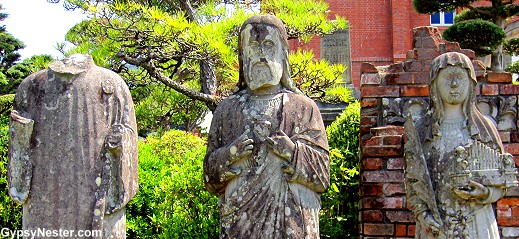
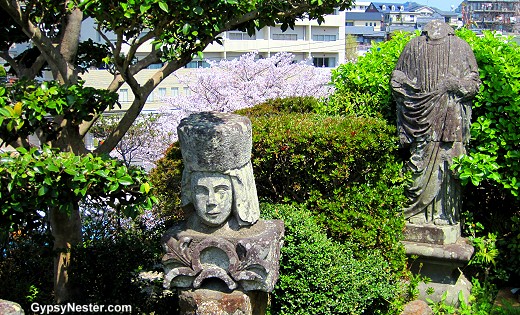
Near the epicenter stood the Urakami Cathedral, one of the biggest Catholic churches in Asia. Even though it was mostly reduced to rubble several of the statues survived and are on display.
After visiting the church we spent several hours in the Atomic Bomb Museum documenting the devastation and suffering in heart-wrenching detail that defies description.
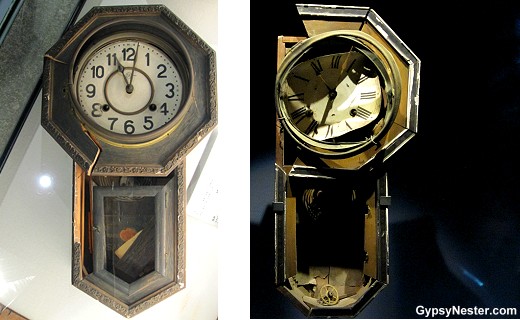
Clocks forever stopped at 11:02 are a stark reminder of how time stood still for the people of Nagasaki on that fateful day.
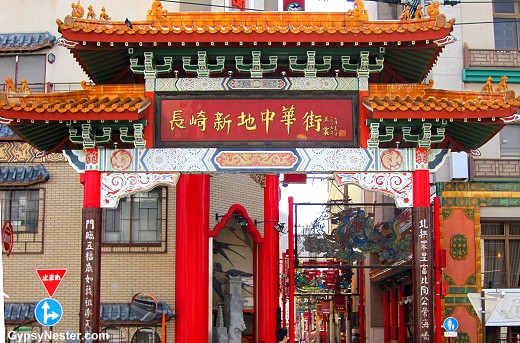
A few kilometers south of ground zero, where the devastation was less severe, some of the older structures remain. Since we were getting a little hungry we headed to Shinchi Chinatown, the oldest Chinatown in Japan, where street food is king.
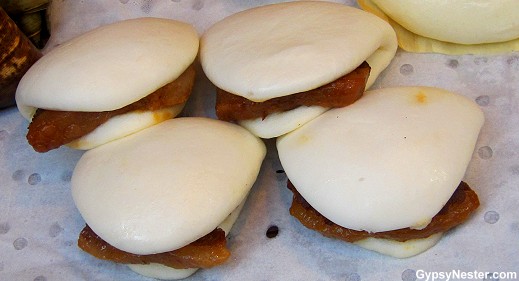
Of the several dishes unique to Nagasaki, such as champon and saraudon, our favorite was kakuni-manju, a slice of barbecued pork on a folded steamed bun.
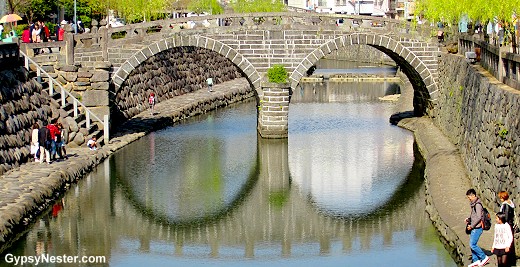
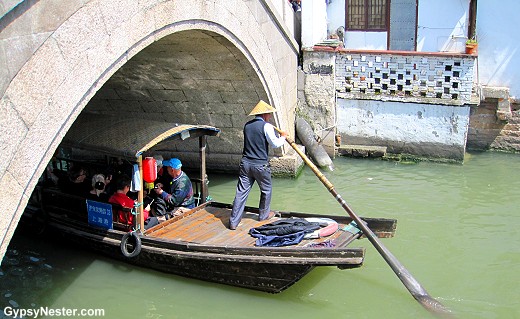
About a dozen old stone bridges span the Nakashimagawa River in the old part of the city a few blocks away from the Chinatown. The most famous of these, Spectacles Bridge, dates back to 1634. The unusual name comes from the way the arches reflect in the water which, from the right vantage point, looks like a pair of eyeglasses.
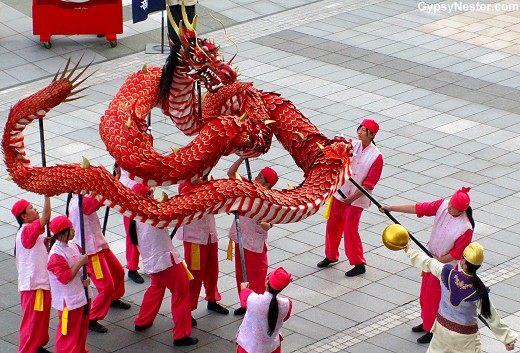
As we climbed back aboard the ship for our last time, a group from a local high school gave us quite a send off with traditional music, dancing and dragons.
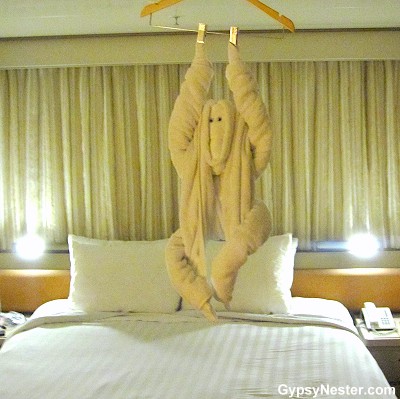
As we head to our stateroom for our last night aboard, a bit sad that our time on the Volendam is over, we are giddily startled by the most elaborate towel art we’ve ever seen! Hanging from our ceiling is an orangutang!
Making us laugh like this when we’re a bit sad proves in a nutshell the kind of attention that Holland America has given us throughout our adventure. Somehow our fabulous attendant knows exactly what we need before we realize we need it.
Our new buddy Oscar the Orangutang hangs above us as we sail on to Kobe, and the word is that our timing is perfect for seeing one of Japan’s most iconic sights. Tonight we dream of cherry blossoms in Osaka.
Under the skillful guidance of Chef David Serrano, our dishes come together beautifully and better yet, even while using razor sharp knives, no cooks are harmed in… CONTINUE READING >>
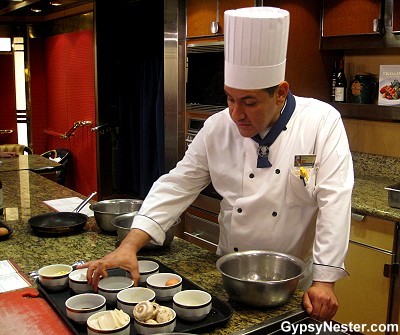
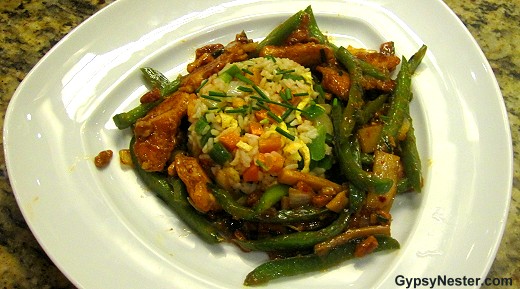
The first of our hands-on cooking classes – Chinese Cuisine. We prepare Sichuan chicken, fried rice, and find out just what makes delicious soup both hot AND sour.
Under the skillful guidance of Chef David Serrano, our dishes come together beautifully and better yet, even while using razor sharp knives, no cooks are harmed in the production. To top it off, at the end of the class our creations become our lunch.
Follow along LIVE with us as we discover Hong Kong, China, South Korea and Japan. We’ll be visiting Shanghai, Zhujiajiao Watertown with its traditional wooden boat markets, the Great Wall and Forbidden City in Beijing, the culture and beauty of Dalian, the amazing port city of Busan, the Peace Garden…CONTINUE READING >>
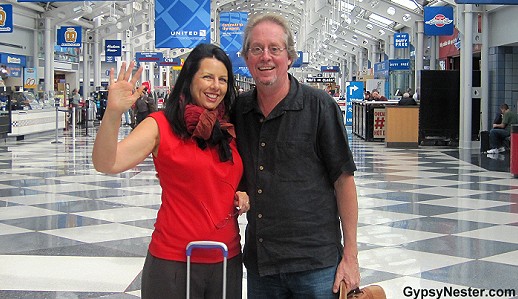
Getting ready to board our flight to Hong Kong – so excited! It’s an almost sixteen hour flight, so when we see you next we’ll be a bit jetlagged! We’re really curious about crossing the International Date Line (we’ve never done it before – does it hurt?) and what happens to the sun. Is it daytime the whole way? How many lunches will be served? Planning on sleeping as much as possible!
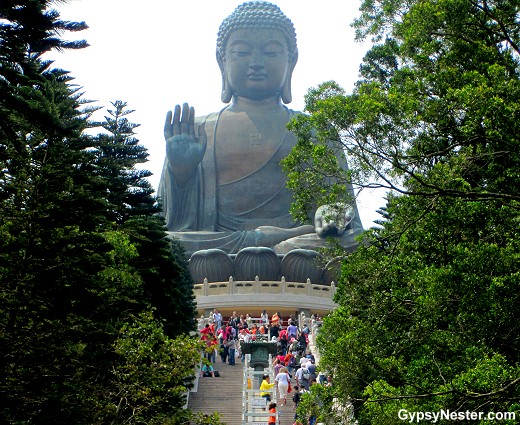
At one hundred and twelve feet tall and at the top of two hundred and forty steps, the Tian Tan Buddha, AKA Big Buddha, looms high above us on Lantau Island in Hong Kong.
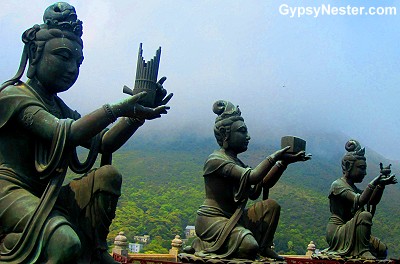
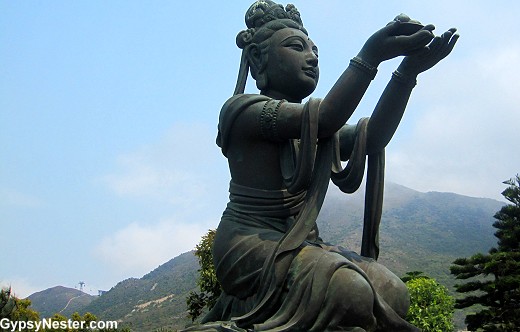
One of the Six Devas with an offering that symbolizes a virtue that is necessary to achieve Nirvana.
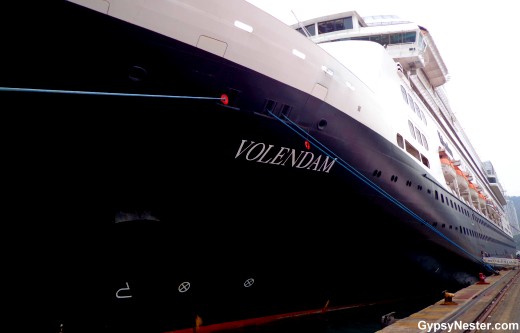
The big day has arrived as we set sail from Hong Kong aboard the beautiful Volendam.
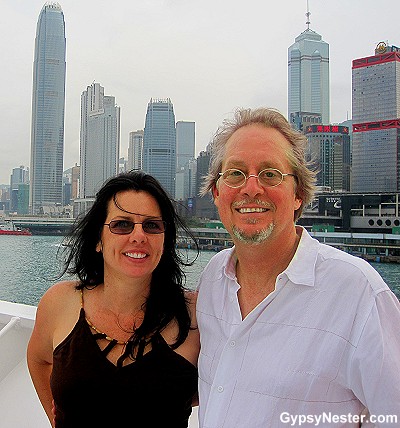
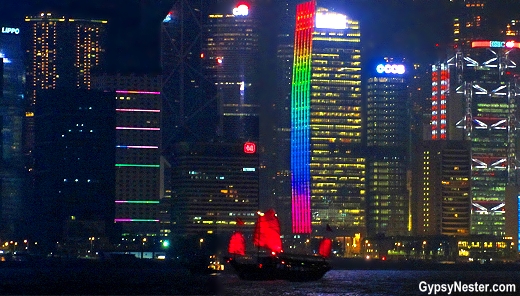
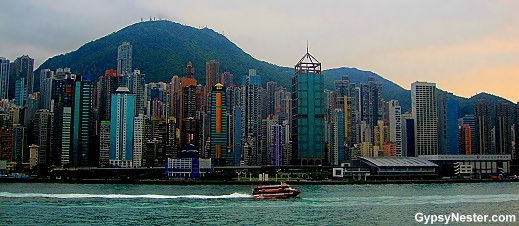
Our captain takes us through the heart of Hong Kong, a city that juts straight from the ocean to the sky.
With over 1200 skyscrapers, Hong Kong is our world’s most vertical city. The blend of architecture and nature is truly mind-blowing, the mountainous backdrop seems to serve as a palette for the skyline.
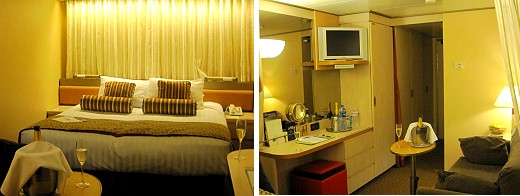
Spacious and comfortable, with more than enough room to stash all of our stuff out from under foot, this will be our home for the next two weeks while we take in the sights, history and traditions of The Orient.
WATCH: Our stateroom on the Volendam!
DAY THREE: Culture & pampering at sea
Volendam’s food culture
Food is a big part of any cruise, it’s everywhere, all of the time. Usually the consuming of mass quantities is as far as the relationship goes, but we discovered a big difference our first day at sea.
The Volendam strives for a more cozy relationship with food.
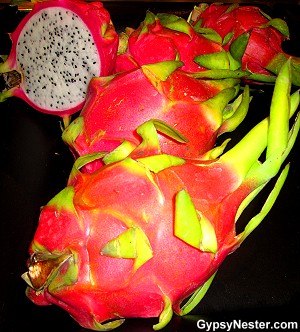
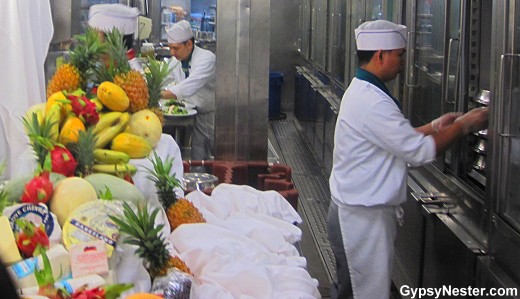
Already we’ve sampled dim sum and dragon fruit. Guests may be treated to a tour of the bustling kitchen where every morsal is prepared. Cocktail classes and wine tastings are standard fare.
The crown jewel is Volendam’s Culinary Arts Center, presented by Food & Wine Magazine, is where the ship’s master chefs take time to demonstrate their talents along with the ship’s fabulous party planner, Beth. This is a state-of-the-art kitchen in a studio / theater setting.
While we are looking forward to the daily television-type cooking shows, we are most excited about the hands-on classes we signed up for later in the cruise where we will learn to prepare Chinese and Japanese cuisine. Better yet, when we’ve finished we get to eat it!
High tea on the high seas, and if that’s not relaxing enough…
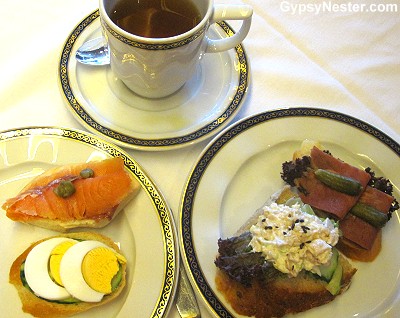
Our first ever high tea was not only experienced while sailing the South China Sea, but sharing a table in the Rotterdam Dining Room with REAL Brits who were more than happy to show us the proper ropes!
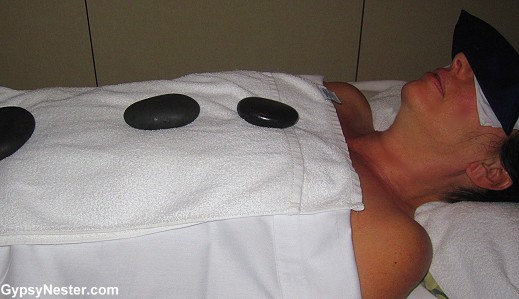
Then we made an attempt at removing some of our halfway-around-the-world jet lag by applying heated rocks. So that’s why we’ve seen this in pictures so many times… hot stone massages rock.
DAY FOUR: Getting Ready for Shanghai
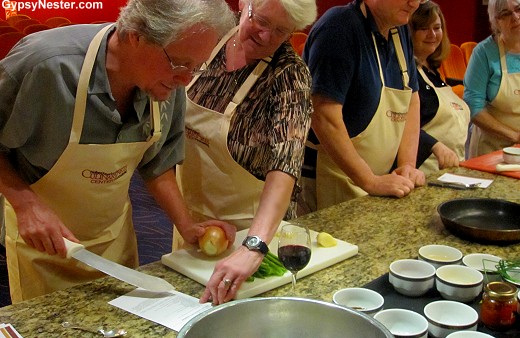
Time for the first of our hands-on cooking classes – Chinese Cuisine. We prepare Sichuan chicken, fried rice, and find out just what makes delicious soup both hot AND sour.
Under the skillful guidance of Chef David Serrano, our dishes come together beautifully and better yet, even while using razor sharp knives, no cooks are harmed in the production. To top it off, at the end of the class our creations become our lunch.
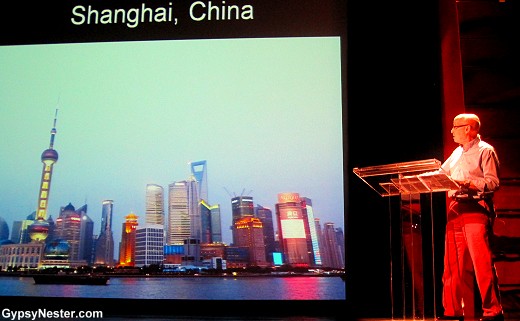
The day before each port of call our ship’s travel guide, Ian Page, gives a briefing on what to look for, how to get around, and basically everything to expect when going ashore. Ian certainly has the experience to speak with authority after having visited over one hundred countries in his years since leaving London — even experiencing a pirate attack off the coast of Somlia.
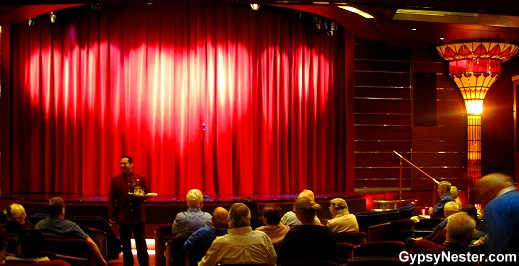
Showtime in the Frans Hall Lounge rounds out our day. With us all the way from the U. K., Scotty McLean manages to both amaze and amuse with an act full of magical humour.
We head back to our stateroom early to pour over the maps, guides and literature waiting for us. We fall asleep dreaming about our upcoming two days in Shanghai.
DAY FIVE: Shanghai and Zhujiajiao Watertown
Shanghai by day
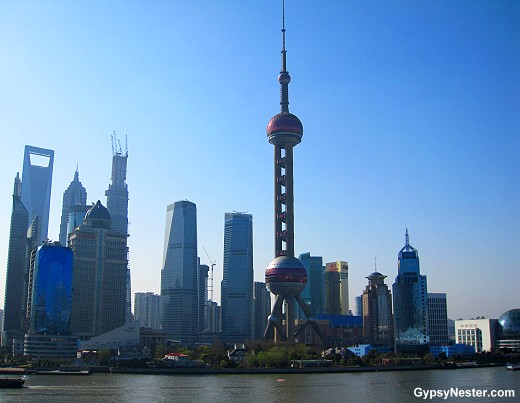
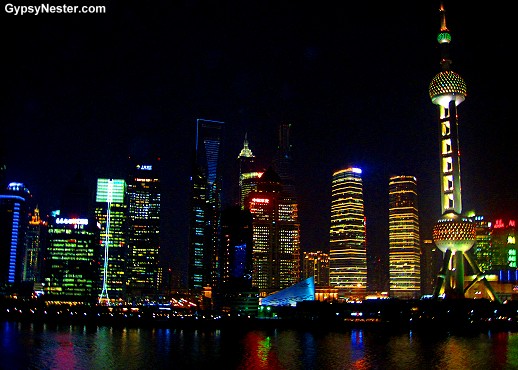
Shanghai is the largest city in China and sometimes considered, depending on the criteria used for defining municipal populations, the biggest in the whole world. The Volendam docks right in the center of it on the Huangpu River. Directly across the river from our pier the skyline looms over us, dominated by some of tallest structures in the world. Perhaps the most striking is the Oriental Pearl Tower.
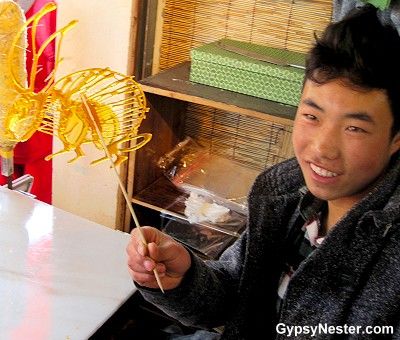
We were intrigued by a young man creating beautiful candy artwork of the symbols from the Chinese zodiac.
Using only a spoon and a slab of marble to cool the molten sugar, he made remarkable lollypops in just a few seconds. It seemed a shame to eat such fine work, but we justified it because they were too delicate to try to keep. Plus the caramelized sugar was much too tasty to ignore.
Shanghai is the commercial and financial center of China and the Bund is home to many of the main financial institutions operating in China, as well as some of the city’s most exclusive shops and hotels. So we took the short walk from our docking point take a look.
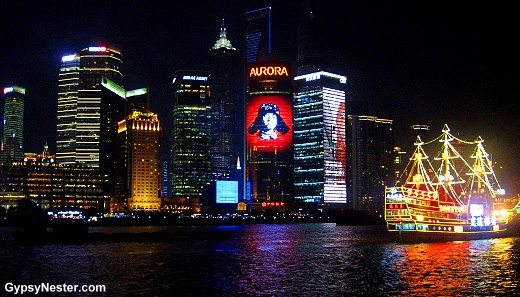
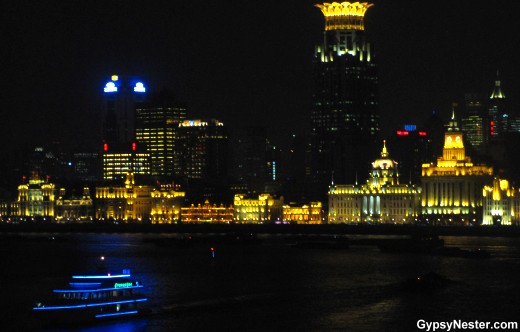
In the past few decades the area has become the gathering center for the city. At night the impressive buildings are lit up in a stunning contrast to the neon skyscrapers across the river.
Tourists from all over the world take in the sights along the riverside walkway that gives the district its name or cruise on the myriad of party boats that make their way up and down the waterfront after dark.
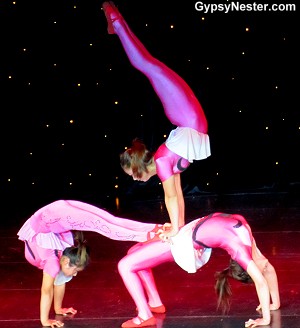
Back on board The Volendam we finish our evening with the Shelong Acrobatic Show by a local troupe of young gymnasts presented in The Frans Hals showroom.
DAY SIX: Getting Shanghai’d
The Old City
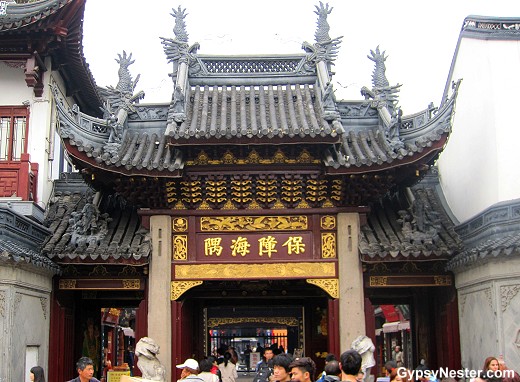
We begin our second day in Shanghai’s Old City. The area is an enclosed district of classic Chinese architecture, housing shops and restaurants.
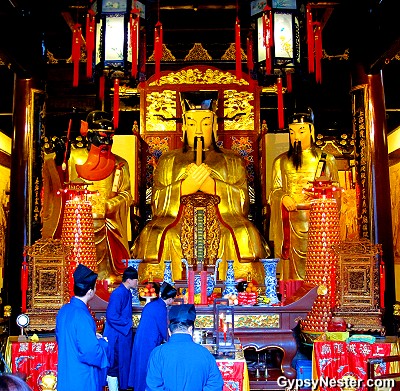
While wandering the streets of the old town we stumble upon The Shanghai City God Temple dedicated to Cheng Huang Qin Yubo.
We notice several differences in this 600 year-old temple from the Buddhist Po Lin Monastery we visited in Hong Kong a few days ago before discovering the obvious reason, this is a Taoist temple.
For lunch we duck into dim sum heaven. Two floors of non stop choices of every sort of Chinese delicacy imaginable.
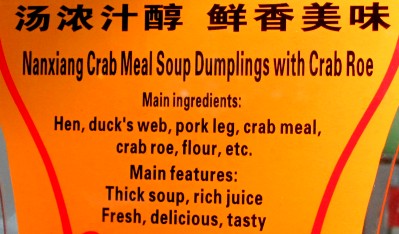
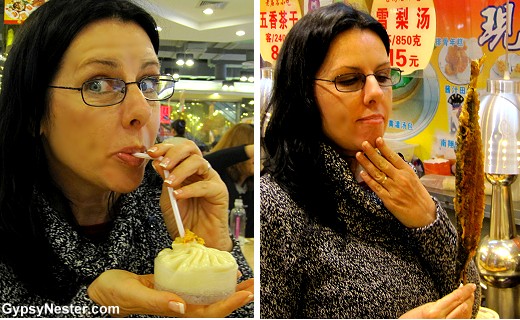
We got the chance to sample a Shanghai specialty, soup dumpling. The steamed bread holds a surprise of boiling hot broth inside. The small versions can be bitten open and sipped, but the large ones, like ours, are served with a straw. Even with the precautionary tubing, David manages to sear a bit of tongue.
Veronica also opts for a whole fish on a stick, having chosen from a wide buffet of stick food — including squids, tiny birds, and crabs.
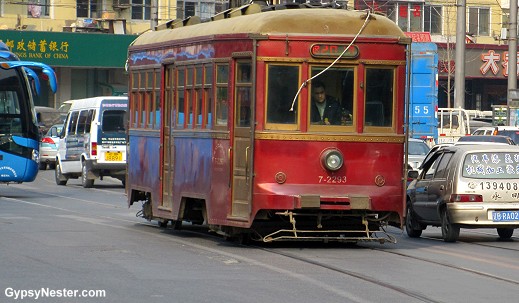
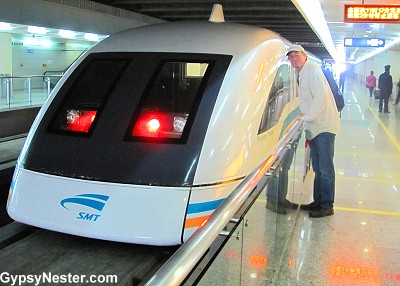
After lunch we make our way to the Maglev, short for magnetic levitation, train for a ride on the fastest train in the world.
Instead of rails the train floats, or levitates, on a magnetic field. China is a pioneer in this technology. While on our run out to the airport The Maglev *only* made it up to 301 kilometers per hour, just short of 200 miles per hour, but it has obtained a record speed of 501 km/h (311 mph) on a test run.
Pretty much beat by our two days of running around Shanghai we chose to spend a quiet “movie night” for a change. We thought it seemed a little goofy that DVD deliveries were available to the staterooms when we first boarded the ship. Who wants to spend time on a cruise laying up with a movie? Well tonight our tired feet have the answer… we do.
DAYS SEVEN & EIGHT: At Sea – It’s not THAT kind of a cruise
There is a very different vibe aboard The Volendam on this cruise than the tropical, Caribbean variety. Not only because of the early spring weather in this part of the world, which is chilly, but also because the ports of call are “bucket list” types of places.
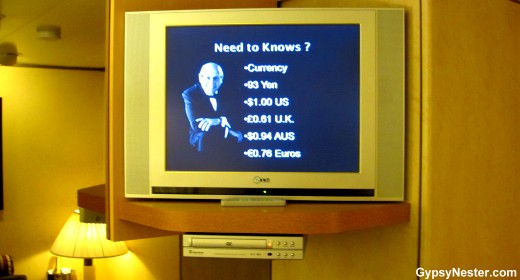
Because of this, the focus of the onboard activities leans toward travel planning and sightseeing making the ship’s travel guide, Ian, a rock star. His daily breifings in the showroom are packed and his Good Morning Volendam show each morning on our stateroom‘s television is packed with information about the upcoming cities we will be visiting.
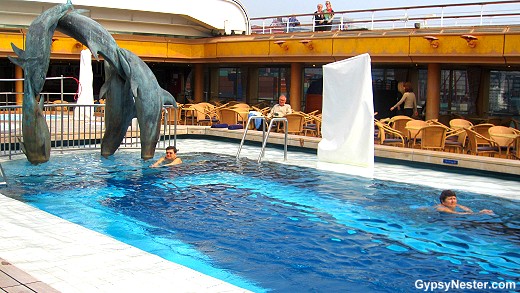
That said, the ship has made adjustments that make possible continued use of outdoor amenities like the swimming pool. A retractable glass roof covers the deck area (including the hot tubs!) making it comfortable no matter what mother nature throws our way.
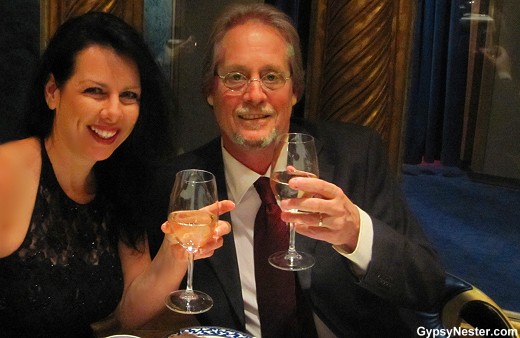
The second of the three formal nights finds us dressed up and ready for a visit to the Pinnacle Grill, one the ship’s fine dining options. Billed as a steak house, seafood is also prominent because we are, after all, at sea.
The meal begins with a little unexpected treat, mushroom espresso with truffle oil, followed by lobster bisque and, one of the house specialties, crab cakes.
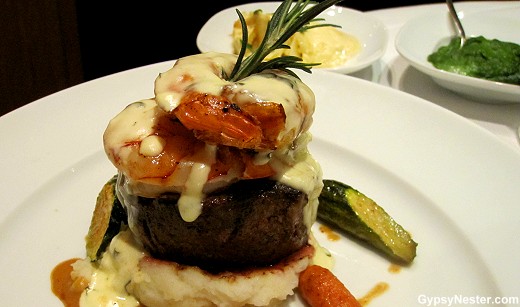
The main event features lobster tail for Veronica and a slightly different take on surf and turf, filet mignon and prawns for David.
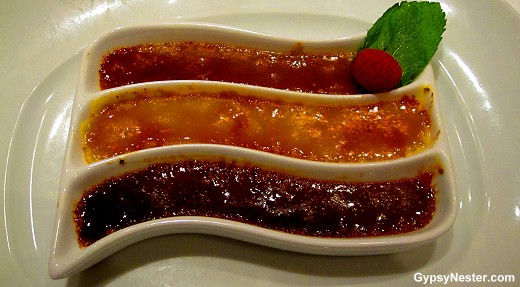
Even though we can hardly hold another bite, we finish the meal with a triple crème brule, chocolate, vanilla, and coffee, along with a chocolate soufflé, piping hot, right out of the oven. Wow, maybe we should get all decked out more often!
Your GypsyNesters give a tour of their stateroom aboard Holland America’s… CONTINUE READING >>
Your GypsyNesters give a tour of their stateroom aboard Holland America’s ms Volendam! Check out all of the closet space, the great bathroom and the comfy surroundings!
Has it happened? Have I become a crotchety old lady? Do I abhor certain kinds of music because I’m too old to get it? Am I shocked at some of the things that “young people” wear these days?
Possibly so. But I’m dead certain of one thing – people are much more rude than they were when I was a young whippersnapper.
Because we have a website I am painfully aware that there are those that don’t treat others with civility. I’ve quit reading the online comments on news stories – it’s horrific.
Then, out of nowhere, cyberspace-type incivility came crashing into Real Life. In a manner that I couldn’t ignore or justify… CONTINUE READING >>
Has it happened?
Have I become a crotchety old lady?
Do I abhor certain kinds of music because I’m too old to get it?
Do my eyebrows fly up at some of the things I see on TV?
Am I shocked at some of the things that “young people” wear these days?
Possibly so. But I’m dead certain of one thing – people are much more rude than they were when I was a young whippersnapper.
Because we have a website (and especially because we have a YouTube Channel) I am painfully aware that there are those that don’t treat others with civility. I’ve quit reading the online comments on news stories – it’s horrific.
The name calling and accusations and disrespect can quickly cause me to lose faith in humanity, to believe that everyone is inclined to be thoughtless toward one another.
After reading comment after despicable comment in BOLDFACE print, it’s sometimes difficult to remember that the great majority of people that David and I have met in this great big world are good.
Fortunately – though I do miss reading respectful debates – I can avoid that hooey online. And if anyone DARES to be nasty on my website – where I have delete button privileges – it’ll be gone faster than a jackrabbit with the squirts.
Don’t be skulking into my kitchen or on to my Facebook page talking that trash – you were raised better than that.
Like a lot of people, for better or worse, I’m becoming become numb to it all. After all – when it comes to visualizing who is behind the keyboard, I can easily conjure up a bored, unsupervised 15-year-old making the modern day equivalent of a prank phone call.
Or some homemade-brown-liquor drinkin’-Unabomber-type hell-bent on causing trouble.
Or a compulsive liar with sixty pet squirrels and a grotesque obsession with Vlad the Impaler issuing proclamations from a digital mountaintop. Heh. I lean toward the grandiose when I’m visualizing.
Then, out of nowhere, cyberspace-type incivility came crashing into Real Life. In a manner that I couldn’t ignore or justify:
Last weekend David and I were visiting The Boy at his Generic Midwestern Directional University (GMDU) town and took in a ball game. It was a beautiful spring day.
We stretched our legs in the warm sun and yelled “GO GMDU Wampus Cats!” We basked in each other’s’ company.
Halfway through the game I developed a jellybean jones that wouldn’t let go.
I could blame it on menopause, but the truth is that jellybeans are freakin’ delicious and I adore them. To relive my hankerin’ I trekked the half mile up the road toward a convenience store.
I was surprised that there was not a sidewalk, as the GMDU area is generally very pedestrian friendly. I had to walk along the curb in the gutter as I did as a kid – except I wasn’t dragging my trusty stick behind me.
I wasn’t in any danger, the lanes were wide, there was little weekend-in-a-college-town traffic and it was broad daylight. A nice pleasant walk on a nice pleasant day with delicious jellybeans at the end of it.
I must have jumped straight up when I heard – at full-husky-masculine voice – from twenty feet behind me,
“GET OUT OF THE ROAD YOU USELESS WASTE!”
I flinched as the bicycling douchebag (I realize that calling the gentleman a douchebag runs contrary to what I’ve said above, but the sorry fact remains – he’s a douchebag) sped past me.
I did what I always do when I’m in a weird situation. I froze. Damn.
As I made my way back to the stadium I was able to think of a million retorts – all of them clever and effective – but at the time, I just stood there like a, ahem, Useless Waste.
GMDU is in a sweet little college town with a high tax base and wonderful services for the handicapped (two more reasons for my sidewalk-less surprise).
What if I wasn’t just a jellybean seeking middle-aged woman, but a handicapped person – like my niece?
Or a college girl with low self esteem? Or a newly widowed lady lost in grief? Douchebag calling me Useless Waste took on an ugly reality.
The more I walked the more I seethed.
How could I just stand there? Why didn’t I come up with a snappy comeback that would have made Douchebag think twice about his actions?
Why couldn’t I run like the Bionic Woman, catch up to DB and give him what-for? And most importantly, why wasn’t I dragging that stick? I could have shoved it into Douchebag’s spokes.
Where was my delete button when I need it most?
I was nearly in tears, my go-to coping mechanism when I feel helpless. I had to force myself to let it go, no use ruining my visit with The Boy because a thoughtless person was rude.
Buck up Veronica – get back to your family and slap a smile on your face.
Back at the bleachers the guys asked why I was jellybeanless, so I recounted my tale.
When I got to the Useless Waste part, The Boy laughed. My neck snapped as my head turned to face him.
“Well, Mom, you’ve got to admit, that’s pretty funny.”
Before you judge, I’m going to come to his rescue, Recovering Helicopter Mommy style.
The Boy is not a heartless bastard. He was granted a high school scholarship for having the most community service hours in his graduating class. He has a big heart – he really does.
He is the first to point out something he perceives as unjust. He’s been known to rescue animals.
But, he does have a wicked sense of humor, something he comes by honestly, inherited from his parents. And he’s grown up in a crudity-anesthetized world.
Does this get him off the hook? Not by a long shot.
I burst into tears – I truly did – I wasn’t just messing with The Boy’s head. That got his attention. He doesn’t like to see his mother cry.
But it wasn’t until I asked him to think how his handicapped cousin would react to being called Useless Waste that he fully grasped the situation.
I’m not so naïve to think that my son is perfect and I am aware that I view him through Mommy colored glasses. But, still, I find it difficult to understand how he could have been so callous. He was raised better than that.
Have we begun to conduct ourselves so poorly as a society that this current generation can’t feel the weight of words?
Are they unable to think past their immediate desires to take another’s feelings into account before shouting/typing/hurling hurtful words?