Search…

Stockholm Syndrome: Captured by Sweden


From now on, when we visit a city and wish we had been able to stay much longer, we shall refer to the situation as Stockholm syndrome.

The Swedish capital was completely captivating.

And we couldn’t help but have fond feelings for our captor… CONTINUE READING >>

Thanks to Visit Stockholm for providing this captivating experience – and to Eurail for the 15-day rail pass that inspired us to undertake it! As always, all opinions are our own.
Stockholm, Sweden at dusk

Strömsborg (Stream’s Castle)

From now on, when we visit a city and wish we had been able to stay much longer, we shall refer to the situation as Stockholm syndrome.

The Swedish capital was completely captivating, and we couldn’t help but have fond feelings for our captor.

Central train station in Stockholm, Sweden
Stockholm’s train station

As the sun set, we stepped off the train and were immediately helped by a friendly local who pointed us toward the bridge leading to the island where the original city and our hotel were located.

We felt completely welcome.

Stockholm, Sweden at dusk
Stockholm consists of fourteen islands, so bridges are everywhere

Walking the ancient streets of the old town, we felt phenomenal. Once we saw the fabulous quarters at the Victory Hotel that we would be occupying for the next couple of days, we knew we would’ve been delighted to remain in captivity much longer.

Old Town, Stockholm, Sweden

A True Victory

The lobby of the Victory Hotel in Stockholm, Sweden
The lobby

The Victory Hotel is the brainchild of Gunnar Bengtsson, who over many years gathered an amazing amalgamation of artifacts, mostly focused on the torrid love story of Admiral Lord Nelson and his scandalous squeeze, Lady Hamilton.

A letter to Lady Hamilton from Admiral Nelson at the Victory Hotel, Stockholm, Sweden
An authentic letter to Lady Hamilton from Admiral Nelson

His solution for storing the memorabilia was to open a hotel and decorate it with his treasures.

And so, the Lord Nelson Hotel was born. But one hotel couldn’t contain Bengtsson’s collection, and soon the Lady Hamilton and the Victory Hotels, the latter named after Admiral Nelson’s ship, were added to the family.

The rooms at the Victory are much more than just a place to stay for the night; they are lodging with a story to tell.

Our suite at the Victory Hotel in Stockholm, Sweden

Each one is named for a captain, and features paintings of his ship, family heirlooms, and pictures. Our suite, honoring Captain A. G. Johansson, was filled with fantastic 18th century furnishings, wedding photographs, and original paintings dated 1642.

Fruit and wine in our room at Victory Hotel in Stockholm, Sweden
Spoiled much? This was in our room when we arrived!

You’ve GOT to see more! Follow us into the beautiful Victory Hotel…

The Whole Beast

Djuret restaurant in Stockholm, Sweden

Even though we were excited to see the city, we couldn’t pass up dinner at Djuret, the restaurant at the Victory Hotel.

The name means the “whole beast,” describing their concept of serving one animal at the time.

Each day, three-course and six-course menus are prepared until an entire animal is used. Our evening’s selection was moose, so it looked as though once again Veronica would be forced to endure the myth.

Moose entree at Djuret restaurant in Stockholm, Sweden

But our server explained that the animal was actually more like what we would call an elk. Veronica believes in the existence of elk because she has personally seen one, so all was well.

Whatever the critter was, it was prepared perfectly — roasted and sausage-d — served with Jerusalem artichoke, onion, and Chanterelle mushrooms.

Dessert stepped away from the moose (we were kind of hoping they’d lay mousse on us), instead we went where every human truly wants dessert to go, chocolate and ice cream.

But not just any old chocolate and ice cream, this was intense. Click here to see more about it and Djuret.

Stockholm Cathedral in Sweden
Stockholm Cathedral

A Brush with Greatness

The next morning we met up with our guide, Marco, for a whirlwind overview of Stockholm.

Beginning with an exploration of the old town, Gamla Stan, we caught up on the history of not only the city, but also the country.

The name Stockholm means “log island” in Swedish and is based on a legend about a gold-filled log coming to rest on the island where the original city was founded.

Evert Taube, Stockholm's beloved troubadour welcomed us to Sweden!
Evert Taube, Stockholm’s beloved troubadour, bid us a good morning!

Royal horseman at the Royal Palace in Stockholm, Sweden

Whether the tale is true or not, the spot on Lake Mälaren was ideal for both protection and trade routes — a perfect spot for a king to take up residence.

These days the parliament does the actual ruling, but the king still reigns from the palace, so that would be one of our first stops.

As we approached the Kungliga Slottet, or Royal Palace, we saw some first-rate imperial pomp and circumstance.

A carriage enters the Royal Palace in Stockholm, Sweden

Mounted guards escorted horse drawn carriages carrying dignitaries through the main gate for a meeting with the king,

We were duly impressed by the regal spectacle, but somewhat surprised at the low-key approach to security.

Marco explained that in Sweden, the royal family regularly goes out in public without causing much of a stir.

 It’s not Sweden without a fika!

Before moving on, Marco announced that we could hardly let the morning go by without a fika. He explained how this Swedish version of the coffee break has become an important part of the culture.

For fika in Stockholm we stopped for Kanelbullar or cinnamon rolls, a Swedish tradition

Generally, one does not refuse to fika when asked unless one wishes to appear rude. It’s a fun word, fika, both a noun and a verb.

So fika we did.

We popped into a bakery and fika-ed our little brains out with coffee and another Swedish tradition, Kanelbullar or cinnamon rolls.

The proper fika also involves socializing, which we did, while Marco described how the practice has had an effect on business relationships in Sweden. Employees and bosses often fika together, and that leads to a more relaxed and better working environment.

A King’s Folly

The star of our next stop most certainly did cause a stir back in its day. From the small island that contains the old city we took a ferry to see an unbelievably unscathed piece of Swedish history.

Stockholm, Sweden

The two hundred-foot ship, Vasa, sank less than a mile into its maiden voyage in 1628 while still in Stockholm’s harbor.

The Vasa Museum in Stockholm, Sweden

Incredibly, it sat submerged and undisturbed for over 300 years, all due to a king’s bluster.

The Vasa Museum in Stockholm, Sweden

King Gustavus Adolphus’ desire to have the biggest, baddest ship on the sea was the vessel’s undoing.

By adding an additional deck of canons without offsetting the weight below the water line, the design was badly flawed and the top-heavy ship rolled over and sank within a few minutes of launch.

Not ole King Gus’s finest moment.

The Vasa Museum in Stockholm, Sweden

In 1961, salvage efforts were undertaken, and now the remarkably undamaged ship stands almost entirely intact in the Vasa Museum.

The poor design may have led to a major embarrassment for the king — it’s said that soon after the sinking, ole King Gus sent men out to cut off Vasa’s masts so he didn’t have to see them sticking out of the water — but it left us with one of the best specimens of shipbuilding from the Age of Exploration to be found anywhere in the world.

Detail on the aft of the Vasa in Stockholm, Sweden

The only parts to suffer from centuries under water were the nails — most of which have been replaced — leaving a nearly perfect time capsule.

The lady who lived in her own museum

Built for the Count Walther von Hallwyl and his wife, Wilhelmina, everything has remained virtually untouched

From the Vasa Museum, Marco continued our time travels at the Hallwyl Museum, which is a perfectly preserved mansion from the gilded age of the 1890s.

The house was built for the Count Walther von Hallwyl and his wife, Wilhelmina, and everything has remained virtually frozen in place.

Wilhelmina von Hallwyl cataloged everything in her Stockholm home

This was completely intentional; the countess had a system of cataloguing every household item.

This she employed almost immediately upon moving into the home in 1898 with an eye toward leaving a behind a museum after passing away.

We aren’t talking about just the valuable stuff either, Wilhelmina had volume after volume filled with details numbering, photographing and identifying EVERY. SINGLE. THING. in the house.

Costumed guides led us through the Hallwyl Museum in Stockholm
Costumed guides led us through history.

The Hallwyl Museum in Stockholm, SwedenHer eccentric obsession, possibly what we would call OCD today (not that we are doctors or anything), makes for a remarkable glimpse into the lives of Swedish aristocracy over a century ago.

Wilhelmina even had many tables and desks enclosed in glass cases so that nothing atop them would be disturbed.

Seafood Nirvana

Östermalm Food Hall in Stockholm, Sweden

For a quick bite of lunch, and a look at how Swedes shopped and ate back in Wilhelmina’s day, we walked over to the nearby Östermalm Food Hall.

This covered market served as the supermarket for the city, with farmers and fishermen bringing in their fresh wares every day.

Östermalm Food Hall in Stockholm, Sweden
Marco shares his favorite goodies with us (David’s stalking out things on his own in the background).

Lisa Elmqvist in Stockholm, SwedenThese days, the hall is a lot fancier.

The shopping selection remains impressive, but now the hall has become a popular midday-break spot for everyone from the neighborhood folks to royalty.

Case in point, we learned that the king himself is a regular at one of the restaurants, Lisa Elmqvist.

Toast Skagen with bleak roe at Lisa Elmqvist in Stockholm, Sweden, which is high on the list of the best things we have ever put in our mouths.

Not being Swedes, we sat down and waited for some royalty to show up — so we could stalk them — while enjoying creamy fish soup and toast skagen.

Lisa Elmqvist’s classic combination of shrimp, dill, and caviar, on toast was beyond… um, better than… no wait, indescribably… that’s it! … fit for a king.

Our eyes rolled back in our heads. No wonder his royal highness is a frequent customer.

For more photos and info, follow us in to the Östermalm Food Hall!

A High Tech Adventure

The Ericsson Globe in Stockholm, Sweden

Marco had to drag us away kicking and screaming, reminding us that we had smorgasbord to tackle later that evening.

While we waddled walked to the old town Marco pointed out many of Stockholm’s cutting edge companies in high tech development.

The Ericsson Globe in Stockholm, Sweden

Stockholm has given life to Spotify, Skype, and Ericsson so, once we parted ways with Marco, we headed into the modern era to take a ride to the top of the world’s largest spherical building, the Ericsson Globe.

At the Globe’s SkyView, we climbed inside a smaller glass globe and traveled over four hundred feet up the rounded side to the top of the arena.

WATCH: Vault the SkyView with us!

The Ericsson Globe in Stockholm, Sweden

During the ride up, being mostly mesmerized by the view, we didn’t really notice a fear factor. Then, reaching the top, the 360 degree panorama of the entire city was all our minds could possibly process.

The trip down was a different story.

The Ericsson Globe in Stockholm Sweden

We are generally immune to any sort of motion sickness, but when we headed over the edge to descend it felt like a slow motion roller coaster.

That sensation of leaving our stomachs somewhere up above our bodies lasted a long, long time, and the view below, with nothing but air beneath us, was pretty darn unnerving.

Smörgåsbording Like it’s Our Job

How to smorgasbord in Sweden


Once we had our feet back on the ground, we knew we had to get those queasy feelings in check because we had one big event left on our schedule – a real traditional Swedish smörgåsbord.

By all accounts, the place to partake in Stockholm is the renowned Grand Hôtel. It’s a very extravagant setting for what originally was not particularly fancy fare.

The idea behind a smörgåsbord has a more humble background.

How to smorgasbord in Sweden

The name is a combination of the words smörgås, meaning sandwich, and bord, which means table, but in practice there is a whole lot more than sandwiches going down.

In fact, there is an entire method to properly approach the smorgasbord, which our server kindly walked us through before we took our first bite.

How to smorgasbord in Sweden

Most importantly, we were told not to pile too much on food on our plates at one time.

Using many plates is not being piggy; it is expected — perhaps even mandatory.

When done properly the meal becomes an event, taking several hours, and we were more than happy to oblige. We feasted our way through the massive spread, beginning with cold dishes of herring.

The next plate is… click here to continue reading about our crazy-fun, food-filled night!

David and Evert Taube taking in the sights of Stockholm
David and Evert Taube taking in the sights

Even with as much as we had seen and done in our short time in fabulous Stockholm, we felt as though we hardly got started before we had to leave.

The only feeling no, syndrome, affecting us was that we would gladly comply with being held hostage for a few more days.

And like it.

David & Veronica, GypsyNester.com

Delve Deeper into Stockholm:
See more of the The Victory Hotel
Learn how to smörgåsbord like it’s your job!
Follow us into the Östermalm Food Hall
Find out how to save on all of the city’s attractions with the Stockholm Card!

Thanks to Visit Stockholm for providing this captivating experience – and to Eurail for the 15-day rail pass that inspired us to undertake it! As always, all opinions are our own.

YOUR TURN: What would you hit first in Stockholm?

Into the Stockholm Sky on the Ericsson Globe!

Your GypsyNesters take a (slightly queasy) trip to the top of Stockholm in a ball!.. SEE MORE  or enlarge video>>


Your GypsyNesters take a (slightly queasy) trip to the top of Stockholm in a ball!

See all of our adventures in Stockholm!

Delve Deeper into Stockholm:
See more of the The Victory Hotel
Learn how to smörgåsbord like it’s your job!
Follow us into the Östermalm Food Hall

Visit our GypsyNester YouTube Channel!

A Passion Shared: The Victory Hotel in Stockholm, Sweden

Every now and then we happen upon accommodations that are far above and beyond anything we could ever expect.

The Victory Hotel is most definitely one of those places… CONTINUE READING >> 

Thanks to Visit Stockholm for providing this luxurious experience! As always, all opinions are our own.
Across from the Victory Hotel in Stock holm, Sweden

The lobby of the Victory Hotel in Stockholm, Sweden
The lobby

Every now and then we happen upon accommodations that are far above and beyond anything we could ever expect.
The Victory Hotel is most definitely one of those places.

Reception at the Victory Hotel, Stockholm, SwedenThe inn is the brainchild of Gunnar Bengtsson, aka The Collector, who over many years gathered an amazing amalgamation of artifacts, mostly focused on the torrid love story of Admiral Lord Nelson and his scandalous squeeze, Lady Hamilton.

A letter to Lady Hamilton from Admiral Nelson at the Victory Hotel, Stockholm, Sweden
An authentic letter to Lady Hamilton from Admiral Nelson

Our host and Gunnar’s son, Mats, explained how, while he was growing up, the collection began to overtake the family home.

Ship’s mastheads, antiques, and other assorted marine memorabilia was stuffed under the beds, in the closets, and almost every other nook and cranny.

The cocktail lounge at the Victory Hotel, Stockholm, Sweden
The cocktail lounge

His father’s solution for storing the collectibles was to open a hotel and decorate it with his treasures.

And so, the Lord Nelson Hotel was born. But one hotel couldn’t contain Mr. Bengtsson’s collection, and soon the Lady Hamilton and the Victory Hotels, the latter named after the Admiral’s ship, were added to the family.

Every room at the Victory is much more than just a place to stay for the night; they are lodging with a story to tell.

Our suite at the Victory Hotel in Stockholm, Sweden

Fruit and wine in our room at Victory Hotel in Stockholm, Sweden
Spoiled much? This was in our room when we arrived!

Each room is named for a captain, and feature paintings of his ship, family heirlooms, and photographs.

Captain's suite at Victory Hotel in Stockholm, Sweden

Captain's suite at Victory Hotel in Stockholm, Sweden

Our suite, honoring Captain A. G. Johansson, was filled with fantastic 18th century furnishings, wedding pictures, and original paintings dated 1642.

This doesn’t mean modern amenities are missing, flat screen TV, wifi, stereo system, and best of all, an absolutely phenomenal jacuzzi tub do their best to blend in.

Captain's suite at Victory Hotel in Stockholm, Sweden

Check out our full adventure in Stockholm!

Djuret: The Whole Beast

Djuret restaurant in Stockholm, Sweden

The restaurant at the Victory Hotel is equally unique, Djuret, which means the “whole beast,” describes the concept of serving one animal at the time.

Often wild game, bought directly from hunters is the choice, with two menus, a three course and a six course, prepared each day until an entire animal is used.

Djuret restaurant in Stockholm, Sweden

In house beer at Djuret restaurant in the Victory Hotel, Stockholm Sweden
Our server called our beer “explosive” – and it was – so fizzy it wanted to leap out of its glass!

On our visit the evening’s selection was moose, so it looked as though once again Veronica would be forced to endure the myth.

But our server explained that the animal was actually more like what we Americans would call an elk.

Veronica believes in the existence of elk because she has personally seen one, so all was well.


Moose entree at Djuret restaurant in Stockholm, SwedenWhatever we want to label the critter, it was prepared perfectly as a first course tartar with pickled squash.

The main dish consisted of a moose variation of rare sirloin, leg braised with beer and mousseline sausage with duck liver served with Jerusalem artichoke, onion, and Chanterelle mushrooms.

Dessert stepped away from the moose (we were kind of hoping they’d lay mousse on us), instead we went where every human truly wants dessert to go, chocolate and ice cream.

at Djuret restaurant in Stockholm, Sweden

To be exact, Tarte au chocolat de Valrhona and chestnut honey ice cream.

These were garnished with salt roasted almonds and a tangy berry coulis, made with sea buckthorn berries, which we still, even after much sly at-the-table Googling, have no clue as to what they are.

Whatever they are, they rocked our socks off.

For more ideas on places to stay check out Konferens Stockholm nära Arlanda.

David & Veronica, GypsyNester.com

Visit the the Victory Hotel’s website – it’s one of the most entertaining sites out there – Mr. Bengtssongives you a personal tour of his collection!

Delve Deeper into Stockholm:
Check out our full adventure in Stockholm!
Learn how to smörgåsbord like it’s your job!
Follow us into the Östermalm Food Hall
Find out how to save on all of the city’s attractions with the Stockholm Card!

Thanks to Visit Stockholm for providing this luxurious experience! As always, all opinions are our own.

Seafood Nirvana: Östermalm Food Hall in Stockholm, Sweden

For a look at how Swedes shopped and ate back in the gilded age, or for a quick bite of lunch, check out the Östermalm Food Hall.

The hall served as the supermarket for the city… CONTINUE READING >> 

Thanks to Visit Stockholm for providing this mouthwatering experience! As always, all opinions are our own.

Östermalm Food Hall in Stockholm, Sweden

For a look at how Swedes shopped and ate back in the gilded age, or for a quick bite of lunch, check out the Östermalm Food Hall.

The hall served as the supermarket for the city back at the end of the 1800s, with farmers and fishermen bringing in their fresh wares every day.

Östermalm Food Hall in Stockholm, Sweden

Fresh fish offerings at Lisa Elmqvist in Stockholm, Sweden

These days, the hall is a lot fancier.

For the inside scoop we met with Johan, from the shop and restaurant Lisa Elmqvist.

Lisa began selling seafood here nearly one hundred years ago, and for four generations her family has continued.

Johan gave us a fresh fish tour and an idea of the logistics behind the scenes.

Fresh fish offerings at Lisa Elmqvist in Stockholm, Sweden

After browsing the offerings, he suggested that we try a few, and didn’t have to ask twice.

Check out our full adventure in Stockholm!

Toast Skagen with bleak roe at Lisa Elmqvist in Stockholm, Sweden, which is high on the list of the best things we have ever put in our mouths.

We started with a sample their signature dish, toast skagen with bleak roe — high on the list of the best things we have ever put in our mouths.

Wow, this combination of shrimp, dill, and caviar, well, let’s just say we see why the King of Sweden is a frequent customer.

Mouth-watering, butter-like salmon at Lisa Elmqvist in Stockholm, Sweden

Creamy fish soup at Lisa Elmqvist in Stockholm, Sweden

We followed up with salmon and soup, which were certainly none too shabby themselves, but the shrimp on the toasted bread had spoiled us.

We may never be the same. It will haunt our dreams.

OK, OK, so that’s a little over the top, but seriously… royally good.

David & Veronica, GypsyNester.com

Delve Deeper into Stockholm:
Check out our full adventure in Stockholm!
See where we stayed – The Victory Hotel
Learn how to smörgåsbord like it’s your job!

Find out how to save on all of the city’s attractions with the Stockholm Card!

Thanks to Visit Stockholm for providing this mouthwatering experience! As always, all opinions are our own.

Perfectly Preserved: Colonial Spain in Valladolid, Mexico


Just because a place is off the beaten path doesn’t mean that a path should not be beaten to it.

We’ve discovered this to be true on several occasions — sometimes by accident — other times by design, as with our visit to Valladolid.

We had heard that this impressively preserved colonial settlement hidden away in the heart… CONTINUE READING >>

The square in front of the Cathedral of San Servacio o Gervasio in Valladolid, Mexico

Just because a place is off the beaten path doesn’t mean that a path should not be beaten to it.

We’ve discovered this to be true on several occasions — sometimes by accident — other times by design, as with our visit to Valladolid.

We had heard that this impressively preserved colonial settlement hidden away in the heart of Mexico’s Yucatan Peninsula was a gem, so we made tracks to find out for ourselves.

Fruit and vegetable street stand in Valladolid Mexico

It only took walking the couple of blocks from the bus station to our hotel on the main square for us to fall in love with the place, and we knew the reports were right.

A Mayan woman walks in Valladolid

It certainly looked as though very little had changed since the Spaniards built the town nearly five hundred years ago, but the city’s history actually predates their arrival.

The Mayan town of Zaci held claim first, until the Spanish pushed the villagers out and used the stones from their city to build a new settlement named after the old capital of Spain.

A historic Mayan home in Valladolid, Mexico
A historic Mayan home
Valladolid, Mexico
The layout of the town consists of huge blocks of buildings with lavish courtyards inside.

The Mayans were not that easily deterred.

They attempted to take back the city two years later, but were defeated. Over the next three centuries there was coexistence, but tensions bubbled under the surface.

A courtyard in Villadolid, Mexico
We peeked into as many courtyards as we could!

A courtyard in Villadolid, Mexico

Once Mexico obtained independence from Spain, the Yucatan pushed to be its own nation and Mexican forces invaded. After helping in the fight against Mexico, the Mayans took the opportunity to revolt and retake their homeland in 1847, in what is known as the Caste War.

David relaxes in his Bluff Works Pants in Valladolid, MexicoDavid’s pants are courtesy of Bluff Works. He really gave these puppies a work out on this trip. He wore them on the plane over, spoke in them at the TBEX convention, rambled the ruins in the heat of Chichen Izta, crammed them in his suitcase, rode in them on the bus to Valladolid, and STILL looks stylin’ – wrinkle free!

Cathedral of San Servacio o Gervasio in Villadolid, Mexico

Happily, Valladolid was spared great damage during those hostilities, which continued for almost one hundred years, so today the city a bit like a time capsule.

The square in front of the Cathedral of San Servacio o Gervasio is virtually unchanged and the church — while not the original structure from 1545 — still incorporated stones from the ancient Mayan structures when rebuilt in 1705.

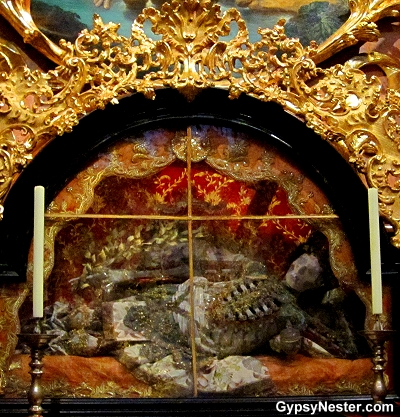
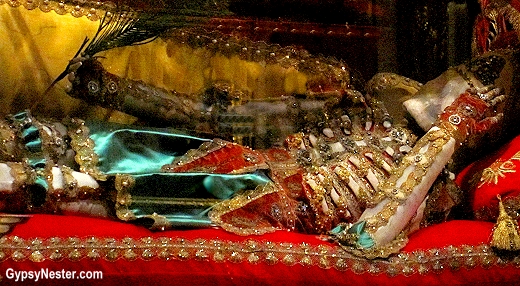
Cathedral of San Servacio o Gervasio contains a casket for Jesus
The cathedral houses Jesus in a casket, something we’d never seen before.
Mounting our trusty steeds!

Riding bikes in Valladolid, Mexico

Riding bikes in Valladolid, Mexico

The old city extends about ten blocks in each direction from the square, so we decided to rent bikes for easier exploration.

Heading east, toward the cenote that supplied the original settlement with water, we made a quick stop at the San Roque Museum.

While small, the collection contributed an abundance of information to our understanding of the town’s history.

The San Roque Museum in Valladolid, Mexico

The building housing the museum is perhaps more interesting than the displays it contains.

Dating back to 1575, it was originally one of the five colonial churches in Valladolid.

A few decades later it was converted to a hospital, serving that purpose for nearly four hundred years before being converted into the city’s first electrical generation plant in 1947, then finally opening as the San Roque Museum in May of 1998.

A necessary plunge

The entrance of the Cenote Zaci in Valladolid, Mexico

The next leg of our ride, from the museum to Cenote Zaci, only took a few minutes but by the time we reached the ancient water source we were more than ready for a refreshing dip.

Cenote Zaci in Valladolid, Mexico

The tropical sun saw to that. Most of the cenote is hidden from the harsh solar rays beneath a cave covered with stalactites – making an inviting oasis in the midst of the city.

Cenote Zaci in Valladolid, Mexico

Cenote Zaci in Valladolid, Mexico

Swimming in Cenote Zaci in Valladolid, Mexico

The fresh, cool water felt fantastic and, while not as colorful and bountiful as a reef, we were happy to have our snorkel gear with us for exploration purposes.

We didn’t make it anywhere near the two hundred and sixty foot bottom of the pool, but we did get underwater views of the cenote walls and the odd little eyeless black fish called lub.

Eyeless black fish called lubs in Cenote Zaci in Valladolid, Mexico

Uh, yum!

Tamale cart in Valladolid Mexico
Tamale cart in Valladolid

Properly chilled and relaxed, our appetites kicked into high gear.

In Valladolid, as with everywhere we went in the Yucatan, street food was our midday sustenance of choice.

Tamale in Valladolid Mexico

From giant banana leaf-wrapped tamales, to mouthwatering underground-pit-cooked pork conchinita pibil, we discovered dishes that trace their roots to the Mayan culture.

These — along with tacos, chicken, elote, frozen treats, and just about anything else our Mexican street food-lovin’ hearts desired — could be found at carts scattered all across the city.

Elote from a street vendor in Cancun

An elote cart in Valladolid

But without a doubt the slow-cooked conchinita pibil was our favorite.

We found the tender delicacy everywhere — from street carts to fancy restaurants — so we ended up consuming our conchinita quota every day.

See more about the street food of Mexico!

Conchinita papil street cart in Valladolid, Mexico

WATCH: We eat our way through the Yucatan – calorie count not included, for your guilt-free viewing pleasure!

See more about the street food of Mexico!

Following the fathers’ footsteps

Riding bikes in Valladolid, Mexico

We resumed our ride on the other side of the square, taking the Calzada de los Frailes, or Avenue of the Friars, out to see the church and former monastery San Bernandino de Siena.

Franciscan monks built the complex in 1552, and it remains very much the same to this day.

The church and former monastery San Bernandino de Siena in Valladolid, Mexico

The avenue the priests used to go back and forth to town has been beautifully restored to its original colonial state and is considered one of the best preserved areas in all of Mexico.

Because of this it has become home to several attractions, two of which caught our eye.

Death by chocolate. What a way to go!

The Cacao Chocolate Factory in Valladolid, Mexico

First we stepped inside the little storefront of the Cacao Chocolate Factory and discovered the story of chocolate as it related to the Mayan people.

Each of several small rooms demonstrated a different phase of the process as cacao is turned into chocolate.

Once they are removed from the fruit, the seeds are peeled and dried in the sun, ground up, mixed with honey and other flavorings, and hand formed into little balls.

Xtabentun is a traditional liquor of the Yucatan that when originally made by the Mayans consisted of fermented honey from the nectar of xtabentún flowers, a type of morning glory. It tastes like liquid Good 'N Plenty!

By the end of the demonstration our mouths were watering. Fear not, the sampling room awaited and we tried all of the rich varieties, including chili, vanilla, orange peel, cinnamon, anise, tequila and xtabentun.

We should probably explain that last one.

Xtabentun is a traditional liquor of the Yucatan that when originally made by the Mayans consisted of fermented honey from the nectar of xtabentún flowers, a type of morning glory.

Touring the Cacao Chocolate Factory in Valladolid, Mexico

The name comes from the legend of Xtabay, who caused men to fall in love with her by using the same intoxicating effect as the drink, and when she died these beautiful flowers sprung up on her grave.

Now mere mortals are able to carry on the tradition.

When the Spanish arrived, they didn’t care much for Xtabentun, so they added anise for flavor and rum to kick things up a notch.

Tequila Tour Los Tres Toños in Valladolid, Mexico

While we thought they had stumbled upon a pretty tasty combination – it sits on the tongue exactly like liquid Good ‘N Plenty – the Spaniards were still not overly fond of it.

Instead they began to focus their distilling prowess on the agave plant.

Ba-dadada-da. Tequila!

Tequila is made from the agave plant

That turn of events brought us to our final stop; we snuck into the Tequila Tour Los Tres Toños just before they closed for the day.

While this is not where the actual tequila is made — Mexican law requires that the drink must come from the region surrounding the small town of Tequila in the state of Jalisco — the tour gave a brief, yet thorough, explanation of the process.

Tequila Tour Los Tres Toños in Valladolid, Mexico

Tequila Tour Los Tres Toños in Valladolid, Mexico

Once the juice of the blue agave is distilled into alcohol, the real magic that separates the varieties of tequila begins.

All tequila starts as blanco, or white; clear and typically un-aged, this is its purest form.

Some will then be put in barrels, where the aging process takes place. If rested less than a year the tequila becomes reposado, over a year añejo, or if the spirits are allowed to age for three years, extra añejo.

Tequila Tour Los Tres Toños in Valladolid, Mexico

As we moved to the end of the tour, we were given the chance to taste these differences in the Tres Toños tasting room.

We are in no way experts on tequila, but after trying all of the above, we bought a bottle of ridiculously smooth añejo for David’s dad, who is an aficionado.

David's one tough hombre in his Bluff Works Pants in Valladolid, Mexico!
David’s one tough, slightly tipsy hombre in his well-worn, wrinkle-free Bluff Works pants.

After that sale our host was more than happy to keep pouring samples, so we moved on to the flavored varieties.

While none of them knocked our socks off, we kept trying them anyway – just to be polite, we have manners after all – or perhaps for medicinal purposes.

Before long it felt like our socks were going to be knocked off in a different way.

Good thing it was our last stop of the day.

David & Veronica, GypsyNester.com

See all of our adventures in Mexico!

YOUR TURN: Is Valladolid your cup of tea-quila?

How it Feels to Visit the Atomic Bomb Ground Zero in Nagasaki, Japan


Physically being in the Zone of Prayers brought us to an emotional state that is impossible to describe.

But, despite the horrific history of this spot, our feelings were directed toward peace and remembrance.

The site is incredibly solemn, yet very beautiful… CONTINUE READING >>

People at Peace monument at Nagasaki's atomic bomb ground zero

Hypocenter: the point directly beneath an atomic explosion, the spot that is exposed to the center of the bomb’s destructive force, often called Ground zero.

In Nagasaki that precise point is marked by a cenotaph in the center of concentric circles.

The precise point of the hypocenter is marked by a centotaph, in the center of concentric circles
The cenotaph was erected in March 1956.

The monument’s empty tomb stands in honor of those who were never found. Physically being in this place brought us to an emotional state that is impossible to describe.

The wall of the Urakami Cathedral at the hypocenter in Nagasaki, Japan

Nearby, a scorched vestige of a wall from the Urakami Cathedral stands as a stark remembrance of the devastating blast.

This was once the largest Catholic church in The Far East, but stood just a few hundred feet from the center of the explosion.

See the rebuilt cathedral and the eerie statues that somehow survived the bomb.

Just below the wall remnants, along the river, a window is cut into the bank.

Window at ground level at the epicenter of the atomic bomb in Nagasaki, Japan

Peering in we saw the moment of impact preserved, the ground as it appeared immediately after the detonation… strewn with crushed brick, scorched rock, and melted glass.

Ground level at the epicenter of the atomic bomb in Nagasaki, Japan

As an inspiration for prayer and reflection, a stone lantern from the Shotokuhi Temple that had been located a mile away from the hypocenter was brought to the park.

It was the only part of the temple to survive the devastation.

Cherry Blossoms flower outside of Nagasaki's Ground Zero Park

A photo is displayed showing the destruction at the temple.

Stone lantern at the Shotokuhi Temple after the atomic bomb in Nagasaki, Japan

More about beautiful, peaceful Nagasaki

In another shrine, paper cranes have been hung in strands of one thousand each, offered by individuals wishing for peace.

Paper cranes at the hypocenter in Nagasaki, Japan

Cherry Blossoms flower outside of Nagasaki's Atomic Bomb Museum

Spring was in full bloom and the cherry blossoms were reaching their peak.

It would be a remarkable sight anywhere but made even more remarkable in Nagasaki.

Many scientists had predicted that no vegetation would grow on this ground for seventy-five years because of the radioactive fallout.

Cherry Blossoms flower outside of Nagasaki's Atomic Bomb Museum

See more about the significance of the cherry blossoms in Japan

Despite the horrific history of this spot, our feelings were directed toward peace and remembrance.

The site is incredibly solemn, yet very beautiful.

Cherry Blossoms flower outside of Nagasaki's Atomic Bomb Museum

A woman creates a perfect rose out of ice cream in Nagasaki

On our way out of what is now called the Zone of Prayers, we came upon an elderly lady creating wonderful rose blossoms out of what we thought was ice cream.

It turned out to be a subtly flavored ice, fittingly made with rosewater.

WATCH: A work of art in seconds!

We sat and enjoyed our cones for a few minutes before heading up to what we knew would be an emotionally draining visit to The Atomic Bomb Museum.

Cherry blossom petals adorn the paths in Nagasaki

The Clocks Forever Stopped at 11:02

Clocks forever stopped at 11:02 are a stark reminder of how time stood still for the people of Nagasaki on that fateful day.

Glass bottles fused together at the Atomic Bomb Museum, Nagasaki, Japan
Enormous heat: Glass bottles melted and merged.

The museum details Nagasaki before, during, and after the blast, as well as the history of the development and deployment of the bomb.

Entering into the first room,we found a depiction of life in the city just before the attack.

It was a normal morning, and there was no warning whatsoever, no air raid sirens sounded, and no one made it into any of the numerous shelters.

We continued into a huge, darkened room showing the aftermath of the explosion. As our eyes adjusted we began to see the items clearly, a twisted water tower, a replica of the collapsed cathedral, and photographs of the destruction.

Silhouetee of a man and his latter on a wall in Nagasaki

The impact of the display captured our attention; it was almost like walking back in time through the ruins. We found it hard to breathe normally.

The main hall of the museum contained artifacts left from the devastation, stopped clocks, melted glass, charred human bone. Striking first-hand accounts from survivors.

An eerie photo entitled Silhouette of a Lookout and his Ladder Remain on a Wall was taken about three miles from the hypocenter after tar exposed directly to the flash of the bomb burned.

The tar disappeared, but the shadows remained on the Nagasaki Fortress Headquarters.

Coins fused together at the Atomic Bomb Museum, Nagasaki, Japan
Coins found fused together

The atomic bomb in Nagasaki, Japan

A good deal of attention is given to the development of atomic weapons.

Displays cover the entire process, including a full-size model of “Fat Man” as the Nagasaki bomb was known.

Numerous statements from scientists warn of the consequences of nuclear weapons, but the museum offers no opinions on the politics or reasons for the war, only facts about the bombing.

After considering it all, the museum and the Zone of Prayers struck us as powerful tributes that convey the message of hope that these weapons are never used again.

We also hope so with all of our hearts.

David & Veronica, GypsyNester.com

More about beautiful, peaceful Nagasaki

Delve Deeper into Nagasaki:
The Peace Garden
The Statues of the Urakami Cathedral
Cherry Blossoms in Japan
Video – How to make a rosewater ice bloom

This post may contain sponsored links.

Going Gypsy is Now Available as an Audio Book!

Are YOU a big audio book fan?

Do you prefer to “read” as you are relaxing in the tub, on your morning commute, working out, hanging dry wall, psyching yourself up before winning an Olympic gold medal, walking your dog, or avoiding awkward questions at family gatherings?

If this sounds like YOU, then download Going Gypsy from Audible.com now!

Are YOU a big audio book fan?

Do you prefer to “read” as you are relaxing in the tub, on your morning commute, working out, hanging dry wall, psyching yourself up before winning an Olympic gold medal, walking your dog, or avoiding awkward questions at family gatherings?

If this sounds like YOU, then download Going Gypsy from Audible.com now!