
Kuidaore, a Japanese word meaning “to ruin yourself with extravagant food,” has become synonymous with the city of Osaka.
How could we possibly not love this place?
Osaka is the undisputed culinary center of Japan, in fact several writers have proclaimed it the food capital of the world, but we were determined to find the heart of the center.
That could only be the small downtown district known as Dōtonbori.
Named for the seventeenth century canal that runs through it, Dōtonbori has become the epicenter of kuidaore.
For hundreds of years the area was famous as the place for Kabuki theatres, but they are all gone now.
Restaurants began replacing them after World War II, and with their arrival came some creative signage.
Signs that Foretold a Big Night Ahead
In fact, the competition for most eye-catching advertising extravaganza is nearly as much of a draw as the food.
Several signs are tourist attractions in their own right, especially the giant neon Glico Man (see him in the video below), famous for being the first on the block.
Almost as popular is the mechanical drumming clown, Kuidaore Taro, who stood guard in front of the Cui-daore Restaurant for years.
Since the restaurant closed he has been enshrined at the Nakaza Cuidaore Building, where he draws crowds into the shopping center.
When the crab restaurant Kani Doraku erected their giant mechanized crab sign back in 1960 they kicked off quite a craze of giant animated seafood signs.
Even fire breathing dragons beckoned us in for some noodles, but we had that other Osaka signature dish, Udon, for lunch so we passed up their flaming invitations.
Eating Octopus Balls (we know what you’re thinking, you dirty bird!)
As overwhelming as the displays could be, we were not going to allow ourselves to be distracted from our primary goal… kuidaore, and the obvious starting point had to be with takoyaki.
No food says Osaka more than these hot octopus-stuffed balls of deliciousness. Takoyaki, which translates to fried octopus, is said to have been invented in 1935 by a street vendor named Tomekichi Endo, and has become the definitive Osaka snack.
We were captivated by the expert cooking demonstration going on beneath one of the giant cephalopod signs and stopped to observe.
The chef began by pouring batter into a specially designed pan with dozens of round indentations.
Once the batter was bubbling he dropped chunks of octopus into each hole, added more batter on top, and some chopped spring onion, red ginger, and tempura for crunch.
Then, with the most skilled use of chopsticks we had ever seen, he flipped each ball in its socket for perfectly even frying.
Watching the creation of the golden brown balls, we knew we had to have some, even if neither of us is that big a fan of octopus.
WATCH: How to make (and EAT!) Octopus Balls! YUM!
So in we went and with the first taste we understood why takoyaki is so popular, it’s freakin’ delicious.
The nugget of tentacle in the center was tender and tasty, and the coating hot, crispy, and just plain good.
By watching the other customers we learned to add some of the smoked, shaved bonita, along with the rich, semi-sweet brown sauce that were on the tables.
The combination gave the balls of eight-legged wonder an almost barbecue flavor.
We certainly could have gone through another order, but we knew there was more food to discover.
So we fought off the urge and hit the street again to see what might strike our fancy.
While walking along the canal side of the street one of the many barkers that try to persuade every passerby to come into their establishment caught our attention.
In this case our guy wasn’t exaggerating, there really was quite a spectacle taking place inside.
One whole wall of the narrow basement restaurant was an open kitchen, so the food preparation was also the entertainment.
A seemingly choreographed ballet between about a half dozen chefs was taking place before our eyes while every imaginable meat, seafood, fungus, vegetable, egg, or combination thereof, was being whomped onto the enormous grill with flair and panache.
Periodically a sort of cheer, rallying cry, or chant type of unison yell would engulf the staff. We were clueless as to the meaning but completely enthralled. We opened our order with beef kalbi (ribs), chicken wing, and lotus root stuffed with shitaki mushrooms.
All of these were grilled right in front of us by our own showman / chef and served directly over the counter the moment they were done. Fantastic! We immediately ordered more.
WATCH: Dinner AND a show! Fantastic!
This time we went for beef neck, asparagus wrapped in pork, duck with scallions, and shrimp bread.
Again, perfection, sizzling hot from grill to plate.
By the time we had finished we both agreed that this evening had introduced us to some of the best food we had ever eaten.
Kuidaore!
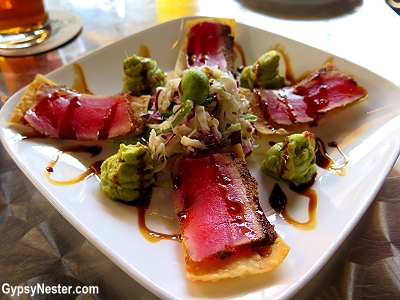
Snow crab wrapped in kadaif.
Waddling Back to Our Hotel
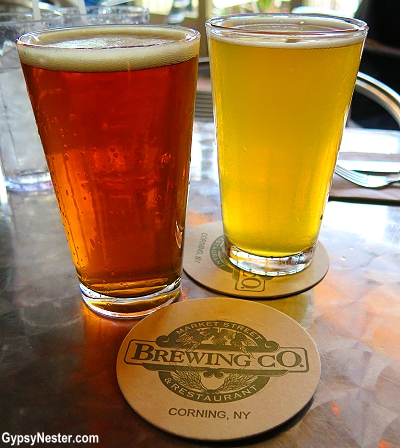
But between the lights, the food, the crowds and a couple beers, we had had about all the fun we could stand for one night.
Plus the trains stop running before midnight on a Monday, yes Dōtonbori was this crazy on a Monday.
So we wandered down a few side streets back to the station, confident that it was a good thing we were leaving in the morning or we would surely be back to live up to the old saying of kuidaore.
Ah yes, to be ruined by food. But what a way to go!
To say Heidelberg’s history goes back a long way would be sorely underselling the city that has the oldest human ever in Europe named after it.
Yup, in 1907, a jawbone of Heidelberg Man was discovered nearby and is now recognized as the earliest evidence of human life in Europe.
The early ancestor of the Neanderthals even got a fancy Latin official name with the city mentioned in it, Homo heidelbergensis.
Jump ahead a half a million years, give or take, and we arrive at the time when much more distant relatives began centuries of building a stronghold above the Neckar Valley.
For several centuries Prince Electors of the Holy Roman Empire took turns adding on to it, until the end result was Heidelberger Schloss, or Heidelberg Castle.
Then, about two hundred years ago, the princes fell from power and the castle became quite a tourist attraction.
Mark Twain even wrote about it in his 1880 book A Tramp Abroad, saying:“A ruin must be rightly situated, to be effective. This one could not have been better placed.”
We noticed that the dude on the gate was, um, quite pleased with a certain body part and thought he might be alone, but…
…apparently it was quite en vogue
Want to own a castle? Rumor has it that if you bite through this knocker on the gate – it’s yours! Our guide filled us in on the legend of the “bite mark,” left by a witch who almost won the castle.
With all of that history behind us, we had to go forward, over the moat, through the imposing gate, and into the Schloss.
We might have even said that we were getting schlossed as we crossed large central courtyard. In fact, I’m sure we did, and that was before we saw what lay beneath us in the cellar.
A Tun of Fun
The Great Heidelberg Tun, which is the world’s largest wine barrel, is kept down there.
Actually this is the forth incarnation of the castle’s giant cask, going back to 1591.
They were originally used to collect the taxes, which were paid in wine, from the local growers.
At almost twenty feet high it’s about the size of a small house.
Funny, that’s the same thing Twain said when he saw the enormous keg. The behemoth holds about 58,000 gallons of vino, enough to fill nearly a quarter of a million bottles.
Those princes must have thrown some serious parties, and it looks like they didn’t want to stray too far from the barrel when they did, because they built a dance floor on top of it.
The Best View in Town
Back upstairs, the view of the town and valley from the castle walls was impressive, and made us want to descend into the thick of it.
We decided to go all the way down to the river Neckar and work our way back up. Standing on the Alte Brücke, or Old Heidelberg Bridge, gave us the best vantage point for a view of the entire castle.
In addition to the photo-op, we got to meet the famous vanity monkey that sits at the base of the medieval Bridge Gate.
Bridge Monkeys
No one knows just how or when the tradition started, but stories of the bridge monkeys go back at least five or six hundred years.
The previous primates stood watch at the old tower, but since it was destroyed, the new guy was placed on a part of the former city wall that survived.
The old tale tells of a monkey that served to symbolize the equality between the city dwellers and their country cousins crossing the bridge. The idea was that neither side was better than the other, so be sure to look back from where you came.
The current version was created by Professor Gernot Rumpf and erected in 1979, and his peculiar simian statue is holding up a mirror while seemingly questioning the viewer. An odd poem below him states:
Why are you
gaping at me here?
Have you not seen
the old monkeys
of Heidelberg?
Look around
Maybe then you
will find more of my same.
Was thustu
mich hie angaffen?
Hastu nicht gesehen
den alten affen
zu heydelberg?
sich dich hin unnd her
Da findestu wol
Meines gleichen mehr.
Going to jail
Climbing up the hill we found that Heidelberg also has a long history as a college town.
Students from all over the world have been coming to study at Heidelberg University since 1386, making it the oldest university in Germany.
Up until the time of the First World War students were not subject to the jurisdiction of the town, so the university dealt out its own form of justice. The school prosecuted unruly behavior and punished the guilty in its own studentenkarzer, or student prison.
Over time, since college kids really haven’t changed much during the past seven or eight hundred years, doing time in the jail became something of a badge of honor for the students.
They began to decorate their cells with elaborate graffiti, at first using soot from the heaters, and later by smuggling in paint.
By the time the incarcerations ended, in 1914, many of the young scholars were intentionally breaking rules in efforts to get tossed in the pokey.
Luckily, someone had the foresight to preserve the jailbird masterpieces for posterity, making the studentenkarzer one of the most unique and enjoyable museums we have visited.
Getting a kiss
Another limb of the student body was the invention of the Heidelberg Student’s Kiss.
No doubt many of those little law breakers, as well as most of the other students, indulged in these sweet treats from time to time.
Of course, we had to try one too.
We found the little shop just off of the main square, and they are still making the delicious confections by the same family recipe that Fridolin Knösel made legendary in 1863.
In those days the university was exclusively attended by young men, and their minds would frequently wander off on to thoughts of young women.
Many of the ladies attending Heidelberg´s finishing schools frequented Café Knösel, so that of course attracted the boys.
But a watchful governess was never far away.
So, being an enterprising chocolatier and master confectioner, Fridolin invented the Heidelberg Student´s Kiss as a clandestine way for the boys to show their interest in a girl.
Simply purchase one of the chocolate covered cookie treats and deliver it to the girl of your choice.
Connection made right under the eye of the chaperone, and profit made for the shop.
Five generations later they are as popular as ever. Having tried (more than one of) the little delights, our guess would be that’s because they beat the heck out of a text message.
Whenever we check an item off of our bucket list, it seems we find two more to replace it.
Without fail someone opens our eyes to another destination that we must add to our ever growing roster of places we want to visit.
We had a passing familiarity with the island nation of Indonesia. We knew about its tropical jungles and beaches, but… CONTINUE READING >>
The following article was written by us, and sponsored by Holiday Inn Bandung. As always, all opinions are our own.
Whenever we check an item off of our bucket list, it seems we find two more to replace it. Without fail someone opens our eyes to another destination that we must add to our ever growing roster of places we want to visit. That’s exactly what happened to us the other day when we were contacted by the Holiday Inn Bandung.
Of course we had a passing familiarity with the island nation of Indonesia. We knew about its tropical jungles and beaches, but it had not really been on our radar before, so this got us to give it a much closer look.
While we are certainly fans of all the fabulous things the tropics have to offer, we especially love to break off the beaten path and explore all that a new discovery has to offer. As we looked into Bandung, on the island of Java, we found that it presents a perfect opportunity for that kind of authentic insight into Indonesia, offering a peek into real life and a step beyond the usual tourist stop.
Best of all, even though it’s a little out of the way it is easy to get to. There are thirty trains a day running back and forth from Jakarta to Bandung through beautiful mountain scenery. That alone got David’s interest. Just say the word train and he’s ready to go.
The city sits half a mile above sea level surrounded by peaks nearly twice that high, which means the days are warm, but not hot, and evenings stay cool year ‘round. That’s our kind of weather, highs in the low eighties and nights in the mid-sixties no matter what the calendar says.
Centuries ago the Dutch East India Company discovered that this was an ideal climate for growing tea and established plantations along the hillsides surrounding the town. Vast fields remain and the success of the era is recollected in the notable colonial tropical Art Deco architecture still seen throughout the city.
One thing that always gets our attention is food, and Bandung has really embraced their foodie side. Recently several areas have been named Culinary Streets, where traditional dishes like Mie Ayam (a noodle soup), Basreng (spicy fried meatballs), Martabak (fried stuffed pancakes), and Nasi Timbel (rice cooked in a banana leaf) can all be found.
Our investigation also revealed that one of our all-time favorite street foods, Satay, originated on the island of Java. The skewers of charcoal grilled spiced meat goodness have become a staple of street fairs and festivals around the world and we would love to try the original.
Speaking of street fairs, every Saturday night along the main road in front of the Holiday Inn an impromptu street fair is known to break out with food, music, and street performers. When the party is over this is Bandung’s top shopping area packed with shops, factory outlets, and restaurants.
That same road leads up the mountain where panoramic views of the city and some of the best cuisine in town await. Travel a little farther and the town of Lembang is a favorite for a day trip or an overnight stay. Visitors can enjoy hiking trails, hot springs, and the Tangkuban Perahu volcanic crater.
With all of those activities to keep us running, we were glad to find out that the hotel can relax away any aches and pains with a peaceful Indonesian massage at the Tea Tree Spa. There is so much to see and do, still we can’t get away with all play and no work, so we were also glad to see that free Wi-Fi is available in all of the rooms.
Now all that’s left is to book the trip.
Your GypsyNesters hit the Lowcountry!
Join us as we learn about the colorful culture and delicious cuisine of the wonderful Gullah people. Stranded on the Sea Islands after slavery ended, the Gullah founded their own language and made their own way under harsh circumstances… CONTINUE READING >>
Before arriving in the Lowcountry of South Carolina, we had never even heard the word Gullah, but now, with our curiosity piqued about Gullah history and society, we set about googling with a vengeance.
We searched for articles on anything and everything Gullah, background, historical sites, language and, oh yeah, food.
The first thing we tend to look for when exploring a new region or culture is the food. It’s not just that we like to eat, although we do, but foods give an unique insight into how and where people live.
Discovering Real-deal Food
A short drive down the Sweetgrass Basket Maker Highway, a stretch of U.S. Highway 17 lined with little makeshift booths where Gullah women make and sell traditional sweetgrass baskets, would lead us to Gullah Cuisine.
According to our newfangled technology, this restaurant is said to have the best authentic Gullah grub in the area. Lucky for us, it was right about dinner time.
The menu features classic Gullah dishes like She Crab Soup, Hoppin’ John, fried okra, okra gumbo, shrimp & grits and Gullah rice.
With no idea what to expect, we ordered up some She Crab and a gumbo, to see how this compared to Louisiana Creole cooking.
The soup is like a cross between a bisque and a chowder, made with blue crab, cream, dry sherry and crab roe – the roe puts the “she” in the She Crab.
The gumbo was similar to the Louisiana variety but with a little less heat in the spices.
Next we went with the Gullah rice and a sampler plate of Hoppin’ John, fried okra and collards.
Gullah rice is a close cousin to jambalaya, with sausage, chicken and shrimp jazzing up the seasoned rice.
Gullah seasoning employs some of the usual suspects; garlic, pepper, onion, salt, bay leaf and paprika, but then mustard, mace, cinnamon and ginger jump in and give the tastebuds a completely different, and slightly sweet twist.
These flavors were also present in the gumbo and the Hoppin’ John, the Gullah version of beans and rice, using field peas in place of beans.
At the end of our meal, Charlotte Jenkins, the chef and owner, came out to greet us. To help answer our questions, she brought out a copy of her book, Gullah Cuisine: By Land and By Sea, and allowed us to browse through it at our leisure.
Her stories of growing up in the Lowcountry are fascinating and her recipes come from the experience of cooking Gullah foods passed down through generations.
It is so much more than a mere cookbook.
With the culinary component of our research complete, we were ready to venture out to the Sea Islands to learn more about Gullah history. These one hundred or so islands along the coast of Georgia and South Carolina became home to thousands of enslaved Africans.
Once it was discovered that rice could be grown, slaves were stolen from the West African rice-growing regions.
Generally left alone due to these islands’ inaccessibility and the plantation owners fear of malaria, much of the Gullah people’s African culture remained intact.
They became known as Gullah, perhaps from the word Angola or the Gola people of West Africa.
In our Google frenzy we discovered that we hit the area in time for the Annual Hilton Head Island Gullah Celebration.
Hilton Head is only a few hours drive from Charleston, but we had a couple days leeway, so we had a chance to mosey through the heart of the Gullah Sea Islands.
St. Helena Island, South Carolina just might be that heart.
Two of the area’s most renown landmarks are on this island. Only a couple of dozen miles from Charleston as the crow flies, we drove over fifty miles to get there because of the bays, rivers and marshland.
Once on the island, we proceeded down Lands End Road to the Penn Center.
In 1862 philanthropists, abolitionists, and missionaries from Pennsylvania opened the Penn School to educate the Sea Island slaves who were freed at the beginning of the Civil War.
The Center operated as a school for nearly one hundred years before shifting its focus to other services such as child care and health training.
Today the Center is focused on preserving the unique culture of the Sea Islands through the History and Culture Program, the Land Use and Environmental Education Program and the Program for Academic and Cultural Enrichment.
A Haunting Chapel
Just down the road from the Center, through a thick growth of live oaks so heavily draped with Spanish moss that they darkened the afternoon sky, we came upon The Chapel of Ease.
Chapels of ease were built by the plantation owners because churches in the cities were too far away.
Less travel, more ease. This particular example dates back to the 1740s.
We pulled off the road to meander through the haunting, roofless structure and adjoining cemetery.
Upon closer inspection, we found the walls of the chapel filled with oyster shells.
The material used, called tabby, employed the local ingredients of lime, water, sand, oyster shells, and ash.
The shells were plentiful and, judging by how sturdy these 270-year-old walls still are, made a pretty good version of concrete.
Off to one side of the chapel we found several unkempt graves and an open, empty mausoleum.
Many of the headstones bear the name Fripp, one of the island’s most prominent families before the Civil War.
Peeking in to the broken entrance of the crypt, we got a pretty creepy feeling gazing down at the empty tomb, formerly occupied by Edgar and Eliza Fripp.
Turns out that there are a couple ghost stories that circulate in these parts.
One involves the mausoleum, which was broken into and raided by Union soldiers.
When repairs were made, the next morning the bricks had all been removed again and neatly stacked next to the broken entrance.
Local authorities assured everyone that no one had been allowed near the cemetery that night so naturally supernatural forces were suspected.
The other spooky legend has a eerie orb of light traveling down Lands End Road after dusk on many nights.
We didn’t learn about this phenomenon until after our visit, but with the way the oaks and moss closed in even in the daylight, it must get crazy dark when the sun goes down and we might have believed anything.
Since we didn’t see it, we’re going to go with that good old catch-all explanation, swamp gas… perhaps from some shrimp and grits.
Anyway, we had a good excuse to keep moving, the Gullah Celebration was awaiting us.
Celebrating Heritage
The day for our visit to the Annual Hilton Head Island Gullah Celebration dawned blustery and rain soaked, but we were not to be deterred.
We drove through the precipitation to the prescribed point, only to find that the Freedom Day Parade was not only deterred, but detoured, deferred, delayed, diverted, disassembled, and finally postponed.
Disappointed but undaunted, we slogged through a soggy parking lot into the old schoolhouse across the street from the Historic St. James Baptist Church for the Ol’ Fashion Gullah Breakfast.
These schoolhouses were built throughout the Sea Islands to serve the Gullah people, who have a proud tradition of education dating back to the founding of the Penn Center in 1862.
Outside, a tent had been set up to serve as a kitchen, De Gullah Ooman (woman) Kitchen, with plates being passed back and forth through a side door.
As we have learned in our travels, people eat what is regionally available, so breakfast on the Sea Islands means a plate of fried fish, shrimp & grits and stewed oysters.
Not what many folks would consider breakfast foods perhaps, but mighty good eating anytime of day.
With the parade postponed, we had plenty of time to linger and chat about history and folklore with many of our fellow breakfasters, including a ghost story from local Lowcountry columnist Ervena Faulkner.
Although she has not seen the spirit herself, she knows some who have witnessed the light of a beheaded lost lover desperately trying to return to his love.
When not spinning yarns, Ervena writes a food and lifestyle column for The Island Packet.
The next event, a film “Remnants of Mitchelville” and a presentation about the Mitchelville Preservation Project, was held across the road in the St. James Church. Founded in 1886, this church is one of the few remaining ties to Mitchelville.
In 1861, during the Civil War, when Union troops landed on Hilton Head Island the plantation owners fled, leaving the slaves behind.
Considered “contraband,” as slaves were not yet free in America, the Union faced a dilemma.
Were the Gullah people slaves or freedmen?
In 1862, a year before the Emancipation Proclamation was issued, the slaves of the Sea Islands were freed by military order. Major General Ormsby M. Mitchel suggested a town be built for the new freedmen.
The first compulsory education laws in the state of South Carolina were enacted in Mitchelville.
Most of the residents worked as contract labor for the military, so the end of the war brought hardship.
The town diminished through time, but survived for several decades with residents who raised subsistence crops and fished.
By the time the Great Depression rolled in, Mitchelville had disappeared.
All of the original buildings were wooden structures and the town has been completely lost.
The Mitchelville Preservation Project is working hard to bring it back.
The plans for The Historic Mitchelville Freedom Park include a recreation of the first Freedman’s Village, as well as a memorial to commemorate the Gullah people’s “experiment in freedom” and a Welcome Center / Pavilion for exhibits and special events.
Worthy goals for bringing attention to this often overlooked episode in American history.
Delving Deeper
In our conversations that morning, the Gullah Heritage Trail Tour came up again and again – a tour of the island led by guides who have lived in the community their entire lives.
With all of the high praise, it seemed the perfect way to complete our Gullah experience.
So we bid adieu to the church and headed to the Coastal Discovery Museum to meet up with the tour.
While we waited, we browsed the museum’s displays of vibrant works by Gullah artists and sweetgrass baskets along with several botanical and sea-life exhibits. Within minutes, we were introduced to our guide, Irvin Campbell.
Mr. Campbell is a fourth generation Gullah Hilton Head descendant so he really knows the island firsthand.
He began with a little background on the Gullah language. Still spoken by about a quarter million people along this coast, almost all Gullah are bilingual, speaking English as well.
Once considered just a dialect of English, more recent studies have deemed it a unique language. The roots come from the native languages of the enslaved Africans brought here, mixed with English. This makes for some recognizable words, but the overall effect is a wholly distinct language.
For example, “Cuz dis ya sum fa eat, ga mek hunnah knock hunnah mammy.” meaning “Don’t sit next to your mother while you eat.” had been written on our breakfast menus the other morning.
Not something we could have figured out without help.
Perhaps the best known example of the Gullah language is the song “Kumbayah,” which is Gullah for “Come By Here.”
With our language lesson learned, it was time to see the island. As Mr. Campbell drove us around, he gave us details about not just the area, but the lifestyle.
“We used to fish over there,” or “My cousin’s family lives there” was an ongoing banter as we went along. He personally knew so many of the people and places we passed by, it was like having an old friend show us around. He told stories of the fields and beaches where he played as a child, now filled with condos and hotels.
Change came very slowly to Hilton Head because there was no electricity until 1951 and no bridge to the mainland until 1956.
But once the connections to the outside world were made, the pace picked up drastically. Within ten years resorts had sprung up all over the island and land speculating ran rampant.
As property values skyrocketed, families that had lived on the land for generations had to sell just to pay taxes on the new values.
The amount of land owned by Gullah families dwindled to a tiny portion of the island, but a few of the families have held on by renting out parcels or building their own developments.
After the tour and our conversations with Mr. Campbell, we realized that it would be easy to visit Hilton Head and never get an feel for its rich history.
The island has been completely transformed into a golf, shopping and beachhouse playland.
Hopefully the Mitchelville Preservation Project can bring a more visible reminder to visitors and residents alike.
We had just purchased our first motorhome, a beat-up old guy we named BAMF (as in Bad Ass MoFo), on eBay for $3,000. What could possibly go wrong?
We found out on day one:
BAMF
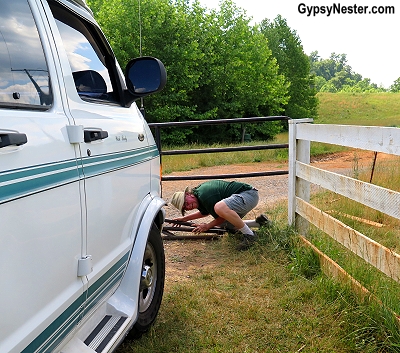
David was dealing with the outside stuff—replacing screws, tightening belts, and talking to mechanics. He would slide out from under our new rolling house covered in grease, grime, blood, and the waterproof caulk he was using to seal everything in his path. He was in hog heaven.
I was relieved that he was happy outside, where his bull-in-a-china-shop tendencies would do less harm.
But not for long.
We had ownership of our new toy just one day when the bull charged inside and broke the main overhead light fixture with a broom handle. It wasn’t a major deal, nothing that a skillfully placed dab of superglue couldn’t fix, and I am a master supergluer.
So we agreed that I would run over to the store for some glue while David promised to confine his work to the exterior of the RV. That way I could get the fixture fixed and things more organized indoors before the bull stampeded again. No telling what other broom handle–like destructive implements could be lurking about.
I believe that David’s tendency to break things and injure himself is not because he is clumsy. He’s not. My theory is that it stems from the way he grew so tall, so fast, as a child. He never quite figured out his proportion to the world around him.
According to family lore, when he was in his thirteenth year, he was so skinny that his hands looked like olives on the end of toothpicks. It’s a challenge to overcome dimensions like that.
Back from my errand, with a sack of hardware goodies in hand, I opened the RV door to find David standing in the middle of the kitchen area, messing with the overhead light fixture. To add a little spice to the mix, the light was on. The man will never learn about electricity.
“I found some superglue.”
“I thought we agreed I would fix that.”
“But I found some glue, so I figured . . .”
“Well, turn the light off. You’re going to electrocute yourself.”
“I can’t.”
“Will you please just go outside?” I was trying really hard to keep my cool.
“I can’t.”
“Dammit! Stop saying you can’t and just go outside!”
“I can’t.”
“Why not?!”
That was when I noticed the shreds of paper towel attached to his free hand and a few tatters clinging around the corners of his mouth.
His other hand was space-age-polymer-bonded to the overhead light fixture, which was now permanently secured in the ON position.
Luckily, we eventually pried David off the ceiling and found the gumption to take the show on the road!
Why should kids in school be the only ones to get a break at this time of year?
We can’t think of a reason not to make a break of our own. After the grey and cold of the last few months we should go someplace sunny, fun, and tropical, but not too far away. That sounds like… CONTINUE READING > >
The following article was written by me on behalf of Choice Hotels and I was paid to write this post. However, the opinions are entirely my own.
Why should kids in school be the only ones to get a break at this time of year? We can’t think of a reason not to make a break of our own. After the grey and cold of the last few months we should go someplace sunny, fun, and tropical, but not too far away. That sounds like the Caribbean, of course!
Through the years we have had the opportunity to visit many of the islands, so we decided to investigate some new destinations. We began by looking just a few hundred miles south of Miami and found the Cayman Islands, some of the closest to the US.
We discovered an escape where colonial British charm mixes with a laidback tropical personality, making for a quick getaway that leaves the daily grind a million miles away. Days filled with diving, snorkeling, sailing, or simply sunbathing, followed by evenings toasting the sunset and enjoying international cuisine or a BBQ on the beach.
On Grand Cayman, Seven Mile Beach is the place to be for watersports and fun in the sun, as well as after-dark dining options, and the Comfort Suites® Seven Mile Beach hotel is right there. A perfect spot to unwind and let stress drift away by the pool, or better yet, in the whirlpool. Still, we might want to touch base with the real world from time to time, so free WiFi is always appreciated.
Looking a little farther south, we came upon the contrasting styles of Aruba and Curacao. Along with Bonaire, these islands are known as the ABC Islands, and although they sit only a few miles off of the South American coast, they are Dutch territory.
Unlike most Caribbean islands, Aruba and Curacao are quite arid, with cactus being more common than palm trees. This means it is almost always sunny. No April showers here, and that’s just what we’re looking for in a spring break… am I right?
The landscape is often compared to the American Southwest, but that’s not why Aruba is known as the Las Vegas of the Caribbean. Legend has it that this is where Caribbean Stud Poker was first played back in the ‘80s. Now over a dozen casinos line the stretch of beach along the northwest shore of the island and the La Cabana Beach Resort and Casino, an Ascend Hotel Collection® member, sits in the middle of them all.
But the casino doesn’t have the only games at La Cabana, we can choose from tennis, racquetball, basketball, volleyball or squash, and then nurse any sore muscles at the spa or step out the front door onto miles of white sand beach. We might never want to leave the resort, except that there’s wildlife right next door.
The Bubali Bird Sanctuary, a breeding ground for over eighty species of migratory birds, is just a few steps away. If we climb the observation tower for a birds’ eye view (ba dum ching!) we might see herons, egrets, coots, cormorants, and even the rare native Brown-throated Parakeet.
Aruba’s nearby neighbor, Curacao, is every bit as inviting, with a more laid back feel and a definite dash of Holland. The island’s connection to its Dutch heritage is distinctively apparent. Rows of buildings that look straight out of Amsterdam, except for their vibrant tropical pastel paint jobs, line the streets in the capital city of Willemstad.
The town was built around a natural deep water harbor that served as a favorite of pirates and traders for centuries. Willemstad remains the center of activity for Curacao, and the Acoya Hotel Suites & Villas, an Ascend Hotel Collection® member, is right in the heart of it. As much as we love an infinity pool with a poolside restaurant and bar, we are even more excited to find a great home base for exploring.
When the Dutch West India Company arrived in 1634, they built a series of eight forts to fend off the buccaneers as well as foreign powers. The main one, Fort Amsterdam, sits at the mouth of the harbor and is still in use today as the county’s capitol building. Five of the others can be found in various states of repair around the island.
Curacao is also home to two National Parks. They cover most of the north quarter of the island with Christoffel Park featuring historic sites such as three former plantations from the time of the Dutch growers, and the Boca Grandi cave paintings left by the Arawak Indians who originally inhabited these islands.
The adjacent Shete Boka National Park is all about the natural beauty of the sea shore. The name means seven inlets, and these coves are not only picturesque, they are a nesting area for three species of turtles. Nearby Playa Lagun is a perfect place to jump in the crystal clear Caribbean water and see myriads of colorful tropical fish, and maybe some of those turtles grownup.
Now that’s a break that will put the spring back in our step.