Paris is truly a magnificent city. It has a lot to offer, and it’s a perfect way to experience the French way of life and their culture. But if you’re going to be visiting it, it’s crucial that you plan well… CONTINUE READING >>
Paris is truly a magnificent city. It has a lot to offer, and it’s a perfect way to experience the French way of life and their culture. It’s a massive city and one that’s expensive, too, and if you’re going to be visiting it, it’s crucial that you plan well.
That being said, there are a couple of crucial things that you’ll want to keep in mind before you head to this French paradise. We’ll talk about them below, and you’ll be able to enjoy your stay in Paris without a worry in the world.
A Bit of Language Knowledge Won’t Hurt
You actually don’t need to be fluent in French if you want to talk to the locals in Paris. However, it does make a massive difference if you know the basics. Therefore, some French lessons won’t hurt. Make sure you know all the basic phrases, the ones you use in your everyday life and try to learn as much as possible if you want a smooth experience.
The thing with the locals is that most of them actually speak pretty good English, but they don’t want you to know that. If you start speaking English with a French person, there’s a very big chance that they will pretend they don’t know English, at all. However, if you start speaking French, they won’t mind switching into English.
Figuring Out Accommodation Can Be Finnicky
One thing that people love about Paris is the variety it offers. It’s organized in neighborhoods, known as arrondissements, and all of them will have plenty of accommodation options. From hotels to private Airbnb accommodation, you can pick and choose whatever you want.
For example, if you want high-end shops and genuine Parisian charm, the Saint-Germain neighborhood is right for you. If you want to be in the center, and close to all the tourist attractions, the first, second, third and fourth arrondissements are perfect. And if you want to experience the artsy Paris, the 18th arrondissement near Montmartre is unparalleled.
Get Ready to Walk, a Lot
Even though there is ample public transportation, the absolute best way to enjoy Paris is to stroll through it. Getting lost is incredibly difficult. There are 20 arrondissements, and there isn’t a street sign in the city that doesn’t tell you which one you’re in.
The neighborhoods are actually organized in the shape of a snail, but counterclockwise. If you find the first one on a map, you can count to 20 when moving your finger in a circular, counterclockwise motion, to see where the rest are.
If, however, you have a reason to avoid walking, you can always resort to the metro system in Paris. It’s very simple, and it’s actually a great way to get from one place to another. There are more than 15 lines that connect the city’s underground area, and five larger lines that head out to the suburbs that surround the city. And if you’re there for a week, for a tad over 22 euros you can get a weekly pass. Just remember, the doors open by lifting the lever, not automatically. Oh, and note that the metro doesn’t work 24/7.
There’s a Market Every Day
No, we aren’t overstating things. There really is a market every day. You can get the largest array of them on Saturdays and Sundays, but there are smaller markets that have produce, and they’re open seven days a week. You can find them all over the city. Some more popular options include Place d’Aligre, Belleville and Bastille.
Keep a Bit of Cash
While most of the places you’ll be visiting, such as supermarkets or restaurants, will accept a card, it’s not a bad idea to keep a few euros in your pocket. This is especially useful when you’re visiting the markets we just spoke about, as well as when you need to make an unexpected stop in a bakery.
Eye Contact Is a Thing
This might freak you out at first, especially if where you come from this isn’t common. But people will make intense eye contact with you in Paris, and it’s going to happen to you a lot. They’ll also hold that eye contact for an uncomfortably long time. What should you do? Do it, too.
Forget About Grabbing a Cab to the Airport
Whether it’s when you’re arriving, or when you’re leaving Paris, it might be tempting to avoid public transportation and grab a taxi to the airport. However, that’s going to be a costly luxury, as it may end up costing you more than $50. You could grab a metro for about 10 euros, or if you have a weekly metro pass, go to Denfert-Rochereau and grab the airport bus. Thank us later.
We are happy to present this collaborative post to offer valuable information to our readers.
With thousands of medical conferences for professionals and paraprofessionals around the world each year, the hardest part is choosing the best one to attend. Here are the top conferences in the U.S. and around the world in the first few months of 2020… CONTINUE READING >>
With thousands of medical conferences for professionals and paraprofessionals around the world each year, the hardest part is choosing the best one to attend. From emergency medical services to primary care, here are the top conferences in the U.S. and around the world in the first few months of 2020. All conferences include keynote presentations, oral talks, poster presentations, workshops, and exhibitions.
January 2020-National Association of Emergency Medical Services Physicians
Emergency room physicians can learn the latest medical updates and complete continuing education requirements at the annual meeting at the Manchester Grand Hyatt in San Diego from January 6-11. The conference is open to physicians, medical professionals, residents, fellows, students, and international physicians. Open sessions include,
•EMS Quality Improvement and Safety Workshop •EMS Medical Directors Advanced Hazmat Life Support for Tox-Medics •All Things Airway: Airway Management in the Fresh Cadaver
February 2020-Pediatrics for Primary Care
Head to the Walt Disney World’s Grand Floridian Resort & Spa from February 17-22 for the Pediatrics for Primary Care Conference. The convention is intended to provide primary care providers with up-to-date information about common issues in pediatrics and upon completion, physicians will have a better understanding of how to diagnose and treat these conditions. Conference topics include,
•Does My Patient Need Surgery? •The Disney Phenomena: Challenging Cases and Updates in Pediatric Immunizations •Infants Behaving Badly •Diagnostic Dilemmas
March 2020-Diagnostic Imaging Update on Maui
For the best radiology conferences, head to Maui in March and attend the conference by the Center for Promotion and Education in Personalized Medicine at the Hyatt Regency from March 23-26. The conference is jointly hosted by CME Science and Postgraduate Institute for Medicine. Session options include,
•Lung Cancer Screening Update 2020 with speaker Ann Leung, MD •MRI Hip Updates and New Concepts with speaker Geoff Riley, MD •Primary Malignant Liver Tumors with speaker Keitarou Sofue, MD
April 2020-12th World Congress on Precision and Personalized Medicine in Bangkok
Leave the U.S. behind and head to Bangkok, Thailand, from April 6-7 for the 12th World Congress on Precision and Personalized Medicine Conference. It welcomes pathologists, clinical geneticists, cytogenetic diagnosticians, cardiologists, and many other professionals to advance precision and personalized medicine around the world. Available sessions include,
•Precision Pathology •Drug Target Discovery and Integration •Preventive Medicine & Public Health •Precision Immunotherapy
May 2020-4th International Conference on Gynecology and Obstetrics Pathology
Head to another foreign destination for the 4th International Conference on Gynecology and Obstetrics Pathology in Munich, Germany, from May 11-12. The annual theme is “Exploring the New Research and Development to Uplift Women-Baby Health.” The world-class conference is designed to provide the latest research in the field of gynecologic and obstetric pathology for infertility, reproductive medicine, assisted contraception for gynecologists, obstetricians, nurses, midwives, pathologists, and other medical professionals. Tracks available at the conferences include,
•Gynecology and Obstetrics Pathology •Polycystic Ovary Syndrome (PCOS) •Pre and Post Partum Care •Ultrasound and Genetics
June 2020-Primary Care Update: Cardiology, Geriatrics, and Pharmacology
Consider the primary care conference from June 26-28 at the Westin Seattle in Washington State, designed for primary care providers regarding common cardiology, geriatrics, and pharmacology matters found in primary care. Upon completion, providers will understand the diagnosing criteria, treatment, and prescribing guidelines for the best outcomes.
Topics the conference will cover includes,
•Truth or AFib: The Truth about Afib • Guide Me! A Practice Overview of Cardiology Guidelines and Impact on Primary Care Medicine •Motivational Interviewing •Exercise-The Medicine of Choice
July 2020-International Conference on Eye Surgery
Held from July 13-14 in Helsinki, Finland, the International Conference on Eye Surgery’s 2020 theme is, “The Thinking Eye . . . The Seeing Brain” and will focus on the latest developments for treating ophthalmology diseases. Tracks at the conference include,
•Clinical and Surgical Ophthalmology •Pediatric Ophthalmology •Glaucoma •Neuro-Ophthalmology
August 2020-Office Orthopedics and Sports Medicine for Primary Care
Attend the Office Orthopedics and Sports Medicine for Primary Care Conference in Colorado Springs, Colorado, at the Broadmoor from August 7-9. It will cover primary care physicians’ role in orthopedics and sports medicine injuries and treatment options and is open to a wide range of medical professionals. Topics the conference will cover includes,
•Overuse Injuries in the Young Athlete •Evaluation and Care of Common Shoulder Problems •Back to Basics: The Diagnosis and Management of Low Back Pain
These are just a few of the top medical conferences throughout the globe in 2020. Depending on your budget and availability, choose from one or more of these gatherings of professionals to expand your knowledge, network, and future career opportunities while completing your continuing education requirements.
We are happy to present this collaborative post to offer valuable information to our readers.
This could be the most festive way we have ever experienced to celebrate the season. Join us on a day by day account of a holiday cruise along the Danube. The cheer factor was off the charts! CONTINUE READING >>
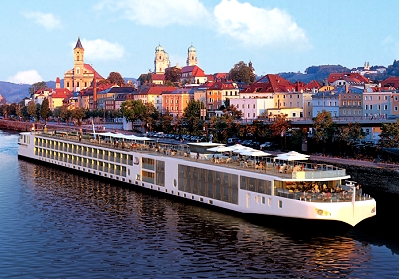
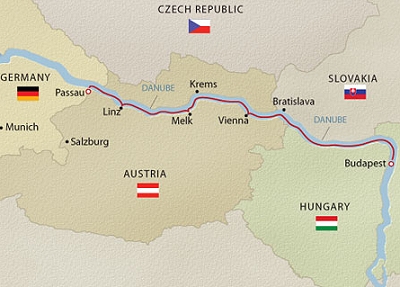
This could be the most festive way we have ever experienced to celebrate the season. Join us on a day by day account of a holiday cruise along the Danube. The cheer factor was off the charts!
We’re excited to bring you along on our waltz down the Danube as we visit the Christmas markets of Hungary, Slovakia, Austria, and Germany.
Our journey takes us to four UNESCO World Heritage Sites, ensuring immersion into the grand history of the area.
We will be sure to pay special attention to the unique culture and customs surrounding the holiday along the River Danube, including gingerbread making, mulled wine sampling and, of course, the wares of the Christmas markets.
Day One: Arriving in Budapest and Meeting Skadi
Afternoon: Beam me up Skadi
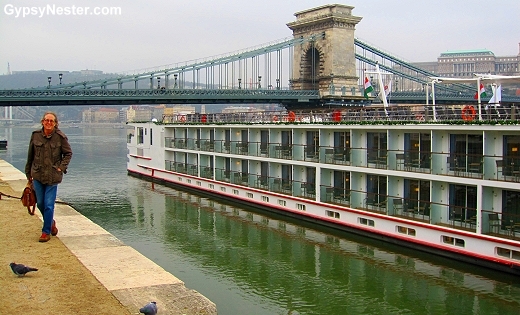
We catch our first glimpse of our home for the next eight days. We’re docked right under Budapest’s famed Chain Bridge!
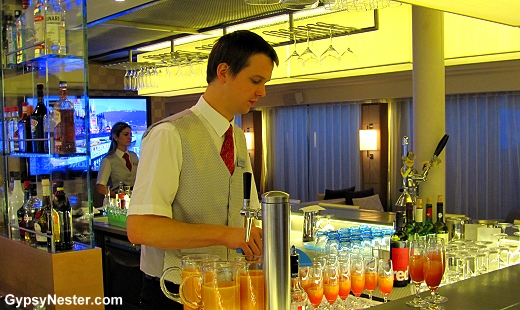
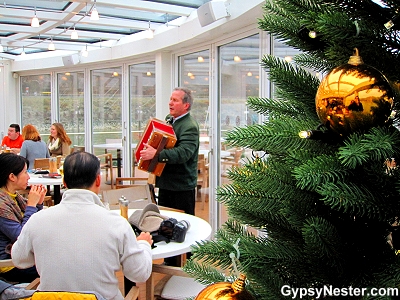
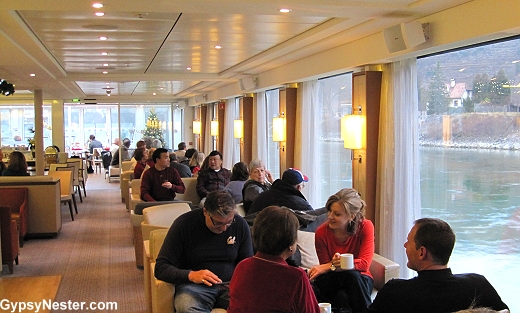
We are treated to a welcome drink in the beautiful lounge upon boarding
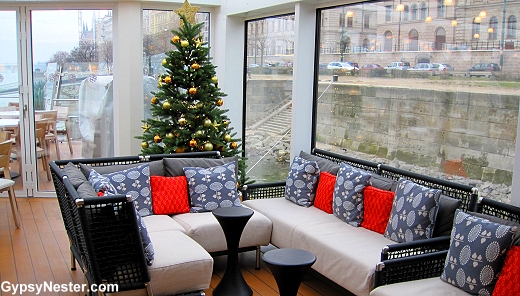
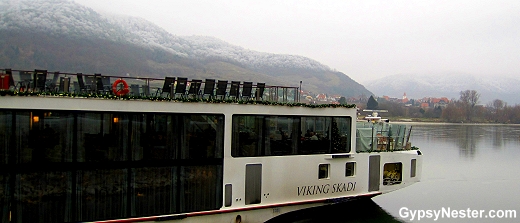
Skadi all dolled up for Christmas. Look at the windows – the entire ship is like this!
Welcome to our stateroom!
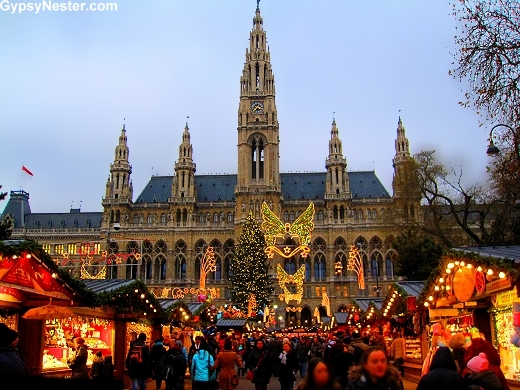
Evening: Budapest’s Christmas Market
Our Christmastime tour of the Danube begins in Budapest. At two million people, the Hungarian capital is the largest city we will see on this journey, in fact it is the biggest city on the entire river.
After checking in on the ship and stowing our gear, we head into the heart of the city to check out the first of several Christmas Markets we plan to visit over the next few days.
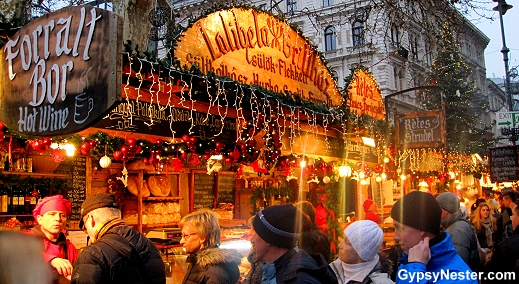
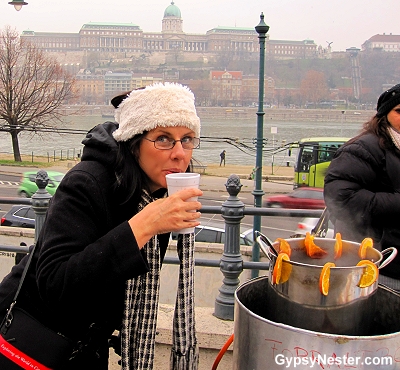
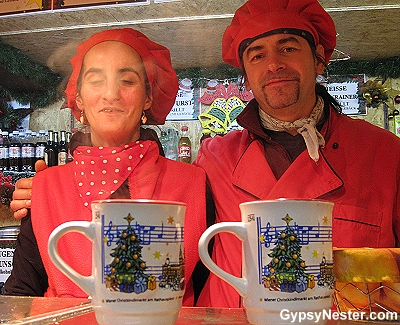
First things first, a cup of steaming hot Glühwein to warm our bodies and souls.
German for “glow-wine,” not because of the warm glow it gives a body, but from the hot irons used for mulling in days gone by.
The Hungarian version of hot mulled wine is called forralt bor, meaning simply “boiled wine.”
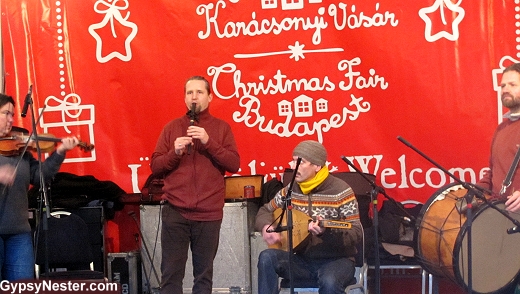
The market is teaming with activity, booths selling handcrafted gifts, and food, lots of food!
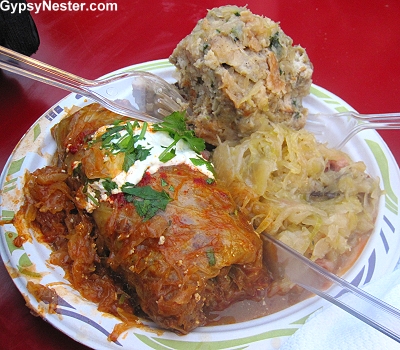
After checking all the offerings we order a töltött káposzta, cabbage stuffed with meat and rice and served with a paprika sauce and sour cream. Exceedingly Hungarian! We also couldn’t resist a huge smoked meat dumpling with sauerkraut.
Best jet-lag cure, total immersion into the local food and customs.
Day Two: Discovering Buda AND Pest (you think we’re kidding, but we’re not!)
Morning: Buda
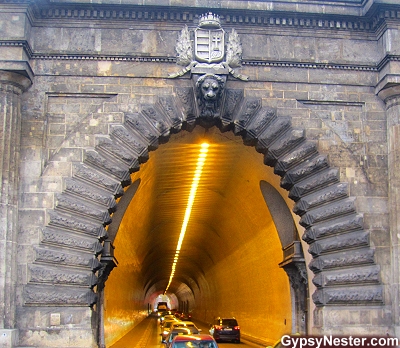
Tunneling through the old city wall of Buda
Buda and Pest. Until 1873 these were separate cities with The Danube dividing them.
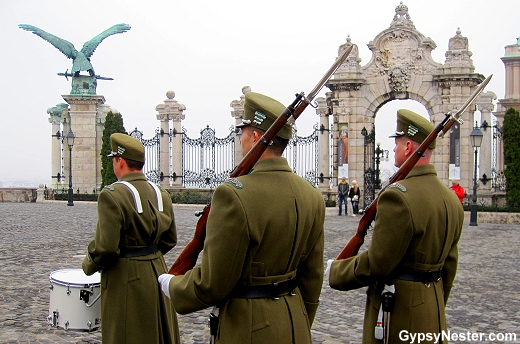
With just one day to attempt to see as much of both as we possibly can, we begin on the Buda side in the neighborhood around the old castle and royal palace.
Buda has been the spot for rulers and royals for nearly 700 years. These days the president lives up here as opposed to a king.
The Changing of the Guard
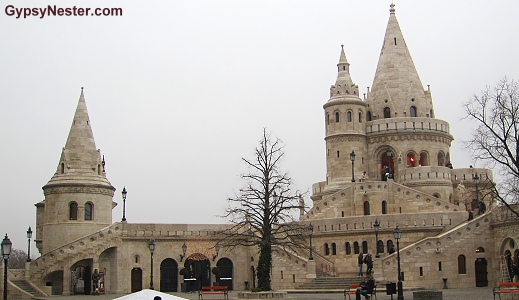
Looking up at Fisherman’s Bastion
On top of the ancient walls of the city, a bastion of seven lookout towers was constructed in 1905.
No longer needed for defense, it is instead a tribute to the seven tribes that established Hungary over a thousand years ago.
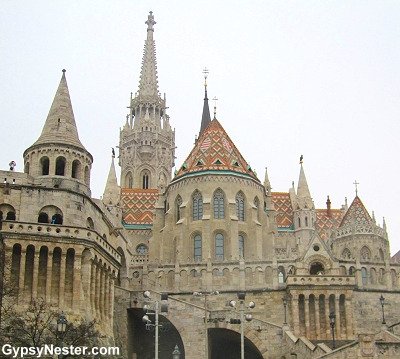
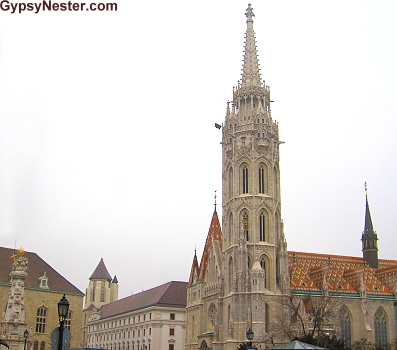
Within the bastion, Matthias Church serves as the second most important church in Budapest.
It is built in a Byzantine style to reflect the eastern heritage of the Hungarian people.
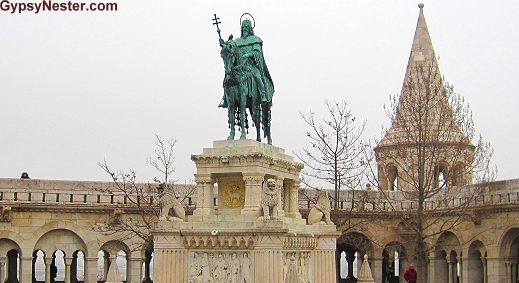
The fortifications also surround a statue of King/Saint Stephen, who was crowned in the year 1000 and brought Christianity to Hungary. The church in his honor is on The Pest side of the river and serves as the main cathedral for the unified city.
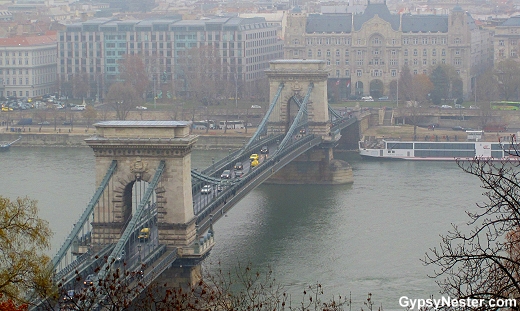
Having spent the morning in Buda, we cross over to Pest on the famous Chain Bridge, one of eight spans that connect the two old cities to make the new Budapest.
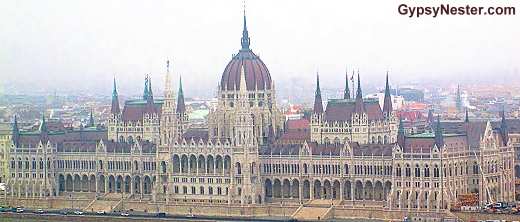
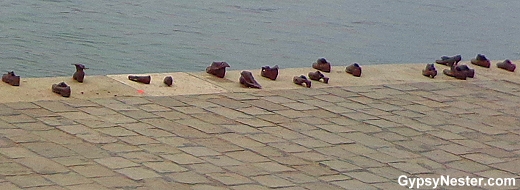
Along the river we pass the Parliament House, and just in front of it The Shoes on the Danube, a memorial to the Jewish people who perished during World War II. Victims were lined up on the river bank so the current would carry their bodies away. They were ordered to remove their shoes first because it was believed that they were too valuable. Very moving.
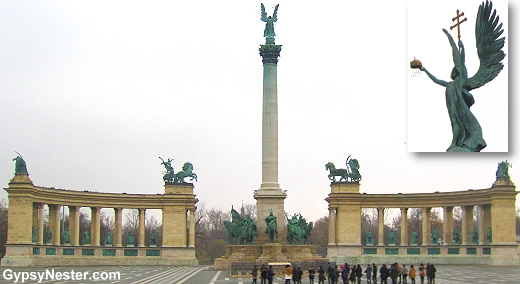
Hősök tere, Heroes’ Square, is the city’s main plaza dominated by the Millennium Monument. The monument was built in 1896 to commemorate the thousandth anniversary of the founding of Hungary in the late 9th century. Statues of the leaders of the seven tribes that came here from Asia are depicted around the main column topped by the archangel Gabriel holding a replica of the royal crown.
Later in the Afternoon: Climbing to the top of Budapest and being handy
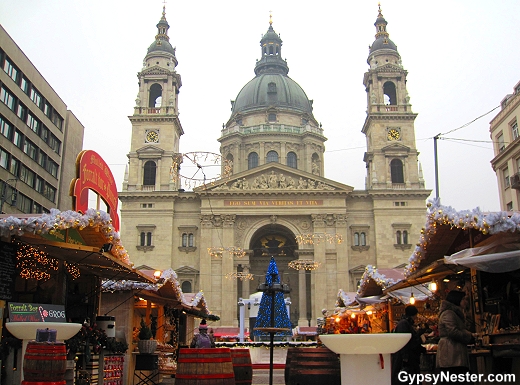
The Christmas Market in front of St. Stephen’s Basilica
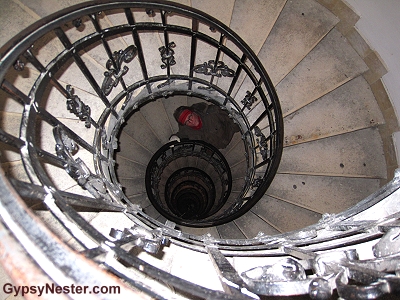
Szent István Bazilika, St. Stephen’s Basilica, serves as the main church for Budapest. Without really knowing what to expect, we buy tickets to go up in the tower. Climbing the seemingly endless stairs, we’re just sure there must be something really good at the top. Three hundred feet up we’re not disappointed.
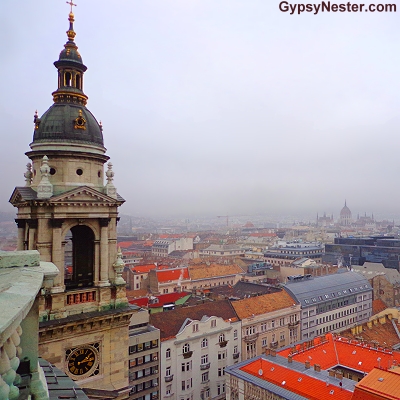
The Parliament Dome is off in the distance in the fog
From the top of the cathedral dome we get a 360 degree panoramic view of the entire city. It certainly seems to be the highest spot in town, then we learn that the dome on the parliament building is the exact same height.
This was done intentionally, to show the equality of political and religious power. By law, no building can be erected higher than the ninety-six meters of these two domes.
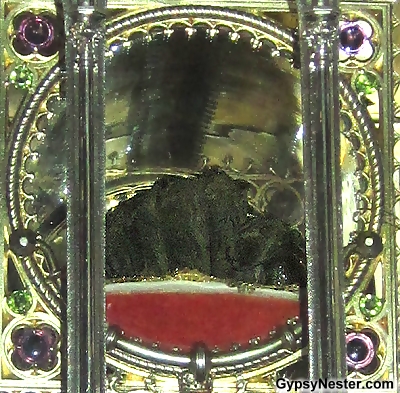
Inside the basilica, the king who became the patron saint of Hungary is honored in several ways, including a display of his right hand.
Yes, the one thousand year old mummified hand of Saint Stephen is kept in a glass case in a small chapel at the back of the church!
Evening: Getting goulash and a tiny little run-in with a policeman!
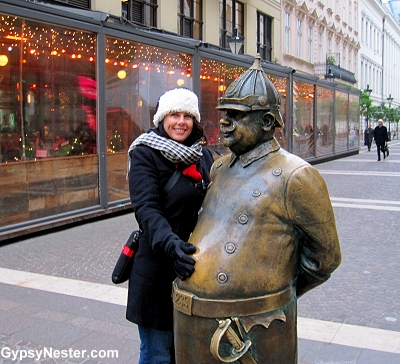
A block or two from the basilica on Zrínyi utca we met this bronze Hungarian policeman from the early 1900s.
Veronica seems to think his belly needs a pat.
Making our way back toward Skadi we stop to warm up with some hot soup.
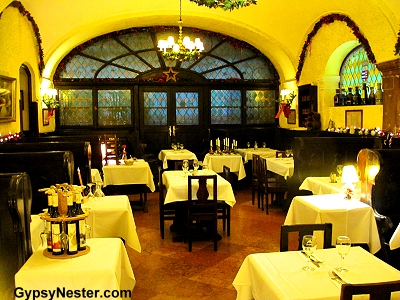
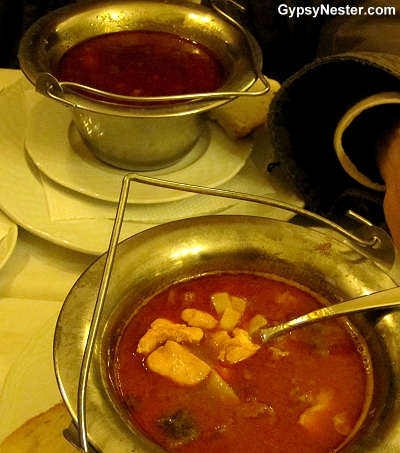
Goulash and fish soup are both classic, typical Hungarian dishes, and what better place to try them the the self-proclaimed oldest restaurant in Budapest?
The name 100 Éves Etterem, One Hundred Years Old Restaurant, doesn’t really tell the story since it was adopted in the 1930s. 180 years old would be more accurate, but hey, they can’t go changing the name every year now can they?
No matter, the soups really hit the spot.
Both heavy on the paprika, this is Hungary after all, the goulash was full of meat, potatoes and carrots, and the fish soup had big chunks of fish with hearty noodles.
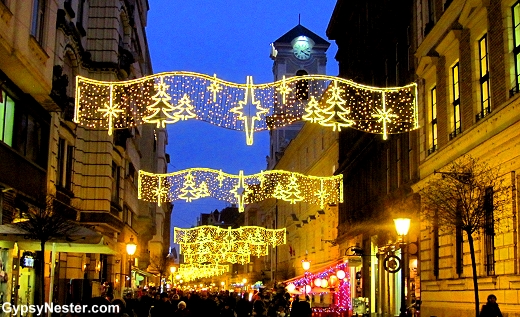
Warmed up, we finish our day along the main shopping street of the city, Váci utca, all decked out in holiday finery.
Night: Leaving Budapest: A send off we’ll remember for the rest of our lives!
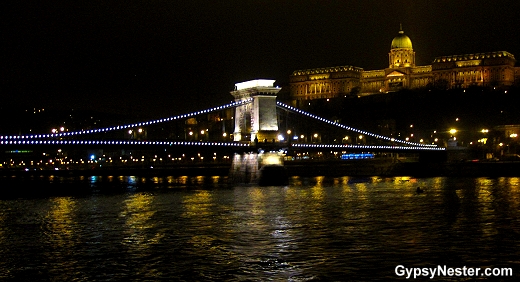
Sailing out of Budapest under The Liberty Bridge, The Chain Bridge, and The Elizabeth bridge gives us an incredible nighttime view of several landmarks.
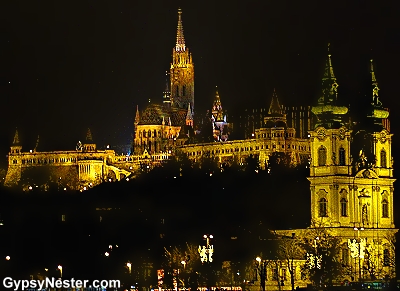
On the Buda side we see the palace and Fisherman’s Bastion lit against the night sky.
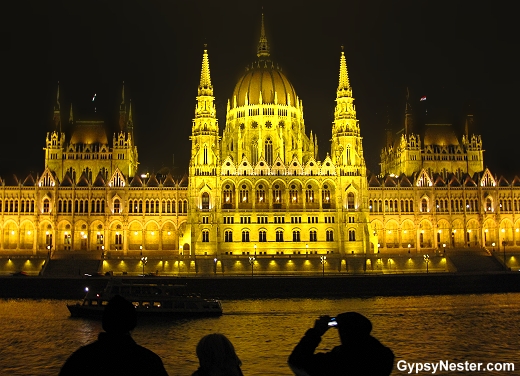
On the Pest side of The Danube, The Parliament Building is stunning as it glows in the foggy darkness. A remarkable send off after two amazing days in Budapest.
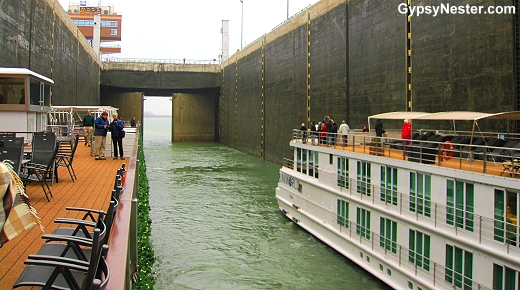
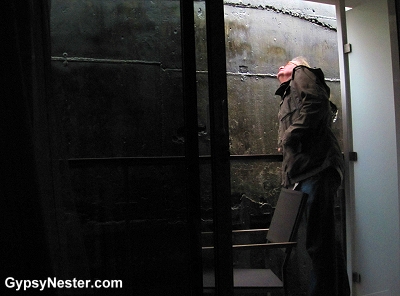
SO close to the wall!
David watching us rise on our stateroom balcony!
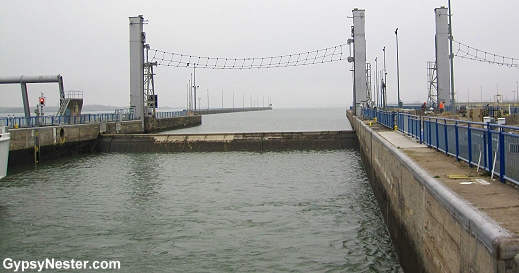
We are sailing upstream, which means we must pass through several locks to rise in elevation as we go along.
Skadi moves into position and then water tight doors close behind her. The lock is filled, raising us to match the river level on the high side. Then the doors open and once again we are on our way.
Afternoon: Storming the Castle
Although the city of Bratislava has played an important role in the history of central Europe for centuries, dating all the way back to Roman times and even serving as the capital of Hungary for over two hundred years, the name is actually quite new.
Not until 1919, when the new country of Czechoslovakia was formed, was the name Bratislava officially adopted. Before that it was known as Pressburg in German or Pozsony in Hungarian.
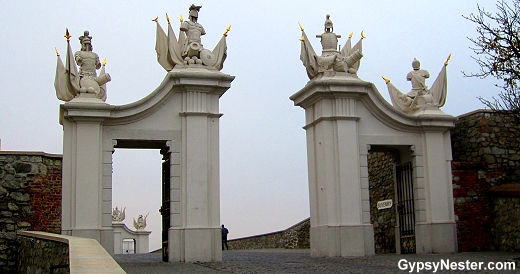
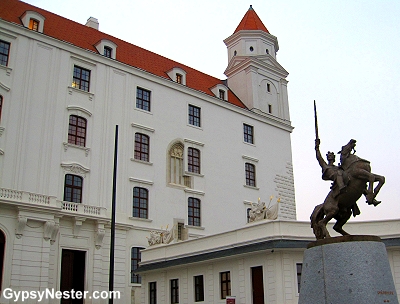
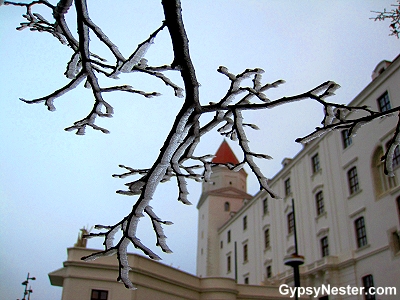
We began our exploration above the river at the Bratislava Castle. Up here the fog is freezing on to everything it touches, making icy art out of the trees.
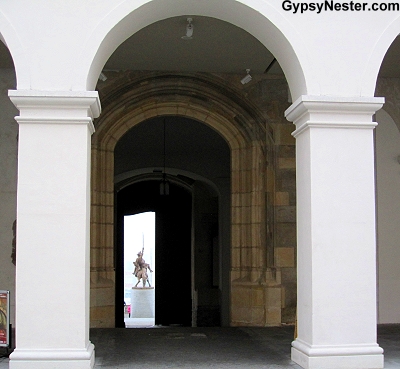
This strategic spot overlooking the Danube has had some sort of fortification since the Romans arrived over two thousand years ago. Then around 1,200 years ago the Slavs came and built the first stone fortress.
Over time it was added to and improved until 1531 when the Kingdom of Hungary chose this as their capital and the castle served as the seat of power until well into the 1800s.
After that it fell into disrepair, but has been wonderfully restored over the past fifty years.
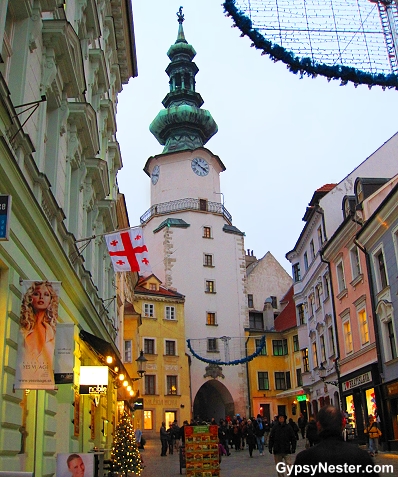
Below the castle we enter the old town through Michael’s Gate, named for the Archangel Michael whose statue sits atop the one hundred and fifty foot high tower.
Built around 1300, this was one of four entrances through the old protective walls, and is one of the city’s oldest structures.
The area inside the old walls has been closed to vehicle traffic so it makes for a very pleasant stroll through the cobblestone streets.
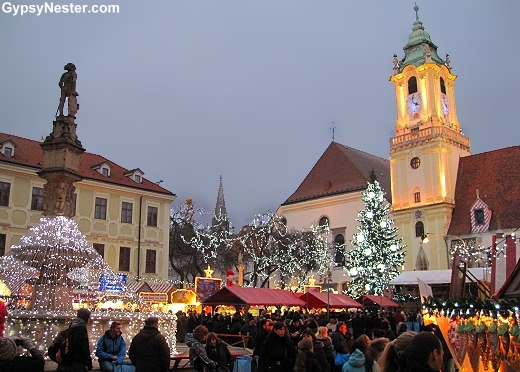
We discover the Christmas Market in front of Old Town Hall in the center of the old town.
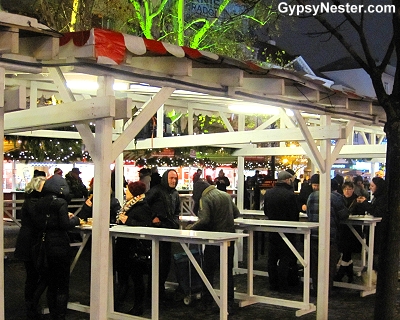
The Hlavne namestie, main square, is filled with booths, mostly selling food and drink, and tables under small shelters where the purchases can be enjoyed.
A very social situation that we are very happy to jump in the middle of.
Nearly everyone warms themselves with varene vino, the local version of mulled wine, but in a twist we hadn’t seen before, hot white wine seems just as popular as the red.
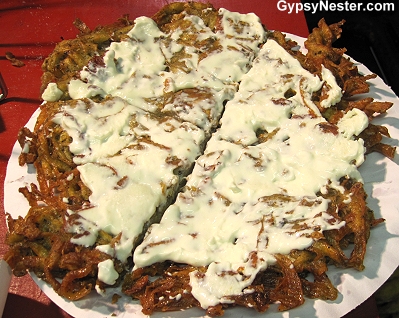
We also gave zemiakové placky with cheese a try. This is a pancake made of shredded potatoes — crisp on the outside and chewy within — covered in a layer of mild, yet tangy white sheep cheese.
Very tasty and stick-to-your-ribs on a chilly December evening.
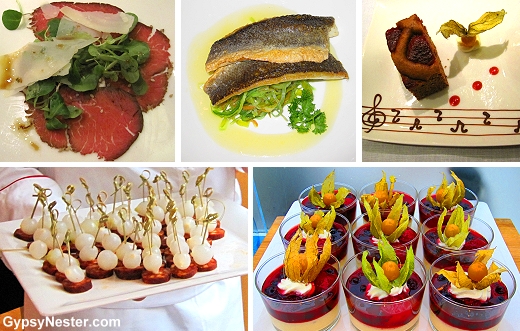
Dinner on board the Longship Skadi is another fine meal, as all of the fare has been so far. Careful attention is given to preparing local ingredients and dishes and local wines are served. We’ve even been greeted with a smile and yummy morsel when coming in from an excursion! Serving both visually and palate-pleasing dishes is accomplished flawlessly, and dare we say, artistically.
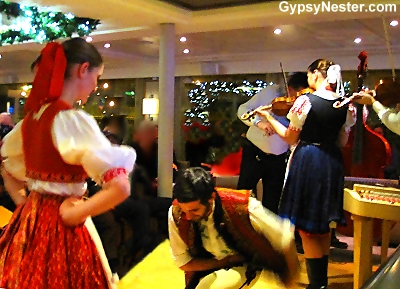
After dinner a group of Slovak musicians come aboard to entertain us.
Traditional folk songs played on dulcimer, violin, and double bass accompany the lively singers and dancers.
Day Four: Vienna, Austria
Morning: Hapsburgs and the most solid (heavy? substantial?) city we’ve ever seen!*
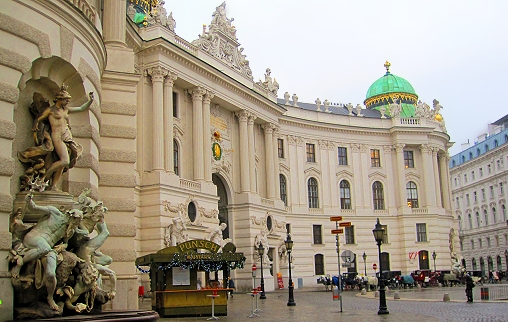
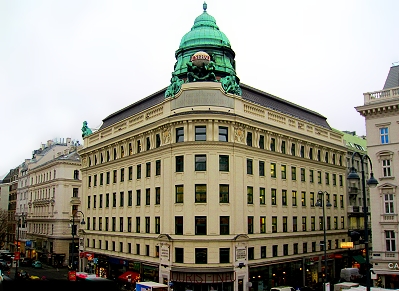
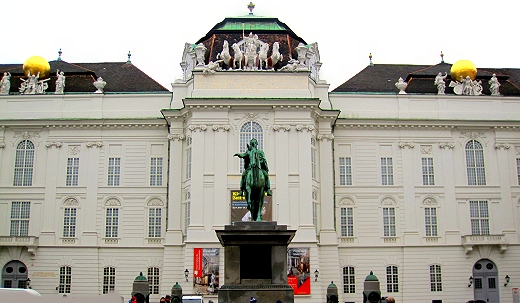
The city of Vienna is completely dominated by the heritage of The Hapsburgs. The dynasty ruled the Holy Roman Empire, then the Austrian Empire, and finally the Austro-Hungarian Empire from here for over 600 years, until 1918. Their palaces, churches, and government buildings are everywhere in the old city center.
The Hapsburgs used marriage to solidify relations with most of the royal houses of Europe, therefore avoiding a great deal of conflict.
None excelled at this better than Empress Maria Theresia who married off all of her daughters, including Marie Antoinette, in arraigned marriages. With one exception, her favorite, Maria Christina.
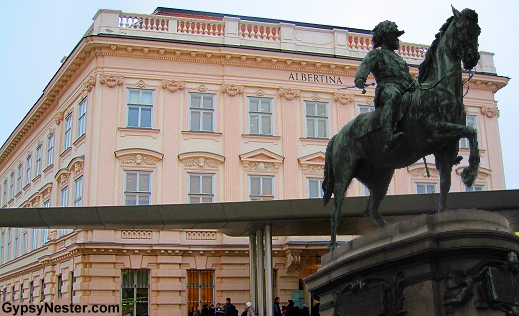
Christina was allowed to marry for love and so with her husband Prince Albert of Saxony became a bit like the Brangelina of their day. In fact the prince even built an art museum and used their combined names, Albertina.
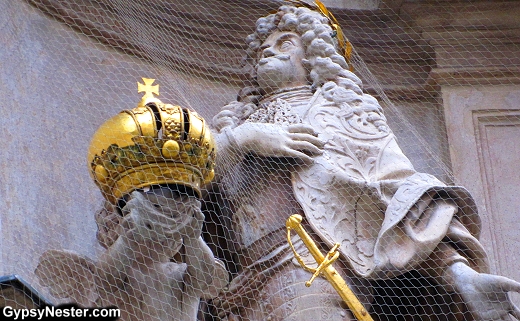
A less-than-flattering rendition of King Leopold I on the Plague Monument, our guide jokes that perhaps he hadn’t paid the artist enough!
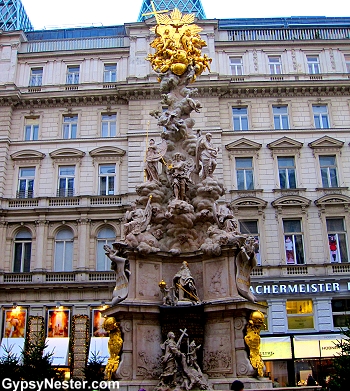
A later Hapsburg ruler, Leopold I, fled the city when plague hit in 1679, but vowed to return and erect a mercy column if the epidemic would end.
The Pestsäule he commissioned is now one of the main monuments in the center of Vienna.
Two ports of call today. We start with an early morning visit to the tiny town of only nine hundred inhabitants, Dürnstein.
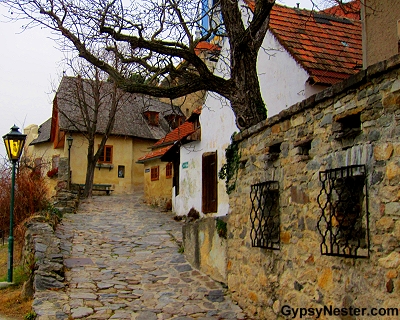
The name means dry rock, and refers to rocks above the town where the remnants of a castle stand. But before climbing up to the ruins of the castle, we stop for a look around inside the old medieval walls.
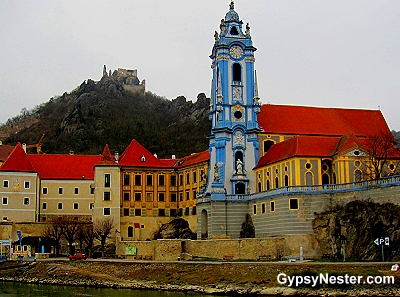
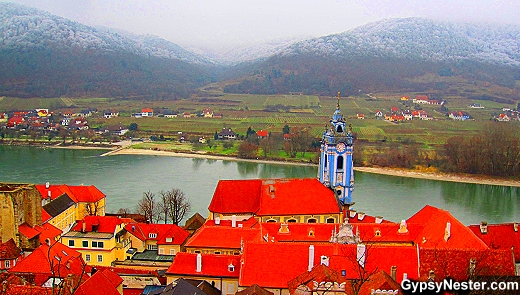
By far the most prominent feature is the blue and white Baroque bell tower that crowns the Dürnstein Abbey.
The abbey dates back to 1410 but the tower is just a baby, having been rebuilt in 1710.
Signs on the way up to the castle inform us that it is most famous for housing King Richard the Lionheart in 1192 after the third crusade, against his will we might add. Duke Leopold V of Austria snatched the king and held him for ransom in the castle. The ransom was paid, Leopold was excommunicated by the pope for messing with a hero of the crusades, and died soon after. Over all the episode did not go well for Leopold.
There is not much left to see of the castle these days, the Swedes came down and destroyed it in 1645 and it has not been used since, but does offer quite a view of the Danube and the Wachau valley.
As we steam up the river to Melk, the crew has prepared and amazing lunch they call A Taste of Austria.
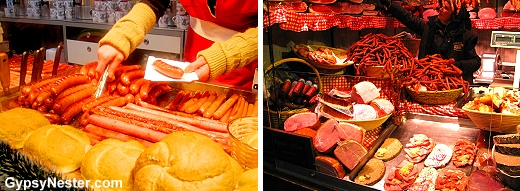
Regional specialties were brought on board yesterday in Vienna, including leberkäse, a meat loaf with a bread crust and cheese inside, and several varieties of sausages.
While these may look a lot like a regular hot dog, these wiener würsten are not even in the same ball park. We’re not talking the left over cuts of meat, these are prime cuts of veal and pork. The käsekrainer, which looked like basic smoked sausage but tasted like heaven, even had a cheese surprise melted in.
And we could never have all of these specialties without the proper beer, so a keg of Zwittler is tapped.
Brewed for over three hundred years in the nearby hills, it is the perfect accompaniment.
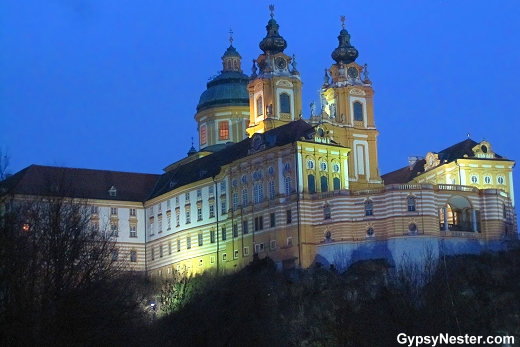
This is still an active monastery, and also houses a school for about nine hundred students.
Many of the old rooms are used as a museum now and we walk through these on our way to the incredibly impressive library.
Tens of thousands of volumes, some over a thousand years old, are kept, and still used by the monks.
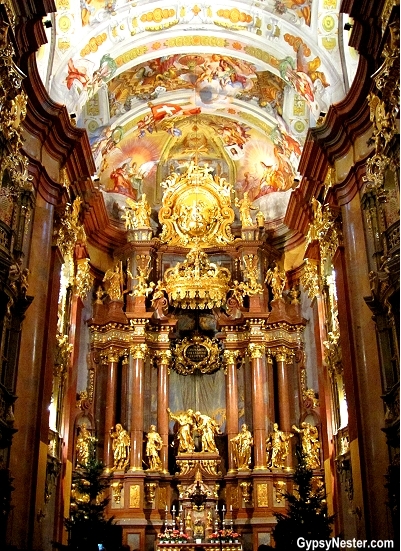
The focal point of the abbey is the church. As beautiful as it is, the highlight for us are the two “catacomb saints” on display.
For some time during the 16th and 17th centuries the desire for relics became so great that the Vatican declared numerous unknown remains brought up from the catacombs under Rome to be saints.
The thinking seemed to be that since they came from Rome they must have been a martyr or great Christian of some sort, so they were dressed up in jewels and finery and sent off to churches in Germany, Austria and Switzerland.
Back on board the Skadi, our day ends with a bit of controversy during the Christmas trivia game. Our program director, Joey, asks how many reindeer pull Santa’s sleigh and quite a brew-ha-ha breaks out as to whether the correct answer is 8 or 9. Order is restored when he decides to accept either answer, eight in good weather and nine in bad.
Day Six: Spectacular Salzburg
Morning: Meeting Mozart
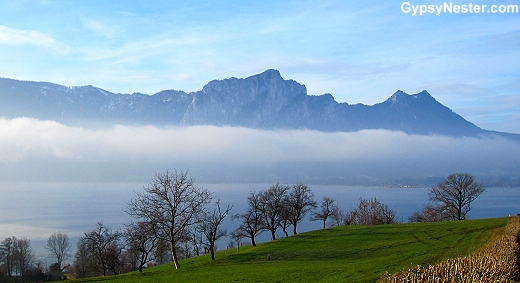
The fog trapped between Mondsee, (Moon Lake) and Drachenwand (Dragon’s Wall) adds to the spectacular scenery on the road to Salzburg.
Today The Skadi is docked in Linz, Austria, but we will take a bus for a short ride to Salzburg. One of the big advantages of river cruising is that we dock right in the heart of the cities we are visiting. Not true with Salzburg, but it is such a gem of a city that it would be a colossally bad mistake to skip the small detour.
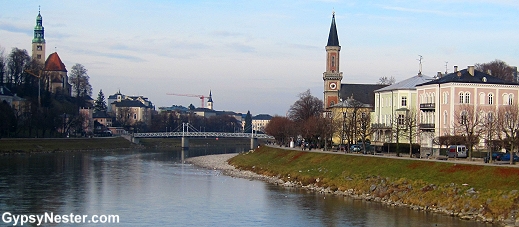
Crossing the Salzach River toward Salzburg’s Old Town
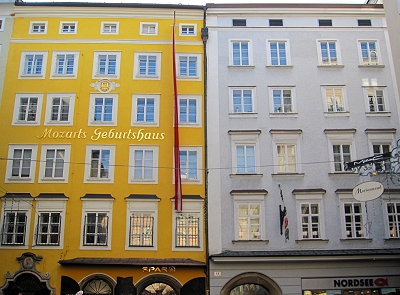
We will spend our day in Salzburg entirely within the walls of the old city, beginning and ending at the home where Mozart was born.
He was, after all, the original source of the sound of music coming from Salzburg. Afternoon: Beer Hall-ing and Walking It Off!
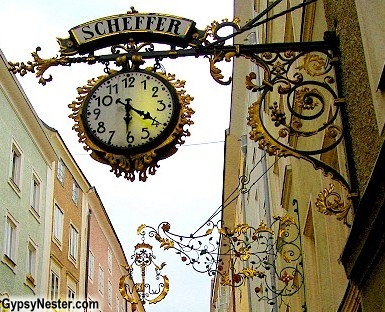
Old Town’s ancient cobblestone streets are closed to vehicles and lined with shops and eateries, most sporting ornate wrought iron guild signs.
These signs date back to the 1400s and the guild system when craftsmen and tradesmen formed guilds, or associations, to manage business and train new apprentices.
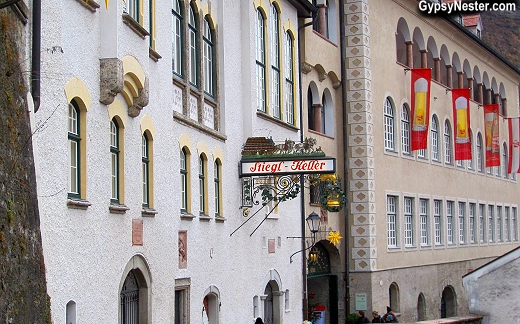
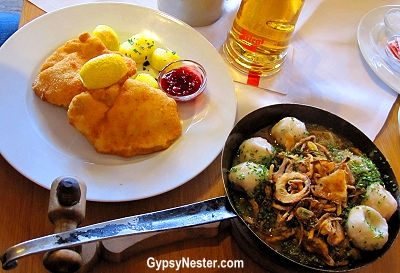
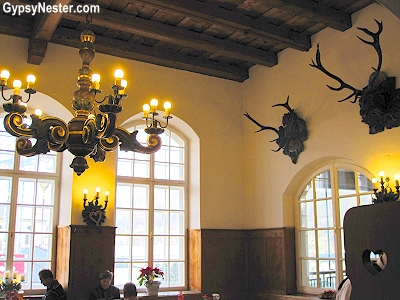
For lunch our fabulous guide pointed us to a classic beer hall, Stieglkeller, which of course features the local bräu, Stiegl, but also excellent authentic dishes. Not having had a schnitzel yet, that was a must, and when we saw six stuffed dumplings mit sauerkraut on the menu we knew what we had to do.
Like any good beer hall, big sturdy tables await mass quantities of food and drink, and animal heads, mostly the kind with antlers, adorn the walls.
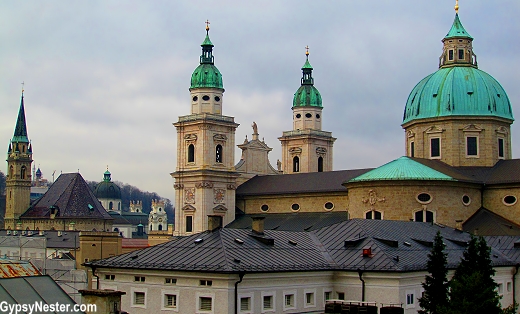
This was not a light meal, so to walk it off we went along the lower wall of the castle. The side facing the city offers a great view over the entire old town.
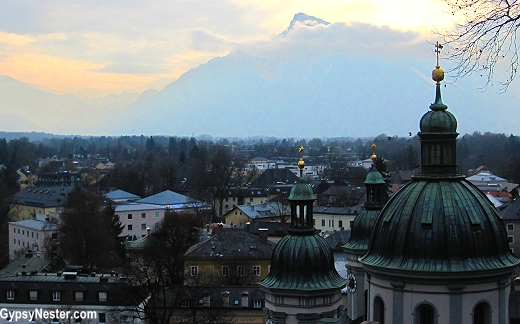
But the real reward came around the back side of the castle where we were greeted with a stunning view of the mountain Untersberg playing hide and seek with the clouds.
Late Afternoon: Christmas Market Ho! (Ho! Ho!)
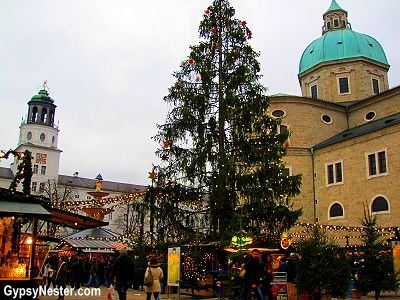
The Salzburg Christkindlmarkt is perhaps the biggest, and best Christmas market we have visited on our trip.
Food and drink are certainly available, but this market has much more to offer in the way of local crafts and unique items.
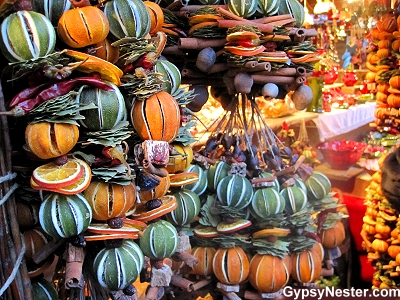
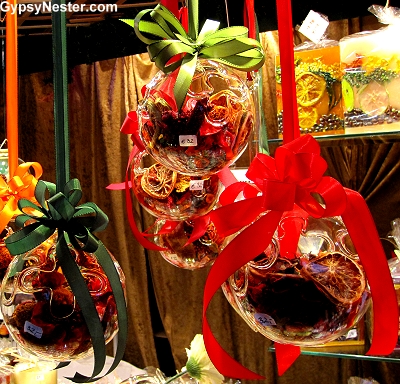
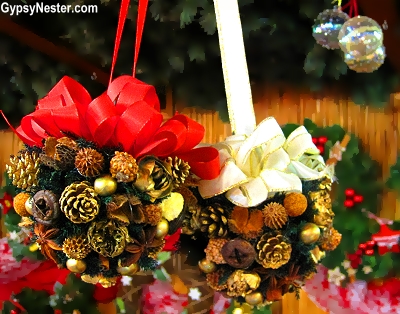
In addition to Salzburg’s famous Mozart chocolates we bought a gewürzstrauss, a traditional spice bouquet that makes anyplace smell like Christmas.
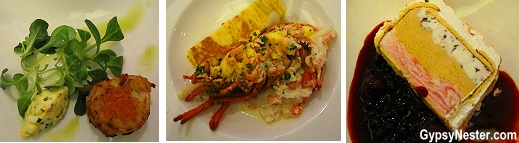
With only a couple of nights left on our cruise, tonight is the special Captain’s dinner. After a toast to a great crew and journey, the lobster is served. Quite a spread, five courses, from caviar to baked Alaska.
Day Seven: Passau Pleasures
Morning: Germany and Gingerbread
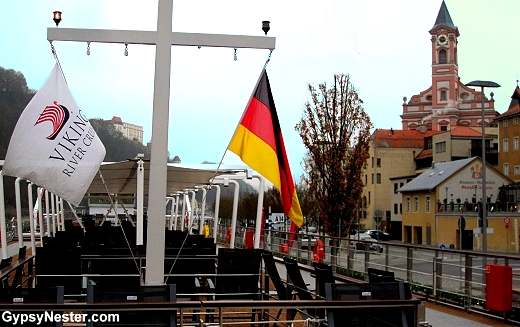
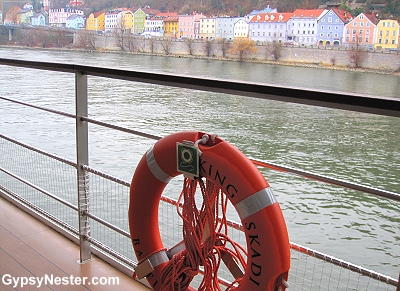
We are finishing our Christmas Market tour in Passau, Germany, where the River Inn and the River Ilz meet the Danube (Donau), and for this reason it is often called the City of Three Rivers.
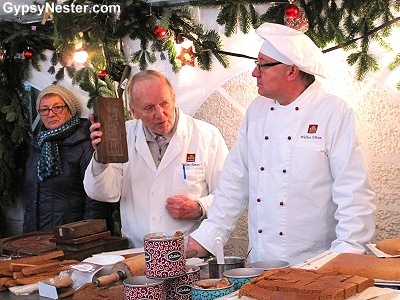
On our tour of the city we stop at Confiserie Café Simon for a demonstration on gingerbread, known here as Lebkuchen, which means loaf of life.
So our English translation is a misnomer, even more so since there is no ginger in gingerbread. The original simple recipe consists only of rye flour, honey and spices such as clove, nutmeg, and cinnamon. A more spicy version known as Gewürzlebkuchen (we learned in Salzburg that gewürzle means spice) includes molasses.
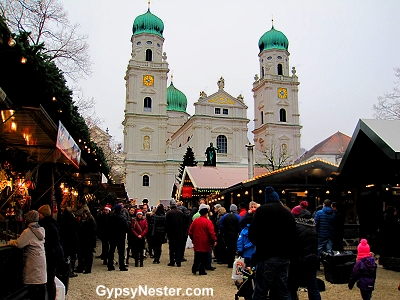
Our final Christmas market is in the square in front of St. Stephen’s Cathedral, a baroque church from 1688.
As with so much of the city, the church was built after the great fire of 1662. Before the fire, the church was not baroque, so afterwards it did need to be fixed. (ba-da-CHING!)
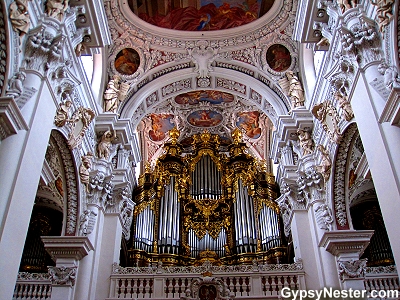
Inside, the largest cathedral organ in the world with 17,774 pipes, has been worked into the stucture. The organ currently has pipes in five different places, including inside the ceiling, all coordinated to play exactly together.
Concerts are held regularly and are a must-do when visiting.
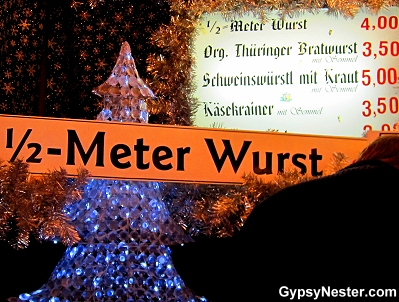
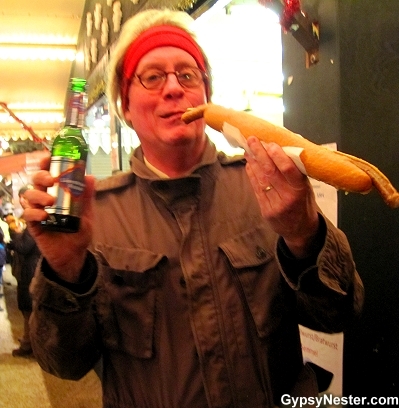
In the market we discovered something new, the 1/2 meter wurst. Almost two feet of sausage. Have we (meaning David) died and gone to heaven?
Unfortunately we just ate a huge lunch so we had no place to put half a meter of wurst.
Afternoon: David Goes Rogue
The thought of the half meter wurst wouldn’t leave me alone, so when Veronica decides to nap back on the ship, I sneak out to the market in search of a super sausage.
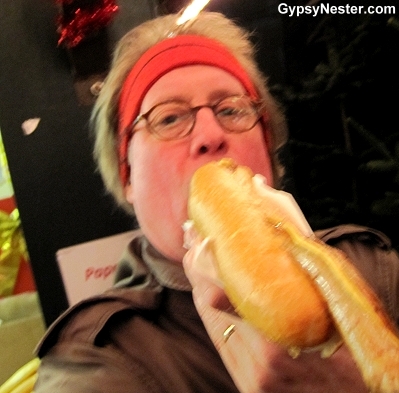
This indulgence must be captured on film, so I attempt the half-meter-wurst selfie. A difficult proposition considering that the sausage is almost as long as my arm.
Seeing my struggles, a helpful German woman offers to snap a photo, which I appreciate, but I really want the perspective of meat and bun at an arm’s length.
After seeing both photos, I think you’ll agree that the half-meter-wurst selfie is truly a work of art.
As our journey comes to an end we have some overall impressions.
First and foremost, the crew of The Skadi are superb, with a special shout out to Joey, our program director, Verona, the concierge, and Wilhelm, the hotel manager. They, and all the staff, made sure that every detail was attended to with near perfection.
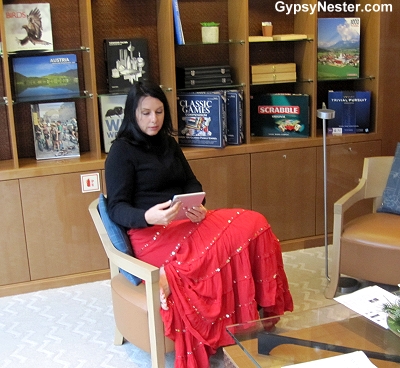
Veronica in Skadi’s library. Free, unlimited wifi was available ship-wide, but this was one of her favorite haunts.
In addition, the tours were all well coordinated to allow free time while still seeing and learning about all of the highlights of each destination. The guides all lived in each city we were visiting, and so had valuable insights from a truly local perspective.
By docking near the city center of the incredible towns we visited, it was almost like having a hotel with a perfect location in each city. This is a different style of cruising, not so focused on shipboard activities as seeing the destinations, yet our time was always filled with educational or entertaining events. Several local music performers came on board, as well as lectures, demonstrations, and regional foods were offered every day.
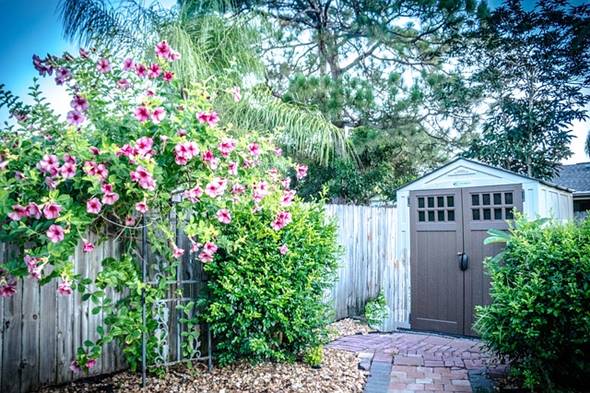
Many companies are selling sheds online. However, there are a few things you need to know before you go ahead and order online storage sheds. For instance, deciding on the most suitable style of roof… CONTINUE READING >>
It is no longer that difficult to fulfill your dream of having a high-end storage shed on your property. Many companies are selling sheds online. You get the equipment you need to build them included and you can learn how by watching tutorials online. However, there are a few things you need to know before you go ahead and order online storage sheds. For instance, deciding on the most suitable style of roof is very important.
Shed Roof Designs
The roof will always be the most important feature on any shed. It has to be up to the job of keeping the building watertight and secure. Online you can find many styles and designs made of different materials that will withstand various weather conditions, even the more extreme. Here are a few options you are likely to come across.
Gable Roof
A gable roof is a simple and popular style. It is the one where same sized roof panels slope down each side of the structure from the ridge at the very top. The best thing about this kind of roof is that its high peak creates additional loft space that is perfect for storage.
Catslide Roof
If you’ve seen structures in New England built following the design of colonial saltboxes, you will have seen a catslide roof. In these roofing systems, the read panel will slope downward to stop a few feet from the ground. With this roof, you benefit from more floor space although it limits the space for overhead.
Sloping Roof
If you want a straightforward roofing option, you may want to look for a sloping roof design. It will have a single panel slowing towards the rear of the shed. Because the gradient is minimal, installation is easier. This roof is a good choice if you want plenty of headroom.
Gambrel Roof
To make your shed look great, you can consider going for barn-style appeal, which you get from a gambrel roof. It is a perfect way to add additional volume. With this roof, you can even go ahead and install a storage loft. You may want to install this roofing type if you are planning a larger than average shed.
Flat Roof
A flat roof is a basic roofing option for someone not interested in spending a lot of money. For these, a single panel covers the entire shed. Whilst it is easy to install and a rather cost effective option, a flat roof is definitely more functional than attractive. Without a gradient, there is also the risk of water pooling and debris, such as fallen leaves collecting on the roof. If not dealt with, this will reduce the working life of the roof and therefore the shed.
Hip Roof
A hip roof is a roof with four triangle-shaped panels put together to form a square pyramid. If you’re in an area with high winds, you may benefit from investing in this sturdy roof style. You won’t be getting the overhead storage you could from other designs but the roof will keep its integrity and keep the shed watertight for decades easily.
We are happy to present this collaborative post to offer valuable information to our readers.
The key to learning about pets for kids is to know your kids’ taste and plan accordingly. Here are some of the best pets for kids and why they’ll be a delight in your home, maybe even after the kids are gone…
There are all kinds of lists out there outlining good first pets for kids. Most of them detail the basics, like the average dog lifespan, such as we have done here. But, the key to learning about pets for kids is to know your kids’ taste and plan accordingly.
Below, you will find some of the best small pets for kids, along with a few ideas about why they’ll all be a delight in your home, maybe even after the kids are gone. Keep reading to learn more.
What Are Some Good First Pets for Kids?
Whether you’re a parent or a grandparent, you want to delight the young people in your life with gifts that will not only bring them joy but also enrich their skills, character, and confidence. Here are a few great pets that just about any child will love.
1. Fish
Fish can really be the most fun. They’re also relaxing and relatively maintenance-free if you start small. These fish tank kits, for example, will be just enough to get you started with a few small fish to brighten any room or kid’s face.
2. Mice/Hamsters/Gerbils/Guinea Pigs
Some of the greatest beginner pets are rodents. They’re cute with great personalities and they’re small enough that you can keep them almost anywhere in your home. Plus, you can teach your kids the importance of responsibility and maintenance with cage cleanup.
Make sure to keep an eye on your child during playtime so these pets don’t get lost.
3. Geckos/Salamanders/Lizards
Geckos, salamanders, and lizards are just plain neat. Lizards will require a heating element such as UV light bulbs so you may consider placing the cage in a common area of your home rather than your child’s bedroom.
4. Dogs
Of course, the best first pet you can give any child is a dog. Start with a puppy that your child can grow with so that they learn together. Every family should have a dog for companionship and even protection. Check out this article to learn how to keep your dog’s digestive system functioning in healthy ways.
5. Cats
When it comes to easy first pets, you can’t go wrong with a cat. They pretty much eat, play, sleep, and use the litter box. But, they’re also often cuddly and will provide constant friendship fr your child for years.
The Best First Pets For Kids Aren’t Always Normal
Sometimes, good first pets aren’t what you would ordinarily think of. Consider that kids often like obscure things like dirt and insects. You might consider an ant farm or maybe a Madagascar Hissing Cockroach. They’re virtually maintenance-free and your kids will get a real kick out of watching them just be bugs.
Of course, as the parent, you will be held responsible for the well-being of your child’s pet. But, with a little guidance, your child will learn the essence of responsibility and compassion by having a pet of their own from a young age.
We hope you found this post inspiring. Check back for more when you need to remember the days of old when you’re children were still kids or you want something to share with your grandkids.
Renting out your home for the holidays in Canada can be a highly lucrative side business. However, the success of your business would depend on how well prepped the place is to receive guests. Here is a list of useful tips… CONTINUE READING >>
Renting out your home for the holidays in Canada can be a highly lucrative side business. However, the success of your business would depend on how well prepped the place is to receive guests. Here is a list of useful tips that would help you get your abode ready for Airbnb guests:
Decide Which Parts To Rent Out
Some homeowners are comfortable with offering the whole house for rent, while others are not. If you don’t have a second home to rent, then you would have to decide which parts should be available to guests.
Ideally, partition the house so both the guests and residents can enjoy privacy during the holidays. The guests will need a separate entrance, separate bathrooms, and possibly a kitchenette. Designing a separate guest bedroom should be easy if you have a basement. Hire a reliable Toronto basement contractor in the area to get the place 5-star ready for arrivals.
Spruce Up the Place to Meet Guest Expectations
Obviously, guests have expectations. As the holiday rental businesses have gotten competitive, landlords are offering various quirks to entice paying customers. But be careful when making additions to your home. It’s not worthwhile to spend a fortune on remodelling only to charge low rents later.
First, do some research. Check out what hotels and other rentals in your area are offering. You can read online customer reviews to find out what travellers expect. Make sure your basement renovation ideas match the rent you are charging.
It’s totally worthwhile to offer a quirk to attract new visitors. These don’t have to be expensive. Big windows that showcase the surrounding view, for example, might be enough for nature travellers.
Improve Safety
Don’t forget to double down on all safety features in the house. You may have to install extra fire extinguishers or railings for disabled visitors. If you are renting out to families with children, make sure the guest areas are completely childproof. Do ensure the complete safety of both guests and your property, go above and beyond what’s required by local laws.
Up the Cleanliness Standards
One of the most common complaints about holiday rentals is the lack of cleanliness. Keep in mind that your guests would expect the rental to be as spotless as a hotel. Therefore, remodel the place in a manner that makes it easy to clean. You may want to invest in industrial grade cleaning equipment as well.
Get Everything Insured
Holiday renting is not all about making money. For every successful rental story, there’s a horror story about guests who have destroyed the property. Therefore, make sure you are well covered under short-term rental insurance. Your liability may increase depending on the type of guests you are attracting. For example, spring breakers and backpackers may not leave your guest bedrooms intact. Anticipate problems in advance and make sure you are covered for damages.
It’s never too late to get into the booming holiday rental market. But before you do so, make sure your house is ready for it by following the above suggestions. Do your research in advance to avoid nasty surprises along the way.
We are happy to present this collaborative post to offer valuable information to our readers.
There are a lot of things to relish about being a senior including retirement, which can offer more freedom and flexibility to do the things you’ve always wanted to do. One of those things might be travel… CONTINUE READING >>
While your older years may include challenges you didn’t face when you were younger, that doesn’t mean this shouldn’t be one of the best periods of your life. There are a lot of things to relish about being a senior including retirement, which can offer more freedom and flexibility to do the things you’ve always wanted to do.
One of those things might be travel. Being engaged and doing things like traveling can provide you with social interaction and keep you sharper than if you were to stay home all the time and avoid traveling.
The following are some of the things you should know if you’re a senior citizen and you’d like to travel more.
Travel Benefits
Briefly touched on were some of the benefits of traveling in your golden years.
• Research shows that if you’re a man and you take an annual vacation, you are 32% less likely to die from heart disease, and women who travel at least twice a year are less likely to experience depression. • Even a three-day vacation can significantly lower your stress levels. • Traveling, particularly abroad, can help you be more emotionally stable and open-minded. • When you travel, it gets you not only out and about but also moving, and that’s important for your physical health at any time in your life • Traveling increases your confidence because it pushes you outside of your comfort zone and helps you better understand what you’re capable of. • A study from the Transamerica Center for Retirement Studies found 86% of people say travel improves their general mood and outlook on life. • When you are meeting new people and engaging in things that are outside of your normal routines, it challenges and stimulates your brain and can help reduce cognitive decline.
Tours and Cruises for Seniors
If you’re traveling alone, you may be more apprehensive than if you have a companion, and you might pay for double occupancy even if it’s just you.
There are ways you can travel alone and avoid the double occupancy charges and also meet people.
There are also cruises geared toward the same objectives.
One of the many options is called Singles Travel International, which is a company offering cruises and trips for all age ranges, including singles aged 50 and above. You might create lifelong friendships if you take one of these guided trips for singles.
Another option you might want to explore is joining a senior travel club. A travel club will usually charge a fee, but they’ll provide you with member-only access to content, discounts, and information.
When you join a travel club, they can help you find group trips, and some travel clubs exist solely to help organize group trips for members.
There are also social gatherings outside of travel that is part of membership. For example, you might attend monthly meetings. Some travel clubs are geared toward specific interests or demographics, like a women’s only group or a group interested primarily in discount travel.
Do be aware of scams parading as travel clubs, though. Some travel scams will try to entice you to come on a trip where you’re required to attend a travel seminar, and the terms and conditions can be so restrictive you never actually get to go on your trip.
General Travel Tips for Seniors
Of course, as with any age group, when you’re a senior, and you’re traveling you want to be mindful about safety and make it as smooth and stress-free as possible. That’s one of the big benefits of traveling as part of a tour group—the operators should take care of all the logistics, including any security and safety issues, so you can just relax and enjoy your time away.
Other travel tips include:
•Try to keep things simple as far as your air travel, and plan as much as you can ahead of time, even if you aren’t going on a tour-based trip. If you can get a direct flight to your destination, that’s often best because it adds fewer unknown variables to your trip. • Choose a hotel that’s in a safe, central location. If it’s within walking distance to most of the things you want to do, even better. • If you’re going abroad, it can be tempting to try and fit several destinations into your itinerary, but this may include rail and car travel and a lot of packing and unpacking. This can be exhausting and stressful, so it may be better to focus on one location. • If you have special needs, don’t be afraid to talk to your hotel because they’re often willing to make accommodations for travelers of all ages. • Don’t let people on social media know that you’re away or the dates you’ll be gone. It can make your home a target. • Don’t push yourself too far—this is a rule that can apply to all of us when we travel. It’s easy to overdo it in an attempt to see everything, but that can cause problems later in your trip. • If you take any medications, make sure you pack them all with some extras in your carry-on in case anything happens to your luggage. Before leaving, ask your doctor for a list of equivalent prescription drugs wherever you’ll be going in case you have to visit the pharmacy. • Make sure your family or friends know the details of your trip and when they can expect to hear from you before you leave.