Check out the fabulous faux facades of the bright and beautiful Ovada! For more about Ovada: https://www.gypsynester.com/ov.htm
Visit our GypsyNester YouTube Channel!

 ORDER NOW -
Wherever Books Are Sold!
ORDER NOW -
Wherever Books Are Sold!Boomer Travel. Food. Laughter. Breaking the Empty Nest Rules!
enlarge video
Check out the fabulous faux facades of the bright and beautiful… CONTINUE READING >>
Check out the fabulous faux facades of the bright and beautiful Ovada! For more about Ovada: https://www.gypsynester.com/ov.htm
Visit our GypsyNester YouTube Channel!
enlarge video
Join the GypsyNesters as they shop on market day in this charming little Italian town! We even get to… CONTINUE READING >>
Join the GypsyNesters as they shop on market day in this charming little Italian town! We even get to practice our Italian! For more: https://www.gypsynester.com/cmi.htm
Visit our GypsyNester YouTube Channel!
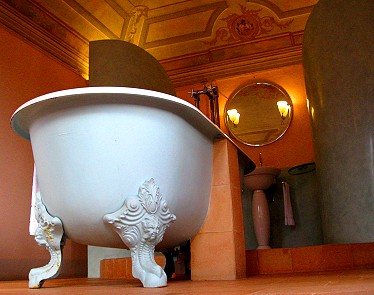 We selected the Camera Sant’Orsola for its wonderful little balcony overlooking a little chapel, the beautiful bed with its ornate wooden cathedral door headboard and the biggest bathroom we had ever been in.
Since choosing a room for its bathroom was a first for us, it seems a detailed description should be… CONTINUE READING >>
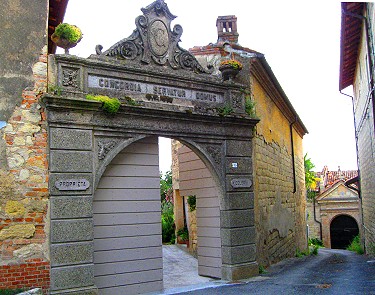
Topping the vineyard laden hills of the Piedmont (Piemonte) region of Italy are charming little ancient villages that offer quaint lodgings and wonderful wine specialties.
With a romantic getaway in mind, Claudia, hostess extraordinaire, took us on a driving tour down the lovely rural lanes of Monferrato to show us her favorite villas. She insisted that we choose one for our evening’s accommodations.
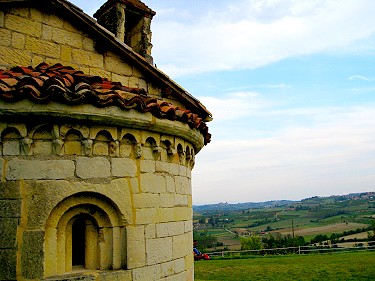
The calming beauty of our trip was broken – just once – when a madcap, out-of-nowhere Vespa driving maniac whipped around our car and Claudia exclaimed “Mamma Mia!” with her hands gesturing wildly.
Italians actually say that in real life! We had mistakenly thought that the phrase was a cliché limited to Super Mario Bros and bad canned spaghetti commercials. We learn something new everyday.
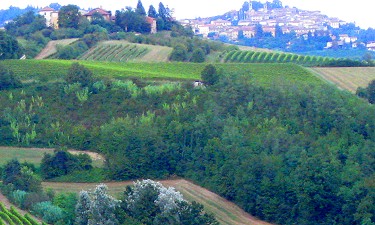
We strolled through several medieval villages before settling upon Cave di Moleto. Moleto is a small community that includes a working vineyard and winery, restaurant and hotel.
A small outdoor theatre with a 360 degree panorama, hosts fantastic jazz concerts. The view the from theatre is spectacular, overlooking the Valle dei Frati (Valley of the Friars) and the rolling hills at the feet of the Alps. Romantic? Si.
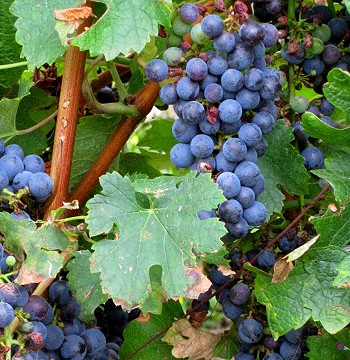
The name Cave di Moleto comes from the ancient quarries of marl (clay) in the area but is also a clever bit of word play. Cave in Italian is the word for mines or quarries, but in French it means the place to store wine.
The village itself dates back to the late 700s and in 1992, the estate was bought and extensive renovations were undertaken.
The winery incorporates the old wine cellars with the technologies of today. The renovations are impressive and were obviously done with much love and the utmost care.
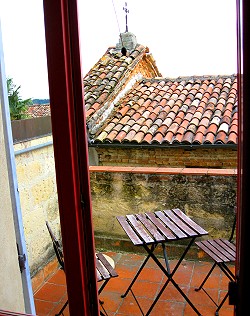
While listening to the vineyard workers play spirited game of ping pong, we were given a tour of the lodgings. There were twelve spacious rooms in all, each with distinctive and whimsical touches, utilizing the art of Trompe l’oeil (we spent a least an hour just staring at the ceiling above our bed).
We selected the Camera Sant’Orsola for its wonderful little balcony overlooking a little chapel, the beautiful bed with its ornate wooden catherdral door headboard and the biggest bathroom we had ever been in.
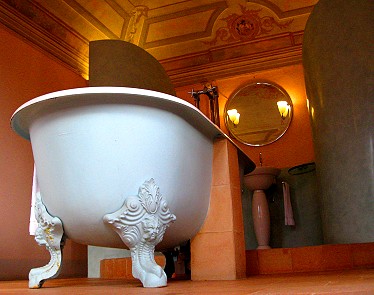
Since choosing a room for its bathroom was a first for us, it seems a detailed description should be made: In the middle of the huge room stood a a free standing, deep, no, VERY deep, white cast iron, four legged tub.
We loved it, even if it was a bit difficult to get in and out of. Perhaps we should look at this review of walk-in tubs for our future baths.
The toilet and bidet each were nestled away with deco-like, back lit partitions with a step-up vanity tucked between. The ceiling was extremely high and elaborately painted. A full wall was dedicated to windows overlooking the courtyard. Molto bella.
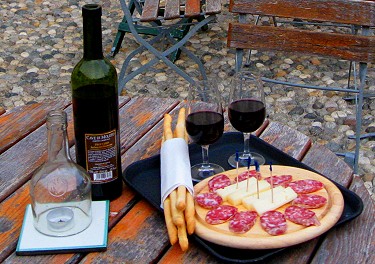
Jaws agape in historical and architectural wonder, we spent our evening strolling around the village, then hiking through the vineyards at sunset.
We finished with a bottle of the estates Barbera del Monferrato perfect for the Symphony of our own sausages to cutting board Monferrato in a candlelit courtyard.
Little details were everywhere — even the lanterns were made from wine carafes. Cosi romantico.
To end a perfect day, we drifted off to luxurious sleep while contemplating the ceiling of our bedroom.
David & Veronica, GypsyNester.com
 Over the first night’s dinner, conversation turned to local food and customs. Gianluca mentioned that horse and donkey were the “national foods” of Sardinia and that people who are not from the island can find them hard to eat. It wasn’t meant as a challenge, but to us, the gauntlet had been dropped. Since David had tried horse on a previous visit to Italy, it was obvious that we must eat the ass.
Sniffing around the next day, we found an intriguing little local haunt called Trattoria da Peppina in a tiny piazza near our hotel. Turns out… CONTINUE READING >>
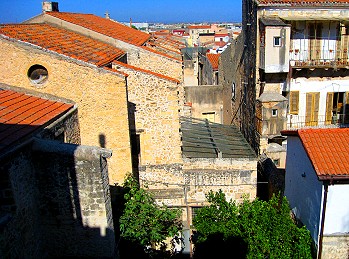
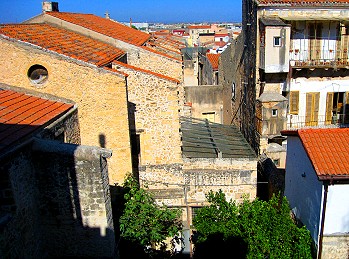
The Italian island of Sardinia (Sardegna) brought out the adventurer in us.
Our first stop was Sassari, a city of about 120,000 with a rich history dating back to the early Middle Ages.
Sassari is a college town, home to the University of Sassari that was established in May of 1562.
Our host, Gianluca, a treasure trove of Sardinian lore, put us up at the Hotel Vitorio Emanuele in the center of the old city.
As we walked around the meticulously preserved town centre, we found cobblestone roads, ancient buildings and streets so narrow we could touch the walls on each side at the same time (yet locals navigate cars, trucks and scooters with side mirrors-tucked-in ease).
The dialect of the people around us, especially the children, sounded beautiful, like music.
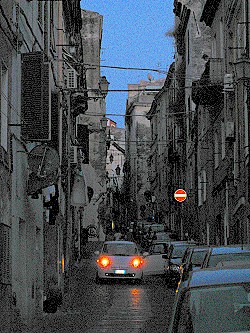
Sassari can seem foreign to modern, New World eyes, yet we soon discovered that behind the ancient veneer were 21st century conveniences.
In our hotel, we found motion sensor lighting, video security, wireless access and a staff that spoke an amazing repertoire of languages, seamlessly moving from guest to guest.
Just a passing glance, or in Veronicas case an intentional snoop, into the open doors of the homes revealed all of the newest gadgets. State of the art kitchens with gleaming, compact appliances, LCD screens on flatscreen TVs and computers and furniture to die for.
Over the first nights dinner, conversation turned to local food and customs. Gianluca mentioned that horse and donkey were the “national foods” of Sardinia and that people who are not from the island can find them hard to eat.
It wasnt meant as a challenge, but to us, the gauntlet had been dropped. Since David had tried horse on a previous visit to Italy, it was obvious that we must eat the ass.
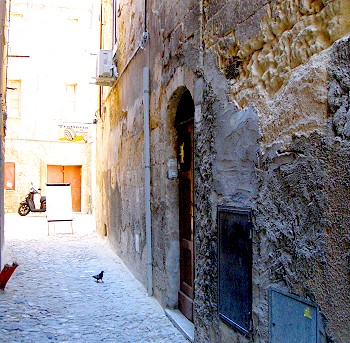
Sniffing around the next day, we found an intriguing little local haunt called Trattoria da Peppina in a tiny piazza near our hotel.
Turns out asinello (little donkey) was one of the least adventurous menu items. Spinal cord, small heads of lamb, three kinds of snails, various entrails, and goat feet were all available, as well as several things we couldnt decipher even with our fairly complete dictionary.
This was it – wed found our place. The nervous, obvious jokes preceded our meal – “Thats some nice ass,” “Theres just nothing like a good piece of ass,” “Howd you like to bite my .
Well, you get the idea.
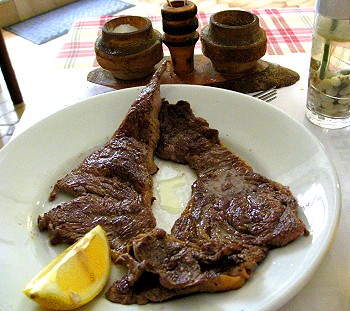
We were hoping a nice sauce might cover our ass, but as we were enjoying our pasta “first plate” we heard the distinct sound of meat on the grill.
Sure enough, the ass was served straight up, all alone on a plate, grilled to perfection.
They even went so far, perhaps by accident, perhaps not, to serve it in a shape that could be seen as a toilet seat or a human butt. Lemon and salt were added as we summoned our courage.
The steak was cut, rather tentatively, and the first bite sniffed and inspected. Smelled good, looked OK . Here we go. Its good! No, really, its good.
Fully expecting to only try a bite or two, we ate every bit. Its really good.
So now, best of all, at dinner we could truthfully say, “No thank you, I had ass for lunch.”
Sassari sleeps in the afternoons, so it felt as though we had the whole place to ourselves, but we did find the Museo Nazionale Sanna open. The museum houses some of the earliest Stone Age and Neolithic finds on the island.
Phoenician and Carthaginian pottery and gold jewelry, Roman statuary, a sprinkling of coins, bronze belt buckles and a stash of heavy Roman boat anchors that pay homage to Sardinias seafaring history share the space with the art collection of Giovanni Sanna, whose family built the museum.
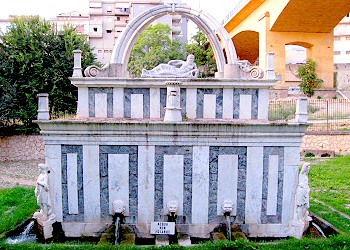
A trip to Sassari is incomplete without a visit to her famous fountain, Fontana di Rosello, crafted in 1606. The fountain first supplied the aqueduct for the nearby seaport of Porto Torres.
Later, the citizens of Sassari hauled the water away in buckets by hand and on donkey – we assume before dinner.
A souvenir shop hocking tee shirts that read “No Mirto, No Party” caught our attention as we strolled. Intrigued, we stepped in to ask the proprietor about Mirto.
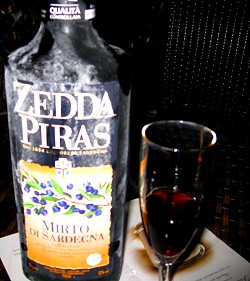 With little language in common, we learned through hand signals and interpretive dance that Mirto is a traditional Sardinian liqueur that tastes harmless, but in a half an hour all hell breaks loose.
Immediately upon arrival back at the hotel, we started our research. Mirto, we found, comes in two varieties, red and white, and is made from the myrtle plant – the red (rossa) is made from the berries, the white (bianca) from the leaves.
Nothing about hallucinations. Since we were not sure who to trust – Wikipedia or the guy at the souvenir shop (could he have been exaggerating just to sell us a tee shirt?) – we felt that further, more personal research must be done.
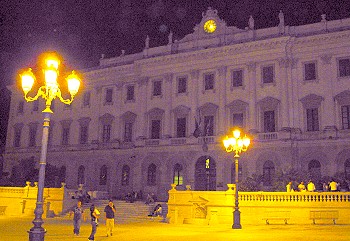
Our quest for mirto took us to Piazza Italia, home of the only clock in Sassari that told the correct time. It resides on the provincial capital building, the Provincia di Sassari. After dark, Sassari really comes alive.
The plaza was filled with outdoor cafes, strolling families, necking teenagers and, as always, the old guys sitting on benches, watching.
Situated at an outdoor table, we started with the Mirto Rossa. Very sweet, thirty-two percent alcohol, with a back taste of herbs.
We enjoyed some people watching, letting some time pass, hoping that the effects of the drink would not be too harsh. Still coherent, we shared a Mirto Bianca. The herbal taste of the Bianca is more obvious, as the sweetness of the berries has been eliminated.
Again we wait for the hallucinations. Nothing.
Our study concluded that while Mirto will warm your spirit, its probably best not to expect a mind-expanding experience, but it may make you want to exclaim the local howl of “Aiooo!”
David & Veronica,
GypsyNester.com
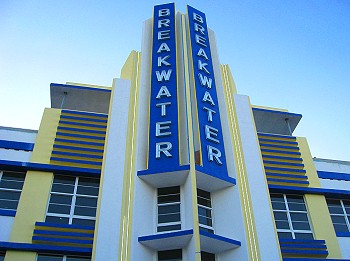 Rockin’ razor-sharp hedges, fast cars and over-the-top opulence is just one way to stand out in an area known for its conspicuous “check me out” attitude.
But we’ll stick to the more frivolous for our… CONTINUE READING >>
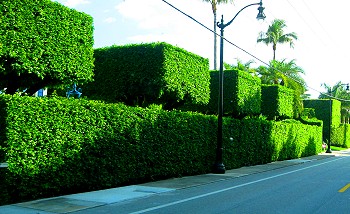
The Florida we know today was mostly brought about by the efforts of one man and it wasn’t Walt Disney, though by the looks of the crazily clipped hedges in Palm Beach we would have never guessed it.
As we discovered in St. Augustine, Henry Flagler was Mr. Florida.
One of Flagler’s first realizations – if he was to transform this subtropical backwater into a premiere winter playground – was the need to get the filthy rich to Florida in some semblance of style.
He proceeded to blow some of the dough he had piled up as a founder of Standard Oil Company buying up the railroads around the state, connecting them into The Florida East Coast Railway, then expanding the tracks southward.
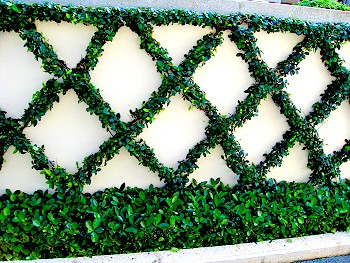
Following his route along the Atlantic seaboard brought us to Florida’s first exclusively resort town, Palm Beach.
The town only exists because of Flagler’s vision for the perfect winter retreat. We believe that the obsessive affinity for razor sharp hedges came later.
The fulfillment of that vision took the form of the largest wooden structure in the world, The Royal Poinciana Hotel. Turn of the century VIPs could pull right up to the door in their private rail cars and and party like it was 1899.
The downside was that The Poinciana faced the mainland, not out to sea. Guests wanted to stay near the ocean “by the breakers.” Seems like a huge miscalculation on visionary Flagler’s part, but hey, we all make mistakes.
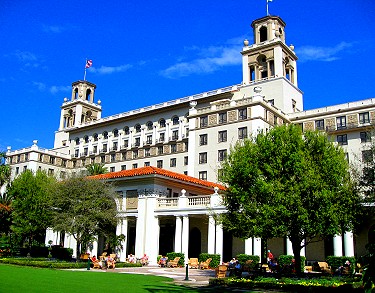
Flagler was nobody’s fool, so he built another hotel, The Breakers, on the Atlantic beach.
The Royal Poinciana fell quickly out of fashion and was torn down in 1935, but The Breakers rocks on to this day as one of Florida’s swankiest resort destinations.
Not exactly our kind of hangout, but we wanted to at least get a glimpse of it.
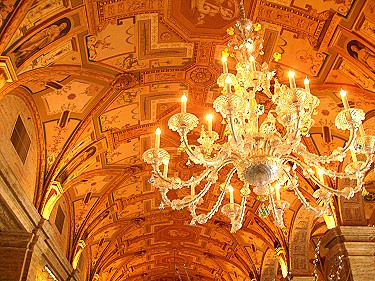
Now BAMF is not exactly a luxury car, but we pulled him right up to the valet anyway, getting aghast looks from the clientele.
Gotta love keeping ’em on their toes – they looked kind of bored before they noticed us – we were happy to provide a scandalous diversion. However, the parking lot personnel seemed quite amused by BAMF’s defiant presence.
After assuring them that we intended to purchase our mid-day repast inside, we were directed to park BAMF in a spot by the tour buses and walked into the luxurious lobby like we owned the joint.
We wore our dress flip-flops and long pants, so we fit right in.
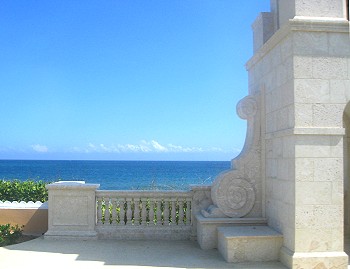
Trying not to gawk like hillbillies, we moseyed through to the walkway along the sea wall, then followed the path around the grand old inn’s gardens to the croquet and tennis courts.
There is no doubt that this is an impressive place to crash for a night or two, but we weren’t really in the mood to take out a mortgage for a $1,250.00 oceanfront suite. Too much paperwork.
We could have settled for the $350.00 regular room, but what’s the point when we have a perfectly good BAMF out in the parking lot? None. Anyway, we said we were going to have lunch and our word is our bond so… off to find some lunch.
After being turned away from the first two restaurants we came upon, we discovered that the dining options are extremely limited for non-hotel-guest riffraff that might wander in off the streets in an ancient motorhome.
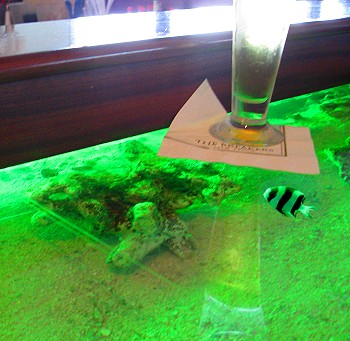
Our only choice was the Seafood Bar, a beautiful setting overlooking the breaking waves of the Atlantic and a seat at a bar that is actually a giant color-changing aquarium.
It’s pretty cool to have little tropical fish swimming under one’s seven dollar domestic beer. Hey, atmosphere comes at a price baby. One look at the menu proved atmosphere came pretty damn high indeed.
Good thing we weren’t too hungry, ’cause for a couple $48 steaks, $21 shrimp cocktails and $14 salads we could have had a room for a night… or bought groceries for about a month.
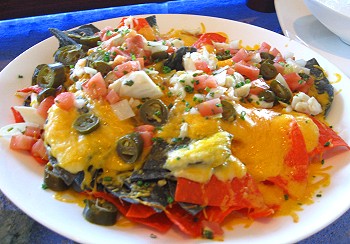
We opted to split the Crab Nachos, a bargain at $26.50. Now, all sarcasm aside, these really could be considered a good deal because – slap my ass and call me Pappy – these were amazing!
These were not your everyday run-of-the-mill nachos with some scrawny canned crab tossed on top, they were inspired.
Tortillas on a bed of cheddar grits with marinated sweet onions, tomatoes, jalapeños, piled high with fresh crab meat, and garnished with toasted cumin and lime sour cream. Call me Pappy one more time – just for good measure.
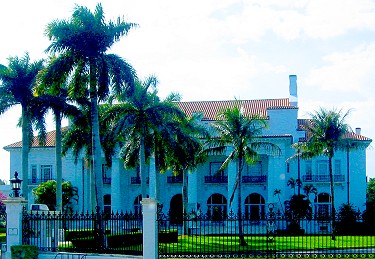
Now we don’t know if Mr. Flagler had anybody call him Pappy or not, but in 1902 he built a winter retreat for the wife as a wedding present, and called it Whitehall.
It might seem a tad ostentatious to name one’s little romantic getaway, but really this was just a modest fifty-five room mansion. It only cost a small fortune, really, it’s nothing. It stands today as The Flagler Museum, and yes, it is still jammin’.
As grand as The Breakers, Whitehall and Palm Beach were, Flagler wasn’t finished with his Florida fantasies just yet. When a big freeze hit Palm Beach in the winter of 1894-’95, Henry decided to push even further down the peninsula.
Stories were circulating that the citrus crop down by Biscayne Bay – the site of present day Miami – had survived just fine. It was time too lay tracks.
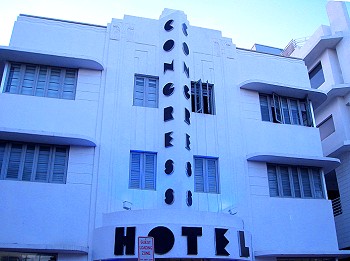
Once again we ventured BAMF deep into a circumstance that no funky, twenty-nine year old motorhome should be exposed to… Ocean Drive, South Beach, on a Friday evening.
We got some looks and several valets tried to lure us into their clubs, not so much for our business – they just wanted to drive BAMF. Wasn’t gonna happen – we were cruising.
We took several passes up and down the beachside boulevard, checking out the Streamline Moderne (intended to give the sensation of speed) and Nautical Moderne (designed to look like ocean liners) styled hotels.
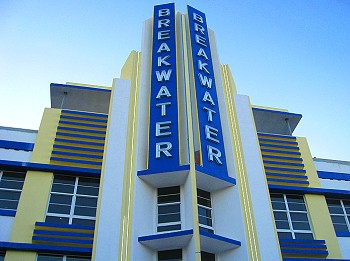
These famous Art Deco hotels began appearing in the 1930s and has since become the largest collection of Art Deco architecture in the world. Absolutely amazing.
Our timing was perfect, as the sun was setting the neon was coming to life.
Something else was coming to life too. An all out, no holds barred battle for attention. Folks were using whatever they had available, women sporting their surgically enhanced attributes in tiny, yet very expensive outfits, and men revving their finely tuned Italian engines.
This is no exaggeration, we saw more Lamborghinis, Maseratis and Ferraris in this one evening than in our entire lives – they’re every third car. BAMF fit right in. We thought about revving his Chevy 350 at a guy at a stop light, but decided not embarrass the dude in his puny little Maserati.
We knew he was compensating.
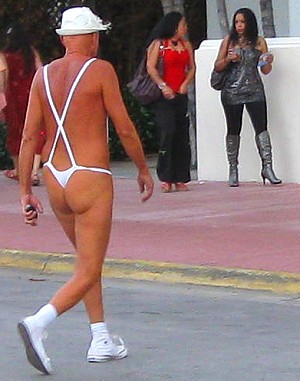
Then it happened. We spotted the one guy in South Beach who wasn’t even remotely trying to compensate. He was putting it all out there for the world to see.
Words fail us here, this is something that has to be seen to be fully grasped.
Basically we were looking at a dapper, Swiss-themed middle-aged fellow wearing a shoestring cleverly contorted around his neck, down through his butt crack and then holding a custom fitted sock for his, um, pee-pee, schwang, junk, hoo ha, yahoo, no, johnson… no wait, let’s go with package, that’s pretty safe.
We’ll say that. Package.
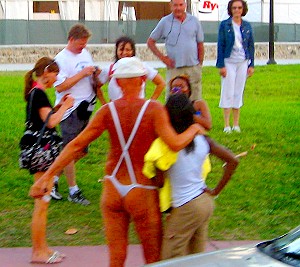
Got to give him this, he was not shy. He actually turned out to be a really nice guy that told us that he just enjoys “doing his own little thing.”
As he walked jauntily from the beach through the sidewalk cafes (the package in close proximity to patron’s plates), he sweetly and patiently posed for pictures and left all who saw him with a smile on their face.
His “little thing” brought joy to others, and he, in return, received joy.
Rockin’ razor-sharp hedges, fast cars and over-the-top opulence is just one way to stand out in an area known for its conspicuous “check me out” attitude. But we’ll stick to the more frivolous for our entertainment buck.
Give us a BAMF and Swiss-themed tan line any day.
David & Veronica, GypsyNester.com
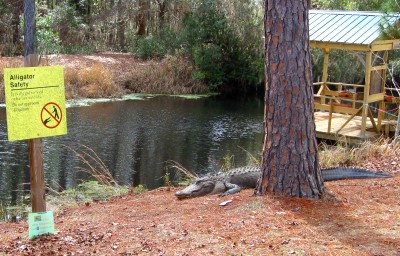 Yes, the Okefenokee Swamp is a real place – and we were up to our elbows in alligators!
Two things struck us, first, someone should try using an alligator next time they want to set the long jump world’s record and, second, The Okefenokee’s most famous resident, Pogo, had it wrong. We have met the enemy and he sure ain’t us. He’s all teeth and…. CONTINUE READING >>
Our travels through the Carolinas and Georgia had been exclusively along the Atlantic coast, perhaps the time had come to see what treasures lay inland.
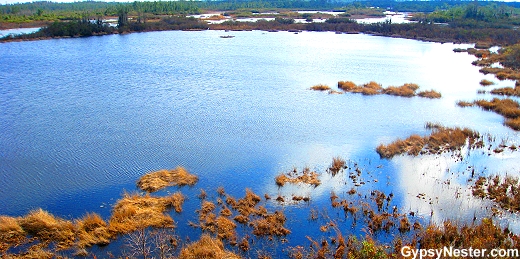
We didn’t have to go far inland before we hit water again, or at least swamp, because a huge chunk of south central Georgia is covered by the Okefenokee Swamp.
The funny name comes from an even funnier spelling, okifanô:ki, meaning “land of the trembling earth” in the original Hitchiti.
The language may be long extinct but the name for this six hundred square mile swath of black water bog endured.
In 1937 the United States government bought up the mushy land and protected the area as the Okefenokee National Wildlife Refuge.
We entered the Refuge from the east and proceeded to the main visitors center – walking inside without even noticing the twelve foot long alligator hanging out right beside the building.
Meet Kay! She & her husband volunteer at National Parks – check out how easy it is to help out AND see the USA!
The resident park volunteer host, a wonderful woman named Kay, greeted us and gave us a whole host of information before guiding us into a little theater for a short introductory film.
After the movie we chatted Kay up some more and discovered that she and her husband had gone gypsy a few years ago, spending most of their time going from park to park as volunteers.
They usually stay for about three months at each place and love it because it’s a great way to really get to know some of America’s natural wonders. As a bonus, they receive free lodging in these beautiful places and meet people from all over the world.
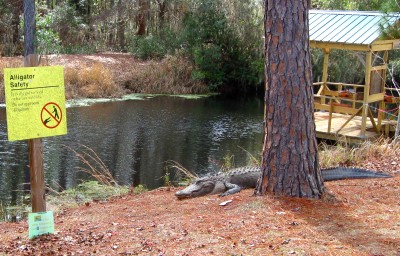
On our way out Kay pointed out the giant man-eating reptile hanging out within a few feet of the building. Whoa, how’d we miss that!
Not to worry she says, he’s just sunning himself, and gators are very lazy. We watched him for awhile, several minutes, even moving around him, and he didn’t budge.
Other than his creepy eyes following our every move, we would have never known he was alive. Maybe Kay is right, he was crazy lazy – or just not hungry for human at the moment. Maybe he had people for breakfast.
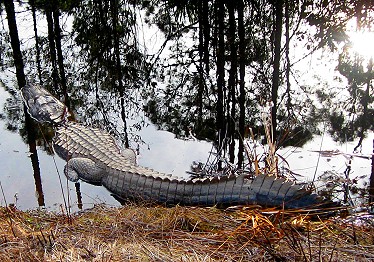
As we drove out along Swamp Island Drive, it wasn’t long before we saw a gator in the water on the side of the road.
Veronica bailed out of BAMF before I could even come to a full stop.
Now we know alligators are dangerous, at least that’s what we were told in Louisiana, but here they assume that anyone with a modicum of common sense should be able to figure out that a future purse, pair of shoes or piece of luggage over ten feet long with teeth like a tiger should be left alone.
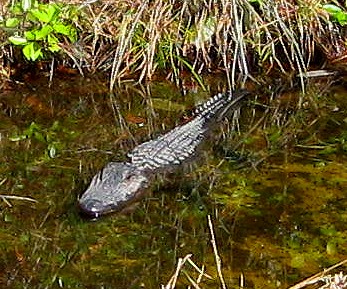
It wasn’t that Veronica didn’t want to leave him alone, she just wanted to leave him alone from much closer.
As I pulled up beside Veronica, I heard a horrible hiss that sounded like it came from the bowels of the Earth, and she jumped back about thirty feet in one leap.
Two things struck me, first, someone should try using an alligator next time they want to set the long jump world’s record and, second, The Okefenokee’s most famous resident, Pogo, had it wrong. We have met the enemy and he sure ain’t us. He’s all teeth and tail.
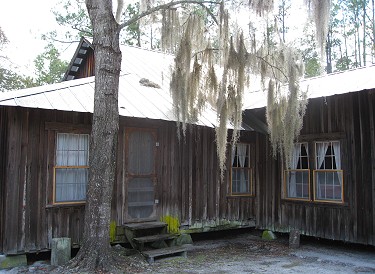
Back in the safety of BAMF, we drove to the Chesser Island Homestead. Late in the 1800s W. T. Chesser and his family settled an island at the edge of the swamp.
The family survived on what they could grow, hunt or fish and raised a little spendin’ cash growing sugar cane and making turpentine from the prevalent pine trees.
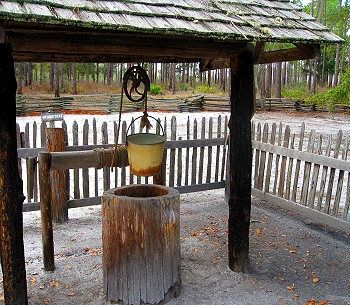
The Chessers lived here for generations, with grandson Tom building the present house in 1927.
The yards of the house and surrounding outbuildings were cleared of vegetation, down to bare sand to help prevent fires and the ever present bugs from reaching them. Wicked smart.
After the Wildlife Refuge was created, Tom stayed on the homestead and worked for the park for seventeen years, to ensure that things were perfectly preserved as an accurate glimpse of what swamp life was like nearly a century ago.
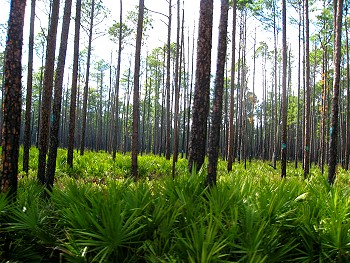
At the end of the Swamp Island Drive we came to the Swamp Walk Boardwalk.
This wooden walkway stretches about a mile out over the marsh to the Owl’s Roost Tower. Along the way there are numbered stops that point out interesting spots for viewing birds, wildlife and even carnivorous plants.
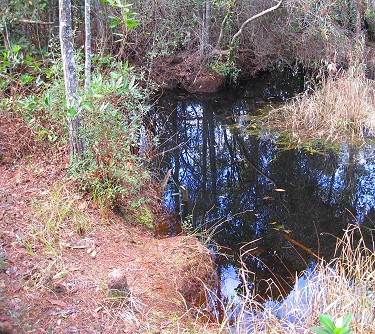
First stop, an alligator hole. The big boys stay in fighting shape by digging tunnels to connect their favorite hangouts by underground waterways.
No one was home when we stopped by or, if he was we couldn’t spot him. As a precaution, we decided that taking a swim would be a colossally bad idea. We opted to obey all rules and stay safely on the boardwalk.
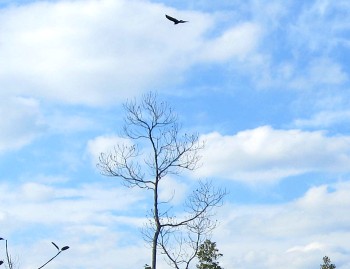
A spur off the main trail led to a bird viewing area, where we saw several hawks gliding overhead looking for lunch and wild turkeys foraging, possibly waiting to be lunch.
All manner of unseen avian activity could be heard out in the jungle.
The Refuge is home to dozens of species of birds that nest here or pass through on their migrations. Depending on the time of year, osprey, cranes, herons, egrets, Ibis, kingfishers, woodpeckers, warblers, nuthatches, coots, purple martins and even a chuck will’s widow or two might be spotted.
No telling which ones of those were making all the racket around us.
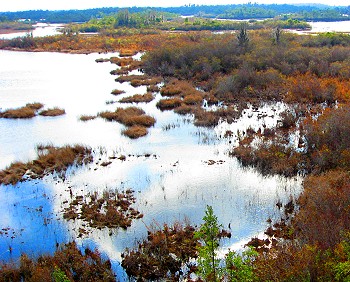
The tower at the end of the trail overlooks Seagrove Lake. It gives a view that is worth every step up the fifty feet to the top.
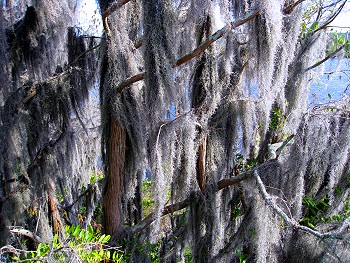
From that height we were above the Spanish mossed tree tops and could see for miles. Spectacular.
We sat in the tower for an hour, eating our lunch, basking in the afternoon sun and oohing and ahhing over our glorious surroundings.
Not another human being showed up to break our commune with nature or overhear our refrains of the classic song from The Who… “I can see for miles and miles and miles and miles and miles.”
Oh yeah-ah.
David & Veronica, GypsyNester.com
enlarge video
Our walk along The Boardwark deep into the Okefenokee Swamp – and, yes, there be alligators! Lots and lots of… CONTINUE READING >>
Our walk along The Boardwark deep into the Okefenokee Swamp – and, yes, there be alligators! Lots and lots of gators.
The tower at the end of the trail overlooks Seagrove Lake. It gives a view that is worth every step up the fifty feet to the top. From that height we were above the Spanish mossed tree tops and could see for miles. Spectacular.
For more: https://www.gypsynester.com/oke.htm
Visit our GypsyNester YouTube Channel!