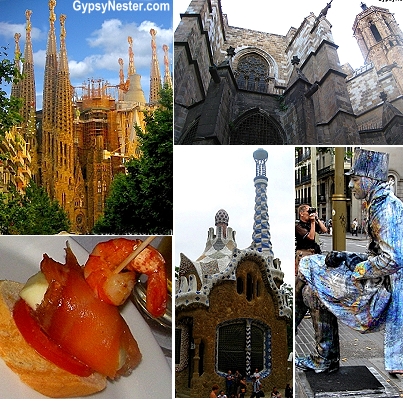
Barcelona, Spain. Home to the most amazing church we’ve ever seen, a Gothic Quarter not to be missed, crazy wonderful human statues, and food to die for. If that’s not enough, meet a genius artist that changed the city forever and invokes so much emotion – you have to either love him or hate him… CONTINUE READING >>
Worship the Sagrada Família
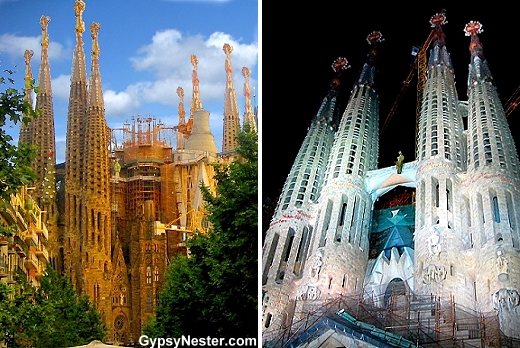
Barcelona has many treasures, but one stood out to us above all the others, literally and figuratively, Sagrada Família. The massive basilica is without a doubt the pinnacle of architect and designer Antoni Gaudí’s incredible career. And we do mean pinnacle. Huge spires rise into the sky over fifty stories high – and it’s not even finished yet. More Sagrada Família…
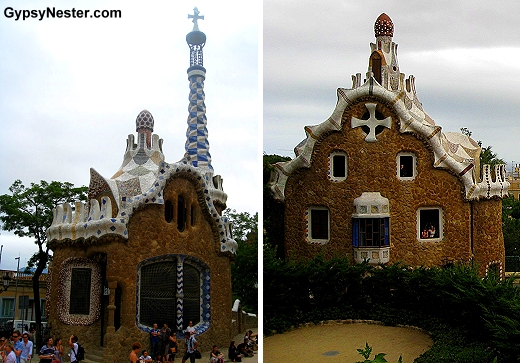
Visit the Fantastical Park Güell
Barcelona quite frankly would not be the city that it is today had it not been for Antoni Gaudí. A walk up several hundred steps, to one of the world’s wildest parks, showed us how Gaudí really got to cut loose, not as a builder, but as a landscape architect. His concept’s incredible interaction with the natural world had us feeling like we were inside the pages of a Dr. Seuss book. More about Park Güell…
WATCH: Step insidePark Güell
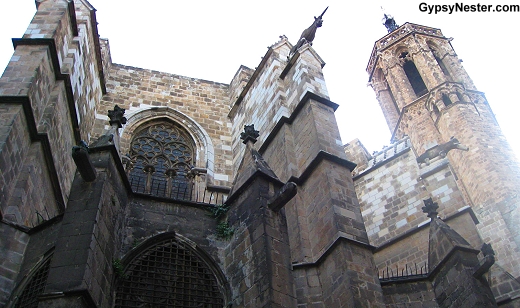
Go Goth – Explore the Barri Gòtic
If the heart of Barcelona is the old city’s Gothic Quarter, known as Barri Gòtic in the local Catalan dialect, then the aorta must be La Rambla. The stretch of streets has become one giant open air theater and is truly one of the world’s premier venues for street performers. More Gothic Quarter…
What would a visit to Spain be without sampling the tapas? Incomplete we’d say. But then tapas are a culinary style that is right up our alley, kind of a national tradition of appy crawling. We were determined to get our mitts on every type of tapa we could during our stay in Barcelona. We believe we achieved greatness. More on Tapas…
Rome may not have been built in a day, but Pompeii was certainly destroyed in one.
Because of the unique nature of the calamity that buried the city, we have an incredibly well preserved peek into every day life two thousand years ago in The Roman Empire.
We had an amazing amount of history and emotion to absorb, making our day at Pompeii one of the most incredible… CONTINUE READING >>
Rome may not have been built in a day, but Pompeii was certainly destroyed in one.
Because of the unique nature of the calamity that buried the city, we have an incredibly well preserved peek into every day life two thousand years ago in The Roman Empire.
On our journey across The Mediterranean aboard The Royal Princess we would encounter a number of prominent historic sites, but this was without a doubt the most dramatic.
When Mount Vesuvius violently erupted in 79 AD the 20,000 citizens of Pompeii were essentially frozen in time, sealed under seventy five feet of volcanic ash and rock known as tephra.
One of the first things we learned at the site was that the material did not fall from the sky like snow, that would have allowed time for escape.
Instead the volcano created a pyroclastic flow, an avalanche of super heated gas carrying the tephra down the mountain at hundreds of miles per hour and instantly covering everything in its path.
For fifteen hundred years the city remained under this blanket of stone, long forgotten until a wall was accidentally uncovered in 1599.
It would be another one hundred and fifty years before serious excavations took place.
Now about two-thirds of the city has been excavated, but most attention is being directed at preserving the currently exposed ruins.
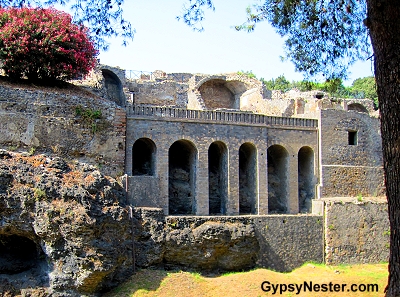
While we made our way to the gate we were blown away by the outer wall, and frantically snapped pictures while trying to keep up with our group.
We didn’t want to miss any of the information our guide was giving, but could barely believe what we were seeing.
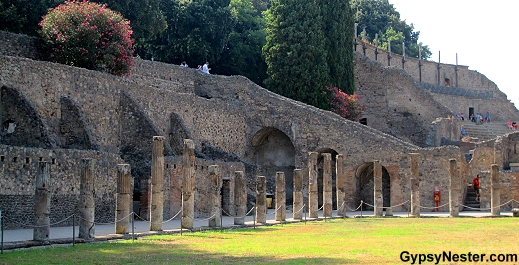
Passing into the city through the Porta di Nocera we found ourselves in The Grand Palestra, a large open area surrounded by columns that is thought to have been a training area for athletes. There was even a huge swimming pool in the center.
Some of the training was likely in preparation for the gladiator’s performances in the adjacent amphitheater.
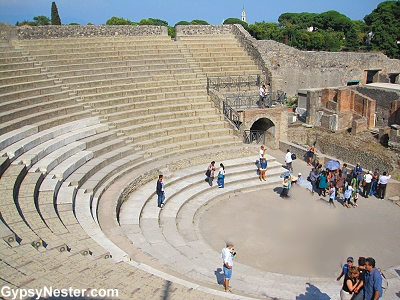
Entering the amphitheater we were stunned by the condition, it is in great shape.
In fact it is still fully functional, so much so that Pink Floyd recorded their Live at Pompeii concert film in it. Pretty remarkable for the oldest Roman theater known to exist.
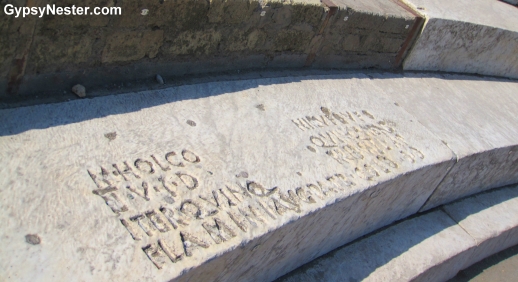
Names engraved on the stadium seats. Season tickets, mayhaps?
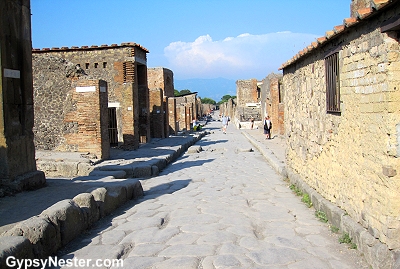
Leaving the theater we meandered through narrow side streets that almost looked as if they could be in the old quarters of any modern Italian city.
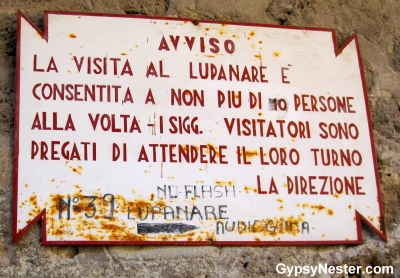
While we walked, we poked our heads into several homes and shops before arriving at the Lupanar.
Lupanar is a common Latin term for brothel, and this was easy for the excavators to identify by the suggestive sex scenes painted on the walls.
Speculation is that the erotic paintings may have served as a menu of sorts. If that weren’t enough for a positive ID, rather lurid graffiti was also found left by both the customers and the workers.
Working our way toward The Forum, we learned about a couple ingenious features built into the roads.
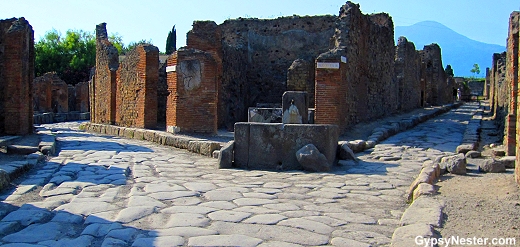
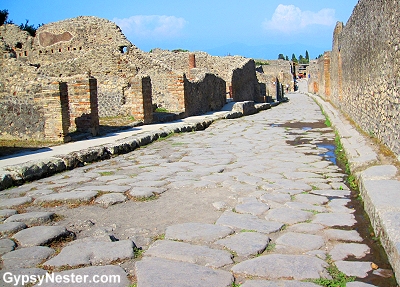
Roads doubled as sewers, so sidewalks were made much higher than modern ones, and periodically large stones were placed in the middle of streets to use as crosswalks.
They served the dual purpose of allowing pedestrians to avoid walking in the disgusting mess and slowing cart traffic by forcing them to navigate their wheels between the rocks.
In some places we could even see ruts in the cobblestones left by the ancient chariots.
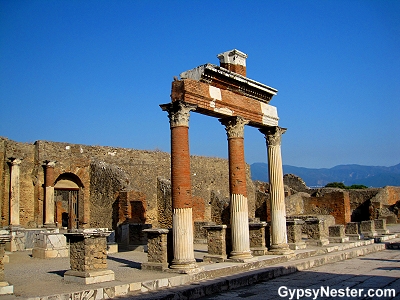
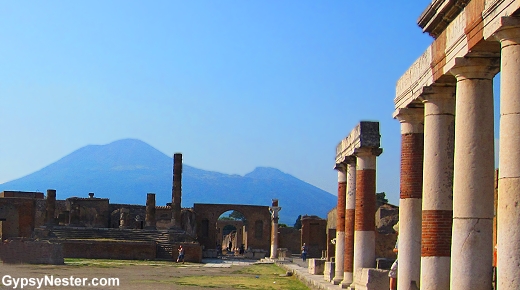
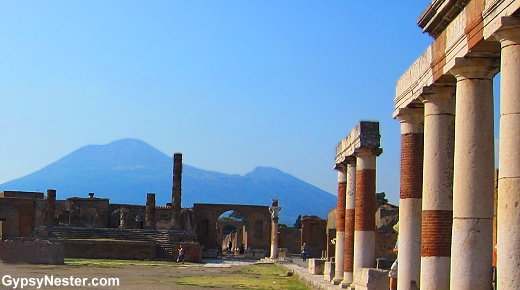
Pompeii, like any Roman city, was built around The Forum, which became the center for the rest of our tour.
Temples, government buildings, businesses, and baths surround the stadium-sized open area where citizens gathered in the shadow of their ultimate demise, Mount Vesuvius.
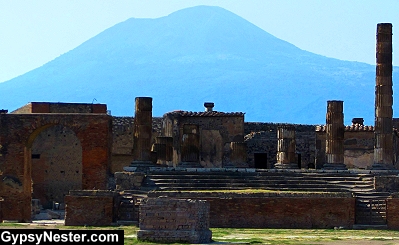
The Temple of Jupiter with Mount Vesuvisus in the background.
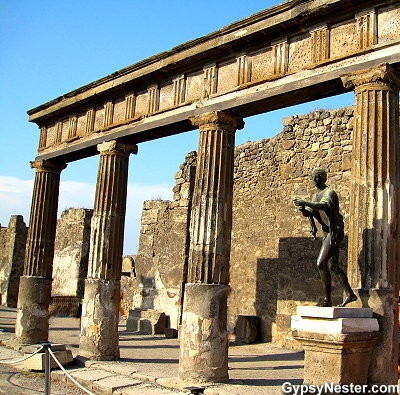
The Temple of Apollo, in the center of The Forum, was perhaps the most important religious shrine to the people of Pompeii, as The Cult of Apollo had been popular for centuries after spreading throughout the religion from Greece.
Unlike most other Greek gods, the Romans didn’t have an equivalent to Apollo so there are temples all across the former empire in his honor.
However, as the ruler of the gods, Jupiter’s temple held the prime real estate of The Forum, overlooking the entire plaza.
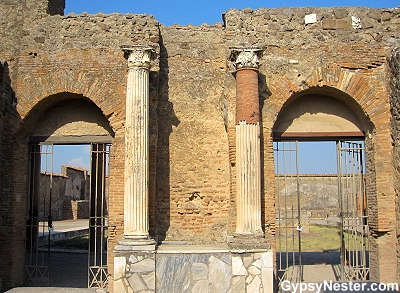
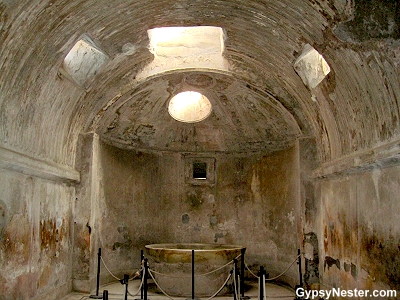
It is not nearly as well preserved as many of the other buildings, but just behind it may be the most intact of all the ruins, The Forum Baths.
These are one of three public baths and survived the eruption remarkably well.
Unlike most all of the other buildings, the roof of the baths remained in place so the inside was relatively unharmed.
In the neighborhood around the baths we got our best glimpse at regular life in a Roman city.
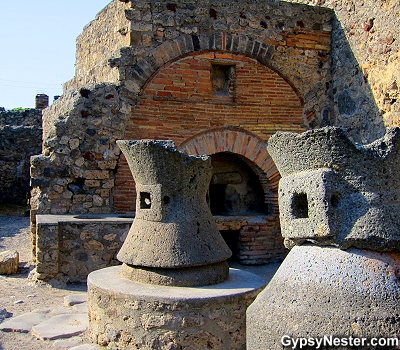
On one corner we found a bakery with large grinding stones in the yard and a brick oven that still looked as though a loaf of bread, or even a wood-fired pizza, could pop out any moment.
Curious, we tried to see if the millstones would move and to our surprise they turned with ease.
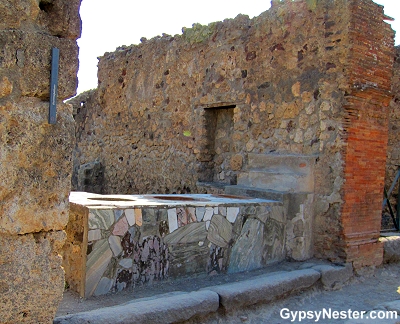
Across the street is one of the several bars or cafes that served the city. The counter is decorated with inlaid stone and even has holes on top for the pots of wine and food.
It was easy to imagine the customers lining up to grab a bite at lunch or on their way home. Some things never change.
One of Pompeii’s most famous homes is also nearby, the House of the Tragic Poet.
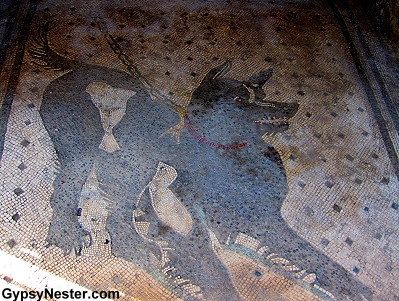
On the floor of the entryway we could still read the mosaic showing a chained dog with the words Cave Canem written below it.
Even two thousand years ago home owners were warning would-be burglars to Beware of the Dog.
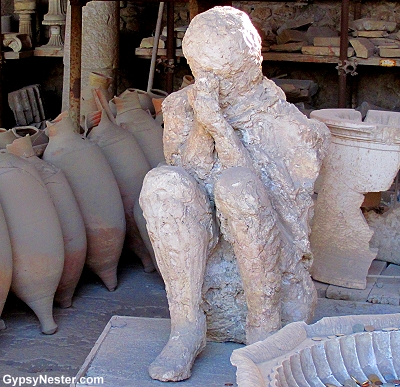
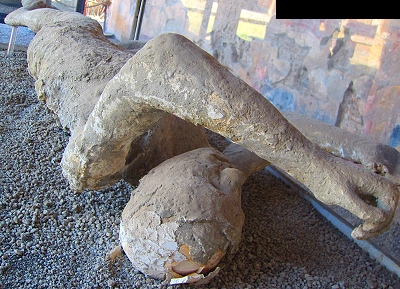
Our last stop before going back outside the walls was the Forum Granary. Originally a storage facility and market for grain, it now houses a treasure of artifacts along with the disturbing, yet mesmerizing plaster casts of a few of the casualties.
The long, open building has been filled with shelves to hold a large number of clay storage pots, statues, stonework, and other items recovered during the excavation.
While these are all interesting and of great historical value, most everybody’s attention was focused on the human figures.
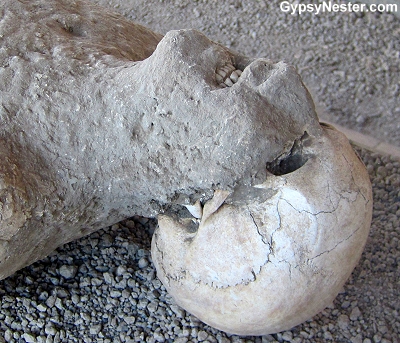
After taking over the excavations in 1863, Giuseppe Fiorelli realized that the open pockets of air he was periodically encountering were actually spaces left by bodies.
The extreme heat of the pyroclastic flow killed the victims and time did the rest, leaving what turned out to be molds that captured the moment of death.
It was his idea to fill the spaces with plaster, then carefully remove the surrounding volcanic material.
Viewing these stark statues brought a hush over everyone present.
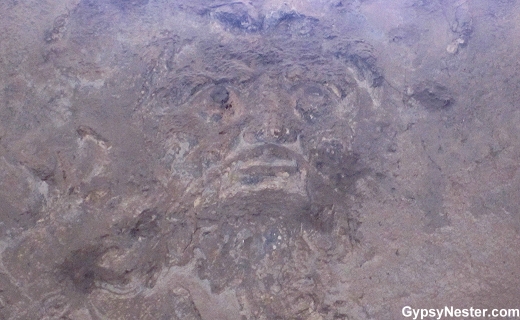
It is difficult to describe our reactions, but it was a somber, moving experience to witness the anguish immortalized by the body positions, and on the featureless, yet expressive faces of these ancient sufferers.
We left the city quietly, with an amazing amount of history and emotion to absorb, but positive that this had been one of the most incredible days of our lives.
Pompeii, like any Roman city, was built around The Forum. Temples, government buildings, businesses, and baths surround the stadium-sized open area where citizens gathered in the shadow of their ultimate demise, Mount Vesuvius… CONTINUE READING >>
Thanks to Princess Cruises for inviting us along and providing this adventure! As always, all opinions are our own.
Pompeii, like any Roman city, was built around The Forum.
Temples, government buildings, businesses, and baths surround the stadium-sized open area where citizens gathered in the shadow of their ultimate demise, Mount Vesuvius.
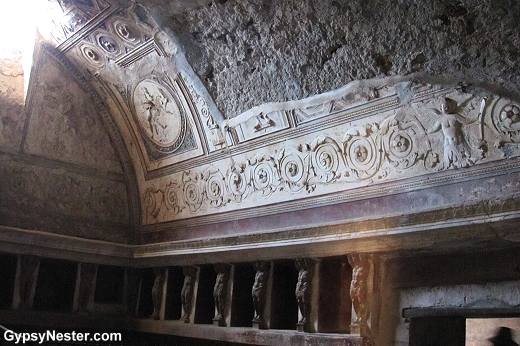
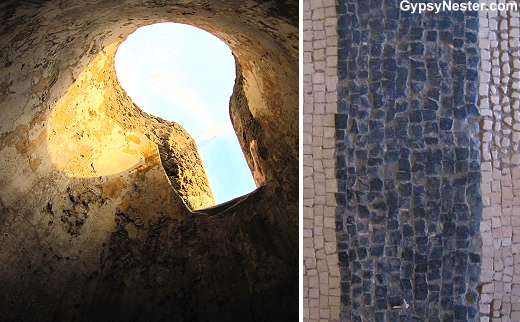
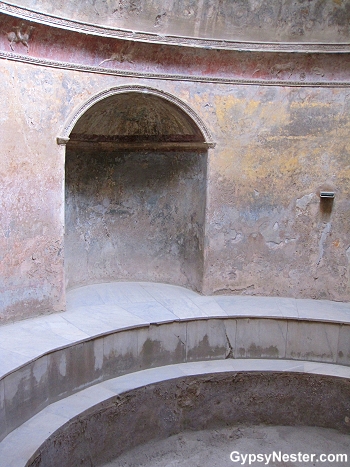
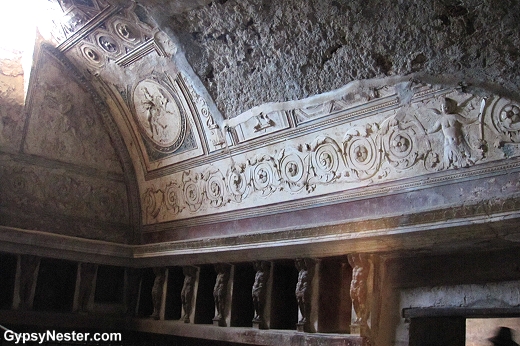
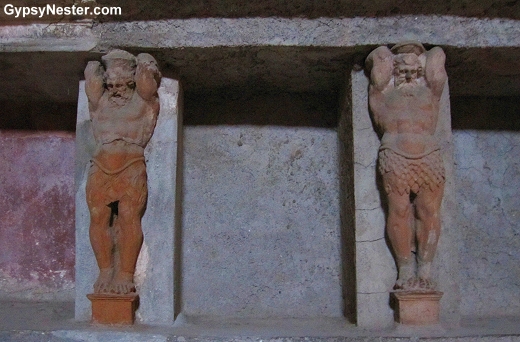
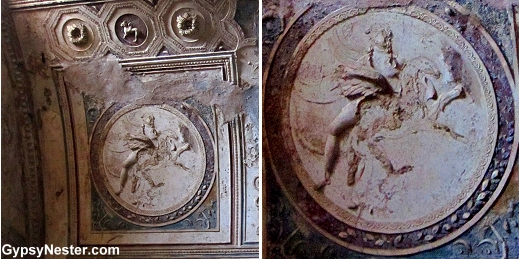
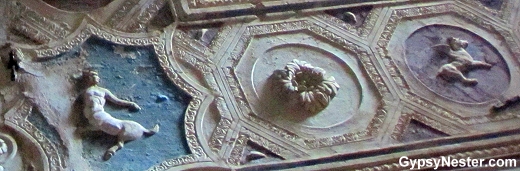
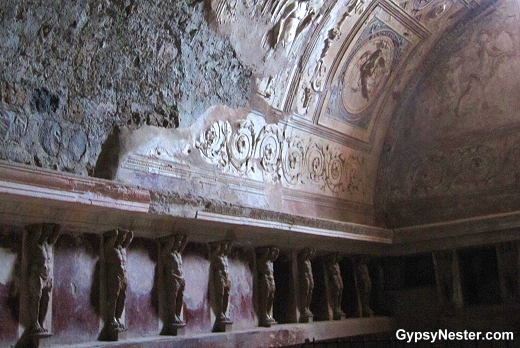
The Forum Baths maybe the most intact of the ruins of Pompeii. These are one of three public baths and survived the eruption remarkably well.
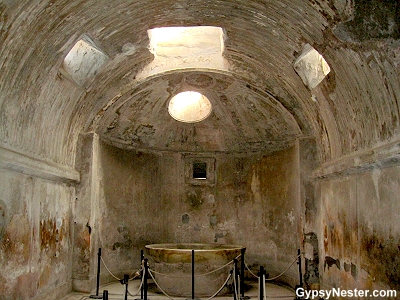
Top to bottom; the ceiling and floor
Unlike most all of the other buildings, the roof of the baths remained in place so the inside was relatively unharmed.
The ornate decorations and many of the frescos survived, so we got a fairly good feel for what it would have been like to take a soak back in the first century BC.
Our daughter, Decibel, spent a whopping twenty minutes at the college of her choice, Tulane University. She never attended a single class. It has to be the shortest college career in history.
There was a storm a brewin‘. And it was a whopper.
On a beautiful August day, Decibel landed in New Orleans ready to take on the world. She was especially giddy since she had been chosen from the pool of incoming freshman in the Musical Theater program to sing at orientation — a high honor indeed. Not to mention instant… CONTINUE READING >>
Our daughter, Decibel, spent a whopping twenty minutes at the college of her choice, Tulane University. She never attended a single class. It has to be the shortest college career in history.
There was a storm a brewin’. And it was a whopper.
On a beautiful August day, Decibel landed in New Orleans ready to take on the world. She was especially giddy since she had been chosen from the pool of incoming freshman in the Musical Theater program to sing at orientation — a high honor indeed. Not to mention instant popularity — a chance to be a rock star right off the bat.
After getting her student ID and visiting her fourth-floor dorm room, complete with a picture window overlooking the quad, David and the understandably nervous/eager Decibel headed to the orientation and the Big Debut.
But it was not to be.
Upon arrival, the president of Tulane took the stage and announced that the school was to evacuate immediately. Any student without means to leave the city was to report to the buses waiting to whisk them away to Shreveport. A Category 5 hurricane was barreling toward New Orleans. Katrina was on her way, and she was pissed.
Here’s the irony of the situation:
Decibel and her siblings graduated from high school on the Caribbean island of St. Croix. Every hurricane season we became Weather Channel junkies. For nearly half the year water cooler discussions were almost exclusively limited to storm tracking, survival stories and theories on tropical weather patterns.
We all lived in steel reinforced cinder-block houses piled high with canned food, drinking water and generators. When living on an island everyone must prepare for the worst – it’s not like we could get in a car and drive away when a hurricane was on the war path.
In the eight years we lived on our island paradise, we encountered one small hurricane. No major destruction was reported. Electricity was amazingly restored within twelve hours.
Now, in New Orleans, our luck had run dry.
Fortunately, David had rented a car because by that afternoon the only way out was by road. After stocking up on food and water for the drive — and very afraid Katrina would make landfall while they were stuck in traffic — Decibel and David headed north on the packed interstate with all lanes heading north.
It took fourteen hours to get to Memphis, normally a six hour trip, where they found a hotel room at four in the morning to wait it out. Meanwhile Katrina destroyed New Orleans.
Tulane University announced later in the week that they would not start classes until the following January.
An amazing outpouring of goodwill was extended by almost every college in the nation. Tulane students were offered immediate placement for the fall semester, with the tuition to be worked out with Tulane after the dust settled. Decibel chose to join her older sister, The Piglet, at school in D.C..
As a mom of multiple spawn, I am regularly astounded at how different each of my offspring are. The college that had opened up so many opportunities for The Piglet was a complete disaster for Decibel. A mismatch of epic proportions.
All of the labor Decibel had put forth in high school to find her best-suited college was blown right out the window, quite literally. She was miserable. I constantly worried.
That Thanksgiving, our family met up in New Orleans to see if the city was in any shape for Decibel to return for classes in January. It had to be the saddest trip I’ve ever made. The city was a wasteland. Mile upon mile of utter devastation.
Tulane seemed to be in fairly good shape — but it was difficult to imagine sending an eighteen-year-old to a city with so many challenges to overcome. The decision was, of course, ultimately Decibel’s and she had other plans.
While in Washington, Decibel had auditioned for and was giddily accepted into a performing arts school in New York City. That first disastrous semester in D.C. had taught her many things and academics were no longer on her radar screen.
I’m not gonna lie, I had huge reservations. But at least she wouldn’t need a car in NYC — and we’re ALL safer for that — I love the girl with all my heart, but she’s a terrible driver.
It’s funny how the world works. My kids attended a tiny high school on a tiny island with only forty kids in their graduating classes. Two of them now live in a city with a subway system that stuffs more people than that into each car.
Decibel’s journey into adult life began with a storm. Like New Orleans, she came out of it with grace and beauty.
Text $10:
It’s so easy to help! Text REDCROSS to 90999 to give $10 to American Red Cross Disaster Relief Fund
Moral Support:
The Nomad Couple, Heart & Matt, grateful that their family has been spared the worst, have lovingly created a forum to send thoughts and prayers of hope to the people in the midst of this tragedy. To offer your support in this way, click here