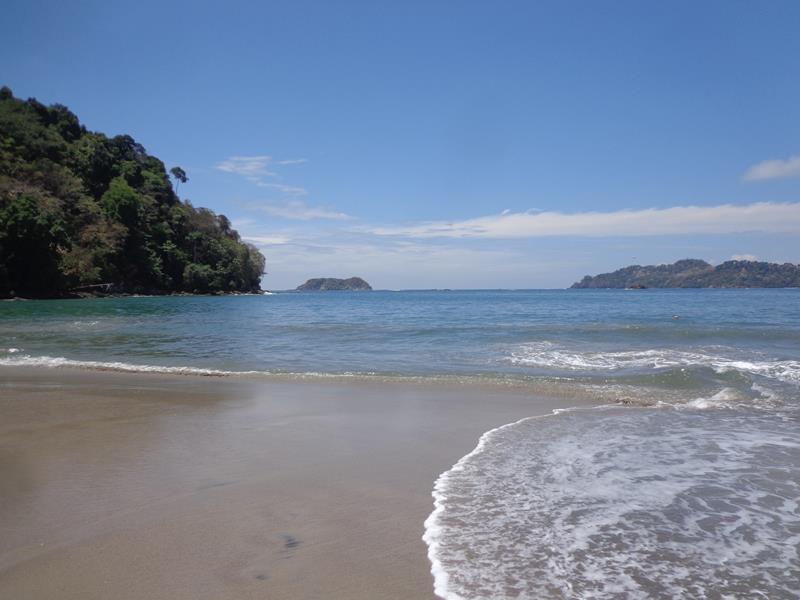
Get swept away by the perfect beaches, incredible food, and relaxed lifestyle – but be sure not to miss these key cultural reference points during your BVI sailing!
While sailing around the idyllic British Virgin Islands, it’s easy to get swept away by the perfect beaches, incredible food, and relaxed lifestyle. You can even book a private wellness resort like The Aerial BVI to elevate your conscience.
However, there is more to these islands than rum and snorkelling. If you embark on a BVI bareboat charter, you’ll soon find that the islands boast a deep history and rich culture that can be explored in the various museums and other landmarks.
Callwood Rum Distillery While the British Virgin Islands may not be ALL about rum, it does play an important part in the history and economy of the islands. The production of rum originated in the Caribbean in the mid-1600s and remains a profitable business today. The Callwood Rum Distillery is the only continuously operating rum distillery in the British Virgin Islands and offers samples of its different types of rum. The rum here is made with locally sourced sugar cane rather than molasses, which is what makes Caribbean rum unique to the islands.
Her Majesty’s Prison This historical prison has the distinction of being the oldest building in Road Town on the island of Tortola. Construction was completed in 1774, and the building was used as a prison until 1997 when the prison was moved to a new location in Balsam’s Ghut. In 1811, plantation owner Arthur W. Hodge was executed by hanging after being convicted of the brutal murder of one of his slaves. In December of 2016, the facility reopened to the public as a museum.
North Shore Shell Museum No beach visit is complete without finding some interesting shells, and the North Shore Shell Museum is the perfect place to do just that. Owner Egbert Donovan has filled his quirky “museum” with shells and signs that he has collected over the past 25 years. Local children create crafts with the shells, and proceeds from the sales go to the schools in the area. Patrons are not charged admission but can leave a donation if they wish.
RMS Rhone
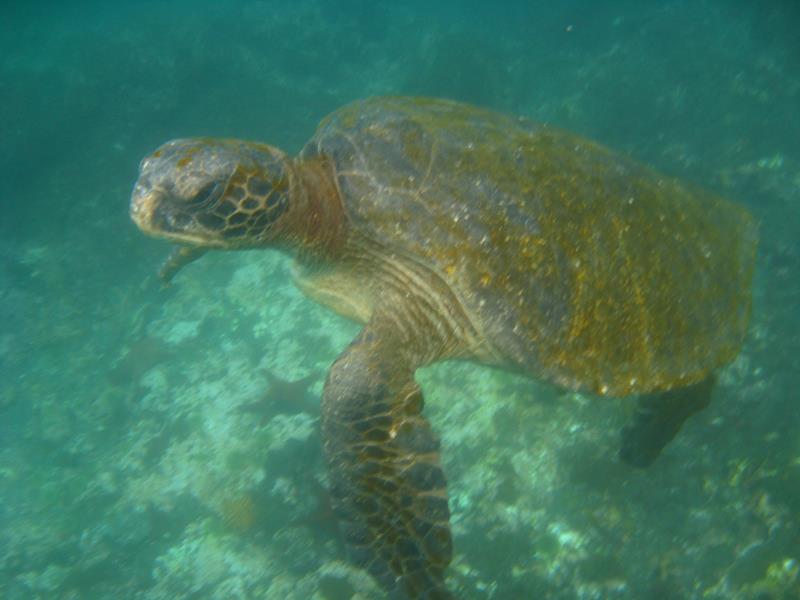
The wreckage of the RMS Rhone provides a spectacular dive experience for those craving some underwater time. The Royal Mail Steamer Rhone sunk in 1867 during a hurricane and many parts of the ship are still intact on the sea floor. A wide variety of marine life, including, sea turtles, can be found in and around the wreck, and it is considered good luck to see an eel or octopus during a dive.
Virgin Islands Folk Museum
To truly experience the history of the British Virgin Islands, a visit to the Virgin Islands Folk Museum is a must. Visitors can see native Arawak and Carib pottery, artefacts from the RMS Rhone, and plantation memorabilia, and will learn about life for the early Amerindian people.
Turkey has been at the crossroads of civilization pretty much since there has been civilization.
One thing we learned on our visit is that a visa is required to enter the country, and the last thing we wanted to do was wait in a long line… CONTINUE READING >>
Turkey has been at the crossroads of civilization pretty much since there has been civilization. Istanbul, first known as Byzantium and then Constantinople, sits at the gateway between Europe and Asia and has a long history as one of the world’s great cities.
Having served as the capital of the Byzantine, Roman, and Ottoman Empires, we found incredible historic sites at every turn. Since this was the city of the Emperor Constantine, religious landmarks were at the top of our list. Some of Christianity’s earliest churches were built here.
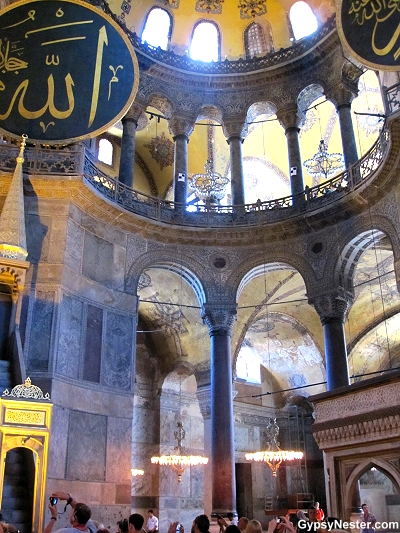
Hagia Sophia could be one of the most impressive structures we’ve ever seen. Not only is the building spectacular, but this massive cathedral was built in the year 532, and finished in only five years. The Emperor Justinian wanted to build the largest church in the world, and succeeded.
Centuries later, under the Ottomans, the city became of great religious importance to Islam.
The Sultanahmet Mosque, better known to us as The Blue Mosque, embodies this. Built in 1609 by Sultan Ahmed I, it is considered the pinnacle of two centuries of Ottoman mosque development.
Istanbul has long been a marketplace of more than religious ideas between continents. The Grand Bazaar – the granddaddy of all malls – embodies this cultural commercial intersection with products from all across the globe.
This is one of the oldest, and certainly largest, covered markets in the world with around 400,000 visitors each day. As we wandered the sixty-one covered streets inside, it was hard not to feel like lab rats looking for cheese.
Beyond Istanbul, Turkey has also played a huge role in the spread of Christianity prior to the time of Constantine.
The ancient Greek city of Ephesus may have been famous for its Temple of Artemis, which was recognized as one of the Seven Wonders of the Ancient World, but the apostle Paul truly immortalized the city when he was a resident for several years around 50AD.
One thing we learned on our visit to Turkey is that a visa is required to enter the country, and the last thing we want to do if and when we return is wait in a long line after several lengthy flights like we had to the first time. The solution is simple, get a visa prior to the trip.
The entire process can be handled online. No sending passports through the mail (which always makes us more than a little bit nervous), no visits to the Turkish Embassy, no photos to take, no delays, and best of all… no lines.
This electronic tourist visa for Turkey is truly one of the easiest things ever when it comes to planning an international trip. An eVisa is available from the Turkish Government for most countries including the USA, U.K., Canada, Australia, Germany, Japan, Spain, and Holland as well as many, many more.
What is the Turkish Electronic Tourist visa and how does it work?
To apply for the Turkey Tourist Visa simply complete an online form.
Fill out the details as shown on your passport.
Pay with a credit card or Paypal account.
After receiving a confirmation email you will be sent a second email with the official visa attached in PDF format. Then simply print the PDF document and off you go on your magnificent trip to Turkey.
It is important to note that the Turkey tourist visa will be linked electronically to your passport, so any errors on the application will require filing a new application.
What do I need to apply online for the Turkey Tourist Visa?
1. Passport valid for at least 6 months after your entry date.
2. Credit card or PayPal account.
3. Computer, laptop, or smartphone to visit www.iVisa.com
How long is the Turkey eVisa valid? The Turkey Tourist Visa is valid from 15 to 90 days depending on your nationality and typically comes with single or multiple entries. Visit www.iVisa.com for answers to any questions.
Apply for your tourist visa to Turkey today!
Thanks to eVisa for sponsoring this informative article. As always, all opinions are our own.
Just in time for the new year we discovered a fantastic new way to save some dough, and have fun while doing it. It’s called… CONTINUE READING >>
Everyone who doesn’t like to save money raise their hand.
Not gonna see many hands in the air asking that question, are we?
Nope, but just in time for the new year we discovered a fantastic new way to save some dough, and have fun while doing it. It’s called dealspotr.com.
When we heard about it, we had to check it out. So with no idea what to expect we decided to dive right in. What we found was a boatload of bargains, delivered with tons of fun. Think what if Groupon and Pinterest had a baby.
In the quick sign up process we entered our info and picked our interests from a huge variety of possibilities. When we finished, we instantly got a personalized feed of deals relating to them. We also got a list of other users with similar preferences who we could subscribe to and message back and forth.
We dug in and looked for deals from our favorite retailers, both online and brick and mortar, and found plenty. Then we could use them, share them, like them, or save them for later. In no time at all we were totally hooked.
We had to wonder, where do all of these great deals come from? That’s the fun part, users add them, and are rewarded for doing so. Of course our next question was how do we get in on the excitement?
It’s easy. After reading the through the instructions and tips for posting we were on our way to earning points toward our first reward, an Amazon Gift Card.
Just in case that isn’t enough motivation, dealspotr has a few features that really added to our enthusiasm by giving us goals. Each day we get a Daily Checklist. Checking items off of the list makes it more fun to earn our bonus points for finishing.
Simple tasks such as adding new bargains, verifying existing ones, or searching the sight for deals we love and passing them along or saving them for later are engaging and easy to complete. Even finding new friends to subscribe to helps us get closer to our next gift card.
Another positive feedback that keeps us motivated is our Accuracy Score. By increasing the score through our activities we earn the ability to post more and more deals, which means we can collect bigger and bigger bonuses.
If we find and post a deal that other members really like it can become Hot, or even On Fire, which helps us build a reputation and move faster to our next reward.
All of this means that dealspotr is like the Wikipedia of finding great deals, because the content is provided by the users themselves. Thirty thousand members contribute, edit, and authenticate each of the bargains, ensuring that all of the information is accurate and complete. This crowdsourcing has saved shoppers over fifteen million dollars, as well as paying users thousands in rewards.
Now, let’s ask everyone who wants to save some money to raise their hands.
OK, OK, put them back down so you can use them to go to dealspotr.com.
Are you an Influencer? Send us an email at [email protected] and we will be happy to share an Influencer access code with you. Use it to join dealspotr’s ambassador program and get an automatic upgrade to Verified Influencer status with tons of added benefits.
Dealspotr rewarded us with bonus points for posting this review, but as always our opinions are our own.
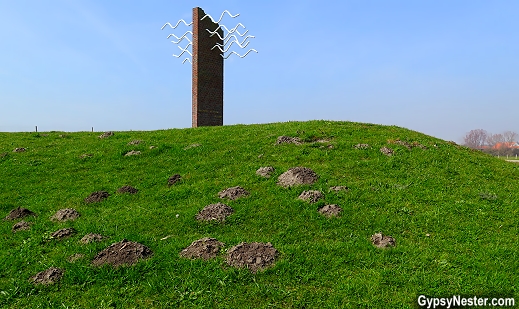
The Dutch have been on a mission to protect themselves against the ocean’s onslaught since the mushy low country was first settled.
At first the hardy inhabitants sought out small batches of higher ground, but as the population grew and became permanent a series of dams, dikes, drainage ditches, and pumps began to take shape.
With over half of their homeland sitting below sea level, over a thousand years of nonstop planning, digging, and building has taken place.
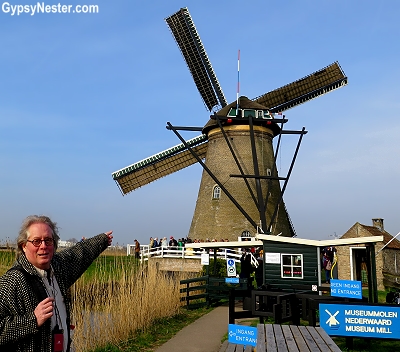
These lovely landmarks have served as air-powered pumps to keep the land above water for centuries.
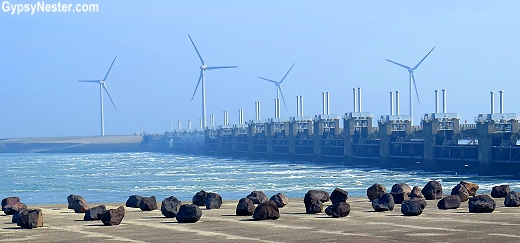
As much as everyone loves to see Holland’s signature symbols turning in the breeze, technology drastically improved over time bringing about an even more impressive, if less endearing, system of enormous doors to hold the North Sea at bay.
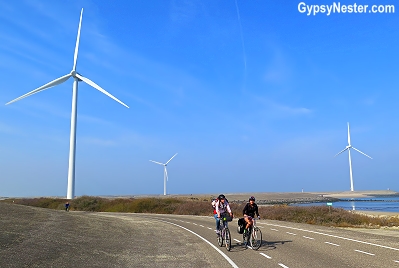
As we drove toward the shore from Antwerp we were eager to learn a bit more about The Delta Works, or Deltawerken in Dutch.
This amazing flood controlling technological marvel has been declared one of the Seven Wonders of the Modern World by the American Society of Civil Engineers.
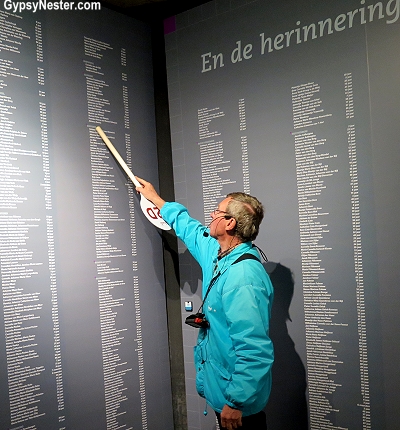
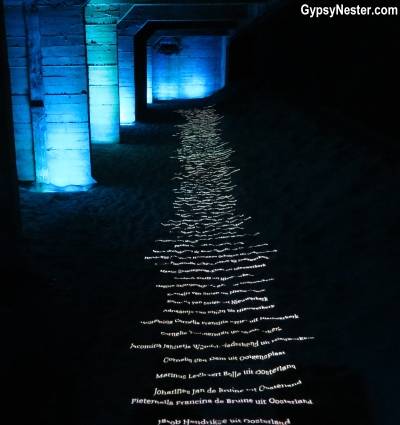
Our guide, Jan, survived the floods in Kortgene, Holland in 1953 and shows us the names of those from his village who perished
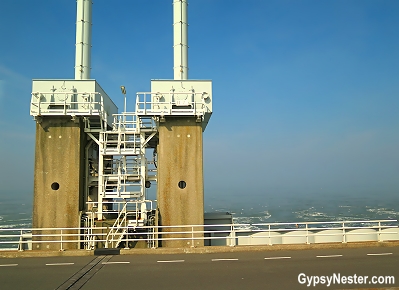
Created in response to a tragic flood throughout the Netherlands province of Zeeland in 1953, huge hydraulic doors at three openings to the North Sea can be closed when the weather turns nasty, preventing the flooding tides from inundating the Lowlands.
Before this solution, earthen dams and dikes protected the islands and peninsulas.
However, these proved inadequate when they gave way during an intense storm and over eighteen hundred people perished.
Something better had to be done.
Driving along the top of the Delta Works
The original idea was to simply dam the channels, cutting them off from the sea, but this would have destroyed the tidal ecology, ruining the shellfish industry that is vital to the area.
By using doors to control the flow without stopping the tides, the mussels and oysters continue to thrive.
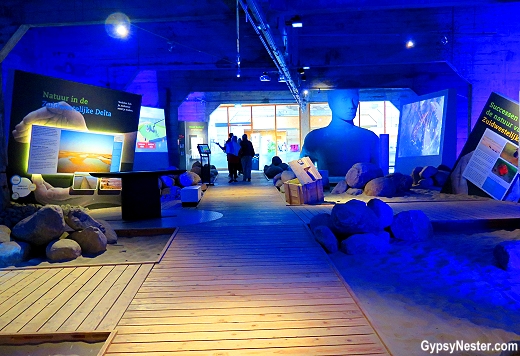
Near the giant sea doors, there is a museum about the history of the flood and solutions to the problems of keeping the seawater at bay.
Beautiful memorial to the lost
We descended inside a caisson underneath one of the earthen dikes, and got an inside look at the defenses built after the flood.
In a stroke of amazing luck our guide, Jan, was a survivor of the 1953 disaster.
This gave us a firsthand account, and a rare, personal brush with history, as he described the night when he was eleven years old and the flood waters hit.
Lucky for him, his family, and the entire town of Kortgene, his older brother and friends were up late celebrating a birthday when they noticed the water rising.
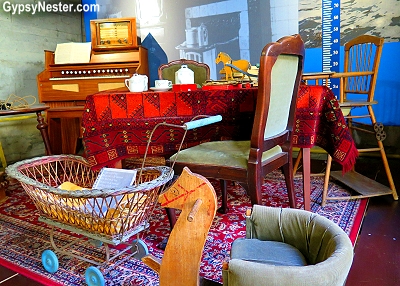
Artifacts saved from the floods
Thinking fast, they saved almost all of the town’s residents by breaking into the church and ringing the bells to awaken them.
With the alarm sounded, people had just enough time to climb to the upper floors or roofs of their houses and survive.
Across the low country many others were not so fortunate, as the water quickly rose over ten feet in the middle of that fateful night.
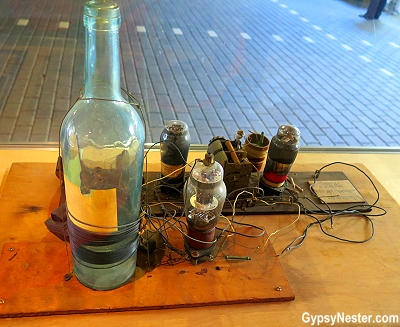
Schouwn-Duiveland had no contact with the outside world after the massive flood until a man named Peter Hossfeld cobbled together this transmitter that blasted out a distress signal.
In light of the tragedy, the huge Delta Works project was designed to withstand floods so severe that they are predicted to occur only once every four thousand years. Hopefully those tolerances won’t ever be tested.
So far the doors have only needed to be deployed a few times, other than the usual testing that is done at least four times each year.
By the time the works were declared finished in 1997, they had become the largest storm barrier in the world and is the basis for several similar projects worldwide.
However, the truth is that the battle against the sea is never really completed, and new reinforcements are undertaken any time a potentially weak spot is identified.
As a bonus, the massive gates allowed for a road to be built along the tops making for a shortcut to the north.
This also meant that we got to drive along the crest of the world’s most impressive water works.
Even on a relatively calm day, that vantage point kept us in complete awe of the power of the Atlantic Ocean crashing into the shore.
Normally, we all tend to put a lot of time, thought and effort into what make and model of the car we are going to purchase but often we fail to ensure that we have the right accessories. Make sure that you have the right car accessories for your vehicle. Some accessories are vital for a number of reasons as this is something that can affect everything from the aesthetics through to safety and practicality. Of course, newer model cars these days often come with a range of features and accessories already built in but it is still important that you run through an essentials checklist to make sure you have the necessary products for your vehicle.
Car accessories that all drivers should have:
Whether you have an old or new car, making sure you invest in the right car stuff can make all the difference. Some of the essential accessories you should consider buying for your vehicle include:
Battery charger: It can be frustrating, inconvenient and troublesome when your battery dies and you could find yourself stranded for hours while you wait for a breakdown service to come and get you restarted. Investing in a charger, such as the high tech smart charger available from Elinz, means that you can charge up your battery with speed and ease. These chargers are available at affordable price on www.OZCodes.com.au along with additional discounts to help you save money on your pocket. Another lifeline you can use when your car battery dies is to jump start your car with a cable. A jump start cable is another tool you should invest in times of emergency. It will bring your battery back to life quickly to keep you going on the road safely.
Blind spot mirrors: Blind spots on the road can cause a real hazard for motorists. While use of your standard rear view and wing mirrors is essential when on the road, these often provide no view in blind spot areas. Investing in blind spot mirrors will help to make life easier for you as the driver and more importantly can enhance safety and even save lives.
Tire Inflator and Sealant: When you get a flat tire it isn’t always possible or practical to change it right away. You could even find yourself in a situation where you do not have a spare tire with you, although this is something that you should clearly avoid. Carrying an inflator and sealer will enable you to put a short term solution into place in the event of a flat, tiding you over until you can get it properly sorted out.
Tire Pressure Gauge:Driving with the wrong tyre pressure can also cause problems and hazards so it is important to keep your tire pressure in check. Make sure you have a tyre pressure gauge in your trunk, as you can then check the pressure whenever necessary. Choose one with a light up screen so that you can get an accurate reading even at night.
Seatbelt Cutter:Wearing a seatbelt when on the road is essential and this has saved many lives. However, on the flipside of the coin you could find yourself in hot water in the event that the seatbelt gets stuck and you need to exit the vehicle quickly because of hazards. Carrying a seatbelt cutter in your vehicle will help to ensure that you do not find yourself trapped in an emergency.
Neck Pillow:If you travel on busy roads on a regular basis, you will know the misery that can come with getting stuck in a traffic jam for hours. This is not only frustrating but can result in aches and pains around your body such as in the neck. Place a high quality memory foam neck pillow on the back of your seat to ensure you can ease this problem and avoid neck problems.
Dash Cam: More and more people these days are investing in dash cams, as they provide a simple and convenient method of recording incidents and accidents. This can make a big difference when it comes to providing proof in the event of incidents such as these and they are very affordable in terms of price.
These are just some of the low cost yet essential car accessories that all motorists should consider purchasing for their vehicles.
We are happy to feature this sponsored post to provide valuable information for motorists.
The home of Scandinavia’s largest food festival (you KNOW we took full advantage of that!), the best-kept wooden houses in all of Northern Europe (so uberquaint), an obsession with pony rides, and the birthplace of a modern technology – all make for…CONTINUE READING >>
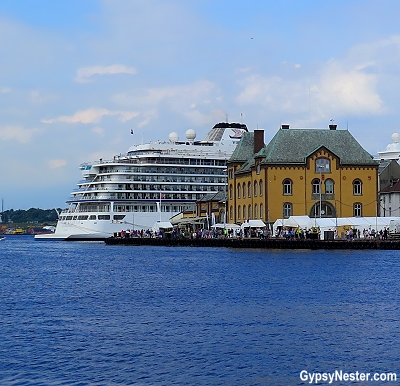
When we saw Stavanger on the itinerary of our Viking Homelands ocean cruise we had no idea what to expect.
This was without a doubt the least known stop among our ports of call; in fact it was the only one that we had never heard of, we were complete strangers to the city.
Birthplace of a Technology
But if we were into deep water drilling it most certainly would have been familiar, since this is the birthplace of the technology.
That meant that the Norwegian Petroleum Museum, just a few steps away from where the ship docked, was the perfect place to begin our exploration.
The exhibits chronicle the history of off-shore oil operations on the Norwegian continental shelf since they began back in the mid-1960s.
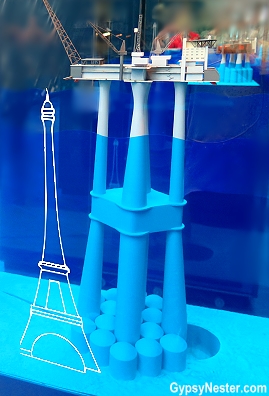
We proceeded through a timeline of models showing how drilling platforms were built as the equipment progressed.
The first rigs sat on steel and concrete platforms permanently anchored to the sea floor, but over time flexible modern production ships and subsea systems were developed to allow exploration into deeper and deeper waters.
This can be dangerous work, as we learned in a couple of the displays, especially the one showing the twisted wreckage of a support pipe from a platform that had overturned.
Next to that, a real lifeboat sat opened for visitors to crawl into. We went inside and were shocked that it was meant to hold twenty-eight people in the cramped space.
After some claustrophobic thought, we decided that it might just be a good thing to be packed so tightly inside, considering the tossing this little cork of a capsule would take on the raging waves of a powerful North Sea storm.
Continuing through a walkway that juts out over the ocean, we entered a mock-up of an off shore rig.
The display is a scaled down reproduction that allowed us a hands-on experience of what it would be like to be at the point-of-attack where the drilling takes place.
To get back on shore, we had to choose between two doors as a way to vote on whether we think that the energy industry can find a way to address and reduce carbon emissions enough to combat climate change.
We both, and most of the people with us, optimistically chose the yes door.
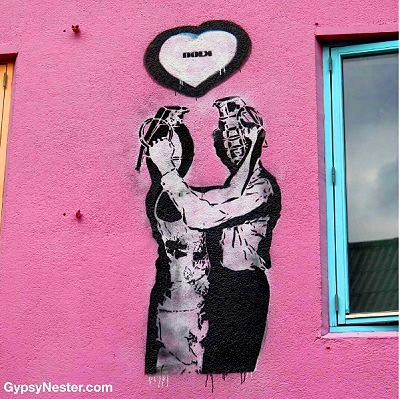
The “Colorful Street”
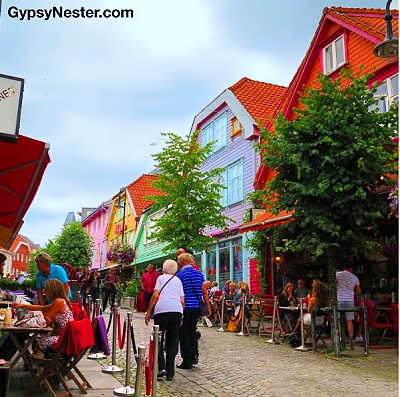
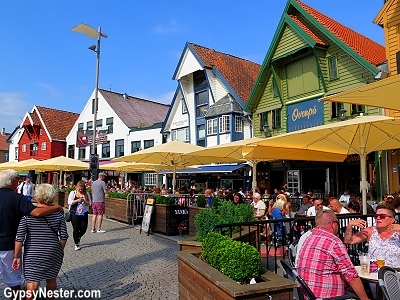
As we worked our way into the city, away from the pier, we walked up Øvre Holmegate, a narrow street lined with brightly colored buildings that has become an attraction for visitors and locals alike because the rest of the city is generally painted white.
The cuteness factor was over-the-top, and the strip has become quite a hangout with outdoor cafes being the order of the day.
The area is also home to wonderfully odd street art!
When we asked what this hoppin’ little area is called, our guide simply said, “the colorful street.”
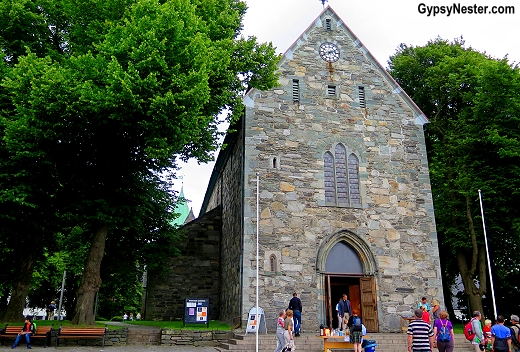
Next we stopped at the Stavanger Cathedral, which is Norway’s oldest cathedral.
Construction is believed to have started around 1100, and finished about fifty years later.
The estimate makes sense, since it coincides with the founding of the city in 1125.
Old Stavanger
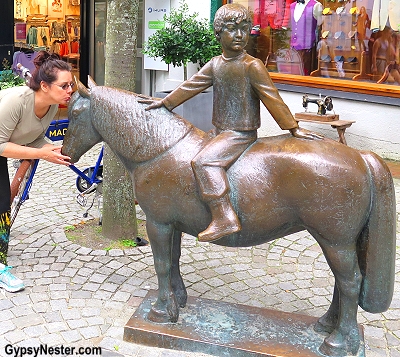
We began noticing that pony ride themes loomed large in Stavanger statuary
The church sits as a sort of divider between the harbor area and Gamle Stavanger, or Old Stavanger.
Unlike most of the old towns that we have visited, this is not right on the waterfront.
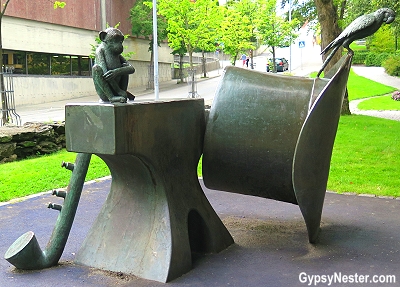
Instead we walked a few blocks uphill, pausing to look at a couple of whimsical statues in a small park along the way.
The first was a giant top hat next to an anvil, with a parrot and a monkey standing by.
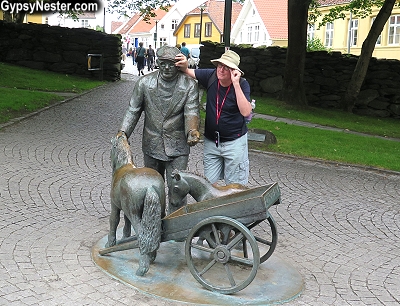
Our clever guide walked ahead to the next one, a man with a pair of Shetland ponies, and asked us how we thought the two were connected.
We were completely clueless, so he soothed our curiosity and explained. The man was Lars H. Lende, who was renowned for his inventive ideas to make the world a better place for children.
His motto, “Alt for barna” roughly translates to “Anything for the children,” especially pony cart rides.
David immediately jumped in next to him for a photo op with his new bronze buddy.
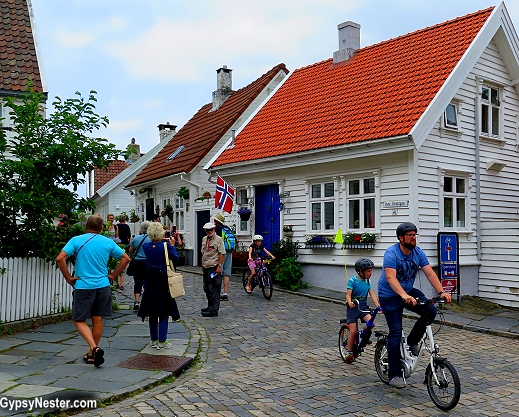
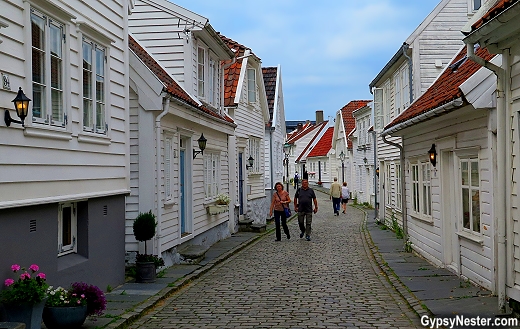
Heading up through the gate at the end of the park, we entered the old town.
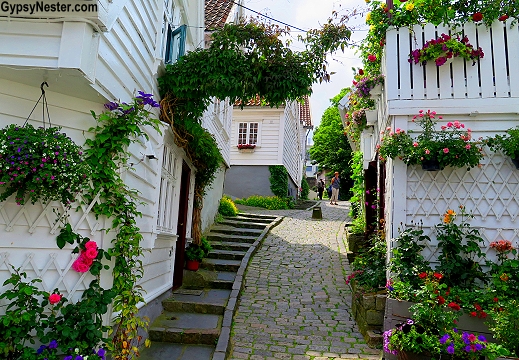
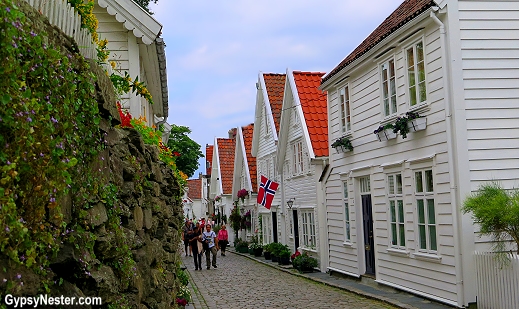
The immaculate cobblestone streets are lined with dozens of what are considered to be the best kept old wooden houses in Northern Europe.
Adding to the unique nature of Gamle Stavanger is that even after several centuries, most all of the homes are still used as private residences.
A Huge Food Festival
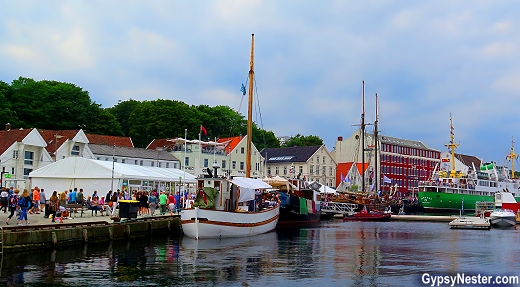
From our perch up on the hill we could see that the Vågen, or inner harbor where small boats put in, was packed with people and lined with vendors.
Our timing for visiting Stavanger happened to be just about perfect.
We had a wonderful summer day and Scandinavia’s biggest food festival, Gladmat, was in full swing.
About 200,000 people – make that 200,002 including us – visit during the four days of the festival each year.
After scanning the dozens of food stands and restaurants, selling everything from gourmet fare to hotdogs, we decided to give some matjes i lompe a try.
This is a very traditional way of eating matjes, which is raw, slightly pickled herring, on lompe, a flat potato bread.
The fish is topped with sour cream, beets, and diced onions, then wrapped in the lompe.
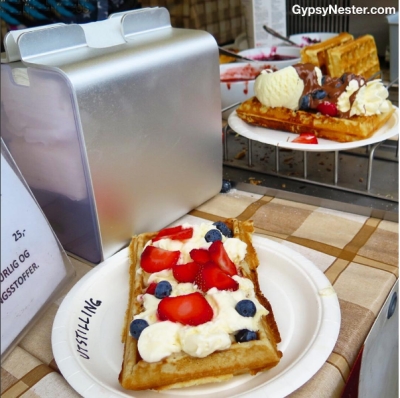
David much preferred the street waffles!
While these Scandinavian burritos may not be David’s new favorite food, Veronica loved it, and we can say it tastes better than it sounds.
Actually, we can’t really say that, because we aren’t exactly sure how it sounds since we never could quite get the pronunciation right.
Peace Down to our Toes
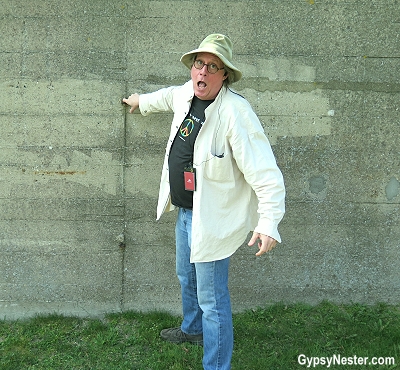
As we wandered on through the festival, we stumbled upon something completely unexpected, Al Gore’s footprints.
Yup, a bronze cast of the former Vice President’s bare feet are set right into the walkway along the harbor.
They are part of the Path of Peace, an ongoing project by the human rights foundation Point of Peace, which incorporates the footprints of several of Nobel Prize winners and peace advocates to form a pathway along the bay.
Word on the street was that Bishop Desmond Tutu had left some prints here too, but we couldn’t find them on our way back to the Viking Star.
One thing we did find, we didn’t feel like strangers in Stavanger anymore.


 RMS Rhone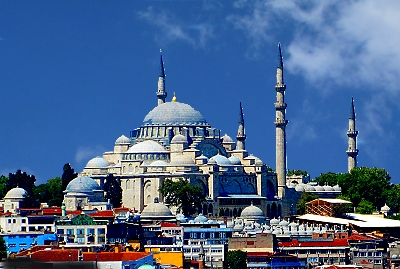
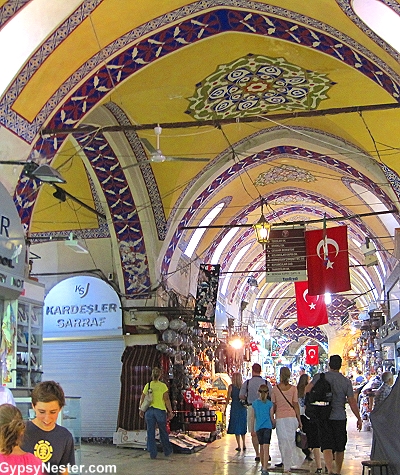 This is one of the oldest, and certainly largest, covered markets in the world with around 400,000 visitors each day. As we wandered the sixty-one covered streets inside, it was hard not to feel like lab rats looking for cheese.
 We dug in and looked for deals from our favorite retailers, both online and brick and mortar, and found plenty. Then we could use them, share them, like them, or save them for later. In no time at all we were totally hooked.
 If we find and post a deal that other members really like it can become Hot, or even On Fire, which helps us build a reputation and move faster to our next reward.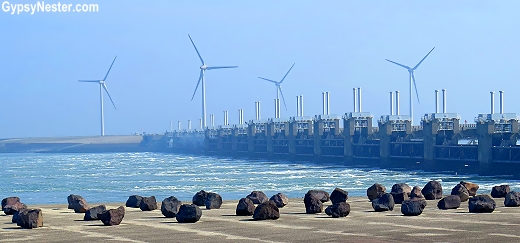

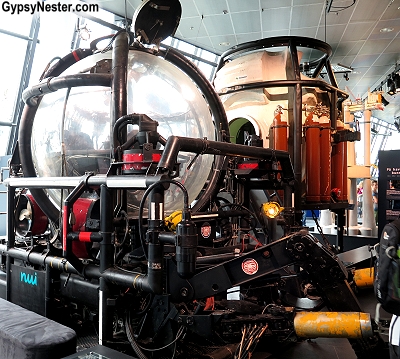 We proceeded through a timeline of models showing how drilling platforms were built as the equipment progressed.
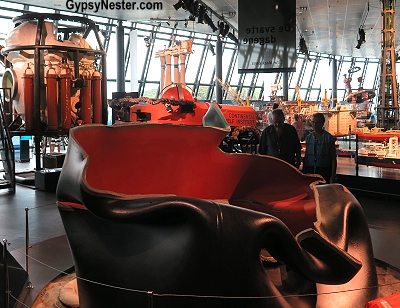 This can be dangerous work, as we learned in a couple of the displays, especially the one showing the twisted wreckage of a support pipe from a platform that had overturned.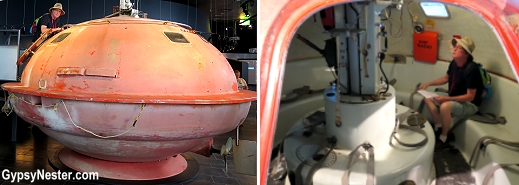
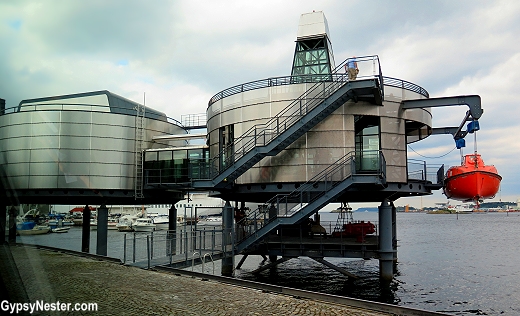
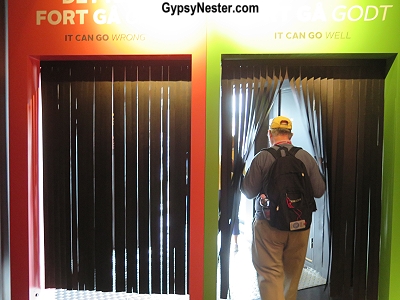 To get back on shore, we had to choose between two doors as a way to vote on whether we think that the energy industry can find a way to address and reduce carbon emissions enough to combat climate change.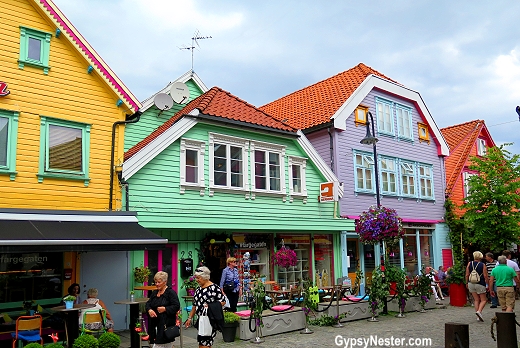
 As we worked our way into the city, away from the pier, we walked up Øvre Holmegate, a narrow street lined with brightly colored buildings that has become an attraction for visitors and locals alike because the rest of the city is generally painted white.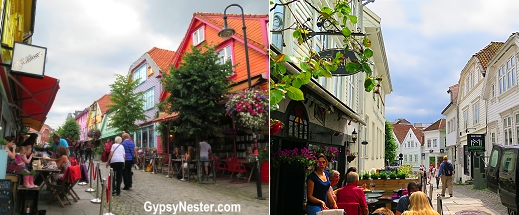
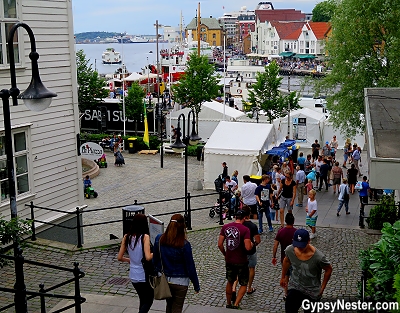 From our perch up on the hill we could see that the Vågen, or inner harbor where small boats put in, was packed with people and lined with vendors.
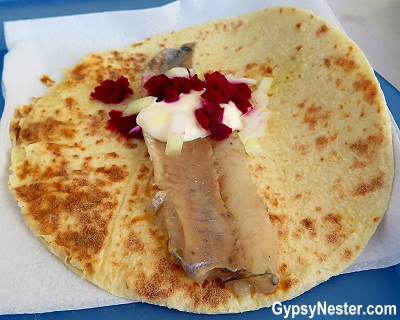 After scanning the dozens of food stands and restaurants, selling everything from gourmet fare to hotdogs, we decided to give some matjes i lompe a try.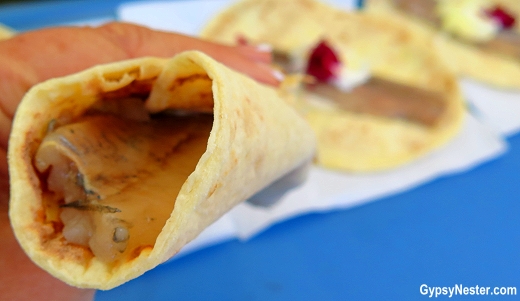

 They are part of the Path of Peace, an ongoing project by the human rights foundation Point of Peace, which incorporates the footprints of several of Nobel Prize winners and peace advocates to form a pathway along the bay.