
Search…

Venice Anyone?

Every now and then we get a chance to scratch something off of one of our bucket lists. Visiting Venezia was one of those opportunities. It’s even possible that this wonderful “City of Canals” had been a tiny sore spot in our otherwise… CONTINUE READING >>

Venice!

Every now and then we get a chance to scratch something off of one of our bucket lists.

Visiting Venezia was one of those opportunities.

It’s even possible that this wonderful “City of Canals” had been a tiny sore spot in our otherwise flawless relationship.

Okay, flawless isn’t perfectly correct, but we’ll call it that anyway – for effect.

I had the good fortune to see Venice on several occasions while working in Italy in the ’90s and couldn’t help but gush on about its beauty and charm.

Veronica, being only human, may have harbored some speck of jealousy, but now we can live out our days in unhindered bliss. Whew.
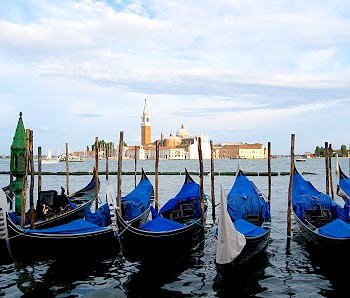
Venice, Italy

Even though Venice is a city without any roads, it can be reached by car or train across the three-mile Liberty Bridge.

There are two big parking garages by the train station and cruise ship port. Once parked, we had two choices for getting around – foot or boat.

We walked – passing through Piazza Roma, the bustling plaza that serves as the entry point to “The Floating City,” and over the first of countless bridges, the Ponte degli Scalzi.

On the other side we found ourselves in a whole new world. A world where water rules.
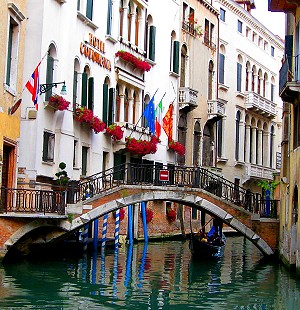
Venice, Italy

In many ways Venice is laid out like an “ordinary” ancient Italian city.

Tightly packed old stone buildings line the cobblestone sidewalks, but where the streets would be… water.

Over fifteen hundred years ago, people came to live on the marshy islands in this lagoon of the Adriatic Sea to escape the hordes of Huns and other such invaders that were constantly causing chaos.

The plan worked like a charm, but the swampy outpost proved unfit for real growth, so a new plan was devised that allowed these innovative people to become one of the dominant powers in the Mediterranean.
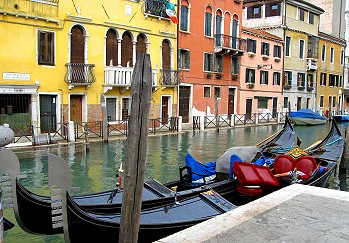
Gondolas in Venice, Italy

Around the year 800 the Serenìsima Repùblica Vèneta was formed, translated – “The Most Serene Republic of Venice.”

The name was to reflect the desire to avoid war and instead focus on trade. Under this philosophy The Republic of Venice stood for nearly a thousand years, making it the longest lasting republic in the history of the world.
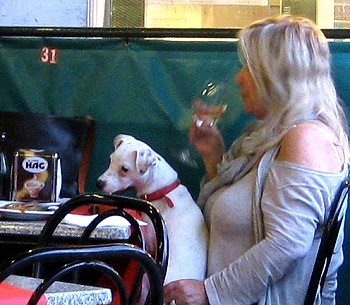
Woman and dog in Venice

Amazingly, this incredible city was built on huge wooden pilings, cut from the mainland, that have stood underwater for so many centuries that the minerals in the sea have petrified them.

These footings hold the foundations for all of the buildings in one of the world’s great engineering marvels.

Unconcerned by whatever might have been supporting us at the moment – our stomachs were growling – we were hungry and needed to find food. Now, Italians have a saying, “If you ever have a bad meal in Italy, you’re in Venice,” but we were determined to prove that false.

Even more important was finding the perfect setting.
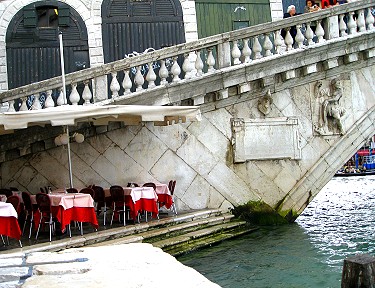
Antico Caffè Ristorante "Al Buso"

Rounding a corner, we walked right into an amazing view of the remarkable Rialto Bridge.

After a bit of gawking we realized we were standing, bovine-like, in the middle of an outdoor cafe.

We pretended we knew what we were doing and asked for a table on the water.

Antico Caffè Ristorante “Al Buso” might have the best location in all of Venice, we were ready to see if the food could compete with the view.
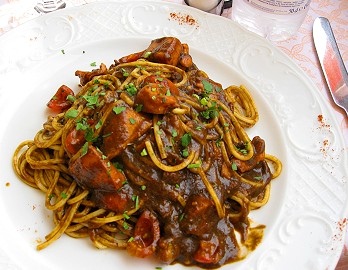
Spaghetti alla Veneziana

Veronica wanted something traditionally Venetian, so she ordered Spaghetti alla Veneziana. The translation said spaghetti with small cuttlefish.

We were reasonably confident that this was a squid-type sea creature. What we weren’t aware of was that in Venice it is traditional to use the ink from the cuttlefish in the sauce.

What? Yup, her pasta came covered in an sepia concoction that turned out to be slightly off-putting visually, but to the ‘buds – delizioso.
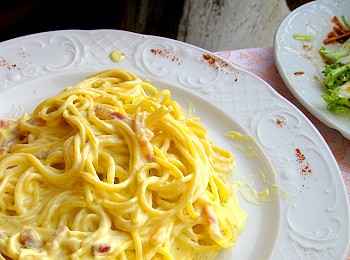
Spaghetti alla Carbonara

I noticed Spaghetti alla Carbonara on the bill of fare and went for one of my favorite Italian dishes. Sometimes called “coal miner’s spaghetti,” legend has it that the recipe stems from bartering with American GIs during WWII.

The soldiers usually had bacon and some powdered milk and eggs to trade. Today fresh eggs, heavy cream, Italian bacon (guanciale or pancetta) and cheese are used to create this heart attack on a plate. Oh yeah, but what a way to go!
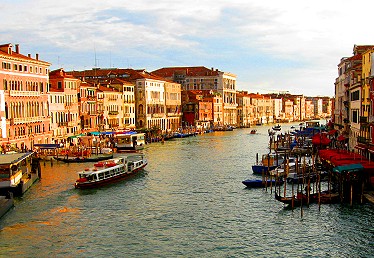
The Grand Canal, Venice

This may not have been the best Carbonara we’ve ever had, but gazing across The Grand Canal while consuming it moved it up toward the top of the list.

We washed it all down with a perfectly passable Pinot Grigio and topped our repast off with Spuma di Banana dal cuore di Fragole (a fancy way of saying banana ice cream with strawberries).

Properly fortified and happy to have avoided the old “bad meal” expression, we were ready to march on to the Piazza San Marco.Saint Mark's Basilica
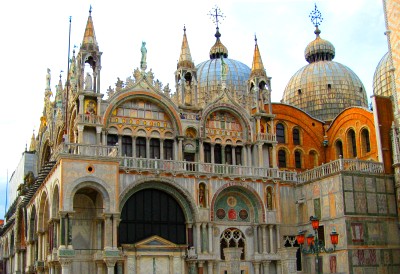
The plaza is dominated by the Basilica Cattedrale Patriarcale di San Marco, commonly known as Saint Mark’s Basilica (if you speak English, that is).

There has been a church on this site since the year 832, the current version, which dates back to 1063, is considered one of the best surviving examples of Byzantine architecture.
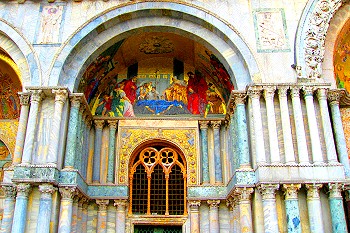
Saint Mark's Basilica, Venice

The facade is highlighted by multicolored marble columns brought from the far off lands that the Republic of Venice dominated for centuries.

Griffins are also prominently featured, not only on the basilica, but throughout the plaza. These winged lions are a symbol of St. Mark.

Another great thing about this piazza – no traffic. This may be the only large public square in all of Europe with no noise from cars, buses and especially scooters.

Two sounds did carry over the muffled din of voices though, a small combo playing at an outdoor cafe and the bells from the famous clock tower.
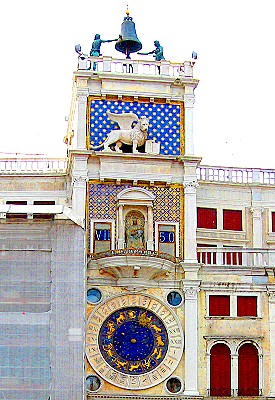
Torre dell'Orologio or St. Mark's Clock

The Torre dell’Orologio was built at the same time as Columbus was sailing around the new world.

Two hammer wielding human figures, one old and one young to symbolize the passage of time, bang the bell every hour on the hour.

Below the clock is a winged lion and a twenty four hour clock, marked off in Roman numerals and is designed to track the phases of the moon and signs of the zodiac.

As beautiful as this tower is, it is dwarfed by the bell tower directly across from it.

The Campanile of St Mark’s church stands 323 feet high. We couldn’t help but notice that this tower looks downright new compared to its surroundings.

That’s because maintaining the height has been a centuries-long battle.

Fires, earthquakes, stones falling off randomly down to the square below and finally a complete collapse in 1902 have led to this current version that’s only a century old. A mere infant in this ancient city.
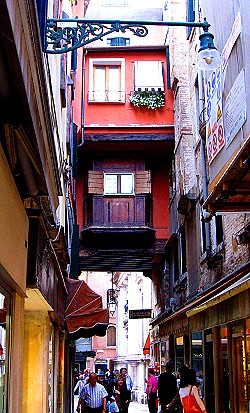
With the sun falling in the western sky, the time had come to find our way back to the Piazza Roma and back to the mainland.

Wandering down a myriad of tiny pedestrian streets and alleyways that make up the interior of this “City of Bridges” in an effort to see the “real” Venezia.

There’s not much of it left. Because of high property prices, relentless throngs of tourists and rising water levels the city’s population is less than a third of what it was fifty years ago.

Many of the once grand homes away from the tourist areas lie boarded up and empty, often with the lower levels underwater.

Still this is an amazing place at every turn. Tiny dead end bridges over secluded canals lead to hidden architectural treasures. Miniature gardens grow in overhanging window boxes and clotheslines span across the waterways.

We tried to tread lightly so as not to disturb the remaining native Venetians.
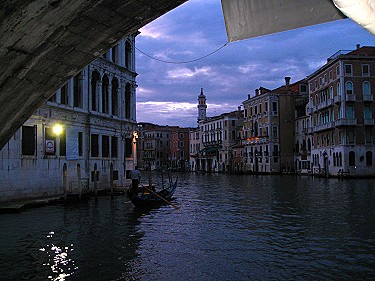
The Grand Canal at night from the water bus

When darkness fell and our feet had about had it for the day, it was time for Venice’s other mode of transportation, a boat.

There were several choices of watercraft available for hire, the classic gondola was just too touristy, not to mention exceedingly pricey, and it turned out the water taxis wanted to sell us tours of the entire city instead of just a ride back to the square (I guess we looked like suckers to them), so water bus it was.
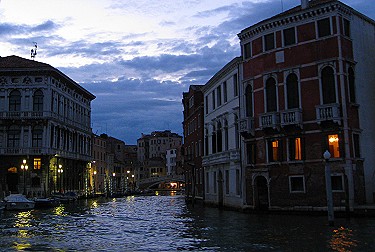
Venice at night from the water

That was fine with us. For a mere handful of Euros we got to cruise The Grand Canal and get dropped off right where we started our day.

Dusk was perfect time – streetlights were just coming on and there was still enough daylight to see Venice in all of its romanic glory.
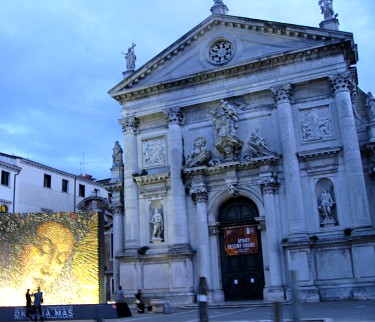
The church of Santa Maria di Nazareth

We drifted down the canal by the Museo di Storia Naturale di Venezia or Natural History Museum and, near the end of our ride, two impressive churches, the Chiesa di Santi Geremia e Lucia and The church of Santa Maria di Nazareth also known as chiesa degli Scalzi.

As we stepped off the bus, with water lapping at the edge of the sidewalk, we realized that Venice has a problem. One might even say they are in a Venetian bind, except it’s no laughing matter.

The city has noticeably descended into the Adriatic Sea since wells were dug around the lagoon early in the twentieth century. Once it was realized that removing water from the aquifer was causing the city to sink, wells were banned.

But now, just when they think this situation may have been solved, the sea level is beginning to rise.
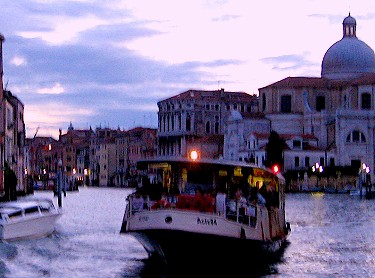
Venice at sunset

The latest plan to protect the “Queen of the Adriatic” involves seventy-nine inflatable pontoons that will block high tides from washing over the city, or so is the hope.

Sadly, for many buildings these efforts come too late. The ground floors, well, sea level floors, of many beautiful architectural treasures have already been inundated by the seawater and are no longer usable.
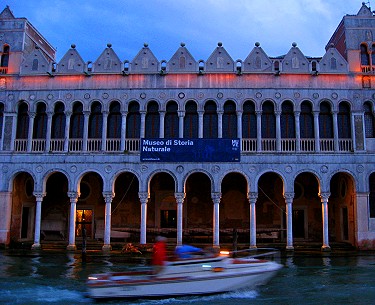
Museum of Natural History

The abandoned levels steal a tiny tidbit of Venice’s charm, but certainly not enough to remove her from every traveler’s must see list.

The sooner the better though, because it’s entirely possible that in the not too distant future, Venice will be the kind of place that tourists visit as an historic sight, along the lines of ancient ruins, instead of an active, vibrant city.

Let’s hope those pontoons work.

David & Veronica, GypsyNester.com

See all of our adventures in Italy!

A Motorcycle Trip To These Places Will Give You An Experience Like No Other

Adventure motorcycling has been growing rapidly over the years. The best part about a bike road trip is the ability to experience natural and scenic landscapes while also being able to get in touch with your wild side… CONTINUE READING >> 

Adventure motorcycling has been growing rapidly over the years. In fact, adventure bikes have been the biggest sector of the motorcycle industry over the past few years. The best part about a bike road trip is the ability to experience natural and scenic landscapes while also being able to get in touch with your wild side. You can choose to travel alone or the experience can be enhanced further by taking some of your friends and enjoying the endless expanse of roads yearning to be explored.

Iceland, on the Ring Road and the Highlands

If you can cope with sidewinds and getting dirty, then Iceland may be the best choice for you. Though it may seem like an unpopular choice, considering its weather is not famous for being biker-friendly, a ride in Iceland can be one of the most amazing things to do in Europe. Riding the Ring Road can easily be done in less than 14 days, although this is only possible between June and August. If you want to experience something unique, enlist the help of some locals and take an off-road tour into the heatherland. No matter which route you choose to take, you’ll certainly enjoy the spectacular sights of the area.

California and Western America

Bikers looking for one of the longest routes that require a bike made to withstand tough routes will definitely find it in Western America. It could take you years to cover all the numerous sights and seasons of the west. This trip is ideal whenever you’re ready to take the plunge since it’s considered an all year top of the line motorcycle route. You can start in Los Angeles and take the famous Route 66 in the direction of Arizona, the Grand Canyon and Monument Valley. You will experience gazing at amazing sites such as Death Valley, Mojave Desert and Yosemite National Park. For the ultimate motorcycle trip, nothing compares to riding under the California sun.

The Cape Town Circuit, South Africa

Have you always longed to spot African wildlife while riding your bike? Then a visit to the Cape Town Circuit in South Africa might be the trip you have been waiting for. The route spans over 1500 kilometers and at an average speed of 80km/h, this route will give you at least 21 hours of riding. During your ride on the circuit, you will get to see some of the most marvelous sites. You’ll ride from Cape Town and head north to the Olifantskop Pass. Then from there, you’ll be able to visit Addo Elephant National Park, Table Mountain and Chapman’s Peak. Moreover, there are endless opportunities to enjoy nature and take photos of the local wildlife.

If you are looking for new and interesting routes to add to your bucket list, then one of the above should definitely be included. Also, research on other routes in order to enjoy a wide range of experiences on your motorcycle trip.

We are happy to present this collaborative post to offer valuable information to our readers.

Important Tips for Your Trip to Australia

Australia, with its beaches, deserts, and unique fauna, is an extraordinary country, very diverse and with many tourist destinations that are in the dreams of most travelers. To help, here are tips for you to plan your trip… CONTINUE READING >> 

Australia, with its beaches, deserts, and unique fauna, is an extraordinary country, very diverse and with many tourist destinations that are in the dreams of most travelers. I don’t think I even need to say it, right

Therefore, those who plan to travel to the country must do a lot of research when planning their trips, to visit destinations that are more related to their profile, and to know more about local customs and of course, the requirements to enter the country. To help, I have prepared here on my list blog with gold tips for you to plan your trip to Australia.

1) Visa and passport

Visas are required to enter Australia, whether for tourism, work or study. Tourist visas can be requested by those who want to travel to recreational activities such as holidays, sightseeing, visiting family, friends or for other purposes in the short term, not including business. This can also be used for those who want to study in this country for a period of up to 12 weeks.

2) Vaccines

To enter Australia, it is necessary that travelers have been vaccinated against yellow fever at least 10 days before going up. To prove that, tourists must have an international vaccine card.

3) Currency

The currency is Australian Dollar. There are $ 100, $ 50, $ 20, $ 10, $ 5 and 5c, 10c, 50c, $ 1, $ 2 bills. Currency exchange offices are spread throughout the country, but know that destinations are not as friendly as the Perth suburbs. , some places on the East Coast of Australia and many others, do not offer many facilities. Therefore, the ideal is to exchange in big cities. In the latter case, exchanges can also be made at the bank. Most international credit cards (Visa, Master, American Express) and prepaid cards are accepted.

4) Official language

The official language of Australia is English. Among the languages ​​of the indigenous people, today only 18 are still used by groups (there are more than 200 in the early colonization). The English spoken in this country is very distinctive, with very different accents and often difficult to understand for those who are not used to it.

5) Climate

The climate in Australia is generally pleasant, without extreme temperatures. In that country there are two climate zones, tropical zones, in the north, which cover around 40% of Australia. In these regions the climate is warmer, with two well-defined seasons: rainy summers and winters. Other parts of the country are in the temperate zone, with four seasons with clearer and lighter temperatures. But it’s good to remember that this country is very broad, so there may be variations.

6) Top tourist destinations

The list of places to visit in this country is endless, so I will mention here only the main purpose. But it is important to know that there is an Australian city for every taste: a fuller place, another empty place, a big city, a small town, a beach, a desert, etc. Only you make your script very personal, according to your taste.

Want to know other traveling tips? Visit https://www.touristsecrets.com/.

We are happy to present this collaborative post to offer valuable information to our readers.

Five Types of Hiking Gear to Keep You Comfortable and Safe

Hiking is a great way to explore the outdoors and be one with nature. Basking in the sunlight, breathing in the fresh air—what more can you ask for? If you’re new to hiking, however, it is best that you know what to do when it comes to preparing for it… CONTINUE READING >> 

Hiking is a great way to explore the outdoors and be one with nature after being in the grueling parts of the city for too long. Basking in the sunlight, breathing in the fresh air—what more can you ask for? If you’re new to hiking, however, it is best that you know what to do when it comes to preparing for it. A well-prepared day hiker has all the essentials to make a hike a lot more comfortable and safe. Know what to bring on a hike by taking note of these five types of hiking gear that help ensure your safety and comfort while on the go.

Map, Compass, and GPS

These three essential items are the most important items at keeping a hiker safe. These not only tell you where you are and how far your destination will be but also help map out ideal places to stay for camp, water, and exit routes for emergency purposes. It is best to have both digital and analog sources of information for you to keep track of your location. A GPS device may be accurate, but because of how reliant it is to battery life, having a map and compass handy will be a safer decision than not carrying any backup navigation tools.

Tumblers and Water Purifiers

Water is essential in keeping your body up to the task when hiking. It will help maintain your body’s performance level while on the hike, and it’s never a bad idea to have extra. Water is more important than food so it is highly imperative that one should keep hydrated at all times. Keep a 1.5-liter tumbler or bigger when hiking to ensure that you have water when necessary. Carry a small water purifier to be able to pump water from natural sources like streams, ponds, or lakes. For every four to five miles you hike, the body needs to consume about a liter of water a day.

Drink in style and enjoy your favorite hot or cold beverage in one of our various custom tumblers! Choose from a wide selection of coffee tumblers for those early morning workdays or tumblers with straws for hot summer afternoons.

Sturdy Footwear

Since hiking is all about walking, ensuring that your footwear is the best one there is for a hike will make you a happy hiker. The correct shoes-and-socks combo is essential for a hiker. If a short hike is intended, then trail shoes are a great choice. For longer hikes, trail boots are more recommended. Trail shoes have flexible midsoles that make them perfect for day hiking and are usually lighter as they are intended for shorter trips with light loads.

Backpacking, or trail, boots are designed to carry heavier loads on longer trips and have excellent well-rounded support for the whole foot up to the ankles. Ensure that your shoe matches the kind of hiking trip to lessen the burdens that your feet will get into.

Solid Backpack

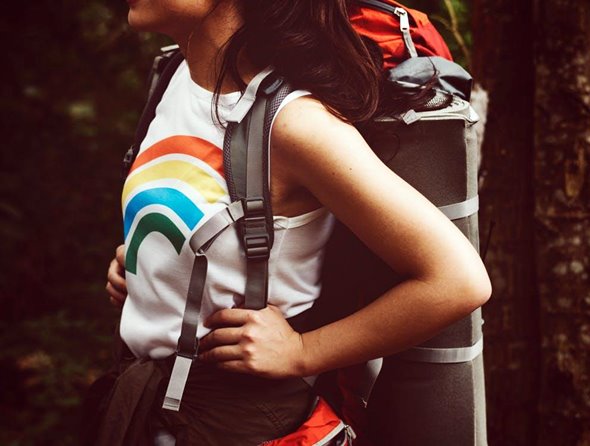
A good rock-solid backpack that can last for years of hiking is a must. This must be comfortable to carry yet big enough to fit all the necessary items that you will be lugging around for all the duration of the hike. Some packs will have design features catered specifically to the needs of a hiker, so take advantage of these. Make sure that a rain cover for the bag is provided, and use it when the time comes.

Layered Clothing and Rain Gear

The correct layers of clothing for a hiker will make or break the whole trip for you, so make sure that the items you will be donning are comfortable enough to walk around in and thick enough to help shield you from unnecessary wounds. Other essential items that you should wear include convertible mittens for women that can be changed according to the weather. Rain gear is also essential since the weather can change drastically while on a trip. Just remember to avoid cotton as it keeps moisture close to your skin and will wear you down, and always carry a hat.

There are other hiking essentials like a first aid kit, safety items (fire starters, light, and a whistle) that one should also add to the list which will make your hike a safe trip. Make sure these items and gear are checked twice before setting off for the actual hike to ensure that everything is ticked off from the list. And lastly, don’t forget to enjoy the hike!

We are happy to present this collaborative post to offer valuable information to our readers.

A Fiberglass Menagerie – the Mecca of Roadside Ginormous Stuff

Nothing lifts the spirits while traveling through America quite like the sight of a fiberglass colossus looming in the distance. On a summertime roadtrip, through the shimmering  heat from the highway, a form begins to take shape… CONTINUE READING >> 

With the good ole summertime upon us, we take a fond look back at those road trips as kids in the way back of the station wagon. Remember the excitement as a dot on the horizon slowly transformed into a giant dinosaur, buffalo, or human?

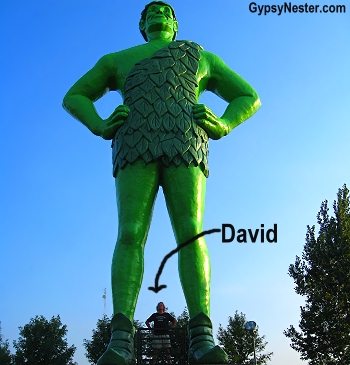
The Jolly Green Giant in Blue Earth, MinnesotaNothing lifts the spirits while traveling through America quite like the sight of a fiberglass colossus looming in the distance. On a summertime roadtrip, through the shimmering  heat from the highway, a form begins to take shape…

See more about this jolly green dude

A sky-scraping Abe Lincoln, a Paul Bunyan the size of a small office building, a life-sized brontosaurus or a fish that could swallow an airliner
— all have great power to inspire, or at least attract attention.

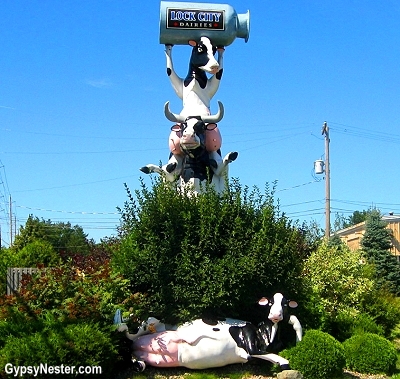
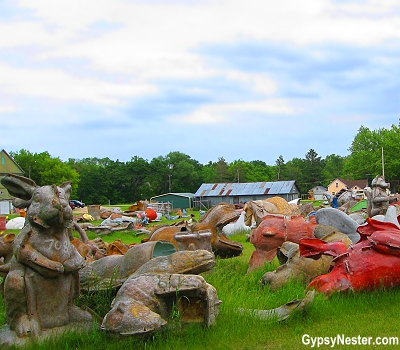
Fiberglass cow pile!As any seasoned voyager trekking throughout the heartland of America will tell you, spotting giant steakhouse steers, cheese haus bessies, liquor store pink elephants, muffler shop gorillas
will garner excited oohs and ahhs.

In many communities, opening a business without a fiberglass
mascot is the kiss of retail death.

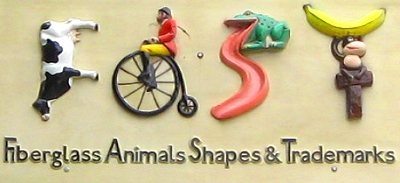
F.A.S.T. (Fiberglass Animals, Shapes & Trademarks Corporation) in Sparta Wisconsin

In the course of our travels we have interviewed several business owners about their colossal fiberglass attention-grabbers and learned of a place in Wisconsin that is the Mecca of campy creatures, the motherland of molded monstrosities–F.A.S.T. (Fiberglass Animals, Shapes & Trademarks Corporation).

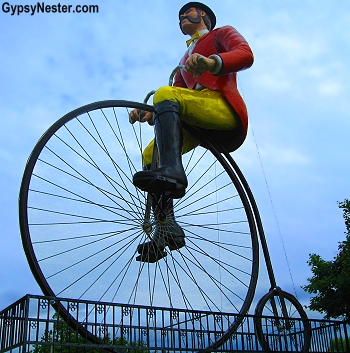
The fiberglass bicylist mascot of Sparta, Wisconsin

So we set out on a pilgrimage to Sparta, Wisconsin and the giant fiberglass mold field of dreams.

Entering the site, we spied the mold field and began to get that need-to-pee feeling of a kid on Christmas morning.

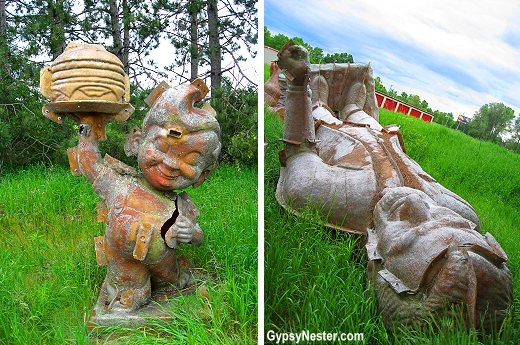
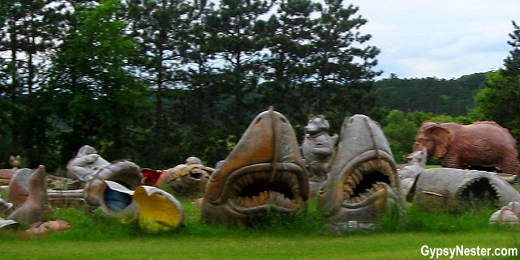
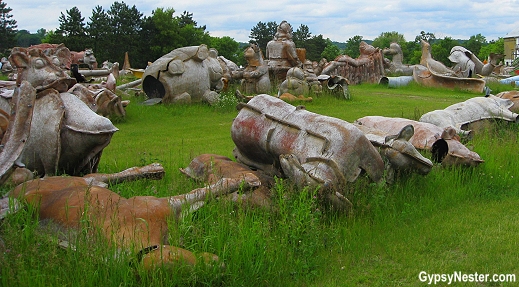
There were acres of molds scattered about – leaping dolphins, dragons, Vikings, religious relics, Yogi and Boo Boo bears of all shapes and sizes.

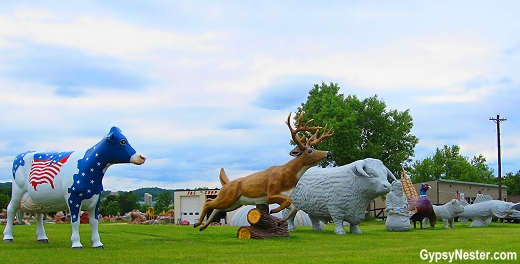
Fiberglass animals n front of FAST Corporation in Sparta, Wisconsin

All waiting outside for a return trip to the shop and a new life drawing attention to kitschy stores, booster clubs, benevolent orders and backyards.

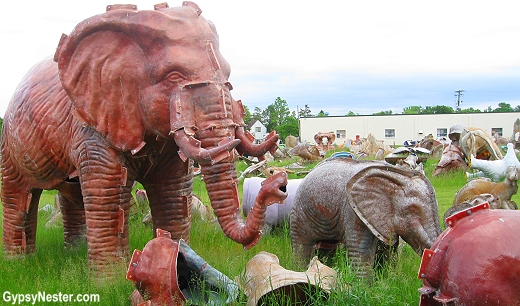
The mold field at FAST corporation in Sparta, Wisconsin

But then attracting attention is what F.A.S.T. is all about.

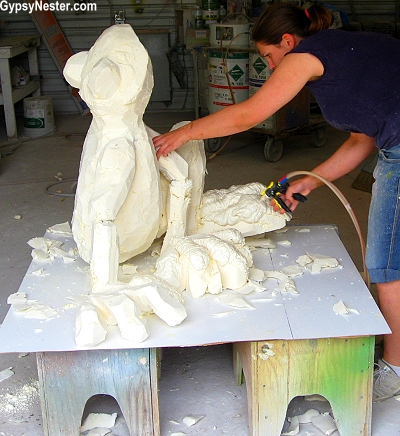
An artist at FAST Corporation sculpts a fiberglass frog in Sparta, Wisconsin

Snooping around the artists’ workshop, and drawn in by the blaring rock music, we met Corey, one of the sculptors, who was shaping a man-sized ornamental frog.

Corey holds a fine arts degree and had learned of F.A.S.T. through one of her favorite professors. Toward the end of her senior year the professor asked her if she was planning on using her art degree for “serving coffee” or if she was serious about her craft. Knowing that Corey loved to work with “big things” as she put it, he pointed her in the direction of F.A.S.T.. Boy did she find the right place!

Corey was kind enough to show us her process.

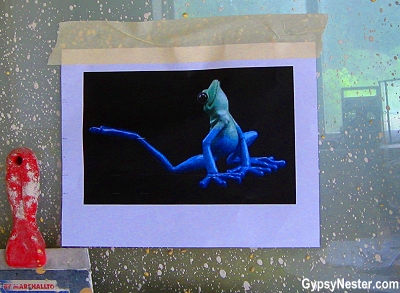
It all starts with a drawing. Corey had been provided a rendition of the frog she was sculpting from the client who commissioned the work.

Starting off with quick setting polyurethane foam, Corey fashions the design with filet knives, sandpaper and a blow torch. More foam is squeezed out as needed, to fill hollow spots or attach large appendages. Lather, rinse, repeat.

Every item that F.A.S.T. produces begins as a hand-sculpted original creation. The biggest behemoths, the friendly little and flamingos – even beloved icons like the Budweiser Clydesdales and the hamburger-holding Big Boy start as a twinkle in the artist’s
eye.

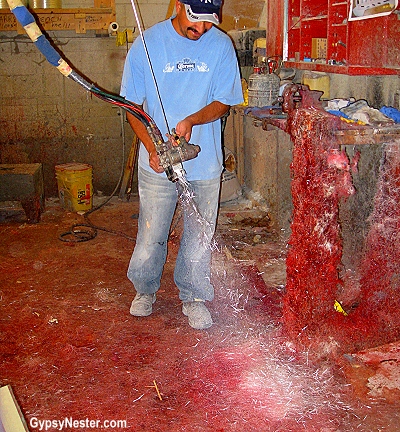
A fiberglass technician shows us how molds are made at F.A.S.T. corporation in Sparta, Wisconsin

Once the artist has a finished piece, it’s time to make a mold. Corey pointed us toward the workshop where the fiberglass is applied.

Inside we met Lupe, a fiberglass technician, who demonstrated how the polyurethane figures are coated with a releasing agent before multiple layers of fiberglass are sprayed on.

The glass sets in a matter of minutes, creating a mold that’s a perfect negative image of the prototype. The finished mold is then removed from the original polyurethane sculpture.

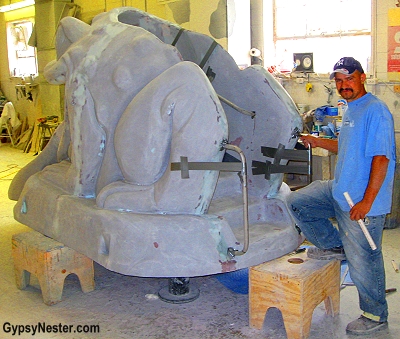
A fiberglass technician shows us how molds are made at F.A.S.T. corporation in Sparta, Wisconsin

Then, the process is flipped and fiberglass is put inside the mold. Lupe explained that once the concoction has set, the mold is opened and gives birth to an exact replica of the original sculpture.

Lupe is proud of the prominent places around the world where his work is displayed and loves to hear from family and friends when they spot one.

The naked newborn is then sent back to the artists for the finishing touches.

The mold field at FAST corporation in Sparta, Wisconsin

What happens the molds? They are set out in the field, waiting for another client to choose them as an attraction.

Pre-molded choices include a full-sized nativity scene, an eight foot swirl ice cream cone, or one (or several) of the seven dwarves.

If an original creation is desired, it can get very pricey, sometimes into the hundreds of thousands of dollars.

The mold field at FAST corporation in Sparta, Wisconsin
See how this Abe Lincoln turned out – and where he ended up!

The mold field at FAST corporation in Sparta, Wisconsin

The mold field at FAST corporation in Sparta, Wisconsin

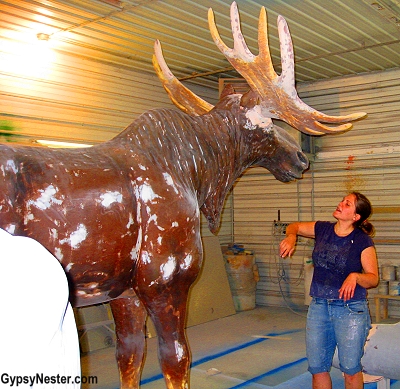
A giant fiberglass moose at FAST in Sparta, Wisconsin

Back in the artists’ workshop, the sanding and painting begins. Automotive paint and clear-coat help bring to life a strikingly realistic likeness or a humorous cartoon critters.

Corey took us to a second studio where a ginormous moose was nearing completion. Stoic and substantial, we could imagine him standing in front of a hunters’ supply store, an Alaskan jerky factory, or maybe one of your antler clubs (a Moose lodge, perhaps?). (Not that we believe in moose!)

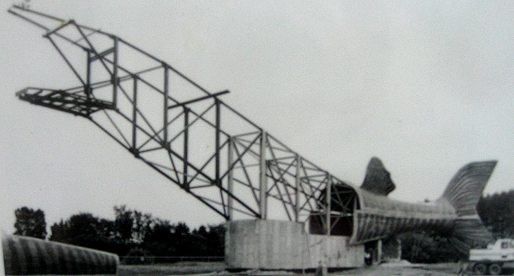
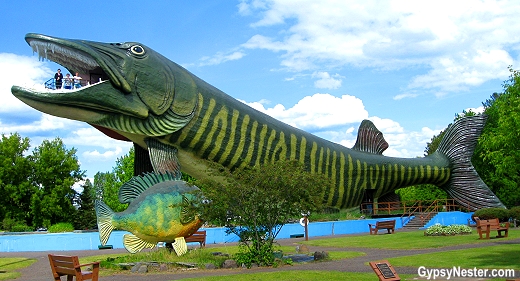
Without a doubt, the true masterwork for F.A.S.T., their magnum opus, is the 145-foot muskie outside of the Fresh Water Fishing Hall of Fame in Hayward, Wisconsin.

The giant fiberglass muskie outside of the Fresh Water Fishing Hall of Fame in Hayward, Wisconsin

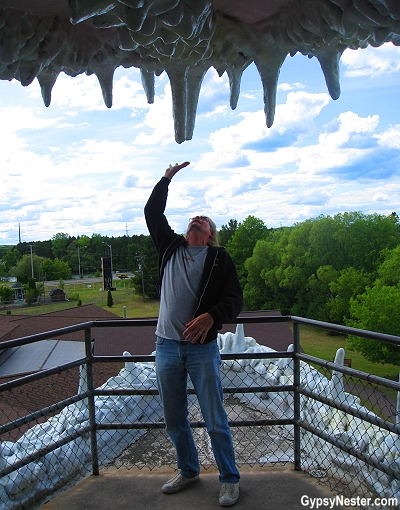
Inside the mouth of the 145-foot muskie outside of the Fresh Water Fishing Hall of Fame in Hayward, Wisconsin

Billed as a “walk-thru fish one-half city block long, four and a half stories tall, hand-sculpted into the likeness of a leaping muskellunge” — this guy does not disappoint. His gaping, open jaw accommodates more than twenty people as an observation platform.

Wanting to get it straight from the fish’s mouth, we left Sparta and headed to Hayward that very day.

What a beaut.

Has to be the biggest fish story ever.

David & Veronica, GypsyNester.com
7 Handy Tips for Traveling With Kids

Traveling with young children can be exciting or exhausting, yet it’s utterly rewarding. Consider these suggestions each time you’re planning to take your children on a trip… CONTINUE READING >> 

Traveling with young children can be exciting or exhausting, yet it’s utterly rewarding. This is usually influenced by a number of factors and the process is different from traveling alone or with adults. Consider these suggestions each time you’re planning to take your children on a trip.

1. Make provisions for entertainment

Kids get bored easily during long distances travels. Most of them will choose this period to have a meltdown. The best thing is to pack attractive toys and books so that they won’t run of entertainment options.

Make sure that you charge your mobile devices and install interesting games, movies, and shows to keep them engaged. You can limit screen time once you get back to your normal life.

Noise-canceling headphones will come in handy as the ones available in airplanes, and buses may uncomfortable.

2. Get the right gear

Jet lag can take a toll on the bodies of young children and leave them exhausted. Adjusting to a new environment will also take some time. Travel with lightweight strollers if you have babies or toddlers.

It’s important to invest in quality gears like backpacks, travel car seats, strollers, and GPS trackers for security. This is the key to reducing risks and making them last longer.

3. Proper planning

Enjoying a family trip often boils down to planning. Give your kids a quick rundown of the trip and what to expect at each stage a few days before traveling. Find out what works for your family and stick to it. For instance, if your children find long flights overwhelming, book shorter ones.

Ensure that you make plans for transportation if your family will be covering long distances at your destination. Plan your itinerary and don’t attempt to visit all your favorite spots at a stretch.

4. Leave extra time

It’s imperative to give yourself extra time to avoid any unnecessary pressure. Each task will require more time unlike traveling solo. Arrive at the airport early enough so that you can avoid missing your flight. The bottom line is to maintain a flexible schedule throughout the trip.

5. Snacks

Nursing mothers are free to travel with baby food and milk when traveling by air. Make sure that you pack healthy snacks and reusable water bottle for everyone. This is because meals can be extended due to certain circumstances beyond your control.

It’s possible to request a kid meal on the airline website at least a week or two before your trip.

6. Pack the necessary items

It’s easier to move around when traveling with your family if you don’t have heavy luggage in tow. Expensive items and heavy clothing should be left at home. Pack extra lightweight clothes, underwears, baby wipes as you prepare for your trip.

In addition, travel with a first aid box that contains prescription drugs, and over the counter medication for allergies and stomach upset.

7. Accommodation

This must be handled as you book your flight. It’s not ideal to be searching for cheap accommodation when you reach your destination. Young children just want to rest before engaging in other activities.

In view of this, search for the best hotels with good facilities on your devices. Ask whether you will need to pay extra for certain facilities, and don’t hesitate to ask for discounts.

We are happy to present this collaborative post to offer valuable information to our readers.

6 Summer Backpacking Tips to Help You Survive the Heat

Backpacking in the heat can be difficult, so planning in advance and ensuring that you have everything you need can help you from getting heat stroke or becoming too dehydrated. You need to stay safe in the heat, so follow these six tips… CONTINUE READING >> 

Backpacking in the heat can be difficult, and so planning in advance and ensuring that you have everything you need can help you from getting heat stroke or becoming too dehydrated. You need to stay safe in the heat, so follow these six tips to make sure you do so this summer.

Sunscreen

One of the most important things to remember on a hot day is sunscreen. Without this, your skin will burn, and even if you do tan, this is still damaging your skin. Over time, too much sun exposure could lead to many problems, and we need to keep our skin safe and protected to prevent long-term damage. Always follow the instructions on the bottle regarding how often to apply. Wearing loose and long sleeves will also protect you from the sun, as well as from insect bites.

Keep Your Backpack Light

When backpacking, you need to only carry the essentials. Carrying too much in the heat will lead to over-exhaustion far too early. Your body needs energy to keep cool, so choose a light backpack and don’t overpack with things that you don’t need.

Backpacks also fit right in with our “One Trip Rule” for packing because they can ride on top of a rolling suitcase.

Keep Hydrated!

Hydration is essential when walking in the heat, so carrying enough water and keeping it cool means that you will be safe and hydrated throughout your day. Before you even set off for the day, you should be drinking water and setting off for your trip already hydrated, otherwise you will become dehydrated easily while walking in the sun. In extra hot weather, your body can lose a whopping one liter of water each hour through sweat. Sipping regularly means you are staying hydrated without filling yourself up on water.

Rest

Take regular rest breaks even if you don’t usually rest when backpacking. When you are in hotter conditions, you are more likely to get tired, so listen to what your body is telling you and take some rest in the shade if possible. Usually the recommended rest breaks are every two and a half hours. In hotter conditions, this should be adhered to, or breaks should be taken even more frequently. When taking a break, let your feet get some air too – this can do you the world of good and help to prevent athlete’s foot.

Choose the Proper Trail

If you are deciding to backpack in hot weather, it is more important than ever to choose a trail that is guided, and that other people will be walking on. The last thing that you want is to get lost in the heat and run out of water or food. A proper trail should also have plenty of areas which are shaded by trees, whereas going your own way may mean unsheltered areas for miles. Always know before you set off where any water points are too.

Check the Time

In the summer, hiking early means that you miss the hottest parts of the day. The hottest hours of the day are usually between 10 and 3 and so it’s best to use these hours to chill in the shade and then continue to hike after this time. If you have set off early, then you will be able to still get to a good camping spot before dark and prevent any heat exhaustion. When backpacking in the hot weather, you need a light sleeping bag which is also durable. Adventure Junkies have reviews of the best backpacking sleeping bag on their website.

Never miss out on sunscreen, always pack enough water, and know the water points on the trail you are heading down. Setting off early in the heat means you can rest during the hottest weather and when your body tells you.

We are happy to present this collaborative post to offer valuable information to our readers.