Search…

HiPP Dutch Formula Stage 2: Why Move to the Second Stage?

As babies get older, their requirements for nutrients and trace elements change. After six months, they start to grow more quickly, become more active, and require more protein. It’s time to move to a new, healthier food… CONTINUE READING >>

As babies get older, their requirements for nutrients and trace elements change. After six months, they start to grow more quickly, become more active, and require more protein. It’s time to move to a new, healthier food during this time. It can be the certified organic HiPP Dutch Formula Stage 2. In this article, we will talk about when you can change the stage and what its advantages over the previous one are.

Main Features of the Formula

HiPP Dutch baby food is made in Germany for the Dutch market. It is appropriate for infants as early as six months of age. It is made with organic milk and whey. Parents can use it as a substitute for breast milk or supplement it with it for their child.

Composition and Purpose

HiPP Stage 2 Dutch contains lactose and lactic acid cultures similar to breast milk. In addition, it includes numerous vitamins and trace elements. They contribute to better brain and vision development. Vitamin D enhances calcium absorption and strengthens children’s bones. Vitamin C improves the immune system and shields newborns from infections.

The balanced formula facilitates digestion and prevents excessive gas formation, diarrhea, or constipation. It is made with the age requirements of kids in mind, no matter whether they are breastfed.

Product Advantages

Dutch HiPP Stage 2 is a high-quality formula of European production. Its main benefits are:

    1. The absence of soy, gluten, starch, synthetic flavors, dyes, and preservatives. Children have a lower risk of allergic reactions or intestinal problems.
    2. The addition of organic lactose, vegetable oils, probiotics, prebiotics, and Omega 3 and 6 fatty acids. They improve the taste of the product and increase its nutritional value. The children receive all the components they need from one mixture.
    3. Careful certification and verification of ingredients. Specialists check baby food for the absence of harmful elements and ensure that it meets the strictest requirements and standards.

HiPP formulas guarantee comprehensive and safe nutrition for your children at each stage of their growth.

When Your Child Is Ready for the Second Step

The child’s age is the primary requirement for progressing to the next stage. If the infant has reached 6 months, you can change the formula. Nevertheless, remember that every child is different and needs a different feeding strategy.

Sometimes specialists allow you to move to the second stage earlier or later. To find the best advice for your child, speak with your pediatrician. HiPP offers a wide range of mixtures for any age and needs of your baby.

How to Find the Perfect Vacation Rental

Selecting the ideal vacation rental involves thoughtfully evaluating key factors such as location, market trends, property size, and available amenities…
CONTINUE READING >>

Entering the vacation rental industry can seem daunting, even if you possess the necessary capital and business acumen to handle the challenges independently. However, success starts with a single, decisive action, just like any other venture.

Before generating revenue and building your brand, selecting a property that aligns with your goals is essential. To help you get started, we’re outlining some steps to guide you in choosing the ideal property for your vacation rental.

Research the Destination

Start by researching your destination to identify neighborhoods that match your trip’s purpose and align with your budget. Typically, accommodations just outside city or town centers offer the best value, especially when they’re conveniently located near transport links and airports.

Compare average accommodation prices for your travel dates to spot good deals and recognize offers that might be too good to be true. Remember, extremely low prices often come with trade-offs.

Timing the Purchase

Timing plays a key role when booking a vacation rental. Availability often depends on the time of year you make your reservation. For instance, during annual festivals or major celebrations, vacation rentals may become harder to find.

If staying within a budget, avoid booking during these festive periods since rental prices are typically higher.

Consider the Property Layout and Size

The size and design of your vacation rental should match the needs of your target guests and the experience you aim to provide. Consider how the property’s layout influences its usability as a vacation rental.

Open-concept designs can create a more welcoming and spacious feel, while tight or poorly planned layouts may leave guests dissatisfied. People look for a space where they can unwind and feel at ease, so make sure the property has a smooth flow and includes distinct areas for dining, relaxing, and sleeping.

Identify Your Requirements

Before exploring rental options, identifying your needs and preferences is crucial for a smooth selection process. Think about factors such as group size, desired location, necessary amenities, and budget to streamline your search and make finding the ideal rental much simpler.

For instance, families traveling with children might prioritize properties with features like pools or playgrounds, while those planning to cook meals may need a fully equipped kitchen. If proximity to the beach is a priority, targeting beachfront properties will ensure the rental aligns perfectly with your expectations.

Avoid Traveling During Peak Periods

If possible, try to avoid traveling in Europe during August. This is a peak vacation period when most people align their holidays with school breaks, leading to high demand. This is especially noticeable in countries like Italy and France, where many locals head to rural or coastal areas, leaving cities quiet and sparse.

Accommodation costs can soar during this time, particularly in popular seaside locations, with prime properties often booked up to a year in advance. Check the public holidays in your chosen destination before planning your trip.

Endnote

Selecting the ideal vacation rental involves thoughtfully evaluating key factors such as location, market trends, property size, and available amenities. By thoroughly reviewing these elements and organizing your finances, you can make a well-informed choice that positions you for success in the vacation rental market.

What It Takes to Produce the World’s Most Luxurious Beef

Producing the world’s most luxurious beef is a harmonious blend of tradition, innovation, and an unwavering commitment to quality. Each stage, from rearing and nutrition to processing and aging, is carefully executed to create a product that transcends mere sustenance… CONTINUE READING >>

 The world’s most luxurious beef, known for its rich marbling, delicate flavor, and melt-in-your-mouth texture, is more than a culinary treasure—it’s a testament to the art of meticulous care and innovation in livestock rearing. From the fields of Japan to boutique ranches in the U.S. and Australia, the production of high-end beef, like Wagyu, demands an unparalleled commitment to quality at every stage of the process. Below, we explore the essential components that make this elite beef a gastronomic marvel.

A Legacy Rooted in Tradition and Science

Producing the world’s finest beef is as much about heritage as it is about advanced science. In Japan, where Wagyu beef originates, the rearing practices are steeped in centuries-old traditions. Farmers cultivate a deep respect for the cattle, treating them almost like family members. This approach goes beyond sentimentality; it ensures that the animals are kept stress-free, which is vital for optimal marbling and texture.

Meanwhile, science has become an indispensable partner in modern luxury beef production. Genetic testing plays a pivotal role in selecting superior breeds, ensuring that only cattle with the potential for exceptional marbling and tenderness are raised. This careful breeding has allowed producers to perfect techniques that enhance the meat’s quality over generations.

Equally important is the balance between these traditional and scientific practices. By marrying the two, producers maintain authenticity while optimizing for global demand, securing the prestige and exclusivity of luxurious beef products.

An Unparalleled Commitment to Animal Welfare

A cornerstone of luxurious beef production is the unparalleled attention to animal welfare. Stress-free environments are not just ethical imperatives; they are also essential for achieving the intricate marbling that defines premium beef. Farmers employ practices designed to minimize stress, such as maintaining consistent feeding schedules and providing spacious, clean living conditions.

This dedication is particularly evident in the production of Wagyu beef, where farmers adhere to precise standards that prioritize the animals’ well-being. For example, some ranchers go as far as to provide individualized care plans, which include tailored diets, regular health checkups, and even massages to improve blood circulation and muscle quality. Such methods ensure the cattle live in comfort, resulting in a superior end product.

The intricate processes involved in raising Wagyu cattle highlight the exceptional dedication required to produce such exquisite beef. Every aspect of care, from the cattle’s living environment to their diet and health monitoring, is meticulously managed to ensure the highest quality. This commitment to precision and compassion reflects the unparalleled effort that goes into crafting luxurious beef, making it a true testament to excellence in animal husbandry.

The Role of Nutrition: A Gourmet Diet for Cattle

The secret to luxurious beef lies in the details, and nutrition is one of the most critical factors. Unlike conventional cattle, premium beef-producing cattle are often fed specialized diets that can include grains, rice straw, and even beer or sake byproducts. These high-quality feeds are carefully selected to enhance marbling and impart a unique flavor profile to the meat.

Feeding schedules are meticulously planned, with portions adjusted to ensure the cattle maintain optimal health and growth. This careful monitoring prevents overfeeding, which could negatively impact the quality of the meat. Instead, a steady, balanced diet allows the cattle to develop the signature fat distribution that distinguishes luxury beef.

The investment in such high-end nutrition doesn’t just enhance the quality—it also elevates the cost. These gourmet diets contribute significantly to the exclusivity of the final product, ensuring that only the finest beef reaches discerning consumers.

Time: The Unseen Ingredient

Luxury beef production isn’t a process that can be rushed. The cattle are often raised for up to three years—significantly longer than the 12-18 months typical for standard beef production. This extended timeline allows the animals to develop the intense marbling that sets luxurious beef apart from its conventional counterparts.

During this period, farmers closely monitor the cattle’s growth and health, ensuring every stage of their development aligns with quality benchmarks. This includes everything from weight gain to muscle composition, all carefully documented and analyzed to ensure consistency in the final product.

Patience is a hallmark of this process. The long rearing period, combined with attentive care, ensures that the meat delivers an unparalleled sensory experience, from its buttery texture to its umami-rich flavor.

Craftsmanship in Processing and Aging

Once the cattle are raised, the craftsmanship involved in processing and aging the meat becomes paramount. Skilled butchers handle the meat with precision, ensuring the marbling is preserved and the cuts meet exacting standards. This attention to detail is vital for maintaining the integrity of the product.

After processing, the aging process begins, which is where the meat’s flavors deepen and mature. Most luxury beef is dry-aged, a technique that involves storing the meat in controlled conditions for weeks or even months. This process allows enzymes to break down the muscle fibers, enhancing tenderness and flavor.

The aging process requires not only time but also expertise. Factors like temperature, humidity, and air circulation are carefully managed to ensure the meat develops its characteristic depth of flavor, making every bite a testament to the craftsmanship involved.

The Economics of Exclusivity

Producing the world’s most luxurious beef is an expensive endeavor, and this is reflected in its price. From the cost of specialized feed and long rearing periods to the labor-intensive care and aging processes, every stage of production is resource-intensive. This exclusivity is a deliberate choice, ensuring the beef remains a luxury product.

Market demand for premium beef, particularly from discerning global consumers, has further driven up prices. While high-end restaurants and specialty butchers cater to this clientele, many producers have also embraced direct-to-consumer sales, offering an intimate experience for buyers who seek only the best.

Ultimately, the economics of luxurious beef production reflect its essence: a rare and coveted indulgence. The meticulous care, time, and resources required to produce such beef ensure that it remains a symbol of culinary sophistication and excellence.

Producing the world’s most luxurious beef is a harmonious blend of tradition, innovation, and an unwavering commitment to quality. Each stage, from rearing and nutrition to processing and aging, is carefully executed to create a product that transcends mere sustenance. Whether enjoyed as Wagyu or another premium variety, this beef represents the pinnacle of gastronomic craftsmanship. For those fortunate enough to savor it, every bite is a testament to the dedication and artistry behind its creation.

Delve Deeper: Tags

Stand Tall on the Lanes: Custom Bowling Shirts Tailored for the Long and Lean Bowlers

The struggle to find well-fitting bowling shirts is over for long and lean bowlers. Custom bowling shirts provide the perfect solution, offering a tailored fit that enhances style and performance…
CONTINUE READING >>

Bowling has always held a place beyond a leisure activity. It’s a lifestyle choice that fosters community and allows for self-expression for many enthusiasts! The bowling culture is steeped in time-honored traditions. It has also adapted to welcome trends and personal flair with open arms. Slender bowlers seeking a blend of comfort and style in their attire can find it challenging to strike the right balance! This is where personalized bowling shirts offer a tailored solution that caters to their preferences. Custom bowling shirts are an option for bowlers who want to stand out while bowling.

The Significance of Alignment for Bowlers

Tall and slender bowlers often face challenges in finding fitting shirts that meet their needs perfectly regarding length and proportions since standard bowling shirts can be lacking in these areas. Too short in the torso or sleeves can lead to discomfort and a polished look. Wearing a shirt that doesn’t fit well does not affect comfort. It also impacts performance by limiting movement and causing unnecessary distractions on the lanes. The solution lies in custom bowling shirts tailored to suit the body shapes of lean individuals. Ensuring a comfortable and seamless fit for an improved bowling experience.

The Importance of Personalization

Personalizing bowling shirts extends beyond selecting the right size; bowlers can pick fabrics in various colors and patterns and even incorporate unique details, like embroidered names or team logos, into the design process. Those with a slender physique can benefit from shirt lengths and sleeve fits to ensure a perfect overall cut that complements their frame. Tailoring shirts to preferences enhances comfort and bolsters confidence during bowling sessions by enabling bowlers to showcase their best performance on the lanes.

The Significance of Textiles in Enhancing Performance

Choosing the fabric is key in determining how well a bowling shirt works during a game session – for taller bowlers who benefit from lightweight and breathable materials that help them stay cool and at ease while playing matches without feeling sweaty due to the moisture-wicking properties of the fabric used in custom made bowling shirts tailored to individual preferences, for enhanced performance and comfort.

Show Off Your Flair While Bowling

Bowling isn’t about being good at it; it’s also about showcasing your style and flair! Custom bowling shirts are a way for tall bowlers to show off their distinct personalities in a fun and expressive manner! With a wide range of options available. From eye-catching patterns to timeless retro designs. There’s something for everyone to choose from regarding colors and styles that reflect their tastes or team spirit! Let’s not forget the attention-grabbing factor these shirts bring while you’re there rolling strikes! For those bowlers looking to make a statement and stand out from the crowd with their sense of self-expression. Custom shirts are undoubtedly the go to choice, for showcasing individuality at its finest!

The Advantages of Personalized Shirts

Customized bowling shirts do not look good. They also serve a practical purpose by preventing wardrobe mishaps such as sleeves rolling up or shirts getting untucked during a game of bowling. Moreover, custom shirts are usually crafted from top-notch materials that guarantee durability and lasting wear. This is especially crucial for bowlers who engage in competitions and require attire that can endure repeated use and washing.

Boosting Team Togetherness through Personalized T-Shirts

Bowling teams benefit from wearing matched shirts, as it promotes unity and professionalism among team members. When everyone sports-fitted shirts featuring the team logo, it helps create a sense of camaraderie and pride. Having tailored shirts is especially important for taller and slender bowlers to feel comfortable within the team. A team that dresses well radiates confidence and may even strike fear in its opponents.

The Nostalgic Allure of Bowling Attire

Bowling shirts hold a past as vintage styles make a comeback. For individuals who bowl, enjoying looks with contemporary customization choices can lead to success. Think of timeless two-tone shirts with striking collars and captivating patterns crafted to suit a physique. Recreating custom retro bowling shirts pays tribute to the sport’s history while keeping it trendy and current.

The struggle to find well-fitting bowling shirts is over for long and lean bowlers. Custom bowling shirts provide the perfect solution, offering a tailored fit that enhances style and performance. Tall bowlers can confidently stand out on the lanes and bowls by choosing personalized designs, fabrics, and cuts. To explore options, visit Bowling Concepts, which offers custom bowling shirts for all sizes. Looking good and feeling great go hand in hand with bowling success; the right shirt can make all the difference.

As Empty Nesters We want to Do More than Travel, We want to Explore

Recently it hit us, we have not been just traveling, but on a trek for the past fifteen years. We discovered that we didn’t want to simply visit places, we wanted to explore them…
CONTINUE READING >>

Recently it hit us, we have not been just traveling, but on a trek for the past fifteen years. It wasn’t intentional, it simply happened fairly soon after we set out to travel around in our beat-up old motorhome. We discovered that we didn’t want to simply visit places, we wanted to explore them.

It may seem to be a subtle difference, but not to us. Exploring means really delving in to an area. Getting a feel for the people, the culture, the food, and the history that makes each and every place unique. To us that is more in depth than typical travel as a tourist.

This also fit in well with our creation of the empty nest travel blog GypsyNester.com. We decided to start writing and photographing our adventures to share our research of the destinations and interesting or quirky sights we found.

At first, this was aimed at keeping our family and friends abreast of our adventures, and that was fairly easy because we stayed confined to the United States of America. This meant that we were only going to places that we could drive to.

This also meant that most everything was at least a little bit familiar to us, but we were still very aware of the vast differences from place to place. Eventually we took a few trips up into Canada and one jaunt down into Mexico. So we were learning to celebrate the individual characteristics of our destinations while staying on our home continent.

I mean, Seattle is nothing like Miami, or Maine is not a whole lot like Texas, and Newfoundland is certainly not at all similar to Puerto Peñasco. Yet we found many reasons to love them all.

As we expanded our travels we realized the need to be able to get online to search for information as well as campgrounds, restaurants, and local attractions was very important to our ability to continue our writing and posting to the website. No problem, our phones worked anywhere we had service.

One quick note. Back then (in 2010) there were still a surprising amount of places in the US that didn’t have cell service. It’s happily much better now.

However, much to our surprise a big change happened after a couple of years. It began when a car company was running ads directed toward empty nesters like us. They contacted us with an idea for us to drive their car up the Pacific Coast Highway and write about our adventure.

Our first reaction was that it must be some type of scam or that they were just trying to sell us a car. But it was legitimate, and it opened the door to dozens of other companies sending us all over the world to write stories for them. Wow! That is really the short version of events, but anyway…

We quickly learned that it was vital for our ability to research these exotic, far-flung destinations we were suddenly flying off to, as well as post online about them, to have reliable data service for our phones. No problem, right?

Wrong.

Back then having reliable service meant finding a new sim card for each country and keeping track of the tiny little buggers while we gallivanted across the globe. Then we would have to crack open the phone to replace the card each time we crossed a border, that is, if we hadn’t lost the seemingly microscopic speck somewhere along the way. Not very no problem, right?

Luckily, as with so many things, today’s technology has advanced to eliminate this frustrating problem altogether because no we can now use an Orange Travel eSIM almost anywhere we go.

Here’s how it works, eSIM means embedded SIM, so there are no more physical cards to change. Simply choose the country or countries that you will be visiting and download an eSIM profile for each of them. You can even have multiple eSIMs installed on your mobile device at the same time so that border crossings won’t mean losing service anymore.

And good news, almost all iPhones and Android devices support the eSIM software, just check for your phone on the Orange Travel website, then choose your destination from the over 100 countries available, then scan a QR code and start using your phone with no problems no matter where in the world you, or Carmen Sandiego, may go.

We also love that the service is reliable because an eSIM connects to local providers to ensure the best high speed data and network coverage. So right now we are exploring the jungles, beaches, and volcanoes of Costa Rica, and yup, eSIM works here.

Another huge reason this is important to us is that we no longer carry a bunch of photography equipment around with us. Now we use our phones instead of a camera, and with good data service we can easily upload any photo or video we shoot instantly.

No more downloading the pictures to our laptop, then waiting to upload them to our website or social media once we find decent WiFi. Nope, just hit send and we’re done. This way we never miss a thing. Well, almost never.

And here is something that fits in nicely with the eco-friendly spirit here in Costa Rica, waste is minimized because the SIM is fully digital. No plastic or electronic trash to dispose of and no pollution from the manufacturing process.

Since Costa Rica generates 98% of its electricity from renewable sources, such as wind, solar, and hydro, and recycles 60% of its waste, and has 25% of its land protected as National Parks, we can’t imagine a better place to go with an Orange Travel eSIM as a part of your green travels.

Of course, anywhere and everywhere is a great place to stay connected. But we can almost hear you asking, That all sounds great, but what about the cost?”

Well, how does around two bucks a day sound?

That’s right, for us while we are here in Costa Rica the price is about two Euros a day, and in some countries the rate is even lower.

Which means the time is right for all travelers to get connected and stay connected where ever we go thanks to Orange Travel.

David & Veronica, GypsyNester.com

How Two Little Girls Saved the Rainforest of Costa Rica

While exploring the area around Costa Rica’s Manuel Antonio National Park, we noticed a rope strung across the road.

Curious, we started to pay closer attention and found that they were all over the place, tons of them.

We wondered what was up, and the answer was a bit surprising, most of the ropes can be traced back to a couple of nine-year-old girls. What?… CONTINUE READING >>


A baby sloth eats a hibiscus flower at Kids Saving the Rainforest in Costa RicaWhile exploring the area around Costa Rica’s Manuel Antonio National Park, we noticed a rope strung across the road.

Curious, we started to pay closer attention and found that they were all over the place, tons of them.

We wondered what was up, and the answer was a bit surprising, most of the ropes can be traced back to a couple of nine-year-old girls. What? That’s right, two kids with a big idea had a huge impact on the ecosystem of the region.

A squirrel monkey on a monkey bridge in Manuel Antonio, Costa Rica

Let’s go back to the beginning and explain how we learned about this.

A Facebook friend suggested that while we were in Costa Rica we should check out Kids Saving the Rainforest if we had the chance and, chance would have it, we would.

Squirrel monkeys on a monkey bridge in Manuel Antonio, Costa Rica

We just happened to be staying near the Hotel Mono Azul, Blue Monkey to us gringos, which is the official meeting spot for tours of the Kids Saving the Rainforest Wildlife Rescue Center and Sanctuary.

A short ride into the forest took us to the Blue Banyan Inn, which provides a home to the sanctuary and lodging for volunteers. As we chatted with a few of the longtime workers, we got the scoop on the remarkable story of how things all came together.

Kids Saving the Rainforest in Quepos, Costa Rica

Back in 1999, two friends, Janine Licare and Aislin Livingstone, got the idea to raise money for a project to “save the rainforest,” so they set about selling papier-mâché bottles and painted rock paperweights from a “crazy cute” roadside stand.

They were shocked to discover that the money they raised was not enough to buy and save the entire forest, they were only nine after all, so they started small by making monkey bridges.

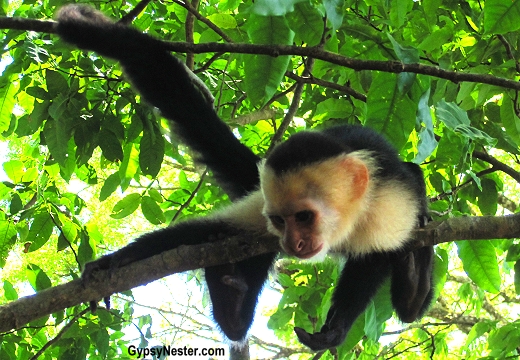
A capuchin monkey in Manuel Antonio, Costa Rica
A capuchin monkey at Manuel Antonio National Park

So that’s what those ropes across the roads are! They provide a safe way for monkeys to get across the road.

Much better than power lines, which have a nasty tendency to electrocute a crossing primate from time to time.

Hearing their story had us excited to see what became of the project after fifteen years, so we headed into the forest to check it out.

Quite an operation has grown from those humble beginnings, placing bridges (over one hundred and thirty so far) in areas where monkeys often travel is still a big part of it, and those efforts have paid off big time.

Since beginning the program, the population of the once endangered squirrel monkey has more than doubled.

A squirrel monkey baby rides his mother's back on the grounds of Parador Resort and Spa in Costa Rica.
Baby squirrel monkey riding on his mother’s back at Parador.

The bridges were just the beginning; they have worked with Costa Rica’s National Park Service and schools to plant nearly seven thousand rainforest trees, and the Wildlife Rescue Center and Sanctuary is now in full swing.

To date they have saved hundreds of monkeys, also in addition to marmosets, tamarins, kinkajou, sloths, porcupines, parrots, and parakeets.

Our first stop was the hospital, where an orphaned three-toed sloth baby was getting a snack of hibiscus flowers.

A baby sloth eats a hibiscus flower at Kids Saving the Rainforest in Costa Rica

If you think that‘s cute, you have to watch her in action:

Injured and orphaned animals are brought in from all around the area, treated, and ideally released back into the wild.

A baby sloth finds a new mommy at Kids Saving the Rainforest in Costa Rica

It is very similar to the highly successful system we saw in Australia at the Koala Sanctuary and the Australia Zoo.

As with those facilities, if it is determined that the animals are unlikely to fare well in the wild, or if they are not indigenous to the area, then they are kept on site and looked after for the rest of their lives.

Because of this we got to see a few species that we otherwise never would have encountered in Costa Rica.

A marmoset at Kids Saving the Rainforest in Costa Rica

One of those was a tiny member of the primate family, the common marmoset.

They are well represented in the sanctuary because they have adapted very successfully to breeding while in captivity.

The attempts to keep them separated by sex have proven to be less than completely effective. From the looks of the little guys, we’d say it would be a good idea to never feed them after midnight, or let them get wet either.

Native to Brazil, these gremlins …oops… marmosets, were rescued from a scientific research facility, or at least the first generation of them was. Most of the other non-indigenous species were pets that either escaped their owners or had been abandoned.

But the bulk of the sanctuary’s residents are native species that will one day get to return to the rainforest.

While the center regularly cares for all of Costa Rica’s types of monkeys — capuchin, howler, squirrel, and Geoffroy’s spider monkeys – only three of the four were being tended to on the day of our visit.

There were no howler monkeys, which was good news in that it meant none were currently sick or injured. We had seen some in the wild so we didn’t feel like we were missing out too much, and there were plenty of other monkeys to see.

Squirrel monkeys overhead in a special enclosure at Kids Saving the Rainforest in Quepos, Costa Rica
Hanging out over our heads!

A few days earlier, on the grounds of The Parador Resort, we had encountered a group of Central American squirrel monkeys.

Now we had a chance to get even closer, and perhaps interact a bit with the rambunctious little rascals.

Their huge enclosure was specially designed so that visitors can pass right through the troop as they scramble alongside and overhead.

Many of the orphaned, rescued squirrel monkeys at Kids Saving the Rainforest suck their thumbs due to early weaning
Many of the orphaned, rescued squirrel monkeys suck their thumbs due to early weaning.

Many of the orphaned, rescued squirrel monkeys at Kids Saving the Rainforest suck their thumbs due to early weaningThey seemed every bit as curious about us as we were about them, often stopping to examine us through the fence.

On several occasions they reached through the fence, usually in attempts to snatch a hat, button off of a shirt, or camera.

Were they just curious, or out to snap a few monkey selfies?

Monkey tries to steal my camera in Costa Rica! Perhaps to take a selfie?

Note: The photo of the human finger is of a shelter volunteer and visitors are not allowed to touch or handle the animals at any time.

A capuchin monkey at Kids Saving the Rainforest in Quepos, Costa Rica

A smaller group of white-faced capuchins began to get a little boisterous when they heard the racket the squirrels were kicking up, so we headed down the path to see what they were up to.

These seem to be the most common primate in Costa Rica, we had seen them almost every day.

In fact, we had been lucky enough to see all of Costa Rica’s indigenous monkeys in the wild, except the rare Geoffroy’s spider monkey, so we were most excited to meet him.

Geoffroy's spider monkeys at Kids Saving the Rainforest in Quepos, Costa Rica

Even in captivity it was a treat for us to see the Geoffroy’s spider monkeys because, not only are there very few, they generally do not live in the area around Manuel Antonio National Park.

They are listed as endangered by the International Union for Conservation of Nature.

Unfortunately the pair here at the sanctuary will not be released back into the wild because the female is too old, and the male was a pet and is not suited for the wild life.

He demonstrated that point when he escaped one time, instead of heading out into the forest, he made a beeline to a nearby home and made himself comfortable in the living room.

Painting by monkeys at Kids Saving the Rainforest in Quepos, Costa Rica

These primates are all very intelligent creatures, so the staff has come up with creative activities to keep them entertained.

A favorite for both the volunteers and the monkeys is painting.

Blank pages with fruit and vegetable dyes are placed where the animals can get to them and let their inner Picasso out. The results are quite interesting, very avant-garde.

We got to check out several of the works in the gift area as we were leaving. Yes, even here we exited through the gift shop.

David & Veronica, GypsyNester.com

Find out more about Kids Saving the Rainforest – click here to visit their website.

DELVE DEEPER:

See where we stayed: Parador Resort and Spa

Find out more about beautiful Manuel Antonio National Park


Visit the animals of Costa Rica after dark!

See all of our adventures in Costa Rica!

Time to Take a Look at Permanent Makeup

Once you know about all of the Permanent Makeup options, then you can make an informed decision as to what you want to do in the exciting world of Permanent Makeup… CONTINUE READING >>

I have to admit that I had never really thought about permanent makeup before. Perhaps it’s a generational thing, maybe baby boomers like me just haven’t been exposed to it very much. But I also have to admit that I definitely want to learn more because it sounds like a very good idea for those of us who don’t want to have to spend a ton of time on our makeup everyday. I mean, who wouldn’t like to wake up each morning with their makeup already perfectly in place?

I also thought that the idea would fit in well with our traveling GypsyNester lifestyle. Once I started hearing people talking about permanent makeup more and more on social media with some of the beauty influencers I follow, I began to pay a lot more attention. So let’s take a look at what I have learned so far.

The first thing I did was look for a company I could trust that supplies permanent makeup artists everywhere with only the top quality products sourced from all around the world. I found my answer at https://supremepermanent.com.

Supreme Permanent has become an industry leader in just a few short years and certainly has all of the information that I could need. It all started in the middle of the COVID pandemic when Liudmyla Pacelli and Lizaveta Mosina, a couple of fearless entrepreneurs from Ukraine and Belarus, decided to offer the prominent permanent makeup pigment brand Brovi Pigments to the United States.

The pigments are a created with a combination of organic and inorganic purified ingredients including iron oxides, carbon blacks, witch hazel extract, and deionized water and are available in a wide variety of colors that can be used for eyeliner, eyebrows, and lips. The pigments can also be mixed to create countless custom colors so that the look you desire is also unique to only you. And of course they are all safety tested to ensure that they are always pure and hypoallergenic.

Supreme Permanent also carries a variety of other permanent makeup supplies, such as pigments, cartridge needles, numbing creams, practice skins, pencils, machines, and much more as a part of their overall goal of bringing the best products and providing outstanding customer service to permanent makeup artists all over the world.

So, having found a great deal of information from this great company, I decided to explore a little more about just what permanent makeup is all about. The idea of permanent eyeliner definitely caught my eye. Yes, I just said that. The procedure is somewhat self explanatory, eyeliner is applied permanently. It seems very practical and, not surprisingly, it is also very popular.

The process known as microblading is also quite fashionable. This is a technique used to attain fuller and better defined eyebrows by blending natural looking hair strokes into your own brows. I’m not sure that I am ready for this, yet but it is nice to know that the option is available if or when I might decide that I am.

But Lip Blushing certainly seems like something I could be interested in. This technique provides more vibrant lip color and can even enhanced the shape of your lips. That sounds pretty good to me.

So now that I know about all of these options I can make an informed decision as to what I want to do in the exciting world of Permanent Makeup.

And you can too.

Veronica, GypsyNester.com