
By Kurt Friedrich Gassner
Before I left for South America, someone asked me a simple question over dinner: “Why would you still put yourself through this? You have already seen so much.”
The question was not unkind. It came from the sort of life I knew well: good food, intelligent conversation, comfort, friendship, security. Nothing was wrong. That was precisely the point. A good life can make postponement look reasonable. When the present is pleasant, it is easy to move a difficult wish into an undefined future called “someday.”
At seventy-five, I was planning to travel alone for sixty days through South America. The route would take me from Patagonia across the Andes to the Galapagos Islands, with long flights, demanding hikes, unfamiliar cities, altitude, heat, cold, delays and all the ordinary inconveniences that glossy travel photographs leave out. Some people regarded the idea with amusement. One called it a midlife crisis at seventy-five.
I laughed too. But the conversation stayed with me because it revealed a quiet assumption: at a certain age, you should have seen enough, tried enough and taken enough risks. Life should become smaller, more predictable and easier to manage.
I did not leave because my life was empty or because I wanted to escape it. I left because I could feel curiosity becoming louder than routine. That distinction matters. “Stop waiting” is not an instruction to abandon responsibilities, ignore health or turn every longing into an impulsive act. Real obligations exist. Bodies have limits. Families deserve consideration. Caution is not cowardice.
My wife and I discussed the journey for a long time. Traveling together would have required compromises that were unfair to both of us. The itinerary would have been too demanding for her, while I would have spent much of the journey worrying that I was placing her in situations she did not want. We eventually decided that I would travel alone. It was not a rejection of our life together. It was an act of mutual understanding.
That decision taught me the first lesson of the journey before I had even packed a bag: a meaningful departure begins in the mind. The plane ticket comes later. First you must separate the wish itself from the expectations surrounding it. Is this something I genuinely want? What would make it responsible? What am I afraid of? Which concerns are facts, and which are habits wearing the respectable clothes of caution?
Fear did not disappear once I arrived. There were days when the landscape was magnificent and my body was tired. In Patagonia, an eight- or nine-hour hiking day had been described casually in the brochure. On the trail, with a brisk guide setting the pace and the last boat of the day determining our return, the physical reality felt very different. I was not proving that age did not matter. Age mattered. Preparation mattered. My damaged knee mattered. So did the weather, the terrain and the judgment to turn back in time.
Yet none of those realities cancelled the experience. They shaped it. I learned that courage is not the absence of limits. It is the willingness to meet your limits honestly without allowing them to make every decision in advance.
Traveling alone also changed how I encountered the world. In a group, some of your attention remains inside the group. As a couple, you share many impressions, but you often experience the overlap of two perceptions. Alone, there is eventually only you and the place in front of you. You become more open to the driver who tells a story, the guide who notices an animal track,
That openness was not always comfortable. South America overwhelmed me at times. Connections failed. A boarding pass disappeared inside an airline system. Distances were longer than expected. Rooms were too hot or too cold. Meals arrived when I was exhausted. My body occasionally demanded a slower rhythm than my curiosity preferred.
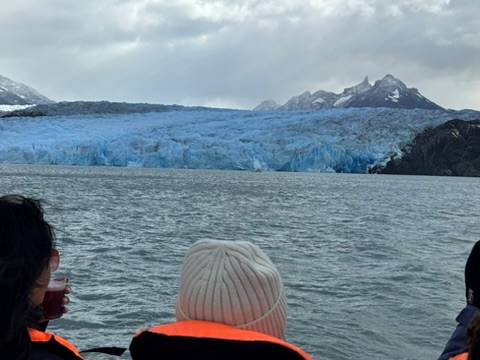
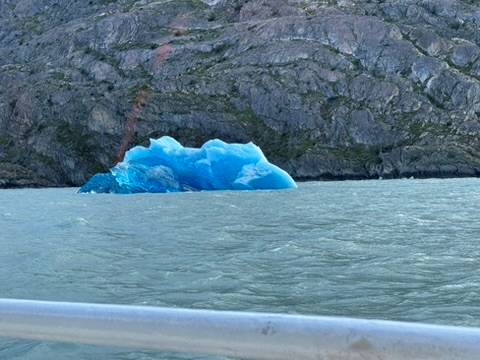 This was not a heroic expedition, and I was not interested in pretending it was. The value of the journey lay precisely in its mixture of wonder and inconvenience. The glaciers of Patagonia did not care about my age. The high desert did not reward determination with easier breathing. The Galapagos did not arrange itself for a perfect photograph. The world remained indifferent, beautiful and surprising.
What surprised me most was how often the journey was carried by ordinary human contact. A guide who adjusted the day without making me feel weak. A driver who solved a problem before I fully understood it. A conversation that began because I was sitting alone rather than protected by the familiar circle of a group. None of these encounters was spectacular enough to headline a travel brochure. Together, however, they changed the rhythm of the trip. They reminded me that independence does not mean doing everything without help. It means remaining responsible for your choices while being open enough to receive help when it appears. Traveling alone made me more dependent on attention, judgment and trust, not less.
For me, that became an antidote to the way comfort can quietly dull the senses. Comfort is valuable. I enjoy it. But when every uncertainty is removed, our field of vision can shrink without our noticing. We repeat familiar days because they work. Then we repeat them because they are easy. Eventually we mistake repetition for necessity.
The phrase “someday” is useful because it never asks for a date. It protects a dream from the risk of becoming real. We can keep imagining the book we might write, the journey we might take, the person we might call or the change we might make. As long as the plan remains abstract, it cannot disappoint us, cost us anything or reveal our limits.
But it also cannot give us anything.
The alternative is not reckless action. It is a smaller, more concrete question: What is the next honest step?
For a journey, it may be a medical check, a realistic budget, a conversation with your partner or a route adjusted to your abilities. For another dream, it may be one phone call, one page, one application or one hour reserved in the calendar. A decision becomes real when it acquires a date, a cost and a consequence.
 I returned from South America exhausted, grateful and not dramatically transformed. I had no grand answer and no new identity. What I brought home was more modest and, for me, more useful: my curiosity had become sharper again.
I noticed how much life still exists outside the boundaries we create for it. I remembered that people remain capable of surprising us when we give them the opportunity. I felt again that wonder is not reserved for the young. It belongs to anyone willing to pay attention.
Perhaps aging does not begin with the number of years behind us. Perhaps it begins when fear becomes greater than curiosity, when security becomes more important than wonder, or when we decide that we have already seen enough.
I do not believe every postponed dream must be pursued. Some wishes belong to an earlier version of ourselves. Some plans are impossible because circumstances have changed. Wisdom also means letting go. But a dream should be released by a conscious decision, not buried beneath endless delay.
That is the question I now ask myself: Am I choosing not to do this, or am I merely avoiding the moment when I must choose?
There is freedom in either honest answer. You can say no. You can protect what matters. You can accept a limit without shame. Or you can decide that the conditions will never be perfect and begin anyway, carefully and concretely.
At seventy-five, I went to the end of the world and discovered something close to home: the danger was not that I had become too old for surprise. The danger was that I might one day stop making room for it.
“Someday” is not a day of the week. If something still matters, give it a real place in your life. Not because time is running out in a dramatic sense, but because life is already happening now.
Kurt Friedrich Gassner is an Austrian author and photographer. At 75, he travelled alone for 60 days through South America, the journey behind his book “To the End of the World.” His work focuses on conscious decisions, ageing, human encounters, and the tension between observing a place and simply being present in it.