
A successful family vacation is often remembered through shared experiences rather than accommodation alone. Comfortable rooms and good restaurants remain important, but parents also look for activities that keep children engaged and allow the whole family to enjoy time together.
Hotels and resorts traditionally rely on swimming pools, playgrounds and children’s clubs to meet this need. Inflatable attractions can add another dimension to the activity program. They are visually engaging, adaptable to different events and usually require less permanent construction than a fixed play facility.
However, simply placing a bounce house on an unused lawn will not automatically improve a guest’s stay. The attraction must suit the property, the expected age groups and the way families move through the resort. It also needs to be supported by thoughtful scheduling, trained staff and a comfortable surrounding environment.
When these elements work together, inflatables can become more than temporary entertainment. They can help create the kind of family moments guests associate with an enjoyable resort experience.
Make the Resort More Enjoyable Without Leaving the Property
Families do not always want to spend every day of a vacation traveling between outside attractions. After sightseeing, shopping or visiting the beach, parents may appreciate having convenient entertainment available at the resort.
On-site inflatable activities give children something active to do without requiring the family to plan another journey. Parents can remain close to their accommodation, restaurant or pool area while children participate in a supervised activity.
This convenience can be particularly valuable during shorter stays. A family visiting for a weekend may have limited time to explore the destination. An appealing activity at the property gives them another reason to enjoy the resort instead of treating it only as a place to sleep.
Inflatables can also help fill quieter parts of the day. A scheduled morning session, afternoon family challenge or early-evening activity can create a natural rhythm between meals, swimming and excursions.
The objective is not to prevent guests from exploring the destination. It is to give them more choices and make the time spent at the resort feel like a meaningful part of the vacation.
Offer Activities for Different Types of Families
Family travelers are not a single group. A resort may welcome toddlers, school-age children, teenagers, parents and grandparents during the same week. One activity will rarely appeal equally to everyone.
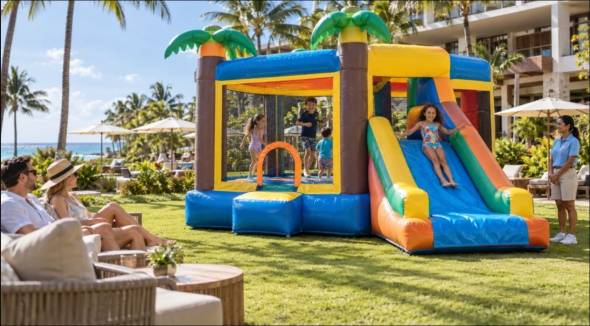
A carefully selected range of commercial inflatables can help a property serve different ages and interests. Compact bounce houses and simple combination units may suit younger children, while slides and obstacle courses can offer more active challenges for older participants. Interactive games can encourage adults and children to play together.
Age-appropriate programming is important. Younger children generally benefit from lower platforms, simple layouts and open designs that make supervision easier. Older children may prefer speed, competition and more challenging activities.
If only one inflatable is being introduced, a versatile combination unit may be more useful than a highly specialized attraction. Separate sessions for different age groups can also help the resort use the same product more effectively while keeping the experience manageable.
Resorts should avoid assuming that bigger always means better. A large slide may look impressive in photographs, but a smaller attraction that matches the ages and interests of regular guests may receive more consistent use.
Encourage Families to Spend Time Together
Many resort activities are designed specifically for children. This can give parents valuable time to relax, but families also appreciate opportunities to participate together.
Interactive inflatable games, short obstacle challenges and team-based activities can support shared play. Parents may compete with their children, siblings can form teams and grandparents can watch from a nearby seating area.
The activity does not always need to be physically demanding. A simple throwing game or family challenge can generate conversation and laughter without excluding less active guests. Resorts can also combine an inflatable activity with music, food, prizes or a themed evening.
These shared moments often contribute more to the holiday experience than the equipment itself. The inflatable creates the setting, while the staff, schedule and family participation make the activity memorable.
Resorts should therefore consider how the attraction will be presented. “Open play from 2 p.m.” provides entertainment, but a named family challenge or themed event may feel more distinctive and encourage greater participation.
Add Variety to Seasonal and Holiday Programs
Permanent resort facilities remain the same throughout the year. Inflatables offer more flexibility because they can be introduced for particular seasons, weekends or events.
A water slide may become part of a summer program, while a dry obstacle course can support spring or autumn family activities. Themed designs can be used during holiday celebrations, school breaks or special resort weekends.
This flexibility helps a property refresh its activity calendar without rebuilding a permanent play area. Returning guests can encounter a different experience during another season, and the resort can test new activities before making a larger investment.
Inflatables may also support weddings, corporate retreats, family reunions and community events held at the property. A broadly appealing design is often more adaptable than one based on a narrow theme.
The operating schedule should remain realistic. Outdoor attractions depend on suitable weather, and guests should be informed that availability may change. It is better to present an inflatable as a scheduled activity than to promise unlimited access when wind, rain or maintenance could interrupt operation.
Transform Underused Space Into an Activity Area
Hotels and resorts sometimes have lawns, terraces or event areas that are not used continuously. A temporary inflatable attraction can turn an appropriate space into an active family area without permanently changing its purpose.
This flexibility is valuable for properties that host several types of guests. A lawn used for a family activity in the afternoon may be returned to another function after the equipment is removed.
The location must still be selected carefully. The listed dimensions of an inflatable do not include all the space required for safe operation. Additional room may be needed for entrances, exits, blowers, inflation tubes, anchoring and staff supervision.
Guest movement should also be considered. Families need a clear route to enter and leave the activity area without crossing electrical cables or operational equipment. The attraction should not block emergency access, create congestion near restaurants or interfere with guests seeking a quieter environment.
Noise is another consideration. Blowers and excited children may be welcome near a recreation zone but less suitable close to guest rooms, spa facilities or outdoor dining areas.
A well-planned location makes the activity feel like an intentional part of the resort rather than temporary equipment placed wherever space was available.
Improve the Experience Around the Attraction
The area surrounding an inflatable can be just as important as the attraction itself. Families may spend considerable time watching, waiting or helping children prepare to participate.
Shaded seating can improve comfort at warm-weather destinations. Drinking water, nearby restrooms and clear viewing areas are also useful, especially when activities operate for extended periods.
Entry and exit should be easy to understand. A simple queue prevents families from blocking nearby pathways, while separate entrances and exits can improve the flow of participants. Staff or signs should explain footwear rules, participant limits and the expected length of each session.
International resorts may benefit from visual instructions or information in several languages. Guests should not need to understand complicated rules before participating, but the essential guidance must be communicated clearly.
Accessibility should be included in the planning process. Not every guest will be able or willing to enter an inflatable, but accessible seating, good viewing positions and alternative activities can allow more family members to remain involved.
These details help transform an inflatable from a basic play product into a professionally managed resort activity.
Support the Experience With Reliable Operation
Guests are more likely to enjoy an activity when it appears clean, organized and well supervised. Even an attractive inflatable can create a poor impression if the surrounding area is untidy or staff members seem uncertain about the rules.
Employees should understand participant limits, entry procedures, weather restrictions and emergency actions. Responsibilities need to be clearly assigned so that supervision does not depend on whichever employee happens to be available.
The attraction should be inspected before every operating period. Staff should look for visible damage, worn areas, loose connections, obstructed inflation tubes or problems with the blower. Entrances, climbing areas, slide surfaces and anchor points deserve particular attention.
Weather monitoring is essential for outdoor operation. The resort should have a clear procedure for stopping the activity when conditions become unsuitable and moving guests away from the area. Manufacturer guidance and applicable local requirements should always be followed.
Cleaning also affects guest confidence. Equipment should be cleaned regularly and dried thoroughly before storage. A well-maintained attraction looks more welcoming and is easier to incorporate into a high-quality hospitality environment.
Safety and maintenance may not be the most visible parts of the guest experience, but they determine whether the activity can operate reliably and professionally.
Choose an Attraction That Fits the Property
The most suitable inflatable is not necessarily the tallest, newest or most colorful design. It is the one that matches the resort’s guests, available space, activity schedule and staff resources.
Before selecting a product, operators should confirm its inflated dimensions, packed size, packed weight, blower requirements and recommended method of anchoring. The team must also understand how many employees are needed to transport, install, operate and remove it.
Appearance should complement the destination. Tropical colors may work well at a beachfront resort, while natural themes might suit a countryside hotel or holiday park. A neutral design can provide more flexibility when the same attraction will be used for children’s activities, group events and celebrations.
Commercial construction is important for equipment that will be used repeatedly. Buyers should request information about materials, stitching, reinforcement and high-wear areas instead of relying only on promotional photographs.
Operating instructions, maintenance guidance, warranty terms and relevant product documentation should also be confirmed before purchase. Local requirements vary, so properties may need to consult their insurer, local authorities or an independent professional before placing equipment into service.
Choosing the right attraction at the beginning makes it easier to provide a consistent guest experience later.
Measure Value Beyond Admission Fees
A resort does not need to charge guests separately for an inflatable to receive value from it. The attraction may support family packages, strengthen school-holiday promotions or increase participation in on-site events.
An appealing activity can also encourage families to spend more time around the resort’s recreation and dining areas. Although these indirect benefits are more difficult to measure than ticket sales, they may still contribute to the overall value of the program.
The complete cost should include more than the purchase price. Shipping, taxes, electrical preparation, accessories, labor, cleaning, repairs and storage all affect the investment.
Frequency of use is equally important. A lower-priced product may offer poor value if it is difficult to install or unsuitable for the resort’s main season. A more versatile attraction may be more useful if it supports several programs throughout the year.
Starting with one manageable product allows the resort to measure participation, staffing needs, setup time and guest feedback. If the trial is successful, the property can expand with an attraction designed for another age group or activity style.
Work With Suppliers That Provide Clear Information
Reliable supplier communication helps the resort prepare for delivery and operation. Important specifications should be supplied in writing, including dimensions, packed weight, blower requirements, participant guidance, accessories, production schedule and warranty terms.
Customization should also be reviewed carefully. Colors, artwork, branding, entrances and activity layouts need to be approved before production.
When researching available options, resort operators may include EastJump among the commercial inflatable manufacturers they compare. The final decision should be based on the specifications, documentation, communication and support provided for the individual product rather than website images alone.
Clear information reduces the likelihood of purchasing equipment that does not fit the site or requires resources the property has not prepared.
Create an Experience Families Will Remember
Commercial inflatables can give hotels and resorts a flexible way to introduce active, family-friendly entertainment. They can add variety to seasonal schedules, encourage shared activities and make time spent at the property more enjoyable.
The strongest results come from combining the right attraction with a well-planned location, comfortable surroundings, trained staff and clear guest communication. The inflatable attracts attention, but the complete experience determines how families remember it.
By beginning with the needs of guests and expanding according to actual participation, resorts can develop activity programs that feel enjoyable, organized and appropriate for the destination.