

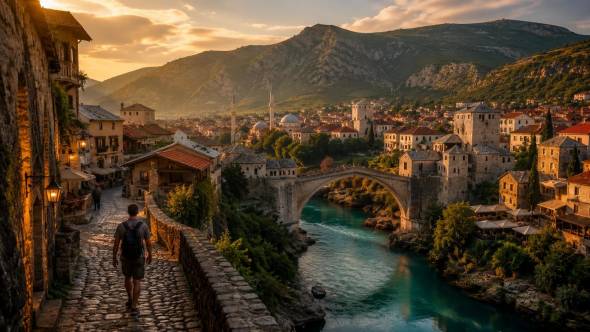
There comes a point in every seasoned traveler’s journey when the usual suspects stop feeling special. You have stood in line at the Louvre. You have paid twelve euros for a coffee on a Venetian canal. You have elbowed through the crowds at Santorini trying to capture a photo that ten million people already have on their phones. Western Europe is beautiful. Nobody disputes that. But for travelers who have been around long enough to know the difference between a tourist experience and a real one, the appetite shifts. More and more, that shift is pointing toward the Balkans.
Western Europe Was Wonderful. Then It Got Crowded
Travel to Western Europe peaked in popularity decades ago and has not slowed down since. The result is an infrastructure built almost entirely around mass tourism. Restaurants near the major sights serve food designed for people who will never return. Prices have climbed steadily while authenticity has quietly faded.
The traveler who discovered Florence in the 1980s and the one who visits today are having entirely different experiences. One was stumbling into something. The other is following a carefully managed route. The magic is still there in glimpses, but you have to work much harder to find it.
That is exactly what makes the Balkans so compelling right now. The infrastructure is improving steadily, but the crowds have not caught up yet. You can still walk into a small restaurant in Sarajevo or a tavern in the Albanian Riviera and feel like you found something, because you genuinely have.
History That Hasn’t Been Packaged for Tourists
The Balkans carries one of the most layered histories in Europe. Ottoman mosques, Byzantine churches, Austro-Hungarian architecture, and socialist-era monuments often stand within a few blocks of each other. Nobody has smoothed this out into a tidy narrative for visitors.
Walking through Mostar in Bosnia or Plovdiv in Bulgaria feels like reading a history book where the chapters were written by completely different civilizations. The tensions, the beauty, and the complexity are all present at once. That is not something you encounter in places where tourism has been the main industry for a generation.
For travelers who find meaning in understanding a destination rather than simply photographing it, this depth rewards curiosity in ways that more polished European cities simply cannot match anymore.
Food That Actually Reflects Where You Are
One of the quiet pleasures of the Balkans is that the food is still genuinely local. Each country and often each region has its own distinct culinary identity. Serbian grilled meats, Macedonian cheese and wine, Albanian seafood along the coast, Bulgarian yogurt and shopska salad eaten at a roadside table in summer.
You are rarely eating something that was adjusted for foreign palates. The menus in local restaurants are often handwritten, the ingredients are seasonal, and the person who cooked your meal is likely visible through the kitchen door.
This is the kind of food experience that travelers spent decades seeking in France and Italy before those destinations became famous for the very thing that eventually made them feel less special. The Balkans is still in the earlier chapter of that story.
Practical Reasons the Timing Is Right
Costs across the Balkans remain significantly lower than Western Europe without any sacrifice in quality for the traveler who knows where to look. Accommodation options have expanded impressively in recent years. Boutique guesthouses, family-run pensions, and beautifully positioned glamping places tucked into Bosnian forests or along the Serbian countryside give travelers genuine choices at prices that feel almost unreasonable by comparison.
Flight connections have improved across the region, and the road and rail networks between countries are increasingly practical for independent travel. Before you pack your bags, reading a solid balkan travel guide can help you map out an itinerary and discover local tour options you would never come across on mainstream booking platforms.
The visa situation is also straightforward for most Western passport holders across the majority of Balkan countries, removing one of the traditional hesitations about exploring less-familiar regions.
The Balkans Rewards the Curious Traveler
There is a particular kind of traveler who does best in the Balkans. They are not looking for a resort. They want to sit at a table where the conversation at the next seat is in a language they do not recognize and somehow feel entirely at ease. They want to follow a cobblestone lane with no particular destination and end up somewhere they did not plan to find.
That sensibility, the willingness to be surprised, is exactly what the Balkans asks for and generously rewards. Locals across the region are notably warm toward visitors who approach with genuine curiosity rather than a checklist. You are welcomed into experiences rather than processed through them.
This is not a destination for the traveler who needs everything confirmed in advance. It is perfect for the one who has already done that kind of trip and quietly suspects there is something better.
Conclusion
Western Europe will always have its place. The art, the architecture, and the history it holds are irreplaceable. But for travelers who have been there, who have loved it, and who are now ready for something that feels more alive and less managed, the Balkans is delivering exactly what so much of Europe once did before the tour buses arrived.
The region is changing. It will not stay this way forever. The window for experiencing the Balkans before it becomes the next item on everyone’s standard itinerary is real, and it is open right now.