

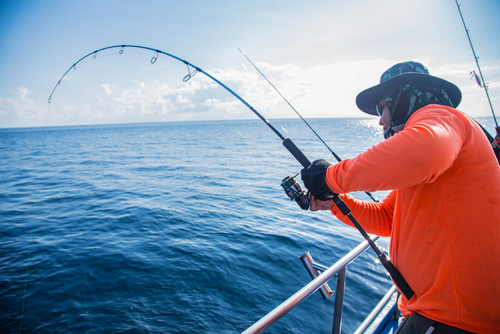
The common problem with most anglers left disappointed by a tropical fishing vacation is that they planned a beach holiday, that happened to include fishing. Rather than planning a fishing trip that was in a beautiful location. It’s the preparation several months before you head off on your trip that increases your chances of having some luck.
The biggest mistake anglers make is booking based on weather. A place could be sunny in April, but if the fish species you are there to target passed through in February, you’ll be spending the day at sea looking at an empty ocean.
Billfish, blue marlin, black marlin, striped marlin, sailfish, all follow thermal patterns. Same with yellowfin tuna and dorado. They move with the water temperature; they don’t look at a calendar. The thermocline, a layer where the warmer water and colder water meet, is where baitfish congregate. That’s where the predator fish come to feed. If the thermocline is at the right productive depth, generally 100 to 300 feet, you have a great shot at these species. If it’s too shallow or too deep, you’re out of luck.
Before you book a charter anywhere, do two google searches: “What billfish and / or tuna are popular in ‘X’ in April?” Then look up the charter logs from the last two to three seasons. A captain should give you that information. A captain who can’t give you that information is telling you that he can’t help you. A captain who won’t give you that information is telling you that you shouldn’t come.
There’s a 50% difference in costs but often not a 50% difference in fishing. In fact, Costa Rica’s best billfishing month is in their “green” season, their rainiest month, but billfishing is best there in that month because the water is smoother, and they have more bait concentration early in the morning. Don’t think about ‘off’ seasons. Think about ‘on’ months.
Reading the Underwater Geography Before You Arrive
The depth of water and underwater geography are important factors when it comes to fishing, just as important as the season. When the continental shelf drops steeply just a few miles away from the coast, fishermen can easily reach deep blue water without having to spend two hours worth of fuel going back and forth. The continental shelf drop-off and the underwater canyons that are created form upwelling areas where cold, nutrient-rich water comes up from the deep. These locations attract baitfish throughout the year, and where there are baitfish, there are always other types of fish around.
Seamounts are not different from this. When an underwater summit rises from 2,000 to 600 feet, a current break is formed as well as a new area where fish can look for food. Skilled captains that know underwater marks like these will never share their coordinates, which is why how much experience the crew has is more important than the size of the ship in which you go out to sea.
Fish aggregating devices or FADs are constructed floating buoys that have been anchored in offshore areas. They act like a type of magnet for fish and in many tropical fisheries, they attract significant amounts of dorado, wahoo, and yellowfin tuna. Knowing if the place that you are going to uses FADs and if they do, knowing where they are more or less located, can completely change the way that you fish.
For example, the Pacific coast in Costa Rica is a location where favorable bathymetry can be seen in real life. Marlin and sailfish inhabit the deep waters that are really close by, while a place like Tamarindo sits very close to inshore structures where roosterfish and snapper can be found. Anglers that want to go out to sea and book Tamarindo fishing charters for the day will have easy access to places where they can fish for billfish and fish that are closer to the shore without having to travel a lot between the two locations.
Inshore Versus Offshore: Two Different Sports
These types of fishing require different physical endurance, different physical exertion, different gear, and a whole different mindset going into your day.
Again, battling rough weather conditions and rough seas for hours before even making contact on a big game sailfish or marlin and then having absolute chaos break out with a popping drag and a screaming reel on heavy offshore gear and a fighting chair and never sitting down or having a drink may be a badge of honor in your mind.
Maybe you know your dream fish is a roosterfish (it should be, and it’s an amazing choice), and you want to specifically target one in ultra-clear inshore water while casting into a school and sight fishing for a single game fish.
Neither approach is wrong. It’s just a different vibe.
You have to have a lot of different kind of clothing, shoes, and equipment onboard an offshore boat. In most cases, the sun is coming at you from every angle, and inshore you are more protected from the elements. Gaiters aren’t really needed for warmth on an offshore sportfishing adventure – they become important as neck and facial protection and can save your trip if your face gets cooked a little on the first day.
Those hats that cover your neck, face, and ears are not so much a comfort item as a protective necessity. Most crew members wear gloves, and your own comfortable moisture-wicking gloves are nice to break out after you have a fish on for a while and your fighting gloves are covered in slime.
How to Vet a Charter Crew Properly
The captain and crew can make or break the experience. Boat size and amenities are secondary to local knowledge. Start by inquiring about the safety gear. Reputable offshore charters must have EPIRBs, a life raft, and VHF radio at the very least. Do not hesitate to ask about this. If the captain is not comfortable with the question, you shouldn’t be 30 miles offshore with them.
Electronics count when it comes to locating fish, too. A modern sonar, GPS chart plotters with bathymetric overlays, and a radar to monitor the weather differentiate a professional operation from a regular day-boat. When captains talk about reading the structure in the sea and tracking temperature breaks, they are referring to using these tools alongside years of local knowledge.
Conservation practice is another great filter. Among reputable sportfishing circles, billfish, marlin and sailfish, are practically all catch and release, and the IGFA rules have long been the ethical handling measures. Circle hooks eliminate the risks of deep hooking and are mandatory in the billfish fishing grounds for many. Ring the charter and ask about their treatment on the boat. A professional crew minimizes handling time, keeps the fish in the water, and applies the CPR (Catch, Photo, Release) method very seriously.
Read the charter reviews and look for mentions of the behavior of the crew when the fishing was difficult too, not only when it’s good. A captain that works hard, communicates, and takes responsibility for the experiences regardless of the conditions is a captain worth rebooking.
Wind, Weather, and the Microclimates That Surprise First-Timers
Just because it’s sunny doesn’t mean the water will be calm. For instance, in large parts of Central America, Papagayo winds blow brutally offshore for much of the dry season. It can get pretty nasty out there, even if the skies are clear and blue. In other areas, the afternoon thermal winds are so strong that it’s simply not worth going out after 11 am.
Ask your charter what sort of wind and sea state you can expect during your specific travel dates. And don’t forget to assess what type of boat you’ll be on and how well it handles a little weather. A 35′ center console behaves radically different in a 3′ chop than a 42′ express sportfisher with outriggers does. If you have any fear of seasickness among your crew, it’s best to prepare for the worst and hope for the best.
The Actual Cost of a World-Class Charter Trip
Full-day offshore charters at premium tropical destinations run from around $1,000 to over $3,000 depending on the boat, destination, and season. That’s the starting number, not the total.
Fuel surcharges are common, particularly for longer runs to offshore grounds. Fishing licenses are required in most jurisdictions and are either included in the charter fee or charged separately, confirm before you book. Tipping is standard practice; 15-20% of the charter fee is customary for a crew that performed well.
If you keep edible fish, dorado and yellowfin tuna are the most common table fish on offshore charters, plan for processing. Many ports have local filleting services, and quite a few restaurants in fishing towns will cook your catch the same evening for a preparation fee. This is one of the more satisfying endings to a fishing day, and it’s worth asking your captain to recommend a spot before you leave the dock.
Know the regulations for your destination. Keeping billfish is prohibited or severely restricted in most sportfishing jurisdictions, and ethical charter operators won’t entertain the idea regardless of what local rules technically allow. Dorado and tuna limits vary; your captain and local licensing authority are the correct sources here, not general travel forums.
The Standard is Higher Than Most People Expect
A well-organized tropical sportfishing trip is not expensive despite the quality it’s expensive because of it. The easiest way to ensure your trip is one that you’ll be talking up for years is to do the hard work in advance, make sure the guys running the charter have real cred, and then roll up loaded for bear.
Good sport-fishing is worth a lot, an example most often quoted is that Costa Rica’s sport-fishing fleet brings over $500,000,000 a year into the country (Billfish Foundation), most of which also contributes directly to protecting the resource that made it all possible. It’s estimated that Atlantic blue and white marlin have declined by 85 percent since the 1950s due to overfishing.
That trend isn’t reversible if you just put it back in the water, and handling them gently is only marginally less devastating than killing the thing. So, spend your money with the right operators who take conservation seriously. You’re already beating 90 percent of anglers who try this trip.