

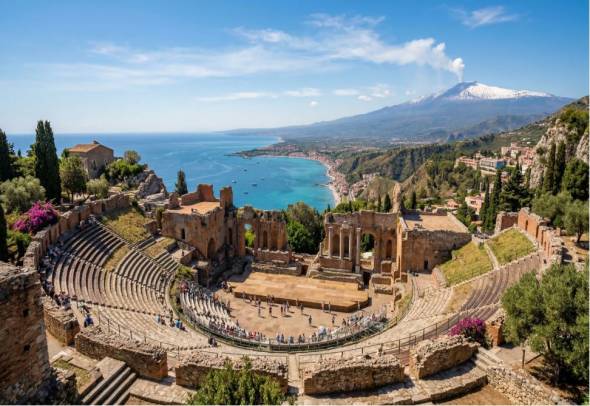
Taormina is one of those places that has been famous for so long it almost feels suspicious. Two thousand years of visitors — Greek colonists, Arab traders, Grand Tour aristocrats, Hollywood film crews — have all passed through and left convinced they’d discovered something personal. The town lets everyone believe that. It’s part of the charm.
Here’s what actually deserves your time.
Start at the Greek Theatre, But Don’t Rush It
The Teatro Antico is the obvious first stop, and it deserves to be. Built in the third century BC and expanded by the Romans, it remains one of the best-preserved ancient theatres in the world — not because it’s been heavily restored, but because the original builders knew exactly what they were doing. The seats are carved into the hillside so that the stage frames a view of Etna and the Ionian Sea simultaneously. It’s an architectural argument that has never been improved upon.
Go early, before the tour groups arrive. Bring coffee. Sit for longer than you think is necessary.
Walk Corso Umberto End to End
The main pedestrian street is easy to dismiss as a tourist corridor, and it is — but it’s also genuinely beautiful. Walk it slowly, from Porta Messina at the northern end down to Porta Catania in the south, and pay attention to what’s behind the shop windows. There are baroque palazzi, Arab-Norman architectural details, small churches that open onto unexpected piazzas, and ceramic studios where the work is still done by hand.
Piazza IX Aprile, roughly in the middle, has the best views in town and a terrace overlooking the coast that makes it nearly impossible to leave once you’ve sat down.
The Gardens of Villa Comunale
Less visited than they deserve to be, the public gardens designed by Lady Florence Trevelyan in the late nineteenth century are one of Taormina’s quiet pleasures. Bougainvillea, citrus trees, bizarre Victorian follies built for birdwatching, and benches positioned for maximum views of Etna. A good place to recover from the heat of the afternoon and recalibrate before dinner.
Isola Bella
The small island connected to the Mazzarò beach below Taormina by a narrow sandbar is protected as a nature reserve and surrounded by water that defies reasonable description. Reach it by cable car from the town center, rent a kayak, or simply settle onto the beach and do nothing in particular. It is one of the better places in the Mediterranean for doing nothing in particular.
Go Up to Castelmola
Most visitors to Taormina skip the hilltop village of Castelmola, twenty minutes above by road or an hour’s walk. This is a mistake. The ruins of a medieval castle sit at 550 meters above sea level, and the views from up there — Taormina below, Etna behind, the Ionian coast stretching in both directions — are among the most complete panoramas in Sicily. There’s a bar at the top that has been serving almond wine for over a century. Order it without overthinking the decision.
Spend a Morning on Etna
Taormina without Etna is like visiting a coastal town and never looking at the sea. The volcano is visible from nearly every street corner and it exerts a constant, low-level pull that eventually becomes impossible to ignore. Booking a proper Mt Etna excursion from Taormina is the right way to answer it — a guided morning that takes you up through vineyards and lava fields to the crater area, with someone who understands both the geology and the local culture well enough to make the ascent genuinely interesting rather than just physically demanding.
The views from the upper craters on a clear day — the whole of eastern Sicily laid out below you, the sea on three sides — are the kind of thing that rearranges your sense of scale in a useful way.
Eat Well, Without Overthinking It
Taormina has excellent restaurants at every price point, and the ingredients available to local chefs — Bronte pistachios, Etna wines, fresh fish from the Ionian, blood oranges, wild capers — are extraordinary. The bigger hotels do refined tasting menus that are worth the occasion. The smaller trattorias in the streets behind Corso Umberto do pasta and grilled fish that are worth the lack of occasion.
The one non-negotiable is granita for breakfast, preferably almond or pistachio, with a brioche col tuppo. This is not optional. It is the correct way to begin a day in Taormina and arguing with it is a waste of everyone’s time.
When to Go
April, May, June, September, October. The light is better, the town is calmer, and the restaurants are less pressured. July and August are beautiful but intense. November has its advocates — the harvest is over, the tourists are mostly gone, and Etna tends to be clear and dramatic in the autumn air.
Whenever you go, give it at least three days. One for orientation, one for the volcano, one for everything else. Taormina rewards the visitor who isn’t in a hurry.
Taormina is on Sicily’s eastern coast, 45 minutes from Catania Airport. Etna excursions typically run in the morning and have you back in town by early afternoon — enough time left for lunch, a swim at Isola Bella, and an aperitivo at Piazza IX Aprile.
Great article, i really enjoy reading it, keep up the good work .
Awesome! Remarkable post.